Affectual Solidarity: Measurement, Theoretical Validity, and Dimensionality
Katherine Pepin
A thesis submitted to the faculty of the University of North Carolina at Chapel Hill in partial fulfillment of the requirements for the degree of Master of Arts in the Department of
Sociology.
Chapel Hill 2006
Approved by
ABSTRACT
Katherine Pepin: Affectual Solidarity: Measurement, Theoretical Validity, and Dimensionality
(Under the direction of Peter Uhlenberg)
TABLE OF CONTENTS
Page
LIST OF TABLES..………v
LIST OF FIGURES..………..vi
Chapter I INTRODUCTION………..1
II BACKGROUND……….……….. 4
Theoretical Explanation………. 4
Intergenerational Stake Hypothesis……….….………. 4
Affectual Solidarity……….……….……….. 5
Leniency Hypothesis……….………. 6
Measurement and Dimensionality of Relationship Quality………... 7
Past Measurement and Findings……….7
Dimensionality and Modeling………12
Importance and Use of Relationship Quality Reports………12
III RESEARCH OBJECTIVES AND QUESTIONS...……….………..15
IV METHODS……….17
Data……….17
Affectual Solidarity Measurement Construction………20
Conceptualization………...20
Model Specification………21
Identification……….. ………22
Estimation……….. 22
Model Fit & Evaluation of Dimensionality………22
Application of Measurement Instrument: Multinomial Regression………...23
Mother-Child Relationship Congruence Patterns……….. 24
VI CONCLUSIONS AND DISCUSSIONS………27
APPENDIX A……… 39
LIST OF TABLES
Table Page
1. Means and Standard Deviations for Descriptive Demographic Variables……….33 2. Affectual Solidarity Instrument Model Fit All Responding Wave 3..………34 3. Affectual Solidarity Instrument Model Fit for Those in Both Wave 2 and 3... ………….35 4. Description of Variables………..…………...………..………..36 5. Mother-Child Difference Scores in Affectual Solidarity (Wave3)……… 37 6. Difference Between Mother-Child Difference Scores in Affectual
LIST OF FIGURES
Figure Page
CHAPTER I INTRODUCTION
The relationship that parents’ have with their children is related to the well-being of their children throughout life (Roberts and Bengtson, 1996 and 1993; van Wel, Linssen, and Abma, 2000; Aquilino, 1997; Parrott and Bengtson, 1999; Amato, 1994; Maccoby, 1984; Knoester, 2003; Lawton, Silverstein, and Bengtson, 1994; Silverstein and Bengtson, 1991; Silverstein, Parrott, and Bengtson,1995). However, the mechanisms producing this
relationship have been understudied. Before studying these mechanisms, however, we need to be clear about how relationships are measured. The extant literature shows that when parents and children respond to questions regarding their relationship quality, their answers often vary significantly. Why does this occur, and what are the implications? The lack of agreement suggests that parents and children tend to have differing views of their
relationship quality. The Intergenerational Stake Hypothesis (hereafter ISH), which states that parents rate their parent-child relationship more positively than do their children, is one of the dominant theoretical explanations used to describe the discrepancies in parent and child relationship quality reports. Their discrepant evaluation of the relationshp is attributed to the parents’ desire to impart their legacy versus the children’s desire to assert their
independence. Despite the Intergenerational Stake’s dominance as an explanatory theory, the lack of a commonly accepted, valid measurement instrument renders the hypothesis
This research analyzes the component of Affectual Solidarity (see Appendix A for complete listing of ISH components), the amount of positive sentiments held about family members and their reciprocity. Due to its importance throughout the life course as well as the current lack of adequate instrumentation, a valid instrument is needed in order to assess the perceived differences in Affectual Solidarity between the mother and her adult child. I propose to develop a means of measurement that will enable me to assess the accuracy of the Intergenerational Stake Hypothesis in terms of this dimension. This will enable me to analyze what causes situations in which children’s ratings of Affectual Solidarity are more positive than that of their mothers. This paper will use National Survey of Families and Household (NSFH) data to first construct an instrument to measure the Affectual Solidarity dimension of the Intergenerational Stake Hypothesis.
I will look at past measures of Affectual and other types of solidarity, what these measures have found regarding mother and child report congruence, and their weaknesses. In addition, I will briefly discuss the importance of this dimension’s application by reviewing past
researchers’ use of Affectual Solidarity levels to predict behaviors and outcomes. Using questions and data from Wave 3 of the NSFH corresponding to the ISH definition, I will apply confirmatory factor analysis to create a measurement instrument of a mother and her adult child’s perceived intergenerational relationship quality, specifically within the
component of Affectual Solidarity. With this instrument, I will be able to assess the implied underlying dimensionality of the latent concept of a shared perception of Affectual
CHAPTER II BACKGROUND
The Intergenerational Stake Hypothesis (ISH) and the Leniency Hypothesis are the most common theories explaining the difference in solidarity reports between parents and children. Thus, it is important to first discuss what these theories say about the incongruence between parents and their children. Second, I will look at past measures of the specific ISH
dimension of Affectual Solidarity as well as what these measures have found in terms of congruence between parents and children. Finally, important weaknesses and uses of the past research will be highlighted.
Theoretical Explanation
Intergenerational Stake Hypothesis
The Intergenerational Stake hypothesis was born out of the more individual
socio-structural level influences. From the socio-structural level concepts of exchange theory, the hypothesis now takes into account the forces of differing costs and rewards garnered by the children and parents. That is, parents invest more in children than vice versa “because of their contrasting position in the cycle of generations” thus creating inequity (252). Accordingly, the Intergenerational Stake Hypothesis makes two predictions: “(a) parent’s descriptions of parent-child relationships will generally be more positive than children’s descriptions, and (b) differential investment as well as differential development may account for cross-generational biases in perception” (229). Further, these predictions were found to hold despite age of parents and children. Initial testing done by Giarruso, Stallings, Bengtson (1995) found that it “appears to be applicable to adult children and their elderly parents without any theoretical elaboration to include developmental tasks of older life-course phases” (257). This was also discussed by Aquilino (1999) who attributes the previous lack of congruence found between young adult children (18-24) and parents in their reports of quality in different dimensions of their relationships to differences in psychological needs established by the generational stake theory (Aquilino 1999, 859). Although the Intergenerational Stake Hypothesis is widely used, it is also frequently criticized for issues pertaining to its use of exchange theory in explaining parent and child differences, the lack of continuity assumed in its use of developmental theory, and for the instrument used for
measuring it in the past (Rossi 1995).
Affectual Solidarity
six elements of Intergenerational Solidarity. It is defined to be the “type and degree of positive sentiments held about family members and the degree of reciprocity of these sentiments” (857). More specifically, Giarusso et al. (1995) delineate it to include: “1. Ratings of affection, warmth, closeness, understanding, trust, respect, etc. for family
members 2. Ratings of perceived reciprocity in positive sentiments among family members” (857). (See Appendix A for definitions of all dimensions).
An emotional dimension of parent-child relationships was chosen because it is seen as a thread through the life course in parent-child relationships in both social and psychological literature. As Pillemar and Suitor (1991) conclude “social scientists convincingly
demonstrated that children and parents continue to interact and depend on one another for both emotional and instrumental support throughout the life course (cf. Bengtson &
Robertson, 1985; Brody, Johnsen, Fulcomer, & Lang, 1984; Cicirelli, 1983; Johnson Bursk, 1977; Nydegger, 1983; Shanas, 1979; Troll, Miller, & Atchley, 1979)” (163). In addition, Eleanor Maccoby’s “Social Development: Psychological Growth and the Parent-Child Relationship” examines parental warmth and affection as being a major aspect in types of parenting in young children, although she admits that these are difficult to define.
Leniency hypothesis
issue discussed between two family members more positively than middle-aged respondents. Thus, in this case, the “leniency hypothesis” was concluded to be more plausible than the stake hypothesis (Winkeler, Filipp, and Boll 2000).
Measurement and Dimensionality of Relationship Quality
Past Measurement and Findings
The value of the method of self-reporting and family member self-reports were recognized by Maccoby and Martin (1983) who acknowledge the unique position held by both parent and child in the intimate knowledge they acquire “by virtue of their daily participation in the family system” (16). With this unique insight “it is reasonable to tap into this information by questioning them” (16). With this diverse source of information from multiple family
member comes the issue of whose perspective is most valid or closest to “reality” among the members. But first, as this research hopes to address, comes the issue of accurately
measuring each member’s perception of the specific self-report of interest to this research – that of Affectual Solidarity between mother and child. In order to do this it is necessary to discuss the importance and use of the measurement of parent and child relationships and its dimensionality.
For example, it was found that incongruence between parent and child relationship quality reports was significantly higher in divorced families (Pelton and Forehand 2001). The lack of congruent responses between parent and child when reporting on the same topics has been well-established across both young and young-adult aged children as well as across
numerous types of parent-child reports (Aquilino 1999, Aquilino 1997, Pelton and Forehand 2001, Tein, Roosa, and Michaels 1994, Shapiro 2004). For example, Tein, Roosa, and Michaels (1994), looking cross-sectionally at the Child’s Report of Parental Behavior
Inventory, found only low to moderate correlation between the child’s and parent’s reports of parental behavior. Moreover, Bengtson and Kuypers (1971), Giarusso, Stallings, and
Bengtson (1995), and Winkeler, Flipp, Boll (2000) find that there is incongruence in parent-child responses, with the parents consistently reporting higher levels of closeness than their children. However, recent studies have started to uncover instances in which children
provide higher ratings on some dimensions or aspects of intergenerational solidarity (Shapiro 2004, Aquilino 1999). Many of the methods in this research will be based on more recent studies and their findings.
Shapiro (2004) and Aquilino (1999) analyze incongruence in parent-child reports of relationship quality using Wave II of the National Survey of Families and Households (NSFH). They both find there were systematic discrepancies between the reports of young-adult or young-adult children and their older parents, although relationship reports were not done on comparatively specific dimensions of relationship quality. Shapiro (2004), driven
report, parents’ age, children’s age, child’s marital status, distance/co-residence, and the dyad’s sex composition are found to be influential. For emotional support (assumed,
although not tested to be, closest to measuring Affectual Solidarity), parent’s age, the child’s marital status, and the dyad’s sex composition were found to be significantly influential in the child’s reports being more positive. On the other hand, Aquilino (1999) looks at a warmth-support dimension, the construction of which was not driven specifically by
Intergenerational Solidarity’s definition. He finds parent’s and child’s marital status, child’s education, parent’s race, and previous parenting techniques (e.g. democratic discipline, restrictiveness) to be significant factors in when the child’s rating is more positive than the parent’s rating. Thus, although both found child’s marital status to be influential in a child’s report being more positive than the parent’s report on closeness or emotional support, there was a lack of consistency in the influential demographic characteristics. Although looking at discrepancies in parent-child reports, neither Shapiro (2004) nor Aquilino (1999) analyze the specific dimension of Affectual Solidarity as defined by the Intergenerational Stake
Hypothesis. Despite findings to elaborate, Shapiro (2004) claims that “older generations report greater closeness than do younger generations” (Shapiro 2004, 129).
So despite the agreement on the existence of discrepancies between parent and children in their perception to relationship quality, researchers disagree about the causes and conditions underlying these report discrepancies are as well as to what dimensions they affect. Aquilino (1999) looked at dimensions similar to those of, but necessarily driven by, the
uni-dimensional scale in order to counteract the canceling out of any effects by other dimensions of Intergenerational Solidarity.
Past research looks at incongruence in many aspects of solidarity and uses unfocused, multidimensional instruments. In order to properly assess parent and child closeness as described through the definition of Affectual Solidarity, an accurate measurement instrument must be used. With a valid instrument, the level and direction of congruence as well as the appropriateness of the Intergenerational Stake hypothesis’ predictions can be assessed. Since I will use Bengtson and Roberts’ (1991) definition of the dimension of Affectual Solidarity, it is important to look at past measures associated, used, and reviewed for this specific dimension. Several instruments attempting to measure Affectual Solidarity
specifically have been identified and critiqued in the past (Giarusso et al. 1995, Rossi 1995). Although, the Intergenerational Stake Hypothesis has itself been critiqued for its use in explanation of change in Affectual Solidarity and overall explanations in differences between parents and children over time, the concept and dimension as delineated by Bengtson and Roberts (1991) are useful (Giarusso et al 1995). In this paper, I will focus principally on the attempt to create a valid measurement instrument based on the ISH theory and definition of Affectual Solidarity by analyzing identical questions asked of a mother and her adult child. Before creating a measure, it is important to examine the specific measures used in the past and their problems. Measures for Affectual Solidarity used by Bengtson and Roberts (1991) have been reused but their appropriateness questioned1. For instance, Alice Rossi criticized
1Giarruso, Stallings, Bengtson (1995) have instruments designed to measure Affectual Solidarity. A shortened,
simplified version of their previous instrument uses 6 questions to measure current Affectual Solidarity. These six measures are:
the instrument consisting of six measures used by Giarusso et al (1995) (Rossi 1995). Giarruso, Stallings, and Bengtson (1995) have instruments designed to measure Affectual Solidarity. A shortened, simplified version of their previous instrument uses 6 questions to measure current Affectual Solidarity. Although they were implemented on multiple occasions (Mangen, Bengston, and Landry 1988; Richards, Bengtson, and Miller 1989), I found these questions to constitute more than one dimension when assessing the fit of models including questions from the NSFH Wave 3 corresponding to the aspects of their questions. This is also seen conceptually by comparing the measure’s content to the definitions of solidarity types by Bengtson and Roberts (1991). Alice Rossi also found this to be the case when analyzing the measures included in this instrument (Rossi 1995). Rossi states one problem to be, “the inclusion in the measure of affectual solidarity of an item, not on
affectual solidarity but consensual solidarity (i.e. a rating on perceived similarity of opinions and values about life)” (266). Due to this inclusion of multiple dimensional measures and the corresponding lack of model fit and issues with dimensionality, I will be using the definitions provided by Bengtson and Roberts in 1991 of Affectual Solidarity to determine which
variables to include to measure Affectual Solidarity specifically. This process, done through confirmatory factor analysis, will be completed and discussed further in the Analysis and Resutls section below.
3. In general, how similar are your opinions and values about life to those of your “study” child (or your mother/father) at this point in time?
Dimensionality and Modeling
In order to assess the adequacy of the Intergenerational Stake Hypothesis’ predictions, explicit delineation of a conceptual model of this dimension implied by those using and applying the theory and the results from these reports is necessary. This is not done overtly in their research. In other words, it is also important to understand the specific conceptual model in order to know what we are measuring.
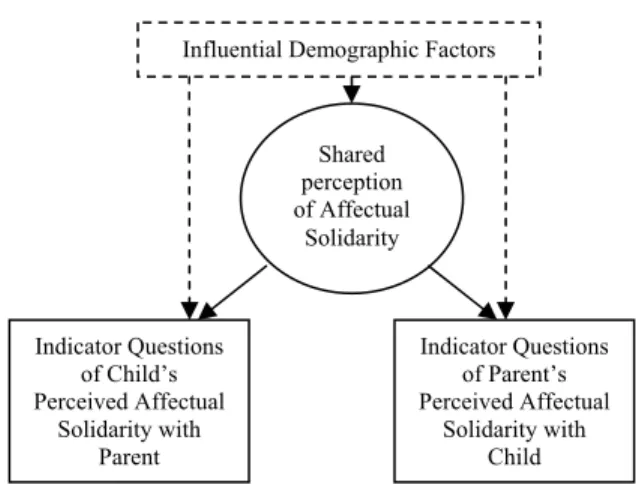
The discussion and common use of only one respondent’s perception of this relationship quality imply that there is a shared dimension of Affectual Solidarity for the parent and child. (See Figure 1) Thus, by asking only one of member of the dyad, it is measuring this shared concept of relationship quality. However, the incongruence in reports and low correlation found between the parent and child reports of relationship quality implies that each
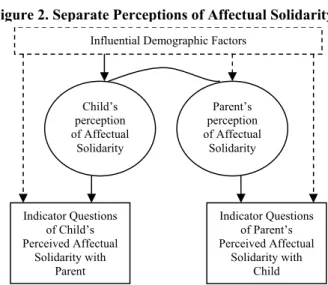
respondent may have his/her own perceived dimension of relationship quality. (See Figure 2) or at least a very different one (Shapiro 2004, 128). Thus, the conceptual dimensionality of the model must be tested to determine the exact conceptual model we intend to measure.
Importance and Use of Relationship Quality Reports
studies have associated children’s behavioral outcomes and the well-being of the parents with the emotional quality of parent-child relationships, although many acknowledge these results are mediated by different demographic characteristics (Amato, 1994; Roberts and Bengtson, 1993). The findings used to predict these outcomes usually come from just one source, either the parent or the child. With the above noted discrepancies, the predicted associated outcome behaviors could be altered if the other member were asked about the relationship quality. It is important to describe the reasons behind the discrepancies to also determine the accuracy of these predicted outcomes associated with parent and child relationship quality. For
example, Roberts and Bengtson (1996), using 20-year panel data of 273 youths aged 16-26 in the University of Southern California Longitudinal Study of Generations, linked strength of affective ties to parents in early adulthood to levels of a child’s self-esteem 20 years later. Using just the child’s report, which may be significantly different than that of the parent, may have altered the associations to self-esteem outcomes found. This was acknowledged and questioned by Roberts and Bengtson (1993), when analyzing both parent and child responses to affection and self-esteem of the children. They question the appropriateness of responses to consider although they find that “filial perceptions of affectual closeness were related positively to self-esteem even after controlling for the parent report of affectual closeness” (268). On the other hand, they acknowledge that they are “unable to determine, however, whether this finding reflected benefits of the son’s or daughter’s perception (accurate or not) or a perceptual bias related to possessing greater self-esteem” (268).
behavior outcomes would have been predicted to be different if a parent’s assessment was used instead. Thus, the persistent incongruence between parent and children on their relationship quality can be problematic in predicting such outcomes as well as deciding which source of information to tap into for assessment. Further, the use of a single respondent has other implications with regard to the dimensionality of the concept of Affectual Solidarity, which will be discussed below.
With this knowledge, it is important to untangle the parent-child differences in the specific dimensions of solidarity and why they exist, in order to more accurately assess and use these reports in predicting other outcomes. Thus, this paper will try to create a uni-dimensional instrument measuring the ISH’s element of Affectual Solidarity which can be used to better understand the dimensionality of the relationship between mothers and their children’s level of solidarity and untangle the demographic characteristics causing the differences in their ratings.2
CHAPTER III
RESEARCH OBJECTIVES AND QUESTIONS
The incongruence in parent-child relationship quality reports has been explained by the theory of the Intergenerational Stake Hypothesis, which states that parents will more often report a more positive view of parent-child solidarity than will the child. However, the instruments used to measure and test the aspects of Intergenerational Solidarity in the past are criticized as not being uni-dimensional in their operationalization. Consequently, they may not be valid. Thus, the predictive power of the theory cannot be accurately assessed. Further, this theory as well as past research uses a single report of relationship quality to predict future behavior of both the parent and child, which implies that there is a single, accurate perception of the relationship quality, a perception that is shared by both the parent and child. However, this has not been stated explicitly in the research or systematically shown through model and testing of dimensionality. As such, in this paper, I will seek to complete and answer the following research objectives and questions:
1. Construct a valid, uni-dimensional measurement instrument of Affectual Solidarity as delineated by the Intergenerational Stake Hypothesis using questions and responses from the National Survey of Families and Households (Wave III).
3. Is there one shared perception of Affectual Solidarity between a mother and her child, or do they each have their own conceptual dimension of perceived Affectual
Solidarity? Despite the implication of a single, shared conceptual dimension in the conclusions and methods of previous research using these reports in prediction and based on the previous low levels of congruence; I hypothesize that there will be evidence of the mother and child each having his/her own perceived level of Affectual Solidarity.
4. What socio-demographic characteristics are associated the child to more positively report aspects of Affectual Solidarity than his/her mother?
CHAPTER IV METHODS
First, I will use confirmatory factor analyses to estimate a model of mother and child perceived levels of Affectual Solidarity. Second, I will look at the difference scores of the measures included in the constructed instrument to assess the congruence levels and direction of the Affectual Solidarity of the mothers and their children at two different points in time (Wave II and Wave III of the NSFH). With these difference scores and assessments of direction, I will be able to assess the validity of the Intergenerational Stake Hypothesis’ predictions that the mother rates the level of solidarity higher than her child. I will use multivariate logit regression to determine predictors of the patterns of congruence and potential explanation for its lack of adherence to the theory. These measures and the corresponding model will be used to compare the correlation between their two latent dimensions in order to determine if the model supports the concept of a single, shared
dimension of perceived Affectual Solidarity or that of each mother and child’s own perceived dimension of this solidarity.
Data
in 1987-1988 (N=13,017) and followed up between 1992 and 1994 (N=10,007), included a nationally representative sample of adults 19 and older living in households in the United States (Sweet and Bumpass 1988). The third wave follows up on certain sub-samples
including, importantly for this research, those those with Wave 2-eligible focal children. The third wave interviews these respondents, the past focal children, as well as any other focal child regardless if they were interviewed in Wave 2 or not (Sweet and Bumpass 2002).3 Thus, the generalizability of this data is somewhat limited. To help correct for item-missing responses and low response rate, multiple imputation methods will be used to get a more full set of responses4. For purposes of analysis, I will limit main respondents to mothers only. However, this research hopes to expand and further the ideas used by Aquilino (1999) and Shapiro (2004) who both used Wave 2 data with then younger adult children. Wave III allows me to look at older adult children as well as their mothers. Thus, it will be used in constructing the measurement instrument an in the multinomial regression analyses. Some demographic information will be supplemented from the first and second wave of the data. With 71% of those with a Wave 2 interview responding and only 22% of those without a Wave 2 interview responding, the overall response rate in Wave 3 was 63% for main respondents. The overall response rate was only 48% for focal children with 61% of those who responded in Wave 2 responding and 27% of those with no Wave 2 interview
responding (Sweet and Bumpass 2002).
3There is not, and I was informed there will not be, a weight variable constructed for these data.
Descriptive Statistics of the Sample
The average age of 1,261 initial responding mothers in the sample at Time 3 was 52 years of age with 50% falling between the ages of 46 and 56 (with 144 missing case). The average age of the 1,261 initial responding focal children who’s mother was the main respondent at Time 3 was 26 with 50% falling between the ages of 22 and 30 (with 12 missing cases). Twenty-seven percent of those who responded (or 295/1082) lived with one or both of their parents. The average educational attainment of mothers that responded (N=1,174) was that of some college: 40.9% had a high school degree, 9.1% did not finish high school, 21.4% had finished some college, 7.8% had an associate degree, and 20.8% had a college degree or higher. The average educational attainment of the children that responded (1,254) was that of some college: 30% had a high school degree, 7.4% did not finish high school, 8% had an associate degree, and 20.6% had a college degree or higher. Of those who responded (N=1,261) 49% of the children are either married or cohabiting. Thirty-two percent of the children are married, 6.8% are either separated or divorced, and 60.8% were never-married. 38.4% percent (N=1,260) of the children are parents. Those focal children with children have an average of 1.74. Forty-seven percent of the 1,261 focal children are male with the other 53% being female.56 (See Table 1)
5There were 443 mother-child dyads responding in both Wave 2 and Wave 3. The average age of the mother at
CHAPTER V
ANALYSES AND RESULTS
Affectual Solidarity Measurement Construction
Conceptualization
As stated above, in this paper I will use Bengtson and Roberts’ (1991) definition of the dimension of Affectual Solidarity. The specific concept of “Affectual Solidarity” was developed by Bengtson and Roberts (1991) as one of six elements of intergenerational solidarity. It is defined to be the “type and degree of positive sentiments held about family members, and the degree of reciprocity of these sentiments” (857). More specifically, Bengtson and Roberts (1991) define it to include: “1. Ratings of affection, warmth, closeness, understanding, trust, respect, etc. for family members [and] 2. Ratings of
perceived reciprocity in positive sentiments among family members” (857). NSFH Wave 3 questions asked of both mother and adult child directly relating to these delineations will be sought when creating the model.
In this process, I will attempt to include questions concerning “‘getting along with’” each other, which was deemed needed by Rossi (1995, 266) as well as those directly related to definitional terms. Questions asked of both mother and child in the NSFH Wave 3, will be compared with the definition by Bengtson and Roberts (1991) and added to the model while
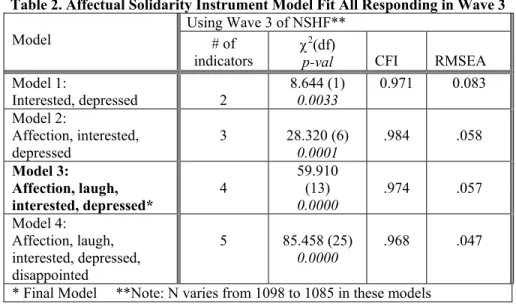
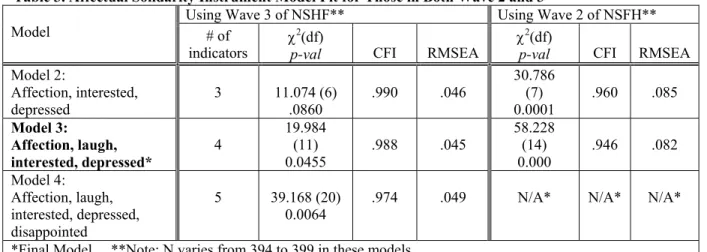
testing for fit.7 Instrument items were added one by one with fit being measured after each addition. The models were measured with both Wave 2 and Wave 3 data for reliability purposes. The resulting model fits are provided in Table 2 for all those mothers and children in Wave 3 and in Table 3 for those responding both in Wave 2 and Wave 3. (See Table 2 and Table 3) Model 3 was selected for its goodness of fit as well as its parsimony. Table 4 shows the four questions of Model 3 (labeled “Dependent Variables”) representing more closely the exact elements outlined in the definition provided by Bengtson and Roberts (1991) [see Appendix A]. (See Table 4) They will be used as the dependent variables in the next step of multinomial regression.
Model Specification
The model used to determine a uni-dimensional measurement instrument of perceived Affectual Solidarity for mothers and their children was shown in Figure 1.
The associated equation for the confirmatory factor analysis with intercepts is (factor complexity =2):
δ ξ+ Λ = x
i
x
where xi is the ith measure of relationship quality; ξ is the quality measure with Λ giving ξ’s impact on xi; and δ is the random measurement error. This model assumes that δ has a mean of zero and is uncorrelated with ξ (Bollen 2005 Class Notes).
7In his research, Aquilino (1999) uses a self-defined Warmth-Closeness dimension which seems to include
Identification
This confirmatory factor analysis is identified based on the 3 indicator, 1 factor rule (Bollen 2005). That is, if each factor has 3 or more indicators, it is identified.
Estimation
The analysis of this model uses weighted least-squares with mean and variance adjustment (WLSMV). This choice was selected by MPLUS because the majority of outcome variables are categorical and binary.
Model Fit & Evaluation of Dimensionality
Individual confirmatory factor analyses were run for the conceptual dimension of
Affectual Solidarity for mother and child separately8 (not shown). They were then completed simultaneously for mother and child to find a model of Affectual Solidarity for both the mother and child. The model with the four indicator (N=1094) for each mother and child provided a χ2 value of 59.910 (df = 13) and a RMSEA of 0.057 (.05 or less implying good fit) as well as a CFI of .974 (perfect =1.00). In addition, looking at the individual fit of the measures, all factor loadings are found to be significant. Furthermore, the R2 values are moderate, ranging from .275-.742. The correlation found between the two latent variables of mother and child’s affectual solidarity is .318.
8The Mother Only CFA produced good fit for the 4-indicator model. The Child Only CFA had lower, but
Thus, in terms of the fourth research question, this rather low correlation indicates that there are indeed separate dimensions and not part of one shared dimension of Affectual Solidarity. This supports Figure 2 rather than that of Figure 1.
Application of Measurement Instrument: Multinomial Regression
Now that a measurement instrument has been established for Affectual Solidarity, I will assess the congruence patterns of mother and child dyads in this dimension. The dependent variables will be those determined in the above measurement model. They have three
response categories: “High Agreement” corresponding to a mother and child score difference of less than or equal to 1; “Mother More Positive” corresponding to a mother’s score being greater than one above that of her child’s score; and “Child More Positive” corresponding to a child’s score being more greater than one more than that of the mother’s score.
Mother-Child Relationship Congruence Patterns
I analyzed the dependent variables delineated in Table 4 to determine the levels of incongruence. Using the original (non-difference) scores of these variables, lower than in past research, the correlations between the mother and child range between .04 and .202. Aquilino (1999) found correlations for parents and children on his warmth-support measures (although this was not based on Intergenerational Solidarity’s definitions) between .18 and .43 (862). He found these numbers to be similar to past correlation levels between college freshmen and their parents on subscales of the Child’s Report of Parental Behavior Inventory (CRPBI) done by Schwarz et al. in 1985 (859).
Patterns of agreement between mother-child dyads through multiple regression provides explanation of which independent, demographic variables are associated with a mother or child being more positive as opposed to the two being in high agreement. First, it is important to look at the general pattern of congruence between them.
response difference scores.9 Mothers were only found to be significantly more positive in their rating of ability to laugh and have a good time with their child. These findings do not differ substantially from Aquilino (1999) who found the majority of parent-child dyads to agree in their ratings. Further, he found only slightly more instances of parents to being more positive (25%) than that of the child being more positive (21%) which, although almost reversed.
In an attempt to assess if there is a significant change of ratings in these dependent
variables as the child ages (approximately 10 years as is the approximate time between Wave II and III interviews), mother and child ratings difference scores were compared from those answered at the time of Wave II with their response at the time of Wave III. Table 6 shows that there are not significant changes in the mother or child’s ratings on 3 of 4 of the
relationship quality indicators from Wave II to Wave III. However, one rating did
significantly increase, indicating that mothers became slightly more likely to talk with her child if she was depressed at time 3 than at time 2.10 (See Table 6)
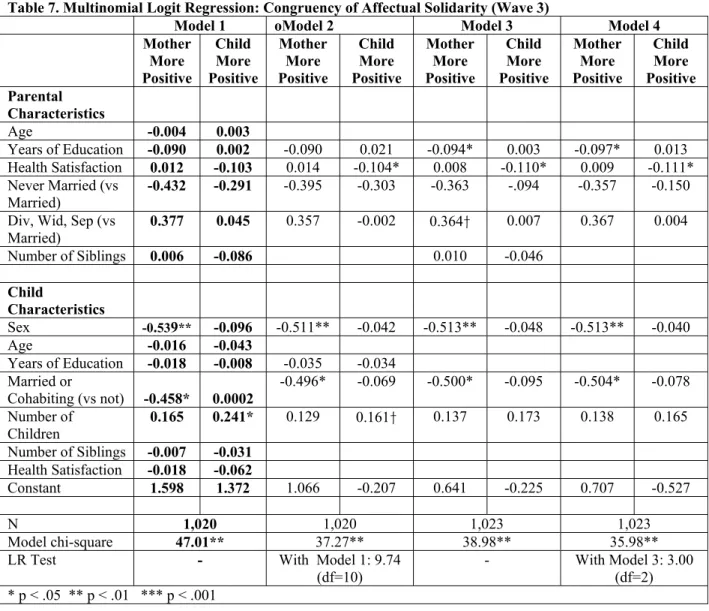
In attempt to explain the reasons for the incongruence in Wave III ratings found above and their direction, I used multinomial logit regression to compare predictive socio-demographic characteristics for mothers being more positive and children being more positive with the high agreement group (See Table 7).
The coefficient of the estimated parameters in Table 7 indicate the log odds of each independent variable of being in the column category (mother or child being more positive) than in the high agreement group. Model 1 was found to be the best model. No model was found to fit significantly better using the likelihood ratio test. It provides evidence that a
CHAPTER VI
CONCLUSIONS AND DISCUSSION
Building up conceptually from the definition, a measurement instrument for Affectual Solidarity was constructed using 4 variables from the third wave of NSFH. Overall, there are moderate levels of congruence in the ratings of Affectual Solidarity measures between
mothers and their young-adult children. The findings show that children are often
significantly more positive in ratings of Affectual Solidarity indicators than their mothers. Further, the correlation found between the two latent variables of mother and child’s Affectual Solidarity is .313. This rather low correlation supports that there are separate dimensions and not part of one, shared dimension of Affectual Solidarity which would be demonstrated by a number closer to 1. This makes explicit that the reports of a mother and her child are not necessarily tapping the same topic through different respondents, but reflecting two separate concepts only slightly correlated. This has implications for
methodologists; it is important to apply the reports and associated predicted future behaviors or conclusions to the appropriate person and not extrapolate too far in predicting for the other member of the dyad.
Stake Hypothesis or the Leniency Hypothesis which state that parents are generally more positive in reports than their children. After evaluating these relationships specifically in the dimension of Affectual Solidarity the differences between mother and child reports may be mediated by sex of the child, mother’s marital status, mother’s education, mother’s
satisfaction with her health, and number children the child itself has. Further, these
differences between the mother and child ratings do not appear to change significantly from Wave II to Wave III. That is, the child and mother are not changing their ratings
significantly over time.
In attempting to determine why mothers were not more positive than her child on the majority of occasions, it is important to note potential differences between this research and that of the past in both concept and methods. It is possible that the differences of these results are due to the instrument being uni-dimensional and therefore not affected by perhaps oppositely incongruent responses in other dimensions. Although these are not radically different from the recent results of Aquilino (1999) who looked at NSFH wave II data, he did find that parents were slightly more likely to be more positive than their children. However, he was analyzing a dimension not specifically in line with the definition of Affectual
Solidarity and included measures of past parenting techniques and other structural measures not conceptually included in Bengtson and Roberts (1991) definition of Affectual Solidarity. Shapiro (2004) looked at several conceptual dimensions of solidarity, not specifically
have been criticized for including measures beyond that of Affectual Solidarity’s definition (Rossi 1995). Accordingly, differences in results may correspond to differences in
dimension studied and uni-dimensionality of the measurement instruments used. Thus, this research has developed a means of measurement that will allows for the assessment of the accuracy of the Intergenerational Stake Hypothesis in terms of its Affectual Solidarity dimension distinctly from its others. This, in turn, has provided a vehicle through which to analyze what correlates with situations in which children’s ratings of Affectual Solidarity are more positive than that of their mothers. Further, it has provided explicit, empirical support for the conceptual separateness of a mother and her child’s perception of their Affectual Solidarity.
This research and its developments provide possibilities for further research. For instance, it is possible that a methodological issue could also produce this lack of congruence in mother-child responses to questions on their perceptions of relationship quality. That is, the same questions used to measure perception of relationship quality could potentially
systematically elicit different responses from parents and children. So this examination of the response indicators and substantive explanations for their patterns of congruence must also take into account if their scale usages are significantly different, thus causing the
incongruence. They should be analyzed for systematic rater effects and variance in scale-use across groups. With a uni-dimensional instrument and identical questions asked of both mother and child, this analysis is now potentially possible. If there are systematic difference in the scale usage of mothers and their children, it would be imperative to know their
Shared perception of Affectual
Solidarity
Indicator Questions of Child’s Perceived Affectual
Solidarity with Parent
Indicator Questions of Parent’s Perceived Affectual
Solidarity with Child Influential Demographic Factors
Child’s perception of Affectual
Solidarity
Indicator Questions of Child’s Perceived Affectual
Solidarity with Parent
Indicator Questions of Parent’s Perceived Affectual
Solidarity with Child Influential Demographic Factors
Figure 2. Separate Perceptions of Affectual Solidarity
Parent’s perception of Affectual
Table 1. Means and Standard Deviations for Descriptive Demographic Variables
Mean SD N Mean SD N
Child Characteristics Parental Characteristics
Age 26 4.43 1249 Age 52 7.05 1176
Female .53 .50 1261 Married .61 .49 1261
Co-Residing .263 .44 1082 Divorced/Sep/Widowed .29 .45 1261
Married .32 .47 1261 Never Married .04 .19 1261
Divorced/Sep/Widowed .07 .26 1261 High School .41 .29 1174
Never Married .61 .49 1261 Less than HS .09 .49 1174
High School .30 .46 1254 More than HS .50 .50 1174
Less than HS .07 .26 1254 Number of Siblings 3.63 2.86 1114
More than HS .62 .48 1254 Health Satisfaction (1-5) 4.00 .89 1116 Married or Cohabiting .49 .50 1261
Is a parent .38 .49 1260
Table 2. Affectual Solidarity Instrument Model Fit All Responding in Wave 3 Using Wave 3 of NSHF**
Model # of
indicators χ 2(df)
p-val CFI RMSEA
Model 1:
Interested, depressed 2 8.644 (1) 0.0033 0.971 0.083 Model 2:
Affection, interested, depressed
3 28.320 (6) 0.0001
.984 .058
Model 3: Affection, laugh,
interested, depressed* 4
59.910 (13)
0.0000 .974 .057
Model 4: Affection, laugh, interested, depressed, disappointed
5 85.458 (25) 0.0000
.968 .047
Table 3. Affectual Solidarity Instrument Model Fit for Those in Both Wave 2 and 3
Using Wave 3 of NSHF** Using Wave 2 of NSFH**
Model # of
indicators χ 2(df)
p-val CFI RMSEA χ
2(df)
p-val CFI RMSEA
Model 2:
Affection, interested,
depressed 3 11.074 (6) .0860 .990 .046
30.786 (7)
0.0001 .960 .085 Model 3:
Affection, laugh, interested, depressed*
4 19.984 (11)
0.0455 .988 .045
58.228 (14)
0.000 .946 .082 Model 4:
Affection, laugh, interested, depressed, disappointed
5 39.168 (20)
0.0064 .974 .049 N/A* N/A* N/A*
Table 4. Description of Variables
Variable Name Description of Variable Dependent Variables
Affection Difference score between the mother and child’s response to: (Please tell me if you strongly agree, agree, disagree, or strongly disagree with each of the following statements.) My mother/focal child is a loving and affectionate parent/child. High Agreement ÆChild-Mother ≤ 1; Mother More Positive Æ Child – Mother <1; Child More Positive Æ Child – Mother >1
Laugh Difference score between the mother and child’s response to: (Please tell me if you strongly agree, agree, disagree, or strongly disagree with each of the following statements.) It's easy for me to laugh and have a good time with my mother/focal child.
High Agreement ÆChild-Mother ≤ 1; Mother More Positive Æ Child – Mother <1; Child More Positive Æ Child – Mother >1
Interested Difference score between the mother and child’s response to: (Please tell me if you strongly agree, agree, disagree, or strongly disagree with each of the following statements.)
My mother/focal child is not very interested in my life or in what happens to me. High Agreement ÆChild-Mother ≤ 1; Mother More Positive Æ Child – Mother <1; Child More Positive Æ Child – Mother >1
Depressed Difference score between the mother and child’s response to: How likely is it that you would talk to your mother/focal child if you felt depressed or unhappy? Would you say you definitely would not, you probably would not, there's a 50-50 chance you would, you probably would, or you definitely would talk to your mother/focal child? High Agreement ÆChild-Mother ≤ 1; Mother More Positive Æ Child – Mother <1; Child More Positive Æ Child – Mother >1
Independent Variables Characteristics of Mothers:
Age Age of the mother at Wave III interview
Self-Reported Health Satisfaction with current health. [1 to 7 point scale]
Year of Education The total number of years of education completed by the mother at Wave II. (Variable not yet constructed for Wave III).
Marital Status Marital status of the responding mother at Wave II. (Variable not yet constructed for Wave III).
Level of Spirituality How spiritual the responding mother considers herself on a 4 point scale of very spiritual to not spiritual at all.
Number of Siblings The number of living brothers and sisters, including step- or half-brothers and Sisters the responding mother has.
Characteristics of Children:
Age Age of the responding child at Wave III interview. Completed Level of
Education
The total number of years of education completed by the child at the time of the Wave III interview.
Marital/Cohabitation
Status Marital and cohabitation status of the child at Wave III. Those married or cohabiting are compared to those divorced/separated/widowed and to those who were never married.
Number of children The number of children birthed or fathered by the responding child. Co-residence with
mother Whether or not the child is currently living with their mother.
Table 5. Mother-Child Difference Scores in Affectual Solidarity (Wave 3) High Agreement: Number / avg. difference c-m Mother More Positive Than Child: Number / avg. difference c-m Child More Positive Than Parent: Number / avg. difference c-m Overall Correlation Overall Mean Difference
Mother/Focal Child is loving and affectionate. (1 str ag to 5 str disag)
N = 1,049
54.15%
0 18.12% 1.27 27.74% -1.17 0.196*** -0.095***
Easy to laugh and have a good time together (1 str ag to 5 str disag)
N = 1,052
53.52% 0 26.52% 1.30 17.78% -1.15 0.229*** 0.098***
Mother/Focal Child not very interested in my life or in what happens to me (1 str ag to 5 str disag)
N = 1,051
49.38%
0 14.56% 1.45 36.06% -1.33 0.200*** 0.2731***
Would talk to Mother/Focal Child if depressed. (1 not to 5 would)
N = 1,053
32.38%
0 33.33% 1.60 34.28% -1.61 0.186*** -0.0057
* p < .05 ** p < .01 *** p < .001
Table 6. Difference Between Mother-Child Difference Scores in Affectual Solidarity (Wave 2 to Wave 3)
Child’s Rating Mother’s Rating
Mean Difference
(w3-w2)
Percent
Unchanged Difference Mean (w3-w2)
Percent Unchanged
Mean Change in Difference Scores Mother/Focal Child is loving
and affectionate.
0.005 58.39% 0.003 58.86% -0.049
Easy to laugh and have a good
time together -0.047 56.26% 0.037 59.36% -0.054
Mother/Focal Child not very interested in my life or in what happens to me
-0.009 59.10% -0.007 52.42% 0.015
Would talk to Mother/Focal Child if depressed.
0.071 38.53% 0.137* 37.56% -.046
* p < .05 ** p < .01 *** p < .001
Table 7. Multinomial Logit Regression: Congruency of Affectual Solidarity (Wave 3)
Model 1 oModel 2 Model 3 Model 4
Mother More Positive Child More Positive Mother More Positive Child More Positive Mother More Positive Child More Positive Mother More Positive Child More Positive Parental Characteristics
Age -0.004 0.003
Years of Education -0.090 0.002 -0.090 0.021 -0.094* 0.003 -0.097* 0.013 Health Satisfaction 0.012 -0.103 0.014 -0.104* 0.008 -0.110* 0.009 -0.111* Never Married (vs
Married) -0.432 -0.291 -0.395 -0.303 -0.363 -.094 -0.357 -0.150
Div, Wid, Sep (vs Married)
0.377 0.045 0.357 -0.002 0.364† 0.007 0.367 0.004
Number of Siblings 0.006 -0.086 0.010 -0.046
Child
Characteristics
Sex -0.539** -0.096 -0.511** -0.042 -0.513** -0.048 -0.513** -0.040
Age -0.016 -0.043
Years of Education -0.018 -0.008 -0.035 -0.034
Married or
Cohabiting (vs not) -0.458* 0.0002 -0.496* -0.069 -0.500* -0.095 -0.504* -0.078 Number of
Children 0.165 0.241* 0.129 0.161† 0.137 0.173 0.138 0.165
Number of Siblings -0.007 -0.031 Health Satisfaction -0.018 -0.062
Constant 1.598 1.372 1.066 -0.207 0.641 -0.225 0.707 -0.527
N 1,020 1,020 1,023 1,023
Model chi-square 47.01** 37.27** 38.98** 35.98**
LR Test - With Model 1: 9.74
(df=10)
- With Model 3: 3.00
APPENDIX A
Six Elements of Intergenerational Solidarty*
Element Definition
Frequency and patterns of interaction in various types of activities in which family members engage
Associational Solidarity
Potential Indicators:
1.Frequency of intergenerational interaction (i.e., recreation, special occasions, etc.)
2.Types of common activities shared
Type and degree of positive sentiments held about family members, and degree of reciprocity of these sentiments Affectual Solidarity
Potential Indicators:
1. Ratings of affection, warmth, closeness, understanding, trust, respect etc. for family members
2. Ratings of perceived reciprocity in positive sentiments among family members
Degree of agreement on values, attitudes, and beliefs among family members
Consensual Solidarity
Potential Indicators:
1. Intrafamilial concordance among individual measures of specific values, attitudes, and beliefs
2. Ratings of perceived similarity with other family members in values, attitudes, and beliefs
Degree of helping and exchanges of resources Functional Solidarity
Potential Indicators:
1. Frequency of intergenerational exchanges of assistance (e.g., financial, physical, emotional)
2. Ratings of reciprocity in the intergenerational exchange of resources
Strength of commitment to performance of familial roles and to meet familial obligations (familism)
Normative Solidarity
Potential Indicators:
1. Ratings of importance of family and intergenerational roles 2. Ratings of strength of filial obligations
Opportunity structure for intergenerational relationships reflected in number, type, and geographic proximity of family member Structured Solidarity
Potential Indicators:
1. Residential propinquity of family members 2. Number of family members
3. Health of family members
WORKS CITED
Amato, P. R. 1994. "Father-Child Relations, Mother-Child Relations, and Offspring
Psychological Well-Being in Early Adulthood." Journal of Marriage and the Family
56:1031-1042.
Aquilino. 1999. “Two Views of One Relationship: Comparing Parents’ and Young Adult Children’s Reports of Quality of Intergenerational Relations.” Journal of Marriage and the Family 61(4):858-870.
Aquilino, W.S. 1997. "From adolescent to young adult: A prospective study of parent-child relations during the transition to adulthood." Journal of Marriage and the Family
59:670-686.
Bengtson, V.L. and J.A. Kuypers. 1971. "Generational difference and the "developmental stake."" Aging and Human Development 2:249-260.
Bengtson, V. L. and R. E. L. Roberts. 1991. "Intergenerational Solidarity in Aging Families - an Example of Formal Theory Construction." Journal of Marriage and the Family
53:856-870.
Bollen, K.A. 2005. "Class Notes."
Cook, W. L. and M. J. Goldstein. 1993. "Multiple Perspectives on Family Relationships - a Latent-Variables Model." Child Development 64:1377-1388.
Giarusso, Roseann, Michael Stallings, and Vern Bengtson. 1995. "Chapter 6: The "Intergenerational Stake" Hypothesis Revisited: Parent-Child Differences in
Perception of Relationships 20 Years Later." Pp. 237-261 in Adult Intergenerational Relations: Effects of Societal Change, edited by V. Bengtson, K. W. Shaie, and L. M. Burton. New York: Springer Publishing Company, Inc.
Knoester, C. 2003. "Transitions in young adulthood and the relationship between parent and offspring well-being." Social Forces 81:1431-1457.
Lawton, L., M. Silverstein, and V. Bengtson. 1994. "Affection, Social Contact, and Geographic Distance between Adult Children and Their Parents." Journal of
Marriage and the Family 56:57-68.
Maccoby. 1984. Social Development: Psychological Growth and the Parent-Child Relationship.
Maccoby, E. and J. Martin. 1983. "Socialization in the context of the family." Pp. 1-101 in
Mangen, D.J., V.L. Bengtson, and P.H. Jr. Landry. 1988. The measurement of intergenerational relations. Beverly Hills, CA: Sage Publications.
O'Connor, T. G. 2002. "Annotation: The 'effects' of parenting reconsidered: findings,
challenges, and applications." Journal of Child Psychology and Psychiatry and Allied Disciplines 43:555-572.
Parrott, T. M. and V. L. Bengtson. 1999. "The effects of earlier intergenerational affection, normative expectations, and family conflict on contemporary exchanges of help and support." Research on Aging 21:73-105.
Pelton, J. and R. Forehand. 2001. "Discrepancy between mother and child perceptions of their relationship: I. Consequences for adolescents considered within the context of parental divorce." Journal of Family Violence 16:1-15.
Pillemar and Suitor. 1991. in Parent-Child Relations Throughout Life, edited by K. Pillemar and K. McCartney.
Richards, L. N., V. L. Bengtson, and R. B. Miller. 1989. "The "generation in the middle": Perceptions of adults' intergenerational relationships." in Family systems and life-span development, edited by K. K. and L. R.M. Hillsdale, NJ: Erlbaum.
Roberts, R. E. L. and V. L. Bengtson. 1993. "Relationships with Parents, Self-Esteem, and Psychological Well-Being in Young Adulthood." Social Psychology Quarterly
56:263-277.
Roberts, R. E. L. and V. L. Bengtson. 1996. "Affective ties to parents in early adulthood and self-esteem across 20 years." Social Psychology Quarterly 59:96-106.
Rossi, Alice S. 1995. "Commentary: Wanted: Alternative Theory and Analysis Modes." Pp. 264-276 in Adult Intergenerational Relations: Effects of Societal Change, edited by V. Bengtson, K. W. Shaie, and L. M. Burton. New York: Springer Publishing Company, Inc.
Shapiro, A. 2004. "Revisiting the generation gap: Exploring the relationships of parent/adult-child DYADS." International Journal of Aging & Human Development 58:127-146. Silverstein, M. and V. L. Bengtson. 1991. "Do Close Parent-Child Relations Reduce the
Mortality Risk of Older Parents." Journal of Health and Social Behavior 32:382-395. Silverstein, M., T. M. Parrott, and V. L. Bengtson. 1995. "Factors That Predispose
Middle-Aged Sons and Daughters to Provide Social Support to Older Parents." Journal of
Sweet, James and Larry Bumpass. 2002. "The National Survey of Families and Households - Waves 1, 2, and 3: Data Description and Documentation." Center for Demography and Ecology, University of Wisconsin-Madison.
Sweet, James, Larry Bumpass, and Vaughn Call. 1988. "The Design and Content of the National Survey of Families and Households." Center for Demography and Ecology, University of Wisconsin, Madison, Wisconsin.
Tein, J. Y., M. W. Roosa, and M. Michaels. 1994. "Agreement between Parent and Child Reports on Parental Behaviors." Journal of Marriage and the Family 56:341-355. Van Wel, F., H. Linssen, and R. Abma. 2000. "The parental bond and the well-being of
adolescents and young adults." Journal of Youth and Adolescence 29:307-318. Winkeler, M., S. H. Filipp, and T. Boll. 2000. "Positivity in the aged's perceptions of
intergenerational relationships: A "stake" or "leniency" effect?" International Journal of Behavioral Development 24:173-182.