Splitting Suffrage:
1869 and the Narrative Forms of Race and Gender in U.S. Feminism
Jen McDaneld
A dissertation submitted to the faculty of the University of North Carolina at Chapel Hill in partial fulfillment of the requirements for the degree of Doctor of Philosophy in the
Department of English and Comparative Literature.
Chapel Hill 2013
ABSTRACT
JEN MCDANELD: Splitting Suffrage:
1869 and the Narrative Forms of Race and Gender in U.S. Feminism (Under the direction of Jane F. Thrailkill and Robyn Wiegman)
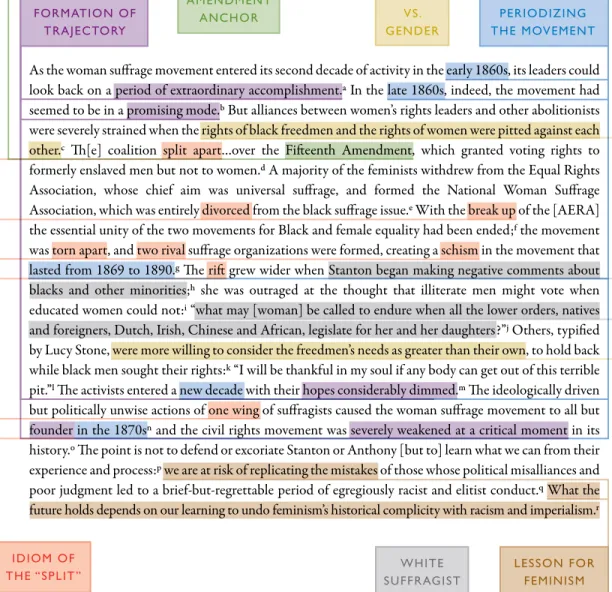
American feminism, like American literature, has a canon: an iconic set of texts, events, movements, and figures that are so well known that the mere mention of a name or a date carries with it an entire history. This dissertation takes one such moment—the 1869 “split” within the U.S. suffrage movement over the Fifteenth Amendment and the granting of voting rights to black men ahead of women—as a site for the literary-critical analysis of the narrative practices that undergird this process of canonization. Despite the sustained attention to suffrage in the fields of American and feminist history, literary scholars have shown little critical interest in the movement. This project addresses this absence from two angles: first, by attending to the historiography of suffrage as a literary object in itself; and second, by rehistoricizing the canonical suffrage story through a variety of literary, journalistic, and polemical texts. By investigating the story of the suffrage “split” across a variety of genres and historical periods, including nineteenth-century periodicals and novels, twentieth-century historiography, and twenty-first-century popular feminist work, I demonstrate that split-narratives obscure the dynamic and shifting relationship between race and gender across historical eras and instead calcify a timeless antagonism between them. Ultimately, I argue that my readings of suffrage stories reanimate understandings of race and gender in
To TNF—my favorite.
ACKNOWLEDGEMENTS
I would like to thank the members of my committee for their support, and especially
Robyn Wiegman, whose endless energy and encouragement has been indispensable over the
TABLE OF CONTENTS
Introduction: The Race-Versus-Gender Problem in Feminism...1
Chapter I. U.S. Suffrage Historiography, White Feminist Racism, and the “Risks of Replication”: Readings of the 1869 Suffrage “Split”...26
II. White Suffragist Dis/Entitlement: The Revolution and the Rhetoric of Racism...75
III. Frances Harper’s Feminist Deconstruction of the Suffrage “Split”...118
IV. Feminist “Waves,” the “Monster Ballot,” and the Politics of the Past...171
INTRODUCTION
The Race-Versus-Gender Problem in Feminism: Contemporary Itineraries and Historical Underpinnings
In early January 2008, just as the Democratic presidential primary contests were
getting underway, Gloria Steinem took to the pages of the New York Times to comment on
race and gender in contemporary U.S. politics. She began the piece, “Women Are Never
Front-Runners,” by engaging in a bit of role reversal fantasy, suggesting that if Barack
Obama were a woman, he would have never been considered a feasible contender for the
nation’s highest office:
The woman in question became a lawyer after some years as a community organizer, married a corporate lawyer and is the mother of two little girls, ages 9 and 6. Herself the daughter of a white American mother and a black African father—in this race-conscious country, she is considered black—she served as a state legislator for eight years, and became an inspirational voice for
national unity.
Steinem asks her readers to consider whether Obama’s biography would qualify a female
candidate for the U.S. Senate, not to mention the White House; she assumes not. Not only
would this imaginary figure not be a “viable candidate,” but the fact that readers presumably
cannot fathom her rise “to head the most powerful nation on earth” leads Steinem to argue
that “[g]ender is probably the most restricting force in American life, whether the question is
who must be in the kitchen or who could be in the White House.”
Steinem was perplexed. Only days before, Democrats had chosen Obama over his
main rival, Hillary Clinton, in the Iowa caucuses, and Steinem wanted to know how such an
after putting in over 7 years as the junior Senator from New York in addition to her time in
the White House as First Lady. But a younger, post-Baby-Boomer first-term Senator from
Chicago had built a passionate coalition of supporters over the previous year, breaking
fundraising records and igniting a movement that would stymie Clinton’s seemingly fated
path to the presidency and with it, the hope that women’s highest of glass ceilings might
finally be broken. How had this happened, Steinem wondered?
Obama’s Iowa victory was not without precedent, according to Steinem, but “follows
our historical pattern for making change” in which the constraints of gender have been more
difficult to overcome than those of race. As evidence of the more formidable nature of the
“sex barrier,” Steinem cites the Reconstruction era of constitutional revision as a foundation
for this pattern: “Black men were given the vote a half-century before women of any race
were allowed to mark a ballot, and generally have ascended to positions of power, from the
military to the boardroom, before any women (with the possible exception of obedient family
members in the latter).” Despite her insistence that she is “not advocating a competition for
who has it toughest,” Steinem produces a litany of reasons why sexism is “not taken as
seriously” as racism, among them, that women do most of the childrearing, are considered
“naturally” different or inferior much like people of color once were, and have a difficult
time wielding power without being viewed as either weak, on the one hand, or overbearing,
on the other. For Steinem, it seemed like Democrats had been energized by the possibility of
breaking the race barrier when it comes to presidential politics but had let the gender barrier
pass relatively unnoticed. Young women in particular, she suggests, have not recognized the
equal pride in breaking all the barriers. We have to be able to say: ‘I’m supporting her
because she’ll be a great president and because she’s a woman.’”
The critical response to the piece came quickly, with feminist writers, academics, and
journalists variously decrying Steinem’s insistence that gender trumps race, or her suggestion
that young women do not seem to know what’s best for them, or her implication that
feminists must vote for the female candidate if they are to be considered true feminists.
Rebecca Walker, editor of the “third-wave” feminist tome To Be Real, wrote a paradigmatic
response, arguing that contrary to Steinem’s claim, “racism and classism are as definitive as
sexism,” citing the “forty percent of black men [who] don’t finish high school in America”
and the “one in four [who] are incarcerated.” Walker claims that despite what Steinem
implies, “women are not only victims, but active participants in the shaping of their lives,”
“men are not the enemy,” and “young women are not stupid.” Steinem’s “divisive discourse”
is “bad for women,” “bad for Hillary’s campaign,” and bad for feminism too: it is rhetoric
like hers that has “few women lining up behind the ‘feminist’ placard” while “many more
ru[n] in the other direction.” According to Walker, these women are not “ungrateful or
unintelligent,” but instead realize that “confrontational political labels and a religious fixation
on gender aren’t productive.” Steinem has, in sum, “crystallized” for Walker that Clinton
“runs the risk of being seen as a Second Wave candidate” who cannot connect with the next
generation and cannot see that “gender is not enough to win” young women’s vote.
Other writers followed suit, claiming that Steinem’s piece represented “the very worst
of second-wave feminism” and put forth a “bizarre reading of history” in which “African
American men somehow [have been] standing over and above white women” (“Race and
after the editorial’s publication, feminist scholar Melissa Harris-Lacewell suggested that
Steinem’s use of Reconstruction history “ignores that black men were then lynched regularly
for any attempt to actually exercise” the right to vote. According to Harris-Lacewell, the
intersections of race and gender are “more complicated” than Steinem allows: “African
American men have been complicit in the oppression of African American women. White
women have been complicit in the oppression of black men and black women.” She then
segues into a comparison of Clinton’s “difficulties” on the campaign trail with Obama’s
“death threats,” suggesting that the two candidates cannot possibly be seen as equally
disadvantaged: “she tears up at being sort of beat up by him, when her husband can come in
and rally around her and suggest that we need to sort of support her because she’s having
difficulties, while Barack Obama is getting death threats, basically lynching threats on him
and his family.” According to Harris-Lacewell, Clinton’s support among older white women
“indicate[s] the ways in which white women’s particular race and gender position can be of
major benefit to them when running against an African American man.” Steinem hears this
claim as an accusation of racism: “Well, are white women being racist when they vote for
Hillary Clinton? I do not know. We’d have to look into the heart of every person who’s
voting.” Harris-Lacewell insists that this is not what she means, but one gets the sense from
the rest of the “debate” that these two feminists are talking past one another; subsequent
writers would note the acrimony of the conversation, suggesting that Harris-Lacewell “was a
few nasty barbs short of calling Steinem an out-an-out racist” (Martin, “Why Race and
Gender Do Matter”).
If these responses seem disjointed, that’s because they are. And if they seem familiar,
feminism in the 2008 election that until that point had been mostly sidelined by Democrats’
expressions of enthusiasm over the possibilities inherent in their two strongest candidates for
president. The ensuing discourse in the media over the next several months largely covered
the same rhetorical and conceptual ground, as Obama and Clinton continued on the primary
trail, with Clinton trailing in delegates but not conceding until early June. Feminist
Clinton-supporters lamented their candidate’s sexist treatment by the media; feminist
Obama-supporters pushed back, often with critiques of what they saw as at best, tone-deaf, and at
worst, racist, claims of gender’s liabilities in American politics. What had been a healthy
competition between two popular candidates, had devolved, according to some critics, into a
“crisis” that threatened not just the Democratic party and its chances to take back the White
House, but the future of feminism itself (Reed). More than four years and another election
season later, how might feminists read this discursive field and the problems placed at its
center?1
The (Origin) Story of the Race-Versus-Gender Problem
One way to understand the discursive field of the 2008 primary is as the repetition of
one of the oldest stories within U.S. feminism. The story is about race, gender, and politics
and its touchstone moment is not 2008, but 1869. According to this story, when the Fifteenth
Amendment was passed that year, giving black men the right to vote, but leaving women of !!!!!!!!!!!!!!!!!!!!!!!!!!!!!!!!!!!!!!!!!!!!!!!!!!!!!!!!
1 See Beverly Guy-Sheftall and Johnnetta Betsch Cole’s collection Who Should Be First?:
all races out, an insidious pattern was put in place: white women would betray the promise of
an integrated liberation movement that would fight both racial and gendered oppression,
choosing instead to fight for their rights in racist terms. This betrayal would not remain mired
in the past, so the story goes, but would haunt U.S. feminism at every turn over the next
century and beyond. Like any story, this one has its primary characters, both villains and
heroines; its integral plot points, both high and low; its arc of action, central tropes, and
themes. And most crucially, it has its lessons—the morals of the story that make its telling so
worthwhile. It is to this story, and the effects of its reiteration, that this project attends.
The public debate over the Obama-Clinton contest represents both an overture to and
exemplar of this most fundamental feminist story. In the popular media, the 2008 primary
presented a choice not only between two candidates and their visions for the nation, but
between two categories of identity. Would race or gender be the winner in the “zero-sum
game” of “breakthrough politics?” (Leibovich) As Mark Leibovich, political reporter and
Chief National Correspondent for New York Times Magazine, framed it in a representative
piece aptly titled “Rights vs. Rights,” “Either Senator Barack Obama will be the first
African-American or Senator Hillary Rodham Clinton will be the first woman to win the
presidential nomination of a major American political party.” Each candidate would seize the
nomination “soaked in history as a culminating figure of one of the great ideological
movements of the last century—civil rights or women’s rights” (Leibovich). The choice
between the two movements that Democrats faced, according to this writer, is not unique to
the contemporary American political environment, but “ha[s] a long, complicated history
dating back to abolitionism and the origins of modern feminism” that portends “an inevitable
when abolitionist and woman suffrage activists such as Frederick Douglass and Elizabeth
Cady Stanton “split” in a “bitter case” over who would win the vote, and when. The “ideals”
of these two historical figures, and the two groups they represented
would eventually clash, resulting in increasingly divisive rhetoric that reached a harsh climax after Stanton condemned the 15th Amendment—which gave black men the right to vote but left out women of all races—as something that would establish ‘an aristocracy of sex on this continent.’ She also alluded to the ‘lower orders’ like Irish, blacks, Germans, Chinese. (Leibovich)
Other writers refer to this Reconstruction-era “split” as a “bitter schism in the long alliance of
abolitionists and suffragists, and within the suffrage movement” (Applegate) and an “ugly
history of the nineteenth century, when the failure of the women’s movement to bring about
universal adult suffrage metastasized into racial resentment and rift that weakened feminism
throughout much of the twentieth century” (“Morning in America”).
The choice in 2008 between Obama and Clinton represents, in these renderings, a
recursive problem in American political history, one in which the election constitutes a
contemporary illustration of the eternal struggle between race and gender. Would women line
up behind Clinton because she’s female? Would African Americans vote for Obama because
he’s black? And what, then, about African American women? Would they, as one writer put
it, “choose their racial identity over their gender identity in deciding where to use the power
of their votes?” (Feldt)
The race-versus-gender choice was clear: when faced with a white woman, a black
man, and the opportunity to take back the White House after eight long years, what would
Democratic voters do? Some critics attempted to refuse this “choice” and instead analyze the
constructing and stoking (Pollitt; Martin, “Why Race and Gender Do Matter”).2 While a
handful of these analysts denounced the “competition between race and gender” as it was
currently delineated, insisting that we resist the “toxic Punch and Judy show of embattled
identity” and refuse to turn a “historic breakthrough moment” into one “marred by having to
choose between ‘race cards’ and ‘gender cards,’” it seemed far easier to employ the
race-versus-gender framing than avoid it (Pollitt; “Morning in America”). For instance,
Clinton-supporters repeatedly decried sexism as “the worst of the ‘isms,” and cited their belief that
“[p]eople are more sensitive to racism than sexism” (Saslow; Long). And as Steinem’s
editorial indicates, even when authors explicitly assert that they want to avoid the
race-versus-gender rhetoric of which group “has it toughest,” they appear to be pulled into just
that sort of discourse. For example, Robin Morgan, author of the infamous takedown of the
sexist male Left in her 1970 “Goodbye to All That,” updated her essay with a second
iteration that begins by critiquing the “competition” between “two communities” over the
Obama-Clinton primary, but then formulates the problem in precisely those terms. Morgan
condemns the sexism Clinton endures on the campaign trail, insists that Obama has not
experienced parallel indignities, and places sexism beyond racism by suggesting that sexual
oppression precedes racial oppression: “A few non-racist countries may exist—but sexism is
everywhere. No matter how many ways a woman breaks free from other discriminations, she
remains a female human being in a world still so patriarchal that it’s the ‘norm’” (“Goodbye
to All That #2”).
Obama-supporters, on the other hand, frequently underscore the misogyny on the
campaign trail but then maintain that racism is in fact “more insidious and trickier to !!!!!!!!!!!!!!!!!!!!!!!!!!!!!!!!!!!!!!!!!!!!!!!!!!!!!!!!
2 Along with Pollitt and Martin, “Why Race and Gender Do Matter,” see Price and Bravo for
confront” (Reed). Author Lorrie Moore writes that Obama’s election would be more
meaningful because “middle-class white girls” “have managed on their own” while boys,
“especially boys of color” “are suffering in this country.” Another writer goes to great
lengths detailing the sexism of the anti-Clinton progressives, but then pivots into the claim
that “[i]n today’s United States, racism continues to have more damaging economic and
social structural implications for African-Americans than sexism has for women” (Traister).
While sexism certainly exists, according to these arguments, it exists as a milder, less
pernicious form of discrimination, one that should not be compared to historical or
contemporary forms of racial discrimination.3
But comparing the two forms of discrimination appears irresistible to the feminist
writers supporting Clinton. Indeed, one of the most striking aspects of the discursive
production around the 2008 primary is the feminist practice of constructing reversals and
parallels to illustrate their arguments about the damaging effects of sexism. As I noted above,
Steinem begins her editorial with this sort of reversal, imagining Obama to be a woman in
order to demonstrate the double-binds of gender when it comes to American politics. Other
writers construct more elaborate analogies, in which every instance of misogyny used against
Clinton undergoes an imaginary reversal to become instead about race—the point being to
demonstrate that racism is “beyond the pale” in ways that sexism is not (Pollitt). A t-shirt that
reads “Hillary, cook my food, but don’t run my country” becomes “Obama, shine my shoes,
but don’t run my country” in order to show how unacceptable, even inconceivable, such !!!!!!!!!!!!!!!!!!!!!!!!!!!!!!!!!!!!!!!!!!!!!!!!!!!!!!!!
3 Even as these writers allow that misogyny plays a role in U.S. politics, they frequently
rhetoric would be if it were racialized instead of gendered (Long). When another
button-wearing Hillary-supporter is stopped by a stranger on the street and told that “A woman’s
place is in the kitchen,” her response is to reverse and redirect the sexism into racism:
“Would he have stopped a black man and said something derogatory like that?...No, I don’t
think so. But somehow sexism is still okay. We all know racism is endemic in this society,
but people who would never dare to make a racist comment on purpose say sexist things all
the time” (qtd. in Saslow). Morgan’s “Goodbye to All That (#2)” provides a host of these
reversals, saying “goodbye to the toxic viciousness” of “sociopathic woman-hating” by way
of representing its parallel form of racism:
[Goodbye to] John McCain answering ‘How do we beat the bitch? With ‘Excellent question!’ Would he have dared reply similarly to ‘How do we beat the black bastard?’ For shame. Goodbye to the HRC [Hillary Rodham
Clinton] nutcracker with metal spikes between splayed thighs. If it was a tap-dancing blackface doll, we would be righteously outraged—and they would not be selling it in airports. Shame…If it were about Jews, we would
recognize it instantly as anti-Semitic propaganda; if about race, as KKK poison. Hell, PETA would go ballistic if such vomitous spew were directed at animals. Where is our sense of outrage—as citizens, voters, Americans?
Feminist supporters of Clinton clearly feel that sexist discourse in the campaign was
alternately either not visible, or visible yet acceptable, and their method for rectifying this
problem is to represent it through the lens of race. The lamentations about what these writers
see as the discursive permissibility of sexism in the public sphere are not quite the same thing
as the claim that sexism is more serious than racism, but the repeated comparisons and
parallels drawn in these pieces makes it easy to conflate the two arguments, especially when
high-profile writers such as Steinem make precisely that claim.4
!!!!!!!!!!!!!!!!!!!!!!!!!!!!!!!!!!!!!!!!!!!!!!!!!!!!!!!!
4 See Mitchell, “Full Transcript,” in which Clinton herself claims, like Steinem, that gender is
In this contest, the different sides of the race-versus-gender problem come to stand in
not only for racial and sexual identities, but also as markers of age and generational
feminism. Media coverage of the primaries frequently notes the “split” among Democratic
women, which ran “largely along generational lines, with older women who had waged their
own battles showing more solidarity and younger ones arguing that voting for a male
candidate over a female one was itself a sign of progress and confidence” (Kantor). National
Organization for Women leaders claim that “The problem is that too many young women
have…turn[ed] to Obama because they feel no obligation to vote for a historic first for their
gender” (Saslow). Another writer suggests that the primary has “provided a Rorschach for
our intergenerational disconnect” (Martin, “More Than a Mother-Daughter Debate”).
Clinton-proponents note with consternation that younger women supported Obama at higher
rates than Clinton and suggest that the younger cohort is “eager to win male approval by
showing they’re not feminists” (Morgan, “Goodbye to All That #2”). When one feminist
writer admits, in a confessional tone, that she is not supporting Clinton “at least in part
because she reminds [her] of being scolded by [her] mother,” feminist scholar and
Clinton-backer Linda Hirshman retorts that this admission is not just an insult to these young
women’s mothers, but to “all those women who had the effrontery to start the feminist
movement in the 1960s” (Hirshman, “Hillary Clinton as the Battleground”).5
!!!!!!!!!!!!!!!!!!!!!!!!!!!!!!!!!!!!!!!!!!!!!!!!!!!!!!!!
campaign more generally. See comments by Geraldine Ferraro for an example of this kind of rhetoric, in which the former Vice Presidential nominee suggests that Obama was “very lucky to be who he is” because “[i]f [he] was a white man, he would not be in this position” (qtd. in Farber). See also Maddaus for Ferraro’s subsequent defense of her comments, in which she suggests critics attack her “because [she’s] white.” For a longer-view analysis of the racist rhetoric of the Clinton campaign, see Berman.
5 See also Bennetts for a piece on the “anger of older female voters” who resented calls for
Feminist Obama-supporters likewise see the support for Clinton as an index both of
women’s age and the “wave” of feminism with which they identify. As one journalist puts it,
“the frustration with the feminist old guard’s reaction to Hillary Clinton is not unmerited.
The exhortations from Robin Morgan have not exactly been lyrical, or tuned to ears of
women younger than 50” (Traister). As evidence, the author cites younger women claiming
they were “appalled” by “those editorials by Gloria Steinem” and Morgan, which they say
“alienated” them “from second-wave feminism” (Traister). The outcome of the primary
becomes not just about which form of identity wins out—race or gender—but which form of
feminism—young or old? “second-wave” or third?—will triumph. As one feminist
Obama-supporter puts it, “If Clinton wins, the older-line women’s movement will continue; it will be
a continuation of power for them. If she doesn’t win, it will be a death knell for those people.
And that may be a good thing—that a younger generation will start to take over” (qtd. in
Reed). The struggle is not only a struggle between race and gender, but a struggle for the
“future of feminism”—will the “rage” of the “old guard” Clinton-feminists “damage”
feminism into oblivion? (Goldberg, “Hell Hath No Fury”) Will older women’s reluctance to
fall in line result in the “grimmest irony imaginable”—the election of the antifeminist John
McCain? (Goldberg, “3A.M. for Feminism”) Or perhaps the results will be less dire, but the
debate will still “unravel” feminist progress and “weaken” the feminist movement, which
Hirschman describes as “having trouble reproducing” (Reed; Hirshman, “Looking to the
Future”). The outcome of the primary was not clear, but already its discursive framing had
become a “crisis” for feminism, one rooted in the pitting of race against gender and its
!!!!!!!!!!!!!!!!!!!!!!!!!!!!!!!!!!!!!!!!!!!!!!!!!!!!!!!!
subsequent translation through feminist “waves” and their age and generational corollaries.6
What had begun as a hopeful, exciting opportunity had devolved, according to these
accounts, into something else entirely: not inspiring or grand at all, but a drearily familiar
“rhetoric of disenfranchisement” that had “become destructive” (Goldberg, “3 A.M. for
Feminism”).
The public discourse of the Obama-Clinton primary election is at once an instance of
contemporary feminist political debate and a map of the conceptual terrain of the
race-versus-gender problem within U.S. feminism. The contours of that terrain are all present in
this discourse: the competition between “who has it toughest”—white women or black men;
the cataloging of identity-based discriminations; the recriminations of white feminist racism,
the defensive measures taken in the face of such accusations, and the age- and “wave-” based
extrapolations from the resulting back-and-forth. Race and gender are pitted against one
another, a discursive formulation so compelling that writers and scholars are drawn into it
even as they critique and attempt to avoid it. The problem is represented as intractable and
part of a long history, on the one hand, and a mortal danger to the future of feminism, on the
other. Indeed, the “choices” presented by the Obama-Clinton rivalry are vital to ensuring a
viable feminism in the present and at the same time discursively rooted in similar “choices”
made by woman’s rights activists in the nineteenth century.
!!!!!!!!!!!!!!!!!!!!!!!!!!!!!!!!!!!!!!!!!!!!!!!!!!!!!!!!
6 During this debate in the popular media, only one piece that I am aware of suggested that
Shifting the Story
I was both fascinated and perplexed by the Obama-Clinton debate in 2008. It seemed
that the discursive dissonance between what feminists claimed to be arguing, and the forms
those arguments took, was not simply a cause for alarm, or dismay, but something to
consider critically. It appeared as though commentators were unable to view things from each
other’s perspective, for one thing; Clinton-supporters seemed not to see how their claims for
gender’s more oppressive liabilities registered as a form of discounting the oppression of
African Americans of both sexes. Feminist scholars and Obama-supporters, on the other
hand, seemed not to hear the frustration of these white women who felt as though sexism was
“allowed” in ways that racism was not. And I wanted to understand how the position of black
women functioned within these arguments—at times figured as the ultimate symbol of the
race-versus-gender “choice,” at times made completely invisible, at times fetishized as the
only position unimplicated in a politics of negation. I was also curious about how history was
deployed to buttress both sides of the debate—either as a way of pointing to the “origin” of
the problem or as a form of evidence for which “side” deserved to win the contemporary
iteration of the contest.
The race-versus-gender problem represented in the Obama-Clinton debate circulates
widely in feminist studies, both as a pairing in which one is pitted against the other, and as
corollary to the critique of white feminist racism. While the critique of racism within the
women’s movement dates back to the mid-nineteenth-century, over the past four decades it
has received greater scholarly attention, particularly by critics interested in bringing the
experience and contributions of women of color into clearer view. Scholars such as bell
black women to remain marginal “others” in the struggle for equality with white men
(Feminist Theory 3). White women’s concept of “sisterhood” was thoroughly critiqued for its
universalist assumptions and its sometimes overt, sometimes covert aggression in allowing
white women to set the feminist agenda in the name of all women.7 Other axes of identity,
such as race, class, and sexuality, were made central to the analysis of women’s lives and
women’s oppression, and the concept of intersectionality was used to critique how a
“single-axis framework” of either race or gender “erases Black women in the conceptualization,
identification, and remediation of race and sex discrimination by limiting inquiry to the
experiences of otherwise-privileged members of the group” (Crenshaw 140). These
interventions did not, of course, undo feminist racism or halt new iterations from circulating,
but they certainly changed the field of feminist inquiry.8
While this shift in the field has had enormous critical and political significance, it has
also produced a body of literature that relies on the nineteenth-century woman’s rights
movement as a point of origin for the problem of white feminist racism. These narratives
offered valuable correctives to a white feminist practice that uncritically valorized feminist
forbearers such as Elizabeth Cady Stanton and Susan B. Anthony and the development of a
historical “sisterhood” among all women that ignored difference, and differences in power,
within that category. Nineteenth-century suffragists such as Stanton and Anthony were read
instead as problematic figures who represented the racism at the core of the development of
!!!!!!!!!!!!!!!!!!!!!!!!!!!!!!!!!!!!!!!!!!!!!!!!!!!!!!!!
7 See the groundbreaking collection All the Women Are White, All the Blacks Are Men, But
Some of Us Are Brave (Hull et al.), esp. xvii-xxxii, for one of the first critiques of the silencing of women of color in both movement feminism and its scholarly counterpart.
8 For a small sampling of this influential body of work, see Davis, Women, Race & Class;
U.S. feminism. The condemnation of the suffragist movement and the representation of its
mistakes served a narrative of feminist failure, in which the feminism of the past is
recursively chastised for failing to live up to present-day standards, and present-day
feminism is in danger of falling prey to the same fate if it is unable to learn from this past.
One curious effect of this critical practice has been to solidify a rhetorical and conceptual
framework that places race and gender in opposition to one another in the name of critiquing
white feminist racism. While the problem of white feminist racism is certainly of great
significance, both in contemporary terms and in its historical formations, the reiteration of
the critique of this object, and the uses of history to underwrite the narrative of critique, have
gone unexamined.
This project interrogates these issues through the lens of a historical event referenced
with remarkable frequency in both feminist academic work and the media coverage of the
Obama-Clinton primary: the 1869 “split” in the U.S. suffrage movement over the Fifteenth
Amendment and its granting of the right to vote to black men ahead of women. Just as this
event was used as a form of evidence for both sides of the primary debate (recall that
Steinem used it as proof that gender presents a more difficult barrier to break than race, while
Harris-Lacewell referenced it to demonstrate the recursive problem of white feminist racism),
it has also circulated as a governing trope in wide-ranging narratives of U.S. feminism over
the past fifty years. I argue that this event has been consolidated through narrative practices
into a hypercanonical symbol of the race-versus-gender problem in American feminism, the
reiteration of this symbol functioning as a way for feminists to secure progressive, antiracist
positions in the present. This process has, paradoxically, made it more difficult to understand
obscured the theoretical contributions of black woman suffragists, on the other. Further, the
canonization of the 1869 “split” has solidified the sense that the race-versus-gender problem
is intractable, unavoidable, and destined to repeat itself in ways that threaten the future of
feminism. This, then, is the practice I would like to intervene in. Through readings of a wide
array of texts, from women’s movement historiography, to radical feminist polemical work
of the 1960s, to a variety of nineteenth-century print culture and oratory, I attempt to
interrupt the naturalized narrative of 1869 and loosen race and gender from the fixed
positions the “split” has calcified for them. Ultimately, I hope to show how critical attention
to a variety of “split-narratives” illustrates how the two categories are not fixed in
antagonism, but part of dynamic processes of political strategy and resistance.
Suffragism and its Absence in U.S. Literary Studies
While scholars in the fields of American and feminist history have demonstrated an
intense and sustained focus on suffragism over the past 30 years, literary critics have largely
passed over the movement. The extent of the literary-critical engagement with American
suffragism lies primarily in the realm of the fictional representation of suffragists in a handful
of novels.9 Even this area of study has gone relatively unexamined from a literary perspective
!!!!!!!!!!!!!!!!!!!!!!!!!!!!!!!!!!!!!!!!!!!!!!!!!!!!!!!!
9 Most of this work looks at fictional depictions of suffragists and the movement as part of
wider examinations of woman’s rights and feminist activism of the nineteenth and early-twentieth centuries. For studies of the literary production of nineteenth-century suffragism, see: Petty; Bardes and Gossett; Kahane; Levander; Chapman and Green; Chapman. There is some indication that the scope of the critical interest in suffrage might be widening beyond the fictional representation of the movement and its activists to a more diverse set of texts; for recent studies of suffrage performance and material culture (such as parades and advertisements), see Lumsden, Ford, Lunardini, and Finnegan; on suffrage theater, see Glenn, Goddard, and Friedl; on women’s periodicals, see Russo and Kramarae, Cane and Alves, and Solomon.
due to what scholars have described as a reluctance to “treat seriously” the fiction of reform
and instead to view these texts as mere didactic tracts of little literary interest (Petty 1).
Critics such as Leslie Petty have noted that because of the lack of attention to texts that
“explicitly depict feminist activism,” a work such as Henry James’s The Bostonians (1886)
has frequently been read as a “unique text about feminist reform” rather than “as part of a
larger tradition of such fiction” (1).
The obscuring of this fictional tradition is certainly something to remedy, but it is
equally important to widen the scope of suffrage scholarship within American literary
studies. Mary Chapman and Angela Mills’ recent edited collection, Treacherous Texts: U.S.
Suffrage Literature, 1846-1946 (2011) begins this work by bringing together an impressive
array of suffrage texts chosen for their creative and rhetorical strategies as well as their
various interventions into the culture and politics of their respective eras.10 As the editors
note, there is a “vast, creative, and stylistically interesting” body of American suffrage
literature, but this work has “not yet received adequate attention from historians, rhetoric
scholars, or literary critics,” a fact that can at least partially be attributed to the lack of
availability of these texts, many of which are out of print or only available on microfilm (4).
Chapman and Mills’ collection aims to begin the process of “recuperation” of suffrage as an
area of critical significance in American literary studies by demonstrating the wide scope of
suffrage print culture—fiction and poetry as well as autobiography, essays, and drama—from
before the Civil War to well after passage of the 19th Amendment (4).
!!!!!!!!!!!!!!!!!!!!!!!!!!!!!!!!!!!!!!!!!!!!!!!!!!!!!!!!
10 As Chapman and Mills note, the only other collection devoted entirely to U.S. suffrage
While Treacherous Texts brings together a fascinating group of texts that will surely
prove valuable to scholars as they take up the study of U.S. suffrage politics and its
associated cultural production, in the current project I am more interested in reframing what
might count as “suffrage literature.” Certainly there is a vast body of traditionally-literary
texts, from both nineteenth- and twentieth-century iterations of the movement, but why not
also look to the massive body of work right underneath our noses? By this I of course mean
the immense historiography of U.S. suffrage that has amassed over the past forty years
alongside the development of the new women’s history. These historiographical works might
be read not only for their critical work in reclaiming woman’s suffrage as a topic of
significance for the historical record, or for their interventions in tracing women’s
involvement in the sphere of politics, but also as narratives that circulate widely and perform
significant work in the realm of feminist studies. When read this way, not simply as histories
of suffrage but as suffrage stories, a canonized narrative of suffrage emerges, one that might
be read as a literary object in itself. When thought of in terms of canonicity, a host of new
questions arise: what makes one suffrage story more canonical than others? What does this
canon exclude, and what does it produce? And what are the consequences of telling a story
so frequently that it hardly need be told anymore, when a mere reference to a date (1869) or a
term (the “suffrage split”) can stand in for the story as a whole?
Reframing 1869
The woman’s suffrage movement “splitting in two” over whether to support or
denounce the Reconstruction Amendments is indeed one of the most frequently-told stories
of historiographical, theoretical, and polemical texts, reference a real historical event, to be
sure, but they also construct that event through the narrative practices they employ. This
project takes these practices as an entry point into understanding how a standard narrative
map of this event in feminist history develops over time and across a variety of different
types of texts. This methodology owes much to the work of Clare Hemmings, whose recent
study of narratives of progress and loss in contemporary feminist theory frames a body of
work not usually read for its production of narrative as a genre with distinct narrative
practices. In Why Stories Matter (2011) Hemmings explores what she calls the “political
grammar” of feminist narrative with the goal of “breaking open dominant forms” of
storytelling within feminist theory through the analysis of how those stories work on their
readers and develop into commonsense, naturalized ways of understanding the past (3).
Hemmings takes the glosses of feminist history found in articles across the major academic
journals of feminist theory as her primary objects of study, looking to how these narratives
are transformed into shorthand ways of understanding feminism “despite the fact that we
know that history is more complicated than the stories we tell about it” (16). Similarly, I am
interested in how narratives of the 1869 suffrage “split” within feminist historiography have
been constructed and then translated into shorthand iterations that repeat across a variety of
texts. As Hemmings notes, what we take for granted in feminism’s past has effects in the
present—and interrogating “the technologies of the presumed” and “the politics of the
rehearsed” of these self-evident stories is a method for understanding those contemporary
consequences (19, 20).
Hemmings is exclusively interested in the consolidations of history in feminist theory,
guidance—a point she repeatedly acknowledges at the outset of Why Stories Matter. In
arguing for the importance of focusing on dominant narratives and the techniques through
which these narratives are secured, Hemmings presents the alternative to this method as
“corrective redress” that, in her view, is ultimately doomed to produce new blindsides and
gaps “while the dominant [narrative] that is corrected remains intact” (14-15). For
Hemmings, one is either interested in “the politics that produce and sustain one version of
history as more true than another” or one is attempting to “intervene at the level of
truth-telling” to create a “fuller, richer version of the recent past of Western feminist theory than
these dominant narratives allow” (16, 12); one is either analyzing how dominant narratives
function or hopelessly attempting to “plug the gaps” in flawed histories in order to make
them whole (16). Indeed, the dominant/alternate relation Hemmings produces appears to
leave little room for any other type of rehistoricization beyond a “corrective” attempt to “set
our story straight” once and for all (20).
But what if one would like to try to read the disorder of an individual historical
moment that lies beneath its historical consolidation and the stories we tell about it? To be
interested in this, in my view, does not necessarily commit one to a “corrective” account of
that history, or even to an “alternate” version of it; it can instead work as an attempt at
accounting for the sheer complexity of any historical investigation and as a method for
deconstructing naturalized narratives of the past. Hemmings wants the chaos of a historical
moment, what she calls the “snapshot of the discursive dissonance that makes up feminist
history,” to “operate as a reminder that all histories are selective and motivated”—for her, the
messiness of the history of feminism can only serve to highlight the ways that there is no one,
reminder than I am in rendering that history again in order to think through the ways that
feminists’ commonsense knowledge of feminism’s past obscures the objects it canonizes. To
that end, in this project I explore both contemporary itineraries of the discursive construct of
the “split” as well as a variety of nineteenth- and twentieth-century texts that shift the terms
and shape of those well-known stories.
In the first chapter, I demonstrate how feminist historiography has not simply
documented but constructed the 1869 “split” within suffragism through narrative practices
organized around a consensus that one “side,” led by Stanton and Anthony, betrayed
feminism by opposing the Fifteenth Amendment in racist terms. These narratives, in turn,
produce the “split” as a self-evident critical object for contemporary scholars, one that need
only be invoked to signal this germinal betrayal. Through readings of foundational
historiographical studies by Eleanor Flexner, Aileen Kraditor, and Ellen DuBois, as well as
the next wave of suffrage histories that build on their analyses, I show how this body of work
deploys narrative tropes, techniques, and affective strategies to secure progressive feminist
positions in the present at the expense of the recognition of the complex subject positions of
nineteenth-century suffragists, both black and white. This process has not only obscured
other ways of understanding this historical moment—it has effaced the very betrayal it takes
as its primary focus by failing to explore the potent contexts in which race and gender
operated in the volatile decade following the Civil War.
In the next two chapters I then turn to a variety of nineteenth-century suffrage texts to
explore other ways of understanding the movement in 1869. In the second chapter, I explore
how white suffragists deployed rhetorics of race in Stanton’s feminist newspaper, The
debates across its two years of publication, I call attention to the specific ways that white
suffragists construct the figure of the black woman to navigate their position as victims of
male privilege, on the one hand, and inheritors of white privilege, on the other—as both
oppressed and oppressing. Despite the fame of its founder, this periodical has been given
little focused critical attention; when the newspaper is cited, it is primarily used as historical
evidence for Stanton’s betrayal of feminist solidarity, rather than as a text that can shed light
on the shifting relation between the formation of feminist politics and its discursive contexts.
I argue that a close reading of The Revolution allows for a fuller view of the ways that white
suffragists such as Stanton deployed racialized rhetorics for particular purposes, exploiting
the black female figure to perform a number of strategic functions in negotiating their
ambivalent and shifting positions in relation to the racist and patriarchal postwar political
system of the nineteenth century. My analysis suggests more generally that by focusing on
volumes, rather than texts published in weekly installments across a number of years, literary
critics have missed an opportunity to trace an unstable, unfolding history in which suffrage
arguments and positions evolve over time and in response to shifting political and cultural
conditions.
The Revolution represents an example of an unexplored text that, when read not just
for its documentation of suffragist failures but also for its discursive strategies, can illuminate
the contexts and consequences of white suffragist rhetoric that narratives of the 1869 “split”
obscure. The third chapter examines how the historiographical construction of this event also
subsumes the activism and intellectual work of black woman suffragists such as Frances
Ellen Watkins Harper by representing them as having to “choose” between their race and
Minnie’s Sacrifice (1869), as well as her Reconstruction-era short stories and oratory, I argue
that Harper develops a black female standpoint that critiques the false “choice” between race
and gender and redefines the concept of suffrage as not simply a right to be won, but a
method for understanding difference and oppression. Harper’s work suggests that in framing
the suffrage issue as a struggle or choice between race and gender, split-narratives
rhetorically erase white and male privilege and at the same time render black women’s
theoretical contributions to the movement invisible. By putting Harper’s literary work
alongside the split-narratives that suppress it, the chapter demonstrates how American
literature can be used to transform the narratives of American feminism by exposing their
blind spots and shifting their critical focus.
In the final chapter, I track the discursive construct of the 1869 “split” as it circulates
through foundational radical “second wave” feminist texts, exploring how representations of
the nineteenth-century suffrage movement undergird the wave periodization of feminism and
are used as a method for defining—and claiming—feminism in the late-1960s and
early-1970s. These movement documents and manifestoes construct their own historical narratives
that produce the “split” not in race-versus-gender terms, as the historiography does, but in
terms of radical-versus-conservative politics. These stories of the past form the basis for a
radical feminist heritage that legitimates the present-day movement and defends it against
liberal feminists, on the one hand, and male Leftists, on the other. While this body of work
has been critiqued for its reproduction of the racism of “first-wave” feminists such as
Stanton, I argue that the feminist practice of reiterating “second-wave” failures has become a
canonical narrative that produces the political agency of feminism in the present by refusing
which feminism is generated. Ultimately, I suggest that “splitting suffrage” and “waving
feminism” are parallel narrative practices, the “split” and the “wave” two canonical narrative
figures that allow feminists to connect with the past and at the same time guarantee the
superiority of the present and the future of feminism.
These chapters demonstrate how stories of the 1869 suffrage “split” have effaced the
past in ways that run contrary to what those narratives appear to advocate. Racism and the
race/gender opposition are not objects of critique or sites of interrogation, but instead are
deployed as tropes that obscure their historical formation and reproduce them as fixed,
timeless things rather than dynamic, historical processes. This dissonance is akin to
Hemmings’s concept of narrative amenability, which she describes as the ways in which “our
own stories, narrative constructs, and grammatical forms” can circulate within “discursive
uses of gender and feminism we might otherwise wish to disentangle ourselves from” (Why
Stories Matter 2). As the 2008 Obama-Clinton debate demonstrates, the construction and
reiteration of the race/gender opposition is not solely an issue for feminist scholarship, but
one that circulates in both feminist and non-feminist popular culture. The development of the
1869 “split” as a commonsense story of the origin of the race-versus-gender problem and
white feminist racism becomes a self-fulfilling narrative with wide-ranging itineraries; in an
important sense, race and gender are locked in eternal, permanent opposition not because
CHAPTER 1
U.S. Suffrage Historiography, White Feminist Racism, and the “Risks of Replication”:
Readings of the 1869 Suffrage “Split”
“I am particularly interested in feminist stories when a consensus emerges about what really happened, because that indicates fixing of both the past and present as providing their own evidence for one another in ways that reduce rather than increase political and theoretical accountability. The story no longer needs to be interrogated because we all recognize it; we no longer need to explain why we think this story needs to be told; the storyteller is not responsible for its effects.”
—Clare Hemmings, “What is a Feminist Theorist Responsible For?” 72
“At the end of the century, all sorts of references echo back in assessments of the past and echo forward in predictions of the future; the whole exercise can be construed as fantastic.”
—Joan Scott, “Fantasy Echo” 285
Turning on the radio in my car one day this past July, I was surprised to find myself
listening to a discussion of Elizabeth Cady Stanton and her effects on the U.S. suffrage
movement. Steve Inskeep, the host of NPR’s “Morning Edition,” was interviewing historian
Lori Ginzberg about her recent biography of the famous suffragist and co-founder of the
nineteenth-century U.S. woman’s rights movement. It was clear from the outset, however,
that this biography was no mere celebration of that woman, or her movement, or its
successes—far from it. The clue to this came early on, when Inskeep introduced Stanton as a
figure who “deeply influenced women’s rights as we talk of them today, even though she
didn’t really fight for all women.” Ginzberg takes this idea and runs with it, describing
Stanton as a suffragist who claimed to be fighting for universal suffrage, when in fact, she
on this point, she responds by briefly outlining the post-Civil War “battle” over the Fifteenth
Amendment, in which one “side” of the suffrage movement supported the enfranchisement
of black men while other suffragists such as Stanton wanted to “hold out” for an amendment
that would include women too. Stanton, in Ginzberg’s view, “claimed” that her side stood on
the “highest moral ground” but in reality, they “descended to some rather ugly racist
rhetoric” that had “modern implications” for us as feminists: according to Ginzberg, this
event in suffrage history “helped create” an “ongoing problem” for feminism, in which the
term “women” comes to silently stand in for middle-class, white women and the movement
is forever marked by its inception in racism.
It was a brief interview, but listeners could quickly get the drift—in Ginzberg’s
narration of it, there were two sides to the nineteenth-century suffrage movement, and
Stanton was on the wrong side, the racist side. According to the narrative, this wrongness,
these mistakes, were not quarantined in the past, but permeated feminism’s future—Stanton’s
mistakes are, in fact, our own. Listening to Ginzberg tell it, I found myself cringing, a
reaction that, upon closer consideration, contained a number of impulses and desires. As I
later tried to map this reflex, I saw that it first contained the recognition of myself as white,
and through this recognition, I came to see myself as tied to Stanton and her racism. This
recognition turned into feelings of disgust and loathing, affects that then led to a desire to
disavow Stanton as a symbol of white feminist racism. Ginzberg’s rendering of the
suffragist-as-racist created a strong need to disidentify with Stanton and her followers in
some kind of imaginary effort to be the right kind of white feminist in contemporary terms.
I begin with this short exchange and my reaction to it because they so neatly illustrate
Ginzberg was describing is known as the “suffrage split” in the historiography, a phrase that
references a real historical event but, as I will argue, also constructs that event in particular
ways that we ought to consider. A term that has become remarkably common within both
U.S. feminist history and theory, the suffrage “split” refers to the emergence of two national
suffragist organizations in 1869 after woman suffrage leaders disagreed over the Fifteenth
Amendment and the enfranchisement of black men ahead of women. Stanton, as Ginzberg
indicates, was at the head of the group of suffragists who rejected the Fifteenth Amendment
and argued for the need to enfranchise women and black men at the same time, often while
deploying a wide variety of racist rhetoric.
But the NPR interview did not simply describe a historical event—it produced one
that in turn became the symbol for the failures of a movement. Ginzberg’s rendering of
Stanton’s role in the “split” portrays a political actor whose racist beliefs and rhetoric tainted
not only her legacy, or the legacy of suffrage, but the entire future of U.S. feminism; the
story of the “split” becomes a story of the suffrage movement, its failures, and their lasting
impacts on and meanings for feminism today. In the process of telling this story, the
interview produced not just a particular kind of past, but also a particular kind of present-day
feminism and its attendant contemporary listener. In listening to Ginzberg’s narrative, I was
encouraged to disavow Stanton and through that disavowal identify with the “correct” side of
a contemporary feminism—the one that Ginzberg endorses, the one that has learned the
lesson of the past and not simply inherited its failures, but moved beyond them. The story of
nineteenth-century suffrage was simultaneously a story of feminism’s present, one that urged
the listener to listen in specific ways that entail a proper feminism, cleansed of the errors of
This is an example of the kind of narrative practice that I want to explore in greater
depth. The NPR narrative is not unique in its construction of the “split” within suffrage or its
implications for the future of feminism; it represents a popularized and current form of a
widespread narrative practice within feminist historiography that dates back to the 1950s and
the emergence of the new women’s history. This body of feminist historiography constructs
the 1869 “split” again and again, in ways that allow it to function as a self-evident, virtually
obvious critical object—a reference to the “split” efficiently evokes the race-versus-gender
quandary and white suffragist racism, without need for elaboration. It is not that those two
objects are not interesting or important, but here I am more concerned with tracking their
recursive invocation and the narratives that facilitate it, rather than an attempt to verify that
racism, on the one hand, or redeem its historical subjects, on the other. The establishment of
the historical facts of this suffrage event has certainly been a valuable development in
women’s and feminist history. But these facts seem to have crystallized into a standard
narrative formula, a kind of shorthand that you might expect to have consequences because
of its ubiquity in the historiography, the significance assigned to it, and the axiomatic quality
it has developed. It is those consequences that are going unexamined in favor of the continual
reiteration of this historical “rupture” within the feminist movement. In this chapter, I select
from a variety of this work to explore how the “split” has become shorthand for white
suffragist racism, and the consequences of this now-commonplace feminist story. I argue that
while this narrative practice has allowed contemporary readers to secure a progressive
antiracist feminist position in the present, it has simultaneously, and paradoxically, obscured
both the critical object of white suffragist racism and the complex subject positions of
My analysis, then, seeks not to dispute the historiographical consensus of this event,
but rather develop an understanding of the effects of this consensus. To be clear: my critique
of split-narratives is not meant to suggest that white suffragists were somehow not racist; that
Stanton and other white U.S. suffragists deployed a variety of racisms, both subtle and overt,
benevolent and malicious, as they lobbied for their cause, is a historical fact. My readings of
the split-narratives within feminist historiography that focus on this racism are not meant as
“apology” for white suffragist bigotry or a tempering of its harms, but as an accounting of the
work the narratives of this event perform in their construction of a feminist history and
contemporary understandings of our present.
Deploying History
Studies of the U.S. woman’s suffrage movement, once but a footnote in the historical
record, flourished in the second half of the twentieth century. With the advent of “second
wave” feminism in the political arena and the new women’s history in academia, the
unearthing of women’s experiences within and contributions to U.S. political and cultural life
took on new significance.1 Wide-ranging accounts of the early woman’s movement appeared.
!!!!!!!!!!!!!!!!!!!!!!!!!!!!!!!!!!!!!!!!!!!!!!!!!!!!!!!!
1 This scholarly movement questioned the lack of a historical record of women’s activities and opened up a new field that could correct this absence. See Deutrich and Purdy,
Biographies of central activist figures were written. Women’s absence in familiar histories
was redressed, where the addition of women to traditional history often transformed what
that history was and could be. That the suffrage movement took on a large role in this reform
and transformation of the historical record is perhaps not surprising; the movement was, after
all, a large mobilization of women struggling for the previously inconceivable right to legal
recognition and citizenship.2 And it was a struggle that was arduous and long, but ultimately successful; enfranchisement did not secure women’s political, social, or economic equality
(as some activists at the time thought it could), but it was a victory of a specific and
!!!!!!!!!!!!!!!!!!!!!!!!!!!!!!!!!!!!!!!!!!!!!!!!!!!!!!!!
“consciousness of collective identity” and to avoid “collective amnesia” (427). Likewise, Nancy Cott and Elizabeth Pleck introduce their volume A Heritage of Her Own: Toward a New Social History of American Women (1979) by suggesting that women’s history is bound up with present-day feminist politics: “The endeavor of truth-telling begun by researchers, teachers, and writers of women’s history in the past decade has served a ‘consciousness-raising function: women who learn more fully about their own history often become more conscious of identification with their gender-group, more aware that their personal
circumstances carry the legacy of a sex-specific historical experience, more determined to advance their position as women” (9). Women’s history, in other words, was not a solitary scholarly enterprise, and its effects were not limited to the scholarly world; the stakes were political, they were big, and they were urgent. See Deutrich and Purdy, eds; Carroll; and Cott, ed. for detailed examples of the field and its mission.
meaningful kind, both in its symbolism and in its practice. Indeed, the movement and its
accomplishments did not signal the end of women’s subordination but instead (one of) the
beginnings of U.S. feminism.
If the history of suffrage has proven central to the history of feminism, it has also
produced central governing anxieties there. To read this body of work is to become well
acquainted with the ultimate success of the movement, but it is its “failures” that permeate
the historiography in myriad ways that are striking and evocative. The 1869 “split” within the
suffrage movement is one such “failure.”3 Rooted in the vagaries of Reconstruction-era
politics, this historical event dominates the history of suffrage in ways that require
interrogation. Indeed, I argue that the historiography is overdetermined by this event; it
functions not simply as a familiar historical fact but as an extraordinary outlet for a variety of
critical exigencies of feminist work. Reading the historiography as a narrative practice, for
the stories it produces, provides a way to explore this process and its meanings. While these
split-narratives are rehearsed in a number of registers and with multiple techniques, they are
all based on the same historical details.
Those details are as follows: after the Civil War, Congress passed a series of
amendments to the Constitution that guaranteed specific rights to newly-freed black men.
The first of these, the Thirteenth Amendment, was proposed and ratified in 1865, abolishing
the institution of slavery at the close of the war. The Fourteenth Amendment, passed by
Congress in 1866, guaranteed citizenship to all persons born in the U.S. While it did not go !!!!!!!!!!!!!!!!!!!!!!!!!!!!!!!!!!!!!!!!!!!!!!!!!!!!!!!!
so far as to guarantee voting rights, this amendment, in a series of convoluted sections, stated
that any state that abridged male suffrage would have its representation reduced by the same
proportion that it disenfranchised its male inhabitants. The amendment took two years for
state ratification, and on its heels in 1869 came the Fifteenth Amendment, which clarified its
predecessor by guaranteeing male suffrage and making it illegal to deny the vote to citizens
“on account of race, color, or previous condition of servitude” (US Const., amend. XV, sec.
1). With the ratification of the Fifteenth Amendment in 1870, the Reconstruction-era of
constitutional revision came to a close.
The proposal and passage of the Reconstruction Amendments were closely followed,
debated, supported, and protested by woman suffragists of the period. In particular, the
Fourteenth Amendment’s insertion of the word “male” into the Constitution, gendered
language not previously present anywhere in the document, was lamented as a setback for
those interested in arguing that women were citizens under the amendment’s first section.4
!!!!!!!!!!!!!!!!!!!!!!!!!!!!!!!!!!!!!!!!!!!!!!!!!!!!!!!!
4 The first section reads: “All persons born or naturalized in the United States, and subject to the jurisdiction thereof, are citizens of the United States and of the State wherein they reside. No State shall make or enforce any law which shall abridge the privileges or immunities of citizens of the United States; nor shall any State deprive any person of life, liberty, or
property, without due process of law; nor deny to any person within its jurisdiction the equal protection of the laws” (US Const., amend. XIV, sec. 1). Many woman suffragists would later argue that under this section women were defined as citizens, even as the amendment’s second section appears to take a narrower view: “Representatives shall be apportioned among the several States according to their respective numbers, counting the whole number of persons in each State, excluding Indians not taxed. But when the right to vote at any
election…is denied to any of the male inhabitants of such a State, being twenty-one years of age, and citizens of the United States, in any way abridged, except for participation in
The Fifteenth Amendment, which protects voting rights on the basis of race, but not that of
gender, added more certainty to suffragists’ fear: women were not to be recipients of these
newly-enumerated rights.
In New York in May of 1869, as Congress sent the Fifteenth Amendment to the states
for ratification, activists held a meeting of the American Equal Rights Association (AERA),
an organization created by abolitionists and woman suffragists three years earlier to advance
the cause of freedom for former slaves and women. This particular meeting of the AERA
focused on whether to support ratification of the Fifteenth or protest it on the grounds that it
failed to grant women suffrage along with black men. From records kept of the meeting’s
proceedings, we know that several prominent suffragists came out in favor of the Fifteenth
Amendment, citing the precarious situation of the newly-freed black men who needed the
vote as protection against mounting terror and violence in the Southern states.5 Other suffragists, Elizabeth Cady Stanton and Susan B. Anthony among them, disagreed; in their !!!!!!!!!!!!!!!!!!!!!!!!!!!!!!!!!!!!!!!!!!!!!!!!!!!!!!!!
already enfranchised. This strategy sought to have the courts recognize women as citizens under the first section of the Fourteenth Amendment. See also DuBois, “Taking the Law into Our Hands,” for an analysis of this strategy. The Supreme Court would eventually reject the New Departure in 1875 with Minor v. Hapersett.
5 See Stanton, Anthony, and Gage 378-399 for the minutes of this meeting. They are also available in the pages of Stanton and Anthony’s suffrage newspaper, The Revolution; see “Annual Meeting” (May 20, 1869) and “Annual Meeting” (May 27, 1869) for the full stenographic reports. That both of these sources were compiled and edited by Stanton and Anthony, who were of course not neutral observers of this event, raises obvious questions of whether the records are slanted toward one side of the debate. Buhle and Buhle note this limitation when they write of Stanton and Anthony’s “partisan” treatment of issues