UDC 811.111‘276.6:004
REFLECTION OF SOCIAL COMPUTING AND LEARNING
THEORIES ON TEACHING AND LEARNING
Valentina Nejković1, Milorad Tošić2 Faculty of Electronic Engineering, University of Niš, Serbia
1Phone: +38163475081, E-Mail: [email protected] 2
Phone: +38118529323, E-Mail: [email protected]
Abstract. Modern technologies have reflected on all spheres of life, including education. We are witnessing a fundamental shift in educational processes as well as theories and methods of teaching and learning at the global level. This change influences specialists and experts in the field of linguistics as well by opening for them new challenges and opportunities of the development of modern technology. In this paper, we present opportunities for adoption of a modern social computing based platform for language learning.
Key words: social computing, learning theory, learning method, tools, framework, learning languages
1. INTRODUCTION
Today we are witnessing a paramount change in the field of education induced by development of information and communication technologies and the impact of e-learning. In the context of modern technologies and their integration into teaching and learning frameworks, intensive research of learning theories is becoming more important (Nejkovic 2014). Traditional educational frameworks could not meet the emerging needs of society and the constant flow of development of new job positions.
The main problem associated with using modern technologies in the curriculum is emergence of the social gap between students and teachers, as well as the capacity constraints in knowledge development in comparison with the direct relationship of students and teachers as in traditional teaching model (Mott 2010). The significance of different relationships between students and teachers in the learning process is best seen through the chronology of the main development directions in learning theories. In this paper, we give a systematic overview of main learning theories presented from the perspective of the development of different relationships between teachers and students. This is important for selecting the appropriate theory that would constitute the basis of a new teaching and learning process (Mayes and de Freitas, 2004).
in the center of the educational process puts teachers, while students are ignored. In such a framework, knowledge accumulation concerns actions of teachers only. Furthermore, the usage of learning management systems is limited to teaching and learning within the course boundaries that constrain the social network of involved students as well as hinder learning content generated outside the course framework. Therefore, there is a need to extend university education with social computing (Nejkovic and Tosic 2011), (Nejkovic 2014). Social computing (SC) is an interdisciplinary field of research representing the synergy of information technologies and social aspects in information society (Chatti 2012).
Usage of social computing in an educational framework can ensure collaboration and knowledge development based on active participation of students in the teaching and learning process. The research results published in the scientific literature show that the use of social networks in university education has a significant potential for improvement of the learning process and learning outcomes (Faizi, El Afia and Chiheb 2014). The most cited advantages include: 1) facilitating collaborative creation and publication of the course materials, 2) improvement of individual knowledge management skills, 3) generation of individual and collective learning resources that lead to personalization of learning, and 4) help students to build personal skills such as thinking, motivation and active participation in the work (Faizi, El Afia and Chiheb 2014), (Nejkovic 2014), (Chatti 2012). Since social computing refers to the use of social software for the purpose of collective gathering, representation, processing and dissemination of information, it does not come with a pre-compiled solution for usage in higher education institutions. Instead, it should be considered as a flexible tool that encourages the creation of innovative learning skills. The inclusion of social software in the educational process requires usage of some learning theories and the appropriate teaching and learning methods, which leads to the problem of selecting adequate teaching methodology that would be the right fit for integration of social software into the existing teaching framework.
The main objective of the paper is giving the answer to the following question: ―How to help professionals in the field of linguistics and language learning find the most appropriate framework of using social computing software and tools for language learning?‖. Consequently, there is a need for systematized knowledge in the field of learning theories, modern teaching and learning methods and social computing in general. Hence, we give review on those fields. Also, we present a solution in the form of framework of platform for learning English for Specific Purposes (ESP) based on social computing tools.
2. RELATED WORK
Many studies criticize approaches to learning where a student‘s activity is restricted to receiving knowledge served by teachers (Mott and Wiley 2010). These traditional approaches are now under the pressure to change due to the influence of innovative technologies. However, learning materials delivery is still limited to the from-a-teacher-to-students style in spite of the new requirements coming from new emerging jobs (Mott and Wiley 2010). In the same time, new interactive technologies provide the possibility for improvement, where students would become participants in creation, accumulation and sharing of content and would take a more important role within the whole context of education (Chatti et al. 2010).
2006), (Schwartz et al. 2004). These systems have a wide range of usage. They support task-oriented collaborative content editing and development of interconnected collective knowledge while being used by teachers as a support for instruction process. The most cited reasons for the rise in popularity of the Wiki-based systems are low cost, relatively easy of use and support for collaboration. Using social computing technologies enables students to create individual content on a shared medium and use the content in a more interesting and understandable way. Social computing technologies can improve communication between students and engage them in the process of learning, facilitating easier monitoring of the new knowledge development, effective content development, as well as more objective knowledge assessment.
Research results on the implementation of social computing technologies in higher education are relatively new. Studies have shown a positive experience when using the social computing technology through the educational process (Mader 2006), (Cubric 2007), (Johnson 2007), (Jaksch, Kepp and Womser-Hacker 2008). They took into consideration the support and encouragement of students to collaborate with other students, creation of learning materials, how to work in collaborative environments, etc. However, studies with negative experiences and failed experiments exist as well (Ebner, Kickmeier-Rust and Holzinger 2008), (Cole 2008). In these unsuccessful experiments, students did not accept social computing technology in their work and did not use the services offered and they did not add new or the modified existing content. Thus, the course design is much more responsible when social computing technologies are used (Ebner, Kickmeier-Rust and Holzinger 2008). Students feel more interested if teachers implement an appropriate teaching and learning model that supports usage of social computing technologies.
3. LEARNING THEORIES AND METHODS
Learning theory represents a psychological model that explains how individuals learn by observing the reaction of the individual to the used learning concept, and that helps the understanding of the complex process of learning, while learning methods represents actions that are undertaken to assist the process of learning at learners. In this section we give review of traditional and modern learning theories and identify important learning methods that can be used in today learning environments.
3.1. Review of learning theories
Initially, university education process revolved around a teacher-student concept where the teacher was expert and the student was the learner. This concept is based on teaching rather than learning (Lave and Wenger 2000), and shows the first shift from the teacher‘s monologue to a dialogue between teachers and students as a bidirectional communication process (Kerr, Gade and Kawaoka 1994), (Dabbagh 2005). Further, the shift from teaching to learning happened when technology made first significant impact on education through the invention of print (Kerr, Gade and Kawaoka, 1994).
be related to something that learners already knew (Butts 1971). Hence, teachers have to be aware of what the learner already knows. This theory follows five step teaching process: preparation, presentation, association, generalization and application (Beck 1965). This theory is teacher and subject oriented, but students are only concerned with remembering and reciting (Dewey 1916). The next shift is based on the opinion that students should learn using the problem solving approach. Accordingly, new theories that are more students centered were raised (Dewey 1916). These theories belong to a pedagogical movement known as progressive education. A summary of theory on progressive education was published by Dewey (Dewey 1897), where he stated that education should take into account a fact that the student is a social being and that educational process has two sides: the psychological and the sociological side. Further, Dewey proposed his own five steps for teachers giving teachers instructions how to engage students in problem solving: student‘s realization of a problem; the inspection of the problem; hypothesis building, proposing and experimentally testing; the extension of the hypothesis following; and hypothesis testing in practice.
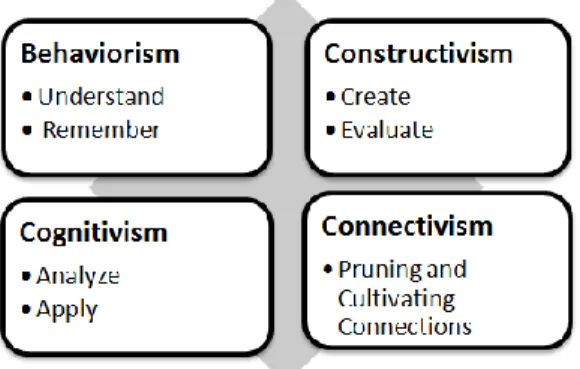
Fig. 1 Four main learning theories (Durff 2010)
Dewey‘s work is further extended by behaviorism, constructivism, cognitivism and connectivism as shown in Figure 1. Behaviorism, cognitivism and constructivism are the three basic learning theories that are commonly used in traditional educational environments.
Behaviorism explains the individual development as a directed process of acquiring new forms of behavior. According to the behaviorist model, teachers can influence the behavior of students by encouraging behavior that leads to the desired educational goals. The desired behavior is obtained by positive incentives, such as extra points, good grades, positive reviews, while the unwanted behavior are sanctioned by negative feedbacks, such as negative points, bad grades, negative reviews, etc. Behaviorism emphasizes teaching and the need for repetition (Shepard 2000). The behaviorist approach is applied using tests, quizzes and other methods for knowledge assessment; planning and implementing various forms of rewards for outcomes in the educational process; as well as debarring rewards for undesirable students‘ outcomes.
type and the level of the developed scheme that students possess and shape the process and the content in a way that facilitates further development, changes and extending of the existing scheme. A scheme that an individual possesses becomes richer more complex and more structured by personal development. Typical methods of teaching according to the cognitivism includes usage of examples and models for knowledge adoption and concepts linking, exercises of categorization and comparison, making diagrams and schemes, reliance on the previously learned in the acquisition of new knowledge, etc.
Constructivism is based on the belief that learning is a process that consists of several parts (Bruner 1986), (Fosnot 1996). Constructivism views learning as a socially and culturally specific activity (Shepard 2000) and considers knowledge creating as based on personal experience (Bruner 1986). Students select and process information, generate hypotheses and make decisions based on their own mental models (cognitive structures and schemes) by which they organize their own experience. According to this theory, the teacher should encourage students to independently discover the principles and laws of learning materials.
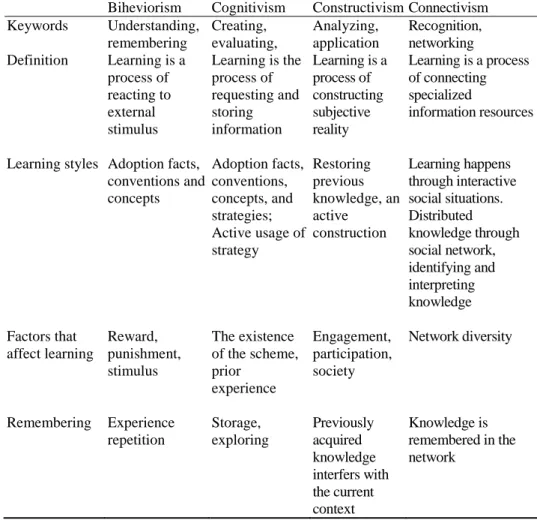
Table 1 The main learning theories
Biheviorism Cognitivism Constructivism Connectivism Keywords Understanding,
remembering Creating, evaluating, Analyzing, application Recognition, networking Definition Learning is a
process of reacting to external stimulus
Learning is the process of requesting and storing information
Learning is a process of constructing subjective reality
Learning is a process of connecting specialized
information resources
Learning styles Adoption facts, conventions and concepts Adoption facts, conventions, concepts, and strategies; Active usage of strategy Restoring previous knowledge, an active construction Learning happens through interactive social situations. Distributed knowledge through social network, identifying and interpreting knowledge Factors that affect learning Reward, punishment, stimulus The existence of the scheme, prior experience Engagement, participation, society Network diversity
Remembering Experience repetition Storage, exploring Previously acquired knowledge interfers with the current context Knowledge is remembered in the network
3.2. Modern Learning Methods
Correlation between technology and pedagogy attracted attention of researchers at the beginning of 21st century (Watson 2001). In (Nichols 2003), the author hypotheses that the ―choice of eLearning tools should reflect rather than determine the pedagogy of a course; how technology is used is more important than which technology is used‖. Many new pedagogical paradigms appeared with a mix of different learning theories and methods.
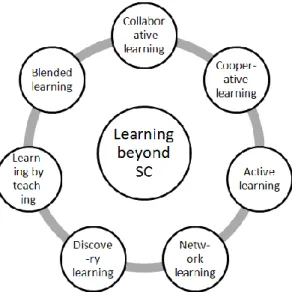
We address the importance of learning methods as shown in Figure 2.
Collaborative learning can be characterized as learning where several people learn
1999). Students work together in order to search meanings, solutions or to create a product of their learning. This learning theory redefines traditional student-teacher relationship and includes activities such as collaborative writing, working on group projects, problem solving, debates, study teams, and other activities.
Fig. 2 Learning methods: Beyond social computing technologies
Collaborative learning is closely related to cooperative learning. The cooperation represents the structure of designed interactions that have for a goal to facilitate achieving appropriate learning outcomes through group work (McInnerney and Roberts 2009). The collaborative models put total responsibility on students‘ groups, while cooperative teachers hold full control over students‘ actions. The main difference between collaboration and cooperation is the following: in a collaborative model, team members work together on the same problems, while in the cooperative model, team members divide tasks, solve these tasks independently and autonomously, and then join them (Dillenbourg 1999).
Blended learning mixes different learning environments and combines traditional
face-to-face classroom approaches with computer-based activities (Cubric 2007). Activities are structured around the access to online resources, communication via social media or interaction with distance learners in other classrooms or learning environments (Garrison and Kanuka 2004).
Active learning represents integration of behaviorism and cognitivism and put the
responsibility of learning on learners (Grassian and Kaplowitz 2001), (Jacobson and Mark 1995). Different methodologies for active learning exist (Jacobson and Mark 1995). For example, learning by teaching is an efficient instructional strategy that mixes guidance with active learning (O‘Hara 2009).
Learning by teaching allows students to teach the new content to each other, while
needs a good understanding of the field and skills to structure knowledge in a form that can be presented to others. Preparation for teaching is self-oriented and open activity where the individual explores, integrates and structures knowledge.
Discovery learning includes teaching and learning model and strategies that focus on
active learning opportunities for students. The basic attributes of discovery learning are: a) focus on research and problem solving for creating, integrating, and generalization of knowledge; b) students manage the activities based on their interests, and c) activities that encourage the integration of new knowledge into the existing knowledge base (Bicknell-Holmes and Hoffman 2000). Learning is active, process-oriented, teachers‘ feedbacks and availabilities are important. In this way, students can achieve a deeper understanding of learning (Castronova 2001).
Social learning refers to learning from peers facilitated by use of technology in a
form of specific web-based and social computing applications (Brouns et al. 2011). Learning process takes place in a social environment where individuals learn from one another.
Network learning is the process of developing and maintaining connections with
people and information. It represents communication that supports how individuals who are connected or networked learn (Jones 2011). Network learning is a materialization of connectivism related to student-oriented view and represents a new concept of learning as a network (Chatti, Jarke and Specht 2010). Each participant is in the center of his/her personal knowledge networks. Students build, maintain and expand personal networks of knowledge, creating new nodes in order to achieve positive learning outcomes.
E-learning describes the use of ICT to support and enhance learning practice
(Redecker 2009), (Brown and Adler 2008). E-learning is not a distinctive educational system in itself and it involves the use of a number of tools that can be applied in different contexts. E-learning cannot be compared with traditional face to face classrooms or distance learning, because it can be a part of those approaches. This approach enables unique forms of education that can fit within the existing curriculum paradigms combining the strengths of face-to-face and distance learning forms of education in different ways using different technologies (Brown and Adler 2008).
The known pedagogical frameworks for e-learning are computer-based learning, computer-based training, computer-supported collaborative learning and technology-enhanced learning. Computer-based learning includes computers usage in the learning environment, while computer-based trainings are self-paced learning activities accessible via a computer or handheld device, where the learning content is presented via online books or tutorials. This framework is similar to web-based training with the primary difference in delivery method, whether using the Internet or not. Computer-supported collaborative learning focuses on collaboration among learners and supports it in collaborative online environments. This framework is usually called E-Learning 2.0 (Redecker 2009). Technology enhanced learning (also known as educational technology) has the goal to provide socio-technical innovations for e-learning practices.
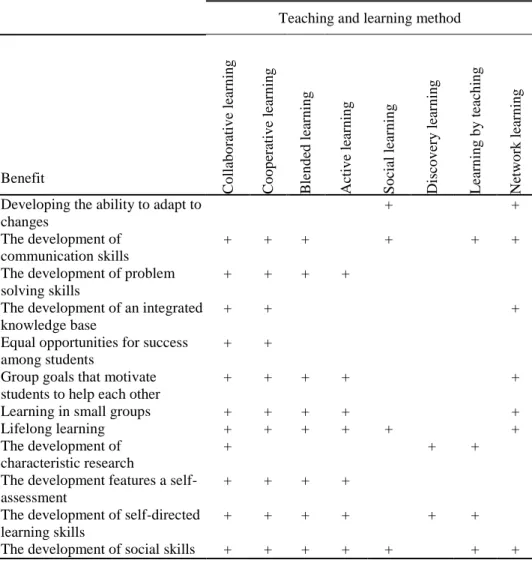
Developing communication skills is very important as well, especially when a growing number of individuals form a community using web-based social networks. The development of communication skills is supported in collaborative, cooperative, social and network learning. Problem solving skills are developed by using a collaborative, cooperative, blended and active learning. Group work is supported by collaborative, cooperative, blended, active and network learning. The development of skills necessary for lifelong learning is not supported within discovery learning and critical thinking, while other teaching and learning methods support it. Research skills can be developed by using collaborative learning, discovery learning and learning by teaching. Self-directed learning is represented within discovery learning and critical thinking. Self-assessment can be developed using the collaborative, cooperative, mixed, active learning, and using critical thinking.
Table 2. Comparison of teaching and learning methods
Teaching and learning method
Benefit C o llab o rativ e lear n in g C o o p er ativ e lear n in g B len d ed lear n in g Activ e lear n in g So cial lear n in g Dis co v er y lear n in g L ea rn in g b y teac h in g Netwo rk lear n in g
Developing the ability to adapt to changes
+ +
The development of communication skills
+ + + + + +
The development of problem solving skills
+ + + +
The development of an integrated knowledge base
+ + +
Equal opportunities for success among students
+ +
Group goals that motivate students to help each other
+ + + + +
Learning in small groups + + + + +
Lifelong learning + + + + + +
The development of characteristic research
+ + +
The development features a self-assessment
+ + + +
The development of self-directed learning skills
+ + + + + +
4. SC AND EDUCATION
4.1. Impact of SC on education
SC seeks to improve interpersonal as well as enterprise information flow and recorded memory, improve how people create, manage, categorize, seek, obtain, evaluate and use information, break down barriers, and extend the use of information and information technologies (Messinger et al. 2009). Social platforms are generating new ways how we acquire, access, manipulate, process, retrieve, present, and visualize information in the teaching and learning space. As a consequence, learning changes its nature and becomes collaborative. Social networks arise around common learning interests and facilitate the learning process by providing social and cognitive support. Learner starts to play the central role in learning process, while learning process becomes increasingly personalized and tailored to individual needs.
The social media for education is dynamic, ubiquitous, distributed, real-time, collaborative, bottom-up, many-to-many, value-based, and personalized. It provides resources, connections and new tools for creativity and collaboration, which empower all actors in the educational environments in new ways, in structured as well as unstructured learning settings. Due to the novelty of SC, its usage in education is still in development and experimental phase. It has potential to facilitate pedagogical innovation in learning by replacing traditional teaching and learning patterns with new and innovative ways of acquiring and managing knowledge. SC tools can be used as methodological tools to support, facilitate, enhance and improve learning processes and outcomes, as well as to provide new means for fostering lifelong learning, and support the vision of personalized future learning spaces in the knowledge society (Redecker et al. 2009), (Kwai and Wagner 2008). It is obvious that SC is very relevant for educational systems that need a change to foster new skills for new jobs, taking into account the changing living, working and learning patterns in a new digital society (Redecker et al. 2009).
Success of the SC tools in facilitating and improving learning processes and outcomes depends on the following factors: a) the availability and accessibility of SC tools by teachers and learners, b) functionalities of the tools employed, c) students‘ familiarity with the tools, d) students‘ acceptance of the tools, e) the extent to which students are able to adopt the tools for their individual needs, f) students‘ background knowledge and skills, g) the form of interaction and communication among peers within a learning group, h) the way in which SC tools are embedded within the course, including in particular guidance and support, structure of the tasks and the teacher‘s ability to encourage participation and embed the tools in the learning process (Redecker 2009).
The SC tools can facilitate learning processes by improving availability of course materials. For example, blogs can be used to distribute information, wikis can support collaboration and collective knowledge and resources building, and podcasts can assist in making learning material accessible (Redecker 2009). Additionally, the SC can improve knowledge exchange and can support individual‘s personal knowledge and resource management by improving personalized learning processes. Generally, the use of the SC increases students‘ performance and academic outcomes. Potential of the SC is not only in supporting students‘ basic skills. It has potential to increase collaboration and personalization too, which can further lead to new learning opportunities.
motivation, improve their participation and foster social and learning skills (Nejkovic and Tosic 2011). Further, the potential uses of the SC lie in developing e-portfolios as an online space where students can record their achievements and collect examples of their work, explore and promote their talents and interests, develop communication skills, foster collaboration and group work, learn about data protection and copyright issues, learn about self-representation in a digital world, learn about e-safety issues, and form communities of practice around particular topics or interest (Nejkovic and Tosic 2011) (Redecker 2009).
4.2. SC tools
Social networking services can be defined as internet based social spaces designed to
facilitate communication, collaboration and content sharing across networks of contacts (Redecker 2009). These services enable users to connect to others, to send e-mails and instant messages, to blog, to develop personal profiles, comprised for example of blogs, photos, videos, images and audio content. Also, syndication and notification technologies cannot be omitted, where syndication represents having an update on changing content from a given web resource (Punie and Ala-Mutka 2007). A feed reader (RSS feed) can be used to centralize all recent changes in the sources of interest, by regularly polling nominated sites for their feeds, displaying changes in a summary form, and allowing the user to see the complete changes (Punie and Ala-Mutka 2007). Syndication for education can provide the basis for an extensive online learning environment without the need for a heavily managed service (Redecker 2009).
Blogs are online public writing environments that enable a single author or a group of
authors to write and publicly display articles, called posts, which are listed in the reversed chronological order (Anderson 2007). In educational settings, blogs can be used by teachers to produce dynamic learning environments for course announcements, news and feedback to students; by students as digital portfolios to collect and present their work; among a group of learners, using their individual blogs, to build interrelated knowledge using posts and comments, enhancing collaboration; and with the aim of linking, using syndication technologies (Farmer 2006). Blogging can enhance reflection, analytical, critical and creative thinking by encouraging students to engage with positions divergent from their own; can enhance communication and promote more engaged learning, increasing student motivation and participation (Farmer 2006).
Wiki represents a website that allows users to add content that may be editable by other users (Nejkovic and Tosic 2011). It does not have a predefined structure and it is open and adaptable. Wiki is useful for collaborative writing and knowledge management. It can be defined as a set of linked web resources that are incrementally created and edited by a group of users that collaborate between themselves. Wiki has incremental nature and it stores shared knowledge originating from multiple sources. Wikis are applied in many different fields and for many different purposes. Wikis are flexible enough to support a variety of application domains including teaching, research, and academic administration (Schwartz et al. 2004).
repositories (Redecker 2009). Using Wiki as a course delivery tool improves communication and students involvement on course topics (Schwartz et al. 2004). Also, Wiki facilitates easier tracking of new knowledge development, more effective content development, and more objective knowledge assessment (Duffy and Bruns 2010).
Collaborative tagging or social bookmarking is regarded as democratic folksonomy
metadata generation and represents an ad-hoc classification scheme that web users invent as they surf and categorize the information they find online (Tosic and Nejkovic 2009). Collaborative tagging systems are non-hierarchical and non-exclusive and exhibit self-organization (Tosic and Nejkovic 2009). In collaborative tagging systems, users may assign uncontrolled keywords (called tags) to information resources, where tags are used to enable the organization of information within a personal information space and enable browsing and searching of tags attached to information resources by other users (Tosic and Milicevic 2006), (Golder and Huberman 2006). This service supports the following educational uses: teachers and students can build up collections of resources by sharing personally classified bookmarks; these collections can be used to maintain reading and resource lists; teachers and students can recommend, rate and comment on certain resources they found, etc., (Tosic and Nejkovic 2009).
Media-sharing sites enable users to store and share their multimedia files, such as photos
and videos. Posting photos online became one of the most popular online content creation activities which bring media-sharing sites in the significant research focus (Redecker 2009).
Podcastingis a way in which a listener may conveniently keep up-to-date with recent
audio or video content, while vodcasts are video versions of podcasts. Podcasting and Vodcasting are powerful tools for communication and distribution of educational content (Cruz and Carvalho 2007). These services allow students to learn, listen to the audio or video content. Podcasts can be used to help the teaching process by providing lecture recordings and course material as well as for student assignments and a way of presenting coursework (Cruz and Carvalho 2007). Education can benefit from media-sharing services by promoting self-directed learning activities and allowing the educational institution to reach out to a wider community (Cruz and Carvalho 2007).
Virtual environments provide users with online game-like three-dimensional digital
environment to which users subscribe. The user takes a role of the chosen avatar in a three-dimensional interactive graphical environment. Users can build, display, and store virtual creations, as well as host events and businesses or real university courses. These environments are used for supervising class projects, class meetings, mentoring student research projects, student services and support activities (Redecker 2009).
Online office applications (Web office or Web desktop) are software packages that
usually include a word processor, data sheet and multimedia presentations and represent collaborative editing tools (Anderson 2007). These tools facilitate the collaborative production of documents online, with some history, discussion and annotation resources, as well as a controlled publication and production management system.
4.3. SC tools and open learning platforms
use of one tool for a single purpose, because the application of the SC in education is not an off-the-shelf solution and depends on specific teaching and learning processes (Nejkovic and Tosic 2011). It has been shown that these tools effectively support learning processes in the following aspects. First, they can facilitate teaching and learning process by publishing course material, information distribution and collective resources building. Second, they support personal knowledge and resources management, and contribute to the personalization of learning processes. The SC tools support writing and language skills development and facilitate acquisition of more complex and abstract concepts in different areas of interests. Further, these tools contribute to the development of higher order skills like reflection and metacognition, and increase motivation and individual empowerment, thus enabling individuals to better develop and realize their personal potential (Redecker 2009).
Among the variety of SC tools, there are also tools specially designed for learning purposes. Some of online collaboration applications are especially designed and developed for educational purposes. On the other side, educational learning management systems (LMS) are e-learning platforms specially designed to help educators create online courses with opportunities for rich interaction (McIntosh 2012). The primary function of these systems is the creation and delivery of content. Usually these systems provide course authoring and some content management features as well, emphasize communication and collaboration features. These systems are generally built on the assumption that teacher is always available to build course content and to communicate with students (McIntosh 2012).
Open Learning Platforms feature a potentially large amount of fine-grained loosely-coupled web services on the back-end and some form of mashup support at front-end (Tosic and Manic 2011). Open learning platforms provide integration of user supplied services and easy integration and consumption of services provided within the platform by external personal applications (Alier et al. 2010).
5. OPEN ESP LEARNING PLATFORM FRAMEWORK
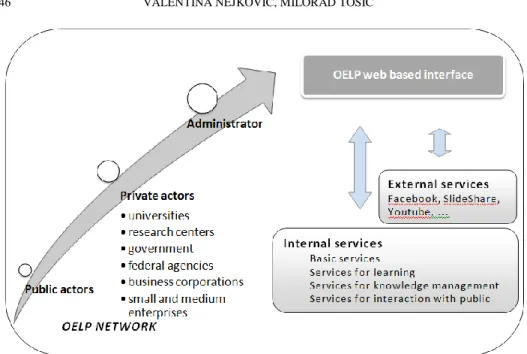
We define Open ESP Learning Platform (OELP) framework as a social, complex, open, interactive process of learning English for Specific Purposes. OELP provides basic features of open learning platform such as integration of private and public services within the platform. A network of participants around OELP should be formed, since the OELP framework is social and open. Here, we identify public and private actors. Private actors are universities, research centers, government, federal agencies, business corporations, small and medium enterprises. Private actors are active participants in OELP network, while public actors represent passive outside visitors. There is an Administrator role responsible for operational issues of the system. Figure 3 shows the interaction of public and private actors within OELP network with a web based interface which offers interactions with internal and external services to the actors.
Fig. 3. Open ESP Learning Platform conceptual framework
Basic services are responsible for the asynchronous actor‘s communication in OELP, which include forums and commenting over content. Notifications ensure actors to be informed about changes made over the appropriate contents. Users and groups management represents a basic service, and it includes authentication and authorization system functions. Different content blending by using web mash-up technology can extend basic services.
Learning services facilitate creating and using learning resources and corresponding literature materials. OELP should provide collaborative development of materials, contents and documents including functionality traditionally associated with social networking web sites such as interconnection of users, publishing of blogs and development of personal portfolios.
Services for knowledge management provide data storage, data retrieving and knowledge acquisition. They are part of the knowledge exchange platform that enables exchange of experiences and ideas. For data retrieval purposes, mechanisms for advanced search of documents should be provided. Further, features such as easy navigation, automatic generation of adjacent links and dynamic drop-down menus are required. The concept of collaborative tagging may be used to provide a collaborative content self-organization that makes easier to retrieve necessary information and knowledge.
6. CONCLUSION
Learning theories represent the first aspect that is essential for language teachers. The second aspect is conditioned with today‘s movements in ICT and SC technologies that have a strong impact on new forms of education. In this paper, we gave a brief overview of selected learning theories and modern learning methods necessary for the development of appropriate models when SC technologies are included in the learning process. We discussed the impact that SC have on education, identified representative SC tools and give their brief overview. Further, we defined services that constitute an OELP framework. The presented OELP framework has offered interactivity and personalization of actors and adoption of bottom-up model based on actors needs. That model is agile, adaptable and brings inter-dependent relationships of actors who share common interests in linguistic learning.
REFERENCES
Alier, M., Casañ, M. J., Piguillem, J., Moodle 2.0: Shifting from a Learning Toolkit to a Open Learning Platform, Technology Enhanced Learning. Quality of Teaching and Educational Reform, Book Series Title: Communications in Computer and Information Science, Vol. 73, Springer Berlin Heidelberg, 2010.
Anderson, P. (2007). ―What is Web 2.0? Ideas, technologies and implications for education‖. JISC Technology and Standards Watch, Feb., 2007, available at: http://www.jisc.ac.uk/ media/documents/techwatch/tsw0701b.pdf.
Beck, R. H. (1965). A social History of Education. London: Prentice Hall.
Bicknell-Holmes, T., Hoffman, P. S. (2000). Elicit, engage, experience, explore: Discovery learning in library instruction. Reference Services Review, 28(4), pp. 313-322.
Brouns, F., Berlanga, A. J., Fetter, S., Bitter-Rijpkema, M. E., Van Bruggen, J. M., & Sloep, P. B. (2011). A survey on social networks to determine requirements for Learning Networks for professional development of university staff. International Journal of Web Based Communities, 7(3), pp. 298-311.
Brown, S,J.; Adler, R.P. (2008). "Minds on Fire: Open Education, the Long Tail, and Learning 2.0". Educause review (January/February 2008): 16–32.
http://eric.ed.gov/ERICWebPortal/search/detailmini.jsp?_nfpb=true&_&ERICExtSearch _SearchValue_0=ED430508&ERICExtSearch_SearchType_0=no&accno=ED430508 Bruffee, K. A. (1999). Collaborative Learning: Higher Education, Interdependence, and the Authority of Knowledge. Second Edition. http://eric.ed.gov/ERICWebPortal/ search/detailmini.jsp?_nfpb=true&_&ERICExtSearch_SearchValue_0=ED430508&E RICExtSearch_SearchType_0=no&accno=ED430508Johns Hopkins University Press, ISBN-0-8018-5974-3
Bruner, J. (1986). Actual Minds, Possible Worlds. Cambridge, MA: Harvard University Press. Butts, R. F. (1971). The College Charts Its Course: Historical Conceptions and Current.
Manchester, USA: Ayer Publishing.
Castronova, J.A, (2001). Discovery Learning for the 21st Century: What is it and how does it compare to traditional learning in effectiveness in the 21s t Century?, [Dostupno na: http://teach.valdosta.edu/are/Litreviews/vol1no1/castronova_litr.pdf, Pristup: 12.10.2012.] Chatti, M. A., Agustiawan, R. M., Jarke, M., Specht, M. (2010). Toward a personal
Chatti, M. A., Jarke, M., Specht, M. (2010). The 3P Learning Model. Educational Technology & Society, 13(4), pp. 74–85.
Cole, M., (2009). Using Wiki technology to support student engagement: Lessons from the trenches. Computers & Education,52(1), pp. 141-146.
Conole, G., Laat, M., Dillon, T., Darby, J. (2008). ―‗Disruptive technologies‘, ‗pedagogical innovation‘: What‘s new? Findings from an in-depth study of students‘ use and perception of technology―, Computers & Education, 50 (2) (2008), pp. 511-524.
Cruz, S. C. S., Carvalho, A.A.A. (2007). ―Podcast: A Powerful Web Tool for Learning History‖. IADIS International Conference e-Learning, 2007, Vol. 1, pp. 313-318. Cubric M., Wiki-based Process Framework for Blended Learning, Proceedings of the
2007 international symposium on Wikis, New York, NY, USA, 2007, pp. 11-24. Dabbagh, N. (2005). Pedagogical models for E-Learning: A theory-based design framework.
International Journal of Technology in Teaching and Learning, 1(1), 25-44
Deryn Watson, Pedagogy before Technology: Re-thinking the Relationship between ICT and Teaching, Education and Information Technologies, Volume 6, Number 4, pp. 251-266, 2001., DOI: 10.1023/A:1012976702296
Dewey, J. (1916). Democracy and Education. New York: Macmillan.
Dewey, John. (1897). My pedagogical creed. School Journal. 54. pp. 77-80. Retrieved on March 19th 2012 from http://dewey.pragmatism.org/creed.htm
Dillenbourg, P. (1999). Collaborative Learning: Cognitive and Computational Approaches. Advances in Learning and Instruction Series. New York, NY: Elsevier Science, Inc. Don McIntosh, Learning Management Vendors, January 2012, Education LMS,
www.trimeritus.com
Downes S. (2012). Connectivism and Connective Knowledge, ISBN: 978-1-105-77846-9, Creative Commons License, [Dostupno na: http://www.downes.ca/files/books/ Connective_Knowledge-19May2012.pdf]
Duffy, P. and Bruns, A., The Use of Blogs, Wikis and RSS in Education: A Conversation of Possibilities, In: Proceedings Online Learning and Teaching Conference, Brisbane, 31-38, 2006, http://eprints.qut.edu.au/archive/00005398/01/5398.pdf, Accessed 10 June 2010. Duffy, P., Bruns, A., (2006). The Use of Blogs, Wikis and RSS in Education: A Conversation
of Possibilities. In: Proceedings Online Learning and Teaching Conference, Brisbane, 31-38, 2006, [Dostupno na: http://eprints.qut.edu.au/archive/00005398/01/5398.pdf, Access 10.06.2010.]
Durff‘s blog. http://durffsblog.blogspot.com/2010/12/death-by-ism.html
E. Grassian and J. R. Kaplowitz, Active Learning. Information Literacy and Instruction Theory and Practice. New York: Neal-Schuman, 2001, pp. 116 – 128.
Ebner,M., Kickmeier-Rust, m., Holzinger, A., (2008). Utilizing Wiki-Systems in higher education classes: a chance for universal access? Universal Access in the Information Society, Springer-Verlag, 7(4), pp. 199–207.
Faizi,R., El Afia, A. and Chiheb, R., Social Media: An Optimal Virtual Environment for Learning Foreign Languages, International Journal of Emerging Technologies in Learning, 9(5), http://dx.doi.org/10.3991/ijet.v9i5.3911
Farmer, J. (2006). ―Blogging to Basics: How Blogs Are Bringing Online Education Back from the Brink‖, in: Axel Bruns and Joanne Jacobs (ed.): Uses of Blogs. Peter Lang: New York, 2006.
Garrison, D. R., and H. Kanuka (2004). "Blended learning: Uncovering its transformative potential in higher education". The Internet and Higher Education7 (2): 95–105. Golder, S., Huberman, B.A., (2006). "Usage Patterns of Collaborative Tagging Systems."
Journal of Information Science, 32(2). Pp. 198-208.
Guth,.S, (2007). Wikis in education: is public better? In WikiSym '07:Proceedings of the 2007 international symposium on Wikis, New York, NY, USA, ACM, pp. 61-68. Jacobson, T.E. and Mark, B., Teaching in the Information Age: Active Learning
Techniques to Empower Students, Reference Librarian, 51/52, 1995, pp. 105 – 120. Jaksch, B., Kepp, S., Womser-Hacker, C., (2008). Integration of a Wiki for Collaborative
Knowledge Development in an E-learning Context for University Teaching, HCI and Usability for Education and Work, 5298/2008, Springer-Verlag Berlin/ Heidelberg, 2008, pp. 77-96.
Johanson, N., (2007). Wikis inEducation: Technology Enhanced Collaboration. In ITUE 10th Symposium:Workshop on Technology and Learning: E-WAVE on Wikis, June 14, 2007, [Dostupno na: http://www.udel.edu/inst/june2007/wikis2.pdf, Pristup 05.09. 2010.]
Jones, C. (2011). Networked learning environments. In: Keppel, Mike; Souter, Kay and Riddle, Matthew eds. Physical and Virtual Learning Spaces in Higher Education: Concepts for the Modern Learning Environment. Hershey, PA: IGI Global, pp. 102–118. Kerr, C., M. L. Gade and M. Kawaoka (1994). Higher Education Cannot Escape History:
Issues for the Twenty-First. New York: State University of New York Press.
Kop, R., Hill, A. (2008). Connectivism: Learning theory of the future or vestige of the past?. The International Review of Research in Open and Distance Learning, 9(3), Article–9.
Kwai, R., and Wagner, C.: Weblogging: A study of social computing and its impact on organizations, Decision Support Systems, 45 No.2 (2008) 242-250.
Lave, J. and E. Wenger (2000). Legitimate peripheral participation in communities of practice. In R. L. Cross and S. Isreaelit (Ed), Strategic Learning in a Knowledge Economy: Individual, Collective and Organisational Learning Process(pp. 167- 184). London, Butterworth-Heinemann.
M. Tosic, M. Manic, A RESTful Technique for Collaborative Learning Content Transclusion by Wiki-style Mashups, in Proc. IEEE ICELIE'11, 5th IEEE International Conference on E-Learning in Industrial Electronics, Melbourne, Australia, November 7-10 2011., pp. 27-32.
Mader, S. (2006). Using Wiki in education, Wiley.
Mayes, T. and de Freitas, S., Review of e-learning theories, frameworks and models , 2004, http://www.jisc.ac.uk/uploaded_documents/Stage%202%20Learning%20Models%20(Ver sion%201).pdf
McInnerney, J.M, Roberts, T.S, (2009). Collaborative and Cooperative Learning, In Encyclopedia of distance learning / Patricia Rogers ... [et al.], editors., 2nd ed. Messinger, P.R., Stroulia, E., Lyons, K., Bone, M., Niu, R.H., Smirnov, K., and Perelgut,
S.: Virtual worlds — past, present, and future: New directions in social computing, Decision Support Systems, 47 No.3 (2009) 204-228.
Nejkovic, Valentina. ―Social Computing Based E-learning Platform.‖ PhD diss., University of Nis, 2014.
Nichols, M. (2003). A theory for eLearning. Educational Technology & Society, 6(2), 1-10, Available at http://ifets.ieee.org/periodical/6-2/1.html
O'Hara, C. E. (2009.), Engaging Active Learning through Wiki Technology: 2 Case Studies, 12th CSU Regional Symposium on University Teaching,
Parker, K., Chao,J., (2007). Wiki as a teaching tool, Interdisciplinary Journal of Knowledge and Learning Objects, 3.
Piaget, J. (1970). Piaget's theory. In P. H. Mussen (Ed) Carmichael's manal of child psychology (Vol. 1, 3rd ed., pp. 703-732). New York: Wiley
Ploetzner,R., Dillenbourg,P., Preier1,M., Traum, D.,(1998). Learning by Explaining to Oneself and to Others, DILLENBOURG (ED) COLLABORATIVE-LEARNING: COGNITIVE AND COMPUTATIONAL APPROACHES. OXFORD: ELSEVIER CHAPTER 6, pp. 103-121, [Dostupno na: http://citeseerx.ist.psu.edu/viewdoc/ download?doi=10.1.1.167.3716&rep=rep1&type=pdf]
Punie, Y. and Ala-Mutka, K. (2007). ―Future Learning Spaces: new ways of learning and new digital competences to learn‖. Nordic Journal of Digital Literacy, 2 (4) (2007), pp. 210-225.
Redecker, C. (2009). "Review of Learning 2.0 Practices: Study on the Impact of Web 2.0 Innovations on Education and Training in Europe". JRC Scientific and technical report. (EUR 23664 EN – 2009).
Redecker, C., CKER, Ala-Mutka, K., Bacigalupo, M., Ferrari, A., Punie, Y. (2009). " Learning 2.0: The Impact of Web 2.0 Innovationson Education and Training in Europe". JRC Scientific and technical report. (EUR 24103 EN 2009).
Schwartz, L., Clark, S., Cossarin, M., Rudolph, J., Educational Wikis: features and selection criteria. Technical Evaluation Review, International Review of Research in Open and Distance Learnig, 5(1), 2004.
Shepard, L. A. (2000). The Role of Assessment in a Learning Culture, Educational Researcher, 29(7), pp. 4-14.
Siemens, G., (2005). Connectivism: A Learning Theory for a Digital Age. International Journal of Instructional Technology and Distance Learning, 2(1), [Dostuno na: http://www.itdl.org/Journal/Jan_05/article01.htm]
Tosic, M, Milicevic, V., "Semantics of The Collaborative Tagging Systems", ''3th European Semantic Web Conference'', ''2nd Workshop on Scripting for the Semantic Web'', June 11-14, 2006, Budva, Serbia & Montenegro.
Tosic, M., Nejkovic, V. "Trust-based peer assessment for virtual learning systems", Lecture Notes in Computer Science, 2010, Volume 6430/2010, pp. 176-191, ISSN: 0302-9743, DOI: 10.1007/978-3-642-16567-2_13
Tosic, M., Nejkovic, V., "Collaborative Wiki Tagging," in ―Networked Knowledge & Networked Media: Integrating Knowledge Management, New Media Technologies and Semantic Systems Series: Studies in Computational Intelligence,‖ Vol. 221, pp.141-153, Pellegrini, T.; Auer, S.; Tochtermann, K.; Schaffert, S. (Eds.), 2009, Springer Berlin / Heidelberg, ISSN 1860-949X (Print) 1860-9503 (Online)