TECHNICAL UNIVERSITY OF CLUJ-NAPOCA
ACTA TECHNICA NAPOCENSIS
Series: Applied Mathematics, Mechanics, and Engineering Vol. 60, Issue III, September, 2017
DYNAMICS OF HUMAN BODY SUBJECTED TO VIBRATIONS
ON A VIBRATING PLATE
Mariana ARGHIR
Abstract: The paper presents a study of dynamics of human body subjected to vibrations on a vibrating
platform, which the human body is placed in the position of sitting, inclined towards the direction of drive train vibrations. Designed system is an original development of the earlier studies. Dynamics of human body system assimilated to the usual material system corresponds of the human body, located in the vibrating field. In the paper are established the scalar differential equations, that govern the human body dynamics.
Key words: dynamics ofhuman body segments, general vibrations, system of differential equations.
1. INTRODUCTION
It is considered a human subject placed on a vibrating platform, which produces vertical vibrations. The body is placed at 45 ° inclined towards horizontal plate. A suggestive image can be date as in figure 1 [3].
Fig. 1. Human body posture sitting on the vibrating platform [1]
It is considered that in this position, the area most exposed to vibration is the range of the legs up to his chest. Therefore, they are not taken into account the arms, neck and head. This part of the body is divided into six segments (Fig. 2) [4].
Fig. 2. Segmented biodynamic model of the human body [4] subjected of vibrations
The segments masses are: m1 – mass of
the dorsal region leg; m2 – mass of the crurale
region of the previous leg (the calf of the leg); m3 – mass of the femoral region leg; m4 – mass
of the leg buttocks region; m5 – mass of the
abdomen; m6 – mass of the thorax.
2. HUMAN BODY ON THE VIBRATING PLATFORM
This initial idea about the human body under the action of vibration on the vibrating platform, was modified, and the new situation are made for the action of the active force in the body base on the m4 mass (Fig. 3).
Vibrating Platform
Fig. 3. Biomechanical scheme of the human body on the vibrating platform
In the Figure 3 are presented the gravity forces for the body segments (Gi , i=1, 2, ..., 6),
the action force (F(t)), that acts over the body situated on the vibrating platform, and the linkage forces (N1 and N2) the normal reactions
on the segments who are posted on the platform.
An important fact is that the action force is situated at the distance „l” about the application gravity force for the „4” segment, because here there is vertical direction of the mass centre position of the mechanical system. But the action force is divided into two different components, because they are direct applied on the subjected components of the human body.
3. MECHANICAL SCHEMES
The start figure of this part of the paper is the Figure 3, and the segment in each figure will be presents as the original position.
3.1. Mechanical Characteristics
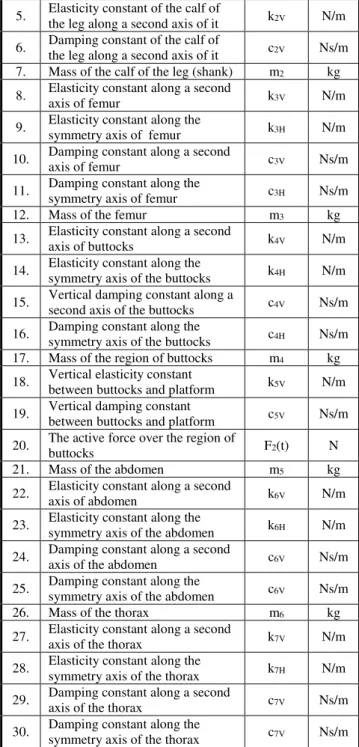
The segment is considered formed with: mass, spring and, damper. The notations and the values are given in the Table no.1.
Table 1. Mechanical Characteristic of the Human Segments
Crt.
No. Denomination Symbol U.M.
1. Mass of the dorsal region leg m1 kg
2. The active force over the dorsal
region leg F1(t) N
3. Vertical elasticity constant of the
dorsal region leg k1V N/m
4. Vertical damping constant of foot c1V Ns/m
5. Elasticity constant of the calf of
the leg along a second axis of it k2V N/m
6. Damping constant of the calf of
the leg along a second axis of it c2V Ns/m 7. Mass of the calf of the leg (shank) m2 kg
8. Elasticity constant along a second
axis of femur k3V N/m
9. Elasticity constant along the
symmetry axis of femur k3H N/m
10. Damping constant along a second
axis of femur c3V Ns/m
11. Damping constant along the
symmetry axis of femur c3H Ns/m
12. Mass of the femur m3 kg
13. Elasticity constant along a second
axis of buttocks k4V N/m
14. Elasticity constant along the
symmetry axis of the buttocks k4H N/m
15. Vertical damping constant along a
second axis of the buttocks c4V Ns/m
16. Damping constant along the
symmetry axis of the buttocks c4H Ns/m 17. Mass of the region of buttocks m4 kg
18. Vertical elasticity constant
between buttocks and platform k5V N/m
19. Vertical damping constant
between buttocks and platform c5V Ns/m
20. The active force over the region of
buttocks F2(t) N
21. Mass of the abdomen m5 kg
22. Elasticity constant along a second
axis of abdomen k6V N/m
23. Elasticity constant along the
symmetry axis of the abdomen k6H N/m
24. Damping constant along a second
axis of the abdomen c6V Ns/m
25. Damping constant along the
symmetry axis of the abdomen c6V Ns/m
26. Mass of the thorax m6 kg
27. Elasticity constant along a second
axis of the thorax k7V N/m
28. Elasticity constant along the
symmetry axis of the thorax k7H N/m
29. Damping constant along a second
axis of the thorax c7V Ns/m
30. Damping constant along the
symmetry axis of the thorax c7V Ns/m
3.2. Mechanical Schemes of the Segmentation
The mechanical schemes [1], [2] of the segmentation are given in the following figures.
Fig. 4. Mechanical scheme of the foot )
z z (
c2V &2 −&1 k2V(z2 −z1)
z1
1 V
1 z
k
) t ( F1
1 V
1 z
c &
m1
) t ( F
4
N
5
G
3
G G2
1
G z
x
l
4
G
6
G
1
Fig. 5. Mechanical scheme of the shank
Fig. 6. Mechanical scheme of the femur
Fig. 7. Mechanical scheme of the buttocks
Fig. 8. Mechanical scheme of the abdomen
Fig. 9. Mechanical scheme of the thorax
m6 z6
x6
) z z )( c c ( 2 /
2 7V + 7H &6 −&5
) z z )( k k ( 2 /
2 7V + 7H 6 − 5
) x x )( c c ( 2 /
2 7V − 7H &5 − &6 ) x x )( k k ( 2 /
2 7V − 7H 5− 6 m5
z5
x5
) x x )( k k ( 2 /
2 6V − 6H 4 − 5
) x x )( c c ( 2 /
2 6V − 6H &4 −&5
) z z )( k k ( 2 /
2 6V + 6H 5 − 4 )
z z )( c c ( 2 /
2 6V + 6H &5 −&4 ) z z )( c c ( 2 /
2 7V + 7H &6 −&5
) z z )( k k ( 2 /
2 7V + 7H 6 − 5
) x x )( c c ( 2 /
2 7V − 7H &5 −&6
) x x )( k k ( 2 /
2 7V − 7H 5− 6
m4
z4
x4
) t ( F2
4 V
5 z
k z
4 V
5 z
c &
z
) x x )( c c ( 2 /
2 4V − 4H &3− &4 ) x x )( k k ( 2 /
2 4V − 4H 3 − 4 ) z z )( k k ( 2 /
2 4V + 4H 3− 4 ) z z )( c c ( 2 /
2 4V + 4H &3−&4
) z z )( c c ( 2 /
2 6V + 6H &5−&4 ) z z )( k k ( 2 /
2 6V + 6H 5 − 4
) x x )( k k ( 2 /
2 6V − 6H 4 − 5
) x x )( c c ( 2 /
2 6V − 6H &4 −&5
x3
z3
m3
) z z )( k k ( 2 /
2 3V + 3H 3− 2 )
z z )( c c ( 2 /
2 3V + 3H &3−&2
) x x )( k k ( 2 /
2 3V − 3H 2 − 3
) x x )( c c ( 2 /
2 3V − 3H &2 − &3 )
x x )( k k ( 2 /
2 4V − 4H 3 − 4
) x x )( c c ( 2 /
2 4V − 4H &3 −&4
) z z )( k k ( 2 /
2 4V + 4H 4 − 3 )
z z )( c c ( 2 /
2 4V + 4H &4 −&3
z2
x2
) x x )( k k ( 2 /
2 3V − 3H 3− 2
) x x )( c c ( 2 /
2 3V − 3H &3 −&2
) z z ( c2V &2 −&1
) z z )( c c ( 2 /
2 3V + 3H &3−&2 2/2(k3V +k3H)(z3 −z2)
4. DIFFERENTIAL EQUATIONS
Using the mechanical schemes made in the figures between 4 and 9, they can be write the differential governing equations, for the system assimilated human body located on a vibrating platform.
4.1. Dorsal Region Leg
In the Figure 4is the mechanical scheme of the dorsal region leg (foot), and the dynamics equilibrium is given by the central motion theorem. ) t ( F ) z z ( k ) z z ( c z k z c z m 1 1 2 V 2 1 2 V 2 1 V 1 1 V 1 1 1 + − + + − + − −
= & & & &
&
(1)
4.2. Crurale Region of the Previous Leg
The crurale region of the previous leg, named and the calf of the leg, has its mechanical scheme in the Figure 5, and the dynamics equilibrium is given by the central motion theorem, into two differential dynamics equilibrium, because the shank has two perpendicular motions. ) z z ( ) k k ( 2 2 ) z z ( ) c c ( 2 2 ) z z ( k ) z z ( c z m 2 3 H 3 V 3 2 3 H 3 V 3 1 2 V 2 1 2 V 2 2 2 − ⋅ + + − ⋅ + + + − − − − − = & & & & & & (2) ) x x ( ) k k ( 2 2 ) x x ( ) c c ( 2 2 x
m2&&2= 3V− 3H ⋅ &3−&2 + 3V− 3H ⋅ 3− 2 (3)
4.3. Femoral Region Leg In the Figure
The femoral region leg (femur) is presented in the Figure 6, and its differential equations into two perpendicular directions are given in the following system.
) z z ( ) k k ( 2 2 ) z z ( ) c c ( 2 2 ) z z ( ) k k ( 2 2 ) z z ( ) c c ( 2 2 z m 3 4 H 4 V 4 3 4 H 4 V 4 2 3 H 3 V 3 2 3 H 3 V 3 3 3 − ⋅ + + − ⋅ + + + − ⋅ + − − ⋅ + − = & & & & & & (4) ) x x ( ) k k ( 2 2 ) x x ( ) c c ( 2 2 ) x x ( ) k k ( 2 2 ) x x ( ) c c ( 2 2 x m 4 3 H 4 V 4 4 3 H 4 V 4 3 2 H 3 V 3 3 2 H 3 V 3 3 3 − ⋅ − − − ⋅ − − − − ⋅ − + − ⋅ − = & & & & & & (5)
4.4. Leg Buttocks Region
In the Figure 7 is given the mechanical scheme of the buttocks, and it has the motions in vertical direction for the active force excitation, but, in same time it has the motion in horizontal direction due to the linkages with the segments of the body.
The differential equations of the buttocks motions are in the next system.
) t ( F z k z c ) z z ( ) 6 k k ( 2 2 ) z z ( ) c c ( 2 2 ) z z ( ) k k ( 2 2 ) z z ( ) c c ( 2 2 z m 2 4 V 5 4 V 5 4 5 H 4 V 6 4 5 H 6 V 6 4 3 H 4 V 4 4 3 H 4 V 4 4 4 + − − − − ⋅ + + − ⋅ + + + − ⋅ + + − ⋅ + = & & & & & & & (6) ) x x ( ) k k ( 2 2 ) x 4 x ( ) c c ( 2 2 ) x x ( ) k k ( 2 2 ) x x ( ) c c ( 2 2 x m 5 4 H 6 V 6 5 H 6 V 6 4 3 H 4 V 4 4 3 H 4 V 4 4 4 − ⋅ − − − ⋅ − − − − ⋅ − + − ⋅ − = & & & & & & (7) 4.5. Abdomen
The abdomen is considered as a segment of the body situated on the vibrating platform, and it has the two different dynamics equilibrium equations. ) z z ( ) k k ( 2 2 ) z z ( ) c c ( 2 2 ) z z ( ) k k ( 2 2 ) z z ( ) c c ( 2 2 z m 5 6 H 7 V 7 5 6 H 7 V 7 4 5 H 6 V 6 4 5 H 6 V 6 5 5 − ⋅ + + − ⋅ + + + − ⋅ + − − ⋅ + − = & & & & & & (8) ) x x ( ) k k ( 2 2 ) x x ( ) c c ( 2 2 ) x x ( ) k k ( 2 2 ) x x ( ) c c ( 2 2 x m 6 5 H 7 V 7 6 5 H 7 V 7 5 4 H 6 V 6 5 4 H 6 V 6 5 5 − ⋅ − − − ⋅ − − − − ⋅ − + − ⋅ − = & & & & & & (9) 4.6. Thorax
The thorax is last segment in this study, and it has the dynamics equations, as:
) z z ( ) k k ( 2 2 ) z z ( ) c c ( 2 2 z
m6&&6 =− 7V+ 7H ⋅ &6−&5 − 7V+ 7H ⋅ 6− 5 (10) ) x x ( ) k k ( 2 2 ) x x ( ) c c ( 2 2 x
4.7. Differential Equations System
The assembly of scalar differential equations is a second-order differential system,
scratchy (not homogeneous), with constant coefficients which can be written in the form of orderly after the unknown, for integration in relation to the independent variable - the time.
(
)
(
)
(
)
(
)
(
)
(
)
(
)
(
k k)
x 05. CONCLUSIONS
In this work it is proposed a new biomechanical model of human body subjected to connections on a vibrating platform.
The human body is divided into six different segments of it, and it sat in an inclined position towards the platform with 45 degrees. Two segments are situated on the platform (foot and buttocks), and over them acts the active force having the distribution about them taking into account the masses of the segments.
The system of scalar differential equations, that governs the mechanical system motion has 11 equations with eleven unknown quantities, and it is a second-order differential system, scratchy (not homogeneous), with constant coefficients which can be written in the form of orderly after the unknown.
In this work the aim was to determine the system of differential equations that are of great complexity and required a different approach,
compared to our previous studies and those that are still in the specialized literature in the field.
5. BIBLIOGRAPHY
[1] Arghir Mariana, Mechanics. Statics & material point kinematics, 186 pag., Editura U.T.Press, ISBN 973-9471-16-1, Cluj-Napoca, 1999.
[2] Arghir Mariana, Mechanics. Rigid Body Kinematics & Dinamics, 240 pag., Editura U.T.Press, ISBN 973-8335-20-5, Cluj-Napoca, 2002.
[3] Sergiu Dan Vescan, Mariana Arghir, Contribution to the Study of Mechanical Properties of Human Body, ACTA TECHNICA NAPOCENSIS; Series: Applied Mathematics, Mechanics, and Engineering, Vol. 58, Issue IV, Pag. 613-618, Ed. UT Pres, ISSN 1221-5872, Cluj-Napoca, November, 2015.
[4] Sergiu VESCAN, Mariana ARGHIR, The Biodynamic Model of Human Body, ACTA TECHNICA NAPOCENSIS; Series: Applied Mathematics, Mechanics, and Engineering, Vol. 57, Issue I, Pag. 123-128, Ed. UT Pres, ISSN 1221-5872, Cluj-Napoca, March, 2014.
Dinamica corpului uman supus la vibratii pe o placa vibratoare
Rezumat: Lucrarea prezinta un studiu al dinamicii corpului uman, supus la vibratii pe o platforma vibratoare, fata de care corpul uman este asezat in pozitia sezand, inclinata fata de directia de actionare a vibratiilor. Sistemul astfel conceput este o dezvoltare originala a studiilor anterioare. Dinamica sistemului material asimilat corpului uman corespunde, astfel, la solicitarile uzuale ale corpului uman, situat in camp vibrational.In lucrare sunt stabilite ecuaţiile diferenţiale scalare, care guvereneazǎ dinamica corpului uman
![Fig. 2. Segmented biodynamic model of the human body [4] subjected of vibrations](https://thumb-us.123doks.com/thumbv2/123dok_us/7999271.2120850/1.892.109.457.733.961/fig-segmented-biodynamic-model-human-body-subjected-vibrations.webp)