27
Genre Analysis of Dissertation Acknowledgements: A Comparative Study
across Contexts
WENHSIEN YANG
National Kaohsiung University of Hospitality and Tourism Taiwan
ABSTRACT
In contrast to those in its Chinese-speaking counterparts, namely China and Hong Kong, the generic structures of acknowledgements in dissertations in Taiwan are understudied. To address this gap, this study examined 120 MA and PhD dissertation acknowledgements written by Taiwanese Chinese-speaking writers in terms of their generic structure and linguistic features in order to investigate whether differences exist within a common culture, and to explore the possible causes of any differences. The results suggest that the authors generally followed the same three-tier structure of writing dissertation acknowledgements as is used by Chinese and Hong Kong writers. However, contextual factors such as academic, socio-cultural or geographical differences among the three settings also affected their construction of moves and choices of linguistic elements. It was found that the rhetorical language in our corpus was relatively direct, emotional, and definite. Moreover, a new step called ‘Making a Confession’, which was not reported in the other two settings, was identified in this study. Suggestions for further investigations as well as pedagogical implications are offered.
Keywords: genre analysis; dissertation acknowledgements writing; contextual variations; corpus study; Chinese-speaking EFL writers
INTRODUCTION
Expressing gratitude in academia is common practice, but the study of the generic structure of acknowledgements in dissertations (DAs)1 is still regarded as a secondary issue in English for academic purposes (EAP). Acknowledgements, according to Giannoni (2002), are staged texts coherently constructed with rhetorical devices to map credits; he described them as a part-genre. Hyland (2003, 2004) defined acknowledgements as a “Cinderella” genre as they are rhetorically-sophisticated and formatively-complex, and neither completely academic nor entirely personal. They are seemingly peripheral to academic research but still have significant socio-pragmatic connections making them relevant to research. That is, an examination of such texts can help students write appropriate acknowledgements themselves. For researchers and postgraduate students, DAs are not merely a list of naming acknowledgees (the people who are acknowledged) to thank them for their assistance, but rather provide a means to “balance debts and responsibilities as well as to display their immersion in scholarly networks, their active disciplinary membership, and their observance of the valued academic norms of modesty, gratitude and appropriate self-effacement” (Hyland & Tse 2004, p. 273). Hence, in writing DAs, authors identify themselves with other members of the university and discourse communities, and seek a more appropriate way to recognise mutual interactions.
28
have different thought patterns which affect their preferred patterns of rhetoric. The usage of the full range of rhetorical devices in one specific language will not occur with equal frequency across different contexts (Kaplan 1987, Nkemleke 2006). As a result, personal identity and language use in DAs is influenced by the cultures to which writers are exposed.
Yet, thorough and systematic research on issues such as what authors write in their DAs, how they construct their DAs, and how contextual factors affect the formation of DAs is still relatively rare in EAP. In addition, analysis of DAs written by Taiwanese Chinese-speaking authors as opposed to Chinese-Chinese-speaking authors from China (e.g., Zhao & Jiang 2010) and Hong Kong (Hyland 2003, 2004; Hyland & Tse 2004) is an opportunity for a comparison of cultural influences on writers and genres. Hence, this present study aims to compare whether the DAs written by Taiwanese writers are similar to or differ from those in the previous studies in terms of their generic structures, linguistic features, possible causes of differences, and directions for instructing the writing of DAs.
LITERATURE REVIEW
Researchers in genre analysis usually examine generic moves at a macro-level and linguistic features at a micro-level. A large number of macro-level studies have investigated moves and steps in academic texts including research/conference paper titles, (Afful & Mwinlaaru 2010a, Haggan 2004), abstracts (Hyland 2000, Lorés 2004, Martin 2003, Salager-Meyer 1990, Samaraj 2005), introductions (Bhatia 1993, Dudley-Evans & Henderson 1990, Holmes 1997, Samaraj 2002, Swales 1981, 1990), results (Atai & Falah 2005, Brett 1994, Thompson 1993, Williams 1999), discussions (Atai & Falah 2005, Holmes 1997, Hopkin & Dudley-Evans 1988, Nodoushan & Khakbaz 2011), and conclusions (Bunton 2002, Yang & Allison 2003). Most of these studies adopt Swales’ (1990) CARS (creating a research space) model to explore the rhetorical aspects of academic writing.
Researchers have examined both generic moves and linguistic features of acknowledgements. Giannoni (2002) analysed 100 acknowledgements in English and Italian scholarly journals from a genre-analytic perspective, paying attention to the issues of generic complexity and staging, personal involvement and peer-reference, authorial responsibility and pragmatic appropriateness. The findings of Giannoni’s study suggest that the generic structures of acknowledgements not only reflect variety across disciplines but are also affected by the national patterns of the disciplinary communities. The three-tier structure of acknowledgements established by Hyland (2003, 2004) and Hyland and Tse (2004) has become a model for explaining generic structure (see Figure 1). They collected 240 MA and PhD dissertations written by Hong Kong Chinese-speaking postgraduates (HKCs) from six academic disciplines and analysed how the DAs were structured to express gratitude. The results demonstrated that DAs not only “play an important role in promoting a competent, even rhetorically skilled, scholarly identity of acknowledgers but reveal their social and cultural characteristics in situated settings” (Hyland 2003: 266). The rhetorical structure of DAs, as outlined by Hyland (2004: 308), seems to consist of one obligatory move, Thanking, together with two optional moves and their subsequent steps:
FIGURE 1. Hyland’s (2004) generic structure of DA
1. Reflecting Move Introspective comment on the writer’s research experience 2. Thanking Move Mapping credit to individuals and institutions
Step 1. Presenting participants Introducing those to be thanked
Step 2. Thanking for academic assistance Thanks for intellectual support, ideas, analyses, and feedback.
29 Continued
Step 3. Thanking for resources Thanks for data access, clerical, technical, and financial support Step 4. Thanking for moral support Thanks for encouragement, friendship, sympathy, and patience. 3. Announcing Move Public statement of responsibility and inspiration
Step 1. Accepting responsibility An assertion of authorial responsibility for flaws and errors Step 2. Dedicating the thesis A formal dedication of the thesis to an individual(s)
Using the same corpus, Hyland and Tse (2004) examined the linguistic features which realise the thanking move. The results suggest that nomination patterns are the most common expression used to convey gratitude, with the acknowledgers tending to use adjectives and adverbs to intensify their expression of gratitude. Most writers of acknowledgements are comfortable with the use of the first person pronoun I as the authorial subject.
In an extension of the research on acknowledgements, Zhao and Jiang (2010) used Hyland’s (2004) and Hyland and Tse’s (2004) models in an exploration of Chinese-speaking postgraduates’ dissertations from China (CNCs). Zhao and Jiang analysed DAs from 20 MA and 20 PhD dissertations in English-related disciplines such as applied linguistics, English language, and English literature. They compared the similarities and differences of DAs between HKCs and CNCs in terms of their generic structure, gratitude expressions and modifiers in thanking acts. They concluded that even though the participants were all Chinese speakers, and the DAs generally followed Hyland’s three-tier structure, there were, however, some major differences. According to Zhao and Jiang, “the absence of reflecting and announcing moves, especially step 3.2 of the latter [and] the excessive use of bare mention form and modifiers in thanking acts” (2010, p. 108) exist in CNCs’ DAs due to the cultural, mental and academic differences in the two contexts.
Furthermore, a number of DA studies have been conducted in Muslim settings. In addition to analysing generic structures and linguistic features of DAs, these studies investigated how social and cultural factors affect the formation of moves/steps and identities. For example, Al-Ali (2006, 2010) investigated 100 Arab PhD students’ DAs in several Middle Eastern countries, finding that his participants used a large number of performative verbs to convey gratitude. The most important outcome of these studies of students in Muslim countries was the identification of a new step, Thanking Allah (God). Al-Ali claimed that due to their religious beliefs, and the academic and social conventions of the Arab writers, the acknowledgers tended to use specific contextualised components to realise their thanking acts. Thus, they were scrupulous about the rhetorical choices, naming practices and organisation conventions in DAs. His research indicates that DAs do not just list assistance received from the acknowledgees, but also reveal how writers perceive their different identities in their interactions with their peers according to the culture-specific preferred conventions. In other words, genres are dynamic and can be shaped to accommodate newly accepted practices and to generate new constructions (Al-Ali 2010, Bhatia 2004).
30
constructing his identities and relationships with the acknowledgees, and yet only the Thanking and Reflecting moves were identified in the data. Depending on the status of different parties, the writer exercised a hybrid discourse in his/her DA. Hence, the researchers claimed that hybridism is a key feature of DAs. Yet, while it can be argued that their claim that writers use different linguistic items to express their gratitude in thanking acts seems to have been confirmed in other studies (Hyland & Tse 2004, Zhao & Jiang 2010), using a single DA to draw the conclusion that there are only two moves in Ghanaian DAs is rather unilateral evidence that personal preferences certainly affect writing.
The most recent research on DAs is by Lasaky (2011). He also relied on Hyland’s (2004) framework to compare DAs in PhD dissertations written by native English speakers (NS) and non-native Iranian students (NNS) majoring in applied linguistics. His results suggest that, in general, both groups followed Hyland’s model, and that there was no statistical difference between the two in terms of constructing DAs. The imitation or verbatim copying of others’ acknowledgements may be a result of the fact that DAs are seldom taught (Hyland 2003, Scrivener 2009). Lasaky also identified the step of Thanking Allah (God) in the NNS group, as was found in previous studies in similar contexts (Al-Ali 2006, 2010). However, one finding which differed from Hyland’s model was that an extra separate dedication page was found in both groups’ dissertations. Furthermore the DAs of the NNS group lacked a Reflecting Move and Accepting Responsibility Step which were both included by the NS group. Lasaky proposed that this difference stems from cultural issues, as the Iranian students usually perceive writing a dissertation as their own duty, and accountability is not given importance in Iran.
In contrast to the above studies, Scrivener (2009) used a diachronic approach to investigate 219 DAs written by the history PhD students in one university from 1930 to 2005. First, in her corpus, libraries, librarians, and archivists are the second most commonly acknowledged group, only after the committee members. This might be because history students rely on library resources much more than students from other disciplines. Second, it was found that the formality in the language obviously decreased over the past 60 years; therefore, the exclusive use of the first person pronoun I as the authorial subject increased dramatically from 42.9% in the 1930s to 100% in 2005, while the use of the third person and passive voice decreased from 57.1% in the 1930s to 0.0% in 2005. In addition, the students were more likely to publicly thank people such as fellow students, friends, or family members for their moral support, and they would expect to gain professional attention by associating with and expressing gratitude to superiors. She concluded that this change mirrors history PhD students’ current life, as they are no longer ‘lone scholars’. Rather than depending on cultural influences to explain the differences, Scrivener portrayed the development of DAs as an evolution, inferring that expressions employed by writers mirror societal and disciplinary changes.
In sum, most of the above cited research adopted Hyland’s (2003, 2004) three-tier model to study the generic moves and linguistic features of DAs. However, socio-cultural factors, which were not included in Hyland’s model, have received much attention from genre researchers, and as a result new steps such as Thanking Allah (God) have been added. This tendency echoes the claim that genres are dynamic and the lexical and generic elements dictated by cultural preferences will shape a new generic form (Bhatia 2004). It is also argued that focusing on identifying moves is no longer a valid strategy for genre analysts if the roles of writers and the expectations of their communities are to be considered (Flowerdew & Dudley-Evans 2002).
31
however, as suggested by Zhao and Jiang (2010), differences in culture and academic environment may cause divergence of practice in terms of move construction and linguistic choices, although all of the writers share the same mother tongue and underlying culture. Independent from China for many years, Taiwanese Chinese-speakers (TWCs) have developed their own social and academic environments. Therefore, the present study is an attempt to fill the gap by investigating the DAs written by TWCs in order to evaluate whether the research by Hyland (2003, 2004), Hyland and Tse (2004), and Zhao and Jiang (2010) is applicable to the Taiwanese context, whether divergence has appeared, and what the causes of the differences may be, if any are found.
CORPUS AND PROCEDURES
In accordance with the established tradition of describing and studying written language, this genre analysis study used a corpus-based approach to collect and analyse data (Schlitz 2010). As is the case in China (Zhao & Jiang 2010), in Taiwan, dissertations together with acknowledgements written in English are only required by English-related disciplines. Therefore, in this study, the DAs were collected from three disciplines: English linguistics (LIN), English language education (ELT), and English literature (LIT). Twenty MA and 20 PhD DAs were collected from each major, giving a total of 120 DAs written by TWCs from 22 Taiwanese universities, made up of 14 national academic, 2 national polytechnic, 5 private academic and 1 private polytechnic university. The total number of words for analysis was 40,380, consisting of 17,106 words from 60 MA texts and 23,274 words from 60 PhD texts. This small-sized corpus has the advantages of taking into account the special status of postgraduates’ genres and identifying their specific problems in academic writing (Bloch 2010, Hüttner 2010).
The corpus was analysed from two perspectives. First, the generic structure of the 120 texts was manually examined by two coders using Hyland’s (2004) model to categorise the moves and steps. Second, the sentence patterns, modifiers, hedges, acknowledgees and keywords used in the thanking acts and the use of authorial subject were analysed using the concordance software package, WordSmith Tools v 5.0 (Scott 2008). In other words, the study adopted two formulae to analyse this genre, namely, genre-function formulae to identify moves and key formulae to examine subdivisions within the text, such as lexico-grammatical features (Hüttner 2010). In addition, a t-test was used to determine whether any statistically significant differences existed between the present corpus and the two reference corpora, that is Hyland’s (2004) and Zhao and Jiang’s (2010) data.
RESULTS AND DISCUSSION
GENERIC STRUCTURE
32
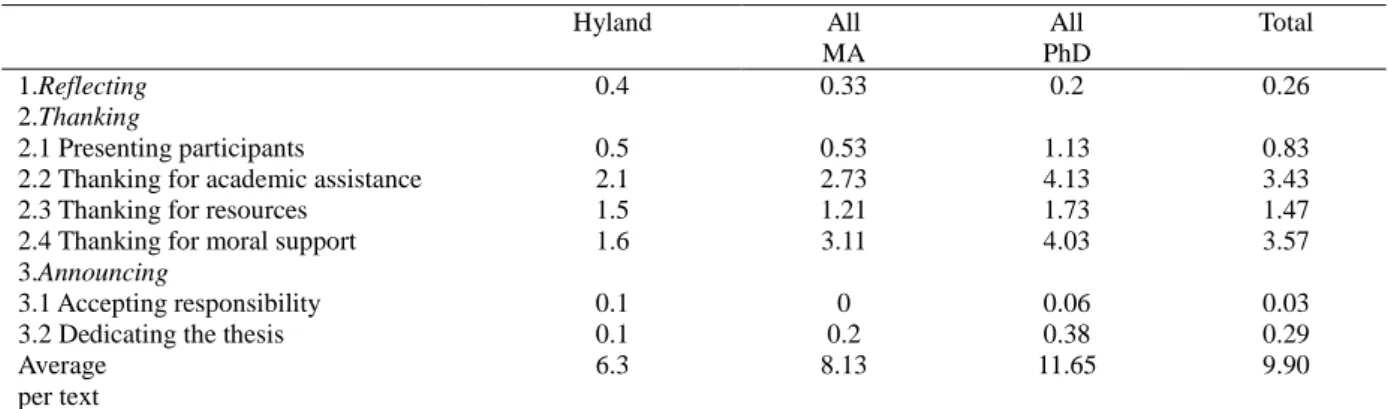
year, while it takes at least two years in Taiwan. The prolonged duration of study in Taiwan likely involves the help of a greater number of individuals, which could lead to TWCs writing longer DAs in recognition of the greater amount of assistance they may have received over the extended period of time. Tables 3 and 4 respectively demonstrate the percentages of DAs with each move/step in the Taiwanese corpus and with reference to Hyland’s and Zhao and Jiang’s results, while Table 5 shows the relative frequency of the steps in each text by discipline with reference to Hyland’s only. Unlike the two referred corpora, not each step was utilised in the present texts. In the masters DAs, step 3.1 i.e. Announcing Responsibility was not found. Academic conventions in Taiwan may be one reason for this, and it may also be due to the thanking rhetoric in Move 2 which has likely “undermined the student’s claim to have independently created an original contribution” (Hyland 2004, 321).
TABLE 1. Percentages of acknowledgement with each move/step by discipline
MA ELTa MA Ling. MA Lit. All MA PhD ELT PhD Ling. PhD Lit. All PhD Total
1. Reflecting 30 15 35 26 10 20 10 13 20
2. Thanking 2.1 Presenting participants
75 45 25 48 95 65 55 71 60
2.2 Thanking for academic assistance
100 100 100 100 100 100 100 100 100
2.3 Thanking for resources
85 80 50 71 90 65 55 70 70
2.4 Thanking for moral support
100 100 100 100 100 100 90 96 98
3. Announcing 3.1 Accepting responsibility
0 0 0 0 0 10 10 6 3
3.2 Dedicating the thesis
25 15 15 18 65 25 25 38 28
a ELT: English language teaching, Ling.: linguistics, Lit.: literature
TABLE 2. Text complexity: Average number of steps per text by discipline and degree
Master’s Text PhD Texts Overall
Hyland’s 3.9 8.5 6.3
ELT Linguistics Literature Total
The Taiwanese corpus
8.35 9.70 6.35 8.13 13.35 12.15 9.55 11.68 10.85 10.92 7.95 9.90
TABLE 3. Percentage of moves and steps in the Taiwanese corpus
All MA PhD
1. Reflecting 20 26 13
2. Thanking
2.1 Presenting participants 60 48 71
2.2 Thanking for academic assistance 100 100 100
2.3 Thanking for resources 70 71 70
2.4 Thanking for moral support 98 100 96
3. Announcing
3.1 Accepting responsibility 3 0 6
33
TABLE 4. Percentage of moves and steps with reference to Hyland’s and Zhao and Jiang’s results
The Taiwanese corpus Hyland’s Zhao and Jiang’s
1. Reflecting 20 24 22
2. Thanking
2.1 Presenting participants 60 43 57
2.2 Thanking for academic assistance 100 100 100
2.3 Thanking for resources 70 100 75
2.4 Thanking for moral support 98 84 97
3. Announcing
3.1 Accepting responsibility 3 13 20
3.2 Dedicating the thesis 28 11 5
Table 5. Relative frequency of steps in each text by discipline with reference to Hylanda
Hyland All
MA
All PhD
Total
1.Reflecting 0.4 0.33 0.2 0.26
2.Thanking
2.1 Presenting participants 0.5 0.53 1.13 0.83
2.2 Thanking for academic assistance 2.1 2.73 4.13 3.43
2.3 Thanking for resources 1.5 1.21 1.73 1.47
2.4 Thanking for moral support 1.6 3.11 4.03 3.57
3.Announcing
3.1 Accepting responsibility 0.1 0 0.06 0.03
3.2 Dedicating the thesis 0.1 0.2 0.38 0.29
Average per text
6.3 8.13 11.65 9.90
a Zhao’s study did not provide this information.
When the percentage of each move/step in the Taiwanese corpus was separately compared to those in Hyland’s (p=0.927, t=0.95) and Zhao and Jiang’s (p=0.93, t=0.088) corpora by way of a t-test, no statistically significant differences were found. This implies that the writers in the three contexts largely followed similar generic patterns while writing their DAs. Yet, the TWCs still exhibited the highest percentages of steps 2.1, 2.4 and 3.2 while having the lowest percentages of Move 1 and step 3.1. These disparities suggest that most TWCs strictly follow the essay writing guidelines of presenting ideas from generality to specificity. In addition, TWCs could be more emotional or willing to express their gratitude to the people who provided them with moral support, and possibly Taiwanese people are also more supportive and respectful of those culturally-respected academic elite. Nevertheless, in the present study, the MA texts show higher percentages than the PhD texts of step 2.4, contradictory to Hyland’s (2004) claim that step 2.4 is largely found in doctoral DAs. Furthermore, Zhao and Jiang (2010) reported that CNC students “feel far less easy to dedicate their work” (p.99) as they do not believe that it is a great achievement or worthy of dedication. Thus, they asserted that CNCs exercise the modesty maxim of the politeness principle. However, TWCs may value their work more than CNCs do, and as a result dedicate it to others including family members, research participants, advisors, God, and even their pets. Generally speaking, Taiwanese people have a ‘marine disposition’ (Hai-yang-hsin-ge)2
, which places sensibility before rationality and emphasises open-mindedness towards encouraging innovations and tolerating divergences, characteristics seen as being synonymous with the ocean (Chuang 2009, Ya 2007). Thus, dedication is considered as an act of joy and honour rather than as showing off.
34
present corpus. Many personal detailed stories were written as part of the thanking acts, and some literature majors wrote poems to express their thanks. Many of the MA writers made closing comments (Al-Ali 2010) such as Thank you all, Thank all those who ever gave me a boost, and My thanks to many others who ever helped me but are not listed here. However, some writers made confessions, often concerning others’ sacrifices during their study; this was especially true of the PhD candidates who made comments such as Meanwhile, I want to give the most heartbreaking apology to my husband and kids for the family time sacrificed by my study; My only apology goes to my two little ones, Albert and Victoria; or Dad, sorry I can’t fulfil your expectation—to pursue a PhD degree (by an MA student). These remarks are generally uncommon in DAs but can be thought of as an implicit way of appreciating others’ assistance, tolerance, or sacrifice. This new step can be much culture-embedded, and further research may be required to understand why it is included.
ACKNOWLEDGEES
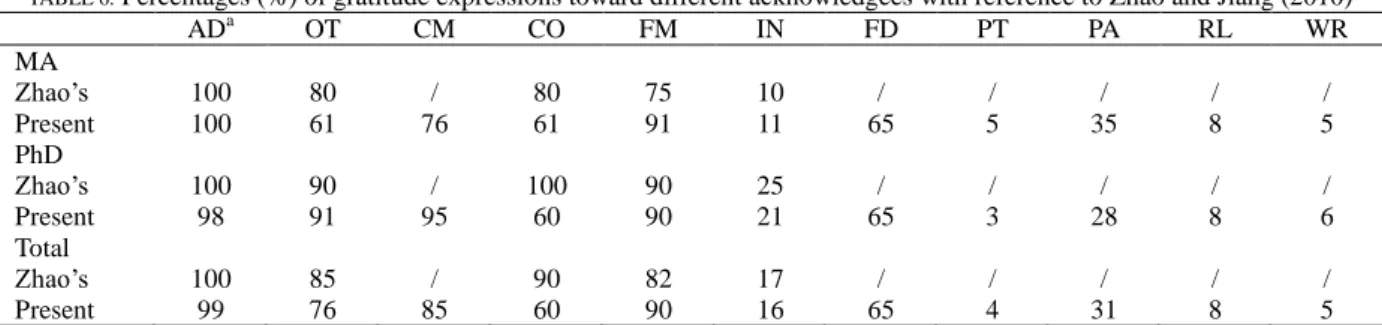
As Al-Ali (2006, 2010) argues, how writers interact with the people acknowledged in DAs is affected by culture-specific preferred conventions; the Chinese-speaking writers in the three contexts show differences in acknowledging people’s assistance, despite their shared culture. Table 6 displays the percentages of gratitude expressions toward different acknowledgees with reference to Zhao and Jiang’s study (2010)3
. One major difference is that not all the writers4 thanked their advisors in the present corpus, which is contrary to Hyland’s finding (2004: 307). Hyland argued that supervisors appeared in all DAs. This omission seems to be a rare case, with the writer’s choice failing to adhere to the principle of who should be thanked first and foremost in a DA. In addition, the results also suggest that TWC writers expanded their gratitude to a broader range of acknowledgees. Other than the frequently-acknowledged people (e.g., advisors, committee members, other teachers, colleagues, institutions or parents), religious beliefs, non-human companions such as pets, and the authors of literary works were also appreciated. The dissertations of English literature majors usually depend on literary works and this heavy reliance made them perceive that it was indispensable to express gratitude to those authors. This situation, that is, disciplines affecting whom should be thanked in DAs, was also confirmed in Scrivener’s (2009) history PhD students’ DAs.
Another remarkable difference is that there was a 20% higher occurrence of thanking colleagues and classmates in Zhao and Jiang’s study than in the present study. One possible explanation is that this present study separated colleagues/classmates/friends into academic cohorts and non-academic friends, whereas Zhao and Jiang combined them as a single category.
TABLE 6. Percentages (%) of gratitude expressions toward different acknowledgees with reference to Zhao and Jiang (2010)
ADa OT CM CO FM IN FD PT PA RL WR
MA
Zhao’s 100 80 / 80 75 10 / / / / /
Present 100 61 76 61 91 11 65 5 35 8 5
PhD
Zhao’s 100 90 / 100 90 25 / / / / /
Present 98 91 95 60 90 21 65 3 28 8 6
Total Zhao’s Present
100 99
85 76
/ 85
90 60
82 90
17 16
/ 65
/ 4
/ 31
/ 8
/ 5
a
AD: Advisors, OT: Other teachers, CM: Committee, CO: Cohorts, FM: Family, IN: Institutions, FD: Friends, PT: Pets, PA: Participants, RL: Religions, WR: Writers.
EXPRESSIONS OF GRATITUDE
35
thanking acts in DAs, that is Move 2 and its four steps, could be mainly classified into five types: nominalisation (e.g., My sincere thank goes to…), performative verb (e.g., I thank…), adjective (e.g., I am grateful to…), passive voice (e.g., Appreciation is given to…) and bare mention (e.g., X was very helpful in…). A comparison of the use of these patterns of expressing gratitude among the three corpora is presented in Table 7. Although there was no statistical difference with respective reference to Hyland and Tse’s (p=0.395, t=0.951) or Zhao and Jiang’s (p=0.157, t=1.739) percentage of the patterns used to express gratitude, some dissimilarities are still noteworthy. For instance, HKCs had a preference for using ‘nominalisation’ and ‘performative verb’ patterns, both taking up one-third of all of their DAs, while CNCs tended to use ‘bare mention’ and ‘performative verb’ patterns. In the present study, TWCs favoured ‘performative verb’ patterns, constituting 51% of their DAs, whereas the ‘passive’ pattern was used in only 3.2% of DAs, ranking the lowest among the three corpora. The ‘performative verb’ pattern always begins with the subject I, implying a very direct authorial voice, which “was particularly marked in the science and engineering texts”, that is, the hard sciences (Hyland & Tse 2004, p. 266). However, the disciplines included in this corpus belong to the social sciences and humanities. Possibly the excessive use of the performative verb pattern may result from Taiwanese EFL learners’ experiences of learning English, as they are always reminded of the importance of using and identifying verbs when approaching English texts. Another possible explanation may be cultural. If overtly using ‘bare mention’ implies that CNCs are more reserved when expressing their feelings and emotions, as Zhao and Jiang (2010) have suggested, then it may imply that TWCs are less reserved. Nkemleke’s (2006) study also supports such an inference. Only one percent of the thanking expressions in his study used the ‘performative verb’ pattern, which may result from their culturally showing extremely high respect to acknowledgees, especially to supervisors who are considered as “All-knowing” or “All-wise”. Hence, choosing a thanking expression might also be affected by the writer’s culture. Yet, still another possible reason accounting for the lowest percentage use of passive voice expression by TWCs may be that “Chinese is a language without voice category since its passive voice is mainly expressed in a covert way rather than a marked way…. That may cause the students to feel uneasy in employing the passive form in English acknowledgements” (Zhao & Jiang 2010, p. 105).
Table 7.Percentages (%) of the patterns used to express gratitude
Patterns Occurrence frequency (%)
MA PhD average Hyland and Tse Zhao and Jiang
Bare mention 3.0 10.8 7.2 6.8 34.7
Performative-verb 56.5 47.4 51.6 33.2 26.6
Adjective 13.8 20.0 17.2 15.4 17.6
Nominalization 22.4 19.0 22.4 33.6 16.4
Passive 4.1 2.5 3.2 11.0 4.6
Total 100 100 100 100 100
MODIFIERS IN THANKING ACTS
36
other teachers and committee members, words such as resourceful, thoughtful, grateful, exceptional, or special were frequently used. These adjectives (esp. –ful) are stronger than those generally used in everyday conversation and thus make these thanking acts more formal (Hyland & Tse 2004). When thanking family, the writers chose more personal words such as dear, profoundly, deep, or especially. Yet, very few modifiers were used to express gratitude to friends, and the ‘performative verb’ pattern (e.g. I thank all the friends…or I would like to thank my friends…) was thus repeatedly used to convey a very direct and less formal tone. The variety of these lexical choices, depending on the relationship between the acknowledger and acknowledgees, also mirrors the fact that acknowledgement is a complex interwoven form of discourse, and that hybridism of tones could be a feature of DAs (Afful & Mwinllaru 2010).
In addition, many performative verb patterns in thanking acts also included hedging modals or mental state verbs (e.g., wish, would like, should, shall, must, have to, or want to) to express their strong intentions. This use constitutes 43% of the present corpus compared with 69.7% of Zhao and Jiang’s and 52% of Hyland and Tse’s. These scholars have explained that such words are used not to imply extrinsic obligation to obey but rather intrinsic necessity to convey irresistibly strong needs to thank those who had offered assistance (Hyland & Tse 2004). Nevertheless, TWCs had the lowest percentage use of such modals and state verbs. This may suggest that rather than keeping a definite demarcation between acknowledger and acknowledgees, the TWC writers might blur the differentiation of seniority and authority. It is likely that traditional values, for example Like teachers, like friends, or Once taught, forever parented, affected TWCs more than HKCs and CNCs. The relationship with advisors is not just that between a teacher and student but is also like that of a parent and child.
CHOICES OF AUTHORIAL SUBJECT
As can be seen in Table 8, the choices of authorial subject in the DAs in the present study are generally in accordance with those in Hyland and Tse’s and Zhao’s studies. In contrast to the impersonal style used in writing dissertations, the writers in the three settings were comfortable with using first person pronouns to emphasise “their commitment to their words, set up relationship with their readers, and establish their personal sincerity in thanking various people” (Hyland & Tse 2004, p. 271). While this tendency is the opposite of Giannoni’s (2002) findings of an I-avoidance strategy in writing journal acknowledgements, it corresponds to Scrivener’s (2009) results of exclusive use of Ifrom 24.9% in the 1930s to 100% in 2005. Other than Giannoni’s finding, all of the other research data seem to imply that writing a DA can be less formal and more personal and emotional.
TABLE 8. Subject types in postgraduate dissertation acknowledgements (%)
MA and PhD Dissertations
I/my none non-author the author
Hyland and Tse 86.1 9.6 7.7 1.5
Zhao and Jiang 66.6 12.9 20.4 0.0
Present corpus 79.0 15.0 6.0 0.0
KEYWORDS IN WRITING ACKNOWLEDGEMENTS ACROSS IDENTITIES
37
2010) and then accordingly compose personalized and honest acknowledgements with choices and constraints provided, rather than copying a sample verbatim. Hence, this study generated a list which categorises all the keywords used in DAs according to word function (see Appendix A). The keyword list highlights the most outstanding or unexpectedly frequent words appearing in DAs, and it is this typical language lexis that indicates the importance of studying and instructing students to write this genre (Schlitz 2010, Römer & Wulff 2010). For instance, from the high rankings of Dr. and the first person singular pronoun, writers would know that using I is a tendency and that the use of the title Dr. is more common than that of Professor. The list also offers implications regarding to whom (e.g., nouns), what (e.g., nouns), and how (e.g., verbs, adjectives, and adverbs) appreciation can be expressed. In other words, the list serves as a skeleton to help writers construct the main moves/steps of a DA. Hyland and Tse (2004) found that the adjectives used to express gratitude typically end in – ful. This form is unusual compared with everyday usage and thus makes DAs rather formal. Yet, in the list, the adjectives ending in –ful only rank third statistically, after the first –ed and the second –ing i.e. participles. Participles used as adjectives are relatively common in daily use, implying that DAs written by TWCs have a less formal tone than those by HKCs. This difference may come from different academic conventions or contextualised factors such as experience of learning English.
CONCLUSION
With reference to Hyland’s (2003, 2004), Hyland and Tse’s (2004), and Zhao and Jiang’s (2010) studies on DAs written by Chinese speakers in Hong Kong and China, the present research investigated 120 MA and PhD DAs written by Taiwanese Chinese-speaking writers with the intention of comparing the differences and similarities of generic structure and linguistic features. The results suggest that differences exist in constructing moves/steps and choosing linguistic elements, even though the three contexts share a common culture. Academic conventions, experiences of learning English, contextualised values, personal dispositions, relationships with acknowledgees, and individual writing styles may account for this diversity. Thus, the findings of this paper support what the previously-cited research argues, that is, that this particular genre is dynamic, changeable, and is able to be manipulated. Moreover, rhetorical forms need to fit a specific setting with its preferred choices and value systems. This research also pedagogically suggests that EAP teachers can explicitly instruct students in how to write purposeful and interactional acknowledgements by offering student writers knowledge of the language (e.g., keywords in DAs) and the context of a genre.
38
ENDNOTES
1. In this study, dissertations is used to refer to both MA theses/dissertations and PhD dissertations/theses. 2. This term is based on geographical location and contrasts with a ‘Continental disposition’. It is believed in
Chinese culture that people living on a large continent and those on a small island surrounded by the ocean would develop different dispositions.
3. Hyland (2003) offered similar information but using different calculations; therefore, it cannot be compared here.
4. The only exception comes from a PhD candidate with an English literature major.
REFERENCES
Afful, J., & Mwinlaaru, I. (2010a). Commonality and individuality in academic writing: An analysis of conference paper titles of four scholars. English for Specific Purposes World. 27(1), 1-32.
Afful, J., & Mwinlaaru, I. (2010b). The construction of multiple identities in the acknowledgement section of a masters dissertation. English for Specific Purposes World. 30(9), 1-26.
Al-Ali, M. N. (2006). Conveying academic and social identity in graduate dissertation acknowledgments. Fifth International Conference of European Association of Language for Specific Purposes, Zaragoza, Spain, pp. 35-42.
Al-Ali, M. N. (2010). Generic Patterns and Socio-cultural Resources in Acknowledgements Accompanying Arabic PhD Dissertations. Pragmatics. 20(1), 1-26.
Atai, M.R., & Falah, S. (2005). A contrastive genre analysis of result and discussion sections of applied
linguistic research articles written by native and non-native English speakers with respect to evaluated entities and ascribed values. Retrieved August 19, 2011, from
http://www.paaljapan.org/resources/proceedings/PAAL10/pdfs/atai.pdf
Yang, W. H. (2012). A genre analysis of PhD dissertation acknowledgements across disciplinary variations. LSP Journal. 3(2), 51-70.
Bhatia, V. K. (1993). Analysing genre: Language use in professional settings. London: Longman. Bhatia, V. K. (2004). Worlds of written discourse. London: Continuum.
Bloch, J. (2010). A concordance-based study of the use of reporting verbs as rhetorical devices in academic papers. Journal of Writing Research. 2(2), 219-244.
Brett. P. (1994). A genre analysis of the results section of sociology articles. English for Specific Purposes. 13(1), 47-59.
Bunton, D. (2002). Generic moves in Ph.D. thesis introduction. In J. Flowerdew (Ed.), Academic Discourse (pp. 57-75). London: Longman.
Chuang, W. H. (2009). The dialectical developments of marine cultures and Taiwanese marine cultures. I- Taiwan Study, 3. Retrieved 20 August, 2011, from www.cjcu.edu.tw/taiwan/a.doc
Dudley-Evans, T., & Henderson, W. (1990). The organisation of article introductions: Evidence of change in economics writing. In T. Dudley-Evans, & W. Henderson (Eds.), The Language of Economics: the analysis of economics discourse (ELT Documents 134) (pp.67-78). London: Modern English Publications and The British Council.
Flowerdew, J., & Dudley-Evans, T. (2002). Genre analysis of editorial letters to international journal contributors. Applied Linguistics. 23(4), 463-489.
Giannoni, D. (2002). Words of gratitude: A contrastive study of acknowledgement texts in English and Italian research articles. Applied Linguistics, 23(1), 1-31.
Haggan, M. (2004). Research paper titles in literature, linguistics and science: Dimensions of attraction. Journal of Pragmatics. 36(2), 293-317.
Holmes, R. (1997). Genre analysis and the social sciences: An investigation of the structure of research article discussion sections in three disciplines. English for Specific Purposes. 16(4), 321-337.
Hopkins, A., & Dudley-Evans, T. (1988). A genre-based investigation of the discussion sections in articles and dissertations. English for Specific Purposes. 7(1), 113-122.
Hüttner, J. (2010). The potential of purpose-built corpora in the analysis of student academic writing in English. Journal of Writing Research. 2(2), 197-218.
Hyland, K. (2000). Disciplinary discourses: Social interactions in academic writing. London: Pearson. Hyland, K. (2003). Dissertation Acknowledgements: The Anatomy of a Cinderella Genre. Written
Communication. 20(3), 242-268.
Hyland, K. (2004). Graduates’ gratitude: the generic structure of dissertation acknowledgements. English for Specific Purposes. 23(3), 303-324.
39
Kaplan, R. B. (1987). Cultural thought patterns revisited. In C. Connor & R. B. Kaplan (Eds.), Writing across languages: Analysis of L2 texts (pp. 9-21). Reading: Addison-Wesley.
Lasaky, F. (2011). A contrastive study of generic organisation of doctoral dissertation acknowledgements written by native and non-native (Iranian) students in applied linguistics. The Modern Journal of Applied Linguistics. 3(2), 175-199.
Lee, S. (2002, June). Politeness and E-mail discourse: A study on the use of linguistic forms of politeness by Chinese learners of English. Paper presented at the 2nd International Conference ‘Knowing and discourse: Speculating on disciplinary futures’. Hong Kong, SAR, China.
Lorés, R. (2004). On RA abstracts: from rhetorical structure to thematic organization. English for Specific Purposes. 23(3), 280-302.
Martin, P. M. (2003). A Genre Analysis of English and Spanish Research Paper Abstracts in Experimental Social Sciences. English for Specific Purposes. 22(1), 25-43.
Mkemleke, D. (2006). Nativisation of dissertation acknowledgements and private letters in Cameroon. Nordic Journal of African Studies. 15(2), 166-184.
Nodoushan, M., & Khakbaz, N. (2011). Theses ‘Discussion’ sections: A structural move analysis. International Journal of English Studies. 5(3), 111-132.
Römer, U., & Wulff, S. (2010). Applying corpus methods to written academic texts: Explorations of MICUSP. Journal of Writing Research. 2(2), 99-127.
Salager-Meyer, F. (1990). Discoursal flaws in medical English abstracts: A genre analysis per research- and text- type. Text. 10(4), 365-384.
Samaraj, B. (2002). Introductions in research articles: Variations across disciplines. English for Specific Purposes. 21(1), 1-17.
Samaraj, B. (2005). An exploration of genre set: Research article abstracts and introductions in two disciplines. English for Specific Purposes. 24(2), 141-156.
Schlitz, S. (2010). Introduction to the special issue: Exploring corpus-informed approaches to writing research. Journal of Writing Research. 2(2), 91-98.
Scott, M. (2008). WordSmith Tools (Version 5.0) [Computer Software]. Liverpool: Lexical Analysis Software. Scott, M., & Tribble, C. (2006). Textual Patterns: Keywords and Corpus Analysis in Language Education.
Amsterdam: John Benjamins.
Scrivener, L. (2009). An exploratory analysis of history students’ dissertation acknowledgements. Journal of Academic Librarianshi., 35(3), 241-251.
Swales, J. M. (1981). Aspects of article introductions (Aston ESP Rep. No. 1). Birmingham: University of Aston. Swales, J. M. (1990). Genre analysis: English in academic and research settings. Cambridge: Cambridge
University Press.
Thompson, D. K. (1993). Arguing for experimental “facts” in science. Written Communication, 10(1), 106-128. Williams, I. (1999). Results sections of medical research articles: Analysis of rhetorical categories for
pedagogical. English for Specific Purposes,18(4), 347-366.
Ya, H. B. (2007, March). President Li, Tung-hui’s marine dispositions. Strait Comments (Hai-shai-ping-lun). 195. Retrieved 20 August, 2011, from http://www.haixiainfo.com.tw/SRM/195-1282.html
Yang, R., & Alison, D. (2003). RAs in applied linguistics: Moving from results to conclusions. English for Specific Purposes. 22(4), 365-384.
Yang, W. H. (2012a). A genre analysis of PhD dissertation acknowledgements across disciplinary variations. LSP Journal. (3)2, 51-70.
Yang, W. H. (2012b). Comparison of gratitude across context variations: A generic analysis of dissertation acknowledgements written by Taiwanese authors in EFL and ESL contexts. International Journal of Applied Linguistics and English Literature. 1(5), 125-141.
40
APPENDIX A
Excerpt of assorted keywords in postgraduate DAs with reference to BNC, ranking from high keyness to low keyness
Nouns Verbs Adjectives Adverbs Functional words
Dr. thank My also and
me am Grateful always without
thesis express Insightful finally like
dissertation graduate Their deeply for
I help(ed) Indebted generously to
gratitude would Sincere greatly during
Prof. owe Deepest especially throughout
thanks dedicate Valuable patiently whenever
professor appreciate academic kindly
advisor go(es) special never
encouragement help(ing) national sincerely
suggestions have thankful besides
study finish invaluable
support inspir(ed) heartfelt
appreciation encourag(ed) generous
university complete dearest
comments gave constructive
patience support(ed) supportive
guidance assist(ed) inspiring
classmates provid(ed) helpful
research extend sincerest
doctoral go dear
writing dedicat(ed) constant
professors guid(ed) precious
who want unfailing
friends cherish unconditional
defense pursue many
committee giv(ing) benefited
family participat(ing) foremost
love taught endless
members wish beloved
linguistics extend(ed) learned
Continued
parents give enlightening