LOCAL OPPOSITION, LOCAL ISSUES? EXPLORING THE DYNAMICS OF URBAN COMPETITION IN AUTHORITARIAN REGIMES
Sean Thomas Norton
A thesis submitted to the faculty of the University of North Carolina at Chapel Hill in partial fulfillment of the requirements for the degree of Master of Arts in the Department of Political Science, Concentration in Comparative Politics .
Chapel Hill 2018
©2018
ABSTRACT
SEAN THOMAS NORTON: Local Opposition, Local Issues? Exploring the Dynamics of Urban Competition in Authoritarian Regimes
(Under the direction of Graeme Robertson.)
TABLE OF CONTENTS
LIST OF TABLES . . . v
LIST OF FIGURES . . . vi
INTRODUCTION . . . 1
The Localization of Politics and Case Selection . . . 3
Data and Empirical Strategy . . . 12
Results and Discussion . . . 19
Conclusion . . . 26
LIST OF TABLES
Table
1 Summary Statistics . . . 15
2 Instrument Strength . . . 18
3 # Commute . . . 20
4 Interaction . . . 21
LIST OF FIGURES
Figure
INTRODUCTION
A growing body of research suggests that authoritarian durability relies heavily on cooperation and control at lower levels of government. Local governments play criti-cal roles in coopting citizens, targeting the opposition, turning out and coercing voters, and distributing patronage to regime elites (Magaloni 2006; Reuter and Robertson 2014; Landry 2008). For these reasons, establishing and maintaining the loyalty of effective political machines is a critical part of authoritarian consolidation (Saikkonen 2016b,a; Reuter, Buckley, Shubenkova and Garifullina 2016).
In particular, urban contentious and electoral dynamics play a critical role in au-thoritarian survival. Increasingly, the professional, urban middle class drives protest and electoral opposition in authoritarian regimes. Opposition gains in local elections disrupt patronage networks, establish programmatic ties to voters, and create effective political bases for opposition to compete against authoritarian incumbents nationally (Lucardi 2016; Magaloni 2006). Urban contention forces incumbents to acknowledge electoral de-feat, challenges electoral fraud, ties opposition actors to citizens, and creates effective mobilizing structures. In the more dramatic cases, urban mobilization even bring down the regime itself (Bunce and Wolchik 2011). In cases as diverse as Tunisia and Serbia, lo-cal protest, subnational electoral defeats, or both preceded the fall of seemingly powerful authoritarian regimes (Bunce and Wolchik 2011; Beissinger, Jamal and Mazur 2015).
In particular, the important role played by actors at the subnational level suggests a level of analysis problem in the authoritarian literature. While a substantial body of work focuses on the relationship between national-level political and economic factors and au-thoritarian durability, urban dynamics may also be critical for auau-thoritarian survival. Using data from Moscow, I argue that local-level political ties are essential to explaining patterns of political support in authoritarian regimes.
Understanding whether and how local issues drive subnational electoral and con-tentious shocks will enhance our understanding of authoritarian regimes in three ways. First, understanding how urban contentious and electoral shocks occur will aid in un-derstanding the durability of authoritarian regimes. Secondly, as authoritarian regimes increasingly use elections as an instrument of cooptation and control, the sheer number of local elections makes them by far the most common electoral events in authoritarian regimes. As such, a better understanding of local electoral dynamics will give us a more nuanced, comprehensive picture of authoritarian politics. Most importantly, understand-ing how opposition actors establish political footholds in authoritarian regimes brunderstand-ings us closer to a theory that not only explains how opposition actors defeat authoritarian regimes at the national level, but also how these actors establish their initial ties to citi-zens and build the mobilizing structures necessary for national contentious and electoral mobilization. Rather than assuming some sort of opposition capable of coherent mo-bilization does or does not exist at the national level, exploration in this vein has the potential to elaborate on when, how, and if opposition actors may create and build on local success to challenge national authoritarian incumbents.
and a discussion of their implications for future research.
The Localization of Politics and Case Selection
Subnational Authoritarian Politics
While a robust literature exists on the role of subnational politics in maintaining authoritarian rule, it largely treats dynamics at the subnational level as a “black box”, investigating how political dynamics treated as given effect authoritarian survival. In particular, cross-national statistical studies have established that large cities significantly reduce the duration of authoritarian regimes, but treat this effect as almost a natural law, ignoring the role of agency (Wallace 2013). Little consideration is given to how and when actors in cities are dangerous to authoritarian regimes. Given that even weak regimes rarely fall without some opposition actor providing the push, ignoring how urban agents actually accomplish regime-threatening mobilization is problematic (Bunce and Wolchik 2011).
In the urban threat literature, cities, particularly the large capital cities that are char-acteristic to authoritarian regimes, are tinderboxes of potential collective action (Wallace 2013). As cities get larger, discontent becomes more dangerous; densely-populated, large cities lower the barriers to collective action, and have the potential to make contention more destabilizing and threatening to state actors. In addition, large protests in cities have more potential to create a national “tipping point” phenomenon in which citizens’ public alignments rapidly and dramatically change in response to perceived decrease in the costs of public opposition (Kuran 1991). As Wallace (2013) details, having a capital city of over 5 million residents is robustly associated with increased hazard of regime failure. Facing this potential threat, authoritarian regimes often choose to redistribute from countryside to cities in an attempt to forestall the short-term threat of collective action, ultimately increasing urban concentration and the threat of longer-run regime failure (Wallace 2013; Ades and Glaeser 1995; Bates 2014).
ra-tionally applies to electoral threats in electoral authoritarian regimes. Bunce and Wolchik (2011) study of electoral authoritarianism in post-communist countries note that in all but one of their cases of authoritarian incumbent defeat, opposition victories in local elec-tions preceded the critical national elecelec-tions. The paradigmatic case is Serbia, in which the government’s initial refusal to certify the opposition’s victories in Belgrade created a large contentious surge. The organizational infrastructure of these protests later proved critical in defeating Miloˇsevi´c at the national level (Bunce and Wolchik 2011; Levitsky and Way 2010). Large cities can be expected to lower the cost of electoral campaigns in much the same way as they reduce the difficulty of solving the contentious collective action problem.
In the literature on authoritarian control, subnational governments play a critical role in patronage, electoral mobilization, and cooptation. PRI rule in Mexico demonstrated the importance of local control for the maintenance of authoritarian regimes. Hierarchical distribution of local positions was a crucial part of the PRI’s elite cooptation strategy, which prevented splits within the PRI regime. Likewise, the “punishment regime” used to manufacture overwhelming PRI victories and prevent challengers depended on local brokers who were able to observe voters (Magaloni 2006; Svolik 2012). Evidence from Russia demonstrates a similar phenomenon. The first Putin presidency’s political in-novation was to tie once independent local political machines to a single regime party, United Russia, imbuing the Putin presidency with far greater autonomy than the Yeltsin regime (Demchenko and Golosov 2016; Saikkonen 2016a; Reuter 2017). As an important demonstration of the role of local political actors in delivering support, Reuter et al. (2016) provide evidence that mayoral elections were only retained where mayors were able to deliver pro-regime votes at the national level. Those who could not deliver were replaced with more easily-controlled city managers.
of defection from the PRI, and created programmatic ties to voters that could be later mobilized at the national level. Much as in Mexico, local electoral victories in Romania, Serbia, Georgia, Croatia, and Slovakia directly contributed to the collapse of national authoritarian regimes. Victory in local elections allowed opposition actors to coordinate, form cohesive fronts, and create mobilizing organizational structures in an otherwise hos-tile electoral environment (Bunce and Wolchik 2011; Levitsky and Way 2010). It is clear that failure to maintain local control, particularly in large cities, presents a real danger to the survival of authoritarian rule, disrupting authoritarian control and giving opposition actors critical electoral and physical resources.
While we know that local dynamics, particularly urban dynamics, play an important role in authoritarian regime trajectories, little is know about how regime and opposition actors gain and maintain support at these levels. Existing studies of subnational regime elites generally focus on appointed elites at the regional level (e.g. Reuter and Robert-son (2012)), obscuring potentially important lower-level dynamics. On the other hand, existing studies of opposition actors focus almost entirely on national level campaigns, similarly obscuring dynamics at lower levels (e.g. Bunce and Wolchik (2011)) Given the consistent role of local electoral success in opposition defeat of national authoritarian in-cumbents, the lack of research on the dynamics of local political contestation represents a consequential hole in the literature. It is clear that oppositions often defeat dictators after gaining local footholds, we do not know how they gain or fail to gain those footholds in the first place. Specifically, the importance of local elections raises the question of whether local issues may play a more important role in authoritarian regimes than pre-viously assumed (Gandhi and Lust-Okar 2009).
Theory: Boundary Control and Local Issues
nationally authoritarian regimes. Gibson argues that subnational authoritarian units (SAUs) in nationally democratic regimes survive when they practice “boundary control”, effectively keeping local conflict out of the national spotlight to avoid inconveniencing or antagonizing the democratic national governments that tolerate their existence. In this environment, oppositions are incentivized to attempt to break containment, linking subnational political issues to national movements or thrusting the SAUs’ authoritarian practices into the national political discourse. This may force the center to acknowledge and work against the continued practice of authoritarianism at the subnational level. In short, local opposition attempts to use the juxtaposition of local authoritarianism and national democracy to its advantage via nationalization of political contestation, forcing national-level actors to intervene and create a democratic opening.
While Gibson argues that the opposition in authoritarian enclaves has a strong in-centive to nationalize conflict, I build on his theory to argue that for SAUs in nationally authoritarian regimes the opposite should be true. Subnational oppositions will attempt to localize political contestation to ensure their own survival, giving local issues criti-cal importance. This follows foremost from the fact that national authoritarian regimes should be expected to control more substantial coercive resources than subnational au-thoritarian regimes. While this assumption is certainly not universally true, it can be expected to hold for almost all SAUs in relatively strong, centralized authoritarian states. Oppositions who attempt to nationalize conflict or tie themselves too heavily to issues that stretch beyond local political space risk bringing the authoritarian center into the subnational arena, lessening their chances for electoral victory or even political survival, and preventing them from establishing a subnational foothold.
their own resources on lower-level threats, or even creating incentives designed to make them do so (Reuter and Robertson 2012). Likewise, SAUs’ leaders may deliver the criti-cal good of subnational control to the center, but except in highly unstable authoritarian regimes generally rely on the goodwill of the more powerful center for their continued existence (Reuter 2017). Given this dependence, SAUs’ leaders are disincentivized from turning to the center for help in containing electorally dangerous local challengers; if local political leaders appear ineffective at generating votes and dealing with electoral threats, their perceived usefulness to the center diminishes. While there is certainly the possibility that local leaders could exploit local opposition to win more resources from the center, in strong authoritarian regimes and when SAUs are not ruled in a personalistic manner, the operation of the local machine is likely possible without the current leader, i.e. leaders who are too noisy or needy are liable to be replaced. In effect, subnational authoritarian leaders’ jobs depend in part on their ability to exercise “reverse” boundary control: keeping oppositions contained and non-threatening to the center.
demonstrating that both local appointments and elections demonstrate similar localiza-tion phenomena.
Qualitative evidence from Russia likewise provides evidence that opposition actors were successful when they focused on local issues. In Yekatarinburg, opposition candi-date Yevgeny Roizman won the mayor’s seat on the basis of his reputation as the head of a local NGO fighting drug addiction, defeating a well-known regional regime party politician. His platform focused on distinctly local issues, such as promises to repair playgrounds, avoid conflict with the regional authorities, and prevent disruptive infill building in the city (Kovalenko 2013). While Roizman remained in office for his entire term, regional authorities have since succeeded in outmaneuvering him and eliminating direct mayoral elections (Meduza 2018) Opposition mayor Yevgeny Urlashov was elected in a landslide in Yaroslavl in 2012, on a campaign against corruption and incompetence in the city, particularly when it came to the poor construction of roads (Englund 2013). Additionally, he capitalized on a local tragedy: the death of the entire local hockey team (Yaroslavl Lokomotiv) in a plane crash. Also in line with the theory, Urlashov was quickly charged with and convicted of extortion in 2013, shortly after attempting to break lo-cal containment by striking an agreement with prominent national oppositionist Mikhail Prokhorov to top his party list in regional parliamentary elections (Herszenhorn 2013). In both cases, the opposition mayors’ focus on local issues seems likely to have given them the traction necessary to win mayoral campaigns and establish some sort of politi-cal foothold, though neither mayor was ultimately able to successfully resist regional or national authoritarians.
The Moscow Renovation Project
My analysis will contribute to the literature by investigating urban opposition sup-port in a paradigmatic electoral authoritarian regime, Russia. A large, disruptive housing project in Moscow preceded substantial opposition gains on municipal formation1
cils in September 2017. As a large capital city, control of Moscow is crucial for the regime’s ability to confront collective action and electoral threats, and also a rational target for opposition actors looking to build an organizational base to contest higher-level elections. This represents an ideal test case for the importance of a local issue due to the specifically local nature of the most salient campaign issue, the renovation project, and the strong incentive for both opposition and regime actors to avoid nationalizing contestation.
The Moscow renovation project is intended to replace decaying Soviet housing stock throughout the city, in particular the five-story walk-up apartment buildings colloquially known as “Khrushchyovki”. These buildings were constructed in the aftermath of World War Two to resolve a severe housing shortage, and were never intended to stand as long as they have; as such, they are in varying degrees of disrepair. The Moscow administra-tion selected 4,573 buildings for potential inclusion in the project. Residents were then allowed to vote on whether or not the buildings were to be demolished; if two-thirds of the apartments in a building supported demolition, it was included in the project. The administration promised residents of included buildings that they would be resettled in equivalent housing in a newly-constructed building if they voted for inclusion. Nearly all buildings voted for inclusion. However, despite the apparent popularity of the project with residents of included buildings, the project has inspired protests throughout Moscow, with Muscovites expressing concerns about the impact of such a large construction project on their neighborhoods, the potentially low quality of new buildings, and potential issues with transport associated with the project. (Levada Center 2017).
was intended to reward regime supporters, and a massive PR campaign for the project launched by the mayor’s office was targeted towards shoring up the support of ordinary Muscovites for Sobyanin (Smyth 2018; Golunov 2017a) Sobyanin is thus disincentivized from turning to the center to crush local opposition. Requesting resources or support from the national government would make Sobyanin appear unable to handle the routine electoral authoritarian tasks of out-maneuvering opposition and distributing rents, jeop-ardizing his position at the head of the Moscow political machine.
Similar incentives hold for the opposition. The project has already inspired consid-erable local protest, mobilizing many people for the first time and potentially creating a new, motivated constituency for outside political forces if they effectively take issue own-ership (Levada Center 2017). However, given the unprecedentedly high approval of the Russian president and the presidential administration’s substantial ability to marginalize and dismantle national opposition challengers, the opposition is strongly disincentivized to avoid challenging actors or policies above the municipal level.
Finally, the very nature of the project makes it an ideal issue for opposition actors to capitalize on at the local level. While abstract ideas of property rights and corruption are certainly likely to be considerations in Muscovites opinion of the project, at its core it concerns the building next door or even a resident’s own home. In densely-populated Moscow, construction of this scale promises to be a major disruption that will affect the lives of many, particularly those in regions with higher numbers of affected buildings.
a critical test of Sobyanin’s electoral machine.
Likewise, for the opposition this represented a critical chance to seize an issue and disrupt the Moscow political machine without having to face the central government, potentially gaining a political and ideological foothold to challenge higher-level elections, such as the mayoral race. Unfortunately for them, the Sobyanin machine was largely suc-cessful. While the opposition’s seat gains were impressive relative to past results, United Russia was largely successful, winning 75% of available seats and denying the opposition a chance to overcome the municipal filter. Regardless of the final result, it is clear that the opposition performed better than expected in the context of an important and po-larizing local issue and in the capital city of a strong, highly-centralized authoritarian regime. If a local issue was able to help the opposition gain a foothold here, the effect of local issues may be even stronger in less politically important cities in Russia or less centralized authoritarian regimes.
In light of the theory and the case selection, I have the following hypothesis:
As the number of affected buildings within a voters’ neighborhood rises, the probability that they will vote for the opposition increases.
will provide more predictive power than the model using only the renovation project as an independent variable.
Data and Empirical Strategy
In this section, I will begin with a brief discussion of the data I will use to test my hypothesis. I will then argue that the main independent variable is not exogenous, necessitating the use of an instrumental variable. Following this, I will specify and explain the use of a multilevel beta regression with a control function. Finally, I will interpret my hypothesis in light of the modeling strategy.
Data
While individual-level data would be ideal for this project, such data is not currently available. As such, I have brought data down to the lowest level available: the polling station. Moscow has 3,619 voting districts, many of which serve geographically small and densely populated areas, meaning most municipal formations have several polling stations. Both the dependent variable and treatment variable are calculated at this level. Controls are also at the lowest level available in Russian census data, the municipal for-mation. While the ecological fallacy is still a risk in this analysis, I have minimized it to the greatest degree possible given data limitations.
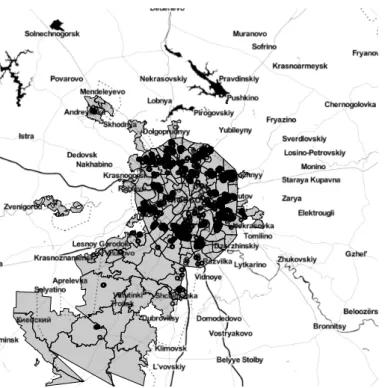
metro, the overall average distance was used 2 . Polling station areas are generally quite small and densely populated, so while this measurement is not ideal, without individually geolocating voters’ addresses or a survey random sample clustered by polling station, bet-ter measures are not forthcoming. This measure is also more likely to be accurate than a simple count within polling station boundaries, as this would create the unrealistic as-sumption that residents of a voting district do not cross district boundaries during their daily commute through their neighborhood. It is also possible that Muscovites are likely to be affected by renovation at the other end of their commute (work, school, etc.), but again, the lack of individual data limits my ability to test this. Figure 1 displays munic-ipal formation boundaries and buildings included in the renovation project 3 . I also run
models using an interaction between the number of buildings and municipal formation level vote in Moscow’s 2013 mayoral election to test for differential effects between more and less opposition friendly districts. Russian online news organization Meduza kindly provided me with a geocoded dataset of included buildings.
The dependent variable of interest is the share of the polling station level vote won by the opposition. There are 2,975 polling stations in total, representing elections to 125 municipal councils 4 . I have operationalized a maximal and minimal definition of
the opposition. The maximal definition includes all parties except the Communist Party of the Russian Federation and United Russia, the regime party. I did not include the Communist Party despite their role as a nominal opposition party, as they are widely considered co-opted (Reuter and Robertson 2014). The minimal definition focuses on the out-of-system opposition; this definition only includes parties not currently represented in the State Duma. Like the Communists, the literature often considers in-system parties to be para-statal or astro-turfed (March 2009). Having two separate opposition indicators allows me to control for this possibility and also note potentially interesting differences
2Approximately 8% of cases
3created using ggmap (Kahle and Wickham 2013)
Fig. 1: Map of Included Buildings
in party choice. The data was scraped from the Moscow central election committee’s website.
A number of control variables are also used. To control for past local and national party preference, I included the percentage of the vote won by the maximal opposition for both the 2013 Moscow mayoral elections and the 2016 State Duma elections. The Moscow municipal elections also represent a first attempt of the opposition to coordi-nate at the municipal level, with many independent opposition candidates, the in-system Yabloko 5 , and the out-of-system PARNAS parties cooperating under the umbrella of
Dmitry Gudkov’s United Democrats coalition (Bennetts 2017). As such, I control for entry coordination based on the findings of Cox (1997), creating a measure of the number of opposition candidates above then+ 1threshold identified as optimal in his work. I also include a number of socioeconomic controls taken from Russian census microdata at the municipal formation level. I include per capita monthly income, government dependence, and higher education from this data. Government dependence is the total percentage of residents who rely on disability, unemployment, pension, or some other form as welfare as
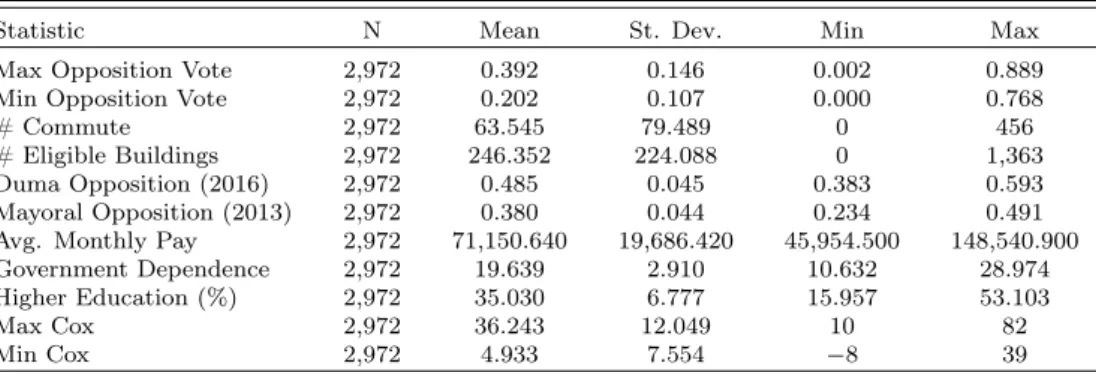
their primary means of income. This excludes students receiving stipends. Higher educa-tion is the percentage of residents with a bachelor’s degree or higher within the municipal formation. Table 1 displays summary statistics for the dataset. I also control for the size of the buffer, to account for the fact that areas with longer than average commutes may include more buildings as a function of the measurement strategy, and the population of the municipal formation, as a proxy for population density, which likewise may be related to the number of buildings within commute distance.
Table 1: Summary Statistics
Statistic N Mean St. Dev. Min Max
Max Opposition Vote 2,972 0.392 0.146 0.002 0.889
Min Opposition Vote 2,972 0.202 0.107 0.000 0.768
# Commute 2,972 63.545 79.489 0 456
# Eligible Buildings 2,972 246.352 224.088 0 1,363
Duma Opposition (2016) 2,972 0.485 0.045 0.383 0.593
Mayoral Opposition (2013) 2,972 0.380 0.044 0.234 0.491
Avg. Monthly Pay 2,972 71,150.640 19,686.420 45,954.500 148,540.900
Government Dependence 2,972 19.639 2.910 10.632 28.974
Higher Education (%) 2,972 35.030 6.777 15.957 53.103
Max Cox 2,972 36.243 12.049 10 82
Min Cox 2,972 4.933 7.554 −8 39
Dealing with Endogeneity and Model Specification
The Renovation Project and Patronage Politics
While the replacement of old housing stock would appear to be an exogenous variable, evidence exists that the selection of buildings for the project was not independent of my dependent variable: opposition support. Smyth (2018) finds that out of all buildings eli-gible for demolition, buildings that were located in districts with higher levels of support for Vladimir Putin in the 2012 presidential elections were more likely to be included in the demolition project. This result is robust to controls for the value, age, and location of the building. As is typical of authoritarian regimes and has been argued earlier, this evidence indicates that the project was targeted at supporters of the regime.
instrument. Following Smyth (2018) I use eligibility to be included in the project as an instrument for inclusion. Using a dataset scraped from Reforma GKH on all Russian housing stock, I define all five-story buildings built between 1930 and 1979 as eligible for inclusion. While the housing project does include some newer and taller buildings, the overwhelming majority of included buildings fall into this age range and height qual-ification, indicating that the instrument has only a small degree of measurement error. Eligibility is also exogenous; the buildings included were almost exclusively built during the post-WWII Soviet housing shortage, and the buildings are spread across densely-populated Moscow, buying independence from many demographic factors (Smyth 2018). While it is still possible that residents of these buildings vary in some consistent way, such as being lower-income, the inclusion of demographic controls in the model gives conditional independence at the municipal formation level, the best level of independence possible given data limitations.
Model Specification
The bounded nature of the outcome variables prevents the use of standard two stage least squares (2SLS) instrumental variables (IV) estimation, forcing me to turn to a control function multilevel beta regression. Beta regression provides unbiased, heteroskedasticity-robust estimates of model parameters and standard errors for outcome variables on the unit scale, even when the outcome distribution is highly skewed (Ferrari and Cribari-Neto 2004; Cribari-Neto and Zeileis 2010). This makes beta regression par-ticularly well-suited to modeling vote data. Like other generalized linear models, beta regression utilizes a link function; while many choices are available, I have chosen the commonly used logit link to allow easy interpretation of coefficients in terms of log odds and predicted probabilities.
regression of the endogenous predictor (number of affected buildings within the commute buffer) on the instrument and all other covariates, producing residuals that are exogenous to the number of buildings by model design. Assuming the standard OLS assumptions hold, the residuals are also an estimate of the portion of the endogenous variable not explained by the conditionally exogenous instrument (number of buildings eligible for inclusion within the buffer). Including these residuals in the second stage then controls for the endogenous portion of the number of buildings, therefore estimating a treatment effect which under the standard IV assumptions is consistent (Wooldridge 2015; Blundell and Powell 2003). I also include random intercepts at the municipal formation level to control for unobserved heterogeneity between municipal formations.
The full model is specified as:
First Stage:
x∼ N(β0+δZ +ξC, σx)
Second Stage:
yi ∼ B(µi, φ)
µi =logit−1(αm[i]+β1x+β2νˆ+β3C)
αm ∼ N(ηCm, σm)
Where x is the number of included buildings, Z is the number of eligible buildings (the instrument), C is a matrix containing the control variables,B is the standard beta dis-tribution, µi is the polling station level opposition support, φ is a nuisance parameter
that controls the intensity of the distribution, νˆ are the first stage residuals (the control function), and Cm are control variables at the municipal formation level.
The model with the interaction term contains a second first stage equation, specified as:
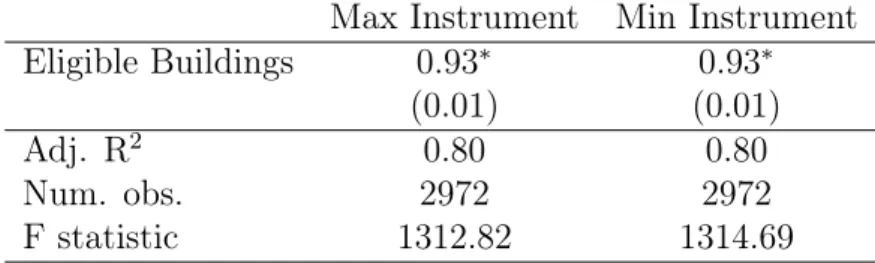
Max Instrument Min Instrument Eligible Buildings 0.93∗ 0.93∗
(0.01) (0.01)
Adj. R2 0.80 0.80
Num. obs. 2972 2972
F statistic 1312.82 1314.69
∗p <0.05
Table 2: Instrument Strength
Where x2 is mayoral opposition, and the instrument used for the interaction variable
is the interaction between the number of eligible buildings and mayoral opposition, per Wooldridge (2010).
While the control function approach produces a consistent estimate of the primary effect of interest, β1, it does not produce asymptotically correct standard errors due to
the two-stage regression process. As such, I use a non-parametric bootstrap to estimate 95% confidence intervals for all parameters. In the simplest possible terms, this model can be interpreted as an ordinary GLM with logit coefficients and bootstrap confidence intervals rather than standard t-tests.
Table 2 reports the first stage regression results, demonstrating that the instrument is strong.
In light of the modeling strategy: I reinterpret my hypothesis as:
As the number of affected buildings within average commute distance of a polling station rises, the opposition vote at that polling station will also rise.
I will reject the null hypothesis of the housing project having no effect if β1 is both
Results and Discussion
I will begin this section with a presentation of model results. I will then discuss why we may be seeing non-results at this point in time, centering mainly on the impact of the renovation project at the time of writing. I will then move on to discuss how interesting results in the controls do suggest some role for local politics in voting patterns under authoritarianism. While not the primary purpose of this analysis, I will discuss these results, which I find to be robust using a more efficient estimation strategy. I will close with a discussion of avenues for further research.
Results
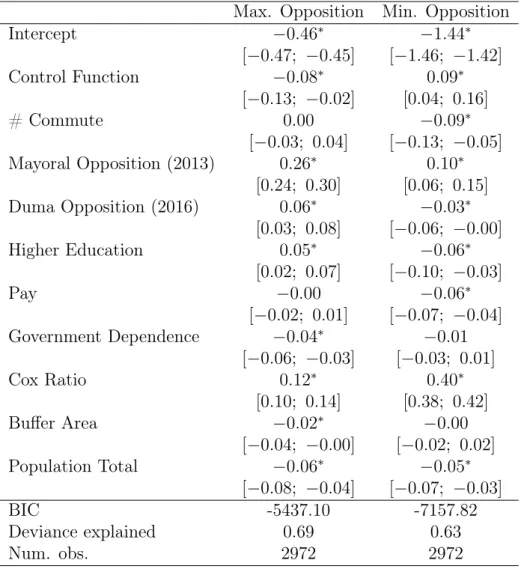
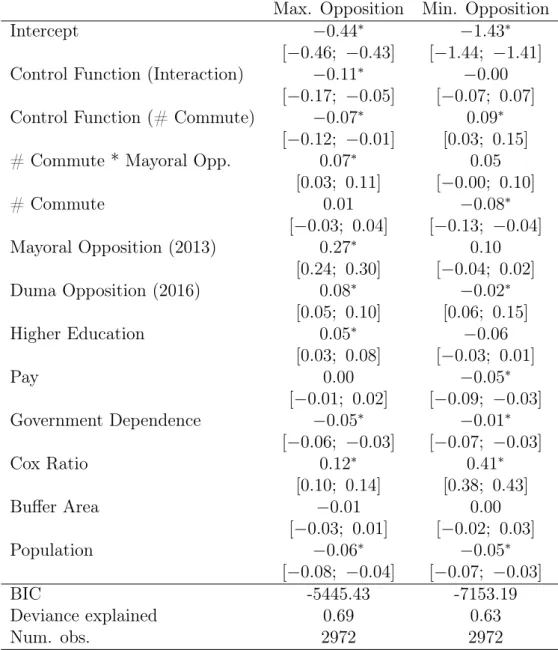
Table 3 displays estimates for the first set of models, in which the number of affected buildings within the average commute distance is the treatment. Confidence intervals are displayed under coefficient estimates, with the star indicating that the 95% confidence interval does not include zero. Confidence intervals are taken from 10,000 non-parametric bootstrap estimates and are biased corrected and accelerated. Table 4 presents the results of the second model, in which the primary DV of interest is an interaction between the number of buildings within commute distance and mayoral opposition vote. To aid model convergence and interpretation, all independent variables have been normalized to have a mean of zero and standard deviation of 1.
Discussion
Max. Opposition Min. Opposition
Intercept −0.46∗ −1.44∗
[−0.47; −0.45] [−1.46; −1.42]
Control Function −0.08∗ 0.09∗
[−0.13; −0.02] [0.04; 0.16]
# Commute 0.00 −0.09∗
[−0.03; 0.04] [−0.13; −0.05]
Mayoral Opposition (2013) 0.26∗ 0.10∗
[0.24; 0.30] [0.06; 0.15]
Duma Opposition (2016) 0.06∗ −0.03∗
[0.03; 0.08] [−0.06; −0.00]
Higher Education 0.05∗ −0.06∗
[0.02; 0.07] [−0.10; −0.03]
Pay −0.00 −0.06∗
[−0.02; 0.01] [−0.07; −0.04]
Government Dependence −0.04∗ −0.01
[−0.06; −0.03] [−0.03; 0.01]
Cox Ratio 0.12∗ 0.40∗
[0.10; 0.14] [0.38; 0.42]
Buffer Area −0.02∗ −0.00
[−0.04; −0.00] [−0.02; 0.02]
Population Total −0.06∗ −0.05∗
[−0.08; −0.04] [−0.07; −0.03]
BIC -5437.10 -7157.82
Deviance explained 0.69 0.63
Num. obs. 2972 2972
∗0 outside the confidence interval
Max. Opposition Min. Opposition
Intercept −0.44∗ −1.43∗
[−0.46; −0.43] [−1.44; −1.41]
Control Function (Interaction) −0.11∗ −0.00
[−0.17; −0.05] [−0.07; 0.07]
Control Function (# Commute) −0.07∗ 0.09∗
[−0.12; −0.01] [0.03; 0.15]
# Commute * Mayoral Opp. 0.07∗ 0.05
[0.03; 0.11] [−0.00; 0.10]
# Commute 0.01 −0.08∗
[−0.03; 0.04] [−0.13; −0.04]
Mayoral Opposition (2013) 0.27∗ 0.10
[0.24; 0.30] [−0.04; 0.02]
Duma Opposition (2016) 0.08∗ −0.02∗
[0.05; 0.10] [0.06; 0.15]
Higher Education 0.05∗ −0.06
[0.03; 0.08] [−0.03; 0.01]
Pay 0.00 −0.05∗
[−0.01; 0.02] [−0.09; −0.03]
Government Dependence −0.05∗ −0.01∗
[−0.06; −0.03] [−0.07; −0.03]
Cox Ratio 0.12∗ 0.41∗
[0.10; 0.14] [0.38; 0.43]
Buffer Area −0.01 0.00
[−0.03; 0.01] [−0.02; 0.03]
Population −0.06∗ −0.05∗
[−0.08; −0.04] [−0.07; −0.03]
BIC -5445.43 -7153.19
Deviance explained 0.69 0.63
Num. obs. 2972 2972
∗0 outside the confidence interval
included buildings increased the vote for the opposition.
While I cannot conclusively determine why I failed to support my hypothesis, it is possible that the operationalization of the treatment variable placed too high of an infor-mational demand on voters. At the time of the municipal council elections, the renovation project consisted solely of a list; buildings had not yet started to come down. My opera-tionalization of average commute distance required voters to know at least roughly how many buildings they passed on a day-to-day basis that were included on that list. With-out individual-level data, we will never know whether individuals who were aware of the project’s impact on their neighborhood did vote in the hypothesized way. However, the upcoming mayoral elections may present a chance to remedy this deficiency. Buildings are scheduled to begin coming down this year, reducing the informational costs for voters in evaluating the program’s impact by creating real inconveniences associated with demo-lition rather than requiring them to know which buildings are affected and forecast how much the project will impact their lives. While I have not demonstrated the importance of a local issue in this particular authoritarian election, it is possible I will be able to do so in the future.
In addition, there remains the possibility that the clientelistic aspect of the renova-tion project has created heterogeneous treatment effects which I am unable to control for. Buildings were selected based in part on prior regime support, and the promise of new housing may have made residents of included buildings more likely to vote for the regime while making their neighbors less likely to vote to regime, causing the effects to cancel each other out. At this time, I have not been able to locate data on residency of affected buildings, a crucial control that would allow me to determine whether heteroge-neous treatment effects exist and condition on them.
Max Opposition Min Opposition
Intercept −3.8416∗ −1.7629∗
(0.0868) (0.0979)
Duma Opposition 1.4271∗ −0.5719∗
(0.2330) (0.2555)
Mayoral Opposition 6.0018∗ 1.8134∗
(0.2814) (0.3148)
Avg. Monthly Pay 0.0000∗ −0.0000∗
(0.0000) (0.0000)
Government Dependence −0.0123∗ −0.0029
(0.0024) (0.0027)
Higher Education 0.0079∗ −0.0048∗
(0.0015) (0.0016)
Cox Ratio Max 0.0084∗
(0.0007)
Cox Ratio Min 0.0537∗
(0.0011)
Num. obs. 2975 2975
Num. groups 125 125
Nagelkerke R2 0.6759 0.6094
∗∗∗p <0.001,∗∗p <0.01,∗p <0.05
Table 5: Predicting Municipal council vote
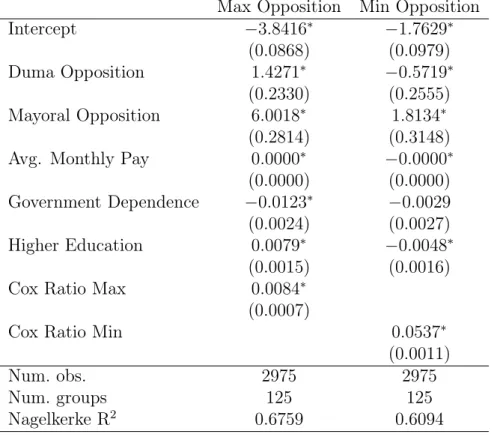
results suggest that there is a disconnect between national level voting patterns and local level voting patterns in Moscow, raising several interesting questions. To determine to what extent the results are an artifact of the instrumental variables estimation strategy, I ran simple multilevel beta regressions without the use of the housing project and control function variables. In both these models, the mayoral opposition variable emerges as a much stronger predictor of municipal council opposition vote. Table 5 shows the results of these regressions 6 , and Figure 2 shows predicted opposition votes along the range of values of both mayoral opposition and Duma opposition using the observed values approach for both models (Hanmer and Ozan Kalkan 2013). As can be seen, mayoral opposition provides considerably more information about a polling station’s municipal council vote despite being a less temporally proximate predictor.
Little can be said about the reason for this disconnect due to potential confounders,
0.2 0.3 0.4 0.5 0.6
0.3 0.4 0.5
Mayoral Election: Opp. Vote
Council Election: Opp
. V ote 100 200 300 Count
(a) Max: Mayoral Opposition
0.2 0.3 0.4 0.5 0.6
0.40 0.45 0.50 0.55 0.60
Duma Election: Opp. Vote
Council Election: Opp
. V ote 50 100 150 200 250 Count
(b) Max: Duma Opposition
0.1 0.2 0.3
0.3 0.4 0.5
Mayoral Election: Opp. Vote
Council Election: Opp
. V
ote
100 200
Count
(c) Min: Mayoral Opposition
0.10 0.15 0.20 0.25 0.30 0.35
0.40 0.45 0.50 0.55 0.60
Duma Election: Opp. Vote
Council Election: Opp
. V ote 100 200 300 Count
(d) Min: Duma Opposition
though its existence does suggest the importance of local politics for understanding au-thoritarian regimes. If local auau-thoritarian elections matter little for both national and opposition actors, as Gandhi and Lust-Okar (2009) argue, we should expect to see a clear connection between national-level opposition vote and local-level opposition vote. This would suggest that local elections in authoritarian regimes are second-order elections in which people vote based on the party/parties they identify with nationally. This is not the result that is seen in the original analysis or the simpler analysis above. Rather, it suggests that either local elections turn out different kinds of voters in different propor-tions or that voters behave differently at the local and national level. A comparative analysis of turnout, beyond the scope of the current analysis, could help determine the extent to which these two implications are true. If the opposition does better in lower turnout authoritarian elections, it suggests they have effective mobilizational connections to voters on the local level that regime machine turnout efforts swamp at the national level. If turnout is not a factor, it implies that voters may make different choices at the local and national level.
Conclusion
While I have not proven here that local issues are an important factor in authoritar-ian electoral success, some evidence has been provided that local political patterns are distinct from national political patterns, contrary to the dominant assumptions in the literature. This suggests that local politics remain an under-theorized and potentially important dimension of authoritarian politics .
REFERENCES
Ades, Alberto F and Edward L Glaeser. 1995. “Trade and circuses: explaining urban giants.” The Quarterly Journal of Economics 110(1):195–227.
Bates, Robert H. 2014. Markets and states in tropical Africa: the political basis of agricultural policies. Berkely, CA: University of California Press.
Beissinger, Mark R, Amaney A Jamal and Kevin Mazur. 2015. “Explaining divergent revolutionary coalitions: Regime strategies and the structuring of participation in the Tunisian and Egyptian revolutions.” Comparative Politics 48(1):1–24.
Bennetts, Marc. 2017. “Liberal anti-Putin coalition causes upset in Moscow council elec-tions.” The Guardian .
URL: https://www.theguardian.com/world/2017/sep/11/liberal-coalition-deals-blow-to-putin-in-moscow-council-elections
Blaydes, Lisa. 2010. Elections and distributive politics in Mubarak’s Egypt. New York, NY: Cambridge University Press.
Blundell, Richard and James L Powell. 2003. “Endogeneity in nonparametric and semi-parametric regression models.” Econometric society monographs 36:312–357.
Bunce, Valerie J and Sharon L Wolchik. 2011. Defeating authoritarian leaders in post-communist countries. Cambridge University Press.
Chen, Xi. 2012. Social protest and contentious authoritarianism in China. Cambridge University Press.
Cox, Gary W. 1997. Making votes count: strategic coordination in the world’s electoral systems. New York, NY: Cambridge University Press.
Cribari-Neto, Francisco and Achim Zeileis. 2010. “Beta Regression in R.” Journal of Statistical Software, Articles 34(2):1–24.
URL: https://www.jstatsoft.org/v034/i02
Demchenko, Oleg and Grigorii V Golosov. 2016. “Federalism, gubernatorial power and the incorporation of subnational authoritarianism in Russia: A theory-testing empirical inquiry.” Acta Politica 51(1):61–79.
URL: https://www.washingtonpost.com/world/europe/ russia-to-charge-independent-mayor/2013/07/03/4a7fe72a-e406-11e2-aef3-339619eab080_ story.html?utm_term=.ea9a58c501d3
Ferrari, Silvia and Francisco Cribari-Neto. 2004. “Beta regression for modelling rates and proportions.” Journal of Applied Statistics 31(7):799–815.
Gandhi, Jennifer and Ellen Lust-Okar. 2009. “Elections under authoritarianism.” Annual review of political science 12:403–422.
Gibson, Edward L. 2005. “Boundary control: Subnational authoritarianism in democratic countries.” World Politics 58(1):101–132.
Golunov, Ivan. 2017a. “У нас народ изобретательный: Как устроена московская машина пропаганды. Расследование Ивана Голунова.” Meduza .
URL: https://meduza.io/feature/2017/12/25/u-nas-narod-izobretatelnyy
Golunov, Ivan. 2017b. “Татарские чиновники, военные управленцы, чеченские бизнесмены: Кто зарабатывает на строительстве домов для жителей пятиэтажек. Расследование Ивана Голунова.” Meduza .
URL: https://meduza.io/feature/2017/08/18/tatarskie-chinovniki-voennye-upravlentsy-chechenskie-biznesmeny
Golunov, Ivan. 2017c. “Кто придумал реновацию: Московские власти планировали массовую программу сноса три года, а потом решили сделать ее политическим проектом. Расследование Ивана Голунова.” Meduza .
URL: https://meduza.io/feature/2017/08/15/kto-pridumal-renovatsiyu
Hanmer, Michael J and Kerem Ozan Kalkan. 2013. “Behind the curve: Clarifying the best approach to calculating predicted probabilities and marginal effects from limited dependent variable models.” American Journal of Political Science 57(1):263–277.
Herszenhorn, David M. 2013. “Russian Mayor, an Opposition Figure, Is Arrested.” The New York Times .
URL: https://www.nytimes.com/2013/07/04/world/europe/russian-mayor-an-opposition-figure-is-arrested.html
Kahle, David and Hadley Wickham. 2013. “ggmap: Spatial Visualization with ggplot2.” The R Journal 5(1):144–161.
Kovalenko, Artem. 2013. “Почему Ройзман.” Эксперт . URL: http://expert.ru/ural/2013/37/pochemu-rojzman/
Kuran, Timur. 1991. “Now out of never: The element of surprise in the East European revolution of 1989.” World politics 44(1):7–48.
Landry, Pierre F. 2008. Decentralized authoritarianism in China. New York, NY: Cam-bridge University Press.
Levada Center. 2017. “Реновация в Москве.” https://www.levada.ru/2017/07/25/ renovatsiya-v-moskve/. Accessed: 2010-09-30.
Levitsky, Steven and Lucan A Way. 2010. Competitive authoritarianism: Hybrid regimes after the Cold War. New York, NY: Cambridge University Press.
Lucardi, Adri´an. 2016. “Building Support From Below? Subnational Elections, Diffusion Effects, and the Growth of the Opposition in Mexico, 1984-2000.” Comparative Political Studies 49(14):1855–1895.
Magaloni, Beatriz. 2006. Voting for autocracy: Hegemonic party survival and its demise in Mexico. New York, NY: Cambridge University Press.
March, Luke. 2009. “Managing opposition in a hybrid regime: Just Russia and parastatal opposition.” Slavic Review 68(3):504–527.
Meduza. 2018. “В Екатеринбурге отменили прямые выборы мэра.” Meduza .
URL: https://meduza.io/news/2018/04/03/zakonoproekt-ob-otmene-vyborov-mera-ekaterinburga-prinyali-v-pervom-chtenii
Reuter, Ora John. 2017. The Origins of Dominant Parties: Building Authoritarian Insti-tutions in Post-Soviet Russia. New York, NY: Cambridge University Press.
Reuter, Ora John and Graeme B Robertson. 2012. “Subnational appointments in author-itarian regimes: Evidence from Russian gubernatorial appointments.” The Journal of Politics 74(4):1023–1037.
Reuter, Ora John and Graeme B Robertson. 2014. “Legislatures, cooptation, and social protest in contemporary authoritarian regimes.” The Journal of Politics 77(1):235–248.
“Local elections in authoritarian regimes: An elite-based theory with evidence from Russian mayoral elections.” Comparative Political Studies 49(5):662–697.
Saikkonen, Inga A-L. 2016a. Subnational Democratization and Electoral Authoritarian-ism in Russia. In Illiberal Practices: Territorial Variance Within Large Federal Democ-racies, ed. Jacqueline Behrend and Laurence Whitehead. Baltimore, MD: John Hopkins University Press p. 265.
Saikkonen, Inga A-L. 2016b. “Variation in subnational electoral authoritarianism: evi-dence from the Russian Federation.” Democratization 23(3):437–458.
Smyth, Regina. 2018. “How the Kremlin Is Using the Moscow Renovation Project to Reward and Punish Voters.” PONARS Policy Memo 513.
Svolik, Milan W. 2012. The politics of authoritarian rule. New York, NY: Cambridge University Press.
Wallace, Jeremy. 2013. “Cities, redistribution, and authoritarian regime survival.” The Journal of Politics 75(3):632–645.
Wooldridge, Jeffrey M. 2010. Econometric analysis of cross section and panel data. Cam-bridge, MA: MIT press.