Original Research Article
Comparative analysis of concurrent and sequential chemoradiation in
locally advanced lung cancer: a single institution experience
Shelly Srivastava, Surendra Kumar Saini*, S. K. Agarwal
INTRODUCTION
Lung cancer is one of the commonest cancers and most common cause of cancer related deaths worldwide. According to the GLOBOCAN 2012 report, the estimated incidence of lung cancer in India was 70,275 in all ages and both sexes; the crude incidence rate per 100,000 was 5.6, the age-standardized rate per 100,000 (world), i.e. ASR (W) was 6.9, and the cumulative risk was 0.85.1 In
terms of incidence rates, lung cancer ranked fourth overall among the various types of cancer (excluding
nonmelanoma skin cancer) after breast, cervical, and oral cavity cancer; in males, it ranked second while in females it was sixth in terms of cancer incidence.2 The quality of
the data acquired from Indian hospital-based registries and regional cancer registries may be hindered by incomplete penetrance of disease registration across the different states of India, resulting in an underestimation of the overall burden. The overall 5-year survival rate of lung cancer is dismal with approximately 15 per cent in developed countries and 5 per cent in developing countries.3 Screening by low dose Computed
Department of Radiotherapy, M. P. Shah Government Medical College, Jamnagar, Gujarat, India
Received: 16 September 2019 Revised: 25 September 2019 Accepted: 31 October 2019
*Correspondence: Dr. Surendra Kumar Saini, E-mail: [email protected]
Copyright: © the author(s), publisher and licensee Medip Academy. This is an open-access article distributed under the terms of the Creative Commons Attribution Non-Commercial License, which permits unrestricted non-commercial use, distribution, and reproduction in any medium, provided the original work is properly cited.
ABSTRACT
Background: Outcome of various treatment regimen are dismal in non-small cell lung cancer. This analysis is done to find possible care in authors institutional set up and to see how these protocols have effect in Indian patients in term of toxicity.
Methods: Medical records and data on patients who had been diagnosed with non-small cell lung cancer histologically or cytologically, and who had been treated with sequential chemoradiation and concurrent chemoradiation at the hospital from January 2007 to March 2015 was retrospectively reviewed and analyzed. Two groups of sequential chemoradiotherapy and concurrent chemoradiotherapy were formed and compared for outcomes. Results: Of the 114 evaluable patients in sequential chemoradiotherapy group, the median survival time was 16.0 months and the 1, 3- and 5-years overall survival were 57.0, 26.9 and 21.2%, respectively. Median progression free survival (PFS was 13.0 months and the 1, 3 and 5 years PFS were 52.6, 14.6 and 7.8%, respectively. In concurrent chemoradiotherapy group (105 patients), the overall median survival time was 15 months and the 1, 3- and 5-year overall survival were 56.2, 20.6 and 14.7%, respectively. Median PFS was 13 months and the 1, 3 and 5-year PFS were 48.8, 19.7 and 10.3%, respectively. Grade 3 and 4 toxicity in both regimen groups are same and statistically not significant.
Conclusions: Analysis confirm dismal outcome with standard treatment and signifies to search for care beyond conventional chemoradiotherapy.
Tomography (CT Scan) in high risk population demonstrated a relative risk reduction of 20 per cent in lung cancer mortality but with a false positive rate of 96 per cent.4 In India where tuberculosis is prevalent, the
applicability of such screening tool is questionable.
Various randomized trials and meta-analysis have shown benefit of concurrent chemoradiation and sequential chemoradiation over radiotherapy only in inoperable non metastatic lung Non-Small Cell Lung Cancer (NSCLC). 5-9 Both concurrent chemoradiation and sequential
chemoradiotherapy are used by oncologist based on patients’ disease factors as well as oncologist’s preference. These therapies for unresectable stage III NSCLC have advanced steadily during the last three decades. More recently, induction chemotherapy and concomitant chemoradiotherapy have been directly compared, and the concomitant approach was shown to increase median survival to approximately 17 months. Different chemotherapy regimen was used in different trials but with platinum. Induction chemotherapy may improve systemic control, and concomitant chemoradiotherapy appears to increase locoregional control. CALGB 39801 was designed to test the value of induction chemotherapy administered in the context of standard concomitant chemoradiotherapy.10 Patients were
randomly assigned to either receive concomitant chemoradiotherapy alone or two cycles of induction chemotherapy with the same chemotherapy agents followed by identical concomitant chemoradiotherapy. The choice of carboplatin and paclitaxel as a chemotherapy regimen was based on its widespread acceptance by oncologists and general good tolerance by patients. Effect of induction chemotherapy on overall survival as well as toxicity and pattern of failure was key parameter to study. Author designed and conducted this retrospective analysis to assess best possible care in institutional set up and to see how these protocols have effect in Indian patients in term of toxicity.
METHODS
Patient selection and experimental design
The study was carried out at department of radiotherapy, M. P. Shah Government Medical College, Jamnagar. Author retrospectively reviewed medical records and collected data on patients who had been diagnosed with NSCLC histologically or cytologically, and who had been treated with sequential chemoradiation and concurrent chemoradiation at hospital from Jan 2007 to March 2015. Patients with medically or surgically inoperable AJCC stage IIIA and IIIB newly diagnosed histologically confirmed NSCLC (adenocarcinoma, squamous cell carcinoma, large cell carcinoma, or NSCLC-not otherwise specified) were eligible for the study. Patients were required to have a Karnofsky performance status (KPS) of 70 or greater, to have no more than 5% weight loss over 3 months before start of treatment, to be between age of 30 years to 70 years, and to be without
evidence of metastatic disease. Patients with pleural effusions with malignant cytology were ineligible as were those with pleural effusions visible on chest x-ray unless the effusion appeared only after a thoracotomy or another invasive procedure. Radiological assessment included chest x-ray, computerized axial tomography of the thorax and upper abdomen and brain, and technetium-99 bone scan where required for evaluation.
Institutional ethics committee approved this retrospective study. To analyze data with at least two years follow-up and planning for analyzing data in April 2017, Author included patients registered until March 2015 only. First, for the evaluation of factors that had influenced the introduction of chemotherapy, Author analyzed a cohort of patients who had been diagnosed with NSCLC at hospital from January 2007 to March 2015 and compared the following two groups within the cohort: patients who received concurrent chemotherapy and patients who received sequential chemoradiation after the diagnosis of NSCLC. Author excluded patients who had moved to other hospitals for further aggressive treatment after confirmed diagnosis. The data collected from the patients’ medical records included the following: sex, age, Karnofsky Performance Status (KPS) or European Clinical Oncology Group (ECOG) performance status (PS), clinical stage based on the eighth edition of TNM Classification of malignant tumors by the international union against cancer and the american joint committee on cancer, chemotherapeutic a, Progression-Free Survival (PFS), Overall Survival (OS), response according to Response Evaluation Criteria In Solid Tumors Version 1.1, 10 delivered cycles, and the reason for discontinuation of each regimen.
Assessments
The evaluable population for overall response included all patients who had completed the treatment, and at least one response assessments after completion of full treatment. In both groups of patients, OS was measured from first day of start of treatment whether chemotherapy or radiotherapy, and PFS was defined as a period from the first day of start of treatment until documented PD or death. The date of data cut-off was March 31, 2015.
Data analysis
RESULTS
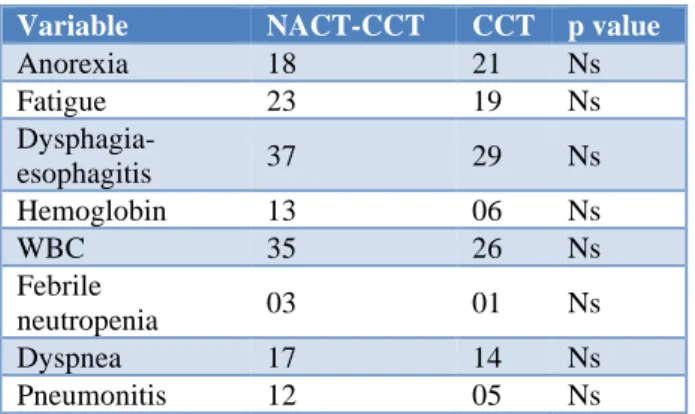
The groups of patients did not differ significantly from one another with respect to the distribution of gender and age (p>0.05), although the percentage of males and mean age were higher in the NACT group (Table 1). Grade 3 and 4 toxicity in both regimen groups are same and statistically not significant. This may be attribute of retrospective nature of study (Table 2). Prospective analysis can find the difference in complications of treatment precisely.
Table 1: Patient characteristics.
Variable
NACT-CCT CCT p value
N 114 105
Age (years) Mean± SD
56.80±8.71
55.20±8.59 0.174
Median (range) 58 55
Gender Male/Female
89/25
78/26
0.708 Stage
IIIA/IIIB
76/38
64/50
0.135 ECOG PS
0/1
39/75
27/77
0.239 Survival (months)
Median
16
15
0.4086 PPF 13 13 0.7560
Table 2: Grade 3 and 4 toxicity of treatment.
Variable NACT-CCT CCT p value
Anorexia 18 21 Ns
Fatigue 23 19 Ns
Dysphagia-esophagitis 37 29 Ns
Hemoglobin 13 06 Ns
WBC 35 26 Ns
Febrile
neutropenia 03 01 Ns
Dyspnea 17 14 Ns
Pneumonitis 12 05 Ns
Sequential chemotherapy and radiotherapy (SCT-RT). Of the 114 evaluable patients, the median survival time was 16.0 months and the 1, 3- and 5-years OS were 57.0, 26.9 and 21.2%, respectively (Figure 1). The interval between the end of CT and the start of RT ranged between 15 and 90 days, with a mean of 35 days. The mean Overall Treatment Time (OTT) was 172 days. Median Progression Free Survival (PFS was 13.0 months and the 1, 3 and 5 years PFS were 52.6, 14.6 and 7.8%, respectively (Figure 2). The interval between the end of CT and the start of RT ranged between 15 and 90 days, with a mean of 35 days. The mean Overall Treatment Time (OTT) was 172 days. Forty out of these 114 SCT-RT patients (35%) had a complete response, 55(48%) had
partial response and rest were stable or progressive disease. In 53 patients, the cause of death was known and was tumor related in 40 patients (75.5%). Local recurrence was present in 16 patients (40%), eight of whom also had distant metastases. The remaining 24 patients developed distant metastases.
Figure 1: Cumulative survival as a function of time after start of treatment. Curve 1- sequentially applied
chemotherapy and radiotherapy (SCT-RT); curve 2- concurrently applied chemoradiotherapy (CCT-RT).
Figure 2: Progression free survival as a function of time after start of treatment. Curve 1- sequentially applied chemotherapy and radiotherapy (SCT-RT);
curve 2- concurrently applied chemoradiotherapy (CCT-RT).
whom ten also had distant metastases. The remaining 35 patients developed distant metastases.
DISCUSSION
The management of patients with locally advanced unresected NSCLC has undergone considerable change since 1990 when 60 Gy thoracic RT alone was the standard of care. Thoracic RT alone resulted in median survival time of 10-12 months and 3-year survival rates of 10%-15% among patients with a good performance status and low levels of disease-related weight loss. The past three decades have witnessed the maturation of at least five major randomized trials demonstrating that the addition of platinum-based chemotherapy before or during RT statistically significantly improved survival in this patient cohort to median survival time of 13-15 months and 3-year survival rates of 15%-20%.5-9 The
magnitude of benefit from the addition of chemotherapy to RT was similar among these trials, and the optimal sequencing of chemotherapy and thoracic RT for these patients remained uncertain.
Overall, the survival times of patients with stage III NSCLC in this study is disappointing and similar to those achieved in trials using induction chemotherapy followed by radiotherapy alone or with low dose weekly concomitant carboplatin.11-15
In this retrospective review, it is likely that the radio sensitizing antitumor effect of the chemotherapy in concurrent chemotherapy group as well as sequential group contributed to the improvement in patient survival in comparison to historic radiation only for lung cancer but hematological toxicities and other chemotherapy related complications in sequential group may have masked any benefit of adding chemotherapy prior to chemoradiation. Acute hematological and nonhematologic toxicity observed in this sequential group may have diminished the benefit of this aggressive concurrent regimen.
Of note is another report of a phase III comparison of concurrent vs sequential cisplatin-based chemoradiation for patients with stage III NSCLC, in which a survival advantage was also noted.16 In a 314-patient trial
conducted by the west japan lung cancer oncology group, median survival time was 17 vs 13 months and 5-year survival was 16% vs 9% (p=0.039), with concurrent chemoradiation compared with sequential treatment. The remarkable similarity in the magnitude of difference between that result and the present report lends further support to the importance of optimizing the temporal relationship between these therapies. In addition, several other smaller European randomized trials have provided support for the use of concurrent chemoradiation as compared with sequential therapy.17-20
This study also had some limitations, the majority of patients with stage III NSCLC have a functional status
that is too poor and have suffered too much disease-related weight loss, as well as other comorbid conditions that would disqualify them from enrollment in this analysis. It is likely that the higher rates of severe esophagitis observed with concurrent therapy would be less well tolerated by patients with lower functional status.
Future approaches to patients with locally advanced NSCLC should continue to capitalize on the clinically relevant integration between these therapies. A number of innovative changes have occurred in radiotherapeutic planning and delivery, which may improve the therapeutic ratio of concurrent therapy.21 In addition, the
integration of new anticancer agents such as those targeting the epidermal growth factor receptor with concurrent chemoradiation is under active clinical in-vestigation. This study does not support any regimen superiority over another but suggest close observation on outcome based on regimen and plan larger study to define appropriate treatment in NSCLC patients. This study also suggests that even with some change in regimen to gain maximum benefit, outcomes are dismal so think beyond these chemotherapy regimens.
Funding: No funding sources Conflict of interest: None declared
Ethical approval: The study was approved by the Institutional Ethics Committee
REFERENCES
1. Ferlay J, Soerjomataram I, Ervik M, Dikshit R, Eser S, Mathers C, et al. Lyon, France: International Agency for Research on Cancer; 2013. Cancer Incidence and Mortality Worldwide: IARC Cancer Base. 2012(11).
2. National Cancer Registry Programme. Three Year Report 2. of Population Based Cancer Registries: 2009-2011. Indian Council of Medical Research; 2013. Available at: http://www.ncrpindia.org. accessed on January 21, 2014.
3. Parkin DM, Bray F, Ferlay J, Pisani P. Global cancer statistics, 2002. CA: Cancer J Clini. 2005 Mar;55(2):74-108.
4. National Lung Screening Trial Research Team. Reduced lung-cancer mortality with low-dose computed tomographic screening. New Eng J Med. 2011 Aug 4;365(5):395-409.
5. Komaki R, Scott CB, Byhardt R, Emami B, Asbell SO, Russell AH, et al. Failure patterns by prognostic group determined by recursive partitioning analysis (RPA) of 1547 patients on four radiation therapy oncology group (RTOG) studies in inoperable nonsmall-cell lung cancer (NSCLC). Int J Radi Oncol Biol Phys. 1998 Sep 1;42(2):263-7.
7. Hoffman PC, Mauer AM, Vokes EE. Lung cancer.
Lancet. 2000;355:479-85.
8. Spira A, Ettinger DS. Multidisciplinary management of lung cancer. New Eng J Med. 2004 Jan 22;350(4):379-92.
9. Pfister DG, Johnson DH, Azzoli CG, Sause W, Smith TJ, Baker Jr S, et al. American Society of Clinical Oncology treatment of unresectable non-small-cell lung cancer guideline: Update 2003. J Clin Oncol. 2004 Jan 15;22(2):330-53.
10. Vokes EE, Herndon JE, Kelley MJ, Cicchetti MG, Ramnath N, Neill H, et al. Induction chemotherapy followed by chemoradiotherapy compared with chemoradiotherapy alone for regionally advanced unresectable stage III non–small-cell lung cancer: Cancer and Leukemia Group B. J Clin Oncol. 2007 May 1;25(13):1698-704.
11. Le Chevalier T, Arriagada R, Quoix E, Ruffle P, Martin M, Tarayre M, et al. Radiotherapy alone versus combined chemotherapy and radiotherapy in nonresectable non-small-cell lung cancer: first analysis of a randomized trial in 353 patients. JNCI: J National Cancer Inst. 1991 Mar 20;83(6):417-23. 12. Dillman RO, Herndon J, Seagren SL, Eaton Jr WL,
Green MR. Improved survival in stage III non-small-cell lung cancer: seven-year follow-up of cancer and leukemia group B (CALGB) 8433 trial. JNCI: J National Cancer Inst. 1996 Sep 4;88(17):1210-5. 13. Clamon G, Herndon J, Cooper R, Chang AY,
Rosenman J, Green MR. Radiosensitization with carboplatin for patients with unresectable stage III non–small-cell lung cancer: A phase III trial of the Cancer and Leukemia Group B and the Eastern Cooperative Oncology Group. J Clini Oncol. 1999 Jan;17(1):4.
14. Sause W, Kolesar P, Taylor IV S, Johnson D, Livingston R, Komaki R, et al. Final results of phase III trial in regionally advanced unresectable non-small cell lung cancer: Radiation Therapy Oncology Group, Eastern Cooperative Oncology Group, and Southwest Oncology Group. Chest. 2000 Feb 1;117(2):358-64.
15. Gervais R, Ducolone A, Lechevalier T, Legroumellec A, Lemarie E, Quoix E. Conventional radiation with daily carboplatin compared with RT alone after induction chemotherapy: Final results of a randomized phase III trial in stage III unresectable non-small-cell lung cancer. Study
CRT/BMS/NPC/96 of the French Lung Cancer Study Group FNCLCC and IFCT. J Clin Oncol. 2005;23:7016.
16. Furuse K, Fukuoka M, Kawahara M, Nishikawa H, Takada Y, Kudoh S, et al. Phase III study of concurrent versus sequential thoracic radiotherapy in combination with mitomycin, vindesine, and cisplatin in unresectable stage III non-small cell lung cancer. J Clin Oncol. 1999;17:2692-9.
17. Ulutin HC, Güden M, Oysul K, Sürenkök S, Pak Y. Split-course radiotherapy with or without concurrent or sequential chemotherapy in non-small cell lung cancer. Radi Medi. 2000;18(2):93-6.
18. Fournel P, Robinet G, Thomas P, Souquet PJ, Léna H, Vergnenégre A, et al. Randomized phase III trial of sequential chemoradiotherapy compared with concurrent chemoradiotherapy in locally advanced non–small-cell lung cancer: Groupe Lyon-Saint-Etienne d’Oncologie Thoracique–Groupe Francais de Pneumo-Cancérologie NPC 95-01 Study. J Clin Oncol. 2005;23:5910-7.
19. Zatloukal P, Petruzelka L, Zemanova M, Havel L, Janku F, Judas L, et al. Concurrent versus sequential chemoradiotherapy with cisplatin and vinorelbine in locally advanced non-small cell lung cancer: a randomized study. Lung cancer. 2004 Oct 1;46(1):87-98.
20. Belderbos J, Uitterhoeve L, van Zandwijk N, Belderbos H, Rodrigus P, van de Vaart P, et al. Randomised trial of sequential versus concurrent chemo-radiotherapy in patients with inoperable non-small cell lung cancer (EORTC 08972-22973). Eur J cancer. 2007 Jan 1;43(1):114-21.
21. Bradley J, Graham MV, Winter K, Purdy JA, Komaki R, Roa WH, et al. Toxicity and outcome results of RTOG 9311: A phase I-II dose-escalation study using three-dimensional conformal radiotherapy in patients with inoperable non-small-cell lung carcinoma. Int J Radi Oncol Biol Physics. 2005 Feb 1;61(2):318-28.
Cite this article as: Srivastava S, Saini SK, Agarwal SK. Comparative analysis of concurrent and