LABORATORY EXERCISE 12 BONE STRUCTURE AND CLASSIFICATION Figure Labels
FIG. 12.1
1. Articular cartilage (hyaline cartilage) 6. Periosteum 2. Spongy bone (red marrow) 7. Proximal epiphysis
3. Medullary cavity 8. Diaphysis
4. Yellow marrow 9. Distal epiphysis
5. Compact bone
FIG. 12.2
1. Spongy bone 6. Perforating canal
2. Compact bone 7. Blood vessels
3. Osteon 8. Nerve
4. Perisoteum 9. Canaliculus
5. Central canal 10. Osteocyte
Critical Thinking Application Answers
The closest blood supply to an osteocyte is located in the central canal of an osteon unit. Nutrients and wastes can move from one cell to another via small cellular processes located in minute tubes in the matrix called canaliculi. In this way, all of the
osteocytes of one osteon are tied together to a blood source.
Laboratory Report Answers PART A
1. Flat 8. Hyaline cartilage covers the articular ends of a long bone. 2. Short 9. Dense irregular connective tissue comprises the periosteum that
3. Long encloses the bone except for its articular ends
4. Irregular 10. Periosteum composed of irregular dense connective tissue forms 5. Sesamoid or round the outer covering of a bone, whereas endosteum composed 6. Flat of reticular connective tissue lines its hollow, internal chambers. 7. Epiphysis refers to the expanded end of a long bone;
diaphysis refers to the shaft between the ends of such a bone.
PART B
1. Compact bone has osteons closely packed together, 3. The marrow of the medullary cavity of an adult is yellow, but and spongy bone has large spaces between thin marrow in the spaces of spongy bone is red.
bony plates called trabeculae.
2. Compact bone provides strength in the shaft and along the borders of the bone. Spongy bone reduces the weight of the bone and provides spaces occupied by red marrow.
PART C (FIG. 12.5 a-b)
1. Epiphysis (distal) 4. Medullary cavity
2. Diaphysis 5. Compact bone
3. Epiphysis (proximal) 6. Spongy bone
LABORATORY EXERCISE 13 ORGANIZATION OF THE SKELETON Figure Labels
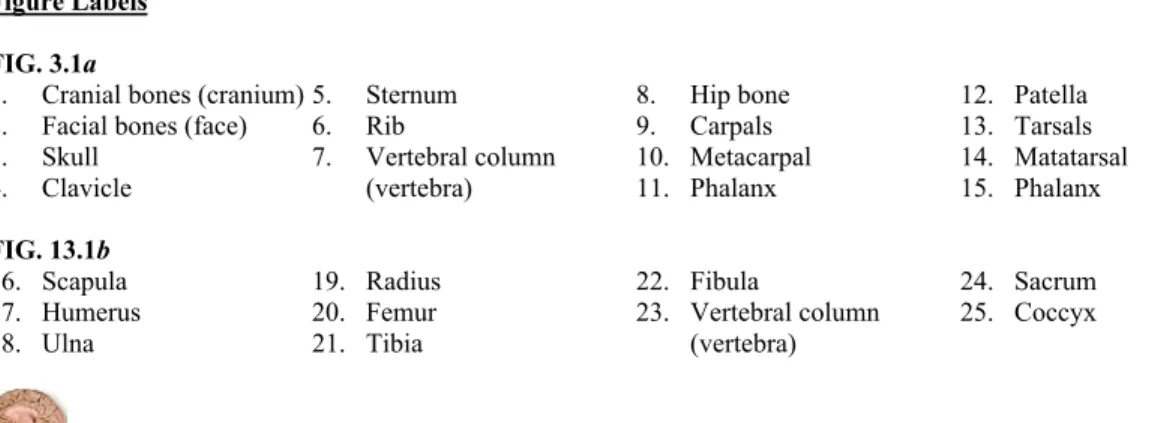
FIG. 3.1a
1. Cranial bones (cranium) 5. Sternum 8. Hip bone 12. Patella 2. Facial bones (face) 6. Rib 9. Carpals 13. Tarsals 3. Skull 7. Vertebral column 10. Metacarpal 14. Matatarsal
4. Clavicle (vertebra) 11. Phalanx 15. Phalanx
FIG. 13.1b
16. Scapula 19. Radius 22. Fibula 24. Sacrum
17. Humerus 20. Femur 23. Vertebral column 25. Coccyx
18. Ulna 21. Tibia (vertebra)
Critical Thinking Application Answers
The largest foramen in the skull is the foramen magnum in the occipital bone. The largest foramen in the human body is the obturator foramen in the hip bones.
Laboratory Report Answers PART A
1. Sutural bones (wormian bones) 6. Sternum 11. Sacrum
2. Axial 7. Twelve 12. Pelvis
3. Skull 8. Pectoral girdle 13. Patella
4. Hyoid 9. Ulna 14. Tarsals
5. Coccyx 10. Carpals 15. Phalanges
PART B 1. c 3. a 5. g 7. d 2. f 4. e 6. b PART C 1. c 3. g 5. b 7. f 2. a 4. e 6. d PART D (FIG. 13.2)
1. Hip bone 5. Ulna 9. Humerus 13. Rib
2. Sternum 6. Scapula 10. Patella
3. Sacrum 7. Radius 11. Femur
LABORATORY EXERCISE 14 SKULL Instructional Suggestion
You might want to have the students use colored pencils to color the bones in figures 14.1 and 14.2. They should use a different color for each of the individual bones in the series. This activity should cause the students to observe the figures more carefully and help them to locate the various bones that are shown from different views in the figures. The students can check their work by referring to the corresponding full-color figures in the textbook.
Figure Labels FIG. 14.1
1. Parietal bone 9. Supraorbital foramen
2. Frontal bone 10. Nasal bone
3. Coronal suture 11. Sphenoid bone
4. Temporal bone 12. Zygomatic bone
5. Perpendicular plate (of ethmoid bone) 13. Middle nasal concha (of ethmoid bone) 6. Infraorbital foramen 14. Inferior nasal concha
7. Vomer bone 15. Maxilla
8. Mandible 16. Mental foramen
FIG. 14.2
1. Parietal bone 11. Zygomatic process (of temporal bone)
2. Squamous suture 12. Coronal suture
3. Lambdoid suture 13. Frontal bone
4. Temporal bone 14. Sphenoid bone
5. Occipital bone 15. Lacrimal bone
6. Temporal process (of zygomatic bone) 16. Nasal bone 7. External acoustic meatus 17. Zygomatic bone
8. Mastoid process 18. Maxilla
9. Styloid process 19. Mandible
10. Mandibular condyle 20. Coronoid process
FIG. 14.3
1. Maxilla 8. Occipital condyle
2. Zygomatic bone 9. Temporal bone
3. Sphenoid bone 10. Palatine process (of maxilla)
4. Vomer bone 11. Palatine bone
5. Zygomatic arch 12. Foramen magnum
6. Styloid process 13. Lambdoid suture
7. Mastoid process 14. Occipital bone
FIG. 14.4
1. Ethmoid bone 6. Sphenoid bone
2. Foramen magnum 7. Temporal bone
3. Crista galli 8. Sella turcica
4. Cribriform plate (olfactory foramina) 9. Parietal bone
5. Frontal bone 10. Occiptal bone
FIG. 14.5
1. Coronal suture 9. Squamous suture
2. Frontal bone 10. Lambdoid suture
3. Sphenoid bone 11. Occipital bone
4. Frontal sinus 12. Sella turcica
5. Nasal bone 13. Styloid process
6. Maxilla 14. Sphenoidal sinus
7. Parietal bone 15. Vomer bone
8. Temporal bone 16. Mandible
Critical Thinking Application Answers
The cribiform plate of the ethmoid bone with numerous olfactory foramina is a weak location of the cranium. Excessive pressure on the cribiform plate could result in a skull fracture.
Laboratory Report Answers PART A 1. d 4. f 7. f 10. e 2. a 5. c 8. a 11. f 3. a 6. f 9. c 12. b PART B 1. Coronal 4. Squamous
2. Sagittal 5. Frontal, ethmoid, sphenoid
3. Lambdoid 6. Maxillary bone
PART C 1. e 4. h 7. h 10. c 2. c 5. d 8. a 11. f 3. c 6. g 9. d 12. b PART D 1. c 3. g 5. d 7. e 2. a 4. f 6. b PART E (FIG. 14.8-14.12) FIG. 14.8
1. Frontal bone 6. Mandible
2. Nasal bone 7. Middle nasal concha (of ethmoid bone)
3. Zygomatic bone 8. Inferior nasal concha
4. Infraorbital foramen 9. Mental foramen
5. Maxilla
FIG. 14.9
1. Parietal bone 8. Mandibular condyle
2. Squamous suture 9. Coronal suture
3. Temporal bone 10. Frontal bone
4. Lambdoid suture 11. Zygomatic process (of temporal bone)
5. Occipital bone 12. Zygomatic bone
6. External acoustic meatus 13. Maxilla
7. Mastoid process 14. Mandible
FIG. 14.10
1. Maxilla 7. Palatine process of maxilla
2. Zygomatic bone 8. Palatine bone
3. Sphenoid bone 9. Vomer bone
4. Temporal bone 10. Occipital condyle
5. Occipital bone 11. Foramen magnum
6. Incisive foramen
FIG. 14.11
1. Frontal bone 5. Ethmoid bone
2. Temporal bone 6. Sphenoid bone
3. Parietal bone 7. Sella turcica
4. Occiptal bone 8. Foramen magnum
LABORATORY EXERCISE 15 VERTEBRAL COLUMN AND THORACIC CAGE Figure Labels
FIG. 15.1
1. Cervical vertebrae 5. Coccyx
2. Thoracic vertebrae 6. Intervertebral foramina
3. Lumbar vertebrae 7. Intervertebral discs
4. Sacrum FIG. 15.2 a-b 8 1 3 6 4 5 7 2 FIG. 15.3 a-c 6 1 7 9 3 2 5 8 4 FIG. 15.4
1. Superior articular process 5. Superior articular process 2. Anterior sacral foramen 6. Tubercles of median sacral crest
3. Coccyx 7. Posterior sacral foramen
4. Sacral canal 8. Sacral hiatus
Critical Thinking Application Answers
The four curvatures allow more resiliency and flexibility, which will enable the vertebal column to function more like a spring instead of a rigid rod.
FIG. 15.5
1. True ribs 6. Xiphoid process
2. False ribs 7. Sternum
3. Thoracic vertebra 8. Costal cartilage
4. Manubrium 9. Floating ribs
5. Body
Laboratory Report Answers PART A
1. Spinal cord 8. Atlas
2. 26 9. Axis
3. Bodies 10. Dens
4. Intervertebral discs 11. Lumbar
5. Spinous process 12. Five
6. Spinal nerves 13. Sacral promontory
7. Vertebral arteries 14. Sacral hiatus
PART B
Vertebra Number Size Body Spinous Process Transsverse Foramina
Cervical 7 Smallest Smallest C2 through C5 are
forked Present
Thoracic 12 Intermediate Intermediate Pointed and angled
downward
Absent
Lumbar 5 Largest Largest Short, blunt, and
nearly horizontal
Absent
PART C
1. 206 5. Clavicles
2. Floating 6. a. Supports shoulder girdle and upper limbs
3. Seven b. Protects visceral organs
4. Hyaline cartilage c. Functions in breathing
PART D(FIG. 15.6)
1. Spinous process 4. Transverse process
2. Atlas 5. Intervertebral disc
LABORATORY EXERCISE 16 PECTORAL GIRDLE AND UPPER LIMB Figure Labels
FIG. 16.1
1. Clavicle 7. Ulna
2. Rib 8. Radius
3. Sternum 9. Acromion process
4. Costal cartilage 10. Head of humerus
5. Scapula 11. Coracoid process
6. Humerus
FIG. 16.2
1. Acromion process 6. Glenoid cavity
2. Coracoid process 7. Acromion process
3. Spine 8. Coracoid process
4. Supraspinous fossa 9. Glenoid cavity
5. Infraspinous fossa
Critical Thinking Application Answers
The clavicles brace the freely movable scapulae, helping to hold the shoulders in place. If an excessive lengthwise force occurs on this structurally weak bone, as when a person breaks a fall with an outstretched rigid upper limb, it is likely to fracture.
FIG. 16.3a-b
1. Head 6. Capitulum
2. Lesser tubercle 7. Trochlea
3. Deltoid tuberosity 8. Greater tubercle
4. Coronoid fossa 9. Medial epicondyle
5. Lateral epicondyle 10. Olecranon fossa
FIG. 16.4
1. Head of radius 5. Trochlear notch
2. Radial tuberosity 6. Coronoid process
3. Styloid process of radius 7. Head of ulna 4. Olecranon process
FIG. 16.5
1. Olecranon process 4. Head of radius
2. Humerus 5. Radius
3. Olecranon fossa 6. Ulna
FIG. 16.6
1. Scaphoid 7. Phalanges
2. Capitate 8. Lunate
3. Trapezoid 9. Proximal phalanx
4. Trapezium 10. Middle phalanx
5. Carpals (carpus) 11. Distal phalanx
6. Metacarpals (metacarpus)
Laboratory Report Answers PART A
1. Scapulae 5. Spine
2. Manubrium (clavicular notch) 6. Acromion process
3. Acromion processes 7. Coracoid process
4. Clavicle 8. Head
PART B
1. a 4. b 7. b 10. e
2. b 5. c 8. a 11. a
3. b 6. d 9. b 12. f
PART C (FIGS. 16.7, 16.8, and 16.9)
FIG. 16.7 FIG. 16.8 FIG. 16.9
1. Humerus 1. Acromion process 1. Phalanges 2. Olecranon process 2. Head of humerus 2. Metacarpals 3. Head of radius 3. Humerus 3. Carpals
4. Radius 4. Clavicle 4. Distal phalanx
5. Ulna 5. Scapula 5. Proximal phalanx
6. Rib PART D (FIG. 16.10) 6 12 5 2 9 11 4 10 1 8 7 3
LABORATORY EXERCISE 17 PELVIC GIRDLE AND LOWER LIMB
Figure Labels FIG. 17.1
1. Hip bone (coxa; pelvic bone; innominate) 3. Coccyx 2. Sacrum
FIG. 17.2a
1. Ilium 6. Anterior superior iliac spine
2. Greater sciatic notch 7. Acetabulum
3. Ischial spine 8. Pubis
4. Ischium 9. Obturator foramen
5. Iliac crest
FIG. 17.2b
10. Anterior superior iliac spine 13. Iliac crest
11. Ilium 14. Ischial spine
12. Pubis 15. Ischium
Critical Thinking Application Answers
All of the features examined are wider in the female pelvis which will result in a larger pelvic cavity and must also serve as a birth canal for a vaginal delivery.
FIG. 17.3a-b
1. Head 5. Lateral epicondyle
2. Fovea capitis 6. Lesser trochanter
3. Greater trochanter 7. Lateral condyle
4. Neck 8. Medial condyle
FIG. 17.4
1. Head of fibula 5. Tibial tuberosity
2. Fibula 6. Tibia
3. Lateral malleolus 7. Medial malleolus
4. Medial condyle
FIG. 17.5
1. Medial condyle 4. Fibula
2. Femur 5. Tibia
3. Lateral condyle
FIG. 17.6
1. Calcaneus 8. Proximal phalanx
2. Talus 9. Middle phalanx
3. Cuboid 10. Distal phalanx
4. Navicular 11. Tarsals (tarsus)
5. Lateral cuneiform 12. Metatarsals (metatarsus)
6. Intermediate cuneiform 13. Phalanges
7. Medial cuneiform
Laboratory Report Answers PART A
1. Hip bones 4. Ischial spines 7. Tuberosity 10. Sacroiliac 2. Acetabulum 5. Symphysis pubis 8. Pubic arch
3. Ilium 6. Iliac crest 9. Obturator foramen
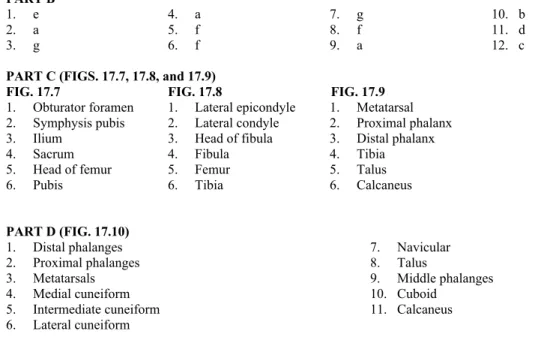
PART B
1. e 4. a 7. g 10. b
2. a 5. f 8. f 11. d
3. g 6. f 9. a 12. c
PART C (FIGS. 17.7, 17.8, and 17.9)
FIG. 17.7 FIG. 17.8 FIG. 17.9
1. Obturator foramen 1. Lateral epicondyle 1. Metatarsal 2. Symphysis pubis 2. Lateral condyle 2. Proximal phalanx 3. Ilium 3. Head of fibula 3. Distal phalanx
4. Sacrum 4. Fibula 4. Tibia
5. Head of femur 5. Femur 5. Talus
6. Pubis 6. Tibia 6. Calcaneus
PART D (FIG. 17.10)
1. Distal phalanges 7. Navicular
2. Proximal phalanges 8. Talus
3. Metatarsals 9. Middle phalanges
4. Medial cuneiform 10. Cuboid
5. Intermediate cuneiform 11. Calcaneus