___________________________________________
* Copyright © 2006 by the Consortium for Computing Sciences in Colleges. Permission to copy without fee all or part of this material is granted provided that the copies are not made or distributed for direct commercial advantage, the CCSC copyright notice and the title of the publication and its date appear, and notice is given that copying is by permission of the Consortium for Computing Sciences in Colleges. To copy otherwise, or to republish, requires a fee and/or specific permission.
PROJECT-BASED WEB APPLICATION DESIGN AND
DEVELOPMENT COURSE
*Heidi J. C. Ellis
Computer Science Department Trinity College
Hartford, CT 06106 860-297-4175 [email protected]
ABSTRACT
Distance education has grown significantly in the past decade and this rate of growth shows little sign of slowing in the coming years. The demand for skilled software developers with project experience is also rising. Distributed software development is one particularly difficult aspect of incorporating projects into an online software engineering course. This paper compares the performance of students on a team project in online and face-to-face sections of a project-based Web Application Design and Development course. Performance factors examined include the number of iterations and the number of days required to finalize project documents, course grades, project grades, and results of a survey that asks student opinions on the project experience and overall opinion of the course.
1. INTRODUCTION
In the fall of 2004, U.S. News and World Report Online [15] identified over 2700 regionally accredited academic institutions in the U.S. that offered distance education courses for credit for their survey on e-learning, an increase of over 700 institutions from the same time the previous year. The growth of the Open University around the world reflects this escalation in online education internationally. In addition, the changing face
of distance education indicates that the population of adult, online learners is both growing and becoming more diverse [7].
This growth of online education coupled with the need for software developers skilled in working in teams has given rise to an increasing number of online courses which involve distributed or virtual teams. As a result, the investigation of distributed team performance in computer science courses is an area of growing interest [12]. Several authors have studied communication and collaboration patterns to determine the effect on virtual team performance. Hause et al [6] studied communication patterns between distributed team members involved in a team project as part of an undergraduate computer science course at two different universities located in Sweden and the U.S. Hause et al studied how communication changed over the semester, and results of the study indicated that communication is critical to team success in a distributed environment. Amponsah [1] also studied collaboration and communication patterns in two distributed work teams in a Human Computer Interface (HCI) course at a university located in the U.S. Amponsah studied and categorized the communication of two teams as they developed an innovative human-computer interface as well as devised documentation for the interface. Results of the study found that communication mechanisms should be matched to the type of task in order to facilitate team success. At the graduate level, Last [11] presented a study of virtual teams in a distributed project course. Last used grounded theory methodology to examine the communication patterns of distributed teams. Results of the study provide some additional evidence that good communication is crucial to the success of distributed teams.
Several authors have studied virtual team performance in order to identify facilitating and impeding factors to distributed team success. Steinfield [14] identifies challenges faced by virtual teams including team dynamics, schedule differences, adapting to new technology, and difficultly in forming relationships. Aids to successful virtual teams include support for both synchronous and asynchronous communication, availability of shared workspace and storage, awareness of schedule differences across team members, and tool support for distributed workflow and project management.
Koppelman et al [10] studied distributed team projects in an HCI course that was offered collaboratively at several Dutch universities. The authors of this study noted some interesting effects. Students in the study appeared to be more highly motivated, lending support to the theory that online students are more self-motivated in their learning. The instructor took more of a guidance role rather than a leader role, another feature of providing an autonomous learning experience for the student. The authors also noted that good tools are critical to supporting online education.
Purvis et al [13] discuss their experiences in a cross-nation collaboration where distributed teams from two universities in different countries (New Zealand and Germany) collaborated to develop a multi-player online game. The authors identify issues related to differences in academic schedules, lack of clear requirements, conflict over team responsibilities and shared component, and cultural issues as impacting the development experience.
This paper presents a comparison of online and face-to-face student performance on a semester-long team project. Section 2 provides background on the course and its motivation, and section 3 discusses the study environment including a description of the
virtual team construction. Three different forms of assessment and a comparison of performance results for online and face-to-face groups are described in section 4, while section 5 contains the conclusion.
2. BACKGROUND
The environment of the study is a Masters-level Web Application Design and Development course taught at a U.S. institution. The course is run in a 15-week semester and has an audience of working professionals. Students have an average age of 33 and most are employed full-time, typically in some sort of a software position and therefore are technologically savvy. In addition, approximately 24% of students have advanced degrees in other areas including engineering and the sciences.
The Web Application Design and Development course is an introductory graduate-level course intended for students in their first year of graduate study. The only prerequisites are an object-oriented data structures course and a working knowledge of Java and HTML. The main goal of the course is to educate students in the architectures, practices, and key technologies used to develop and support a commercial-grade web site from client side through to server. Deliverables include a midterm and a final exam, each worth 20% of a student’s final grade, and a semester-long, student-defined, team project which is worth 60% of the student’s final grade.
Since the Fall of 2000, the Web Application Design and Development course has been structured around Knowles’ theory of andragogy [8,9] and other principles of adult learning [2,3,4,5]. The student-defined project has been central to supporting the adult learning principles of providing relevancy-oriented learning, providing adult students with a self-directed learning experience, using work or professional experience as a foundation upon which learning activities are based, and providing practically-oriented and goal-oriented learning.
The team project used in the Web Application Design and Development course is based on the concept of allowing students to define both the domain and application for a project, as well as to define their own requirements for the selected application. As part of the process of project definition, students are provided with three documents. The Project Assignment defines the format and content of the deliverable that describes the students’ project. As part of their project description, students must define a grade specification for grades of A, B, and C. The Minimum Project Standards defines the minimum standards for the project and includes the three sections of functional requirements, design requirements, and implementation requirements. The Example Project Assignment document provides students with a completed project definition for a sample custom bicycle order domain. Students are provided these three documents during the third week of class and have two weeks to complete their project requirements. The instructor provides immediate feedback on the project requirements and communicates with teams that have problems with their requirements with the goal of all student teams having an approved set of project requirements before the middle of the semester. The self-directed team approach to supporting adult learning has been employed successfully in the course when taught using a face-to-face format [2,3,4,5].
3. THE ENVIRONMENT
During the Spring 2004 semester, two sections of the Web Application Design and Development course were offered, one using the traditional face-to-face format and the second using an online format. Both sections were taught by the same instructor, also the author of the study. The face-to-face section was taught in a computer classroom one night a week for three hours. Lectures were supported by PowerPoint slides and workshops were used to allow students explore some of the course concepts. The online section was taught asynchronously during the same 15-week semester via video-streaming of taped lectures using the same course material. Online students could view material at their own rate with the restriction that they take the midterm and final exam within the same week’s time-span as the face-to-face group. The only true synchronous interaction required with the instructor was scheduling a time to present their final projects at the end of the course. A single WebCT site was used to support both sections.
During the spring 2004 semester, a total of 47 students completed the Web Application Design and Development course, with 23 students in the face-to-face section and 24 students in the online section. The instructor encouraged students to get to know their peers in both sections by requiring introductions on the common WebCT bulletin board. Team formation occurred during the third and fourth week of the course. Students were allowed to form their own teams and team members could come from both the online and face-to-face sections. The instructor did not have to aid any students in forming teams. A total of 23 teams were formed, with 11 distance teams (10 teams of 2 and one team of one), and 10 face to face teams (two teams of three, seven teams of two, one team of one). In addition, there were two teams that contained one member who was in the face-to-face section and the remainder of the team was in the online section (one team of two and one team of three). In the face-to-face teams, one team of three had a team member move to Russia in the middle of the semester.
The projects chosen by the teams were similar to previous student projects in both scope and application. While there was little duplication in topic, there was little difference in topics between the online projects and the projects selected by face-to-face teams. Project topics included online journals, customer support applications, personal finance applications, and various scheduling applications.
After formation, student teams were encouraged to use the forms of communication which best suited the team. No communication or project development tools were provided other than the WebCT platform. The virtual teams used email as their primary form of communication and there were several distributed teams who had never even heard their team member’s voices upon project demonstration. In addition, several teams used source code control tools to manage their project.
4. LEARNING EVALUATION
Successful learning may be measured by using a variety of different approaches including an analysis of grades, using a pre and post test, and by soliciting student opinion. In this paper, learning was measured by examining the three main aspects of
grades, project performance, and survey results. These assessments are discussed in the sections below.
4.1 Grades
An examination of the final grades provides high-level insight into the performance of online students as compared to their face-to-face peers. Since the project was 60% of a student’s final grade, the project had significant impact on the final grade. The final letter grades for spring 2004 (based on a range of A, B, C, and F) for both the online and face-to-face sections included a total of 12 As (25.5%), 33 Bs (70.25), 2 Cs (4.25%). The online section contained 9 As (45%), 10 Bs (50%), and 1 C (5%). Therefore the distance section had 75% of all As given in the course and only 30% of the Bs and 50% of the Cs. These results show an overall higher success rate of students in the online section when compared to their face-to-face peers.
The high, low, median, and mean raw course scores (based on a range from 0 to 100) for both groups and the two groups together are shown in Figure 1. It is interesting to note that the face-to-face group had a wider spread of scores, but the online section had consistently better performance as evidenced by the higher course grade average and median figures.
Face to Face Online Both Groups
High 95.80 93.20 95.80
Low 70.20 68.40 70.20
Mean 83.43 85.50 85.32
Median 84.00 87.00 85.40
Table 1. Raw Course Grades 4.2 Project
Student performance on the project can be examined based on several criteria. The process by which the project requirements document was approved was an iterative cycle of submission and revision until the requirements document met the instructor’s approval. While the requirements document itself was not graded, one measure of student performance is the number of iterations required for students to get an approved requirements document. The overall average number of iterations required to get a final requirements document was 3. The online students had an average of 2.85 iterations and local students required 3.20 iterations on average. The lower average number of iterations for online students may indicate that, due to the distributed form of communication, the online teams took greater care to ensure that the requirements document was complete. Another measure of student performance, albeit less accurate, is the average number of days required for teams in the online and face-to-face sections to get a final set of requirements documents. The online group required an average of 31.1 days while the face-to-face teams required an average of 37.4 days. While the instructor attempted to
edit and return project requirements documents within two days, this measure of performance is somewhat less accurate due to variability in instructor response times.
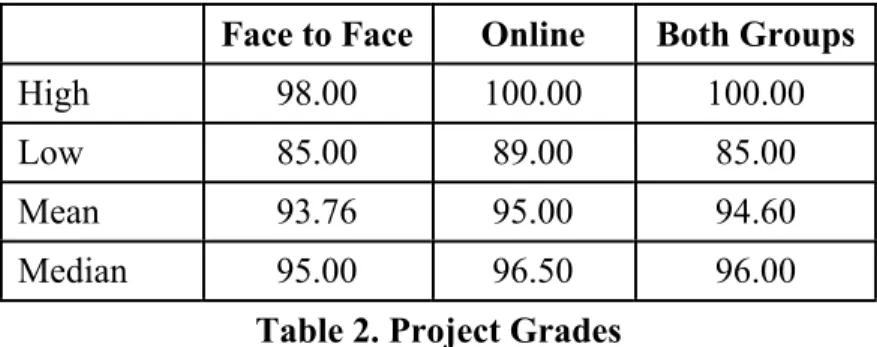
The last measure of student project performance is a comparison of the average project grades for both groups. Note that all team members received the same project grade. Table 2 shows the high, low, mean, and median project grades for the face-to-face group, the online group and both groups together. Note that the online group had a slightly higher project scores overall.
Face to Face Online Both Groups
High 98.00 100.00 100.00
Low 85.00 89.00 85.00
Mean 93.76 95.00 94.60
Median 95.00 96.50 96.00
Table 2. Project Grades
Based on the criteria of number of requirements iterations, days needed to create an acceptable requirements document and project grades, the online students, on average, demonstrated better performance on the project. This result is somewhat surprising as it could be expected that the online teams had more significant communication costs which could negatively impact performance. However, this performance differential may be the result of the online students being a more self-motivated group.
4.3 Survey Results
The survey-based evaluation of student performance in online and face-to-face virtual teams is part of a larger study on the effectiveness of approaches to autonomous learning that has been ongoing since fall 2001 [5]. As part of the larger study, students complete an anonymous survey on their opinions and satisfaction with the level of self-determination used in the Web Application Design and Development course.
The survey consists of 19 questions and uses a five-point Likert scale to assess statements about a student’s learning experience. Survey responses were transformed into numeric form with a range of 1 to 5 where the “strongly disagree” category mapped to a value of 1, the “neutral” category mapped to a value of 3, and the “strongly agree” category mapped to a value of 5.
Table 3 shows the survey questions pertaining to the team project as well as two questions on students’ overall satisfaction with the course. The survey was administered twice during the semester, once in the initial quarter of the semester and once at the very end of the semester after students had completed the final exam and demonstrated their projects. Results from the final surveys only are discussed in this section as the final surveys reflect student opinion after having fully experienced the project-based approach. The response rates for the final survey were 82.6% for the face-to-face group and 91.3% for the online group, providing a relatively high level of confidence in the results.
9. I like the level of self-determination used in project domain selection.
10. The range of domains for selecting a topic is/was adequately defined by the instructor. 11. I like the level of self-determination used in project functionality definition.
12. The definition of required project functionality by the instructor is/was sufficient to support project development.
13. The guidance provided by the instructor during project definition is/was sufficient. 14. The guidance provided by the instructor during project development is/was sufficient. 15. The project development process is/was rigorously defined.
16. The project development process is/was overly rigorously defined. 17. The project development process is/was insufficiently defined.
18. I expect to be/am very satisfied with my learning experience in this course. 19. Overall, I am very satisfied with this course.
Table 3. Project-related survey questions
Cronbach’s alpha was used on the final responses to questions 8 through 15, 18, and 19 (the survey questions that asked about student opinion of the learning experience in the positive form) for both groups to determine the reliability of the survey answers. Results of Cronbach’s alpha indicate a reliability of ? = 0.917, signifying a high degree of consistency across the questions related to student learning.
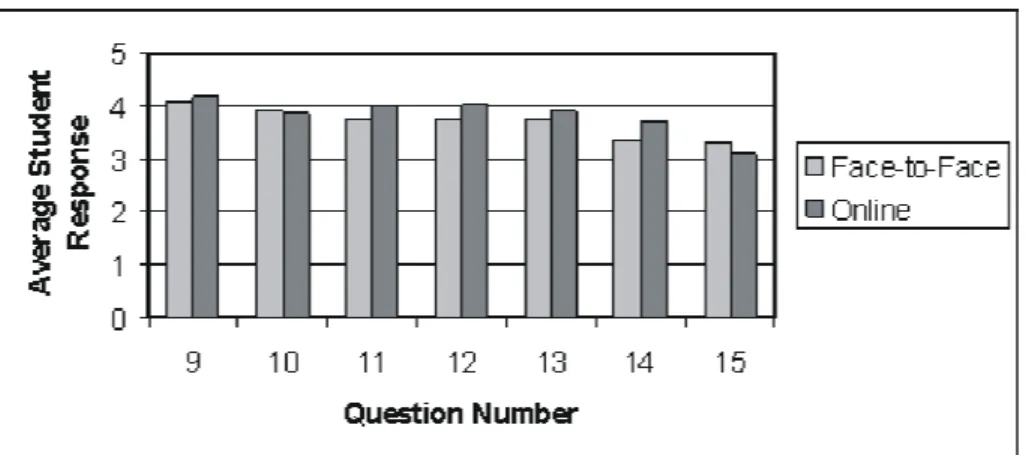
Figure 1 shows a comparison of the average final responses for the online and face-to-face sections of the Web Application Design and Development course for the positively worded questions about student opinions of the student-defined project approach (questions 9-15).
One obvious feature of Figure 1 is that the opinions of the online students were more positive with respect to domain selection and project definition and development. In addition, for questions 9 through 13, average results for the online students approached the “Agree” category. These results appear to indicate that the online students were
relatively satisfied with the student-defined project approach. However, both groups of students appeared to be close to neutral on the sufficiency of the project development process (question 15). It is interesting to note that for this question alone, the online group was less satisfied than their face-to-face counterparts. This lower result may indicate a need to provide a more defined development process to both groups of students, and that the online section requires somewhat more structure during development.
Figure 2 shows the comparison of the average, final results of the two survey questions on student opinion of the team project where the questions were phrased in the negative (questions 16 and 17). While question results indicate that both sections were positive about the project experience, once again, the online section was clearly more positive about the experience than the face-to-face section, as evidenced by the lower average response. This result may be indicative of the online student’s greater familiarity with an independent learning experience.
To provide a view of overall satisfaction with the course, Figure 3 shows the average final results of the satisfaction of the online and face-to-face groups with the Web Application Design and Development course (questions 18 and 19). Both groups show results close to the “Agree” level (4), indicating satisfaction with the course.
While there was no significant difference in overall course satisfaction between the online and face-to-face sections (Q18 t=0.6816, df=21; Q19 t= 0.3855, df=21), it is interesting to note that the online students indicate a greater overall satisfaction with the course while the face-to-face students exhibit a greater satisfaction with their learning experience. Once again, this difference may be a result of the online students’ increased exposure to a more autonomous learning experience. Another possible reason for these results is that the online and face-to-face groups may obtain satisfaction from different aspects of the course. While the online students appear to obtain fulfillment from the autonomy allowed by the self-directed approach to project definition and development,
Figure 2. Student opinion of team projects – negative questions.
face-to-face students may derive gratification from other aspects of the course such as in-class interaction.
4.4 Discussion
The comparison of the face-to-face and online groups across the three broad categories of final grades, project development, and survey results show that the online group had a slightly higher level of achievement in the Web Application Design and Development course. While the grades achieved by both the online and face-to-face groups were comparable to previous offerings of the course, the online group showed a higher percentage of As. The online group was also somewhat more efficient in the development of the project requirements as evidenced by the relatively shorter time and lower number of iterations required to develop an acceptable set of requirements. The online group also reported a slightly greater satisfaction with the course as a whole.
While these results do not indicate a statistically significant difference between the two groups, the evidence supports the hypothesis that the online group attained at least the same level of achievement and satisfaction in the course as their face-to-face peers. Some possible reasons for the success of the online student group include that online students in the study seemed to take greater care to ensure that they were fulfilling the course obligations. They were more likely to contact the instructor with questions and the questions that they asked tended to revolve around ensuring that they understood and met course requirements. The online teams also appeared to communicate more precisely. As might be expected, much of the communication among online team members was electronic and this format may encourage team members to be more concise in their interactions. Another factor that may have contributed to the success of online teams is that the online environment promotes a more independent learning process and therefore online teams may be more accustomed to working autonomously. The online teams therefore may be more comfortable with less formal structure during project development.
5. CONCLUSION
This paper has presented a comparison of student performance on a team project in online and face-to-face sections of a Web Application Design and Development course. Three general assessment mechanisms were used to examine the differences in performance. Results of all three measures indicated that the students in the online section performed at least as well or better than students in the traditional, face-to-face section. While the results of the three forms of evaluation described in this paper appear to provide substantial evidence that online students perform well on distributed teams, the nature of the forms of measurement impart little insight into the factors that impacted the student success in this study. In order to get a more complete picture of the reasons why the online section had slightly better performance on team projects than their face-to-face peers, additional research must be performed to determine the characteristics that cause this difference. One area of future exploration is the study of the communication within teams, to determine both the amount and type of communication. Another aspect of investigation is the influence of student background on performance in online teams. In
particular, a similar study of undergraduate teams could provide insight into the impact of differences in experience on performance. An examination of the software engineering methodologies and tools employed by project teams may also shed some light on reasons for the performance of both face-to-face and online teams.
REFERENCES
[1] Amponsah, K. Patterns of Communication and the Implications for Learning among Two Distributed-Education Student Teams. Proceedings of 2003 SIGDOC, San Francisco, CA, Oct. 2003.
[2] Ellis, H.J.C., and Mitchell, R. Self-Grading in a Project-Based Software Engineering Course. 17th Annual Conference on Software Engineering Education and Training, Norfolk, VA, Mar. 2004.
[3] Ellis, H.J.C., Student-Directed Learning in a Graduate Software Engineering Course, The 2004 Frontiers in Education Conference, Savannah, GA, Oct. 2004. [4] Ellis, H.J.C. Transfer of Knowledge in a Web Design and Development Course. The
2003 Frontiers in Education Conference, Boulder, CO, Nov. 2003.
[5] Ellis, H. J. C. Andragogy in a Web Technologies Course. Proc. of 33rd SIGCSE, Covington, KY, Feb. 2002.
[6] Hause, M., Marian, P., and Woodroffe, M. Performance in international computer science collaboration between distributed student teams. The 2003 Frontiers in Education Conference, Boulder, CO, Nov. 2003.
[7] Howell, S. L., Williams, P. B., and Lindsay, N. K. Thirty-two Trends Affecting Distance Education: An Informed Foundation for Strategic Planning. Online Journal of Distance Learning Administration, Volume VI, NumberIII, Fall 2003. Downloaded November 15, 2004 from:
http://www.westga.edu/~distance/ojdla/fall63/howell63.html
[8] Knowles, M., Andragogy in Action, Jossey-Bass, San Francisco, 1984.
[9] Knowles, M., et al, The Adult Learner: The Definitive Classic in Adult Education and Human Resource Development, Gulf Publishing, Houston, TX, 1998.
[10] Koppelman, H., van Dijk, E. M. A. G., van der Mast, C. P. A. G., and van der Veer, G. C. Team Projects in Distance Education: a Case in HCI Design. Proceedings of 2000 ITiCSE Conference, Finland, 2000.
[11] Last, M. Z. Understanding the Group Development Process in Global Software Teams, The 2003 Frontiers in Education Conference, Boulder, CO, Nov. 2003. [12] Powell, A., Piccoli, G., and Ives, B. Virtual teams: a review of current literature and
directions for future research. ACM SIGMIS Database, 35, 1, (Winter 2004), 6-36. [13] Purvis, M., Purvis M., and Cranefield, S. Educational Experiences from a Global Software Engineering Project. Proceedings of the 2004 Austrailian Computing Education Conference, Australia, 2004.
[14] Steinfield, C. Realizing the Benefits of Virtual Teams. IEEE Computer, 35, 3, Mar. 2002, 104-106.
[15] U.S. News and World Report Online – Elearning Directory. (2004). Retrieved October 29th, 2004 from the World Wide Web: