Adnan Khali d*a,Dr. Muhammad Shahbaz b, Dr. Athar Masoodc d
Department of Computer Science, Government College University Lahore, Pak istan, adnan_k [email protected]
d
Department of Computer Science and Engineering, University of Engineering and Technology, Lahore Pakistan, [email protected], [email protected]
Department of Engineering Manamgnet, University of engineering & Technology, Texila
Abstract: Cloud computing has emerged as the next big technological breakthrough in the field of computing. There is however a huge debate leading to many misconceptions about what a cloud is. In this paper we aim to provide a concise definition of cloud computing by restricting the cloud according to certain basic principles. We will first discuss the prevalent concepts of cloud computing and will try to identify the inadequacies therein. We will then try to differentiate the services of the cloud from its types in order to provide a clearer picture of cloud computing . Then we will discuss certain parameters that are essential co mponents of cloud computing and without which a service could not be considered cloud oriented. Then we would move on to identify the various relationships between cloud providers and cloud users and would try to remove confusions related to the concept of cloud providers. Finally we will provide a concise definition of cloud computing with an aim to set certain boundaries to it.
Ke ywor ds: Cloud computing, users of cloud, definition of cloud computing, services of the clouds
1 IN TRO DUC TION
Cloud computing is perhaps the most talked about technological advancement in the field of computing in the recent years. With the cloud emerging as the next in; thing many have tried to explain what cloud computing is. The expectations from cloud computing as the re-shaper of IT industry have caused many commentators to associate every possible service available in the computing world with the cloud. So much so, that the CEO of oracle LARRY ELISSON described cloud computing in the following words; “The interesting thing about cloud computing is that we’ve redefined cloud computing to include everything that we already do… I don’t understand what we would do differently in the light of cloud computing other than change the wording of some of our ads.” (Armbrust, 2010). Larry Ellison has hit the nail on the head when it comes to identifying the major proble m with the current definitions of cloud computing. It is the inability of the e xperts to restrict the definition of cloud computing according to its distinct principles and features that causes people to think that cloud computing is just a different label for a lready prevalent technologies such as grid computing and utility computing.
What is cloud c omputing belie ve d to be?
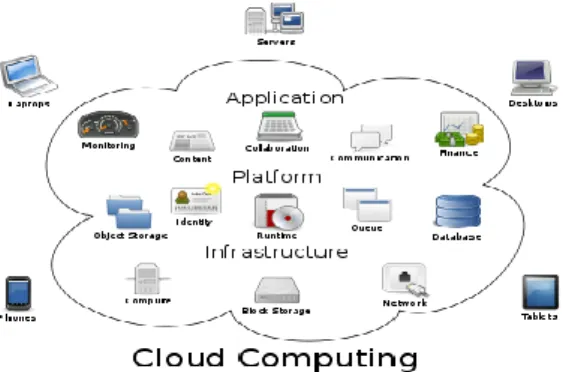
Cloud computing is the use of computing resources (hardware and software) that are shared as services over a network (typically the Internet). It is called “ Cloud” computing because a cloud-shaped symbol is often used to represent large networks especially the internet. As evident from Figure.1, the c loud is in fact a symbol that emphasises the comple xity of infrastructure combined in system diagra ms. Cloud computing uses remote services to deal with a user's data, software and computation needs and relieves the user of the responsibility of managing these needs. Financia lly, the ma in benefit of c loud computing is that customers only use the resources they actually need without caring for pea k usage, and only pay for what they actually use without speculating and worrying about the future. Resources are available to be accessed from the cloud at any time, and fro m any location through the internet. There is no need to worry about how things are being managed at the back end. The users simply purchase the IT service they require as they would any other utility. Because of this, cloud computing has also been referred e xtensively as utility co mputing. (Bal, 2012) In a co mputing world where physical resource as well as development platform is increasingly becoming a huge investment for the IT industry, the concept of a highly scalable pool of hardware and software resources has emerged as a breath of fresh air (Armbrust, 2010). The notion of no upfront commit ment by the resource user leading to a “pay as you
go” scenario gives cloud computing a powerful backbone that allows organizations to save a huge amount of investment. The fact that now companies do not necessarily have to pre -emptively buy resources to meet peak usage allows the m to only pay for as many resources as they use saving a huge chunk of money for them.
Figure 1 B asic Cloud Computing Arc hitecture
Char acteristics of Cl oud Computing
Cloud computing is a technology aimed at facilitating convenient network access to a shared collection of configurable computing resources (i.e. networks , servers, physical and virtual storage devices, applications and services) that can be rapidly provided and launched with the least amount of management effort or service -provider interaction (NIST). Fo llo wing are the necessary requisites for cloud computing. These parameters should be achieved in order to truly deem any service as being cloud -based and without them being manifested the true cloud computing technology would not be imple mented. (Dillon and Wu, 2010)
On de mand self-ser vice
A consumer who needs instant computing resources can be provided with the required resources (such as CPU-time, network storage, software, virtual storage, development platform etc.) in an automatic (i.e. convenient, self-provisioned and scalable) fashion without having the need of any human being interacting with providers of such resources.
The required computing resources are provided over the network mostly the internet and are used by various clients (applications) that have varied platforms including sma rt phones and mic ro-co mputers typically laptops and PDAs located at the consumer's end. The broad network access provides extre me utility and enhances the scope of the benefits provided by cloud computing.
Resource pooling
Co mputing resources provided by cloud service providers are pooled (i.e . collected together) in an effo rt to serve multiple consumers. This is achieved by either using “multi-tenancy” featuring mult iple users of the same resources or by virtualization featuring virtual mach ines representing physical hardware . Th is is made possible by having different physical resources as well as virtual resources dynamically assigned and reassigned in wake of fluctuating demand of the consumer (Dillon and Wu, 2010). Econo mies of scale and specialization of resources act as the motivational forces behind the concept of a pool oriented computing paradig m. The result of such a collective model is the obscurity of physical computing resources. This means that the resources are hidden from the consumers. The consumers do not have the knowledge of the location, structure, and origins of the resources they are using. For exa mple, consumers are unable to tell the location where their data is supposed to be stored in a particular Cloud. This allows a truly fle xible provision of resources to the consumers and hence enables resource pooling without giving away the manage ment structure of the resource provisioning mechanis m.
Rapi d elasticity
Rapid elasticity ensures that computing resources become scalable rather tha n absolutely fixed. This means that for the consumers there are no upfront commit ments or contracts. The users can scale up resources whenever they want and get rid of them once they are no more in need of them and decide to scale down. Moreover, resource provisioning appears to be infin ite to them. Th is ensures that resource availability can rapid ly rise in order to meet peak require ments at any time and can then come down to the daily require ment by releasing resources that are not required.
Co mputing resources maybe shared by mult iple users (i.e. mu lt i-tenancy) in a cloud environment yet the cloud infrastructure can use prescribed mechanisms to measure the use of these resources for individual users. Multiple consumers benefit ing fro m the cloud can be metered individually using the metering methods emp loying in c loud computing.
2 DIFFER ENCE B ETWEEN TYPES AND S ERVICES OF CLOUDS COMPUTING
Go ing through various articles and research papers, we have identified that the premiu m cause of confusion in the definition of cloud computing is the constant misunderstanding of its types and services. People often refer to the services of cloud computing as if they we re three d istinct types of clouds rather than being three diffe rence service models provided by the cloud. We are of the view that defining cloud computing in terms of the various services provided by the cloud creates ambiguity and unjustifiably broadens the scope of cloud computing . The concern of Larry Ellison’s (CEO oracle) abou t too many things being put into the cloud arises due to this very confusion. (Armbrust, 2010)
Types of cloud
Clouds can be divided into three types based primarily on the size of the network, the number of users and the security of access. They are public, private and hybrid clouds.
Public Cl ouds
Public c louds describe the traditional meaning of c loud computing technology. They represent scalable, dynamica lly available , usually virtualized resources shared over the Internet. The offsite third party provider rations resources and bills its customers on the basis of utilizat ion also termed as pay -as-you-go. An exa mple is Think Grid, a co mpany that provides a multitenant architecture for providing services including Software asaService (SaaS), PlatformasaSe rvice (PaaS), hosted storage etc. Other popular cloud vendors include Sales -force and Amazon EC2. The public nature of the cloud poses some serious threats to the security of the data in question (Ryan, 2011)
Private Cl oud
Private cloud is a term used to refer to a computing architecture providing hosted services on private networks. La rge companies emp loy this type of cloud computing to provide in -house services for customers within the organization. The corporate network and data-centre admin istrators can setup a local cloud for their customers. However, private clouds nullify many of the benefits of cloud computing ma inly because organizations need to buy, configure and manage their personal clouds and hence cannot avail the true benefits of cloud computing in terms of a co mmit ment-less fle xib le availability of resources.
Hybri d Cl oud
A hybrid cloud environment combines resources from both internal and external providers and hence has the potential to become the most popular choice for businesses and organizations. For exa mp le, a company could choose to use a public cloud service for its day to day computing, but would store its business -critica l data emp loying its own data centre. One of the reasons of employing a hybrid cloud may be that organizations of magnitude and repute are like ly to have already made heavy investments in the infrastructure required to provide resources in-house. Another reason could be that they may be concerned about the security of public clouds. In fact a ma jor obstacle in the use of public clouds has been the lack of data security (Ryan, 2011) offered by the public c louds and perhaps that is the reason private clouds have emerged as a choice for enterprises.
Virtual pri vate cloud
A specialized type of cloud is the cryptographic cloud storage introduced by researchers at Microsoft (Anthes, 2010). Th is specialized storage solution provides the security rendered by a private cloud while ensuring cost savings inherent of a public cloud.
While many people diffe rentiate cloud on the basis of three different service models, we believe that all the three basic services of the cloud are hiera rchal in a way that one provides the platform for the others. The service models are as follows:
Software as Ser vices (SaaS)
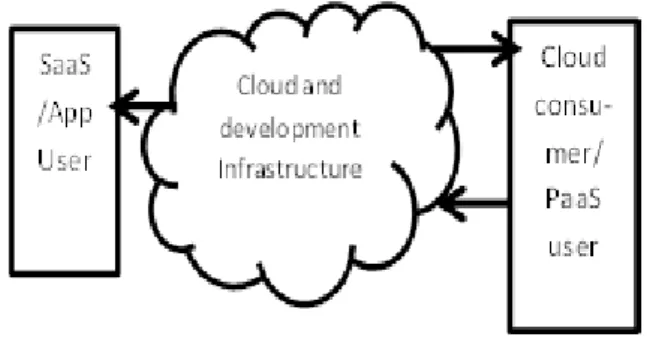
As shown in Figure.2, in this service model the cloud consumers introduce their respective applications on a hosting environment that can be accessed through various network-based clients by different users. The clients could be web browsers, PDAs, desktops etc. This is the most commonly used service of the cloud but it also is the most misunderstood one and hence a lot of confusion and debate has come forth in re lation to this service model. (A rmbrust, 2010)
Figure 2 S oftware as a Ser vice Platfor m as a service (PaaS)
Cloud consumers can develop and release their applications on the cloud by using the PaaS provided by the cloud. The developed applications are then available for SaaS users t o use as Figure.3 suggests . With the platform licenses becoming increasingly expensive and with software development emerging as a huge industry PaaS has become a potentially ground breaking aspect of cloud computing. If harnessed properly this service of the cloud can reap unimaginable benefits in the times to co me.
Infr astructure as a service (IaaS)
Figure 4 shows that cloud consumers in this scenario are d irect users of the infrastructure and normally co mprise of PaaS or Saa S providers. They use the hardware resources provided by the cloud in form of virtual machines and data centers. This allows them to have high end physical resources without the huge cost associated.
Figure 4. Infrastructure as a Ser vice
The services in a way represent functionality of the cloud in layered structure with infrastructure as a services being the bases on which platform-as-a-service rests which in turn provides a base for software as a service. Having closely studied cloud computing with re ference to the services and properties of cloud co mputing , we have understood the software as a service is often wrongly considered as an exa mple of c loud computing without ensuring if the infrastructure was scalable fle xib le and was paid for on the basis of usage.
According to our understanding IaaS is essential for the provision of PaaS and only a prerequisite combination of IaaS and PaaS can ensure proper cloud base SaaS. This can be seen in Figure 5. Hence to refer to every SaaS as being cloud-based is not appropriate until a proper analysis of the platform and infrastructure in use is carried out to see if the infrastructure and/or the platform was truly scalable or not.
Figure 5 Layere d Structure of Ser vices of the clouds
3 IDENTIFICATION OF TH E CLOUD US ER
We often view ourselves as cloud users when we use software-as-a-service (SaaS) on the internet. This however is the major root of misunderstanding as far as the ambiguity in the definition of cloud computing is concern ed. In most cases the end user availing the services is in fact a SaaS user getting the services from a SaaS provider. The SaaS provider is actually the cloud user and is responsible for ma intenance of resources both in terms of infrastructure and platform. Hence we now understand that SaaS itself is not a cloud but is in fact a service generated by the user of the cloud.
Cloud Computing can have different models of provider and user relationship. Follo wing is an effort to elaborate on how the roles change from c loud providers to cloud users to service users.
Figure 6 Relati onshi p between cl oud pr ovi der and user
Scenario 1
The cloud provider might be an IaaS provider with the cloud user being responsible for both platform and software. In this scenario the cloud only provides the infrastructure in the form of hardware or virtual resources and the cloud user is responsible for the platform to use and the software to avail as a service. In such scenario the use of SaaS might not directly be considered as the use of cloud computing. It is in fact the use o f infrastructure that displays cloud computing and the platform and software are a rranged for by the cloud user. We need to reme mber that in this case cloud computing truly works only at the infrastructure level.
Figure 7 User Scenari o 1
Scenario 2
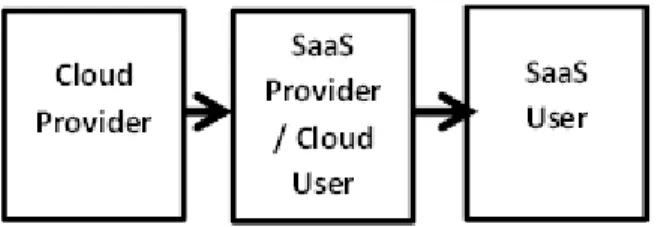
The cloud provider might provide both the infrastructure and platform with the cloud user being responsible for the provision of services . In this scenario the cloud consists of the infrastructure and the development platform and the cloud provider is responsible for the uninterrupted availability of both these resources. The software being shared for use by the end user is organized and released by the cloud user or the SaaS provider. Re me mbe r that is this scenario SaaS is not purely a service of the cloud but is provided by an SaaS provider.
Figure 8 User Scenari o 2
Scenario 3
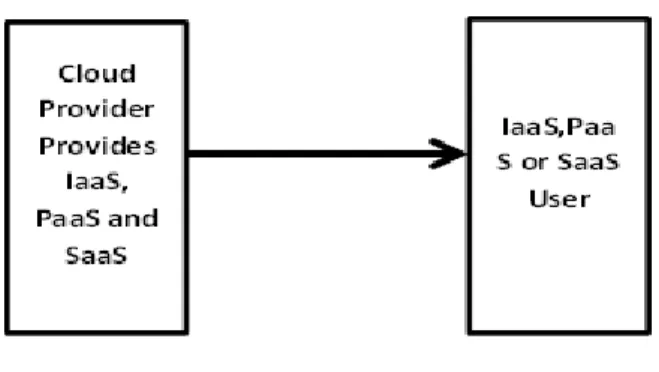
In a third scenario all three services might be provided by the cloud provider. Here the cloud provider would be the one setting up the hardware or virtual resources, the platform and would a lso release the software available for the SaaS users. Here Saa S purely manifests as a service of the cloud.
Figure 9 User Scenari o 3
Understanding cloud computing in these terms, we imply that the basic unit of cloud computation is infrastructure as service and the other two services are built upon it.
4 A CONCIS E DEFINITION OF CLOUD COMPUTING
Although the definition of cloud co mputing provided by the National Institute of Standard and technology (Mell and Grance, 2009) tries to explain cloud computing but being 800 words long it serves as more of an essay than a definit ion. We therefore, a re ma king an effort to actually define the technology.
“Cloud computing refers to the computing technology whereby resources (both hardware and software) are shared over a network typically the internet ensuring that the end user receives a highly scalable infrastructure on a pay as you go basis. The end user of t he cloud may be a software-as-a-service (SaaS) or platform-as-a-service (PaaS) provider or a direct user of infrastructure. The core of cloud computing, however, lies in the fact that the infrastructure i.e. the hardware and \or the platform is leased, flexible and scalable and is paid on a per usage basis.”
5 CONCLUS ION
The literature revie w and the in depth study of cloud computing technology has brought us to the conclusion that it is the constant misunderstanding of the services provided by the cloud that has led many to doubt the importance of cloud computing altogether. We therefore have made an effort to discuss and remove as many amb iguities as possible and provide a concise definition of c loud computing.
6 REFERENCES
1. Ba l, S.N, “ Clouds for Diffe rent Serv ices”. In IJCSI International Journal o f Co mputer Sc ience Issues, Vo l. 9, Issue 4, No 1, Pages 273-277, July 2012, ISSN (Online): 1694-0814)
2. Armb rust, M., Fo x, A., Griffith, R., Joseph, A.D., Kat z, R., Konwinski, A., Lee , G., Patterson, D., Rabkin, A., Stoica , I., and Zaharia, M. “A Vie w of the c loud”. In Co mmunications of the acm april 2010 vol. 53 no. 4 Pages 50-58
3. http://csrc.nist.gov/publications/nistpubs/800-145/SP800-145.pdf
4. Dillon, T. and Wu, C. “ Cloud Co mputing: Issues and Challenges”. In 2010 24th IEEE International Conference on Advanced Information Networking and Applications, Pages 27 -33
5. Mell, P., and Grance, T. "Dra ft nist working definit ion of cloud co mputing - v15," 21. Aug 2009, 2009. 6. Ryan, M.D. “ Cloud Co mputing Privacy Concerns on Our Doorstep”, communications of the acm,
January 2011 vol. 54 no. 1 Pages 36-38
7. Anthes, G. “Security in the Cloud” co mmunications of the acm, November 2010 vol. 53 no. 11 Pages 16-18