SIMPLE (2,1)-SPARSE MATROID
T.A. MCCOURT AND A. NIXON
Abstract. A simple graph G = (V, E) is a (2,1)-circuit if |E| = 2|V| and |E(H)| ≤
2|V(H)| −1 for every proper subgraphH ofG. Motivated, in part, by ongoing work to un-derstand unique realisations of graphs on surfaces, we derive a constructive characterisation of (2,1)-circuits. The characterisation uses the well known 1-extension andX-replacement operations as well as several summation moves to glue together (2,1)-circuits over small cutsets.
1. Introduction
For a finite (multi)graph G = (V, E) let iG(X) denote the number of edges induced by X ⊂V. The graphG is (k, `)-tight if|E|=k|V| −` and iG(X) ≤k|V| −`for all X ⊂V. For` <2kthe (edge sets of) (k, `)-tight graphs form the bases of a matroid [10, 18]. These matroids are examples of count matroids (see [4]); we refer to them as the (k, `)-sparse matroid, and when loops and multiple edges are prohibited, as the simple (k, `)-sparse matroid.
A simple (respectively multi-) graph Gis a (k, `)-circuit ifG is the graph induced by a circuit in the simple (k, `)-sparse matroid (respectively the (k, `)-sparse matroid). Equiv-alently a graph G is a (k, `)-circuit if |E| = k|V| −`+ 1 and iG(X) ≤ k|V| −` for all X (V.
A constructive characterisation of a class of graphs is a method of building all graphs in the class from certain base graphs by elementary operations. Constructive characteri-sations of classes of graphs (or other objects) from small base cases by elementary local transformations are natural and relevant to a variety of problems. In particular in the field of combinatorial optimization [9]. As particular motivation for us we seek a means to un-derstand when a generic realisation of a graph on a surface is globally rigid (unique up to isometries), see [7, 8] for details on the geometry of this problem. A related construction for circuits in the (2,3)-sparse matroid [1] was a vital aspect of the characterisation of global rigidity in the plane [6] and we expect that the construction here, along with the construc-tion for circuits in the simple (2,2)-sparse matroid, will be crucial in establishing analogues for global rigidity on surfaces supporting either two (e.g. the cylinder) or one (e.g. the cone or torus) tangentially acting isometries. See [11, Conjecture 5.7] and [7, Conjecture 9.1].
Constructive characterisations of (k, `)-tight (multi)graphs are known, for example when k = ` [17] and more generally when l ≤ k [3]. For simple graphs the requirement that each intermediate graph be simple means that new constructions are required. Whenk= 2 constructions are known for several classes [12, 13, 14].
For (k, `)-circuits less is known, however some general constructions, such as whenk=` can be extracted from work on tree packings [5]. In this paper we are interested in simple (k, `)-circuits. Fork = 1 the problem is easy. When k= 2, and ` = 3, there is an elegant result of Berg and Jord´an [1]. It is easy to check that the minimum degree, δ(G), in a
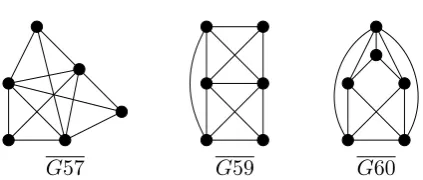
G57 G59 G60
Figure 1. Base graphs on six vertices.
(2,3)-circuit G is equal to three. They proved first that every (2,3)-circuit which was 3-connected contains an admissible degree three vertex, that is a degree three vertex which can be removed and an edge added between its neighbours in such a way that the resulting graph is a (2,3)-circuit. To complete their constructive characterisation they observed that whenever G was not 3-connected there is a 2-separation {x, y} and xy /∈ E. Such a graph can be broken into two smaller (2,3)-circuits by separating over this cut and adding the edgexy to both parts. (This is the inverse of the well known 2-sum operation.)
For (2,2)-circuits one must distinguish between the multigraph and simple graph cases. For multigraphs a constructive characterisation occurs as a special case of a characterisation of highly k-tree connected graphs [5]. For simple graphs there is a constructive character-isation in [11]. It is a nontrivial extension of Berg and Jord´an’s result in the following senses: firstly since K4 can occur as a subgraph of any (2,2)-circuit, it is non-trivial to
preserve simplicity; secondly the connectivity level required to guarantee admissibility is higher (requiring 3-connectivity and essential 4-edge-connectivity); and thirdly when these connectivity assumptions do not hold there are several separation moves required.
In this paper we consider simple (2,1)-circuits and in particular, we prove a constructive characterisation of such circuits where every intermediate graph is also simple. At a high level the scheme is analogous to the above cases: we establish the connectivity level required to guarantee an admissible vertex and when this fails we define separation moves to pull apart (2,1)-circuits into smaller (2,1)-circuits. However, in the (2,1)-circuit case their are numerous complications to previous cases. Firstly observe that (2,1)-circuits need not have δ(G) = 3, thus we are forced to consider a degree four operation. Secondly since K4
is not a base in the simple (2,1)-sparse matroid we separate out two cases in our result guaranteeing an admissible vertex of degree three. Thirdly, due to the connectivity level required to guarantee an admissible node, there are six different separations that can occur.
1.1. Terminology. We now define the set G of base graphs for our constructive charac-terisation. Note first that K5 is the unique (2,1)-circuit on at most five vertices. There
are five distinct graphs formed from deleting three edges from K6. Deleting a one factor
leaves a 4-regular graph which has an admissible vertex by Theorem 1.2. Deleting a degree three star does not give a (2,1)-circuit. The other three possibilities are the complements of G57, G59 and G60 as listed in [16] (see also Figure 1).
There are 65 non-isomorphic graphs formed from deleting seven edges fromK7; of these
34 are (2,1)-circuits. Two of these are 4-regular and hence contain an admissible node by Theorem 1.2. Of the remainder note that if there is a node not in a copy ofK4 then either
adding a missing edge creates a K5 subgraph or that node is admissible. This
G293 G308 G312
Figure 2. Base graphs on seven vertices.
S2 S3 S4
[image:3.595.148.414.117.201.2]S1
Figure 3. Base graphs on eight vertices.
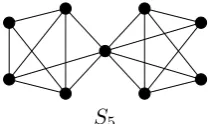
S5
Figure 4. Base graphs on 9 vertices.
A further five base graphs of orders eight and nine arise in the proof of the recursive construction; there are four on eight vertices (graphs S1, S2, S3 and S4 in Figure 3) and
there is one on nine vertices (graph S5 in Figure 4).
Hence we defineGto be the set{K5, G57, G59, G60, G293, G308, G312, S1, S2, S3, S4, S5}.
For a graph G let δ(G) denote the minimum degree of a vertex in G. A k-edge-cutset is a set of k edges whose removal disconnects a graph. If one of the components, of the resulting disconnected graph, contains only a single vertex then we say that the k-edge-cutset is trivial. Otherwise it is non-trivial. A graph is essentially k-edge-connected if it has no non-trivial (k−1)-edge-cutsets. Since (2,1)-circuits haveδ(G) ∈ {3,4} this will be a useful notion for us.
[image:3.595.228.333.428.490.2]As outlined above, when a circuit is sufficiently connected we will show that either a 1-reduction or an inverseX-replacement can be applied to form a new circuit. In the cases where a circuit is not sufficiently connected we will apply inverse ‘summation’ moves to reduce to a smaller circuit.
There will remain a handful of cases where the circuit, G say, is invariant under these inverse ‘summation’ moves. In order to deal with these cases we will construct a new circuit G∗ which is a, sufficiently connected, multigraph. We will then show that there exists a 1-reduction or inverse X-replacement that can be applied to G∗ to yield a new circuit. Finally we use this to show that an analogous 1-reduction or X-replacement could have been applied inG to yield a new circuit.
Let M∗(2,1) denote the set of all multigraphs that are (2,1)-circuits and let M(2,1) denote the set of all simple graphs that are (2,1)-circuits. The multigraph circuits that we construct in the manner referred to above are all elements of the subset M⊆M∗(2,1) defined as follows.
LetM0 be the subset ofM∗(2,1) whereG∈M0 if and only if – Gis 3-connected;
– the maximum edge multiplicity is three;
– all the vertices in G incident with a multiple edge have degree greater than three;
– ifG contains a loop, then the vertex incident with the loop has degree greater than three and it is not incident with any multiple edges;
– ifG= (V, E) contains a vertex,v say, incident to two loops thenV ={v}; and – if there are any triple edges inG, then they are incident with vertices of degree greater than or equal to five, and hence, G must contain vertices of degree three.
ThenM=M(2,1)∪M0.
Note thatM(2,1)⊂M⊂M∗(2,1). With this in mind, letting G∈M, we call
• a vertex of degree three inG anode;
• a node v of G admissible if there is a 1-reduction removing v that results in a (2,1)-circuit in which the added edge is between previously non-adjacent vertices;
• a degree four vertexvinGadmissibleif there is an inverseX-replacement removing v that results in a (2,1)-circuit in which the added edges are between pairs of previously non-adjacent vertices.
As M(2,1) ⊂ M, in the case where G ∈ M(2,1) the resulting circuit is also in M(2,1). (The reader may find the motivation behind the results in Section 3 clearer if these results are thought of in the restricted case of M(2,1); we will not need the general case until the end of the proof of Theorem 1.1.) We will use G∗ to refer to the set of base graphs in M. The elements ofG∗\M(2,1) will be derived in Section 3.
1.2. Results. Our main result is as follows.
Theorem 1.1. A simple graph G is a (2,1)-circuit if and only if it can be generated re-cursively from G∈Gby applying 1-extensions and X-replacements sequentially within con-nected components and taking sums of concon-nected components.
In order to prove the theorem we first establish admissibility when the minimum degree is 4.
Theorem 1.2. Every essentially 5-edge-connected (2,1)-circuit G not equal to K5 with
From there, the key technical step to proving Theorem 1.1 is to establish admissibility, in theδ(G) = 3 case, whenG is sufficiently connected.
Theorem 1.3. Let G = (V, E) be a 3-connected (2,1)-circuit with δ(G) = 3 and G 6∈ G. Suppose either
(i) Gis essentially 5-edge-connected and there is no proper critical set or (ii) Gis essentially 4-edge-connected and there is a proper critical set.
Then G contains an admissible node.
Proper critical sets are defined in Section 3 and the reason for splitting the above theorem into these two cases is purely technical.
1.3. Outline of paper. In Section 3 we prove Theorem 1.3 establishing that whenever a (2,1)-circuit hasδ(G) = 4 then either it has an admissible vertex or it has a small separating set of edges. In Section 2 we prove Theorem 1.2 establishing the analogue for the case when δ(G) = 3. In Section 4 we deal with graphs that are (2,1)-circuits but fail to be sufficiently connected. In Section 5 we combine our results to prove Theorem 1.1.
2. X-replacement
An X-replacement is the deletion of two non-adjacent edges ab, cdand the addition of a vertex v adjacent to a, b, c, d. The inverse operation is the deletion of a degree four vertex and the addition of two non-adjacent edges between the neighbours. ForG= (V, E), define f(G) = 2|V| − |E|, so that a graphG is a (2,1)-circuit if and only if f(G) = 0 and every proper subgraph H satisfies f(H)≥1. If Gis a (2,1)-circuit and v∈V, then we say that v is admissible if there is an inverse X-replacement onv resulting in a (2,1)-circuit. Lemma 2.1. A graph Gis a (2,1)-circuit with δ(G) = 4 if and only ifG is connected and 4-regular.
Proof. Let G = (V, E). If G is a (2,1)-circuit with δ(G) = 4, then G is 4-regular and a
simple counting argument implies thatGis connected. Conversely, ifGis connected and 4-regular then |E|= 2|V|. Suppose H= (V0, E0) is a proper subgraph ofGwith|E0| ≥2|V0|
thenH has average degree at least four. SinceHis proper andGis connected we contradict
the 4-regularity ofG.
With this lemma, the following theorem can be extracted from [2]. For completeness we provide an alternate proof.
Theorem 1.3. Every essentially 5-edge-connected (2,1)-circuit G ∈ M(2,1) not equal to
K5 with δ(G) = 4 contains an admissible vertex.
Proof. LetG= (V, E).
Claim 2.2. Let v ∈ V. Then v is non-admissible if and only if every possible inverse X-replacement on v results in a non-simple graph.
Proof of Claim. If every inverse X-replacement on v creates a multigraph, then clearly v
It follows thatG0 is not simple if and only if in G, v is (a) contained in a copy ofK4 or
(b) there is x∈N(v) (the neighbour set of v) adjacent to every other vertex inN(v). We next show that no subgraph of G is isomorphic to K4. Suppose otherwise, i.e., that
H is a subgraph ofG isomorphic toK4. As Gis 4-regular there is a 4-edge-cutset between
H andG−H, sinceG6=K5 this cutset is non-trivial.
We complete the proof by showing that eitheru or one of its neighbours are admissible. (In fact, eitheru or three of its neighbours are admissible.) Let N(u) =w, x, y, zand note that u is not in a copy of K4. Hence if u is not admissible then, say, xy, xz, xw ∈ E.
Let N(y) = {u, x, r, s} and note that, since u is not in a subgraph isomorphic to K4,
r, s∈ V − {u, x, y, z, w}. By 4-regularity ur, xs are not in E. Thus Claim 2.2 implies y is
admissible.
3. The 1-extension Operation
In this section we prove Theorem 1.3. We start with some facts (Lemmas 3.1 to 3.6) about (2,1)-circuits that can be proved by simple counting arguments. See [1] or [11] for similar results. Crucial to the problem is that we must retain simplicity throughout the recursive construction. We achieve this, in Subsection 3.2, by establishing conditions for a (2,1)-circuit with δ(G) = 3 to have nodes not contained in subgraphs isomorphic to K4. Finally in Subsection 3.3 we loosely follow the method established in [1] to deduce
admissibility for some node.
3.1. Preliminaries. Let G = (V, E) be a (2,1)-circuit. A subset X ⊂ V is critical if i(X) = 2|X| −1 and is semi-critical if i(X) = 2|X| −2 and for all X0 ⊂ X we have i(X0)≤2|X0| −2. We are particularly interested in special kinds of critical sets. We define a critical setX⊂V to be: v-critical for a node v∈V ifXcontains exactly two neighbours ofvbut notvitself;node-critical ifX isv-critical for some nodev (whereN(v) ={x, y, z}) inV such thatx, y∈X and d(z)≥4; andproper if|X|<|V| −1. Note that node-critical sets are proper, but proper critical sets need not be node-critical. Suppose that A, B⊆V; then we denote the number of edgesuv∈Esuch thatu∈A−B andv∈B−Abyd(A, B).
Lemma 3.1. LetG= (V, E)be a(2,1)-circuit. ThenGis connected and 2-edge-connected.
Lemma 3.2. LetG= (V, E)be a(2,1)-circuit. LetX, Y ⊂V be critical sets, let|X∩Y| ≥1
and let |X∪Y| ≤ |V| −1. Then X∩Y andX∪Y are critical sets andd(X, Y) = 0.
Lemma 3.3. Let G = (V, E) be a (2,1)-circuit. Let v be a node with N(v) = {u, w, z}. Then removing v and adding uw is not admissible if and only if there exists a critical set
X ⊂V withu, w ∈X and v, z /∈X or uw∈E.
Lemma 3.4. LetG= (V, E)be a 3-connected(2,1)-circuit containing a nodevwithN(v) =
{w, u, z}, uz /∈E, wz, wu∈E. Then v is admissible.
Lemma 3.5. Let G= (V, E) be a (2,1)-circuit containing a node v withN(v) ={w, u, z},
uz, wu /∈E, wz∈E. Then v is admissible.
Let V3 = {v ∈ V : d(v) = 3}. Let V3∗ ⊂ V3 be the subset of degree three vertices not
contained in copies ofK4.
3.2. Finding Nodes. We now establish connectivity conditions that guarantee that, in a 3-connected, essentially 5-edge-connected (2,1)-circuitGwithδ(G) = 3, there exist nodes not contained in copies of K4. Since (the vertex set of) K4 is semi-critical, this is significantly
harder than the corresponding result in [11]. We will first prove two lemmas for (2,1)-circuits that contain proper critical sets, before proving their (simpler) analogues for (2,1)-circuits that contain no proper critical sets. We make this distinction as we can give a weaker edge-connectivity assumption for (2,1)-circuits that contain proper critical sets, than for (2,1)-circuits that do not (see Theorem 1.3).
3.2.1. Proper critical sets. We first consider the case when there exists at least one proper critical set.
Lemma 3.7. Let G∈Mbe essentially 4-edge-connected. Suppose that Gcontains a proper critical set X. Then |V3−X| ≥2 (and hence δ(G) = 3).
Proof. LetE0 be the set of edges betweenX andV −X. The sum of the degrees of vertices inX is 4|X| −2 +|E0|. The total sum of the degrees of vertices in Gis 4|V|. So the sum of the degrees inV −X is 4(|V| − |X|) + 2− |E0|. Hence, as δ(G)≥3 and the average degree of Gis four, there are at least two nodes that are not in X.
Lemma 3.8. Let G ∈ M be 3-connected and essentially 4-edge-connected. Let X be a critical set and let W = {Wi |1 ≤ i≤ n: Wi is critical or semi-critical}, where X 6∈ W. Let Y =V −(∪n
i=1Wi)−X. Suppose that either
(1) |Y| ≥2; or (2) A:=G[X]∪(∪n
i=1G[Wi])] is disconnected.
Then Y contains two nodes.
Proof. SinceG∈M, with vertices of V labelled as v1, v2, . . . , v|V|, we have |V|
X
i=1
(4−dG(vi)) = 0. (3.1)
Let A1, . . . , Am be the vertex sets of the connected components of A. For any pair of
semi-critical setsWi, Wj ∈W we have
2(|Wi|+|Wj|)−3 = 2|Wi∪Wj| −1 + 2|Wi∩Wj| −2
≥ i(Wi∪Wj) +i(Wi∩Wj) = i(Wi) +i(Wj) +d(Wi, Wj) = 2(|Wi|+|Wj|)−4 +d(Wi, Wj) (3.2)
so either d(Wi, Wj) = 0 or equality holds and d(Wi, Wj) = 1. Hence, wheneverWi and Wj have non-empty intersection, the union is semi-critical or critical. Similarly ifWi is critical, Wj is semi-critical and they have a non-empty intersection then the union is critical. (Note two critical sets with a non-empty intersection givesV, contradicting (1) and (2).)
Reordering if necessary, let A1, . . . , Ar be critical sets and let Ar+1, . . . , Am be semi-critical sets. Denote the vertices ofAj byu1, . . . , u|Aj| and define
fj =
|Aj| X
i=1
(4−dG[Aj](ui)).
and y` ∈V −Aj, where the x` ∈Aj (respectively they` ∈V −Aj) are not necessarily all distinct. Define
gj =
|Aj| X
i=1
(4−dG(ui)).
Hence, for 1≤j ≤r,gj ≤ −2 and, forr+ 1≤j≤m,gj ≤0. Now m
X
i=1
gj =−2r≤ −2 (3.3)
sincer ≥1. The result follows by comparing Equations (3.1) and (3.3).
Lemma 3.9. LetG= (V, E)∈Mbe 3-connected and essentially 4-edge-connected. Suppose that Gcontains a proper critical set X. Then |V3∗−X| ≥2.
Proof. IfGcontains no copies of K4, then V3∗=V3 and Lemma 3.7 yields the result.
So suppose that B1, . . . , Bn are the vertex sets of all the copies of K4 which are not
subsets of X. Let Y =V −(∪n
i=1Bi)−X and A=G[X]∪(∪ni=1G[Bi]). If |Y| ≥2 or Ais
disconnected, then we may apply Lemma 3.8 to yield the result.
Hence, suppose that |Y| ≤ 1 and A is connected. So, without loss of generality, there exists a t≥1, such that X∩Bi =6 ∅, for all 1≤i≤t. For each of these Bi, and a subset B0 ⊂ Bi, we have i(B0) = 2|B0| −α where α = 2 when |B0| ∈ {1,4} and α = 3 when
|B0| ∈ {2,3}. Thus, using a similar calculation to Equation (3.2) we have: if |X∩Bi|= 3, thenX∪Bi =V, contradicting the fact thatXis a proper critical set, and if |X∩Bi|= 2, thenX∪Bi =V, contradicting 3-connectivity. So we have that|X∩Bi|= 1. Ifd(X, Bi)>0 or the multiplicity of any of the edges in G[Bi] is greater than one, then X∪Bi = V, contradicting 3-connectivity. Sod(X, Bi) = 0 and G[Bi] is simple, for 1≤i≤t.
We define an auxiliary graph G† as follows. The vertex set isX, B1, . . . , Bn and there is
an edge between two vertices if and only if the corresponding sets in Gintersect. Claim 3.10. The graphG† is a tree.
Proof. First note that a path in G†either corresponds to a critical or a semi-critical set in G.
Suppose that G† contains a cycle. Let C= (c0, c1, . . . , c`) be such a cycle. Without loss of generality c0 corresponds to one of theBi, so letP be the path obtained by deleting c0
from C.
SupposeP corresponds to a critical setP0 =∪`
i=1ci inG, that isi(P0) = 2|P0| −1. Now let C0 = ∪`
i=0ci, note that C0 contains, at most, an additional two vertices from P0 and G[C0] contains an additional six edges fromG[P0], a contradiction.
SupposeP corresponds to a semi-critical setP0 =∪`
i=1ci inG, that is i(P0) = 2|P0| −2.
Then X is not a vertex ofP. Now let C0 =∪`
i=0ci, note that, as P0 is not critical, G[C0] contains an additional two vertices and an additional six edges fromG[P0]. HenceC0 =V, but does not contain X, a contradiction.
The claim follows from the connectivity of A.
AsB1 exists it follows from the claim thatAcontains a cut-vertex,v. AsAis connected
the vertex set ofAeither corresponds to a critical set in Gor it is V. In the first casev is part of a cut-pair inG(as |Y| ≤1) and in the second casev is a cut-vertex inG. In either
3.2.2. No proper critical sets. Now we deal with the case when there are no proper critical sets.
Lemma 3.11. Let G = (V, E) ∈ M be essentially 5-edge-connected. Suppose V contains no proper critical sets, let W1, . . . , Wk, withk≥1, be the vertex sets of all the copies ofK4
in G and let Y =V − ∪k
i=1Wi. Suppose that either
(1) |Y| ≥2; or (2) ∪k
i=1G[Wi]is disconnected.
Then G contains an admissible node.
Proof. If any of the Wi are critical sets (i.e., G[Wi] contains multi-edges or loops), then, as V contains no proper critical sets, |V| = 5 and neither (1) nor (2) hold. So, since G is a (2,1)-circuit, Equation (3.1) holds and Wi is semi-critical, for each 1 ≤ i ≤ k. Let A1, . . . , Ar be the vertex sets of the connected components of ∪ki=1G[Wi]. Observe that each of A1, . . . , Am is semi-critical.
Denote the vertices ofAj byu1,· · ·u|Aj|. Then
4 =
|Aj| X
i=1
(4−dG[Aj](ui)).
There are no non-trivial 4-edge-cutsets so, as at least one of (1) or (2) holds, there exists five edgesx`y`, 1≤`≤5, wherex`∈Aj and y`∈V −Aj (where thex` are not necessarily distinct and nor are the y`). Then
r
X
j=1 |Aj| X
i=1
(4−dG(ui))≤ −1. (3.4)
Comparing Equations (3.1) and (3.4) gives that |Y| contains a node v. Now v is not in a copy of K4 and since there are no proper critical sets, we can apply Lemma 3.3 to deduce
that v is admissible.
3.3. Admissibility.
Lemma 3.12. Let G= (V, E) be a(2,1)-circuit. Supposev∈V3∗ is a non-admissible node with N(v) ={x, y, z}. Then there exists two v-critical sets X, Y such that X∪Y =V −v.
Moreover, we may choose X, Y such that z∈X∩Y.
Proof. By Lemmas 3.4 and 3.5, since v is not admissible and v ∈ V3∗, there are no edges between x, y and z. Now 3.3 implies there exists critical sets X containing x, z but not y, v and Y containing y, z but not x, v. It follows from Lemma 3.2 and the definition of a (2,1)-circuit thatX∪Y is critical, henceX∪Y =V −v.
The following has essentially the same proof as the corresponding results for (2,3) and (2,2)-circuits, [1, Lemma 3.3] and [11, Lemma 2.10]; however we obtain a slightly stronger result.
Lemma 3.13. Let G= (V, E) be a (2,1)-circuit with δ(G) = 3. Let v∈V be a node with
N(v) ={x, y, z}, d(z)≥4 and suppose there are no edges between neighbours of v. Let X
be v-critical on x, y. Suppose either
(1) there is a non-admissible node u ∈ V −X−v where dG[V∗
3](u) = 2 with no edges
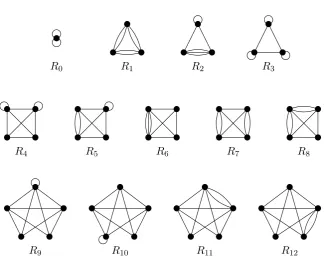
R0 R1 R2 R3
R4 R5 R6 R7 R8
[image:10.595.120.447.104.367.2]R9 R10 R11 R12
Figure 5. Circuits inG∗∩(M\M(2,1)).
(2) there is a non-admissible node u ∈ V −X −v where dG[V∗
3](u) = 0or 1 with no
edges between its neighbours.
Then, in G, there is a node-critical set X0 for a node with no edges between its neighbours such that X(X0.
Proof. Suppose (1) holds and let N(u) = {w, p, q}. As dG[V∗
3](u) = 2 we may assume that dG(p) = 3 and dG(q) ≥ 4. Since u is non-admissible and wp 6∈ E, by Lemma 3.3, there exists au-critical set, Y say, onwandp. Now,w∈X∪Y, andu, q6∈X∪Y, so by Lemma 3.2, X0 :=X∪Y is node-critical for u. Asp6∈X,X (X0.
So, suppose that (2) holds. Letrbe a neighbour ofuof minimum degree inG, by Lemma 3.12, there existu-critical setsY1 andY2 whose intersection containsrand Y1∪Y2 =V−u.
Hence, without loss of generality,X∩Y16=∅. As|N(u)∩X| ≤3, we consider four cases. If |N(u)∩X|= 0, then the setX0 =X∪Y1 is node-critical and, as|N(u)∩X|= 0, we have
that X(X0.
Suppose that |N(u)∩X|= 1, say N(u)∩X ={s}. If s∈Y1, then set X0 =X∪Y1 is
node-critical and, asN(u)−(X∪Y1)6=∅, we have that X (X0. So, assume that s6∈Y1,
that is s∈ Y2−Y1; hence X0 =X∪Y2 is node-critical and, as N(u)−(X∪Y2) 6=∅, we
have thatX (X0.
If|N(u)∩X|= 2, then the set X0 =X∪ {u}is node-critical and henceX (X0. Finally, if|N(u)∩X|= 3, then V =X∪ {u}, butv6∈X∪ {u}, a contradiction.
Before we prove Theorem 1.3 we establish the following lemma to deal with some small circuits.
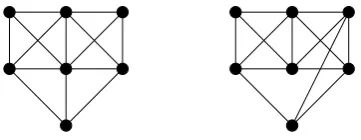
Figure 6. Potential base graphs on seven vertices.
Figure 7. Potential base graphs on eight vertices.
Suppose that G contains a copy of K4. Let W1, . . . , Wk, with k ≥ 1, be the vertex sets of all copies of K4 in G and let Y =V − ∪ik=1Wi. Further suppose that A=∪ki=1G[Wi]is connected and |Y| ≤1. Then G contains an admissible node.
Proof. First note that, asGcontains a copy of K4,|V| ≥4.
Suppose that |V| = 4. In this case V = W1 and as G is a circuit, G ∈ M0 (so G is a
multigraph). There are five possibilities for a circuit on four vertices: R4,R5,R6, R7, R8
(see Figure 5) all of which are contained inG∗.
Suppose that |V|= 5. Either there are two vertex sets underlying copies of K4 or there
is one set and an additional vertex of degree three. Note that these cases are equivalent, hence there are five possibilities for a such a circuit on five vertices: K5,R9,R10,R11,R12
(see Figure 5) all of which are contained inG∗.
Suppose that |V|= 6. As Y| ≤ 1, k ≥ 2 and any pair of distinct Wi, Wj intersect in either two or three vertices. Consider W1 and W2. If |W1∩W2|= 2, thenV =W1∪W2,
and asGis 3-connected it must be isomorphic toG59∈G. So suppose that|W1∩W2|= 3.
Then there exists a vertex v 6∈ W1∪W2. As W1∪W2 is a critical set v has degree three
and henceG is either isomorphic to G57 or G60, in either case G∈G.
Suppose that |V| = 7. As |Y| ≤ 1 and A is connected, k ≥ 2 and any two Wi, Wj intersect in either one, two or three vertices. However, as G does not contain a proper critical set|Wi∩Wj| 6= 3. If|W1∩W2|= 1, then asGis 3-connected it must be isomorphic
to either G308 or G312. In either case G∈G. So suppose that |W1∩W2|= 2. Then there
exists a vertex v 6∈W1∪W2. As W1∪W2 is a critical set v has degree three and as G is
3-connected it is isomorphic to one of the two graphs illustrated in Figure 6. In either case Lemma 3.5 or 3.4 implies the existence of an admissible node.
Finally, suppose that|V|= 8. AsAis connected and|Y| ≤1,k≥2 and for any pairWi, Wj, where 1 ≤i < j ≤k, |Wi∩Wj|= 0 or 1 and there exists a pair, say W1, W2, where |W1 ∩W2| = 1. Then there exists a vertex v 6∈ W1 ∪W2 and as G is 3-connected in this
case it must be simple and isomorphic to one of the three graphs illustrated in Figure 7; in each case Lemma 3.5 or 3.4 implies the existence of an admissible node.
[image:11.595.126.436.236.308.2]Theorem 1.2. Let G = (V, E) ∈ M be 3-connected with δ(G) = 3 and G 6∈ G∗. Suppose either
(i) Gis essentially 5-edge-connected and there is no proper critical set or (ii) Gis essentially 4-edge-connected and there is a proper critical set.
Then G contains an admissible node.
Proof. Suppose that (i) holds. There exists a vertexv of degree three. Ifv is not contained in a copy ofK4, then, as there are no proper critical sets, we can apply Lemma 3.3 to show
that v is admissible.
So we may assume that G contains a copy of K4. Let W1, . . . , Wk, with k ≥1, be the vertex sets of all the copies of K4 in Gand let Y =V − ∪ki=1Wi. By Lemma 3.11 we may
assume that ∪k
i=1G[Wj] is connected and |Y| ≤ 1. If G has less than 9 vertices, then, by Lemma 3.14, it is either in G∗ or has an admissible node.
So suppose G has at least 9 vertices. Since there are no proper critical sets, the only options for two copies of K4, with vertex sets Wi and Wj say, are that Wi ∩Wj = ∅ or
|Wi∩Wj|= 1 andd(Wi, Wj) = 0.
We define an auxiliary graphG‡as follows. The vertex set isW1, . . . , Wnand there is an edge between two vertices if and only if the corresponding sets in Gintersect.
Claim 3.15. The graph G‡ is either a tree or a cycle.
Proof. We show that if G‡ contains a cycle this must be the whole graph; then, as A is
connected, the claim follows. As Wi∩Wj = ∅ or |Wi ∩Wj| = 1 and d(Wi, Wj) = 0 for 1≤i < j ≤na path in G‡ corresponds to a semi-critical set inG.
Suppose thatG‡contains a cycle. LetC= (c0, c1, . . . , c`) and letP be the path obtained
by deleting c0 from C. Consider the set of verticesP0 =∪`i=1ci inG, then i(P0) = 2|P0| − 2. Now let C0 = ∪`
i=1ci and note that G[C0] contains an additional two vertices and an
additional six edges from G[P0]. HenceC0 =V.
If G‡ is a cycle, then |Y|= 0 and every edge of G is contained in one of the K4’s soG
has a cut-pair, a contradiction. Hence,G‡ is a tree.
As |V| ≥ 9 and A is connected, G‡ has at least three vertices. As Wi ∩Wj = ∅ or
|Wi ∩Wj| = 1 and d(Wi, Wj) = 0 for 1 ≤ i < j ≤ n, ∪ki=1Wi is a semi-critical set in G. Hence |Y| 6= 0, thus |Y|= 1. Denote the vertex in Y asv, as∪k
i=1Wi is a semi-critical set,
d(v) = 4. AsG‡ is a tree,Gcontains a cut-pair (the vertex vand one of the vertices in the intersection of a pair Wi,Wj that intersect); a contradiction.
Now, suppose that (ii) holds. Let X={X∪V |X is a node-critical set in G}. Suppose thatX=∅. By Lemma 3.9, |V3∗| ≥2 and, by Lemma 3.6,G[V3∗] is a forest. Letv be a leaf vertex of G[V3∗], then v is also a leaf in G[V3]. Thus v has a neighbour of degree greater
than three, and as vis not contained in a copy of K4 and X=∅, by Lemma 3.3,v must be
admissible.
So we may assume that X 6=∅. By Lemma 3.9 we have |V3∗| ≥2. By Lemmas 3.5 and 3.4, we may assume that each vertex in V3∗ has no edges between the neighbours.
Choose X ∈ X to be a maximal node-critical set chosen over all nodes inV3∗. Suppose X is node-critical for v on x, y where N(v) = {x, y, z} and dG(z) ≥ 4. By Lemma 3.9, V −X−v contains a node u ∈ V3∗ and, by Lemma 3.6, we may choose u to be a leaf in G[V3∗−X−v].
By the maximality of X, each vertex t ∈V −X−v−z has at most one neighbour in X. Hence dG[V∗
2|A| −1 2|B| −1 2|A| −1 2|B| −1
Figure 8. Illustration of the sum move for Case (1).
Thus Lemma 3.13 Part (1) and the maximality of |X|imply that u is an admissible node. IfdG[V∗
3](u) = 0 or 1, then Lemma 3.13 Part (2) and the maximality of|X|imply that uis
admissible.
4. Sum Moves
In this section we reduce the connectivity assumptions from the previous sections by defining operations that ‘pull apart’ (2,1)-circuits into two smaller (2,1)-circuits.
Consider a graph G= (V, E) that is either not 3-connected or has a non-trivial 4-edge-cutset. We will provide a series of lemmas that consider the cases where Gsatisfies one of the following:
(1) a cut-vertex x, A, B ⊂ V such that A ∩B = {x} and A ∪B = V such that i(A) = 2|A| −1 andi(B) = 2|B| −1;
(2) a cut-pairx, y(where neither are cut-vertices),xy /∈E,A, B⊂V such thatA∩B=
{x, y} and A∪B =V such that either (a) i(A) = 2|A| −2 andi(B) = 2|B| −2, or (b) i(A) = 2|A| −1 andi(B) = 2|B| −3;
(3) a cut-pairx, y(where neither are cut-vertices),xy∈E,A, B⊂V such thatA∩B=
{x, y} and A∪B =V such thati(A) = 2|A| −1 and i(B) = 2|B| −2;
(4) a 3-edge-cutset {xiyi :xi ∈A, yi ∈B,1 ≤i≤3}, where |{xi, yi |1≤ i≤3}|= 6, forA, B ⊂V, such thatA∩B =∅ and A∪B =V such that i(A) = 2|A| −1 and i(B) = 2|B| −2; or
(5) a 4-edge-cutset {xiyi :xi ∈A, yi ∈B,1≤i≤4}forA, B⊂V, such thatA∩B =∅
and A∪B =V such thati(A) = 2|A| −2 andi(B) = 2|B| −2.
Lemma 4.1. Let G= (V, E)be a graph satisfying (1) in the list above. Let ai, bi, ci, di, for i = A, B be eight distinct vertices not in V. Then G is a (2,1)-circuit if and only if the graphs Gi =G[i]∪(K5(ai, bi, ci, di, x)−e), for i=A, B, are(2,1)-circuits. (See Figure 8.)
Note that the choice of the missing edge in the K5−eis arbitrary.
Proof. Suppose GA and GB are (2,1)-circuits. Assume for a contradiction that G is not. Then there is a proper subset X⊂V with i(X) =i(A∩X) +i(B∩X) ≥2|X|. However i(A∩X)≤2|A∩X| −1,i(B∩X)≤2|B∩X| −1 and |A∩X|+|B∩X| ≤ |X|+ 1 so
2|X| ≥2(|A∩X|+|B∩X|)−2≥i(A∩X) +i(B∩X)≥2|X|.
Hence, we have equality throughout and in particulari(A∩X) = 2|A∩X| −1,i(B∩X) = 2|B∩X|−1 and (A∩X)∩(B∩X) ={x}. Nowi((A∩X)∪{aA, bA, cA, dA}) = 2|A∩X|−1+9 = 2(|A∩X|+4), so, asGAis a (2,1)-circuit, we have that (A∩X) =A. Similarly (B∩X) =B. Hence X=V, a contradiction.
Conversely, suppose Gis a (2,1)-circuit. Then for anyX⊂Awe have i(X)≤2|X| −1. Let Y ⊂ {ai, bi, ci, di, x}, theni(Y)≤2|Y| −1. Asx is a cut-vertex, i(X∪Y)≤2|X∪Y|, since |X ∪Y| ≥ |X|+|Y| −1. Note equality holds if and only if X = A and Y =
2|A| −2 2|B| −2 2|A| −2 2|B| −2
Figure 9. Illustration of the sum move for Case (2a).
Lemma 4.2. LetG= (V, E) be a graph satisfying (2) (a) in the list above. Let ai, bi, ci, di,
for i = A, B be eight distinct vertices not in V. Then G is a (2,1)-circuit if and only if the graphs Gi =G[i]∪(K4(ai, bi, ci, di)∪ {xai, ybi, xci, ydi} fori=A, B, are(2,1)-circuits.
(See Figure 9.)
Note that the proof holds for other choices of the 4-edge-cuts in GA and GB, provided two edges are incident with x, two are incident withy, simplicity is maintained and we do not choose the edge xy.
Proof. Suppose GA and GB are (2,1)-circuits. Assume for a contradiction that G is not. Then there is a proper subset X ⊂ V, containing at least one of x or y, with i(X) = i(A∩X) +i(B ∩X) ≥ 2|X|. First suppose that A∩X contains both x and y. Then i(A∩X) ≤ 2|A∩X| −2 with equality if and only if X∩A = A; similarly i(B∩X) ≤
2|B∩X| −2; and|A∩X|+|B∩X| ≤ |X|+ 2 so
2|X| ≥2(|A∩X|+|B∩X|)−4≥i(A∩X) +i(B∩X)≥2|X|.
Hence, we have equality throughout and in particulari(A∩X) = 2|A∩X| −2,i(B∩X) = 2|B∩X| −2. As noted above, this implies that (A∩X) = A and (B∩X) = B. Hence X =V, a contradiction.
Now suppose A∩X containsx but noty. Then |A∩X|+|B∩X| ≤ |X|+ 1. Thus 2|X| ≥2(|A∩X|+|B∩X|)−2≥i(A∩X) +i(B∩X)≥2|X|.
Hence, we have equality throughout and in particulari(A∩X) = 2|A∩X|−1 andi(B∩X) = 2|B∩X| −1. This is a contradiction as (A∩X)∪(B∩X) would induce a (2,1)-circuit not containing y.
Conversely, supposeGis a (2,1)-circuit. First note that for any subsetX⊂Acontaining xbut not yand any subsetY ⊂ {aA, bA, cA, dA}we havei(X∪Y)≤2|X∪Y| −1. Now for any X⊂Acontainingx andywe havei(X)≤2|X| −2 with equality if and only ifX=A. Let Y ⊂ {ai, bi, ci, di}, theni(Y) ≤2|Y| −2 with equality if and only if Y ={ai, bi, ci, di}. Thus i(X∪Y) ≤2|X| −2 + 2|Y| −2 + 4 = 2|X∪Y| where equality holds if and only if
X =A andY ={ai, bi, ci, di}.
Lemma 4.3. Let G be a 4-regular (2,1)-circuit which contains a cut-pair {x, y} such that one component of G[V \ {x, y}] is isomorphic to K4 on the vertices a, b, c, d; and {xa, xb, yc, yd} ∈E where z1, z2∈V \ {a, b, c, d, y} are neighbours ofx. Then x is admissi-ble.
Proof. The edgesz1a, z2b6∈G; so performing an inverse X-replacement onxthat introduces
the edgesz1aandz2byields a connected 4-regular graph. Hence, by Lemma 2.1, the resulting
graph is a (2,1)-circuit.
Lemma 4.4. Let G= (V, E) be a graph satisfying (2) (b) in the list above. Let aB, bB, cB, dB, eB be five distinct vertices not in V. Then Gis a(2,1)-circuit if and only if the graphs
2|A| −1 2|B| −3 2|A| −1 2|B| −2
Figure 10. Illustration of the sum move for Case (2b).
2|A| −1 2|B| −2 2|A| −2 2|B| −3
Figure 11. Illustration of the sum move for Case (3).
Note that the proof holds for other choices of the 4-edge-cuts in GA and GB, provided two edges are incident with x, two are incident withy, simplicity is maintained and we do not choose the edge xy. Moreover the choice of the missing edge inK5−f is arbitrary. Proof. Suppose GA and GB are (2,1)-circuits. Assume for a contradiction that G is not. Then there is a proper subset X ⊂ V, containing at least one of x or y, with i(X) = i(A∩X) +i(B ∩X) ≥ 2|X|. First suppose that A∩X contains both x and y. Then i(A∩X) ≤ 2|A∩X| −1 with equality if and only if X∩A = A. Similarly i(B ∩X) ≤
2|B∩X| −3 and|A∩X|+|B∩X| ≤ |X|+ 2 so
2|X| ≥2(|A∩X|+|B∩X|)−4≥i(A∩X) +i(B∩X)≥2|X|.
Hence, we have equality throughout. Hence, (A∩X) =A. Moreover,i(B∩X) = 2|B∩X|−3. Nowi((B∩X)∪ {aB, bB, cB, dB, eB}) = 2|B∩X| −3 + 13 = 2(|B∩X|+ 5), so, as GB is a (2,1)-circuit, we have that (B∩X) =B. HenceX =V, a contradiction.
Now suppose A∩X containsx but noty. Then |A∩X|+|B∩X| ≤ |X|+ 1. Thus 2|X| ≥2(|A∩X|+|B∩X|)−2≥i(A∩X) +i(B∩X)≥2|X|.
Hence, we have equality throughout and in particulari(A∩X) = 2|A∩X|−1 andi(B∩X) = 2|B∩X| −1. This is a contradiction as (A∩X)∪(B∩X) would induce a (2,1)-circuit not containing y.
Conversely, suppose G is a (2,1)-circuit. Clearly GA is a (2,1)-circuit. Note that for any subset X ⊂B containing x but not y we havei(X)≤2|X| −2 and so for any subset Y ⊂ {aB, bB, cB, dB, eB} we havei(X∪Y)≤2|X∪Y| −1.
Now for any X ⊂B containing x and y we have i(X) ≤2|X| −3 with equality if and only ifX=B. LetY ⊂ {aB, bB, cB, dB, eB}, theni(Y)≤2|Y| −1 with equality if and only if Y = {aB, bB, cB, dB, eB}. Thus i(X∪Y) ≤2|X| −3 + 2|Y| −1 + 4 = 2|X∪Y|where equality holds if and only if X=B and Y ={aB, bB, cB, dB, eB}.
We emphasise that in the following lemma that the edgexy is included in the count for iG(A) and iG(B).
Lemma 4.5. Let G= (V, E) be a graph satisfying (3) in the list above. Let aA, bA, cA, dA, aB, bB, cB, dB, eB be nine distinct vertices not in V. Then G is a (2,1)-circuit if and only
if the graphs GA = (G[A]−xy) ∪K4(aA, bA, cA, dA) ∪ {xaA, xbA, ycA, ydA} and GB =
(G[B]−xy)∪(K5(aB, bB, cB, dB, eB)−f)∪ {xaB, xbB, ycB, ydB} are (2,1)-circuits. (See
2|A| −1 2|B| −2 2|A| −1 2|B| −2
Figure 12. Illustration of the sum move for Case (4).
Note again that the proof holds for other choices of the 4-edge-cuts in GA and GB, provided two edges are incident with x, two are incident with y, simplicity is maintained and we do not choose the edge xy. Moreover the choice of the missing edge in K5−f is
arbitrary.
Proof. SupposeGA and GB are (2,1)-circuits. Assume, for a contradiction, that Gis not. Then there is a proper subsetX ⊂V, containing at least one of x ory, with either:
• iG(X) =iGA(A∩X) +iGB(B∩X)−1≥2|X|, ifx, y∈X; or
• iG(X) =iGA(A∩X) +iGB(B∩X)≥2|X|, ifx∈X and y6∈X.
First suppose thatx, y∈X. Then iG(A∩X)≤2|A∩X| −1 with equality if and only if X∩A=A. Similarly,iG(B∩X)≤2|B∩X| −2 and|A∩X|+|B∩X|=|X|+ 2 so
2|X|= 2(|A∩X|+|B∩X|)−4≥iG(A∩X) +iG(B∩X)−1≥2|X|.
Hence, we have equality throughout. So, (A∩X) = A. Also iG(B ∩X) = 2|B∩X| −2. Now iGB((B∩X)∪ {aB, bB, cB, dB, eB}) = 2|B∩X| −3 + 13 = 2(|B∩X|+ 5), so, as GB is a (2,1)-circuit, we have that (B∩X) =B. HenceX =V, a contradiction.
Now, suppose that x∈X buty6∈X. Then |A∩X|+|B∩X| ≤ |X|+ 1. Thus 2|X| ≥2(|A∩X|+|B∩X|)−2≥iGA(A∩X) +iGB(B∩X)≥2|X|.
Hence, we have equality throughout and in particulariG(B∩X) =iGB(B∩X) = 2|B∩X|−1. Then (B∩X)∪ {aB, bB, cB, dB, eB}would induce a (2,1)-circuit in GB not containingy, a contradiction.
Conversely, suppose G is a (2,1)-circuit. For any subset X ⊂ A containing x but not y and any subset Y ⊂ {aA, bA, cA, dA} we have iGA(X ∪Y) ≤ 2|X ∪Y| −1. Now, for any X ⊂ A containing x and y we have iG(X) ≤ 2|X| −1 with equality if and only if X = A. Let Y ⊂ {aA, bA, cA, dA}, then iGA(Y) ≤ 2|Y| −2 with equality if and only if Y ={aA, bA, cA, dA}. ThusiGA(X∪Y)≤2|X| −2 + 2|Y| −2 + 4 = 2|X∪Y|where equality holds if and only if X=A and Y =K4(aA, bA, cA, dA).
For any subset X ⊂B containing x but not y we have that iG(X) ≤ 2|X| −2 and for any subset Y ⊂ {aB, bB, cB, dB, eB} we have iGA(X∪Y) ≤ 2|X∪Y| −1, otherwise we contradict Gbeing a (2,1)-circuit.
Now for any X ⊂B containing x and y we haveiG(X)≤2|X| −2 with equality if and only if X =B. LetY ⊂ {aB, bB, cB, dB, eB}, then iGA(Y)≤2|Y| −1 with equality if and only ifY ={aB, bB, cB, dB, eB}. ThusiGA(X∪Y)≤2|X| −2−1 + 2|Y| −1 + 4 = 2|X∪Y| where equality holds if and only ifX =B and Y ={aB, bB, cB, dB, eB}.
Lemma 4.6. Let G= (V, E) be a graph satisfying (4) in the list above. LetaA, aB, bB, cB, dB, eB be six distinct vertices not in V. Then G is a (2,1)-circuit if and only if the graphs
GA = G[A]∪aA ∪ {x1aA, x2aA, x3aA} and GB = G[B]∪K5(aB, bB, cB, dB, eB) −f ∪
{y1r1, y2r2, y3r3}, for ri ∈ {aB, bB, cB, dB, eB}, are (2,1)-circuits. (See Figure 12.)
2|A| −2 2|B| −2 2|A| −2 2|B| −2
Figure 13. Illustration of a sum move for Case (5).
Proof. Suppose GA and GB are (2,1)-circuits. Let X ⊂ A and Y ⊂ B. First suppose X
contains x1, x2, x3 and Y contains y1, y2, y3, then i(Y) ≤ 2|Y| −2. As i(X) ≤ 2|X| −1,
i(X∪Y)≤2|X∪Y| −3 + 3 = 2|V|, with equality if and only ifX∪Y =V. Next supposeX containsx1 andx2 but not x3 and Y containsy1 andy2 but noty3. Theni(X)≤2|X| −1
and, asiGB ={aB, bB, cB, dB, eB}= 9,i(Y)≤2|Y| −2. Thusi(X∪Y)≤2|X∪Y| −3 + 2. Now supposeX containsx1, x2, x3 andY containsy1 but noty2, y3. Theni(X)≤2|X| −1
andi(Y)≤2|Y| −1. Thusi(X∪Y)≤2|X∪Y| −2 + 1. The remaining cases can be proved similarly.
Conversely, suppose G is a (2,1)-circuit. Then for anyX ⊂A we havei(X)≤2|X| −1 and when x1, x2, x3 ∈ X we have equality if and only if X = A. It follows that GA is a
(2,1)-circuit.
Let Y ⊂ {aB, bB, cB, dB, eB}, then i(Y) ≤ 2|Y| −1 with equality if and only if Y =
{aB, bB, cB, dB, eB}. Let X ⊂ B. If |X ∩ {x1, x2, x3}| = 0 or 1, then i(X) ≤ 2|X| −1,
thus i(X∪Y) ≤2|X| −1 + 2|Y| −1 + 1 = 2|X∪Y| −1. If |X∩ {x1, x2, x3}|= 2, then
i(X)≤2|X|−2, otherwiseX∪Awould be a (2,1)-circuit that does not contain all ofB, thus i(X∪Y)≤2|X|−2+2|Y|−1+2 = 2|X∪Y|−1. If|X∩{x1, x2, x3}|= 3, theni(X)≤2|X|−2,
with equality if and only if X =B, thusi(X∪Y) ≤2|X| −2 + 2|Y| −1 + 3 = 2|X∪Y|, with equality if and only ifX =B and Y ={aB, bB, cB, dB, eB}.
Recall that, e.g. in Theorem 1.3, we only want to deal with non-trivial 4-edge cutsets when there are no proper critical sets. We utilise this fact in the next lemma.
Lemma 4.7. Let G= (V, E) be a graph satisfying (5) in the list above. Let aA, bA, cA, dA, aB, bB, cB, dB be eight distinct vertices not inV and let E denote a set of four edges of the
form xy where x∈A, y∈B. For I ∈ {A, B}, if there are exactly:
• 3 distinct x’s in I, then let GI =G[I]∪K4(aI, bI, cI, dI)∪F1, where F1 is a set of
four edges such that each has exactly one end vertex inI, the degree of each vertex in
GI[I]is equal to their degree inG[I]and between them they have two, three or four
distinct end vertices in {aI, bI, cI, dI}, call the graphs in these cases type-2, type-3
and type-4 respectively and denote this set of end vertices byFI;
• four distinctx’s inI, then let GI=G[I]∪ {aI} ∪ {x1aI, x2aI, x3aI, x4aI};
Then we have the following.
(1) IfGI, for each I ∈ {A, B}, is either a type-3 or type-4(2,1)-circuits with no proper critical sets or type-2 (2,1)-circuits with the unique proper critical set I∪FI, then Gis a (2,1)-circuit.
(2) SupposeGis a(2,1)-circuit with no proper critical sets. Then ifGI, forI ∈ {A, B},
is type-3 or type-4, thenGI is a (2,1)-circuit with no proper critical sets; and ifGI, forI ∈ {A, B}, is type-2, then it is a(2,1)-circuit with the proper critical setI∪FI.
Proof. (1) LetX⊂AandY ⊂B. Then, asF∩I =∅,i(X)≤2|X| −2 andi(Y)≤2|Y| −2. Thus i(X∪Y)≤2|X∪Y| −4 +d(X, Y). We have thati(X∪Y) = 2|X∪Y|if and only ifi(X) = 2|X| −2,i(Y) = 2|Y| −2 and d(X, Y) = 4. This holds if and only ifX =A and Y =B and henceX∪Y =V. (Note that, if d(X, Y)<4 then i(X∪Y)<2|X∪Y|.)
(2) Suppose Gis a (2,1)-circuit with no proper critical sets.
First we consider the case where there are exactly three distinct x’s in A. Then for any X ⊂A we have i(X) ≤2|X| −2. This implies that i(X∪ {aA, bA, cA, dA}) ≤ 2|X∪ {aA, bA, cA, dA}|with equality if and only ifX contains all the x’s in Eand hence X =A. Hence, GA is a (2,1)-circuit. Suppose that GA contains a proper critical set. Then this critical set must either be of the form X∪ {aA, bA, cA, dA} where X ( A or of the form X∪FA where |FA|= 2 and X ⊆A. If the critical set is of the form X∪ {aA, bA, cA, dA} where X(A, theni(X∪B) = 2|X∪B| −1 and |X∪B|<|V| −1 (since|X|<|A| −1), contradicting the fact that G does not contain any proper critical sets. If |FA| = 2, then A∪FA is a proper critical set. The case where there are exactly three distincty’s in B is identical.
Next we consider the case where there are four distinct x’s in A. Then for any X ⊂A we havei(X)≤2|X| −2. This implies thati(X∪ {aA})≤2|X∪ {aA}|with equality if and only if X contains all thex’s inE and hence X =A. Suppose thatGA contains a proper critical set. Then this critical set must be of the form X∪ {aA} whereX (A and either: X contains exactly three of thex0s, in which casei(X) = 2|X| −2; orX contains all four of thex0s, in which casei(X) = 2|X| −3. In either casei(X∪B) = 2|X∪B| −1, contradicting the fact that G does not contain any proper critical sets. The case where there are four
distincty’s in B is identical.
5. A recursive construction
We need one final elementary lemma.
Lemma 5.1. Let Gbe a (2,1)-circuit and let G0 be formed from G by a 1-extension or an
X-replacement. Then G0 is a (2,1)-circuit.
Now we can prove our main result.
Theorem 1.1. A simple graph G is a (2,1)-circuit if and only if it can be generated
re-cursively from H ∈ G by applying 1-extensions and X-replacements sequentially within
connected components and taking sums of connected components.
Proof. (⇐) SupposeGis recursively generated by applying 1-extensions andX-replacements sequentially within connected components and taking sums of connected components. Then Lemmas 5.1, 4.1, 4.2, 4.4, 4.5, 4.6 and 4.7 together imply that Gis a (2,1)-circuit.
(⇒) Suppose thatG∈M(2,1).
• If G is essentially 5-edge-connected and δ(G) = 4, then Theorem 1.2 implies that there exists an admissible vertex (an inverse X-replacement can be performed at this vertex).
• If G is 3-connected, essentially 5-edge-connected, contains no proper critical sets andδ(G) = 3, then Theorem 1.3 (i) (restricted toM(2,1)) implies that there exists an admissible node (a 1-reduction can be performed at this node).
• IfG is 3-connected, essentially 4-edge-connected, contains a proper critical set and δ(G) = 3, then Theorem 1.3 (ii) (restricted toM(2,1)) implies that there exists an admissible node (a 1-reduction can be performed at this node).
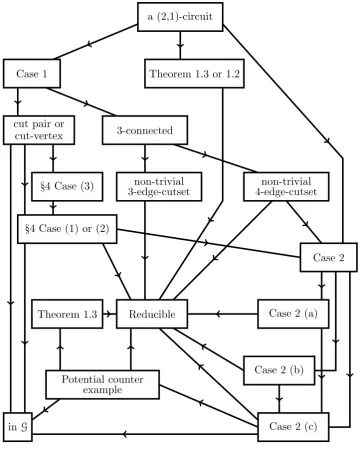
a (2,1)-circuit
Theorem 1.3 or 1.2 Case 1
cut pair or
cut-vertex 3-connected
§4 Case (3)
§4 Case (1) or (2)
Reducible non-trivial
3-edge-cutset 4-edge-cutsetnon-trivial
Case 2
Case 2 (a)
Case 2 (b)
Case 2 (c) Potential counter
example
inG
[image:19.595.100.462.121.573.2]Theorem 1.3
Figure 14. The interaction between cases in the proof of Theorem 1.1 .
(1) δ(G) = 4 andG is not essentially 5-edge-connected; or (2) δ(G) = 3 and either:
(a) Gis 3-connected, contains proper critical sets and non-trivial 3-edge-cutsets; (b) Gis 3-connected, contains no proper critical sets and is not essentially
5-edge-connected.
(c) Gis not 3-connected.
We illustrate how these cases interact during the following argument in Figure 14.
T1 T2
Figure 15. The graphs T1 and T2.
First, suppose that G contains a cut-vertex or a cut-pair. Then G satisfies either (1), (2a), (2b) or (3) in the list at the start of Section 4. If G satisfies (1), then we can apply Lemma 4.1 and reduce to two new (2,1)-circuits both with minimum degree three. If G satisfies (2a), then we can apply Lemma 4.2 to reduce to two new (2,1)-circuits unless one (or both) of A and B are isomorphic to the graph T1 (the cut pair inG correspond to the
degree two vertices in T1) shown in Figure 15. (If both ofAand B are isomorphic toT1 we
can apply two inverse X-replacements to achieve the graphS1 ∈G, see Figure 3.)
Hence, any potential counterexample arising from this case has no cut-vertices and any cut pairs,{x, y}say, satisfy: xy is not an edge and at least one of the ‘sides’ of the cut-pair is isomorphic toT1. Then, by Lemma 4.3, we can perform an inverse X-replacement atx.
IfGsatisfies (2b), then we can apply Lemma 4.4 to reduce to two new (2,1)-circuits (one has strictly fewer vertices than Gand the other has minimum degree 3). If Gsatisfies (3), then we can apply Lemma 4.5 to obtain two new (2,1)-circuits (these two circuits do not contain the edgexy, so we have moved to (2,1)-circuits satisfying (2a) or (2b)).
Next, suppose thatGcontains a non-trivial 3-edge-cutset but no cut-vertices or cut-pairs. Then we can apply Lemma 4.6 to achieve two new (2,1)-circuits both with minimum degree three.
Finally, suppose that G is 3-connected and contains a non-trivial 4-edge-cutset, but no non-trivial 3-edge-cutset.
Claim 5.2. G contains no proper critical sets.
Proof of Claim. Asδ(G) = 4, we have that G is 4-regular. Suppose that G did contain a
proper critical set S, then
X
v∈S
dG[S](v) = 4|S| −2.
However, asG is 4-regular this means there must be either a cut-vertex or a cut-pair inG,
contradicting the fact that Gis 3-connected.
Thus we can apply Lemma 4.7 to achieve two new (2,1)-circuits one with strictly fewer vertices than G and we can apply the lemma in such a way that the other has minimum degree three.
Case 2a: δ(G) =3, G is 3-connected, contains proper critical sets and non-trivial 3-edge-cutsets.
Suppose that G contains a non-trivial 3-edge-cutset, then we can apply Lemma 4.6 to form two new (2,1)-circuits. When we apply Lemma 4.6 we choose to do so such that the resulting circuits are strictly smaller and (by setting r1 =r2) not 3-connected respectively.
AsGdoes not contain a proper critical set it does not contain a non-trivial 3-edge cutset. HenceGcontains a non-trivial 4-edge cutset and we can apply Lemma 4.7 to form two new (2,1)-circuits. We can apply Lemma 4.7 so that either the resulting circuits have strictly fewer vertices thanG or, by the freedom in the choice of edges when applying Lemma 4.7, we may assume that they are not 3-connected.
Case 2c: δ(G) =3 and G is not 3-connected.
Suppose that there exists a cut-vertex in G, then we can apply Lemma 4.1 and reduce to two smaller (2,1)-circuits unless one (or both) of the sides of the cut are isomorphic to K5−e. If both sides are isomorphic to K5−e, we can, if necessary, reapply Lemma 4.1
until we obtain one graph, S5∈G(see Figure 4).
Now, suppose that there exists a cut-pair in G. Then G satisfies (2a), (2b) or (3). IfG contains a cut-pair that satisfies:
• (2a), then we can apply Lemma 4.2 to obtain two new smaller (2,1)-circuits, unless one side of the cut-pair is isomorphic toT1 (if both sides were isomorphic toT1, we
would haveδ(G) = 4);
• (2b), then we can apply Lemma 4.4 to obtain two new smaller (2,1)-circuits unless one of the sides of the cut-pair is isomorphic toT2; or
• (3), then we can apply Lemma 4.5 to obtain two new (2,1)-circuits (the edge xy occurs in G but in neither of the resulting circuits). The new (2,1)-circuits are either smaller or we have moved to case (2a) or (2b).
Assume G is a counter-example to the theorem (we will show that no such G exists), thenG has:
(I) every cut-vertex has one side isomorphic toK5−e; and
(II) every cut-pair {x, y} satisfiesxy 6∈E and has one side isomorphic toT1 orT2.
Associate the following multigraphG∗ withG: if (I) occurs inG, replace theK5−ewith a
loop at the cut-vertex; if (II) occurs in G, replace any occurrences ofT1 with a double edge
between the vertices of the cut-pair, and any occurrences ofT2 with a triple edge between
the vertices of the cut-pair. Note that:
• all the vertices inG∗ incident with a multiple edge have degree greater than three and thatG∗is 3-connected (otherwise we could have reducedGusing one of Lemmas 4.1, 4.2, 4.4 or 4.5);
• ifG∗contains a loop, then the vertex incident with the loop has degree greater than three and it is not incident with any multiple edges (else both sides of the 2-cut are not isomorphic toT1 orT2);
• ifG∗= (V, E) contains a vertex,v say, incident to two loops then V ={v}.
• if there are any triple edges inG∗, then they are incident to vertices of degree greater than or equal to five, and hence,G∗ must contain vertices of degree three.
Hence G∗∈M. See Figure 16 for an illustration of the construction ofG∗.
We will consider two cases, when δ(G∗) = 4 (and hence G∗ is 4-regular) and when δ(G∗) = 3.
First, suppose that δ(G∗) = 4 and G∗ 6= R1, hence G∗ is 4-regular and, as it is
3-connected, contains no proper critical sets (see Claim 5.2). As G∗ is 4-regular and 3-connected it cannot contain a loop or a triple edge. If G∗ contains a double edge, then it results from a copy ofT1inG; so, applying the same argument as in the proof of Lemma 4.3,
Figure 16. Illustration of the construction of the multigraphG∗.
So, suppose that δ(G∗) = 3. We will show that there is an admissible node v in G∗. Recall that G∗ is 3-connected and that any vertex of degree three is not incident with a loop or a multiple edge.
Claim 5.3. We may assume that the multigraph G∗ ∈ M\M(2,1) constructed from a counterexample G does not contain any non-trivial 3-edge-cutsets.
Proof of Claim. If G∗ contains a non-trivial 3-edge-cutset, then, as G∗ is 3-connected, G also contains a non-trivial 3-edge-cutset. In which case we can apply Lemma 4.6 to form two (2,1)-circuits. These circuits are both nonisomorphic to G (contradicting our assumption that G is a counterexample) unless one side of the edge-cutset is isomorphic to K5 −e.
Moreover, we can choose the cut-edges so that they are all incident with the same vertex in the copy of K5−e. At this stage we have a cut-vertexv with one side isomorphic toK5−e
and in our construction of G∗ this is replaced by a loop onv.
Suppose thatG∗ contains a proper critical set. AsG∗ is essentially 4-edge-connected, as long asG∗ 6∈G∗, by Theorem 1.3 (ii),G∗ has an admissible node, and, by construction, this
node is also admissible inG.
Finally, suppose that G∗ does not contain a proper critical set.
Claim 5.4. If the (2,1)-multi-circuit G∗ (containing no proper critical sets) constructed
from the counter-example G contains a non-trivial 4-edge-cutset, then either one of the
sides of the cut is a double edge or, from G, we can construct a new counter-example which contains a proper critical set.
Proof of Claim. We know that G∗ is essentially 4-edge-connected. If G∗ contains a
non-trivial 4-edge-cutset, then:
• if a non-trivial 4-edge-cutset is formed from four single edges, then these edges form a non-trivial 4-edge-cutset inG;
• if a non-trivial 4-edge-cutset is formed from two single edges and a double edge between vertices x and y say, then the two single edges combined with the two edges incident with x in the copy of T1 that results in the double edge form a
non-trivial 4-edge-cutset.
(As G∗ is 3-connected it cannot contain a 4-edge-cutset comprised of a triple edge and a single edge.) So, suppose that G∗ contains a non-trivial 4-edge-cutset. As G∗ contains no proper critical sets,Gcontains no proper critical sets. Hence we could have applied Lemma 4.7 to G and reduced to two (2,1)-circuits. These circuits are non-isomorphic to Gunless one or both sides of the cutset is isomorphic to K4. If both sides are isomorphic to K4 we
either have G=S1 ∈G or a graph that we can construct by summing S1 with itself using
Lemma 4.7.
If only one side is isomorphic to K4 a further application of Lemma 4.7 guarantees that
theK4 contains a proper two vertex cut,{x, y}say, this yields a proper critical set.
We may assume that, inG∗, if it contains a non-trivial 4-edge cutset then one of the sides of the cut is a double edge.
For any such 4-edge-cut in G∗ replace the two vertices forming one component with a single vertex z, call the resulting graph G∗∗. This either results in two vertices with four edges between them (which is in G∗) orz is a degree four vertex with either three or four neighbours (as G∗∗ is 3-connected). If z has four neighbours, then we have reduced to a case with one less non-trivial 4-edge-cutset.
So assume thatzhas three neighbours, sayuis the neighbour with the double edge, then the degree of u is greater than three (otherwise we contradict the fact G∗ was essentially 4-edge connected). Ifuhas degree four then repeat the above over the double edge between u and z, which is one side of a non-trivial 4-edge cutset. Hence we may assume that the degree of u is at least 5. In this manner we can eliminate all non-trivial 4-edge cutsets, thus we may assume that G∗∗ is essentially 5-edge-connected. If G∗∗ 6∈G∗, then Theorem 1.3 (i) implies thatG∗∗ contains an admissible node, and, by construction, this node is also admissible in G.
All that remains is to consider the (2,1)-circuits Ri, where 0 ≤ i ≤ 12. First note that, as they would reduce toR0, neitherR9 orR10 will arise as the multigraph generated
from a minimal counter example. The graphs that would yieldR2,R8 and R11 all contain
admissible nodes. The graphs that would yield R1,R6,R7 and R12 all contain admissible
vertices (at which anX-replacement can be performed). The graphs that yieldR0are either
isomorphic to S5 or can be reduced to copies of S5 through an application of Lemma 4.1.
Any graph that generates R3 contains a cut pair to which Lemma 4.5 can be applied to
yield two (2,1)-circuits, each on fewer vertices. Any graph that generatesR4 contains a cut
pair to which Lemma 4.5 can be applied to yield two new circuits, G1 and G2 say, where,
without loss of generality, G1 has an admissible vertex and Lemma 4.5 can be applied to
G2 to yield two (2,1)-circuits that both have admissible nodes. Finally, any graph that
generates R5 contains an admissible vertex.
6. Concluding remarks
1. We expect that our characterisation will be useful for the problem of characterising the global rigidity of realisations of graphs1 on surfaces of revolution (such as the cone). In
1A graph is realised using a map p : V →
R3, such a realisation is globally rigid if any other map q
inducing the same edge lengths is congruent top. A realisation on a surface is a realisation inR3 in which
Figure 17. A 3-connected (2,1)-circuit where no degree 4 is admissible,
and every admissible node results in a (2,1)-circuit which is not 3-connected.
[14], rigidity of such frameworks was, generically, shown to be equivalent to the graph being (2,1)-tight. In [7, Conjecture 1] it was conjectured that the graphs which are generically globally rigid on the cone are those which are 2-connected and contain a spanning subgraph which is (2,1)-tight. It is not hard to prove that the graphs with |E| = 2|V| that are 2-connected with a spanning (2,1)-tight subgraph are exactly the (2,1)-circuits. Thus the constructive characterisation of (2,1)-circuits in this paper is likely to be useful in developing a combinatorial characterisation of global rigidity. See also [8, 11] for analogous results for the cylinder, additional results in this direction and warnings of the additional complication for the cone.
2. In [1] it was proved that all 3-connected (2,3)-circuits can be generated from K4 by
1-extensions. (This is non-trivial since admissible nodes need not result in smaller circuits which are 3-connected even when the original circuit is 3-connected.) For (2,1)-circuits we now briefly comment on such extensions. It is easy to see that if Gis 2-connected andv is an admissible node in G then the resulting (2,1)-circuit G0 is 2-connected. Moreover it is easy to check that the same holds for inverseX-replacement and for our sum moves (clearly we do not consider the sum move for a graph with a cut-vertex). Thus we instantly have the following result. Let G2 denote all the graphs in Gwhich are 2-connected.
Corollary 6.1. Let G= (V, E) be a simple graph. Then G is a 2-connected (2,1)-circuit if and only if G can be generated from some graphs in G2 by 1-extensions, X-replacements and sum moves.
However we do not know a corresponding statement for 3-connected (2,1)-circuits. Indeed Figure 17 illustrates a (2,1)-circuit which is 3-connected and essentially 4-edge-connected for which each admissible 1-reduction results in a (2,1)-circuit which is not 3-connected.
References
[1] A. Berg and T. Jordan, A Proof of Connelly’s Conjecture on 3-connected Circuits of the Rigidity Matroid, Journal of Combinatorial Theory, Series B, 88, (2003), 77–97.
[2] F. Bories, J-L Jolivet and J-L Fouquet, Construction of 4-regular graphs, Annals of discrete mathemat-ics, 17 (1983) 99–118
[3] Z. Fekete and L. Szego, A note on [k, l]-sparse graphs, in: A. Bondy, et al. (Eds.), Graph Theory in Paris, 2007, 169–177.
[4] A. Frank, Connections in Combinatorial Optimization, Oxford University Press 2011.
[5] A. Frank and L. Szego, Constructive characterisations for packing and covering with trees, Discrete Appl. Math. 131 (2003) 347–371.
[7] B. Jackson, T. McCourt and A. Nixon, Necessary Conditions for the Generic Global Rigidity of Frame-works on Surfaces, Discrete and Comput. Geom. 52:2, (2014), 344–360.
[8] B. Jackson and A. Nixon, Stress matrices and global rigidity of frameworks on surfaces, Discrete and Comput. Geom. 54:3, (2015) 586–609.
[9] R. Kovacs and L. Vegh, Constructive characterization theorems in combinatorial optimization, in Com-binatorial Optimization and Discrete Algorithms (ed. S. Iwata), RIMS Kokyuroku Bessatsu B23, (2010), 147–169.
[10] A. Lee and I. Streinu, Pebble Game Algorithms and Sparse Graphs, Discrete Mathematics, 308, 8, (2008), 1425–1437.
[11] A. Nixon, A Constructive Characterisation of Circuits in the Simple (2,2)-sparsity Matroid, European J. Comb., 42, (2014), 92–106.
[12] A. Nixon and J. Owen, An inductive construction of (2,1)-tight graphs, Contrib. Discrete Math., 9:2, (2014), 1–16.
[13] A. Nixon, J. Owen and S. Power, Rigidity of frameworks supported on surfaces, SIAM J. Discrete Math., 26:4, (2012), 1733–1757.
[14] A. Nixon, J. Owen and S. Power, A characterization of generically rigid frameworks on surfaces of revolution, SIAM J. Discrete Math., 28:4, (2014), 2008–2028.
[15] A. Nixon and E. Ross, One brick at a time: a survey of inductive constructions in rigidity theory, in Rigidity and Symmetry, New York: Springer, (2014) 303–324.
[16] R. Read and R. Wilson,An Atlas of Graphs, Oxford Science Publications, The Clarendon Press Oxford University Press, New York, (1998).
[17] T.-S. Tay, Henneberg’s method for bar and body frameworks, Struct. Topol. 17 (1991) 53–58.
[18] W. Whiteley, Matroids for Discrete Applied Geometry, in Matroid Theory, J. Bonin, J. Oxley and B. Servatius (eds.), Contemporary Mathematics 197, AMS, (1996), 171–311.
School of Computing, Electronics and Mathematics, Plymouth University, Plymouth, PL4 8AA, U.K.
E-mail address:[email protected]
Department of Mathematics and Statistics, Lancaster University, Lancaster, LA1 4YF, U.K.