MARCH
1959
•
VOL.8 -
NO.3
Producing Magnetic Memory Cores
The most serious of facts
• "Power when wielded by abnormal energy is the most
serious of facts," wrote Henry Adams in
The Dynamo and theVirgin.
One serious fact is the birth of the handful of power
above: the early form of a transistor regulated power supply,
developed by
tech/ops,now in production, in sophisticated
forms by
tech/ops'subsidiary, Power Sources, Incorporated.
Best suited for arduous requirements in applications
de-mand.ing reliability under extreme operating conditions which
force rejection of conventional power supply circuItry (such
as guided missiles and other military space needs), this
hand-ful of power is also presently being used in television stations,
as in a host of other applications.
And it is another typical example of
tech/ops'product
capability and broad scientific research and development for
business, industry, and government.
Technical Operations, Incorporated
Central Research Laborataries / Burlington, Massachusetts• WASHINGTON, D.C • • MONTEREY, CALIFORNIA. FORT MONROE, VIRGINIA
personnel requirements at Fort Monroe, Virginia, or Burling ton, Massachusetts: Operations Ana-lysts experienced in industrial or military operations research., systems analySiS. weapons systems evaluation, computer techniques, or related fields; training should be In mathematiCs or physical sciences, preferably on graduate level. at Washington, D. C.: Programmers With substantial experience In the de· velopment of large digital computer programs; background should include experience With design and application of assembly programs, compilers, and advanced programming concepts. at Monterey, Califomia: Communica· tions engineer or phYSicist thoroughly familiar with the principles of radio transmiSSion and communications net· work analYSIS.
address: Robert L. Koller
COMPUTERS
and
AUTOMATION
DATA PROCESSING
•
CYBERNETICS
•
ROBOTS
Volume 8
Number 3
MARCH, 1959
Established September 1951
EDM UND C. BERKELEY Editor H. JEFFERSON MILLs, JR. Assistant Editor NEIL D. MACDONALD Assistant Editor
SERVICE AND SALES DIRECTOR
MILTON L. KAYE 535 Fifth Ave.
MUrray Hill 2-4194 New York 17, N.Y.
CONTRIBUTING EDITORS
ANDREW D. BOOTH
NED CHAPIN JOHN W. CARR, III
ALSTON S. HOUSEHOLDER
ADVISORY COMMITTEE
MORTON M. ASTRAHAN
HOWARD T. ENGSTROM GEORGE E. FORSYTHE
RICHARD W. HAMMING ALSTON S. HOUSEHOLDER
HERBERT F. MITCHELL, JR. SAMUEL B. WILLIAMS
ADVERTISING REPRESENTATIVES
Middle Atlantic States MILTON L. KAYE 535 Fifth Ave. New -Xork 17, N.Y.
MUrray Hill 2-4194
San Francisco 5 605 Market St.
Los Angeles 5 439 S. Western Ave.
A. S. BABCOCK YUkon 2-3954
W. F. GREEN DUnkirk 7-8135
Elsewhere THE PUBLISHER
Berkeley Enterprises, Inc. 815 Washington St., Newtonville 60, Mass.
DEcatur 2-5453 or 2-3928
COMPUTERS and AUTOMATION is publisned monthly at 815 Washington St., Newtonville 60, Mass., by Berkeley Enterprises, Inc. Printed in U.S.A.
SUBSCRIPTION RATES: (United States) $5.50 for 1 year, $10.50 for 2 years; (Canada) $6.00 for 1 year, $11.50 for 2 years; (Foreign) $6.50 for 1 year, $12.50 for 2 years. Address all Editorial and Subscription Mail to Berkeley Enterprises, Inc., 815 Washington St., Newtonville 60, Mass.
ENTERED AS SECOND CLASS MATIER at the Post Office at Boston, Mass.
POSTMASTER: Please send all Forms 3579 to Berkeley Enterprises, Inc., 815 Washingtor: St., Newtonville 60, Mass.
Copyright, 1959, by Berkeley Enterprises, Inc.
CHANGE OF ADDRESS: If your address changes, please send us both your new address and your old address (as it appears on the magazine address imprint), and allow three weeks for the change to be made.
4
NOVEL APPLICATIONS OF COMPUTERS
Computer Aids Research for Better Beef .
c. J. BROWN Crew less Vehicles
Simulation of Consumers' Decisions C. JOSEPH CLAWSON Automated Capitalism
EDWARD G. BRENDER University Student Scheduling by Datatron
NEVA SABBAGH FRONT COVER
12
12 12
12
13
An In-Circuit Transistor Tester . .1, 6
ARTICLES
Producing High-Performance Low-Cost Magnetic Memory Cores for an Expanding Digital Computer
Mukct 9
c. L. SNYDER
Make Your Tabulating Department a Service
Department 16
EDMOND W. McNAMARA
READERS' AND EDITOR'S FORUM
Reaching Out By Scientists Into Other Fields . 6 CARMON C. BASORE
Association for C'omputing Machinery Meeting, Sept.
1 to 3, 1959 - Call for Contributed Papers 6
The Art of Getting Published 11
JORDAN and VAN DEUS EN Correction
Intensive Summer Courses Calendar of Coming Events
REFERENCE INFORMATION
Computer Talks: 1959 Western Joint Computer Conference
Computer Talks: 1959 Electronic Components Conference
Survey of Recent Articles .
A Survey of British Digital Computers (Part 1) JOSEPH L. F. DE KERF
New Patents .
Who's Who in the Computer Field (Supplement) .
INDEX OF NOTICES Advertising Index Back Copies . Bulk Subscriptions Computer Directory Manuscripts .
Who's Who Entry Form.
15
. 31 31
14
15 20 25
32 31
38
33 33
37 37 36
.,.-
'--"
The men who represent ESC in the field are all top-flight tech-nical people in their own right. Each is thoroughly conversant with the very latest developments in the fast-moving delay line field and each stands ready to apply the combined knowledge of the entire ESC organization to your particular problems. Whether you want advice on a standard delay line application,
COMPONENTS SALES CORPORATION 218 East Hartsdale Avenue
Hartsdale, New York SCarsdale 5-1050 New York State, New Jersey except Camden and Moorestown, Westchester
County 44 Brattle Street Cambridge 38, Massachusetts
UNiversity 4-1727 New England
ELECTRODESIGN 736 Notre Dame Street West
Montreal, Canada UNiversity 6-7367
Canada
KAY SALES COMPANY 2600 Grand Avenue Kansas City 8, Missouri
BAltimore 1-3800 7603 Forsyth, SUite 206
Clayton 5, MISSOUri PArkvlew 7-3414 Kansas, Nebraska, Missouri, Oklahoma,
Arkansas, Albuquerque, N. M. and the following counties In illinoIs: Monroe, Calhoun, Jersey, Madison and St. Clair
A. L. LlVERA AND ASSOC., INC. 144-15 Hillside Avenue Jamaica 35, New York
OLympia 8-1828 New York City, Long Island
In~ide
ESC: Ntj,mber
T".re~\,
or something special from ESC's modern research laboratory, you can be sure of receiving top engineering talent, prompt delivery, and expert, local service. There's an ESC engineer-rep very close to you, wherever you are. Why not discuss your cur-rent delay Iin"e problem with him now.
MAGNUSON ASSOCIATES 3347 West Irving Park Road
Chicago 18, Illinois KEystone 9-7555 Teletype CG 913 illinOIS (except Monroe, Calhoun, Jersey, Madison and St. Clair counties), Indiana,
Iowa and S. Wisconsin 1359 West Maynard Drive
St. Paul 16, Minnesota Minnesota and N. Wisconsin
WEIGHTMAN AND ASSOCIATES 4029 Burbank Boulevard
Burbank, California Victoria 9-2435
HARRY J. WHITE COMPANY 121 Covered Bridge Road
Haddonfield, New Jersey HAzel 8·2304
Camden and Moorestown, New Jersey; Eastern Pennsylvania and Delaware
Mr. Richard Trainor 115 Greenbrier Road Towson 4, Maryland
VAlley 3-6184 Maryland, Virginia as far south as
Alexandria, and Washington, D.C.
TEX-O-KOMA SALES COMPANY 235 S. E. 14th Street Grand Prairie, Texas Dallas: ANdrew 2-0866 Ft. Worth: CRestview 4-4530
Texas 1436 EI Camino Real, Suite ~5
Menlo Park, California DAvenport 6-3797 Arizona, California, Nevada and
-f@7f
~
~Lt.
WRITE TODAY FOR COUPLETE T::::I:::
'::;:~Ib"q""q",
~ exceptional employment opportunities for engineers experienced in computer components . .. excellent profit-shar~nf! plan.
e
0 R P 0 RAT ION
534 Bergen Boulevard, Palisades Park, New JerseyDistributed constant delay lines - Lumped-constant delay lines • Variable delay networks • Continuously variable delay lines • PushbuHon decade delay lines • Shift registers. Pulse transformers. Medium and low-power transformers • Filters of all types. Pulse-forming networks. Miniature plug-in encapsulated circuit assemblies
See you at the I.R.E. Show, Booth #2409
'~R
e a
d
e r s'
and
Editor's Forum
FRONT COVER: AN IN-CIRCUIT TRANSISTOR TESTER
The front cover shows a testing apparatus which is able to test transistors mounted and connected in their circuits. This is believed to be the first transistor tester able to check the performance of transistors while they are connected in their circuits and without turning power on in the equipment. The tester is now being produced by Philco Corp., Philadelphia; a contract to build more than 900 of these transistor testers has been awarded to Philco by the u.S. Navy Bureau of Ships.
This tester is able to distinguish between normal input and output signals generated by the transistor being checked, and spurious input and output signals arising from "sneak" paths provided by the circuits surrounding the transistor being checked. To nullify the effects of the external circuits, low impedance methods are used in the tester.
ASSOCIATION FOR COMPUTING MACHINERY MEETING, SEPT. 1 TO 3,
1959-CALL FOR CONTRIBUTED PAPERS
The next Annual Meeting of the Association for Com-puting Machinery will be held at Mass. lnst. of· Tech-nology, Cambridge, Massachusetts, Tuesday September 1 to Thursday September 3, 1959.
Contributed papers concerned with all phases of an-alog and digital computers and computation are in-vited. Each person wishing to have a paper considered for the contributed program is requested to submit to the Program Committee by May 4, 1959, four copies of a 100 word abstract, and 'four copies of a summary of the paper. The amount of time which can be allotted to each contributed paper is limited to 15 minutes, followed by 5 minutes for discussion. The abstract should be suitable for inclusion in the printed program of the meeting. The summary should be of sufficient length to permit evaluation of the paper by the Pro-gram Committee but less than four typewritten pages is suggested. One copy of the summary should b~ typed in black ink on white paper to permit photographic reproduction for inclusion in the Preprints. Preprints will be distributed to all registrants, and offered for sale by the Association for three months after the meeting. Authors who do not wish their summaries to appear in the Preprints should say so.
Abstracts and summaries should be sent to:
J.
H. Wegstein, Chairman ACM Program Committee National Bureau of Standards Washington 25, D.C.Papers for the program will be selected by the Program Committee after May 4, 1959. It will not be possible to consider those papers whose summaries are not in quadruplicate, nor those papers which arrive after the deadline.
6
REACHING OUT BY SCIENTISTS INTO OTHER FIELDS
I. From Carmon C. Basore Cabazon, Calif. To the Editor:
Your magazine has raised the question of the social and moral responsibilities of scientists in regard to the effect of their inventions upon society, whether the effect be good or bad. To me, this is a timely question. Per-haps your editors are among the first to realize its in-creasing importance, for I believe that the first rate scientists of this country are already assuming social responsibility in regard to those effects of their work that extend into international affairs.
I
cl~im
that, in the scientific world we now live in, the implements of war that have been developed are capable of destroying the whole of mankind - and that any scientist, view:ing his own work, cannot escape some responsibility, in his own mind, to see that this does not happen.I cannot accept such a point of view as that expressed by one editor, in your poll of technical magazines, who states:
"We do believe that any scientific development can be used in a good or bad manner; and it follows from this that the scientist's responsibility in evaluating this is not so much greater than the average citizen's. Such questions are philosophical and should be aired by philosophers, but finally determined by the ci tizenry."
For me this view means that all we scientists can do is duck our heads and take what comes, and nothing can be done about it. But of cOt:lrse this is not true.
The leading scientists of our country, whose study of science has greatly broadened their minds, have mastered their own field of endeavor and are then able to look about them, understand other fields, and relate their work with other aspects of society.
The capacity of an able scientist to relate his work to other fields has been illustrated in the recent past, as with the quantum theory, when the theoretical develop-ments of science have led into philosophical concepts that traditional philosophy was unable to cope with. To meet this situation the scientist had to take over the job of philosopher and had to provide a philosophic inter-pretation that would allow him to proceed.
This caused strong objections from some professional philosophers who felt that the scientist was incapable of entering another field of knowledge with any success. Of course the real obstacle probably was the fact that philosophers were not able to keep abreast of the ad-vances of science and were not able to develop the
[Please turn to page 30}
11·90
To Senior Computer Programmers interested In
Research and Development
on advanced
Programming Techniques
Those interested in performing research and development on advanced programming techniques will find full scope for their ability at System Development Corporation in Santa Monica, California. SDC's projects are concerned primarily with developing large·scale, computer-centered systems in a number of fields. The application of advanced digital com-puter techniques is particularly important in these systems.
As these systems are computer-based, programming is an essential function at SDC. Programming is Tlot a service activity at SDC.
A few positions are open for senior Computer Programmers. The positions call for strong experience and ability in pro-gramming and keen interest in:
MechaTlical and programmed techniques
0/
retrieval-Logical design0/
computers from a Programmer's point of view-Pattern recognition and machine learning-Language trans-lation (both natural and computer-oriented languages).Those who desire additicmal information are invited to con-tact William Keefer at System Development Corporation, 2406 Colorado Avenue, Santa Monica, California.
SYSTEM DEVELOPMENT CORPORATION
Santa Monica, California
Speed routine calculations-increase creative time
with this powerful electronic computer
ROYAL PRECISION LGP-30
Large capacity ... easily programmed and operated ... mobile ... low in cost
Compact, simple to use, Royal Precision LGP-30 will today bring high-speed computation right to your desk
... thus relieve you of the tedium of standard hand calculations ... increase available time for truly cre-ative work ... help you simulate optimum designs in a matter of minutes. And at the lowest cost ever for a complete computer system!
Unusual capacity. Operating from a standard wall outlet, performing an almost unlimited range of calculations, LGP-30 gives you the flexibility of stored-program operation combined with speed, memory (4096 words) and capacity equal to computers many times its size and cost. Completely mobile, LGP-30 is easily wheeled from room to room, building to building.
8
Simple to operate and program. LGP-30 controls have been so thoroughly simplified that it may be operated with only minimum computer experience. Direct print-out of answers - no deciphering required. Programming is easily learned-even by non-technical personnel. Library
of sub-routines, plus programs for a wide variety of applications, is available.
Wide range of applications. In addition to general design and system optimization, LGP-30 is currently being used for the refinement of estimates; computation of design parameters; specification of new product prop-erties and capabilities; calculation of such data as reactance, load saturation curves, time constants, har-monics, torque-speed and vee curves.
Exceptional value; complete service. Smallest initial in-vestment ever for a complete computer system is com-bined with low operating and maintenance costs. Service facilities coast-to-coast.
For further information and specifications, write Royal McBee Corporation, Data Processing Division, Port Chester, N. Y.
ROYAL MCBEE
WORLD'S LARGEST MANUFACTURER OF TYPEWRITERS AND MAKERS OF DATA PROCESSING EOUIPMENT
Producing High-Performance low-Cost Magnetic
Memory Cores For An Expanding
Digital Computer Market
C. L. Snyder
Vice President, General Ceramics Corp. Keasbey, N.J.
E
LECTRONIC DIGITAL COMPUTERS were first reduced to practice in the middle 1940s. Since that time, as their speed and reliability have increased, these computers are being more and more widely used to solve industrial, and military engineering problems, handle production controls, and speed and simplify office procedures. One of the most important components in the computer system is the memory, since nearly every operation of the computer requires access to it.Heart of the internal memory in most large modern computers is the ferrite magnetic memory core. This is the most reliable means yet developed of providing high speed random access memories, which permit informa-tion to be obtained in any sequence desired. When these tiny magnetic cores first became available in small volume, their cost, although competitive with that of other available systems, was high - nearly SOc apiece. This presented what seemed to be a problem to the growth of the computer industry but within the past five years General Ceramics, through plant investment and research, has reduced the cost to about 3c each, improved the yield of quality cores from 30% to 98
%,
and increased the production from 1,000 to 250,000 daily.History
The first practical memory device for electronic digital computers was the mercury delay line, and some early digital computers were built using this storage method. In a few years these delay lines were replaced by cathode ray electrostatic storage tubes which operated more rapidly and permitted an increase in the size of the mem-ory. But storage tubes are expensive to install and maintain and the memory was a volatile one and sub-ject to errors every few hours. It soon was recognized that it was possible using magnetic devices to construct a memory storage system that would make no errors, be permanent in character, have a large capacity for memory bits in a relatively small space, and be much less ex-pensive. A few memories were made using metallic tape-wound cores which demonstrated all these ad-vantages with the exception of low cost.
In Fhe meantime experiments were being conducted using ferrites as memory devices. These are magnetic ceramic materials which have many of the characteristics of metallic magnetic materials, but have an internal re-sistance which is enormously greater; ferrites reduce eddy currents to a negligible factor, and thus have their ability to hand!e higher frequencies. This in turn made them operable on far smaller electrical impulses. Experi-ments further showed that ferrites could be made which have a response time two to four times faster than the best of metallic tapes in coincident current circuits.
COMPUTERS aJJd AUTOMATION for Marc!1, 1959
In the late 1940's Dr. Ernst Albers-SchJenberg, Gen-eral Ceramics' Director of Research, and pioneer in the development of ferrite materials, developed a unique ferrite material which exhibited a rectangular hysteresis loop pattern. This material provided a practical solu-tion to the memory storage problem. Essentially the same materials are being used in cores today.
The rectangular hysteresis loop ferrite core is mag-netized by a small amount of driving energy which ex-ceeds a certain threshold value, the core remaining mag-netized when the energy is turned off. When an equal amount of reverse energy is applied, however, the mag-netic polarity is reversed. The core remains in either of two states of stable magnetization unaffected by time or external influence other than the specifically applied driving force.
Each core stores a single bit of information which can be correlated with the numbers 1 or 0, which are the basis of the binary system of numbers used in digital computers. Through a system of circuits this informa-tion is broken down into arithmetic operainforma-tions of addi-tion and subtracaddi-tion to provide the soluaddi-tion of the prob-lem being solved.
In December, 1949, Dr. Albers-Schoenberg published his findings. They came to the attention of William Papian of Massachusetts Institute of Technology's Lin-coln Laboratories who was actively involved in the de-velopment of a reliable large high-speed memory system. As a result, a joint development program evolved, in which General Ceramics and Lincoln Laboratories co-operated closely. Within a year ferrite cores were com-mercially available for use in random access memory devices. The first of these cores were used to replace the electrostatic storage tube memory in the MIT Whirl-wind Digital Computer. The new memory equipped with the ferrite cores, while of the same size as the earlier system, had a speed three times as fast, occupied only one quarter the space and reduced the air con-ditioning load by four tons. A further result was reduc-tion of memory errors from two to three each twenty-four hours to only one in the first six months of use.
Production
Ferrite cores, the latest of which have a response time of one microsecond, are produced in the shape of rings so that all of the flux generated by the driving circuit can be coupled to th~. 'largest possible area of magnetic material. The rings' are, extremely small. Of the two sizes now availal:?le; ,one has an outside diameter of .080" and an inside:di'aiietei 'of .050" while the other has an
D f < k~"'~"'d"'r' "r,-\' ·>'t " O. . 0 .059fi~J;l"~~i:<~~~:~'o~~",0~0'.,
oxides, hydroxides~or carbonates of other bivalent metals to provide the desired magnetic properties. Binders and lubricants also are added to assist in subsequent forming operations. Protracted wet ball-milling yields a mixture that is very fine and homogeneous.
The ferrite material is dried, and from the product the cores are pressed and fired. Since firing is one of the major factors affecting performance, an entirely new kiln technology, based on exact control of temperatures, rates of heating and cooling, and special atmospheres, during heating up, soaking and cooling, has been de-veloped for ferrite manufacture.
General Ceramics produces a broad line of' .ferrite products other than the rectangular hysteresis loop mat~ rials, 'and this broad development and manufacturing effort has led to materials and production control and economies that have been very advantageous in the pro-duction of t~e memory cores. These other ferrites have different chemical compositions, are subjected to differ-ent physical and thermal treatmdiffer-ents and have magnetic properties which are different from those of the mem-ory cores. They are designed to perform specific mag-netic functions, many of which were formerly unattain-able either in kind or degree. For example, one small ferrite antenna rod gathers feeble radio signals so effec-tively that it has rendered portable wire-wound antennae obsolete, while at the same time making possible minia-ture portable radios. Other types of ferrites have impor-tant applications: magnetic cores for recording heads, saturable reactors, deflection yokes, permeability tuners,
permanent~magnets, and special trans1formers. Some are
magnetic niaterials specifically designed to yield high efficiencies within different frequency bands. Two un-usual qualities may be noted. The first is that these magnets are electrical semi-conductors, with the result that eddy current losses can be reduced to very low levels. The second is that by altering the composition, a wide range of magnetic permeability and coercive force can be designed into the magnets. For example, a very high coercive force, which is a measure of the resistance to demagnetization, has been developed in certain barium ferrites, with the result that permanent magnets resist demagnetization to a greater degree than any other magnetic material.
Testing and Handling
No equipment existed to test finished memory cores when production began five years ago. The evolution of test equipment has run parallel to the development of the cores themselves. Some testers are now commer-cially available, but the design, development and modi-fication of testing equipment by General Ceramics has become an integral part of the manufacturing operation. This equipment includes devices for measurement of permeability and coercive force, current calibrators, voltage calibrators, low level sense amplifiers, current sources, and high speed core handlers.
The two primary areas of consideration in the design of this equipment are ,current sources and core handling. The current source testing equipment simulates the smallest possible electrical information pulse while
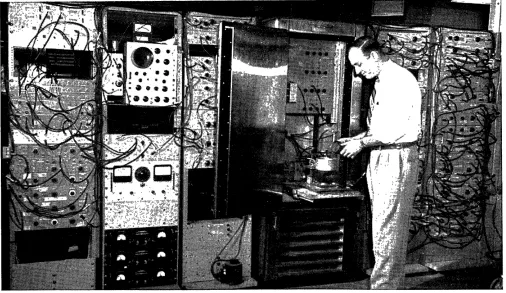
in-,Figure' 1 - 'An automatic core handler
Figure 2 - An automatic core tester
troducing a high degree of disturbing outside influence into the wire system; this determines the core's stability level. But this has never presented a major problem.
Most of the difficulty in making test equipment has centered around handling the very small cores, which are about the size of a pin-head. Originally the opera-tion was entirely manual, and a wire to contain the test current was placed through each core by hand. Only 1000-1500 cores could be tested daily by this method. An automatic core handler then was developed which handled 6000-8000 cores daily but still required the op-erator to determine the rejects.
The next step was the development of a fully auto-matic tester to eliminate human decision. The first of these handled one core per second or 25,000 per eight hour day.
Fully automatic handling and test equipment has since been upgraded twice. In the first of these improve-ments, core handling speed was increased to 4 per second and the equipment now in use handles 10 per second or 250,000 cores per eight hour day, as well as measuring additional parameters of the core.
As core testing and handling speed have increased, production improvements have kept pace and the core reject rate has dropped sharply.
Core Performance: Present and Future
Present day cores are used in large high-speed digital computers and such other equipment as buffer mem-ories, digital voltmeters, industrial programmers, re-dundancy devices, even jukeboxes. They are uniform in quality and performance, are stable indefinitely, econom-ical to use, inexpensive to measure and calibrate, and fast in response time. Development work, however, is being actively pursued and higher performance stand-ards are continually being attained.
COMPUTERS alld AUTOMATION for March, 1959
Production has begun on cores of .050 inches of out-side diameter in contrast to the .080 inches of the earlier cores; this change permits many more bits of informa-tion to be stored per cubic foot. The smaller cores also allow the use of transistor drives with greater reliability and simpler circuitry. Presently available materials with switching times of about 1 microsecond soon will be complemented by new materials having twice the switch-ing speed.
Thus, the struggle continues to improve and make perfect.
THE ART OF GETTING PUBLISHED
I. From Jordan and Van Deusen Laguna Beach, Calif.
We are often asked if we guarantee the publication of technical articles that we may be commissioned to write. Our answer:
There is no inside track to getting an article published in the trade press. If the article is well written, infor-mative, and newsworthy, it will be printed. If it does not meet this test, all the personal contacts (and ad-vertising schedules) in the world will not make up for the lack.
Editors are constantly looking for good technical articles . . . .
Editors judge an article by just one measure: its value to the reader. The reader must get something out of the article or it will not be printed. The more technical the subject, the more difficult and important this be-comes. Engineers cannot be convinced by unsupported claims or adjectives. They want to be educated but with facts. They can tell, like the editor, when a "technical" discussion is only an advertisement in editorial dress ....
II. From the Editor: Hear! Hear!
NOVEL APPLICA TIONS
OF
COMPUTERS
COMPUTER AIDS RESEARCH FOR BETTER BEEF
C. J. Brown University of Arkansas
Fayetteville, Ark.
DEVELOPMENT OF MUCH more productive and eco-nomical types of beef cattle is being aimed for by use of an electronic computer, installed at the Department of Animal Industry and Veterinary Science at the University of Arkansas. The computer is a G-15 general purpose digital computer produced by the Computer Division of Bendix Aviation Corporation.
The computer will be programmed to determine and interpret trends and correlations in the qualities of beef cattle and allied livestock. Statistics concerning breeding, efficiency of production, mothering ability of cows, weight of animals, body measurements, and various feeding and digestive factors in different breeding groups, etc., will be processed.
Statistical data projected over generations of cattle even-tually should take the guesswork out of breeding.
SIMULATION OF CONSUMERS' DECISIONS C. Joseph Clawson
Facts Consolidated Chicago, 111.
(Based on a talk before the American Marketing Association, Chicago, Ill., December 30, 1958)
Computers are used in the simulation of the probable flight of an intercontinental ballistic missile or a space rocket: in the same way, it may soon be possible to give trial flights to promotional programs on electronic com-puters.
They may make it possible to forecast with greater accuracy the behavior of consumers in response to mar-keting programs which are under consideration.
I believe there are many indications that the decision-and-action process of consumers will soon be simulated, or at least reduced to a systematic set of mathematical functions which can be programmed onto an electronic computer. In this way, we will be thinking about a representative sample of consumers in a way similar to the way they think for themselves.
CREWLESS VEHICLES
Charles 1. Patterson, Chairman of the Transit Auth-ority of the City of New York, which operates the city subway trains, has reported on a year-long study of crewless trains. Engineers of the authority and four electronics companies have explored the feasibility of running subway trains by remote control. The shuttle subway trains between Times Square and Grand Central (about three blocks) would be a logical first test. If the
12
system were successful, it could mean the transfer to other work of 90 percent of the 3100 motormen and 775 percent of the 3500 conductors now employed by the New York City Transit Authority.
Michael
J.
Quill, international president of the Trans-port Workers Union, and Matthew Guinan, president of the New York local, have protested the dangers of "tampering with the safety of millions of passengers daily." But they apparently did not discuss the point whether passengers might not be safer with guidance systems, that make fewer mistakes than human beings. The Soviet Union has reported a recent test run of an automated train between Kuntsevo, near Moscow, and Usovo, a distance of about 300 miles. In this test, an automatic control system replaced the train engineer, made computations solving problems in connection with the train's movemerits, and interpreted coded informa-tion on the grade of the tracks, the distances between stations, and other such data.The elevators in a number of N ew York's new office buildings with 20 to 30 floors have no human attendants. The automatic elevators appear to operate more safely and efficiently than those having human operators. There are no signs in those buildings however saying how the displaced elevator men are now earning their living.
AUTOMATED CAPITALISM Edward G. Brender
Brender and Brender Wayne, Mich.
Some time ago, a number of small groups of people got together to study the stock market. Needing edu-cation in the way that investments in the stocks may be wisely made and to learn how the stock market operates, the groups joined together in a cooperative effort, and established a National Association of Investment Clubs.
These clubs are composed of 10 to 15 people, who need guidance in their education, and learn by actually investing in stock of their choice. But what stock should they buy?
The NArC published a four page "NArC Stock Se-lection Guide," which formulates the principles and policies of the investments of the clubs. These principles require plotting sales and earnings records for 10 years past, and their projections for 5 years in the future. The price-earnings ratio, the dividend pay-out, and the re-turn on invested capital are also averaged for 5 to 10 years. The current investment yield is also computed. A prediction is made by a formula for the possible high and low prices five years from now. From this informa-tion, zones for buying, holding, and selling, are estab-lished, and compared with the market price.
to 2 hours of work, and some pulling of teeth and tear-ing of hair. But one of our staff members who was in our club programmed this process for our Royal McBee LGP-30 computer. Zoom - 10 minutes analysis time! So we now enjoy 6 to 8 analyses per month to look at and consider each month. The computer program also permits speedy up-dating of the reports of the stocks that we have in our portfolio, as well as 40 other stocks that we have examined but not purchased.
Through cooperation, at least seven other clubs from Poughkeepsie to Phoenix are also using this investment analysis computer program.
The printed-out report is a delight to behold, with its alphanumeric, precise tabulation and color shifts.
Viva La Capitalism, and Computers!
UNIVERSITY STUDENT SCHEDULING BY DATATRON
Neva Sabbagh Purdue Univ. Lafayette, Ind.
Purdue University students of the past and even up to a few years ago remember the seemingly endless hours of waiting in line to be registered, first at the Registrar's Office, then at the Armory, and later in Quonset Huts. What a bother, they grumbled, to have to walk into registration headquarters, wait in line while the guy in front argued with the registration official, and then when your turn finally came, you found out that the class you had to be in - it was your last se-mester and it was a required course - was closed. This meant starting all over - again consulting with your ad-visor, again trekking to registration headquarters, again . . .
But that's all over now. At least the long lines are getting to be a thing of the past. Through the efforts of Mr. James F. Blakesley, Administrative Coordinator of Schedules and Space, and other staff members devoted to helping Purdue operate efficiently, Purdue's digital computer, the Datatron, has been adapted to the sched-uling process. Purdue is the first university, so far as we know, to use this practical- and satisfactory - way to schedule students electronically. Although the ma-chine was bought from ElectroData Division of Bur-roughs Corp. for research in the Statistical Laboratory, it was found to be of great use in student registration and scheduling. .
The Datatron electronic digital computer "memorizes" in about five minutes the 1400 courses and 4000 divi-sions that may be selected by students. The machine also "knows" the course identification, the maximum size of each class, and the meeting time of each class. As students are scheduled and divisions of courses be-come filled, a method is available for opening addi-tional divisions.
Here's how a student is scheduled electronically: He goes to his counselor and together they list the courses he is to take in the next semester. This information is translated into Datatron language through pre-punched cards and fed into the machine. In processing the sched-ule, the computer schedules first those courses with only one division (because this division has no alternate time schedule), and then continues to schedule courses by a pre-determined priority. The machine keeps track of available spaces and equalizes the number of students
COMPUTERS and AUTOMATION for March, 1959
assigned to particular sections of a course by attempting to schedule the section with the most remaining spaces first. If a student plans to work, he signs up with his advisor for a period of "free time." If no conflict de-velops, this free time will be scheduled along with the other courses by the Datatron.
In a matter of seconds (in many cases 35 or 40), out of the computer comes the student's sc~edule of classes punched on cards. Tabulating equipment is used to produce the student's schedule in readable form.
Advantages of the Datatron are numerous. First, there is the speed of selecting sections of courses to meet the students' requests (free from conflicting hours). Second, course section enrollments are equalized. Third, the last student through the computer has nearly the same opportunity to be enrolled in the courses of his choice as the first student. Fourth, the instructors have classes of a more uniform size. An additional benefit of equalized enrollments is found in more effective use of instructional rooms; that is, fewer rooms are needed since the classes are spread among many rooms at various times instead of using a large number of rooms at a peak hour. Finally, the staff members previously busy with registration details are freed for counselling and instruction.
The machine is no more infallible of course than the information put into it by human beings. But, once it begins its electronic scheduling, it does a job no human being can possibly do in five seconds or perh.aps 20 min-utes. It is a certainty that no human can make such an even distribution of classes as the Datatron does in the same time limit.
Work on the idea of electronically scheduling stu-dents began in 1955. After much probing and testing, the first group of students was registered December 11, 1957. In order to sample a diversified group of students, agriculture and engineering students were chosen. Two hundred and nine freshman ags were registered suc-cessfully by the Datatron. The next day nearly 1600 freshman engineers were scheduled by the same proce-dure. A maximum time of 2 minutes and a minimum of five seconds was used in scheduling each student. This made an average of between 35-45 seconds for almost 1800 students. Since that time more than 20,000 regis-trations have been processed, with a similar average time for scheduling on the computer.
Enrollment is promising to double at Purdue U niver-sity in the next few years and threatening to triple by 1970, but the Datatron still promises quicker and more practical individual scheduling of students. It will also give them the advantage of better clas'room atmosphere, free from over-crowded conditions. The student is not turned into a mere number by the Datatron; he receives his own schedule tailored to his individual needs.
The University benefits in utilizing its staff to near-maximum efficiency in doing the job it was expected to do, and the number of rooms that are needed for in-structional purposes are reduced to a minimum.
If any reader of this brief report is interested in this application and has access to a high speed computer, he is invited to contact Mr. James F. Blakesley, President's Office - Schedules and Space, Purdue Univ., Lafayette, Ind., for more information and details of the program-ming technique.
COMPUTER TALKS
1959 Western Joint Computer
Conference, Fairmont Hotel, San
Francisco, March 3 to 5, 1959
New Components and Circuits /
c.
L. Wanlass, Aero-nutronic Systems, Inc.A Multiload Transfluxor Memory / D. G. Hammel, W.
L. Morgan and R. D. Sidnam, RCA
Design and Analysis of MAD Transfer Circuitry / D. R. Bennion and H. D. Crane, Stanford Research Institute A Magnetic Matrix Memory for Semi-Permanent
Infor-mation / D. H. Looney, Bell Telephone Laboratories Card Changeable Nondestructive Readout Twistor Store / J. Janik, Jr.,
J.
J. DeBuske and B. H. Simons, Bell Telephone Lab.Square Loop Magnetic Logic Circuits / E. P. Stabler, General Electric
Information Retrieval and Machine Translation /
c.
Bourne, Stanford Research InstituteRelative Merits of General Purpose and Special Purpose Computers as Used for Information Retrieval/A. Opler and N. Baird, Computer Usage Co., Inc. A Special Library Index Search Computer / B. Kessel,
Computer Control Co., Inc., and A. DeLucia, Rome Air Development Center
Programmed Interpretation of Text as a Basis for Infor-mation Retrieval Systems / L. Doyle, System Develop-ment Corp.
A Theory of Information Retrieval /
c.
Walker, Hughes Aircraft CompanyThe Role of USAF Research and E)evelopment in Infor-mation Retrieval and Machine Translation / R. Sam-son, Rome Air Development Center
Industry's Role in Supporting High School Science Prob-lems / Dr. Paul Hurd, Associate Professor of Edu-cation, Stanford University
Information Retrieval and Machine Translation /
c.
:2ourne, Stanford Research InstituteComputing Educated Guesses / E. S. Spiegelthal, Gen-eral Electric Company
A Memory or 314 Million Bits Capacity With Fast and Direct Access - Its Systems and Economic Considera-tions / N. Bishop, Time, Inc., and A. Dumey, Con-su4tant
Information Retrieval on a High Speed Computer / A. Barton, V. Schatz and L. Caplan, General Electric Company
The Next 20 Years in Information Retrieval: Some Goa:ls and Preaictions /
c.
N. Mooers, Zator Company Computer Communication / H. C. Martel, CaliforniaIn-stitute of Technology
Simulation of an Information Channel on the IBM 704 Computer / E. G. Newman and L. O. Nippe, IBM
14
A Compiler with An Analog-O~iented Input Language / Marvin L. Stein, Univ. of Minnesota, and Jack Rose and Donn B. Parker, Convair-Astronautics
Automatic Design of Logical Networks / T. C. Bartee, Mass. Inst. of Technology
The Role of Digital Computers in the Dynamic Opti-mization of Chemical Reactions / R. E. Kalman and R. W. Koepcke, Research Inst. for Advanced Study, Baltimore
Simulation of Human Problem Solving / W. G. Bour-icius, IBM
Education and Methodology for Use of Computers / G. W. Brown, Univ. of Calif. at Los Angeles The Role of the University in Computers,
Data-Process-ing, and Related Fields / L. Fein, Consultant, Palo Alto, Calif.
The RCA 501 Assembly System / H. Bromberg, T. M. Hurewitz, and K. Kozarsky, RCA
A Program to Draw Multilevel Flow Charts / L. M. Haibt, IBM
A Compiler Capable of Learning / R. Arnold, Michigan State Univ.
Achieving Reliability in Operation Control / L. Fein, Cotlsuitant, Palo Alto, Calif.
Special Purpose Electronic Data Systems / M. V. Crow-ley, RCA
The Residue Number System / H. L. Garner, Univ. of Michigan
System Evaluation and Instrumentation for Military Spe-cial Purpose Digital Computer Systems / A. J. Strass-man and L. H. Kurkjian, Hughes Aircraft Co. Automatic Failure Recovery in a Digital Data Processing
System / R. H. Doyle, R. A. Meyer and R. P. Pedo-witz, IBM
Learning Concepts and Pattern Analysis / P. Suppes, Stanford Univ.
A High-Speed Data Translator for Computer Simulation of Speech and Television Devices / E. E. David, M. V. Matllews, and H. S. McDonald, Bell Telephone Lab.
Some Experiments in Machine Learning / H. Campaigne, American Univ., Washington, D.C.
Some Communication Aspects of Character Sen-sing Sys-tems /
c.
C. Heasley, Jr., Intelligent Machines Re-search Corp.An Approach to Computers That Perceive, Learn, a-nd Reason / P. H. Greene, Univ. of Chicago
Military Applications / H. Silverstein, Dept. of the Army, Washington, D.C.
Drafting Digital Computers Into Tactical Combat / Capt. A. B. Crawford, Jr., Fort Huachuca, Arizona Data Transmission Equipment Concepts for Fieldata /
Capt. W. F. Luebbert, Fort Monmouth, New Jersey A High-Accuracy Real-Time Digital Computer / W. J.
Milan-Kamski, EPSCO
The Man-Computer Team in Space Ecology
I.
J. McLeod, Convair, andJ.
Stroud, Naval Electronics Laboratory New Machines and Systems / M. Montalbano, KaiserSteel Corp.
The RCA 501 High Speed Printers - The Story of a Product Development -; C. Eckel and D. Flechtner, RCA
A Digital Computer for Industrial Process Analysis and Control/E. L. Braun, Genesys Corp.
The Burroughs 220 High Speed Printer System / F. Bauer, Electro-Data Corp.
The ACRE Computer - A Digital Computer for a Missile Checkout System / R. I. Tanaka, Lockheed Aircraft Corp.
The IBM 7070 Data Processing System / J. Svigals, IBM Computer Applications in Business Environments / R.
R. Crane, Touche, Niven, Bailey & Smart, Detroit An Organizational Approach to Electronic Data
Pro-cessing / G. Fleming, Boeing Airplane Co.
Developing a Long-Range Plan for Corporate Methods and the Dependence on Electronic Data Processing / N. J. Ream, Lockheed Aircraft Corp.
A Long-Range Electronic Data Processing Plan for a National Multi-Plant Manufacturing Company / G. Redmond, Chrysler Corp.
Dynamic Production Scheduling of the Job Shop Op-eration /
;r..
N. Caplan and V. L. Schatz, General Electric Co.Numerical Analysis / R. D. Levee, Univ. of Calif., Law-rence Radiation Lab.
Survey of Numerical Analysis / G. E. Forsythe, Stan-ford University
More Accurate Linear Least Squares / R. Von Holdt, Univ. of Calif. Lawrence Radiation Lab.
The Cordic Computer: (1) The Cordic Transcendental Computing Technique / J. E. VoIder, Convair; (2) Implementation of Coordinate Rotation and ether Trigonometric Function Algorithms by Cordic / D. R. Clutterham, Convair; (3) Decimal-Binary Con-versions in Cordic / D. H. Daggett, Convair
Monte Carlo Techniques Applied to Statistical Mechanics / W. W. Wood, Los Alamos Scientific Lab.
Real-Time Digital Analysis and Error Compensating Techniques / W. Ito, Minneapolis-Honeywell Regu-lator Co.
Automatic Digital Matric Structural Analysis / B. Klein and M. M. Chirico, Convair
Problems of the Future / S. Ulam, Los Alamos Scientific Lab.
"Blue Sky" Session / L. N. Ridenour, Lockheed Aircraft Corp.
A New Approach to High-Speed Logic / W. D. Rowe, Westinghouse Electric Corp.
Experiments in Information Retrieval / R. Cochran, General Electric Co.
Communication Across Language Barriers
I.
W. F. Whit-more, Dept. of the Navy, Washington, D.C.Program Design To Achieve Maximum Machine Uti liz
a-COMPUTERS and AUTOMATION for March, 1959
tion in a Real Time Computing System / A. F. Rosene~
Sylvania
Pattern and Character Recognition Systems - Picture Processing by a Net of Neuron-Like Elements / L. A. Kamentsky, Bell Telephone Lab.
Philosophy and Responsibility of Computers in Society / R. W. Tyler, Center for Advanced Study in the Be-havioral Sciences, Stanford University
Social Responsibility of Engineers / F. Wood, IBM Emergency Simulation of the President of the United
States / L. Sutro, Datamatic
Can Computers Help Solve Society's Problems /
J.
Rothstein, Edgerton, Germeshausen & Grier, Inc. Measurement of Social Change / R. L. Meier, Univ. ofMichigan
Analog Simulation / J. E. Sherman, Lockheed Aircraft Corl!'.
Simulation of Sampled Data Systems Using Analog-to-Digital Converters / M. S. Shumate, Space Technology Lab. Thompson-Ramo-Wooldridge Corp.
A Transistorized Analog Memory for Functions of Two Variables / P. C. Sherertz, and L. E. Steffen, Convair A Time-Sharing Analog Computer / J. V. Reihing, Jr.~
Westinghouse Electric Corporation
Computers - The Answer to Real-Time Flight Analysis / G. Hintze, Chief, Flight Simulation Lab., White Sands Missile Range
Symbolic Language Translation / E. C. Gluesing, Rem-ington Rand
New Horizons In Computer Technology / H. Aiken~ Harvard Univ.
New Applications of Computer Technology / H. D. Huskey, Univ. of Calif.
A Generalized Scanner for Pattern and Character Rec;-ognition Studies / W. H. Highleyman and L. A. Ka-mentsky, Bell Telephone Lab.
File Searching Using Variable Length Keys / R. De La Briandais, U.S. Naval Ordnance Lab.
1959 Electronic Components Conference, Benjamin Franklin Hotel, Philadelphia, Pa.,
May 6, 7, 8, 1959 Session on High Speed Data Processing
(May 6, morning):
Functional Components / R. J. Cypser, IBM Corporation Electronic Components for Future Computers / N. M.
Abov-Taleb, IBM Corporation
Magnetic Domain Switching in Evaporated Magnetic Films / David W. Moore, Servo-mechanisms, Inc. The Fabrication and Properties of Memory Elements
Using Electrodeposited Thin Magnetic Films of 82-18 Nickel Iron / I. W. Wolf, H. W. Katz, General 'Elec-tric Electronics Laboratory, and A. E. Brain, Stanford Research Institute
CORRECTION
In the January, 1959, issue of Computers and Auto-mation, in the article "Symbolic Logic and Automatic Computers, Part 3," on page 19, on the last line, a tilde (--') should be inserted before the expression "xM". On page 20, left column, line 6, the same inser-tion should ~e made before the same expression, and again on line 12. Our thanks to William F. Culliton of Niagara Falls, N.Y., for catching these three errors.
Make Your Tabulating
Department a Service Department
Edmond W. McNamara Ed McNamara Associates
Bridgeport, Conn.
S
TUDENTS ANALYZE THE evolution of electronic data processing into certain stages of development. One of the early stages pictures the giants of industry, the large insutance and utility companies, and the gov-ernment pioneering in the use of electronics against a backdrop studded with many pronounced question marks. While off to the side, the smaller, more con-servative, more timid managements wait for the first full audit of results bef9re they take any active step to become involved with the spectacular and expensive new tools of data processing.Some of these managers await the returns with eager anticipation. They seek justification for going out on thin ice in hopes of finding solutions to their clerical problems. Others are far less eager. In fact, some of them hope that the new equipment and methods will prove to be failures so that they can justify a continua-tion of their old ways and not muddy the water of their existing systems - at least not until their own personal retirement from work has excused them from the re-sponsibility for action.
Reports on Computer Applications
Meanwhile the reports roll in. In some ways they are encouraging. Yet in many respects there is an emphasis on the negative, and an air of caution. For example, there is the recently published "Computer Use Report," by the Systems and Procedures Association's Empire State Chapter's Research Committee. This was pub-lished by the Systems and Procedures Association, l>en-obscot Bldg., Detroit, Mich., in 1958, 12 pages long. It ~s a "statistical information release," covering 281 replies to a questionnaire. 82 organizations reported applications in service. The total number of computers involved in the study is 203, about 15
%
of the total medium and large scale computers in use as determined by a recent census. Table 1 analyzes about 270 applica-tions accepted for electronic computer operation (82 companies reporting). Table 2 covers about 160 applica-tions rejected (63 companies reporting, 23 of which have applications in service). Five more tables analyze occurrence of applications by size of firm, industry, etc.16
This report, however, has the following introduction: Information on the success or lack of success of the use of electronic data processing equipment has, up to this point, been somewhat vague. To the best of our knowledge, no specific figures have been released from any source that can be used to determine with any accuracy the acceptance or rejection of such
equip-ment. We believe that this report contributes to help fill this void in the field of electronic data processing. In the section devoted to applications rejected, the rejections are analyzed as to when they were rejected, such as: during the study, after study, in the programming stage, and so on. And then the reasons for rejection are
listed as follows:
Too costly
Volume of data too large Volume of data too small Routine has too many exceptions Programming too difficult
Lack of reference to account history Inadequate input-output equipment Inadequate input-data sources Fear of equipment obsolescence
Lack of continued top management: support Lack of employee cooperation
Memory capacity too small Access time too high Excessive down time
Underlying Reasons for Rejection or Failure Psychologists tell us that there are two reasons for everything, the obvious and the underlying. Perhaps this explains why two of the major reasons for -rejection and ultimate failure are not even mentioned. Nor is their omission a reflection on those who compiled the report. The twO major reasons I refer to are:
1. Failure to do sound systems analysis before forging ahead into electronic mechanization.
2. Failure to establish proper operating policy as to organizational location and role of the data pro-cessing function.
On this point, we might consider a few significant ex-cerpts from another recent publication, "The Ram Myth," Apr. 1958 issue of EDP Analyzer, by Canning, Sisson, and Associates.
"With all the excitement about large volume random access memories for EDP systems, we think the time has come to add a few words of caution about them ... "To state it bluntly, we think that RAM memories are heavily booby-trapped for the unwary . ~ .
". . . we feel that only a few of the many orders on the books for RAM systems are really valid appli-cations . . .
"The answer to the proper use of RAMs is, of course,
hig~ quality systems plans. Equipment always is a poor substitute for thinking. . . ."
POGO is a new programming system that combines the use of simple, easy to learn commands with all of the G-1S's machine language power and speed. A fixed point compiler, POGO recodes a simple state-ment of a problem in machine language with all commands stored in optimum memory positions. Thus, a programmer with very little training can write high speed production programs.
For the first time in a low-price computer, a set of fully self-contained automatic programming systems is available . . . POGO, with its ability to convert simple commands into fast and powerful machine language programs . . . and the already famous INTERCOM 1000 interpretive system, with its extreme programming simplicity and speed of preparation.
*
Program Optimizer for 6-15 OperationsAUTOMATIC
PROGRAMMING
0-/5
Digital Computer
POGO commands are very similar to those used for INTERCOM 1000. The principal difference between the two systems is that POGO, unlike INTERCOM 1000, compiles an optimum machine language pro-gram and reproduces it for repeated use. Computing speed is also increased, since no interpretation is required during computation. While floating point INTERCOM 1000 is ideal for open shop problems, POGO may be preferred for production problems that must be solved repeatedly at high speed.
In POGO, data is handled in decimal form. Seventeen accumulator registers are available, as well as twelve index registers, which can be used to modify the effective address of any command. Additional data on the G-15, POGO, and INTERCOM 1000 will be sent on request.
NEW PROGRAM STORED ON PUNCHED
PAPER OR MAGNETIC TAPE FOR
REPEATED USE
DIVISION OF BENDIX AVIATION CORPORATION, Dept. D-IO LOS .ANGELES 45, CALIF.
Getting back to the two major reasons cited above for rejection and failure, my experience tells me that these are perhaps the two most serious reasons. Yet they are the ones least discussed or admitted by official spokesmen of co'mpanies engaged in electronic data processing pro-grams. You get much of your information "off the rec-ord." Much of it must be deduced. Here is a case in point.
Inadequate Systems Work
A large, national organization solicited help in June of 1958. They wanted to hire a systems man. The es-sence of my questions and their answers follows:
Q. What is this man to do? What will be the scope of his job?
A. He will have to hire and train assistants in pro-gramming and be ready for the installation of a medium scale computer.
Q. To whom will this man report? A. We're not sure yet.
Q. When is the computer scheduled for delivery? A. Next December.
Q.
Nineteen fifty-nine?A. No, No! This year, fifty-eight.
Q.
Is this a basic computer, or . . .A. It is the basic unit first and tape units will be de-livered in 1959.
Q.
Do you have anybody working on systems now? A. No.Q. Who has done the systems analysis?
A. Nobody; that is why we want to hire a systems man.
Q.
Who chose the computer?A. An executive [whose knowledge and background in the field was slightly above zero].
Q. Who advised this executive? A. The equipment salesman.
Q. Who determined the feasibility? A. The equipment salesman.
What would you consider are the chances of success in this installation? If it fails, what do you think will be recited as the reason for failure? Lack of employee -cooperation? . . . , memory capacity too small?
Six months later I revisited the company whose computer was due in December 1958. I found the computer installed in a room far removed from the tabulating department (the floor there wouldn't hold the weight of the computer). The computer had been in for two weeks. It had actually been running but not very much. Three young service engineers, with a full library of charts and diagrams, were still
tink-ering and experimenting. The harried systems man told me he had been working "all hours" trying to get the thing running, and was busy explaining to a member of management that there are mechanical bugs, etc., etc.
Operating Policy on Role of Data Processing Function Perhaps some organizations can get by without classi-<:al systems analysis. So let us consider the second of
the two major reasons mentioned - failure to establish adequate operating policy as to the place and role of
the data processing function.
Since a great number of computer applications are an outgrowth of punch card tabulating functions, let us concentrate our attention back in the tabulating depart-ment and inquire immediately: Is your tabulating de-partment a service dede-partment?
18
There are many illogical situations in business offices. Think of the systems function, fettered under the juris-diction of an old school accounting officer. Or think of the tabulating department used as a tool at the whim of the controller; keeping' only the records he wants kept, making only the reports and analyses that serve his purposes; actually providing an imbalance of infor-mation which distracts management attention from im-portant matters and gives birth to a cardinal sin of data processing, duplicate records. These duplicate records are maintained by each division as a defense against the highly mechanized record keeping in the controller area. Let us not carry this illogical philosophy and thinking into computer installations - if we want success. One of the best insurances against this carryover of illogical thinking is to make your tabulating department a service department now.
Overloaded Tabulating Department
Writing in SYSTEMS magazine, Vincent P. Connolly observed:
"A sudden demand for a tab report by the executive committee of a large steel mill confronted its comp-troller. The chore, accepted as routine, revealed that
the tab department on three shifts was working just about to capacity. Investigation showed that any
employee in the organization on the level of supervisor could requisition a machine tabulation job, while the tab accountant had no discretion, only a squawk, about taking it on."
This far from healthy situation is not uncommon.
Underloaded Tab:.Ilating Department
In other companies we find a deplorable situation which is the opposite of the above. The tabulating de-partment is on a one-shift basis and overtime is frowned upon. In this situation the machine accountant, through his superior, exercises what may be too much discretion - to the extent that the services of the electric account-ing machines are denied to legitimate users. In some situations desirable reports either are done by longhand methods or on some cumbersome office machine, or not done at all.
Such operating conditions emphasize t4e need for an intelligent perspective in relation to the use of tabu-lating equipment; a perspective and an approach which help to furnish maximum service in the issuance of es-sential reports and analyses, on time, and at minimum cost.
In one medium size company whose tab department was on a one-shift basis on the controller's department, it was found that their "loaded to the hilt" situation not only denied the company the clerical savings of mechan-ical preparation of reports, but it presented a serious roadblock to any unemotional, openminded approach to the possibilities of integrated or electronic data pro-cessing applications. It was recommended that if they were ever to get into a position to benefit from in-tegrated application of machines to paperwork, they must first of all break the road block.
Basic Principles
To begin with, management had to agree that in the area of control reports for management there are three