DRTRMRTIElN®
February
'-c:
.!o
:)-z
c.u
Ampexmakes
computer tape
comeclean
and comfortable.
Ever since we started making magnetic tape, we have worked hard to make it as clean as possible. First we developed an inherently clean coating for it. Then we began giving it a super cleaning before and after certification. Now two packaging innovations will make certain you get it clean and comfortable and keep it that way.
1) A new canister:
Our exclusive new design eliminates all the problems you may have had with canisters before. It has an all-plastic positive locking mechanism that cannot introduce contamination.
2) A new shipper:
Probably the best idea the industry saw last year, we modestly admit, was our new TAPE-SAFE Environmental Shipper. Made of expanded-bead polystyrene, this shipping container individually supports and separates up to ten tape canisters. Guards them against shock, vibration, tempera-ture and humidity variations. Won't contaminate your computer area. And these unique reusable boxes are standard with your minimum order of Ampex tape for IBM and IBM-compatible computers.
What it comes down to is this: We're not simply selling you tape. We are providing you with unparalleled data reliability even after hundreds of thousands of equipment passes.
If you would like a free copy of our new technical bOOk-,
let, "The Care and Storage of Computer Tape," just write
AM PEX
us at 401 Broadway, Redwood City, California 94063. L . . . _______ - - - - 'Our
optical
reader can do
anything
your
keypunch
operators do.
(Well, almost.)
It can't take maternity leave. Or suffer from morning sickness. Or complain of being tired all the time. But it can read. And gobble data at the rate of 2400 typewritten (or hand printed) characters a second. And compute while it reads. And reduce errors from a key-punch operator's one in a thousand to an efficient one in a hundred thousand.
Our machine reads upper and lower case characters in intermixed, standard type fonts.
It can handle intermixed sizes and weights of paper, including carbon-backed sheets.
An ordinary computer program tells our reader what to do ... to add, subtract, edit, check or verify as it reads. Lets you forget format restrictions, leading and trailing zeros, skipped fields, and fixed record lengths. And our reader won't obsolete any of your present hardware because it speaks the same output language as your computer.
Our Electronic Retina Computing Reader can replace all-or almost all-of your key-punch operators. At least that's what it is doing for American Airlines.
If you have a vo'lume input application, it can do the same for you. Tell us your problem and we'll tell you how.
RECOGNITION EQUIPMENT
Incorporated
2
Introducing a
$90,000.
computer .
that can end up
costing you
$500,000.
Sigma
5.
There are three things to remember about Sigma 5.
First, it is multi-use, like its big brother Sigma 7.
It does foreground real-time control, background
general-purpose computation, and high-speed
input/output. Simultaneously.
Second, Sigma 5's central processor is so
power-ful and sophisticated that
it
works even more
efficiently with $500,000 worth of memory,
periph-erals and options than it does in its basic $90,000
configuration.
Third, Sigma 5 grows without fuss. Everything
is modular-memory, input/output processors,
peripherals, central processor options, software.
Each upward transition is simple and logical until
you reach Sigma 5's limit. Then if you want to keep
on growing, just substitute a Sigma 7 CPU and
behold! You have a Sigma 7 time-sharing system.
Two computers aren't better than one.
It no longer makes economic sense to have
dif-ferent computers for difdif-ferent kinds of jobs.
Sigma 5 will control your plant, do your
scien-tific and engineering computation, and look after
your accounting and inventory. All at once.
Nobody will have to stand in line. Everyone will
be protected against loss or interference. Sigma 5
can deal with foreground real-time interrupts in
6 microseconds without losing control of any of its
other jobs, yet every background user will get hjs
answers faster than he needs them.
Nobody
loves a
lazy computer.If
your Sigma 5 ever has an idle microsecond it
will be your fault.
Sigma 5 doesn't stop computing to wait for input/
output.
It
doesn't reserve idle capacity to take care
of on-line peaks.
Instead it dynamically and very rapidly shifts
from one task to another in order to keep all its
power working all the time. Input/output is
man-aged independently by one built-in and five optional
I/O processors, with up to 160 automatic I/O
channels.
The bigger the better.
One reason why Sigma 5 gets more efficient as
it grows larger is that when memory modules are
added interleave and overlap occur. This not only
increases the effective speed of the central
proces-sor but raises input/output capability too.
Sigma 5 won't wait for software.
Sigma 5 is program-compatible with Sigma 7.
The software for both has already been developed
and is being delivered now with Sigma 7's.
So you won't have problems with new and untried
software. And you won't have to wait either.
Sigma 5 software is modular like the hardware.
As your Sigma 5 grows the software grows too, in
natural, simple, logical steps.
Software for Sigma 5 includes Basic Control
Monitor, Batch Processing Monitor, three
ASA-compatible FORTRAN IV compilers including a
high-efficiency version, Symbol Assembler,
Meta-Symbol Extended Assembler, SDS COBOL 65,
Sort/Merge, and a library of mathematical,
busi-ness and utility routines.
All Sigma 5 software is multi-use.
Here are some numbers.
Basic memory cycle time of 850 nanoseconds is
reduced as overlapping of memory occurs.
32 memory sizes, from 4,096 to 131,072 words.
Memory uses 32-bit words, is addressable and
alterable by 8-bit bytes, halfwords, words, and
doublewords.
16 general purpose registers, expandable to 256.
All memory is directly addressable without base
registers.
8 automatic I/O channels in CPU, plus 5
op-tional I/O processors, either multiplexor lOP's
(300,000
bytes/sec.) or selector lOP's
(30
million
bits / sec.) in any desired combination.
224
levels of priority interrupt. Priorities
auto-matically recognized without program intervention.
How soon?
Order now and you'll get your Sigma 5 (with
software) in August.
You can order the exact configuration that fits
your needs. Or if you have budget problems, order
what you can afford now and
plan to add modules as more
i
iii ) \
i
i
funds become available.
Growing with Sigma 5 is
almost painless. All you feel is a
Scientific Data Systems,slight twinge in the pocketbook.
Santa Monica, CaliforniaCIRCLE 5 ON READER CARD
4
WHAT'S
AN I
•
If you saw the phrase,
"fastest growing systems
group in the country,"
would you know it meant
ISC? Probably not. But you
will.
We design and implement
information systems for
industry and government.
ISC programmers,
mathe-maticians and scientists
are located wherever there
are information problems
.ta.. be solved. In Saigon.
Bangkok. You name it.
Our symbol tells the story.
From rosetta stone to
punched card, we make
information easier to come
by. Need help?
1111 Wilshire Blvd., Los Angeles 90017
(Area Code 213) 482-4633
CIRCLE 6 ON READER CARD
february
1967
volume 13 number 2
, Publisher Editor
CATAMATIDN.
GARDNER F. LANDON ROBERT B. FOREST
Managing Editor & Arl Diredor
Associate Editors
CLEVE MARIE BOUTELL EDWARD K. YASAKI WILLIAM J. ROLPH HEIDE H. THORSTENSON WENDY R. REID ANGELINE PANTAGES CHARLES WHITE HOWARD BROMBERG ROBERT V. HEAD PHil HIRSCH
Assistant Editors Ealiitern Editor -European Editor Contributing Editors Washington Reporter
Editorial Adviser Technical Consultant Production Manager Director of Circulation Circulation Fulfillment
Eastern Distrid Manage,.
New England Disfrid Manager
& Vice President Midwest Disfrid Manager
ROBERT l. PATRICK lOWELL AMDAHL MARILEE PITMAN FRANK DeCARLO AlGENE TRAINA
JAMES M. MORRIS WARREN A.TIBBETTS
35 Mason Street, Greenwich, Conn. 06830 (203) 661-5400
WARREN A. TIBBETTS
112 West Haven Rd., Mancheat.f, N.H., [603] NAtional 5-9498
JOHN BRENNAN 205 W.at Wack.f Drive, Chicago, III. 60606
[312] Financial 6-1026 Western Disfrid Manager -HAMILTON S. STYRON & Vice President 1830 W. Olympic Blvd., Loa Angeles, CaL, 90006
(213) 385-0474
EDITORIAL OFFICES 1830 WEST OLYMPIC BLVD. LOS ANGELES, CALIF. 90006
Circulation audited by BUliness Publicatlonl Audit
Member, American BUllne.. Pre .. , Inc.
DATAMATION is published monthly on or about the tenth day of every month by F. D. Thompson Publications, Inc., Frank D. Thompson, Chairman; Gardner F. Landon, Pr"es-ident; Gilbert Thayer, Senior Vice President. Executive, Circulation and Advertising offices, 35 Mason Street, Greenwich, Conn. 06830 (203) 661-5400. Editorial offices, 1830 W. Olympic Blvd., Los Angeles, California 90006. Publishei at Chicago, III. DATAMATION is circulated without charge by name and title to certain qualified individuals who are employed by companies involved with automatic information han-dling equipment. Available to others by subscription at the rate of $15.00 annually; Single issues (when available) $1.50. Reduced rate for qualified students. Foreign sub-scriptions are on a paid basis only at a rate of $25.00 annually. No subscription agency is authorized by us to solicit or take orders for subscriptions. Controlled circulation paid at Columbus, O. and Chicago, III. Form 3579 to be sent to F. D. Thompson Publications, Inc., 205 W. Wacker Dr., Chicago, III. 60606. Copyright 1967, F. D. Thompson Publications, Inc. Microfilm copies of DATAMATION may be obtained from University Microfilms, Inc., 313 No. First St., Ann Arbor, Michigan. Printed by Beslow Associates, Inc.
This issue 70,311 copies
We're probably too late. You've just launched yourself into the third gen-eration' and the champagne has hardly quit sparkling. Now what are you going to do? Is your software system yours and yours alone? You know it isn't. Compilers and operat-ing systems you're now usoperat-ing were designed to accept an awesome number of problems in a wide variety of disciplines. For your specific pur-poses, therefore, they contain capa-bilities and processes you will never use. Yet these processes slow down operation and greatly increase your
buy a new computer.
education and maintenance expense. The key is customization. Digitek customizes software with specific emphasis on those areas most im-portant to your needs. Speed is increased. Reliability is increased by many magnitudes. And the result is far more production. The cost? You will save as much in computer rental over a few months as the entire cost of the customization procedure. If you start early enough, you can cut your hardware rental in half. It makes all kinds of sense. But why Digitek? In ever-increasing numbers, the
computer manufacturers themselves are turning to Digitek for the solu-tion of software problems.
I n the specific area of FO RTRAN and PL/1 compilers, Digitek is an acknowledged leader. Digitek is obviously in a prime position to customize your compilers and oper-ating systems (or to produce new ones) because of past performance. If you're entertaining the notion of tearing your hair out don't. A call to Digitek will (might?) solve the prob-lem. (213 670-9040) Ask for Chuck Schwedes.
ItlGITEIERPORATION
5959 WEST CENTURY BOULEVARD. LOS ANGELES. CALIFORNIA 90045 CIRCLE 7 ON READER CARD
The end of the card game.
Fold, staple, and mutilate to your heart's content. Because there is a new generation of computer input that makes punched cards old hat.
It's the NCR 735 Magnetic Tape Encoder.
It has a keyboard like a card punch. It's about the same size as a card punch, but doesn't work like a card punch. It works like an NCR Tape Encoder. It "writes" directly on mag tape. It eliminates a computer run, saves
computer time, and increases throughput speeds. You have no cards to buy, punch, read, store, or insure. You have one device that both "punches" and verifies. Your input media is magnetic tape ... storable and reusable and less costly than cards.
So play your cards right. Get rid of them in favor of magnetic tape. Your NCR representative can tell you how. Or write to us at NCR, Dayton, Ohio 45409.
THE NATIONAL CASH REGISTER COMPANY, DAYTON, OHIO 45409 ®
1967
volume 13 number 2
automatIc
information
processIng
for business
industry
sCIence
February 1967
®
22 THE PRACTICE OF COMPUTER SELECTION, by
Norman F.
Schneidewind.
Survey of users and analysis of data show current practice regarding competitive selection, use of outside consultants, and preference among the several selection criteria available.26 SCERT: A COMPUTER EVALUATION TOOL, by
Donald
J.
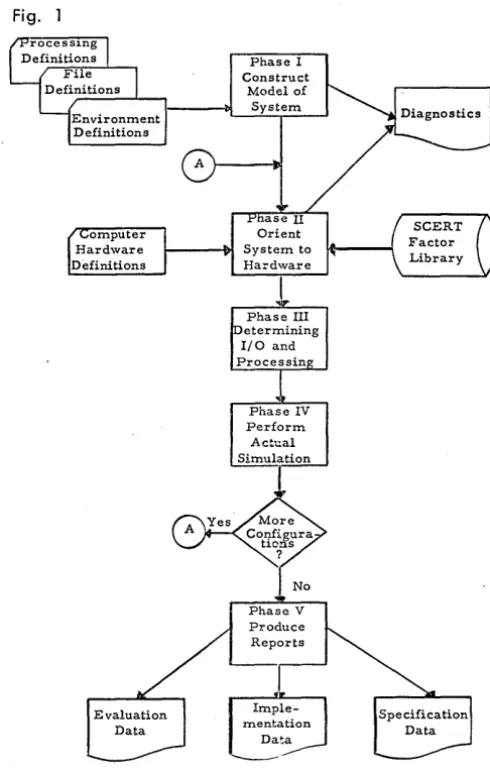
Her-man. The Systems and Computers Evaluation Review Technique software package simulates user's processing requirements against models of selected computer configurations.
29
DESIGNING A
MACHINE PARTNER, byAiko M. Hormann.
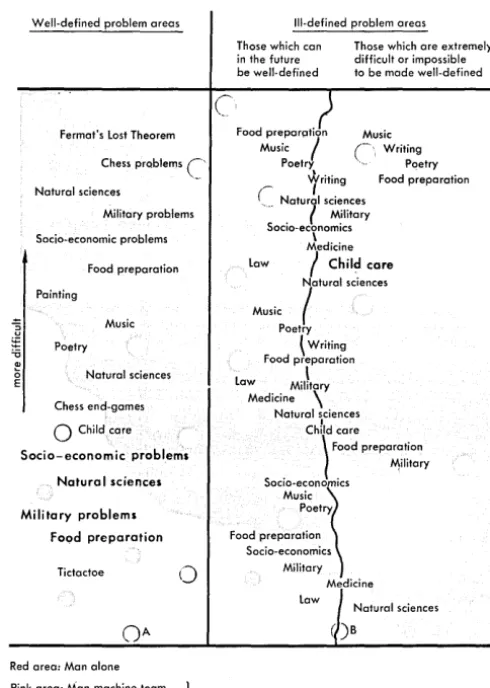
The requirements and desirable features of an adaptive machine partner, and the characteristics of problem domains and how they affect "partnered" man and machine.34 COMPUTERS IN THE HIGH SCHOOL, by
William
S.Dorn.
Examples of computer-extended instruction, the teaching of a discipline using
a computer, which is contrasted with a computer science course.
41 DIGITIZING CONTOUR MAPS, by
Steve Cordell.
A method fordigitizing contour map coordinates and corresponding values using Portapunch cards, recommended especially for one-time jobs.
49 THE TIME-SHARING BUSINESS, by
Harris Hyman.
The problemsin offering time-sharing service on a commercial basis - e.g., configuring to
handle large numbers of users, file management - are topped by the fact that it's expensive.
84 IEEE PATTERN RECOGNITION WORKSHOP
datamation departments
9 Calendar 95. World Report 13 Letters to the Editor 101 Washington Report
17 Look Ahead 111 Books
21 The Editor's Readout Tl5 People
59 New Briefs 117 Datamart
77 New Products 121 Index to Advertisers
89 New Literature 124 The Forum
Adage makes the best computer
on the market for signal processing.
It's called Ambilog
200.
Combining the best of both analog and digital techniques, Ambilog 200 was designed right from the start for processing signals (time-related variables, often in analog form). Its unique hybrid structure and ability to handle efficiently both analog and digital information make pos-sible at relatively low cost the extremely high computing rates re-quired in signal processing appli-cations.
DIGITIZING AND RECORDING
Up to several hundred inputs are routed under program control through an array of multiplexer switches, hybrid arithmetic ele-ments, and a 14-bit, 4 microsecond analog-to-digital converter for re-cording or outputing. Ambilog 200 converts raw data to engineering units, including corrections for cali-bration error, at even faster sam-pling rates than conventional sys-tems. which simply "acquire" data.
WAVEFORM MEASUREMENT
Peak values, axis crossings, ratios of successive differences, and other characteristics of analog signals are measured in real time. Using com-plex programmed detection criteria,
incomirig signals are monitored for events of interest, typically with a resulting 100-to-1 reduction in the bulk of magnetic tape output records.
RANDOM SIGNAL ANALYSIS
Parallel hybrid multiplication and summing, 2 microsecond 3D-bit digi-tal storage, and a flexible instruc-tion format providing efficient list processing combine to make Ambi-log 200 an extremely powerful tool for statistical signal analysis tech-niques. These include Fourier trans-formation, auto and cross correla-tion, power spectrum density anal-ysis, and generation of histograms of amplitude spectra.
GRAPHIC DISPLAY
On-line CRT displays of incoming data, or of results derived by reduc-tion and analysis, are generated at frame rates of about 30 per second using line-drawing elements. Other visual display configurations, in-tended as design aids, generate iso-metric or true-perspective projec-tions of objects containing more than 1000 line segments, with arbi-trary translation and rotation.
CIRCLE 9 ON READER CARD
FUNCTION GENERATION
In generating arbitrary functions of one or more variables, quadratic or cubic interpolation is achieved at high speed by using hybrid arith-metic elements in parallel to evalu-ate a polynomial function. Or, where straight-line approximations are adequate, different values of slopes and intercepts for each line seg-ment are fetched from memory for operating on the variable.
SOFTWARE
Programming aids are tailored to the specialized needs of signal proc-essing tasks, and include an Adage assembly system, Fortran, programs for source language editing and on-line debugging and control, and a wide range of applications programs and subroutines. Ambilog 200 sig-nal processing systems are currently being used for seismic research, dynamic structural testing, sonar signal analysis, wind tunnel testing, speech research, simulation, and biomedical monitoring.
~
:'\I J _ .1
:. t
'--.. ?
'r'
calendar
DATE TiTlE LOCATION
Feb. 20 Paper deadline: 1967 National ACM Conference
Feb. 20-21 Users Meeting International Inn Washington, D.C. Feb. 25 CDP Examination DPMA Test Centers
100 national locations
March 1-3 Conference Statler-Hilton Hotel Detroit, Michigan March 15 Paper deadline:
International Electronics Conference
April 4-7 Users Conference Bellevue Stratford Hotel
Philadelphia, Pa. April 4-7 Users Conference Fontainebleu Hotel
Miami, Fla.
April 6-7 Systems Conference Americana Hotel New York, N.Y. April 12-14 Conference: Electronic Univ. of Pittsburgh
Information Handling Pittsburgh, Pa.
April 17-28 Course: Advances in Univ. of California Digital Systems Los Angeles, Calif. Design. $300.
April 18-20 Spring Joint Computer Chalfonte-Haddon Hall Conference Atlantic City, N.J. April 24-26 Conference: Machine Sheraton Western Skies
Records Albuquerque, N.M .. April 27-28 Conference: Tools of Hotel Muehlebach
Management Kansas City, Mo. April 28 Seminar: Computer in McGregor Center
Local Government Wayne State Univ. Accounting & Detroit, Mich.
Management
February
1967
SPONSORl CONTACT
Dr. Jack Minker, Auerbach Corp., 1815 N. Ft. Myer Arlington, Va. RCA Computer Users Assn. Data Processing Management Assn.
Numerical Control Society Dr. Rudi de Buda, Int. Elec. Conference, 1819 Yonge St., Toronto 7, Canada Honeywell H-800 Users
Univac Users &
Scientific Exchange Systems & Proce-dures Assn. U. of Pittsburgh, ACM SIGIR, O. N. R., Good-year Aerospace, W. Mich. U.
AFIPS
U. of New Mexico Systems & Proce-dures Assn. Governmental Accountants &
Ana Iysts Assn.
Curtis
1.000'5
continuous
envelopes
run
better,
10011
better,
are
better.
Curtis 1000's Chain-O-Matic Continu-ous Envelopes run smoothly through computers ... and through envelope handling equipment. That's because they're conventional envelopes in con-tinuous form, not looking odd-sized adaptations. They're available in most popular sizes and in time-saving specialties.
Chain-O-Matic Multiple Forms, for example, let you go right from a com-puter run into the mailbox with 1099's, collection notices, audit verification forms, and the like. You bypass the time-consuming envelope inserting, sealing, and postage metering opera-tions.
Save time and money with better Chain-O-Matic Continuous Envelopes.
~ii~
r --- - - --""
-;S6"!:?
11111.I CURTIS 1000 INC. 11111111111111111111111 I
I
Box 28154, Atlanta, Ga. 30328I
Please send samples and more information : about Chain-Q-Matic Continuous Envelopes. :I Name I
I I
I Firm
I
I Address I
I 2DM67 I
, CURTIS 1000 INC.
, heller
env~lopesand forms
CIRCLE 10 ON READER CARD
10
The Bryant
Series
XLO·1000
Controller
This is a plug for our new .
. ." .. ", :.', ".~:.. .... :. :_.-.... .~:.
. ' " . .-.... , "
Imagine. A Bryant memory system that plugs into almost any computer made.
Just like that.
What's more, you can specify a software package consisting of both handler and
maintenance routines. We'll even code the routines in your own machine language.
The controller can work in several different modes-serial or parallel-with
word transfer rates from 50 microseconds per word to 900 nanoseconds per word.
It
can also transfer information to and f:r:om two computers.
Capacity is from one to 500 million characters with up to eight new Bryant
Auto-Lift Drums. Or, if you prefer, disc files can be
us~d.
These new plug-in memory systems are already in
use in military, commercial and industrial applications.
Call your local Bryant Representative or write Bryant
Computer Products, 850 Ladd Rd., W
all~dLake,
Michi-gan 48088.
We'll make a Bryant Believer out of you, too.
BRYANT
COMPUTER PRODUCTS
r •.•• ~,--- 1
:XLO;
_. _ _ . , 1
EX-CELL-O CORPORATION
universal memory system.
CIRCLE 11 ON READER CARD
Two Level Editing
The 720 Data Display is the Only system with full editing capability, control
characters that save memory space, and expandable modular memory. To get details
oIl these and other 720System benefits, write or call Data Systems Division,
Sanders Associates, Inc., Nashua, New Hampshire 03060. Sales Offices located in
NewYork(212) 421-5664, Chicago (312) 631-3317,
S .'
A
'
I"
"8,"'"
*
L, o,sAngeleS'(714, ) 624·8820,andWashington,D.C.
ANDERS' SSOCIATES, NC..:.;. ,
(202) 298-6842.
Creating New Directions in Electronics
v-~ ~
J
letters
fait accomPLI.Sir:
Much of the confusion and perhaps some of the wrath caused by the pub-lication of outdated comments and ports concerning PLjI could be re-moved if a better notation were ap-plied to the several descriptions of the language, namely PL [i, j).
Thus PL [0, j), j=0,1,2 could des-ignate, respectively, the March and June 1964 SHARE reports and the IBM report on NPL of December '64. And, PL [1, j], j= 0,1,2,3,4, . . . would refer to the finite if perhaps unbounded collection of IBM SRL's. In the unlikely event that other groups attempt to define a (shell) language of the scope and purpose of that described in PL [1,3] or if the language changes in any substantial but still evolutionary manner, we might agree to change the value of i.
A third subscript could be added to handle the subset problem. Thus our experimental compiler (earlier known as PL ri,j] for all i and some j) might be designated as PL [1,2,k] and we would ask some authority presently unknown to us what value we might assign to k.
In any event, while I feel that com-ments on PL [O,j] are no longer rel-evant, I have my copy of PL [0,0] pretty well hidden away in the belief that someday it will be worth more than an early issue of Batman.
LON GRACE, JR.
Cherry Hill, New Jersey
a bit confused
Sir: '
In the Editor's Readout (Nov., p. 21), your remark, "A cycle is like a bit per second, I think," could be
misunder-stood.
Actually, the cycle rate of infor-mation is half its bit rate at the most, assuming 1:
i
ratio between "I" and "0".In order to get sufficiently discerni-ble information for the demodulator, the necessary frequency band is not equal to the cycle rate but at least 60% wider. So, only in the case that the "allowance factor" is twice the cycle rate-which is half the bit rate maximum-you can state that a cycle
February 1967
is like a bit per second. Besides, you should have written "cycle of trans-mission bandwidth."
PETER WIRTH
Munich, Germany
We told you we were confused. Thanks for (partially) straightening us out.
data bank: greater freedom?
Sir:
In a recent Forum (Nov., p. 140), Congressman Cornelius E. Gallagher presented some of the problems which have been brought to the attention of the Congress and the general public by the proposal of the U.S. Bureau of the Budget for a data bank. The possible consequences of the availa-bility of this kind and quantity of in-formation and its effect on our right to privacy speaks highly of this coun-try's concern with the liberty of the individual.
So far, however, it seems as though nobody is taking up the cudgels for the other side-for the concept that there might be a possibility of greater free-dom if such a data bank were avail-,able. There are things to be said for
the collection of information by the government, provided there are both technological and legal safeguards. For as many of us know, the problem has long been with us. We know that credit bureaus maintain files concern-ing not only the financial condition of individuals but also all the personal information which they believe to be important to them. Although banks have traditionally held confidential the confidences of their clients the fact is that banks are also used for credit information. They service inquiries made to them on the status of a par-ticular individual's account.
There are other aspects which may be of greater concern than those of financial position. Insurance compa-nies keep and exchange careful files on health and medical history. The only reason we have not seen much of this before is that the facts have been kept underground.
All of this is done in the name of protecting business interests, and in each case it is difficult to deny the right of business to do so . . . Those who have the monetary resources can
Can a $400
Flexoline look-up unit
find computer
input information
faster than
a $30,000 electronic
device?
We compared Flexoline with a new electronic device that finds and photo-graphs a customer's code number in 30 seconds. Flexoline units give in-stant access to thousands of customer code listings and normal finding speed is well under 30 seconds. Flexoline provides code numbers for computer input faster than the complex $30,000 device. It uses little space. Listings can be updated and sequenced in sec-onds. It is also ideal for instant loca-tion of personnel, inventory items, and for other information finding jobs. Ask your Acme Visible systems represent-ative about it. He's expecting your call in one of our 76 branch offices.
,
6
3Mh)'
VI SIB LE I
The problem solver's assistant
7502 west Allview Drive, Crozet, Va. 22932 In Canada: Acme Seeley Business Systems Ltd.
letters
find out pretty much whatever they please, but those without money can-not-hardly a democratic situation.
The most outrageous feature of a system in which information is ex-changed behind our backs is that the person involved has no idea what in-formation is being exchanged-or indeed if it is cexchanged-orrect infexchanged-orma- informa-tion. All of us who have worked in data processing systems know that there must be mistakes. Indeed, in a non-checked, uncontrolled system of this sort the error rate must be extraor~ dinarily high. And the implications of garbled information is akin to gossip of the most vicious sort-in that one never has a chance to determine what it is that is being said about him. This constitutes to my mind a greater danger than the data bank now being proposed as a government information center. If such a center were carefully controlled, then a most important in-clusion would be the prevention of these mentioned abuses.
All information to be stored in such a data bank should be indicated to the
individual involved, for his approval.
If he indicates that the information is incorrect an opportunity exists to cor-rect it. If he objects to information being included, he has legal recourse and can prevent it., The individual can then protect himself against incorrect, unprovable or undesirable informa,. tion.
I have not seen any sugges-tions made to the effect that one of our individual rights is the right to defend oneself against information be-ing transmitted without one's knowl-edge, and in the context of modern technology, this may be an important right. It is one that the government, within the context of protection for the individual, could implement. It is difficult to enforce among private users. The individual could certainly determine to whom and under what circumstances information is to be made available. Transmission of in-formation is then available only under his own authorization. The problem of making such information available to a few people in government could perhaps be solved by requiring the authorization of several people at once in order for information to be retrieved, and information on an individual
NEW family of
standard preCision
CRT
displays!
• HIGH RESOLUTION
• HIGH SPEED
For applications in: • Film
and hard copy printing
re-corders • Programmable
flying spot scanners for
film reading • Radar
dis-plays • Computer output
displays • TV monitors
Send for specs and prices
on Series PD 1000, PD
1100 and PD 1200.
14
CIRCLE 14 ON READER CARD
-"""'!!;:::':l<~'~
",>~~,-i
,,~ .. :.;>•
i"
"."'S,!!'•
j;;
•
would never be allowed except under that individual's authorization.
It seems to me that the problems and possible dangers of the centralized data bank should be balanced against the abuses which already exist in the system we now have.
EVELYN BEREZIN Albertson, L.I., N.Y.
management's seat
Sir:
r
d like to fill you in on the reactions I have received from my article, "The Revolving Executive Chair" (Dec., p. 45). From the first day the magazine hit the readers, the telephone started ringing and it has just recently sub-sided back to its normal intrusion.In one short period of time, I have achieved more fame-or notoriety, de-pending on how you look at it-than 10 years of hard work have accom-plished . . . Thanks for giving me my moment of glory. And don't let any-one underestimate the power or reader-ship of DATAMATION ..
H.
J.
CADELL Phoenix, ArizonaHow come no one has written us about the article?
there's the rub
Sir:
Correct your quotation from..1!amlet (Nov., p. 27) toJ2.e "2B
y
2B" and not to be "2B V 2B.'~ARTHUR R. ZINGHER New York, N.Y.
capital punishment
Sir:
This is a plea to persuade you to dis-continue the use of small letters in place of capital letters. Capital letters give character, beauty, and readability to our language; to abolish them willy-nilly creates ugliness and discord. To
me, it is in a class with the WORST in modern art and music - and life in general!
GEORGIA ·M. NAGLE Cambridge, Mass ..
Datamation welcomes your
correspondence concerning articles or items appearing in this magazine. Letters should be double spaced . . . and the briefer the better. We re-serve the right to edit letters submitted to us.
A Page from the Vermont Research
MEMORY FACT BOOK
Fact:
Capacity. 8 to 128 data tracks provide maxi-mum storage of 200,000 to 4,000,000 bits. Data input format may be serial, parallel or any combination.
Speed. Average access time is 8.3msec; maximum access, 17msec. (Average access to 3.7msec on special order.)
Physical Specifications. Type 104S is a
10/1 diameter drum utilizing VRC's patented "flying head" design. Standard enclosure measures 17/1 x 17/1 x 14". Hermetically sealed, gas filled version also available for use in rarefied or contaminated atmospheres. Performance. Design life exceeds 100,000 hours of operation, a figure proven conserva-tive in customer application of similar VRC 'drums. Bearing lubricatiop life exceeds
50,000 hours.
$3,000 Buys a
320,000-Bit Memory
Our brand-new 1048 is a truly low-cost, universal, random access drum memory of computer quality. You can order it in capacities from
¥.t
million to 4 million bits ... with or without read/write elec-tronics ... with oxide or plated drum ... and with dozens of other options that make it the ideal solution to countless memory problems.Check the specifications that follow. Then start factoring the 1048 into your plans.
Electronics. Read/write electronics can be furnished in rack-mounted card or integrated circuit module forms. Custom interface elec-tronics also available.
Price. Basic price of $3,000 includes: drum, motor, 16 data tracks, 4 clock tracks and diode matrix. Quotations on custom options will be furnished promptly. '
Computers are known
by their MEMORIES
' ... so
lS
Vermont Research
C O R P O R A T I O N
Box 20d
Precision Park • North Springfield • Vermont
CIRCLE 15 ON READER CARDDATA ACQUISITION PROBLEM AT ARGONNE:
Process data received from on-line
nuclear physics experiments fast enough
to feed back results in real-time.
SOLUTION: PHYLIS
(pHYsics Online Information Station).
Argonne National laboratory wanted to process data
from an on-line nuclear experiment and modify the
ex-periment in progress using the results. Our system
engi-neers helped Argonne solve the problem with special low
cost peripheral device interfacing with a high-speed
com-puter system.
Data links connect the computer system, two particle
accelerators, a remote station, and other instrumentation.
The PHYLIS System now permits Argonne to analyze
low-energy experiments, calculate calibration distribution, and
feed the information to other controls.
When your processing problems require a high-speed
computer with a special systems touch, call or write to:
Computer Division - Electro-Mechanical Research, Inc.
8001 Bloomington Freeway, Minneapolis, Minnesota 55420.
COMPUTER DIVISION " " " ,
CIRCLE 16 ON READER CARD
IERS:
on
Jnities
aiting you. And for good
gest computer complexes
'ogrammer, you can move
lS
simulation or modeling
: have exciting career
chal-er with Fortran expchal-erience.
1M 360 Model 65 or 7094
he responsibilty of
contri-stress analysis, and
simu-te expansion plan in
busi-lmmer requirements in all
e given to applicants with
ating systems, and COBOL
'ight now, with the
oppor-as IB M System 360 Model
;itions, send your resume,
Douglas Aircraft Division,
Long Beach, California
DATAMATION
look
CRITICS RISE AGAINST
SDC AND AIR FORCE
ahead
Software houses that find they are bidding for a
contract in competition with System Development Corp.
are starting to raise a fuss.
They say that SDC, in
its role as technical adviser to many government
agencies, has gained information not generally known
to contractors.
This favored position, it is alleged,
benefits SDC when it subsequently bids for a job.
A spin-off of the Rand Corp., SDC built up a
competent staff and a technical capability with Air
Force contracts for its first three years.
It
acquired its first non-AF job in 1960, has since had
over 100 non-military jobs, most still active.
But
last year the AF figured SDC's capabilities were also
available in private industry, and began requiring
that SDC bid for AF jobs in competition with them.
IBM EASES UP
ON T-S DELIVERIES
DelIvery of the Time-Sharing System (TSS) for the
360/67 has not only slipped from August to October
'67, but the initial package will be Without Cobol,
conversational
PLII,
sort/merge and remote job entry.
These features, or substitutes for them, have been
scheduled for the second release, due in mid-68.
The
mod 67 is still being delivered, but has been placed
in "controlled marketing" _status, meaning each deal
must have approval of the regional IBM vp.
AT&T's PROPOSED TARIFFS
RAISE-MICROWAVE's IMAGE
Filing of data communications tariffs by AT&T has
caused users to start considering the use of private
microwave, to order different mainframes and
configurations, and just sit and wait. One user figures
on saving 40% on his long-distance transmission.
The new private line tariffs cover voice,
telegraph, teletypewriter and related services with
generally increased short-haul rates and lower
long-haul rates, and replaces Telpak A and B with a new
wideband 48KC service.
Line charges for the new
offering are roughly similar to those for Telpak A.
Terminal rates are increased across the board.
The
new tariffs are scheduled to become effective
May 1, assuming the FCC approves and no users protest.
But objections are virtually certain.
Others argue that the FCC order directing AT&T
to file new rates was restricted to line charges. The
order said nothing about terminal charges. And critics
say that if short-haul private line rates were too
high before, as the FCC order implied, AT&T has hardly
solved the problem by raising them.
Later this year, AT&T says, it will propose a
substantial hike in Telpak C and D rates. We hear,
too, that Raytheon is readying an interface system
that will make computer-to-computer microwave
communication economically and technically preferable
over short distances.
The new CCT unit, with a 1024
byte buffer (more memory available), will convert and
transmi t data, -do error checking at rates up to
2 megabytes/second (16 megabits), providing automatic
AUTOflOW*
DOCUMENTATION MAGIC
Almost magically, AUTOFLOW reduces time-consuming, dreary
doc-umentation chores! ADR's AUTOFLOW provides your programmers
with a new software system that assists in debugging and
maintain-ing programs.
COBOL/AUTOFLOW,
FORTRAN/AUTOFLOW,and ASSEMBLYI
AUTOFLOW, produce accurate, up-to-date standard flow chart
doc-umentation of your installation's computer programs.
AUTOFLOW Systems currently available from ADR include:
COBOL
-IBM
360,RCA SPECTRA
70FORTRAN -IBM
360,7090/94,RCA SPECTRA
70ASSEMBLY-IBM
360, 7090/94, 1401, 1410, 1460,RCA
501,SPECTRA
70And best of all, you don't have to be a sorcerer's apprentice to
use AUTOFLOW. Any programmer can ... every programmer should.
You can get usable documentation of all of your COBOL,
FOR-TRAN, and Assembly programs through AUTOFLOW.
Write to ADR today, for detailed AUTOFLOW information.
• • APPLIED DATA RESEARCH, INC.
~
Route 206 Center, Princeton, New Jersey 609-921-8550, . . . . with offices in Washington, D.C., Los Angeles, Calif., and New York City. "Trademark, patent pending ADR is an equal opportunity employer (M/F)
18 CIRCLE 17 ON READER CARD DRTRMATION
An an
This sl leave both tl cartoo edited have a joyed 1
Also now available
-"PROCEEDINGS
21st
NATIONA~ACM CONFEREN(
BV2"xll", 576 pages, permanent cloth bindinl (50% discount to ACM members if ordered
Thompson Book Company
National Press Bldg., Washington, D. C. 20004 Please send me
_ _ _ copies of "faith, hope and parity"... .. $
_ _ _ copies of "Proceedings of 21st National ACM Conference".
o
check 0 cash 0 money order Total $_Name _ _ _ _ _ _ _ _ _ _ _ _
Address _ _ _ _ _ _
City _ _ _ _ _ _ _ _ _ State _ _ _ _ Zip_
look ahead
COMPARISON SHOPPING
FOR COMMERCIAL
TIME-SHARING
SPECIAL PURPOSE COMPUTER
OR SMART MEMORY?
ANOTHER ON-LINE
SERVICE
TO OPEN
February 1967
error control and retransmission without returning
to the sending cpu.
The need for various adapters,
modems and some mainframe software is thus eliminated.
Use is mostly for distances up to 50 miles, within
which repeaters are not required in transmission .
(50-100 miles is feasible).
Triangle University Computer Center in North
Carolina, now serving Univ. of NC, NC State, and Duke,
is planning a microwave system using CCT's.
When the
new system is completed, probably in three years,
cost will be about $12K/month for equipment and 500K
bytes/second transmission service, versus the present
$8K/month for equipment and common carrier services
providing up to 48KC (5100 characters/second). "
Next best thing to window shopping is to ask the man
who's tried 'em.
Tom O'Sullivan of Raytheon, Sudbury,
Mass., tells of seven t-s systems they're using from
remote terminals.
He says the CEIR GE 235 is great
for jobs with high compute times because they charge
by terminal hook-up time.
Quiktran-New York City is
excellent for training new programmers, but too slow
for veterans.
Popular with the latter is the IBM
remote turnaround 7044 with batch IBSYS, also in NYC.
Bolt Beranek's PDP-l in Cambridge, Mass., he says,
has a slow I/O and programs have to be fed in before
execution starts.
Dartmouth's GE 235 with Basic has
a short training period, user could be on the"air
within several hours, solving problems.
They also use
Applied Logic's PDP-6 in Princeton, N.J., and GE's 235
in Valley Forge, which will be replaced by GE centers
in New Jersey and the Boston area.
A new service recently added is Dial Data in
Newton, Mass.
They have an SDS 940.
This and the
Dartmouth hook-up are the only ones with full duplex
lines.
This means the user can hit a key, see an X
typed out, say, and know this is the character that
the computer received.
With an eye to a world of automated manufacturing
and fabrication, Data Machines Inc. is taking a new
approach to the computer biz.
The Newport Beach,
Calif., firm will soon introduce what they call the
Smart Memory, a stripped down computer aimed at the
systems and control fields.
It has the control,
arithmetic and 1/0 units from their integrated-circuit
620 I computer, but can be had with 16, 18, 24 or
32-bit word length.
The software consists of only a
minimal assembler and diagnostics.
For the user, it can mean easier tailoring to fit
the application.
And lower cost: an 8K 32-bit
internally-programmable device reportedly costs 50-60%
less than a comparable gp cpmputer.
The Smart Memory has forerunners in such devices
as the programmable decommutators used in telemetry.
But in addition to being another step toward the
separation of hardware and software pricing, DMI's
move to market them as gp control elements for
manufacturing, if successful, could resuscitate
arguments about special-purpose vs. gp computers as
the way of the future.
Another on-line service bureau is in the works.
With
a B3500 due later this year, Time-Sharing Services
Inc., Los Angeles, will have 36 lines available,
figures it can sign up five clients/line.
Terminals
(Continued on page 93)
ONLY HONEYWELL OFFERS
U@u'~u@L~3[J3©~~@ IB3~3~~@ @L~
O/©
©©)ruu[fDOJr~Ug~ooo
••• AND THEY'RE BEING DELIVERED
u@@f~~ V~
I/C construction . . . 16-bit word' . . . 960 nanosecond speeds . . . strong software support -unprecedented computer capability in a low cost compact. And these are only some of the features that put 3C's two new fl.-COMP machines in'
to-morrow's computer class today.
THE DDP-516, at $25,000, is the most advanced
I/C 16-bit computer now available. Both hardware and software are already operational. Hardware includes high-speed multiply and divide (optional), a 4096-word memory (expandable to 32K), 960 nsec cycle time. The command r'epertoire includes 72 instructions with such capabilities as byte manipu-lation, skip-branch, conditioning, and extensive memory reference and control.
250 field proven programs are available with every DDP-516 ... including ASA FORTRAN IV compiler, selectable one- or two-pass assembler with a unique DESECTORIZING loader that lets you ig-nore memory restrictions. DDP-516 delivery: as few as 90-days.
THE DDP-416, at $16,900, was engineered for a
price/performance ratio that can't be beat by any
other on-line real-time computer. Hardware fea-tures include a 4096-word memory (expandable to 16K), 960 nsec cycle time, 1.92 ,Ltsecs add, with indirect addressing.
A 30-command repertoire, priority interrupt and power failure protection are standard. Both the DDP-516 and the DDP-416 may be mounted in standard 19" racks. Best of all, if you decide to get the more powerful DDP-516 in the future, you can continue to use your DDP-416 programs be-cause of direct compatibility. DDP-416 delivery: second quarter of 1967.
Write today for information on both fl.-CaMP computers.
You can't go wrong with either one. Honeywell,
Com-puter Control Division, Old Connecticut Path, Fram-ingham, Massachusetts.
TIll
CID
IIll
®Y\lJy®nn
~
COMPUTER CONTROL
~
DIVISIONFebruary 1967
editor's read\l ut
A SELECTION ATTITUDE SAMPLER
Our recent survey of how users in four general categories go about the tricky task of evaluating and selecting information processing systems is neatly sum-marized by Norm Schneidewind in an article beginning on p. 22.
The article does not, however, include the comments triggered by an open-ended question in our questionnaire, which asked the respondents to sound off about equipment selection as it's practiced in their organizations. In the belief that such comments may offer additional insights into attitudes toward selection, we offer the following sampler:
'''Since computer rental must be justified to management, cost is the principal factor. The next most important point . . . is ease of conversion from the present configuration . . . . "
" . . . Organizations and personnel inexperienced in computers must not be allowed a strong voice in the selection of equipment for their use. If your com-pany, is supported by government contract, maintain complete documentation to
support possible audits."
"Although the previously listed selection factors are investigated and taken under consideration, I do not feel that our decisions are based upon completely unbiased objectivity. I feel that this situation is a universal problem among a high percentage of computer users. It is common to get the facts and then ignore or discount them. Loyalty to a company or salesmen based upon past experience of our organization or an individual seems to reign high. After 8}f years in the business I have seen little progress in objectivity."
"Selection has been: any computer as long as it is manufactured by IBM. Policy may be shifting in near future."
"We think it costs less to stay with one manufacturer."
"It's a tricky business at best. Advances in hardware and software are so rapid these days that by the time you install the selection it is almost out of date. In general, a quick selection with a good manufacturer will keep you abreast of the game. I don't think you can get ahead."
"All too often, computers are selected on the basis of which salesman does the best 'snow job' or more simply, sticking to the manufacturer of the current equipment. We do write specifications and go out for bids, but this is really window-dressing. Probably this is true in most government controlled situations. Almost any major manufacturer's equipment can be made to do almost any job. All it takes is money. The manufacturers seldom tell the unvarnished truth about capabilities and availability. Logical "computer selection seems almost im possible."
"We have hesitated to use any equipment except IBM because of local sup-port limitations. I favor bringing in competition for the sake of competition and Honeywell has demonstrated a superiority over the 360 in performance and cost. But the superiority is in existing applications and liberation of 1401 programs. Will IBM de-liberate our programs if we decided to return to the fold? Will other manufa~turers introduce competitive optical scanning equipment similar to the latest from IBM? Will they have applications packages to compete with ALIZ and PALIZ for insurance companies? What is the price tag for turning your back on this 'free' IBM support?"
"Like most organizations, we tend to favor IBM very strongly in our EDP equipment selection. While we look to other systems, by and large this is done more as an exercise than an analytical appraisal. I believe we should be more objective than we are but I almost stand alone in this attitude. The personnel directly involved in EDP functions are united in their IBM orientation and bias. While T disagree with this, in general I am frank to admit there is a certain built-in security in staying with them. I also find the performance of their representatives is generally superior to the competition. I don't believe this is true of the products."
"We are paying a heavy price for the criteria used two years ago-to eliminate IBM from our shop; the competition simply fell on his face, as did his equip-ment and software."
"Extremely complicated."
THE
PRACTICE OF
COMPUTER
SELECTION
by NORMAN F. SCHNEIDEWIND
[
- - ] A great deal of mystery has been associated with the process of computer selection. And judging by the available literature, little has been done --- to reveal the current practices of users. In an attempt to illuminate this subject, some DATAMATION readers were surveyed recently. We hoped, in this way, to confirm or reject certain hunches or hypotheses that peo-ple have about the selection process.
One would assume, for example, that government agen-cies rely on the competitive selection of computers (as distinguished from single-source selection) more than the commercial ·users. And, alternatively, that -machines ac-quired by single-source procurement are of the smaller, lower-cost variety. But are these assumptions correct? Further, is there a correlation between the use of outside consultants and the reliance on objective criteria in the selection process? Probably everyone assumes that subjec-tive criteria overrule any objecsubjec-tive measurements that can be made to determine what computer to acquire. But do the facts bear this out?
Answers to these and other questions were sought by this writer with the assistance of DATAMATION. Of course, a survey produces only the raw data; what we've done is to analyze the sample data and, from that, draw an in-ference about the characteristics of computer selection in the total population of computer users.
Covered in the questionnaire were four aspects of com-puter selection. These are:
1. Competition. The extent to which computer
selec-tion takes place on a competitive basis as opposed to single-source procurement.
2. Methods. The methods employed in computer
selec-tion.
3. Selection Criteria. The degree to which various
crite-ria are used in ~omputer selection.
4. Outside Assistance. The use of outside
assistance-consultants and computer manufacturers.
Data was also obtained about computer applications and the cost of the installation.
22
'a
survey of users
A random sample of the DATAMATION readership was selected to receive the questionnaire. The types of com-puter users or prospective users to whom the questionnaire was directed are listed and defined below.
1. Commercial: government, aerospace and non-university.
2. Government: civilian, military; federal, state, local. 3. Aerospace: aircraft, missile, space.
4. Universities.
The number of responses received in each category is indicated below.
1. Commercial 37 2. Government 20 3. Aerospace 8 4. University 4
69
Dr. Schneidewind is manager of Management Systems Pro;-ects in the Advanced Systems Div. of System Development
Corp., Santa Monica. He is also
a senior lecturer in quantitative methods at the U. of Southern California, from which he holds an MBA and DBA in that discipline. He also holds a BS
in electrical engineering from
the U. of California. In the past, he has been affiliated as a consultant with Planning
Re-search Corp., Computer Usage Co., and Univac.
The small sample size in aerospace and university categories precludes analysis of just these two groups. How-ever, analysis of commercial versus non-commercial and government versus nongovernment can be made. Also, many other breakdowns (cost of installation, type of ap-plication, etc.) can be made and analyzed when sample sizes are adequate.
competition
The use of competitive selection in the sample for each group of users and for users as a whole is shown in Table
l. Respondents were asked to indicate the use of competi-tive or single-source selection. On the basis of responses, we estimate that between 77% and 92% of all users utilize competitive selection. This is based on a 90% confidence level, a tenn used by statisticians to indicate the degree of reliance that can be placed on the estimate. If a higher confidence were required, the spread of the estimate would be greater.
Table 1
Type of User
Government Nongovernment
Commercial Aerospace University
Total Nongovernment Total All Users
Percent Using Competitive Selection
94.4 80.6 85.7 75.0 80.9 84.6
As can be seen, the government uses competitive bidding to a greater degree than non-government users-reflecting the former's concern with competition in computer selec-tion because of its accountability to the public and a desire to maintain competition in the development of the com-puter technology.
Not surprisingly, we also found that, in general, the smaller (lower cost) installations use single-source procurement, while larger installations go to competitive bidding. The average monthly rental being paid by those who use competitive selection was $62,300 (a standard de-viation of $112,600), while that of the single-sourcers was $16,800 (standard deviation: $11,070).~
But one would also think that users employing single-source procurement will depend upon the services of com-puter manufacturers for their application development to a greater extent than users employing competitive selec-tion. This study does not bear this out. The percent of competitive selectors who rely on the manufacturer is 29.1%, while that of the single-sourcers is 30.0%.
The study also shows that users with only administra-tive type (business) applications tend more toward single-source procurement than do users with other or additional applications. These users tend to be smaller and less sophisticated in the evaluation of computers than those users with a variety of applications; consequently, they arc more likely to be a captive of the computer manufac-turer. Table 2 shows this relationship between type of ap-plication (administrative-only apap-plications and non-admin-istrative-only applications) .
Table 2
Type of Selection
Competitive Single Source
Per Cent With Administrative Only
38.2 70.0
* Another statistical term, the standard deviation as used here is a measure of the spread between the highest and lowest rentals being paid by respondents in the respective groups.
Fe
oruary 1967We can conclude from all this that computer selection is more competitive in government than it is in non-govern-ment organizations, and selection is less competitive among users whose application is restricted to administrative dp as opposed to users with a variety of applications. In 'general, however, the use of competitive computer
selec-tion is extensive.
methods
Respondents were also asked to indicate which of the following methods (one or more) are employed in com-puter selection in their organizations:
• Evaluation of benchmark problems
• Published hardware and software evaluation reports • Program and execute test problems
• Computer simulation • Mathematical modeling
Some of the methods listed above are considered more objective than others, although all methods are basically objective. Simulation and modeling are considered the most objective, followed by test problems, benchmark problems and evaluation reports. The programming and execution of test problems is considered more objective than the evaluation of published reports about hardware and soft-ware because, in the former, the user can simulate the conditions under which the full-scale system will operate. But in the latter, evaluations may relate to alien applica-tions or may present hardware and software specificaapplica-tions which have limited value to the user's operating environ-ment.
Relative to the methods of computer selection employed, we can hypothesize that government users will employ more objective methods of computer selection than will non-government users. Again, government selection meth-ods are in the public view, via Congress, and, secondly, the government desires to maintain competition among computer manufacturers.
Results: the use of two methods of computer selection, evaluation of reports and programming and execution of test problems, is shown in Table 3 for government and non-government users. There is not a statistically
signifi-Table 3
Type of User
Government Non-government
Per Cent Use of Reports
55.5 67.4
Per Cent Use of Test Problems
60.0 49.0
cant difference in the use of the two methods by the two users groups and hence the above hypothesis is rejected.
It was found, however, that larger (high cost) installa-tions use more objective methods than smaller (lower cost) installations. This was expected. Higher cost installations will use more objective methods because there is more at stake in the computer selection decision. Also, larger in-stallations are better staffed to employ sophisticated meth-ods. The relationship between use of the five methods and installation cost is shown in Table 4 (p. 24). Statistically significant differences were found in the use of all meth-ods, except test problems.
users of consultants
One might also assume that users who employ con-sultants utilize more objective methods than users who do not. Consultants, thy reasoning goes, will recommend the use of more objective methods in computer selection in order to defend a recommendation and to protect their
[image:25.621.327.570.496.544.2]