© 2019, IRJET | Impact Factor value: 7.211 | ISO 9001:2008 Certified Journal
| Page 1552
Optimal Analysis for Improving Performance of Different Liquid Phase
Heat Transfer Fluids in Ribbed Tube
Mr. Balasaheb Dattatraya Patil
1, Professor, G. R. Selokar (PhD)
21
PhD Scholar, Mechanical Engineering, Sri Satya Sai University of Technology and Medical Sciences, Sehore,
Madhya Pradesh, India. Pin Code – 466001.
2
Mechanical Engineering, Sri Satya Sai University of Technology and Medical Sciences, Sehore, Madhya Pradesh,
India. Pin Code – 466001.
---***---Abstract - The optimal performance analysis of four heattransfer fluids therminol 55, therminol 66, Liquid-vapor mixture and water liquid phase heat transfer fluids was carried out to examine the flow pattern of fluids inside the ribbed tube. Apart from that, the system modelling was performed to improve the temperature fluctuations that occurred within the evaporator tube. Our focus is to enhance the heat transfer coefficient of the fluid which increases the overall performance in a ribbed tube by using numerical simulation. The Liquid Phase Heat Transfer Fluids are optimally analysed by performing the analysis of four fluids i.e. Therminol 55, Therminol 66, Liquid-vapor mixture and water liquid phase heat transfer fluid w.r.t their Nusselt number, Reynolds number, temperature contour across the plain, Velocity profiles at different positions of the pipe and Pressure coefficient profile at inlet, at outlet and at midplane. From the simulation result of the four fluids it was found that the therminol 66 is superior in performance as compared to the other considered fluids.
Key words: Relative gap width, ribbed tube, numerical simulation, Nusselt number, Reynolds number, relative gap position, thermo-hydraulic performance
1. INTRODUCTION
This document is template. We ask that authors follow Heat transfer fluid selection is a necessary step towards increasing the heat transfer and minimizing the pressure drop while maintaining the design structure of the heat transfer device as small as possible in terms of weight particularly [1]. Generally, the heat transfer fluids employed air and water. Here we have performed the experiment with the different liquid phase fluids like Therminol 55, therminol 66, liquid-vapor mixture and water. Though, there are different heat transfer fluids that satisfy the needs of energy applications and issues such as low rate of heat transfers, restricted temperature range, high pressure drop, suitability and providing safety for particular applications.
The main problem lies in the heat transfer efficiency where due to environment and economic problem, engineers are constantly focusing on increasing the efficiency of steam production rate and reducing the
expulsion with the same quantity of fuel. Generally, the transfer of heat is enhanced by integration of various passive and active techniques by the surface modification process and integrating an added device into the heater [2]. The size and weight of heat transfer apparatus was considered as small as possible within the heater design. To evaluate the flexibility of the operation in the ribbed tube, numerical techniques are applied. Our research is performed by considering the future merits and demerits of these four liquid phase heat transfer fluids.
© 2019, IRJET | Impact Factor value: 7.211 | ISO 9001:2008 Certified Journal
| Page 1553
2. LITERATURE REVIEWHr pressure drop and heat transfer coefficient and found that these parameter are higher in the ribbed tubes. They have conducted the experiment between the polygon tube and the soft tube and quantified by the friction coefficient and Nessel. The study has proposed a new correlation equation in order to calculate the friction coefficient and the Nessel number. This correlation formula can determine the experimental data for the friction coefficient and the relative error rate. However, this research perspective has mainly focused on the Thermal effects of high speed metro railway concrete bridges.The analysis of this research will help to know about the thermal effects, properties and nature of high speed metro railway concrete bridges.
In [3] the authors experimented Therminol 55 liquid phase heat transfer fluid from scratch in order to determine the friction factor and heat transfer coefficient. In this study the friction factor and heat transfer coefficient for therminol 55 was determined w.r.t the rib height, rib width and pitch. This study was approached by the 3D flow structures which is followed by the temperature distribution, velocity rate, turbulent kinetic energy and dissipation rate using the numerical simulation. Their research has revealed improvement in the flow performance and the heat transfer coefficient of the Therminol 55 liquid.
The hydraulic and thermal performance of micro channel using TLBM i.e thermal lattice Boltzmann method was investigated [4] by taking into effect of relative height roughness and the geometry. The geometry roughness is performed using a series of circular and square riblets within the height of the channel. Geometric model of the roughness the measurement of the thermal-hydraulic performance is measured in terms of its fluid friction ranging from 0.01 to 0.10. They worked on the micromechanics system through which friction characteristics and heat transfer effectiveness were evaluated. The results of the study have been compared with the previous study results and found to be quiet reliable in terms of thermo-hydraulic performance. The authors in [5] conducted experiment to determine the heat transfer characteristics in a rib-grooved tube in order to determine the rib-groove superior geometry for enhanced performance of heat transfer. In this study the longitudinal swirl flows were created where the flow pattern has generated a long flow path within the tube that lead to a significant impact on the heat transfer performance.
In another study, by enabling a certain gap within the inclined ribs, there is a substantial enhancement in the performance of thermo-hydraulic as compared to a smooth duct performance. The authors in [6] estimated
that, with the relative gap of 1/3 and a relative gap width of 1.0, causes a maximum value of heat transfer from the thermo-hydraulic element. It as estimated in the study that presence of inclined ribs and a gap of about 2.1 fold has created an enhanced thermo-hydraulic performance of the liquid.
The studies in [7] and [8] revealed that the roughness of the surface might show significant impact on the performance of micro-channels both in terms of heat transfer and pressure drop. To estimate the roughness, the rough surfaces were configured with semicircular, triangular and rectangular roughness elements respectively. The potential effect was identified by Reynolds number along with the roughness element spacing and their pressure drop, heat transfer and roughness height that were existed in the rough microchannels. The result showed that the global performance of the heat transfer is generally improved by the roughness elements due to the expense pressure head as compared to the smooth channel. When the roughness height gets increased, the surface flow with triangular and semi-circular roughness induced flow separation and fosters stronger recirculation. The review of these existing studies led to overcome the challenges that were faced by the earlier researchers. This has enabled us with a clear direction for carrying out the research by overcoming the gaps found in earlier outcome.
Due to the global economic problem and environmental concern, it is important to enforce efficient steam production and improve the heat transfer in order to achieve and high rate of thermal system. Although the heat transfer efficiency has increase to a larger extent in the earlier research with the implementation of rib height, improvement is required to increase the overall system enhancement.
3. RESEARCH METHODOLOGY
The system design is mainly concentrates on optimal analysis for improving performance of different liquid phase heat transfer fluids in ribbed tube. The working fluids are Therminol 55, Therminol 66, Liquid-vapour mixture and water liquid phase heat transfer fluids. The performance of thermo-hydraulic of a ribbed tube with Therminol 55, Therminol 66, Liquid-vapour mixture and water liquid phase heat transfer fluids are evaluated in the context of improvement of thermal gain. The energy used up in the flow resistance of operational fluid is also considered into account. It is needed that the design of heater must be formed in a way that it must transfer highest amount of heat energy to the operational fluid with least utilization of pump energy.
© 2019, IRJET | Impact Factor value: 7.211 | ISO 9001:2008 Certified Journal
| Page 1554
examine the characteristics of pressure drop and the heattransfer of different liquid phase heat transfer fluids in ribbed tube. Additionally, the empirical data are given as reference for the confirmation of mathematical simulation. Heat transfer and flow behavior of different liquid phase heat transfer fluids is overseen by 3-Dimensional steady state RANS (Reynolds Averaged Navier Stokes) equations in ribbed tube. The CFD code modeling involves mathematical resolution of the preservation equation for mass, energy and momentum.
3.1 Experimental Set-up
The experimental setup system mainly consists of test section, heat exchanger, heat transfer fluid storage tank and heat transfer fluid cooler. The temperature of the heat transfer fluid is maintained constant in cooler by using water as circulating cooler. In existing study, we have considered the dimensions of ribbed tubes are taken as 15mm and 19mm as inner and outer diameter and length of the tube is 2000mm. But in our enhanced research study we need to optimise the dimensions of ribbed tube. The parameters that can be considered for efficient heat transfer are rib height, rib height-to-passage hydraulic diameter, rib angle of attack and rib aspect ratio and skewness towards the flow direction. The optimization approach help in finding out the exact parameter requirement for the ribbed tube. A nichrome heater is used to heat the test object by means of electricity in such a way that there should not be physical touch between test section and nichrome heater. Asbestos rope and glass wool and jute is used to insulate and prevent heat loss.
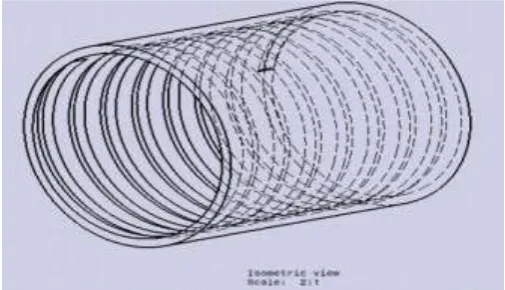
Fig -1: Drafted image of the considered geometry Both inlet and outlet fluid temperatures are measured with thermocouples. K-type thermocouples are used to measure wall temperature of test section. One manometer is used to measure the pressure drop in these heat transfer fluids. Two rotameters are used to measure flow rate of and the pump is used to set up the flow rate of heat transfer liquid phase fluid. The main objective is to set up the flow rate at desired value. The heat transferred by these heat transfer fluids is controlled by nichrome electrical heater by regulating the input current to the
heater. The instantaneous flow rate, temperatures and pressures at inlet and outlet are measured in the time steps of 20 min, and the average values are recorded. The characteristics of heat transfer and volumetric rate flow and pressure drop in those considered heat transfer fluids were calculated to analyse the system efficiency and performance.
Fig -2: Final solid image of the geometry
After the meshing we have imported the geometry into the ansys fluent where the analysis is to be initiated. The solver set up is comprised of solver model, materials and the maintained boundary conditions are :-
Inlet - velocity inlet Outlet - pressure outlet Pipe - heat flux
For the solver setup:- Solver :- pressure based Model :- laminar Turbulent
Grid independency:- The simulation for the different grid densities has been run in order to make sure that the model is independent of the grid density. Grid independency for different size is performed through the medium, coarse, fine grid density within the system of Ansys meshing.
Table -1: Nusselt Number Grid size minimum
element length (mm)
Nusselt number
1.2 31.626
1 55.35045
0.8 58.73416
Table -2: Surface Nusselt Number Grid fineness Surface nusselt
number
Coarse 58.73416
Medium 58.47985
[image:3.595.308.558.190.308.2] [image:3.595.35.288.486.631.2]© 2019, IRJET | Impact Factor value: 7.211 | ISO 9001:2008 Certified Journal
| Page 1555
The above table showed that the nusselt number is not ashigh and it is within 0.8 to 1 mm, hence we have considered our minimum grid size as 0.8. Similarly we have checked for the medium and fine mhes and found that there were no considerable changes so have finalize the final grid for further analysis.
3.1 Mathematical Model
The purpose of the experimental investigation is to work on the performance characteristics of the heat transfer and pressure drop of heat transfer liquids (Therminol 55, therminol 66, liquid-vapour mixture and water) in a ribbed tube by using numerical simulation. The experimental data is used and processed using the relevant equations manually in addition to performing numerical simulation for validation. The evaluation parameters for checking the performance of the fluids considered are energy balance condition, heat Transfer Coefficient, friction factor, Reynolds number and Nusselt number. The tool used in this experimental investigation is ANSYS. The energy balance equation that is applied to the selected heat transfer fluid flowing in the ribbed tube at the steady condition is:
(1)
Where is the heat flux, l is the test section length, m is the mass flux and is the specific heat. And and are the outlet and inlet temperature respectively. The calculation has been done for the determination of Nusselt number and the friction factors at steady state condition from the recorded set of data during the test. The heat transfer coefficient of the selected heat transfer fluids in the ribbed tube is calculated as:
( ) (2)
Where and are the mean wall temperature and fluid temperature respectively. A is considered as the test section heat transfer area and is the heat flux. Now the friction factor ‘f’ is determined on the basis of pressure drop across the test section.
i / 2L (3)
Where and are the density and velocity of the selected heat transfer fluids. Reynolds number and Nusselt number are the two parameters of interest and are defined as:
(4)
(5)
Where is the mean diameter of the ribbed tube, is the viscosity, is the thermal conductivity, is the inlet velocity.
4. EXPERIMENTAL RESULTS
[image:4.595.315.553.285.414.2]We have performed the analysis for the four fluids i.e Therminol 55, Therminol 66, Liquid-vapor mixture and water liquid phase heat transfer fluid to analyse its optimal performance along with their drawback and to examine its flow pattern inside the ribbed tube based on the numerical techniques. The following results from the analysis was observed corresponding to our investigation.
Table -3: Obtained results
Fluid Nusselt number
Therminol 66 104
Therminol 55 102
Water + Water vapor 3.24
Distilled water 40.06
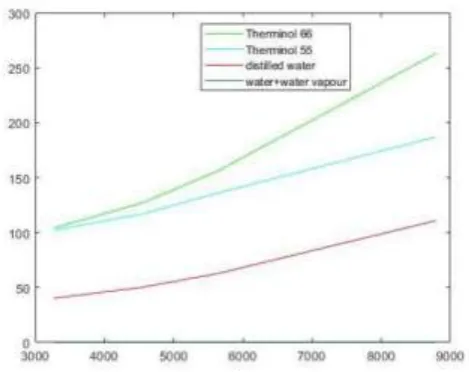
The above result of the simulation is showing better result for Therminol 66, which is also proved from the simulation graph.
3.1 Numerical Simulation
Fig- 3: Re vs Nu for all the fluids considered in the analysis
[image:4.595.313.548.499.685.2]© 2019, IRJET | Impact Factor value: 7.211 | ISO 9001:2008 Certified Journal
| Page 1556
increasing as the performance of the therminol-66 is much [image:5.595.323.546.91.273.2]more enhanced then the therminol-55, water & water vapour. In this project we have performed the simulation to show that therminol-66 with the V-shaped groove in the pipe will give better performance.
Fig 4: A) Inlet temperature contour B) Outlet temperature contour
Fig 4 C): Temperature contour across the plain
[image:5.595.37.284.170.286.2]From the above figure we observe that at inlet, the profile is plain due to the initialization of temperature at inlet from fig c we observe that as the flow starts the heat from the walls of the pipe is starts diffusing into the fluid. From fig b which is outlet we can observe the variation of the temperature across the cross section. This profile is showing the quantitative figure about the contours which we have shown in the figure inlet is a straight line with the constant temperature which as shown in figure 4a and figure 4b shows the variation of the temperature on outlet which we can confirm from above figure that the outlet temperature profile is maximum at the edges and comes to the mean flow temperature at the middle.
Fig 5: Velocity profiles at different positions of the pipe
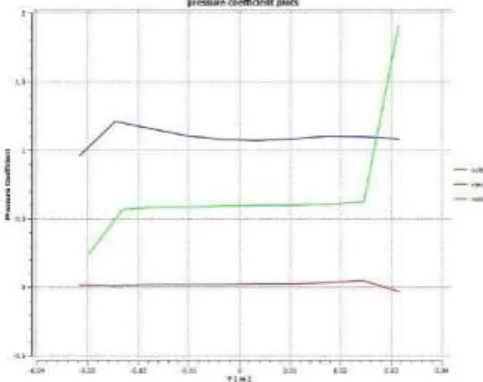
Fig 7: Pressure coefficient profile at inlet, at outlet and at midplain
[image:5.595.311.553.312.503.2] [image:5.595.50.272.331.516.2] [image:5.595.311.557.546.733.2]© 2019, IRJET | Impact Factor value: 7.211 | ISO 9001:2008 Certified Journal
| Page 1557
For further analysis we have performed our analysis byvarying the rib depth(e) and obtained the above results which shows us that with increase in the rib depth graph is moving towards the higher nusselt number which concludes that the increased rib depth will leads to higher heat transfer.
3. CONCLUSION
From the above results we can conclude that the therminol-66 with the v-shaped groove in the pipe is showing the enhanced performance from the one which is shown in the base paper. The performance of thermo-hydraulic of a ribbed tube with Therminol 55, Therminol 66, Liquid-vapor mixture and water liquid phase heat transfer fluids are evaluated in the context of improvement of thermal gain. The friction factor and heat transfer rates of different liquid phase heat transfer fluids was investigated using experiments and mathematical simulations in a ribbed tube. This article will open the prospects of purpose of ribbed tube in the company of Therminol 66 liquid phase heat transfer fluids in the heater design. This study has highlighted the following suggestions including heat transfer of different liquid phase heat transfer fluids, their pressure drop, correlations of friction factor and Nusselt number in a ribbed tube and this is how their thermal performance improvement factor was predicted.
Future Scope
This research perspective has mainly focused on the performance enhancement of the Liquid Phase Heat Transfer Fluids by studying their Thermal effects. The analysis of this research will help to know about the thermal effects and properties of various Phase Heat Transfer Fluids that may lead to effective design of concrete bridges.
REFERENCES
[1] Xu, W., Wang, S., Lu, H., Wang, Q., Zhang, Q., & Lu, H.
(2016). Thermo-hydraulic performance of liquid phase heat transfer fluid (Therminol) in a ribbed tube. Experimental Thermal and Fluid Science, 72, 149-160.
[2] Xu, W., Liu, G., Zhang, Q., Wang, S., Lu, H. and Tan, H.,
2016. Heat transfer and friction factor of Therminol liquid phase heat transfer fluid in a ribbed tube. Chinese Journal of Chemical Engineering.
[3] Xu, W., Wang, S., Zhang, Q., Wang, Q., Lu, H. and Tan, H.,
2016. Experimental and numerical studies of heat transfer and friction factor of therminol liquid phase heat transfer fluid in a ribbed tube. Applied Thermal Engineering, 95, pp.165-177.
[4] Taher, M.A., Kim, H.D. and Lee, Y.W., 2015. Study of
thermal and hydraulic performances of circular and square ribbed rough microchannels using LBM. Journal of Thermal Science, 24(6), pp.549-556.
[5] Zheng, N., Liu, P., Shan, F., Liu, Z. and Liu, W., 2016.
Numerical investigations of the thermal-hydraulic performance in a rib-grooved heat exchanger tube based on entropy
[6] Gupta, S., Chaube, A. and Verma, P., Thermo-Hydraulic
Performance of a Roughened Square Duct Having Inclined Ribs with a Gap on Two Opposite Walls. International Journal of Engineering Research and Development e-ISSN, pp.55-63.
[7] Rovenskaya, O. and Croce, G., 2013. Numerical
investigation of microflow over rough surfaces: coupling approach. Journal of Heat Transfer, 135(10), p.101005.generation analysis. Applied Thermal Engineering, 99, pp.1071-1085.
[8] Zhang, C., Chen, Y. and Shi, M., 2010. Effects of
roughness elements on laminar flow and heat transfer in microchannels. Chemical Engineering and Processing: Process Intensification, 49(11), pp.1188-1192.
[9] Sabeeh, N.S., 2014. Thermo-Hydraulic Performance of
Horizontal Circumferentially Ribbed Double Pipe Heat Exchanger. Journal of Engineering and Development, 18(3).
[10] Kaushik et al S. (2017). “Numerical Investigation of
Boiler Tubes for Performance of Heat Transfer Enhancement with Varying Shapes of Corrugated Tube”, International Journal of Engineering Research and Application, Vol. 7, Issue. 4, pp.46-54.
[11] Kathait, P.S. and Patil, A.K., 2014. Thermo-hydraulic
performance of a heat exchanger tube with discrete corrugations. Applied Thermal Engineering, 66(1), pp.162-170.
[12] Sabeeh, N.S., 2014. Thermo-Hydraulic Performance of
Horizontal Circumferentially Ribbed Double Pipe Heat Exchanger. Journal of Engineering and Development, 18(3).
[13] Negi P, Singh S, Kumar P, and Joshi LC (2015). CFD