AN INTEGRATED PRODUCT, PROCESS AND
RESOURCE MODELING TECHNIQUE FOR COST
ESTIMATION: A REMOTE LASER WELDING
CASE.
By
Ken Asare
A thesis submitted in partial fulfilment of the requirements for the degree of Doctor of Philosophy in Engineering
Warwick Manufacturing Group University of Warwick
United Kingdom, CV4 7AL
DEDICATION
This work is dedicated to my beloved wife, Mina, for her endless support, my
children for their understanding and my Mum and Dad who toiled, cheered and
DECLARATION
This thesis is presented in accordance with the regulations for the degree of
Doctor of Philosophy. It has been written by myself and has not been submitted
anywhere else. The work in this thesis has been undertaken by me except where
ACKNOWLEDGEMENTS
I am thankful to God Almighty for the grace He offered me to be able to accomplish
this research study.
Words cannot express how grateful I am to Professor Dariusz Ceglarek, Dr Neil
Davis and Professor Kwabena Agyapong-Kodua whose supervision, direction and
concern enabled me to successfully complete this work.
My gratitude also goes to all the past and current members of the Digital Lifecycle
Management (DLM) lab of Warwick Manufacturing Group (WMG), University of
Warwick, particularly Manoj Babu, Erkan Ozkat, Dr Pasquale Franciosa and Dr
Aniruddha Gupta who made my stay at the DLM lab an enjoyable one.
My appreciation goes to EU-FP7 FoF-ICT-2011.7.4: “Remote Laser Welding
System Navigator for Eco &Resilient Automotive Factories” (#285051) for the
support received for my research projects. I would like to appreciate Mr Charles
Marine for his sincere opinion and industrial point of view and support towards my
research.
I also acknowledge the financial support received from WMG, University of
Warwick throughout my doctoral research.
I would also like to express my sincere appreciation to my wife, Mina and children:
Jesse, Eliane, Christelle and Emmanuel for their encouragement, support and
cooperation with me during my time of study. To my siblings, extended families
and in-laws, I thank you all for your encouragement, understanding and prayer
support.
Special thanks to LCI Coventry members for their prayer support and to my IT
ABSTRACT
Current advances in manufacturing systems engineering have led to the development of tools and techniques that support enterprises to remain in business, be competitive and at the same time deliver products that meet the needs of their customers. Some commonly identified tools and techniques observed in literature today are: Cost Modelling techniques such as Activity Based Costing, Parametric, Expert judgment, Analogy, etc; System Modelling Techniques such as Knowledge Based Engineering; Enterprise Modelling and Behavioural Modelling tools using IT systems (Static, Dynamic and DES models) to help understand and represent systems.
Although current tools and techniques have demonstrated significant benefits to enterprises, the following challenges are observed in literature; (i) the lack of an integrated engineering and cost modelling technique during early design stages, (ii) lack of a systematic execution of engineering models into existing cost modellers to extend its capabilities to include new processes is not well documented. Which means that currently, most cost modellers are only capable of estimating cost with existing inbuilt models which depend on domain experts modification, (iii) engineering cost estimation tools that only generates manufacturing cost of products which does not include design and installation cost for new products that requires new processes. Addressing these challenges may lead to the development of dedicated and more integrated tools for useful collaborative analyses during early design phases. Also, this may lead to the development and improvement of digital modelling tools that represent actual conditions of production systems and facilities. Furthermore, this may also support organisations with the capturing of engineering knowledge to help understand processes as well as to have a better overview of capital investments.
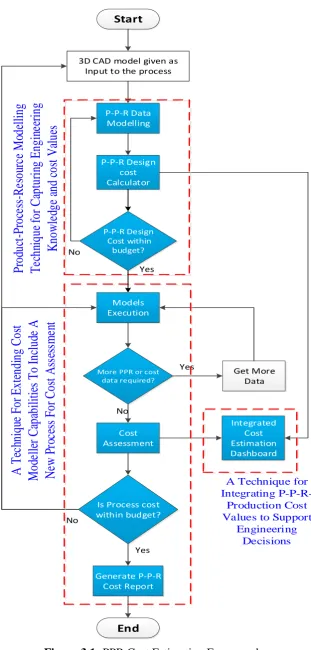
This research proposes a Product-Process-Resource (PPR) Cost Estimation
Framework to satisfy the above challenges. The proposed framework is developed through three interlinked techniques.
The first technique is a “product-process-resource modelling technique for
cost values of product, process and resource design and changing cost parameters to see its effect on the total cost. This technique is based on the assumption that product features can be associated with process capabilities which then can be mapped onto resource competencies and capacities.
The second technique is a “technique for extending cost modeller capabilities to
include a new process for cost assessment” addresses challenge (ii) above. This solution is based on identifying cost modeller requirements and then developing and implementing compatible product, process and resource models to extend the cost modeller’s capabilities. These models as discussed in the first approach becomes input for extending the capabilities of a cost modeller for costing a specific feature on a product 3D model.
Finally, challenge (iii) is addressed by introducing a “technique for integrating
P-P-R-Production cost values to support engineering decisions”. This is a unique technique that integrates PPR design cost models, installation cost model and production cost database to generate visible cost values as a cost summary. The cost summary contains cost algorithms and equations, modelled to reflect the effect of time, rate, annual production volume, material and batch size changes to the total cost.
TABLE OF CONTENTS
DEDICATION ... i
DECLARATION ...ii
ACKNOWLEDGEMENTS ... iii
ABSTRACT ... iv
TABLE OF CONTENTS ... vi
LIST OF FIGURES ... x
LIST OF TABLES ... xiv
LIST OF PUBLICATIONS ... xv
ABBREVIATIONS ... xvi
1. INTRODUCTION ... 1
1.1 Introduction ... 1
1.2 Motivation ... 6
1.3 Research Objectives ... 9
1.4 Research Question ... 10
1.5 Research Outline ... 10
1.6 Research Scope ... 12
2. LITERATURE REVIEW ... 13
2.1 Engineering Cost Estimation ... 13
2.1.1 Cost Estimation Techniques ... 14
2.1.2 Activity-Based Costing... 15
2.1.3 Parametric Cost- Modelling Technique ... 19
2.1.4 Feature Based Cost-Modelling Technique ... 21
2.1.5 Cost Modelling: Accounting versus Engineering ... 22
2.1.6 Limitations of The State Of The Art Techniques ... 25
2.2 Product and Features ... 26
2.2.1 Feature Definitions ... 27
2.2.2 Feature Recognition ... 27
2.2.3 Feature Recognition Techniques ... 28
2.3 Welding Technologies ... 31
2.3.1 Resistant Spot Welding (RSW) ... 32
2.3.2 Remote Laser Welding (RLW)... 32
2.3.3 Gap Controlling Techniques ... 36
2.3.4 Stitch Parameters ... 37
2.4 Knowledge Based Engineering ... 38
2.4.1 KBE Definitions ... 39
2.4.2 Knowledge Based Engineering Methodologies ... 40
2.4.3 Applications of Knowledge Based Engineering ... 44
2.5 New Product Introduction ... 45
2.5.1 New Product Introduction Models ... 46
2.6 Summary ... 52
3. PRODUCT-PROCESS-RESOURCE (PPR) COST ESTIMATION FRAMEWORK ... 57
3.1 Introduction to PPR Cost Estimation Framework ... 58
3.2 A Product-Process-Resource Modelling Technique for Capturing Engineering Knowledge and Cost Values ... 62
3.2.1 Engineering Modelling Techniques ... 62
3.2.2 Cost Modelling Techniques ... 63
3.2.3 Limitations of The State Of The Art Techniques ... 65
3.2.4 Proposed Product-Process-Resource Data Modelling Technique ... 66
3.3 A Technique for Extending Cost Modeller Capabilities to Include A New Process For Cost Assessment ... 94
3.3.1 Knowledge based models in support of cost engineering ... 94
3.3.4 Proposed Research Technique ... 96
3.3.5 Cost Assessment ... 105
3.4 A Technique for Integrating P-P-R-Production Cost Values to Support Engineering Decisions. ... 106
3.4.2 Generation P-P-R Cost Report ... 110
3.5 Summary ... 112
4. CASE APPLICATION ... 113
4.1 Remote Laser Welding (RLW) Navigator Project ... 113
4.2 PPR Cost Estimation Framework Implementation for Remote Laser Welding Process ... 115
4.3 3D CAD of Car Door Model ... 118
4.4 RLW PPR Data Modelling ... 119
4.4.1 RLW Product Model ... 119
4.4.2 RLW Process Model ... 126
4.4.3 RLW Resource Model ... 131
4.4.4 RLW Process and Resource Integration Model ... 134
4.4.5 RLW’s PPR Design Cost Calculator ... 139
4.5 Feature Recognition in Cost Modeller ... 140
4.5.1 RLW Execution Input ... 143
4.5.2 Remote Laser Welding Implementation in aPriori’s Cost Modelling Workbench. ... 144
4.6 Cost Assessment stage for RLW ... 154
4.6.1 RLW Installation CostCalculation ... 159
4.7 Results for RLW Process ... 160
4.7.1 Product Design Cost ... 160
4.7.2 Process Design Cost ... 160
4.7.3 Resource Design Cost ... 161
4.7.4 Installation Cost ... 161
4.7.5 Remote Laser Welding Process Cost ... 162
4.7.6 RLW Design and Production Cost Scenarios ... 165
4.8 Integrated Cost Estimation for RLW ... 171
4.9 A Comparative Analysis of Resistant Spot Welding and Remote Laser Welding process ... 172
4.9.1 Process Cycle Times: RSW v RLW ... 173
4.10 Summary ... 176
5. DISCUSSION ... 177
5.1 A Review of The Proposed PPR Cost Estimation Framework ... 177
5.2 Welding Technologies: RSW v RLW ... 180
5.3 Results of Remote Laser Welding using PPR Cost Estimation Methodology ... 181
5.4 How PPR Cost Estimation Framework Has Been Applied in This Research ... 185
5.5 PPR Cost Estimation Benefits against Required Effort ... 188
5.5.1 Benefits ... 188
5.5.2 Requirements ... 189
5.6 Remote Laser Welding Characteristics ... 190
5.7 Framework Limitations ... 191
5.8 Summary ... 193
6. CONCLUSION AND FURTHER WORK... 194
6.1 Conclusion ... 194
6.2 Research Contributions ... 196
6.4 Recommendations and Future Works ... 197
6.5 Concluding Remarks ... 199
REFERENCES ... 200
APPENDIX A ... 229
APPENDIX B ... 260
APPENDIX C ... 263
APPENDIX D ... 265
APPENDIX E ... 269
APPENDIX F ... 271
LIST OF FIGURES
Figure 1.1:Thesis Outline ...10
Figure 2.1: Product cost estimation techniques (Niazi, Dai et al. 2006) ... 15
Figure 2.2: Activity Based Costing Model (Turney, 1996) ... 17
Figure 2.3: Parametric Cost Modelling Process (ISPA, 2008 ) ... 20
Figure 2.4: (a) Sample part; (b) Attributed graph of the part; (c) its subgraphs (Owodunni et al., 2002) ... 29
Figure 2.5: An example of CSG Tree (Geuzaine, 2015) ... 31
Figure 2.6: Powertrain Application ... 33
Figure 2.7: Tube Welding ... 33
Figure 2.8: MOKA Lifecycle (MOKA Consortium, 2001) ... 41
Figure 2.9: Main processes and deliverables of the MIKE methodology (Studer, 1998) ... 43
Figure 2.10: Kotler’s NPI Model (Kotler & Armstrong 2012) ... 47
Figure 2.11: An Overview of a Stage-Gate System (Cooper 1990) ... 49
Figure 2.12: The coupling model of an innovation process (Rothwell & Zegveld1985)…...………...…..48
Figure 2.13: The chain-linked model(Kline & Rosenberg 1986)………....49
Figure 3.1: PPR Cost Estimation Framework 61 Figure 3.2: PPR Data Modelling Schematic ... 68
Figure 3.3: Summary of PPR Data Models ... 69
Figure 3.4: Product Models ... 70
Figure 3.5: Product Tree Illustration ... 72
Figure 3.6: Snap Shot of Product Tree Script Representation ... 73
Figure 3.7: Process Model ... 77
Figure 3.8: Sample Process Model ... 78
Figure 3.9: Workstation Model Flow ... 79
Figure 3.10: Workstations Level Computer Representation ... 79
Figure 3.11: Operations Level Computer Representation ... 80
Figure 3.12: Resource Model ... 83
Figure 3.14: Resource Flow Illustration ... 85
Figure 3.15: Resource Flow Representation ... 85
Figure 3.16: Computer representation of Resource Flow ... 88
Figure 3.17: Process and Resource Integration Model ... 89
Figure 3.18: Workstation and Resource Integration Model ... 90
Figure 3.19: Computer Representation of Workstations and Resources Integration ... 91
Figure 3.20: Operations and Resources Integration ... 91
Figure 3.21: Computer Representation of Work Station Level Integration ... 92
Figure 3.22: PPR Design Cost Calculator ... 94
Figure 3.23: Relevant knowledge sets for a cost modeller (Agyapong-Kodua et al., 2011)………93
Figure 3.24: Generic Cost Modeller Requirement Structure ... 98
Figure 3. 25: A Generic Cost Modeller Requirements and Input ... 99
Figure 3.26: Integrated Cost Calculator ... 107
Figure 3.27: Sample of Report form SEER-DFM ... 112
Figure 4. 1: RLW Application of PPR Cost Estimation Framework ... 117
Figure 4. 2: 3D Door Components ... 118
Figure 4. 3: RLW Door Assembly Tree ... 120
Figure 4. 4: RLW Computer Representation ... 120
Figure 4. 5 RLW Process Illustration ... 127
Figure 4. 6: RLW Workstations Sequence Representation ... 128
Figure 4. 7: ST110 Operation Sequence ... 128
Figure 4. 8: RLW ST110 Sequence Representation ... 129
Figure 4. 9: RLW Resource Model ... 131
Figure 4. 10: RLW Resource Model ... 132
Figure 4. 11: Operator Activity ... 132
Figure 4. 12: RLW Process and Resource Integration Illustration ... 135
Figure 4. 13: ST110 Operation and Resource Activities ... 136
Figure 4. 16: PPR Design Cost Calculator For RLW ... 140
Figure 4. 17: Cost Modeller Architecture ... 109
Figure 4. 18: Working Principle of Cost Modeller ... 110
Figure 4. 19: Cost Modeller Feature Costing Principle ... 141
Figure 4. 20: PPR Cost Estimation Implementation ... 142
Figure 4. 21: A Snapshot of Costs Equations for RLK Using CSL ... 143
Figure 4. 22: PPR Cost Estimation Implementation ... 145
Figure 4. 23: VPE Creation Work Flow ... 145
Figure 4. 24: VPE Selection and Process Group Creation ... 146
Figure 4. 25: Remote Laser Welding ... 147
Figure 4. 26: Create Operations for Remote Laser Welding using CSL ... 148
Figure 4. 27: Weld Template Creation ... 148
Figure 4. 28: RLW CSL Cost Taxonomy ... 149
Figure 4. 29: Routing Rule Creation for RLW ... 150
Figure 4. 30: RLW Machine Type and Information ... 151
Figure 4. 31: RLW Process Setup Options ... 152
Figure 4. 32: RLW Cost Equations ... 152
Figure 4. 33: Material Cost Definition ... 153
Figure 4. 34: CAD Model Import ... 155
Figure 4. 35: Laser Stitch Problem ... 156
Figure 4. 36: Laser Weld Stitches Solution ... 156
Figure 4. 37: RLW Weld Stitches Creation ... 157
Figure 4. 38: VPE and Machines Selection ... 158
Figure 4. 39: Routing Selection ... 159
Figure 4. 40: Experimental Parameters in aPriori ... 163
Figure 4. 41: Scenario 1 for Product Design Cost Effect on Parameter Changes ... 166
Figure 4. 42: Scenario 2 for Product Design Cost Effect on Parameter Changes ... 167
Figure 4. 43:Scenario 3 for Product Design Cost Effect on Parameter Changes…….. ... 168
Changes ... 169
Figure 4. 45: Scenario 5 (A) RLW Production Cost Effect on Parameter
Changes ... 170
Figure 4. 46: Scenario 5 (B) RLW Production Cost Effect on Parameter
Changes ... 170
Figure 4. 47: Scenario 5 (C) RLW Production Cost Effect on Parameter
Changes ... 171
Figure 4. 48: Scenario 5 (D) RLW Production Cost Effect on Parameter
Changes ... 171
Figure 4. 49: RLW Integrated Cost Calculator ... 172
Figure 5.1: RSW process time for 140 spot welds with annual volume of 10000
using aPriori batch size………...……….181
Figure 5.2: RLW process time for making 75 stitches with annual volume
of 100,000 using batch size of 1,000 ... 186
Figure 5.3: RSW process cost for 140 spot welds with annual volume of
10000 using aPriori batch size. ... 1752
Figure 5.4: RLW process cost for making 75 weld stitches with annual
volume of 100,000 using batch size of 1,000. ... 175
Figure 5.5: A comparison of RSW and RLW welding techniques using
aPriori ... 181
LIST OF TABLES
Table 2. 1: Part-to-part gap control techniques in laser welding ... 37
Table 2. 1: Related Literature Survey of Cost Estimation Models………...59
Table 2. 2: Related Literature on System Modelling and Cost Estimation Techniques……….60
Table 3. 1: Sample of a Resource Database……….. 84
Table 4. 1: RLW Resource Database ... 133
Table 4. 2: Process and Resource Matrix ... 135
Table 4. 3: RLW Resources Rates ... 138
Table 4. 4: Workstations Cost Calculations ... 139
Table 4. 5: Material Data ... 153
Table 4. 6: Product Design Cost ... 160
Table 4. 7: Process Design Cost Results ... 161
Table 4. 8: Resource Design Cost ... 161
Table 4. 9: Installation Cost Results ... 162
Table 4. 10: RLW Process Results using Design of Experiment ... 164
Table 4. 11: (Scenario 1) Product Component Design and Inspection Time Changes ... 165
Table 4. 12: (Scenario 2) with workstations ST130 and ST140 rework times increased ... 166
Table 4. 13: (Scenario 3) Process Workstations Design and Inspection Time Changes ... 167
LIST OF PUBLICATIONS
Asare, K. B, Agyapong-Kodua, K., & Ceglarek, D. J. 2014. Digital Modelling
Methodology for Effective Cost Assessment. Procedia CIRP, 17, 744-749.
K. B. Asare, M. Shang, D. Ceglarek, K. Agyapong-Kodua, 2017. Submitted to
Research in Engineering Design. A Product, Process, Resource and Cost integrated
methodology for effective system design.Under review.
K. B. Asare, M. Shang, D. Ceglarek, K. Agyapong-Kodua, 2017. Submitted to
International Journal of Computer Integrated Manufacturing. Life Cycle Design,
Production Modelling, Simulation Manufacturing Systems Engineering.
K. B. Asare, D. Ceglarek, N. Davis,K. Agyapong-Kodua and C. Marine, 2017. ‘A
Product-Process-Resource Modelling Technique for Capturing Engineering
Knowledge and Cost Values’.To be submitted to International Journal of Industrial
Engineering Computations.
K.B Asare, D. Ceglarek, N. Davis, K. Agyapong-Kodua, 2017. ‘A Technique for
Extending Cost Modeller Capabilities to Include a New Process For Cost
Assessment.’ To be submitted to International Journal of Computer Integrated
Manufacturing.
K. Asare, K. Agyapong-Kodua and N. Davis, 2017. ‘An Integrated
Product-Process-Resource-Production Cost Estimation Technique’. To be submitted to
ABBREVIATIONS
ABC: Activity Based Costing
AI: Artificial Intelligence
CAD: Computer Aided Design
CAE: Computer-Aided Engineering
CAM: Computer Aided Manufacturing
CER: Cost Estimating Relationship
CIMOSA: Open System Architecture for CIM
CMWB: Cost Model Workbench
COQ: Cost of Quality
CSL: Cost Scripting Language
DfA: Design for Assembly
DfM: Design for Manufacturing
DSM: Decision Support Model
EA: Enterprise architecture
EE: Enterprise Engineering
EI: Enterprise Integration
EM: Enterprise modelling
GERAM: Generalised Enterprise Reference Architecture and Methodology
ICAD: Intelligent Computer Aided Design
IGES: International Graphics Exchange Standard
KBE: Knowledge Based Engineering
KPI: Key Performance Indicator
ME: Manufacturing Enterprises
MIKE: Model-based and Incremental Knowledge Engineering
MOKA: Methodology and tools Oriented to knowledge based Applications
NPD: New Product Development
NPI: New Product Introduction
PERA: The Purdue Enterprise Reference Architecture
PPR: Product-Process-Resource
RA: Reference Architecture
RLW: Remote Laser Welding
RSW: Resistance Spot Welding
SPR: Self-Piercing Riveting
STEP: Standard for the Exchange of Product Model Data
TOGAF: The Open Group Architectural Framework
VFF: Virtual Factory Framework’s
VPE: Virtual Production Environment
CHAPTER 1
INTRODUCTION
1.1 Introduction
Manufacturing Enterprises (MEs) are currently facing extreme levels of competition
due to complex customer demands/changes and other challenges such as
technological, social, environmental, legal and political issues. To remain competitive,
there is the need for MEs to deploy strategies and techniques that will enable them to
become flexible in their design, manufacturing and service operations. It is however
estimated that about 70% of manufacturing cost is determined at the design stage, with
very limited production information (Jin, 2012). Most decisions which are cost
sensitive are taken at early stages of the design phase and it is, therefore, necessary to
support designers to understand the cost implication of their engineering decisions
(Agyapong-Kodua et al., 2012). Pragmatic techniques are used by many
manufacturing companies today to improve their manufacturing operations by
reducing the time taken to carry out activities, processes, projects or programs from
conception through to delivery to the customer.
To survive in an ever-changing economic environment, manufacturing enterprises are
increasing the use of modelling techniques and simulation tools for product, process
and resources, mainly focusing on lifecycle simulations and design for product
variation to achieve high-quality product and robust processes (Maropoulos and
Ceglarek, 2010). The main objectives for using these tools and techniques are to
understand the system’s dynamic in order to reduce the total process cycle times for
sections of departments or for the entire organization. Enterprises have adopted the
ubiquitous technology of using simulation tools and models in today’s cutthroat
environment. Generally, simulations deployed by MEs are to encourage parallel
processing during the product development stage; shorten the product development
cycle times; and to avoid the cost of physical prototype building (Lee et al., 2011).
The need for modern manufacturing systems to be able to meet several challenges and
at the same time satisfy customer requirements and constraints that change over time
resources may undergo various engineering changes critical to enterprise’s success.
The manufacturing systems life cycle approach looks at the manufacturing system and
the entire factory as a product characterized by several stages: design stage,
implementation stage, operation stage and subsequent re-design/reconfiguration of the
manufacturing system (ElMaraghy, 2005); (Westkämper et al., 2005) (Westkämper,
2007). However, complexities in manufacturing systems trigged the idea of analytical
methods (Chung and Synder, 1999), (Heragu and Kusiak, 1988), (Hamann and
Vernadat, 1992), (Kim and Kim, 2000) which are currently employed by many MEs
((Gershwin, 1994); (Matta et al., 2005)). As these complexities in manufacturing
systems are ever increasing, the use of information technology (IT) is employed to
handle some of the complexities and at the same time reduce time and cost for
manufacturing innovation and productivity enhancement by supporting several stages
in the design, development, production and operation of novel manufacturing systems
(Alexopoulos et al., 2011), (D'Addona and Teti, 2011). It is always expected in every
organization that design, manufacturing departments and cost knowledge work
together seamlessly but in reality, there is a gap between them. This is supported by
Agyapong-Kodua et al. (2014) research on digital modelling methodology concluded
that the implications of such gap result in time consuming and unnecessary process
activities that generate extra expenses due to several levels of iterations required to
reach optimal decisions.
Since most engineering decisions which are cost sensitive are taken at early stages of
the design phase, it is necessary to support designers to understand the cost implication
of their engineering decisions (Agyapong-Kodua et al. 2012; Jarratt et al. 2011).
Achieving this is not trivial because there are a number of competitive key
performance indicators that designers will have to control to reach optimal design
solutions (Shrouti et al. 2013). To manage this challenge, proponents of cost
engineering and accounting (Akintoye and Fitzgerald 2000; Caputo and Pelagagge
2008a; Cavalieri et al. 2004; Curran et al. 2004a) have recommended a number of
these bodies of literature, however, shows that due to the inherent complexities and
dynamic changes in product, process and resource requirements, it is fairly difficult to
estimate, predict, control and monitor cost consumption appropriately. It was also
noted that traditional cost accounting practices are best deployed to manage and
control cost during operational stages of manufacturing systems but less helpful during
early stages of product, process or resource systems design. Coupled with this,
traditional cost accounting practices have not been kept up with the advances in design
and manufacturing technologies (Agyapong-Kodua et al. 2012c). Current cost
accounting techniques may be able to provide ‘static cost’ impressions when fed with
suitable information but limited in predicting cost as a result of frequent engineering
changes of dimensions, materials, tolerances, shapes and so forth (Asiedu et al. 2000).
Cost is an important key performance indicator (KPI) amongst others which need to
be considered at the very early stages of product design. Carter and Baker (2002)
argued that cost should be incorporated in the conceptual phase of a product
development. According to their research, the scale of cost increases by almost a factor
of 10 when changes have to be made at the next level of the product lifecycle. This,
however, is to emphasize the major benefit of saving by means of increasing an
organization’s profit margin through controlling cost at the concept and design phases
of a new product introduction (NPI) process. In support of this, Agyapong-Kodua et
al. (2012) inferred that designers are to be supported to understand the cost implication
of their engineering decisions early enough. More critically, Shrouti et al. (2013),
mentioned that this is not trivial as there are other KPIs designers will have to control
to reach optimal design solutions of which cost may not necessarily be one. To
overcome this challenge, experts in cost engineering and accounting recommended
approaches such as: cost estimation of projects, lifecycle analysis, technology down
selection and assessment of economic viability of engineering projects (Akintoye and
Fitzgerald (2000); Caputo and Pelagagge (2008); Cavalieri et al. (2004); Curran et al.
(2004).
A new product that can be realized by existing processes and existing resources may
purposes. Likewise, developing a new technology (process and resources) to realize
existing product to manufacture in a more cost efficient way may not also exhibit too
much complexity. However, the challenge is this, where a new product and a new
process are required, what systematic approach does MEs take to ensure that all
necessary knowledge requirements are identified and captured in a way that ensures
repeatability of the method? In many instances, estimating the cost of a product or a
process is done by cost estimators using their expert judgement which may result in
overestimating or underestimating. Other means of estimating today is the use of cost
estimation tools. The negative side of the latter is that, cost estimation tools has
predefined processes and resources database which may not necessarily reflect reality,
and hence, although that estimate may be good, it may not be suitable. There is,
therefore, the need to develop a generic system that is capable of capturing, use, storing
and managing the knowledge of creating a process for a new product that generates
cost information that is repeatable for other applications. This will support and reduce
engineering decision making time by bridging the gap between design and
manufacturing through the introduction of cost as a key performance indicator (KPI)
for both. This is achieved by integrating product, process and resource models for a
manufacturing system in a way that cost information is generated early at various
design stages. Also, to ensure that the cost values are available to both design and
manufacturing as geometric features and manufacturing feature undergo various
iterations. This will give designers options to choose alternative process or resource
where there is an engineering change and at the same time identify the cost
implications of the engineering change.
To satisfy the above challenges, this research proposes a modelling framework called
Product-Process-Resource (PPR) Cost Estimation Framework. The proposed
framework is developed through three interlinked approaches.
The first approach is a data modelling technique that captures engineering knowledge
and extracts cost information for estimating product (P), process (P) and resources (R)
expected to be consumed to realize a particular product or features on a product. This
technique makes use of business process modelling notations to illustrate the
integration of process and resources. The process is divided into workstations where
the integration is further carried out at the workstation levels, to show detailed
activities of resources at each workstation. Furthermore, a computer representation of
each workstation is generated Extensible Markup Language (XML), which are both
human-readable and machine-readable to be used in the next stage of the proposed
methodology. Also, a PPR Design Cost Calculator is developed that captures the times
and rates based on a unique cost algorithm created. The calculator enables engineers
to visualize cost values of product, process and resource design and changing cost
parameters to see its effect on the total cost. This technique is based on the assumption
that product features can be associated with process capabilities which then can be
mapped onto resource competencies and capacities.
Secondly, a systematic approach of executing engineering models into a cost modeller
to extend its existing cost modeller capabilities is addressed. This solution is based on
identifying cost modeller requirements and implementing compatible product, process
and resource models that satisfy the requirements. These models as discussed in the
first approach become inputs for extending the capabilities of a cost modeller for
estimating the cost of a specific feature on a 3D CAD model of a product.
Thirdly, an integrated P-P-R-Production cost estimation technique was introduced.
This is a unique technique that integrates PPR design cost database and production
cost database and makes cost values visible to both design engineers and
manufacturing in a cost summary. The cost summary contains cost algorithms and
equations that are capable of estimating the effect of engineering changes on product
design, process design, resource design and the production process costs.
The proposed PPR Cost Estimation Framework have been validated with an industrial
case studies of an automotive sheet metal door assembly process, a novel Remote
Laser Welding (RLW) case application for its rigorousness and future industrial
applicability. Results obtained from the case application were compared with a
systematic engineering knowledge capturing during early design stages for estimating
cost and for generating instant cost values based on engineering scenarios to support
engineering decisions.
1.2 Motivation
Based on reviews of current literature on cost estimation, factory system modelling,
knowledge based engineering amongst others in design and manufacturing domain,
cost is considered as a very important performance indicator and an ineffective cost
decision can cause an organization to be non-competitive and insolvent due to the lack
of process understanding. The review further confirmed the relevance of an integrated
product, process and resource modelling concept. However, the review also shows that
there is the:
(i) Lack of an integrated engineering system modelling and digital cost modelling
techniques
Major design and engineering decisions bother on cost but current generation
industrial practice dissociates critical engineering activities from cost modelling.
Although there is the drive towards integrating these two fields, manufacturing
industries are yet to fully benefit from this. In some advanced manufacturing
industries, initial CAD models are generated by product designers. Product Designers
typically describe the functions, materials specifications and dimensions of products.
These details are then used by process engineers to define process sequences, facilities
and hence estimate the cost required to realize the product. This initial estimate is
based on metrics such as run time per day, tooling and facilities investment required,
floor space, labour, material, and job per hour. The manufacturing feasibility is usually
checked by the process designer and when there are potential issues with the
manufacturability of the product, a change request is sent to the product designers.
This cycle could repeat itself for a long time until a suitable solution is obtained.
Although digital modelling tools have been developed to help with this process, these
tools do not provide adequate support for direct realization of cost implication of
are currently isolated although required to complement each other. The implication of
such separation can be time consuming and expensive as it may require several levels
of iteration to reach improved decisions. The direct integration of engineering
decisions with cost will:
1. Reduce product design life cycles and improve cost effectiveness of
manufacturing industries
2. Allow the economic implication of alternative product designs to be assessed
3. Experiment the economic effect of introducing different features on products
4. Check alternative processes (as well as resources) and their suitability to meet
product requirements
Based on the above points, there is the need for methods and techniques which will
define a modelling approach that allows the assessment of cost implications of
engineering decisions.
(ii) Lack of full representation of real instances of manufacturing processes for
product flow
Current best digital modelling tools do not necessarily recognize actual work loading
conditions of production systems, and therefore cost estimation based on these models
may not fully represent business conditions of the customized manufacturing system.
This is so because best process modelling techniques in support of cost modelling
assume single flow dedicated manufacturing systems and underestimate the
implication of multiple flows, resource sharing, product mix, rework and other
manufacturing dependent failures. This assumption is challenging when real
manufacturing instances are to be considered. This is because real manufacturing
industries are characterized by complex interrelated systems of processes which may
be causally or temporarily related and need to be resourced with technical and human
systems. As a result, waiting times, inventory sources, resource availability, actual
cycle times may need to be considered in any model geared towards cost modelling.
These systems need to be properly coordinated and controlled to allow a variety of
products to be realized through them over varying periods of time. Current approaches
to the identification and modelling of cost have not been adequate because most of the
cost modelling techniques do not encode time dependencies related to product flows,
of alternative flows of product (volume and mixes) through a shared process cannot
accurately be modelled by current generation cost modelling techniques. There is,
therefore, the need for research into suitable representations of the dynamic instances
of manufacturing systems and how they can be reflected in cost models so that in the
product design phase, the behaviour of such systems can be used to support actual cost
models.
(iii)Lack of a comprehensive cost modelling tools for developing a new process
options to support engineering decisions
Remote laser welding (RLW) is a novel joining process competitive with conventional
processes such as resistance spot welding (RSW) and self-piercing riveting (SPR).
Literature shows that RLW has potential to be five times faster and occupies 50% less
floor space when compared with RSW (Agyapong-Kodua et al., 2014). RLW utilizes
80% fewer robots, less tooling stations and consumes 10% less operation cost (Mori
et al., 2010). Energy usage is reported to be reduced by 20% when compared with
RSW (Um and Stroud, 2013). Due to these reported benefits, many automotive
industries are investing in RLW technologies. The introduction of RLW technologies
leads to geometrical changes in product designs. This means products that can be
conveniently assembled through RSW and self piercing riveting (SPR) will need
modifications for them to be realized through RLW technologies. Initial research
focused on the development of systems models (Colledani et al., 2013, Colledani et
al., 2014), process details (Shrouti et al., 2013) and monitoring activities (Prakash et
al., 2009). Whilst realizing the technical objectives, cost models were developed to
justify the economic benefits of RLW compared with other assembly technologies
(RSW and SPR) (Matsuda et al., 2012). Other achievements and reported findings
include RLW process optimization (laser beam parameters selection, fixture layout
optimization), RLW process control (in-line monitoring and control) and RLW
Eco-Efficiency evaluation (Prakash et al., 2009). The aim of these research activities was
to provide a toolkit to facilitate process planning, design, implementation and
optimization of RLW process for Body-In-White Sheet metal joining (Matsuda et al.,
One major objective of the integration process is to be able to assess the cost
implication of engineering decisions associated with new features of the RLW-related
products. Furthermore, the cost implications of RLW process on product lifecycle
from design to service have not been properly investigated and understood. This cost
analysis can be applied as a benchmark for investment justification. Therefore, there
is a need to develop a cost modelling workbench specifically for RLW process, which
can encapsulate the uniqueness of the RLW process features.
As a results of the identified gaps in literature, this research work addresses (i); by
integrating engineering system modelling techniques with cost modelling techniques.
Also, some aspect of (iii) is covered in this research, where a new process (RLW)is
introduced into an existing cost estimation tool (aPriori) as a process option to support
engineering decisions. The RLW process was selected for the purpose of this research
because it is an emerging and novel fabrication process in the automotive body in
white (BIW) industry. Although aPriori is capable of costing fabrication techniques
such as resistant spot welding (RSW), MIG welding, etc., RLW process and its
associated resources are not currently available in the tool. This work therefore
introduces RLW as a novel process within aPriori.
1.3 Research Objectives
1) To review literature in manufacturing systems engineering with emphasis on
engineering cost estimation, product and features definition, Knowledge Based
Engineering, Enterprise modelling and Engineering Decision Making
2) To gather and model data that represents a manufacturing system
3) To create an integrated cost model that generates cost information during
design and production stages
4) To integrate the modelled data with a cost modeller
5) To expand the capabilities of a cost modeller to include a new process routing.
6) To generate cost values using scenarios that show the effect of changes to
1.4 Research Question
How can product, process and resource be integrated in a way that ensures that
engineering knowledge, product and process design costs are captured during early
design stages when introducing a new manufacturing technology?
1.5 Research Outline
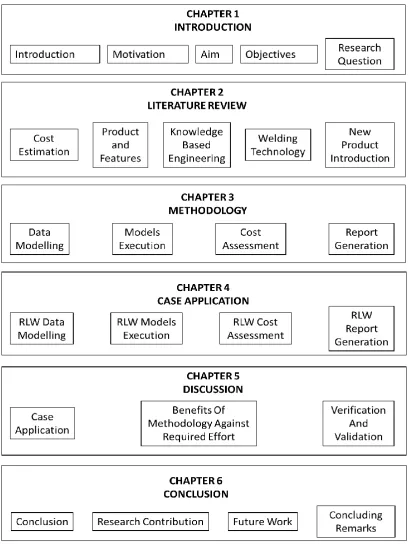
The outline of this research is shown in Figure 1.1.
Chapter 1 introduces the research, outlining the aims, objective and a background to
the research.
Chapter 2 reviews literature in Cost estimation and existing NPI processes looking at
research gaps that this research aims at satisfying.
Chapter 3 explains the PPR Cost Estimation Framework, showing the systematic flow
of data collection, modelling, execution, cost assessment and cost report generation.
Chapter 4 is a case application of the PPR Cost Estimation Framework on a novel
Remote Laser Welding (RLW) technology, showing how a new process can be
introduced and made available as a process routing option.
Chapter 5 discusses the results of the case application considering some of the benefits
of the methodology is discussed as a means of verifying and validating it to prove the
generic use of the approach.
Chapter 6 concludes the research with some limitations of the methodology as well as
1.6Research Scope
Although the proposed methodology in this research may be applicable to other areas,
this work is limited to the manufacturing domain as data used was mainly obtained
from a laser welding technology project which is a manufacturing process.
Based on the gaps identified in literature in section 1.4, the scope of this is to address
the lack of an integrated engineering system modelling and digital cost modelling
techniques by:
Modelling and integrating product, process and resources (PPR) of a system
using stastic system modelling techniques.
Reviewing state of the art cost estimation techniques and developing a
dynamic cost model that is capable of capturing PPR design cost during early
stage design.
Implementing the developed PPR models into a commercial tool and
CHAPTER 2
LITERATURE REVIEW
This chapter presents a literature review of current work done in the field of
manufacturing systems engineering. The topics covered in this section are state of the
art approach used in the research domain relevant to this thesis. Seven main sections
this chapter which are Section 2.1 introduces engineering cost, Section 2.2 defines
product and features, Section 2.3 welding technology, Section 2.4 knowledge based
engineering, Section 2.5 enterprise modelling, Section 2.6 enterprise decision making,
Section 2.7 new product introduction and Section 2.8 summary of the chapter.
2.1 Engineering Cost Estimation
Cost estimation is an important activity in today’s manufacturing industry considering
the competition that exists amongst companies. However, the existence of cost
modelling literature, particularly in the area of estimating the manufacturing cost of a
design is very limited (Langmaak et al., 2013). The manufacturing cost of a design
which is also known as unit cost is achieved using parametric process time estimation
in combination with a bottom-up calculation of the resources consumed by all
manufacturing activities within a process. Langmaak (Langmaak et al., 2013)
concludes that the £-per-hour cost rate of every manufacturing operation is realized by
the bottom-up costing element and the parametric element of the model is also realized
by linking historical operation times and design data for an operational time estimate
for future products based on its design parameters. The prediction of the unit cost of a
future design is estimated by multiplying the regresses operation times by the
respective cost rates and summing up the results of the costs. (Westkämper et al.,
2005) asserts that in this information technology age, there are a plethora of software
available in the market that is able to help with cost in the manufacturing environment,
but each comes with different purchasing costs, benefits, and implication of
possibilities and risks. A research conducted by Volkmann (Volkmann and
Westkämper, 2013) on cost model for digital engineering tools for the analysis of the
not focus on the calculation of cost before the introduction of a new product but rather
usually based on data retrieved after implementation. According to Curran (Curran et
al., 2004), cost estimating could be defined as the means of predicting the cost of a
work activity by making sense of historical data or knowledge by means of creating a
cost model. Cost estimation is an industrial practice which is largely based on the
experience of the cost estimator and not on science due to its lack of consolidating
theories. However, other unpredictable factors outside of design, such as inflation and
market condition have the tendency of affecting the costing process (Curran et al.,
2004), (Scanlan et al., 2002). However, in some industries such as the aerospace
industry which is a high-tech but low-volume manufacturing, obtaining well
documented and comprehensible costing information becomes very challenging
(Curran et al., 2004). Objective cost estimation and validation becomes a major
challenge in situations where there are meagre and increases in inaccurate data
(Collopy and Curran, 2005) (Smith and Mason, 1997).
2.1.1 Cost Estimation Techniques
Estimating cost and cost modelling helps to know the future manufacturing cost at
very early stages of a product design. Estimating the cost during early design stage
with enough accuracy has great benefits to a project launch (Hueber, 2016). Having a
poor cost estimate may result in too low or too high cost values which can eventually
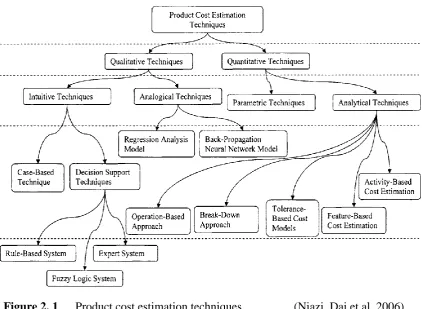
Figure 2. 1 Product cost estimation techniques (Niazi, Dai et al. 2006)
Figure 2.1 shows the various classifications of product cost estimation techniques used
in the field of engineering. In view of this research, qualitative costing techniques are
most suitable considering the objectives of the research where the cost of engineering
changes are to be captured and translated numerically. Under the quantitative group
of techniques, the most appropriate techniques to be reviewed and analysed are the
parametric, activity-based and feature-based cost estimation techniques.
2.1.2 Activity-Based Costing
The Activity-Based Costing (ABC) methodology was first introduced by (Cooper and
Kaplan, 1987) as a more efficient way of costing compared with the traditional
accounting methods. A comparison of ABC and the known traditional cost accounting
methods was done by (Park and Kim, 1995). Their research claims that the main
advantage of ABC is its ability to more accurately reflect indirect costs of different
products. However, (Park and Kim, 1995) concluded that it takes more effort in
obtaining accurate information concerning the consumption of resources at each
definition for ABC as: “a method for accumulating product cost by determining all
cost associated with the activities required to produce the output”. More critical,
(Lewis, 1993) spotted two differences between ABC system and the traditional
system; firstly, cost pools are defined as activities rather than production cost centres
and secondly, the cost drivers used to assign activity costs are structurally different
from those used in traditional cost systems. ABC gained popularity over the years due
to dissatisfaction with the distortions created by traditional costing systems and has a
wide usage both with accounting academics and in business practice (Cooper and
Kaplan, 1987). According to (Turney, 1991), ABC model consists of a ‘cost
assignment view’ and a ‘process view’ which has ‘activities’ in between the two views.
In the cost assignment view, information on resources, activities, and cost objects are
provided whiles the process view gives both non-financial and financial information
regarding cost drivers and key performance measures and indicators for each activity
or process. The consumption of resources by products based on ABC could be
analysed by modelling the causal relationship between products and resources used
during a production process. ABC then gives a good understanding of process
activities that demands costs as well as providing more accurate cost information on
products to help in decision making (Cooper, 1988). Figure 2.2 shows the components
of the ABC model, showing the relationship between cost objects, resources, resource
Figure 2. 2: Activity Based Costing Model (Turney, 1996)
2.1.2.1 Activity Based Costing in Manufacturing
ABC analysis model was developed and used by (Tseng and Jiang, 2000) to help in
evaluating the different manufacturing costs for multiple feature-based machining
methods, restricting the shape of the part to prismatic parts and prismatic features
suitable for machining on 3-axis milling centre. Tornberg (Tornberg et al., 2002) also
combined ABC and process modelling for the evaluation of various design options in
cost. In their research, they modelled processes using graphical flowcharts form
design, purchase, to manufacturing. For design and development activities for
machining rotational parts, (David Ben-Arieh, 2003) adopted activity based costing
technique for cost evaluation. ABC methodology was adopted and used in push and
pull manufacturing systems for the estimation of manufacturing and production cost
where the two systems were compared to verify their effects on cost (Özbayrak et al.,
2004). A product cost-estimation framework was proposed by (Park and Simpson,
2005) in support of product family design based on ABC consisting of three phases:
allocation, estimation and analysis. Other research also suggests the combination of
ABC with two or more approaches for quicker and more accurate cost estimation
(Niazi et al., 2006), (Tornberg et al., 2002). According to (Gunasekaran and Sarhadi,
1998), new concepts in manufacturing technologies including design for quality,
non-value-adding activities in processes has their roots from ABC methodology. The
implementation of ABC method of costing is confirmed in five different firms in
Finland ranging from metal and engineering to food industries. The research looked
into the following: (i) the reasons why the companies wanted to implement ABC, (ii)
the cost drivers for different manufacturing environments, (iii) the implementation
issues including behavioural and managerial aspects, and (iv) the results obtained from
the implementation of ABC (Gunasekaran and Sarhadi, 1998).
A research conducted by (David Ben-Arieh, 2003) adopted and modified (Cooper and
Kaplan, 1999) ABC model, stating the implementation process of the activity based
costing methodology. According to them, the implementation follows the following
steps:
i) Identify cost centres
ii) Analyse indirect costs and calculate their cost-drivers rates
iii) Assign resources to each cost centre and determine cost centre driver rates
iv) Identify activities
v) Analyse each activity and find the total cost for each activity
vi) Define activity drivers for each activity and find activity cost-driver rate
vii) Estimate the cost of new parts via activity cost-drivers spent
Limitations of ABC - Limitations of the ABC technique noted by (Roy, 2003) are: it
is time-consuming when properly implemented and it is expensive to implement and
operate in an entire company. Other disadvantages identified using ABC its difficulty
in making it the only costing method. Allocation of overhead cost is complicated and
requires experienced personnel. Jawahar (2009) also mentioned that due to the
numerous cost pools and multiple cost drivers of ABC systems, its use of may be more
complicated when compared with the traditional product costing systems. Due to the
complexities involved in the use of ABC systems, Saxena, et al, (2010) is of the view
that more time is needed for the analysis of the activities taking place in the activity
2.1.3 Parametric Cost- Modelling Technique
The parametric cost-modelling technique is often associated with (Wright, 1936) in
some of his initial works which he was able to determine the cost of an aircraft as a
function of the total quantity of aircraft manufactured. According to Crawford
(Crawford, 1985), wright’s modelling technique was extended by Stanford Research
Institute and then further extended by Rand Corporation. The advancement of
parametric cost modelling accredited to Rand Corporation according to Crawford
(Crawford, 1985)and (Curran et al., 2004) are as follows:
i) The developing cost estimating relationships (CER).
ii) Merging the CER and the learning curve to form the base of parametric
estimating.
iii) The development of CERs for aircraft cost as a function of speed, range and
altitude.
iv) The observation of statistical correlation in checking CERs.
v) The development of families of curves data for different aircraft.
When developing parametric cost models, Pace (1995) suggests three most important
relationship factors that have to be considered which are:
i) Performance and physical attributes are measures of technical capabilities.
ii) Technical risk and design maturity attributes of a part are measures of the
relative difficulty of developing and producing the part.
iii) Programmable parameters describe ways in which programs are operated
(Agyapong-Kodua and Weston, 2011).
Parametric cost- modelling technique is being used in different engineering discipline
such as in the construction (Akintoye and Fitzgerald, 2000), aeronautics (Polmear et
al., 1999) and component part manufacturing (Curran et al., 2004) industries for their
design, development and production or implementation phases of engineering
projects. (Agyapong-Kodua et al., 2011) however, concludes that the cost model is
useful for bidding and target cost estimation as well as for determining the cost of
The principle behind the parametric method is the collection of collection of historical
cost data and converting it to mathematical forms known as cost estimating
relationship that may be used for estimating similar activities in future projects. As
mentioned earlier, the cost estimating relationship CER is the backbone of parametric
cost model for estimating resource needs in projects. According to the International
Society of Parametric Analysts (ISPA), CERs expressed mathematically are mostly in
the form of algebraic equations although sometimes they may be tabulated data (ISPA,
2008 ). Figure 2.3 below shows a generic process flow of parametric cost modelling
technique.
Figure 2. 3: Parametric Cost Modelling Process (ISPA, 2008 )
Suggested steps involved in the development of parametric cost models adopted from
ii) Identification of Model Requirements;
iii) Resolution of model architecture and data availability;
iv) Development of model based on requirements and defined assumptions;
v) Calibrate and validate the model for its credibility;
vi) Model documentation;
vii) Model updating.
Limitations - A major limitation of parametric cost methodology identified is the
availability of adequate quality data (Beltramo, 1988), (Briand et al., 1999), (Shepperd
and Cartwright, 2001). More critically, (Gray et al., 1999) concludes that expert
judgement is necessary because, in real life situations, poor and inadequate data is
always the case. Also, (Beltramo, 1988) argues that the cost modelling technique is
incapable of predicting the cost of projects or products beyond the scope of CER
databases. Roy (Roy, 2003) also identified a couple of limitations associated with
parametric costing techniques such as parameters not included in costing can become
important, mainly useful when combined with other methods, CERs are sometimes
too simplistic to predict costs accurately and also, uncertainties are high as CER
specifications are not available. In situations where cost drivers cannot be identified,
the technique is ineffective (Cavalieri et al., 2004), (Hajare, 1998), (Roberts and
Hermosillo, 2000), (Boothroyd and Reynolds, 1989).
2.1.4 Feature Based Cost-Modelling Technique
A feature is defined by (Shehab and Abdalla, 2001) as “a generic shape carrying
product information, which may aid design, or communication between
manufacturing and design, or between other engineering tasks such as assembly,
manufacturing, and maintenance”. Features are classed into two categories; design
related such as the material type used for a particular product, geometric details, etc.
or process oriented, where a product to be manufactured is dependent on a particular
al., 2006) (Agyapong-Kodua et al., 2011) described feature based cost-modelling
technique as a product design approach which links product design features to the cost
of the product. Their description of the costing technique is based on the fact that, (1)
functions that describe cost can be derived from classes of similar objects and (2)
factors which affect cost can be influenced by design decisions (Wierda, 1991).
Apparently, this costing technique is used in many research investigating the
integration of design, process planning and manufacturing ((Bronsvoort and Jansen,
1993) (Ou-Yang and Lin, 1997)). Feature-based cost estimation methodology is also
described by (Niazi et al., 2006) as the identification of a product’s cost-related
features linking it to its associated costs. Rush (Rush and Roy, 2000) concluded that
the increase in the use of CAD/CAM technology and 3D modelling has possibly
influenced the development of feature-based costing technique. (Curran et al., 2004)
also argues that majority of manufacturers have a database of historical geometric data
related to product features which could be linked to technical specification through
functionality and performance, and manufacturing capability.
Limitations - Curran (Curran et al., 2004) has observed several limitations of the
technique. According to them, although feature based cost modelling technique is
understood by many many design and manufacturing engineers, the concept has still
not gain industry wide application. Another challenge they identified with this
technique is that when product features changes, it becomes very tedious to redesign
a cost model that captures the changes. That is, the cost of engineering changes on a
product in the form of a feature modification is not automatically captured by this
technique. Another limitation of this technique it is not capable of estimating the cost
of complex or very small geometric features on a product where machining processes
are required to produce these features (Niazi et al., 2006).
2.1.5 Cost Modelling: Accounting versus Engineering
Literature shows that estimation of product, process and resource cost has been mainly
achieved through traditional cost accounting methods usually led by Accountants,
intended for management and financial appraisal and do not directly reflect the cost
implication of engineering decisions (Agyapong-Kodua, Asare, & Ceglarek, 2014;
Johnson & Kaplan, 1987; Maskell, 1991). Consequently, current generation
independent cost accounting models perform less well when applied to dynamic
product and process design scenarios (Agyapong-Kodua & Weston, 2010). A typical
scenario is in the space industry on continual cost overruns of engineering projects, an
issue which has existed for the last 40 years although there are better databases,
models, estimators, and more stringent reviews (Arthur et al., 2004). According to
audit experts on such industry, such as US General Accountability Office, who track
cost performance there is difference between models for predicting cost at the
inception of projects and those for project implementation (ref). This raised arguments
where some are in support of the accuracy of the costing tools and models yet accepts
the fact that essential cost elements are omitted whereas others disagree and argue that
the tools used are inadequate and a better approach to costing is needed (Keller, et al.,
2014). More critically, at early stages of engineering product design, designers need
to understand the cost implication of their decisions. Engineering decisions based on
CAD models can relate to tolerances, materials selection, dimensions, speed, assembly
sequence, cycle time, etc. Traditional cost accounting does not provide formalisms for
such micro level cost estimation and it currently rests on the experience of the
engineer. The situation becomes more challenging, when there are different technical
options to choose from. Under such situations, there must be a fair balance of technical
and economic indices and a confirmation of which outcomes to trade-off. This is
where cost engineering knowledge becomes very useful. Also in establishing budgets
for technical projects, preparation and evaluation of price proposals, contract
negotiations and assessing the cost impact of introducing engineering changes to
existing designs. To achieve these, cost engineering techniques attempt to capture
practical experience, analyse the experience in order to develop tools and models
which, together with expert judgement, can be applied under different circumstances
to make predictions of likely cost or assessments of whether a proposed cost is
reasonable (David, Herve, & Cahill, 2003). Many authors (Johnson & Kaplan, 1987;
E. Shehab & Abdalla, 2002; Son, 1991) have argued that cost engineering mainly
engineering domain has shown that cost engineering extends beyond estimation and
assessment of cost but includes engineering knowledge which in general terms can
help achieve cost effective solutions. Nonetheless, there is the need for scientific
methods and techniques to support cost engineering activities so that timely and
relevant results can be generated at all times (Agyapong-Kodua, Wahid, & Weston,
2011; Rush & Roy, 2001b). In view of this some researchers in enterprise and systems
engineering domains (Kwabena Agyapong-Kodua, J.O Ajaefobi, & R H Weston,
2009; Baines, Harrison, Kay, & Hamblin, 1998; Bernus & Nemes, 1996; Kosanke,
1996; Weston, 1999) have indicated that there is the need for well-structured
process-based models to support in-depth analysis.
In recent times, cost engineering principles and modelling methods have been applied
by some researchers to support cost estimation, business analysis and planning, project
management, profitability analysis and scheduling of major engineering projects (K.
Kodua, J. O. Ajaefobi, R. H. Weston, & S. Ratchev, 2012;
Agyapong-Kodua, Asare, et al., 2014; R Curran, S Raghunathan, & M Price, 2004; Tammineni,
Rao, Scanlan, Reed, & Keane, 2009). Many researchers (Agyapong-Kodua, 2009a;
Agyapong-Kodua, Asare, et al., 2014; Agyapong-Kodua & Weston, 2010; Curran,
Watson, Cowan, Mahwinney, & Raghunathan, 2003; Roy & Palacio, 2000; Rush &
Roy, 2000a) have indicated that to overcome the limitation of cost estimation imposed
by traditional cost accounting techniques as well as meeting time deadlines, there
might be the need for (1) first sight estimate (suitable for ‘Rough Order Magnitude’
and (2) detailed estimate for precision costing.
More critically, in general terms, companies are expected to meet customers’ requests
for quotation in a more efficient and faster manner. The ability to satisfy such
requirements is an enabler for good competition and usually a determinant for a
company to survive economically. Meeting the requirement for product or project
quotation is usually faced with the problem of over or underestimation since in most
cases, actual manufacturing systems behaviour or capacity to meet customers’