warwick.ac.uk/lib-publications
Original citation:
Schaefer, Teresa, Rahn, Johanna, Kopp, Tobias, Magdalena Fabian, Claudia and Brown, Alan (2018) Fostering online learning at the workplace : a scheme to identify and analyse
collaboration processes in asynchronous discussions. British Journal of Educational Technology . doi: https://doi.org/10.1111/bjet.12617
Permanent WRAP URL:
http://wrap.warwick.ac.uk/100272
Copyright and reuse:
The Warwick Research Archive Portal (WRAP) makes this work of researchers of the University of Warwick available open access under the following conditions.
This article is made available under the Creative Commons Attribution-NonCommercial 4.0 (CC BY-NC 4.0) license and may be reused according to the conditions of the license. For more details see: http://creativecommons.org/licenses/by-nc/4.0/
A note on versions:
The version presented in WRAP is the published version, or, version of record, and may be cited as it appears here.
Fostering online learning at the workplace: A scheme
to identify and analyse collaboration processes in
asynchronous discussions
Teresa Schaefer, Johanna Rahn, Tobias Kopp, Claudia Magdalena Fabian and Alan Brown
Teresa Schaefer is a researcher at the ZSI - Centre for Social Innovation. Her work focuses on participation processes in digital social innovations and the assessment of its impact. Johanna Rahn is a post-doc at the Knowledge Exchange Lab at the Leibniz-Institut f€ur Wissensmedien in T€ubingen. Her work focuses on psychological processes in digital communication. Tobias Kopp is a researcher at the Institute for Learning and Innovation in Networks at Karlsruhe University of Applied Sciences. His work focuses on digitalization and its impact on cognitive processes and organisational learning. Claudia Magdalena Fabian is a researcher at the ZSI - Centre for Social Innovation. Her research focus is on online ethnography studies and learning in online communities. Alan Brown is a professorial fellow at the Institute for Employment Research at the University of Warwick. His work focuses on identity and career development. Address for correspondence: Teresa Schaefer, ZSI - Centre for Social Innovation, Linke Wienzeile 246, 1150 Vienna, Austria. Email: [email protected]
Abstract
Research has shown that providing participants with high-quality learning material is not sufficient to help them profit most from online education. The level of interaction among participants is another key determinant for learning outcomes. However, merely proposing interaction does not automatically lead to fruitful discussion and collaboration. Specifically, social presence and facilitation activities add value to online discussions. In Murphy’s collaboration framework, social presence represents the basis of successful online collaboration from which more reflective discussions and co-construction can evolve. In this paper, an adjusted version of this framework was applied in a workplace learning context. The content analysis of 1170 comments in an online course for careers practitioners of a public employment service showed that the extended framework generated deeper insights into the dynamics of online discussions. The results show that involvement in collaborative learning at the workplace was supported by a high social presence and influenced by course topic and tasks. Facilitation played an important role in creating a sympathetic sense of community and stimulating co-creation processes.
Introduction
In fast changing labour markets, employee continuing education and training has become a key requirement for employers and employees. Learning while working is essential, particularly when advanced knowledge is required. New ways of workplace learning should strengthen col-laborative (peer) learning. Computer supported colcol-laborative learning (CSCL) promises to meet this demand as part of blended or online learning, enriched by social learning. Online asynchro-nous discussions (OADs) are a major part of CSCL (Cheng, Wang, Mørch, Chen, & Spector, 2014) which can foster feeling embedded in a community of learners (M€akitalo, H€akkinen, Leinonen, & J€arvel€a, 2002) and promote critical thinking (Koops, Van der Vleuten, De Leng, Houterman, & Snoeckx, 2014).
VC 2018 The Authors. British Journal of Educational Technology published by John Wiley & Sons Ltd on behalf of BERA
However, merely proposing opportunities to share experiences around a specific topic does not automatically result in participation, interaction and the critical reflection required for substan-tive learning (Milligan & Littlejohn, 2014; Murphy, 2004). Facilitation, social presence and critical inquiry are all needed for active support of knowledge construction processes (Garrison, 2007).
Several models of learning and collaboration in OADs have been evaluated (Garrison, Anderson, & Archer, 2000; Murphy, 2004; Salmon, 2013) primarily in higher education (Loncar, Barrett, & Liu, 2014), and the results are not necessarily applicable to workplace CSCL (Daneshgar, Van Toorn, & Chan, 2008).
Present research
This paper strives to enrich current research by applying a more nuanced approach to investigat-ing interpersonal dynamics in workplace OADs. By adaptinvestigat-ing the collaboration model of Murphy (2004), a systematic analysis of OADs among employees of a European Public Employment Serv-ice (PES) in an online course was conducted with respect to collaboration, (peer) facilitation and social presence.
Understanding collaboration and learning in OADs
Murphy (2004) conceptualises collaboration in OADs on a continuum of six processes (see Figure 1). The first process refers tosocial presence, whereby participants “show awareness of each other’s presence and begin to relate as a group” (Garrison et al., 2000, p. 422). The second step concerns thearticulation of individual perspectiveswithout referring to the perspectives of others. In
Practitioner Notes
What is already known about this topic
• Current models to analyse online asynchronous discussions (OADs) were applied
mainly in the academic sector.
• Research on OADs in the academic sector suggests: Collaboration processes
requiring higher cognitive involvement do not evolve automatically; Social pres-ence is a dynamic prerequisite for collaborative learning and increases learner satisfaction and perceived learning; (Peer) facilitation supports collaboration in OADs and learning outcomes.
What this paper adds
• Extends Murphy’s (2004) collaboration model to content analysis of online
dis-cussions in a European public employment service.
• Analysis of collaboration processes, social presence and facilitation in online
workplace discussions.
Implications for practice
• OADs can successfully involve workplace learners in collaborative reflection and
co-construction of new knowledge.
• Social presence is an important process also in collaborative workplace learning
and builds the basis for increasingly deeper levels of collaboration.
• Facilitation is important in creating a community of learners at the workplace
the third step, participants start toaccommodate or reflect on each other’s contribution. Agreement or disagreement might become apparent in this phase. On the fourth level,co-constructing shared
per-spectives learners start challenging each other’s ideas. Learners verify, challenge and improve
their mental models through discussions. The first four processes get a common direction when learners share goals and “a sense of common purpose emerges” (Murphy, 2004, p. 423). This def-inition of common goalsrepresents the fifth level, and the final level is thecreation of shared artefacts, representing new and common perspectives and meanings. Specific facilitation measures are required to actively lead learners from interaction to collaboration. The extent of higher-level activities can be used as an indicator of the sophistication of the learning community.
Thus, the model integrates three core concepts of online collaborative learning: social presence, facilitation and collaboration.
Social presencehas been identified as critical in sustaining a community of learners (Swan & Shih, 2005) and enhancing learners’ experience of online learning (Kehrwald, 2008).
[image:4.485.91.393.61.386.2]Facilitation and teaching presenceis another integrative factor in investigating OADs, with facilita-tion activities as subcategories of the first five processes of Murphy’s (2004) model. Facilitafacilita-tion increases learner satisfaction and perceived learning (Miller, Hahs-Vaughn, & Zygouris-Coe, 2014; Swan & Shih, 2005) and supports critical inquiry and co-creation (Garrison, 2007). Facilitators exercise responsibility for balancing socio-emotional interaction, by building group cohesion or by facilitating and modelling respectful critical discourse to foster productive inquiry
(Garrison, 2007). This requires an encouraging tone, coupled with support for constructive criti-cism and shared experiences leading to a deeper understanding of course content (Clarke & Bartholomew, 2014). Facilitators support ownership and free voicing of opinions and experiences. Facilitation is related positively to social presence (Shea, 2006) and an increase in both can posi-tively influence participants’ engagement in higher processes of collaboration (Bangert, 2008).
A number of models (Garrison et al., 2000; Murphy, 2004; Salmon, 2013) view social presence as a prerequisite for deeper learner interactions. Most learners’ contributions to online discussions can be classified as low-level collaboration, with few higher-level interactions such as critical inquiry, co-construction and resolution (Garrison, 2007; Murphy, 2004).
Applications of Murphy’s collaboration model
Murphy’s (2004) model has proven useful to the analysis of collaboration in OADs (Coutinho & Lisboa, 2014; Murphy 2004; Rodrigue et al. 2012). Murphy (2004) showed that learners were most frequently involved in social presence (process 1) and articulating individual perspectives (process 2), but did not reach processes 5 and 6 of building shared goals and creating shared arte-facts. These findings were seconded by an analysis of forum discussions within a community of practice of teachers (Coutinho & Santana, 2014). This lends empirical support to the expectation that higher-level processes might need to be more explicitly promoted in order to counteract par-ticipants’ tendencies to invest in individual rather than collaborative effort. Thus, to achieve collaboration, higher-level processes need to be fostered more strongly in the design of OADs.
Rodrigue et al. (2012) extended the collaboration model and showed that facilitators were most frequently involved in social presence, followed by the accommodation and reflection of the per-spectives of others and the co-construction of shared meanings.
Whereas the previously reported findings support the process view underlying collaboration, Coutinho and Lisboa (2014) criticised the absence of a distinct role for facilitation in this model.
Driving questions of research
This paper addresses calls for further research into social presence, facilitation and cognitive involvement in OADs, including outside academia (Benbunan-Fich & Arbaugh, 2006). The authors chose Murphy’s (2004) model to analyse the dynamics of workplace OADs because it focuses on the increasing maturity of collaboration, which is a key aspect in workplace learning. The model differentiates levels of (productive) collaboration and examines the relationship between interaction and learning. It was applied as a coding scheme to investigate facilitators’ activities in social presence and collaboration (Rodrigue et al., 2012).
As current research highlights the importance of facilitation and social presence for deeper collab-orative learning, the authors extended the model in this direction. The driving questions for the research team were:
• whether the collaboration processes visualised as a pyramid shape in Murphy’s (2004)
model can be detected in a workplace setting,
• how prevalent are the processes of social presence and facilitation,
• how these aspects develop over the timespan of a course, and
• which activities prevail in these core concepts in professional learning.
Method
Participants
individuals actively participated in the course: the 62 PES careers practitioners (69% female, 25% male, 6% missing) 2 moderators (50% female), and 9 guests (management, training advisors and technical support, 67% female).
Course design
The FutureLearn online course addressed the challenges of the careers practitioners’ changing role over 6 weeks, with each week divided into learning steps (70 in total). Each week provided a unique focus:
• cultural changes in the organisation
• work in the digital age
• personal experience of coaching support, including case studies
• in-depth discussions of coaching, stress reduction and resilience, including case studies
• knowledge about labour market information (LMI) and tools
• reflection on the course
The online course was created by members of a European research group and the learning con-tent consisted of articles, discussions, quizzes, presentations, videos, audio material and external links. Participants were encouraged to use the platform to discuss ideas, ask questions and give feedback to others. Learners were invited to consider how changes in cultural, organisational and work processes were working out in practice and how they might evolve. Participants were also encouraged to work with a LMI App, which could transform aspects of their professional practice and their work identities. More details of the course design and how it was evaluated are given in the Supporting Information.
The intense information exchanges among colleagues succeeded in creating positive learning experiences, and participants identified the exchange of experiences as a major enhancer of their learning (as shown by reflections in the OAD). One participant commented that you “feel less iso-lated when getting involved in online learning.” As post-course evaluation showed, learners perceived the course as highly useful. Six months later learners reported that they still applied the newly gained knowledge in their working practice (EmployID Consortium, 2017).
Coding scheme
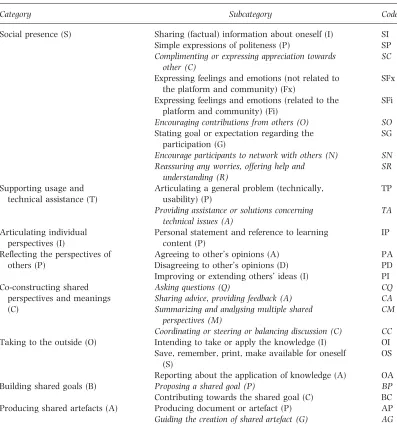
The coding was based on a scheme developed by Murphy (2004) and extended by Rodrigue et al. (2012). After four coders tested the original scheme on a restricted set of course comments, the scheme was adapted to fit the research goals with a stronger focus on facilitation, social presence and workplace application (see Supporting Information for details): see Table 1.
Procedure
Each week was coded by two independent coders. The units of analysis were chosen themat-ically (Rourke, Anderson, Garrison, & Archer, 2001). The exact beginning and ending of each idea within the comments was marked and assigned a code using the MAXQDA soft-ware tool.
Results
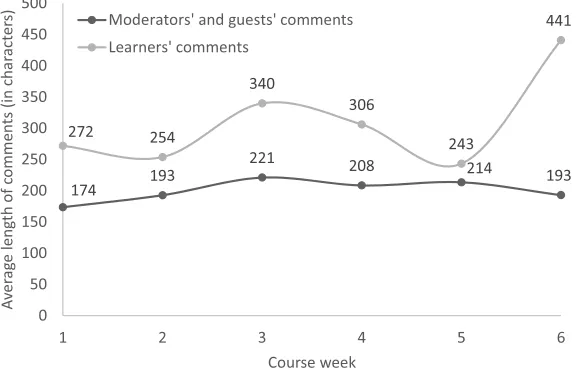
Participants shared 1170 comments, 882 by learners and 288 by moderators and guests. Figure 2 shows the average number of comments per person, which is higher for moderators and guests (facilitators) than for learners. This is not surprising. However, it is remarkable that learners’ par-ticipation stayed rather stable over time. Figure 3 displays the average lengths of comments, which is higher for learners than for facilitators. Comments were especially long when working on the case studies (weeks 3 and 4) and when reflecting on the course (week 6).
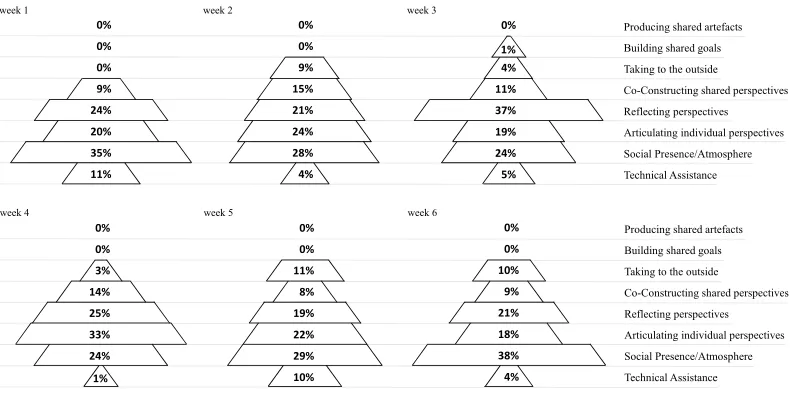
[image:7.485.44.441.74.500.2]Figures 4 and 5 visualise the distribution of codes for the whole course and per course week. Krippendorff’s alpha indicated inter-coder agreement of 0.90 on subcategory and 0.91 on
Table 1: Coding scheme
Category Subcategory Code
Social presence (S) Sharing (factual) information about oneself (I) SI
Simple expressions of politeness (P) SP
Complimenting or expressing appreciation towards other (C)
SC
Expressing feelings and emotions (not related to the platform and community) (Fx)
SFx
Expressing feelings and emotions (related to the platform and community) (Fi)
SFi
Encouraging contributions from others (O) SO
Stating goal or expectation regarding the participation (G)
SG
Encourage participants to network with others (N) SN
Reassuring any worries, offering help and understanding (R)
SR
Supporting usage and technical assistance (T)
Articulating a general problem (technically, usability) (P)
TP
Providing assistance or solutions concerning technical issues (A)
TA
Articulating individual perspectives (I)
Personal statement and reference to learning content (P)
IP
Reflecting the perspectives of others (P)
Agreeing to other’s opinions (A) PA
Disagreeing to other’s opinions (D) PD
Improving or extending others’ ideas (I) PI
Co-constructing shared perspectives and meanings (C)
Asking questions (Q) CQ
Sharing advice, providing feedback (A) CA
Summarizing and analysing multiple shared perspectives (M)
CM
Coordinating or steering or balancing discussion (C) CC
Taking to the outside (O) Intending to take or apply the knowledge (I) OI
Save, remember, print, make available for oneself (S)
OS
Reporting about the application of knowledge (A) OA
Building shared goals (B) Proposing a shared goal (P) BP
Contributing towards the shared goal (C) BC
Producing shared artefacts (A) Producing document or artefact (P) AP
Guiding the creation of shared artefact (G) AG
Note. Facilitation activities highlighted in italics. Examples for each code are part of the Supporting
category level. Overall the largest shares of codes were attributed to the processes of social pres-ence (30%) and reflecting perspectives (25%), but the distribution of codes changed dynamically per course week. In detail the results for the eight processes can be described as follows:
Technical support (T): 7%
[image:8.485.98.389.59.253.2]Technical support was divided into problems (TP) and answers (TA). Both codes were mostly used in week 1 (57% problems, 43% answers) and week 5 while accessing a LMI application (58% and 42%, respectively). Multiple users often reported the same problem for which one answer was sufficient. Facilitation in this category often occurred by offering practical solutions.
Figure 2: Average number of comments
Figure 3: Average lengths of comments
[image:8.485.100.389.432.622.2]Social presence (S):30%
[image:9.485.76.404.68.175.2]Social presence is the biggest category (30%). In week 1 (35%), it mostly occurs in the expression of feelings and emotions related or not related to the learning platform (SFi and SFx), in sharing factual information about oneself (SI) and in the communication of goals regarding one’s participation (SG). In week 2, most codes are attributed to the sharing of emotions not related to the learning platform (SFx), when learners discussed changes to their job due to digitalisation. In week 3, the acknowledgement of others’ contributions (SC) is the most frequent sub-code, as learners started to work together during a case study. In week 4, participants often expressed emotions not related to the learning platform (SFx) and acknowl-edged the contributions of others (SC). In week 5, social presence refers mainly to emotions related to the learning platform (SFi) and to simple expressions of politeness (SP). Social pres-ence peaks in week 6 (38%), with a focus on feelings and emotions related to the learning platform (SFi), the acknowledgment of others’ contributions (SC) and expressions of politeness (SP). Facilitation in this category can often be observed in the recurring subcategory of acknowledgement of others’ contributions (SC), as shown by the facilitator’s first sentence in Example 1. Also, showing understanding for a problem and offering help, falls into this cate-gory, as shown in Example 2.
Figure 4: Code distribution for the whole course
[image:9.485.46.441.443.644.2]Example 1
Learner: Peer coaching has always been there, it’s not new and happens day in day out without thinking. In my own office we have various champions and “experts” with lots of experience in their field.. . .
Facilitator: Thanks for the interesting update. Are the ’champions’ formally chosen[. . .]?
Individual perspectives (I):23%
Process 2 represents the third biggest category and peaks in week 4 (33%). This was the week when learners were invited to share their individual strategies to reduce work-related stress.
Reflecting perspectives of others (P):25%
Reflection makes up the second highest share of codes, peaking in week 3 during the first round of case studies. The improvement of others’ ideas (PI) is the most frequent sub-code, followed by agreement with others’ ideas (PA). Disagreement (PD) only occurred six times.
Co-constructing shared perspectives and meanings (C):11%
The co-construction process counts for 11% of all codes, where advice and feedback (CA) make up half of the codes in this category, counting for 8% of all codes in week 2, when learners elaborated strategies together to address the challenges of digitalisation. Asking questions (CQ) is a frequent subcategory. Both sub-codes are related to facilitation, as shown in Example 1, where the facilitator asked a question to further the discussion, and in Example 2, where the facilitator points to resources that could help the learner to solve his problem.
Example 2
Learner: Interested that one of the headings on improving was “What formal learning could you do”. Obvi-ously this course is one interesting way, but there are courses on the intranet that I feel would also benefit me, but that old enemy TIME comes to the fore. I do not feel that the training for those new to the role like myself get (virtually nil in my case) adequately prepare you for the complexities of the role.
Facilitator: [Learner], it is not really acceptable that in such a responsible job you are getting ’virtually nil’ training. There is a Foundation Learning Journey and a Coaching Learning Journey, both of which you should have had the opportunity to complete. Together they cover the skills and knowledge needed for the role and consolidation time is built in so you can practise, spend time with your peers etc. [. . .] If you haven’t already done so (I know it’s difficult!) you really need to discuss this with your line manager. . . .. The organisation has put a lot of investment into developing and running all this learning so you are not being unreasonable in asking to complete itThe learning journeys are available on the intranet. Good luck
Taking to the outside (O):5%
The sixth process counts for 5%, where the intention to apply the knowledge gained in the course to the outside world (OI) was strongest in weeks 2 and 5. The highest share of saving information (OS) was found in week 6. Reporting about the application of the new knowledge (OA) occurred at a constant rate between weeks 2 and 6.
Shared goals (G): 0.2%
In week 3, five codings related to the definition of shared goals.
Artefacts (Ar): 0.0%
No shared artefacts were proposed or produced.
Example 3
In week 1, learners are introduced to a new way of working as a work coach. After the presentation of the learning content, participants are explicitly invited to share their thoughts and experiences with other learners as part of the course:
Learner 1, an experienced coach, openly speaks about his fears of the upcoming learning challenges and opens the space for others to join the discussion. It is an individual statement without reference to others (I) that contains aspects of social presence (S): expressing emotions and showing understanding (facilitation in S). It also contains a critical statement to initiate further discourse (facilitation in the co-construction category C):
Although I understand why phase 2 is being rolled out I do feel it is a big ask for coaches. I have covered all the roles previously but will definitely need upskilling. I can’t imagine how daunting this will be for staff who have only ever done support for job seekers. This is a job that takes time, to build knowledge of health prob-lems, provision, etc. I feel the process is the easy bit but without the background knowledge it is going to be very difficult for my colleagues.
Learner 2, new to the job, agrees and adds his perspective (P). The comment shows factual informa-tion and emoinforma-tions, both important elements of social presence (S):
Like many other people, I am starting to feel concerned. I have only worked for the department for 3 years, having come from the private sector, I noticed massive changes in the way things are done. [. . .] As I only work 3 days a week and I am so busy during those days, I don’t know how I will have the time to do the mammoth task of upskilling to a level that fits with the strategic plan. I have always embraced change and a challenge but even I am feeling a little overwhelmed.
The facilitator answers Learner 2. He shows understanding (facilitation in S), and offers concrete advice what to do (facilitation in C). The final question tries to keep the co-construction process ongoing (again facilitation in C):
[Learner 2] - remember no one becomes the perfect Coach overnight! Hopefully on your site you have a team that will be able to support you and answer any specific questions you have when they arise. And remember in your support role you will probably have a better understanding of all the different benefits than your col-leagues due to having to field customer enquiries. And you may have better digital skills! Have you discussed the Coach Learning Routeway with your line manager yet?
Learner 3, an experienced work coach, comes in and shares concrete experiences concerning the facili-tator’s advice. Again, the comment contains agreement and the addition of information (P). The cohe-sive elements of referring to the community as a whole is an important aspect of social presence (S):
Agree with comments made. In my office the managers are already in discussion with staff on skills analysis for phase 2. I will be involved with phase 2 but so will other staff experienced in each benefit. As long as we help and support each other we will learn and work with the new benefit customers. Good challenge for us all.
Learner 4 has similar feelings, but also brings in another perspective. Thus the comment contains the reflection on several others’ experiences (C), shows understanding (facilitation in S) and cohesive ele-ments (S):
I agree with all of the comments posted so far and feel very much the same however we have completed an implementation plan Learning Needs Analysis this week and we have also been encouraged to observe other interviews. . .so it looks as though we have made a promising start with the upskilling.
Learner 2 offers thanks for the facilitator’s advice (S) and indicates he will transfer what he has learned from this discussion to the world “outside of the learning course” (O):
Thanks [Facilitator], the coach learning routeway is definitely something I need to discuss with my manager.
Discussion
collaboration in a workplace context. Although the complex coding process requires high cogni-tive involvement, it then provides rich insights in three main aspects in online discussions: social presence, facilitation and collaborative processes. The analysis of over 1000 comments, shared in an online course taken by 62 public servants, shows the pyramidal shape of the collaboration model was nearly entirely reflected.
Similar to Murphy’s (2004) model, the biggest share (almost a third) of statements expressed social presence (S). Furthermore, collaborative processes requiring high levels of involvement in critical reflection and the co-construction of new mental models (C) were less frequent than indi-vidual expressions of opinions, both with and without reference to others (I and P). Apart from advanced collaboration, the analysis investigated whether learners intended to apply the newly gained knowledge in their working practice or reported back about its actual application. The new process taking to the outside world (O) had an overall share of 5% of all comments, thus demonstrating its relevance. Finally, the processes of creating shared goals (G) and artefacts (A) were hardly observed in the present research, in line with previous findings related to the model (Coutinho & Santana, 2014; Murphy, 2004). Overall, the extended model with its eight defined process steps provided a structured approach to analyse collaboration in OAD. However, its appli-cation to different contexts may well result in different blueprints for the desired outcome (cf. Figure 1). By applying this scheme in the workplace context, for instance, it is suggested that the transfer of the newly gained knowledge to the workplace and its integration to existing working processes (O) is the highest goal of collaborative learning. These codes are thus put on top of the pyramid, while the creation of artefacts and goals (G and A) is dispensable. Moreover, specific fea-tures of the learning environment can take their toll on communication. Technical assistance (T)—as a precondition for collaboration—appeared frequently in this study, due to the restric-tions in technical equipment and the high security issues of a public administration setting. It might be dispensable in other workplace contexts.
In this study, deviations from the original shape of Murphy’s (2004) model were caused by a higher level of individual reflections on others’ contributions (P). It can be attributed to the high number of agreements (PA) between participants, while disagreement (PD) rarely occurred. How-ever, agreement often led to an addition of information to others’ comments (PI), which is supported by the analysis of co-occurrence of codes (see Supporting Information). Hence, although explicit disagreements with others are rare, critical reflection of others’ comments still occurred. The amount of agreement and absence of disagreement could also reflect participants’ intention not to offend others when bringing in new aspects or improving others’ ideas (Clarke & Bartholomew, 2014).
Example 3 demonstrates how the higher-level process of co-constructing shared perspectives (C) builds on the sharing of individual statements without (I) and subsequently with reference to others (P), mainly as agreement and subsequent improvement (PA, PI). Discussions start with individual statements that are taken up by other learners or facilitators, leading to the sharing of different experiences and meanings that resulted in Example 3 in someone intending to transfer the newly gained knowledge to the practical work context (O).
Reflection (P) was high overall, but especially in week 3 reflection peaked when learners collabo-rated on a case study on coaching, which is a core work task. Interestingly, in week 4, learners continued their work on the case study, and while reflection activities decreased, co-construction (C) increased. This suggests that learners reached the next level of collaboration.
Example 3 also demonstrates how aspects of social presence (S) are interwoven with the learners’ statements and critical reflections (I, P, C). Social presence makes up 30% of all codes. It is neces-sary for the development of critical discourse (Bangert, 2008), which is confirmed by this study, not only by the coexistence of S, I, P and C, but also by original statements from learners like:
I enjoy the discussion forums, you do feel like other colleagues are in the same boat. I find it interesting we all have different experiences but are positive as well as realistic about what lies aheador
Thanks to all for their interesting comments which have brought new ideas and different trains of thought to my attention.
Social presence is expressed above all by emotions (SFx, SFi), followed by complimenting others (SC) and expressing politeness (SP). In the present study, affective communication categories were persistent over time and seem to be influenced by discussion topics. Some topics seem more likely to prompt emotional discussions, especially at the end of the course, when feedback was explicitly requested. Cohesive elements (ie, expressions of politeness) increased at the end of the course, and their rise indicates learners identified themselves as a group rather than just a collec-tion of individuals (Vaughan & Garrison, 2006).
Interactive elements that further represent collaboration, like agreement, acknowledgement, questioning and personal advice, were influenced by topic and task. They were high in those weeks where the topic was especially relevant for learners or the task was to work collaboratively on a case study.
From these insights, we suggest that social presence and subsequently collaboration can be fos-tered by course design. Discussions are equally important as the offered course content and learners purposefully were drawn into them by topic. Initially discussing course expectations allows participants to project personal characteristics into the community, to openly relate to each other and it helps to set the baseline for further collaboration processes. Thus, social pres-ence was high in week 1.
Moreover, practitioners can stimulate affective communication and thus set the ground for fur-ther collaboration by integrating discussions around highly relevant but familiar topics at the beginning of the course, like in week 2 when learners shared their personal experiences with increasing digitalisation at work. The group’s work on tasks such as case studies fosters higher levels of collaboration and thus stimulates elements of interactive communication within the group, as in weeks 4 and 5.
Finally, social presence and collaboration are not only be influenced by course design but also by facilitation throughout the course. Example 3 shows thatfacilitation activitiesoccurred in different processes and came from peers as well as facilitators. As Garrison (2007) stated, facilitation should model respectful critical discourse; in this regard, Example 3 contains constructive, critical statements and questions (CQ) as well as advice (CA) that fosters the co-construction of shared meanings (C). Overall, the dynamics of asking questions (CQ) and providing advice (CA) are among the most frequent facilitation activities summarised in the co-construction process. A posi-tive and encouraging tone is an important part of facilitation (Clarke & Bartholomew, 2014), which can be found in nearly all comments in Example 3 and is related to social presence (S). The most important facilitation activities in this process are acknowledging others’ contributions (SC), followed by showing understanding and reassuring of worries (SR). As encouragements to share experiences (SO) were part of the course content, this facilitation activity was rarely observed in the discussions.
emergence of new knowledge. The experienced coaches acted as peer facilitators and newcomers brought in new perspectives. Statements with and without reference to others (I, P) as well as the provided advice (C), expressed in affective tone (S) due to the personal attachment to the topic and concrete experiences, opened the space for high levels of collaborative learning.
Implications and conclusion
The results suggest that high levels of social presence in collaborative learning at the workplace are an important predecessor for reflection and co-construction and can be fostered by course design (structure and instruction). Additionally, during the course the high number of expres-sions of feelings and emotions together with supporting feedback encouraged people to participate in discussion and created a sympathetic sense of community as a baseline for success-ful collaboration (M€akitalo et al., 2002). This created a successful learning environment with long-term positive effects on learners’ individual development, such as increased digital capabil-ities and coaching skills, as well as significant changes in learners’ attitudes towards collaborative learning. These positive learning effects triggered by the social learning approach have also been recognised at higher management level and influenced the approach towards how learning will be implemented in PES (see summary of post-course evaluation in the Supporting Information). Further research will reveal if these dynamics can be observed in other workplace OADs and how processes of collaboration develop over time. Concerning facilitation, further research could ana-lyse the role of professional facilitators in contrast to peer facilitators at the workplace, applying the same coding scheme but differentiating between those groups. Overall, the results call for more comparative research on workplace OADs which will be addressed by the authors in future work.
Acknowledgements
This work is part of the EmployID project, funded from the EU’s Seventh Framework Programme (grant agreement 619619). We thank Barbara Kieslinger and Steffen Kinkel for their valuable feedback on an earlier version of the manuscript.
Statement on open data, ethics and conflict of interest
Due to data privacy and organisational restrictions there is no access to the original comments shared by learners in the online course. Detailed results from the evaluation can be retrieved at the project website: employid.eu.
To protect the privacy of participants the research followed the ethical guidelines of the EmployID project. All data were always anonymised before analysis.
There is no conflict of interest by publishing this research work.
References
Bangert, A. (2008). The influence of social presence and teaching presence on the quality of online critical
inquiry.Journal of Computing in Higher Education,20, 34–61.
Benbunan-Fich, R., & Arbaugh, J. B. (2006). Separating the effects of knowledge construction and group
collaboration in learning outcomes of web-based courses.Information & Management,43, 778–793.
Cheng, B., Wang, M., Mørch, A. I., Chen, N. S., & Spector, J. M. (2014). Research on e-learning in the
workplace 2000–2012: a bibliometric analysis of the literature.Educational Research Review,11, 56–72.
Clarke, L. W., & Bartholomew, A. (2014). Digging beneath the surface: analyzing the complexity of
instructors’ participation in asynchronous discussion.Online Learning,18, n3.
Coutinho, C. P., & Lisboa, E. S. (2014). Collaboration in virtual environments: a study of interactions in a
social network. In T. Bastiaens (Ed.),Proceedings of E-learn: world conference on E-learning in corporate,
Daneshgar, F., Van Toorn, C., & Chan, S. C. E. (2008). E-learning in workplaces. In M. A. Salem & M. T.
El-Hadidi (Eds),Proceedings of 2008 ITI 6th international conference on information and communications
technology(pp. 65–70). Danvers, MA: IEEE.
EmployID Consortium. (2017).Empowering change in public employment services. Part II, Retrieved March
17, 2018, from http://employid.eu
Garrison, D. R. (2007). Online community of inquiry review: social, cognitive, and teaching presence
issues.Journal of Asynchronous Learning Networks,11, 61–72.
Garrison, D. R., Anderson, T., & Archer, W. (2000). Critical inquiry in a text-based environment:
com-puter conferencing in higher education.The Internet and Higher Education,2, 87–105.
Kehrwald, B. (2008). Understanding social presence in text-based online learning environments.Distance
Education,29, 89–106.
Koops, W., Van der Vleuten, C., De Leng, B., Houterman, S., & Snoeckx, L. (2014). Computer-supported collaborative learning at the clinical workplace: students’ perceptions and the effect of knowledge
con-struction on learning outcome.Journal of Contemporary Medical Education,2, 71–78.
Loncar, M., Barrett, N. E., & Liu, G. Z. (2014). Towards the refinement of forum and asynchronous online discussion in educational contexts worldwide: trends and investigative approaches within a dominant
research paradigm.Computers & Education,73, 93–110.
M€akitalo, K., H€akkinen, P., Leinonen, P., & J€arvel€a, S. (2002). Mechanisms of common ground in
case-based web discussions in teacher education.The Internet and Higher Education,5, 247–265.
Miller, M. G., Hahs-Vaughn, D. L., & Zygouris-Coe, V. (2014). A confirmatory factor analysis of teaching
presence within online professional development.Journal of Asynchronous Learning Networks,18, 53–82.
Milligan, C., & Littlejohn, A. (2014). Supporting professional learning in a massive open online course. The International Review of Research in Open and Distributed Learning,15, 197–213.
Murphy, E. (2004). Recognising and promoting collaboration in an online asynchronous discussion.
Brit-ish Journal of Educational Technology,35, 421–431.
Rodrigue, A., Hyland, N., Grant, J. M., Craig, A. C., Hudon, M., & Nethery, C. (2012). Exploring facilitation stages and facilitator actions in an online/blended community of practice of elementary teachers:
reflec-tions on practice (ROP). In S. Van Neuland & J. Greenlaw (Eds),Social media & teacher learning(pp. 71–
82). Oshawa, ON: UOIT E-Press.
Rourke, L., Anderson, T., Garrison, D. R., & Archer, W. (2001). Methodological issues in the content
anal-ysis of computer conference transcripts.International Journal of Artificial Intelligence in Education,12, 8–
22.
Salmon, G. (2013).E-tivities: the key to active online learning. Abingdon: Routledge.
Shea, P. (2006). A study of students’ sense of learning community in online environments. Journal of
Asynchronous Learning Networks,10, 35–44.
Swan, K., & Shih, L. F. (2005). On the nature and development of social presence in online course
discus-sions.Journal of Asynchronous Learning Networks,9, 115–136.
Vaughan, N., & Garrison, D. R. (2006). How blended learning can support a faculty development