Subsurface imaging of two-dimensional materials on the nanoscale Franco Dinelliρ, Pasqualantonio Pingueθ, Nicholas D. Kay† and Oleg V. Kolosov†
ρ CNR, Istituto Nazionale di Ottica (INO), via Moruzzi 1, 56124 Pisa, Italy
θ Laboratorio NEST - Scuola Normale Superiore, and Istituto Nanoscienze - CNR, Piazza San
Silvestro 12, I-56127 Pisa, Italy
† Physics Department, Lancaster University, Lancaster, LA1 4YB, UK
Abstract
Scanning probe Microscopy (SPM) represents a powerful tool that, in the past thirty years, has allowed one to investigate material surfaces in unprecedented ways at the nanoscale level. However, SPM has shown very little power of depth penetration, whereas several nanotechnology applications would require it. Subsurface imaging has been achieved only in a few cases, when subsurface features influence the physical properties of the surface, such as the electronic states or the heat transfer. Ultrasonic Force Microscopy (UFM), an adaption of the Atomic Force Microscopy (AFM) contact mode, can dynamically measure the stiffness of the elastic contact between the probing tip and the sample surface. In particular, UFM has proven highly sensitive to the near-surface elastic field in non-homogeneous samples.
In this paper, we present an investigation of two-dimensional (2D) materials, namely flakes of graphite and molybdenum disulphide placed on structured polymeric substrates. We show that UFM can non-destructively distinguish suspended and supported areas and localize defects, such as buckling or delamination of adjacent monolayers, generated by residual stress. Specifically, UFM can probe small variations in the local indentation induced by the mechanical interaction between tip and sample. Therefore, any change in the elastic modulus within the volume perturbed by the applied load or the flexural bending of the suspended areas can be detected and imaged. Such a power of investigation is very promising in order to investigate the buried interfaces of nanostructured 2D materials such as in graphene-based devices.
Keywords:
Introduction
In the past decades Scanning Probe Microscopy (SPM) has represented a major breakthrough in surface science, allowing investigations on the nanoscale not even thinkable before.1,2 The range of studies is so vast that any attempt to review it would fall short.3,4 Nevertheless, the same near-field principles, that allow SPM to achieve high spatial resolution, inevitably confine the investigations to the surface or at best to shallow regions a few angstroms deep. On the other hand, subsurface detection is more and more required due to the ever-growing development of new nanotechnology applications, namely, multilayer high integration chips, ultrathin coatings or confined semiconductor hetero-structures. For instance, it would be extremely important to characterize buried interfaces, such as in graphene-based devices.5
Examples of subsurface detection with nanoscale resolution are so far very few. The literature reports of some operational modes sensitive to the electronic states or thermal properties. In Scanning Tunnelling Microscopy (STM), the surface electronic states can be affected by the presence of subsurface features.6,7,8 In Electric Force Microscopy (EFM), charges located below the surface can similarly influence the electrostatic force or the surface displacement sensed by the tip.9,10,11 Finally, in Scanning Thermal Microscopy (SThM), the thermal dissipation depends to a great extent on a given volume located under the tip and any non-homogeneity can be thus probed.12,13,14
to image glass nanoparticles (NPs) embedded in a soft Polydimethylsiloxane (PDMS) film.23
UFM has specifically proven a valid tool to localize subsurface defects in stiff materials. This can be achieved working at low load values and eliminating the shear stress at contact thanks to a superlubricity phenomenon ultrasonically induced.24 Yamanaka et al. have firstly reported images showing subsurface features in graphite,25 attributing them to dislocations between adjacent graphene layers.26 Afterwards, Checanov et al. have imaged cracks in hard disk heads27 and Dinelli et al. have shown other examples, such as the detachment of Al coatings grown on polymer films or buried rubber spheres in a Poly(methyl methacrylate) (PMMA) matrix.28 Finally, HFM has been employed to detect NPs deeply buried in polymeric matrixes.29 While the theoretical explanation of the nature of the subsurface contrast, whether it is due to ultrasonic wave scattering or elastic field modification, is still under discussion,30 recent investigations have confirmed the reproducibility of this experimental observation.31,32
Based on these premises, we have carried out a study of samples made of two-dimensional (2D) materials,33 targeting the exploration of subsurface details by means of UFM. In particular, we have deposited thin flakes of graphite and molybdenum disulphide (MoS2) on structured polymeric substrates in order to obtain suspended and supported areas. UFM data are also compared to data obtained with TM-AFM and Peak Force modes, the latter with a Quantitative NanoMechanical (QNM) real-time software analysis.34 Our results are then discussed and interpreted according to well established models of contact mechanics.
Experimental
Graphite or MoS2 thin flakes can be transferred to a given substrate exploiting a PDMS stamp based technique.35 In our case the substrate chosen is a film of Cyclic Olefin Copolymer (COC) polymer patterned via hot embossing in order to produce periodic flat mesas with randomly distributed voids in the regular array of grooves on a macroscopic scale (around 5x5mm2). The height and the periodicity of the grooves are approximately 250nm and 1µm, respectively. Given the typical lateral size of the flakes in the range from 5 to 20 m, they present adjacent regions alternatively supported by the COC mesas and suspended over the voids.
transferred to the specimen reversibly bonded to the stage with a low melting point crystalline compound, such as phenyl salicylate.36 The AFM tip and the sample surface are in contact under a fixed average load FN, equal to the product of the cantilever stiffness
klever and its deflection dlever.
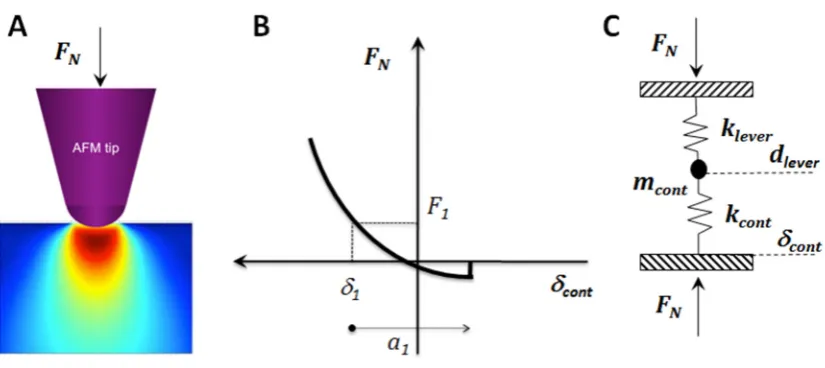
At static equilibrium, in order to sustain the pressure exerts by the probe, the surface under the tip deforms by cont that depends on the contact stiffness kcont, defined as cont =
FN/kcont, (see Figure 1A and B). The equations describing it are those of a simplified
“two-spring model” (Figure 1C):
(1)
In UFM technique the excitation frequency must be much larger than the first cantilever resonance (in contact) and should not coincide with the higher resonance modes (again in contact). Working in this “inertial” regime, the cantilever cannot follow the vertical modulation and the effective cantilever spring constant ( ) results:37
/ ≫ (2)
(3)
where fUFM is the ultrasonic frequency and fRes the first free resonant frequency of the
cantilever.
Thus, during an ultrasonic cycle, the local indentation can be modulated. In particular, as shown in Figure 1B, there is a critical value at which the contact breaks: i. e. a1 = 1
corresponding to FN = F1. Beyond that, the non-linearity of the FN versus cont curve
produces a rectification effect that can be detected as an additional positive deflection of the cantilever.38 Modulating the ultrasonic amplitude, one can measure this critical value point by point with a lock-in amplifier while simultaneously sampling topography, lateral force or any other required signal (see Supporting Information). When the adhesion properties of the sample are homogenous, the contrast of an UFM image can be interpreted as follows: brighter colours indicate regions where the indentation is lower, corresponding to areas with larger Young's modulus.36
Information, an Icon-type head AFM system with a Nanoscope V controller (Bruker) has been employed.
Results
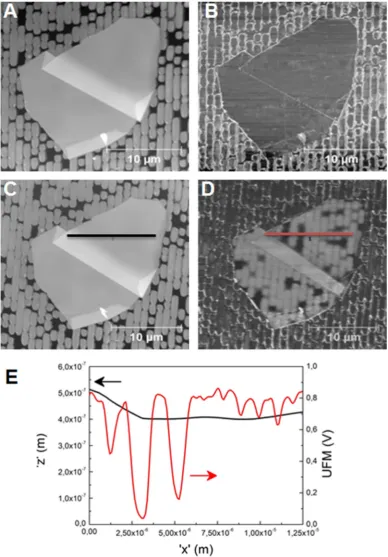
In Figure 2, we show some data obtained for a graphite flake (around 50nm in thickness, excluding folded areas) deposited on a patterned COC film, described above. Figures 2A and B show the topography and phase images obtained with standard TM-AFM. The topography image is smooth, and it is not possible to identify suspended or supported regions within the flake. Another important issue to be underlined is represented by the fact that TM-AFM phase signal is almost constant: an indication that the adhesive properties of the surface are homogeneous across this flake. The same is valid also for all the other flakes we have analysed. This fact has been confirmed through a characterization by means of QNM (see Supporting Information).
Figures 2C and D show the same flake imaged with UFM. On the one hand, the topography (C) is identical to the topography acquired by means of TM-AFM. This is an indication that no surface damage occurs, also thanks to the superlubricity effect ultrasonically induced.24 On the other hand, the UFM contrast (D) clearly identifies the supported from the suspended portions, the latter appearing darker. In Figure 2E, the profiles of the lines drawn in Figure 2C and D are presented. The topographic profile does not show any major variation that can be attributed to the presence of voids. In the UFM profile the signal is smaller in correspondence of the voids underneath the flake with a minimum at the centre of the suspended areas. This minimum depends on the lateral size of the suspended regions. The UFM signal depends also on the flake thickness.
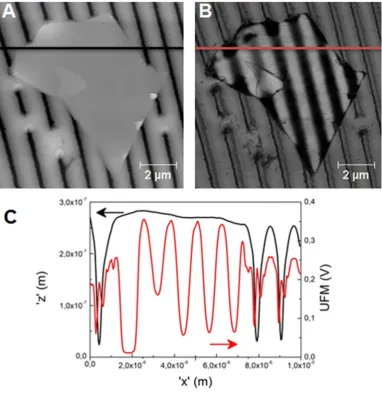
In Figure 3, we show a second example, represented by a MoS2 flake (from 10 to 50nm thick) placed on a COC film, patterned with parallel grooves randomly bridged. In this case, the flake is thinner than the graphite flake above reported. The topography signal faintly reveals the presence of grooves underneath, as the flake is less rigid and its shape is affected by the substrate topography. On the other hand, the UFM contrast is even higher than for the case of the graphite flake, whereas it still depends on the flake thickness and on the lateral size of the suspended regions.
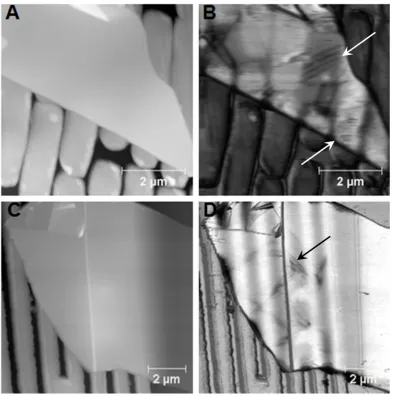
internal structure of the flake itself (see arrows). We suggest that these features are due to dislocations or other defects, as reported elsewhere.25 Signatures of this substructure can be observed both in the suspended and the supported regions. The fingerprints are represented by dark lines, variously long and orientated, or by finer details. A similar contrast can be observed on other graphite and MoS2 flakes, even when they are placed on the flat COC regions (see Supporting Information).
Discussion
Standard CM- and TM-AFM techniques are sensitive to the surface properties and it is not possible to visualize the suspended portions or any other internal defect. In particular, the contrast is dominated by the contact stiffness, typically much larger than the cantilever stiffness (Equation 2). In our case, the tip-surface contact can be described by the Derjagin-Muller-Toropov (DMT) model:39
∗ / (4)
∗ / / (5)
2 ∆ (6)
2 ∗ 6 ∗ / (7)
∗
(8)
where r is the contact radius, ∆ and FC respectively the work of adhesion and the
adhesion force, Ei and i (i = 1, 2) respectively the Young's moduli and Poisson’s ratios of
tip and sample, E* the reduced Young's modulus, R the tip radius. The stress field extends in a volume that is indicated in Figure 1A and can reach a depth value of around 3r.40 The TM-AFM phase and QNM data indicate that, over a single flake, the adhesion can be considered homogeneous.
(9) (10)
(11) (12) (13)
where kflex is the flexural stiffness elastic constant, flex the flexural bending, tot the total
indentation, and ktot the total stiffness
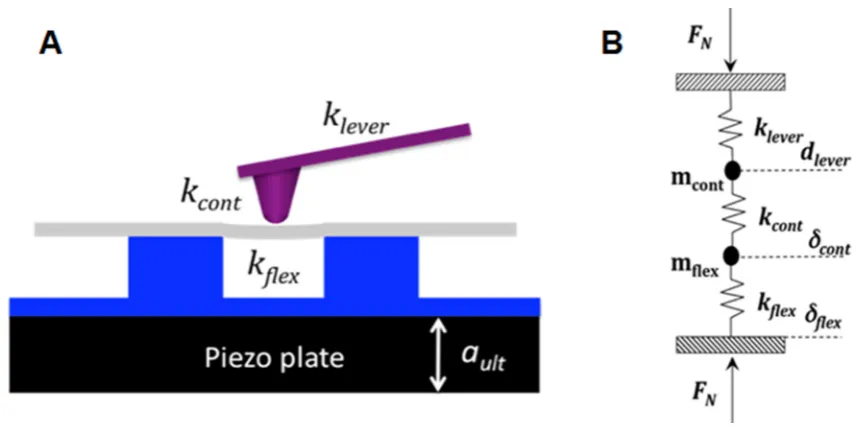
Thus suspended areas present larger tot and larger ultrasonic amplitude values are
needed to break the contact. The profile in Figure 2E shows that, in the suspended areas, the UFM signal is not constant but varies as the contribution from the flexural bending to
tot is lower in correspondence of the borders and maximum in the middle, depending also
on the lateral size of the suspended regions.
In our case, the suspended regions have a rectangular shape of various dimensions: perpendicular (b) and parallel (c) to the flat mesas, respectively. However, we can estimate that:
≪ 1 (14)
2 25 (15)
where h is the flake’s thickness.
Moreover, the c/h ratio can be up to 100. Given these boundary conditions, we can assume that the suspended regions behave like 'plates', stiff objects that undergo pure bending. Therefore, we can employ the formulae obtained from the theory of plates. However, simple equations for our experimental case, where the load is applied by the tip during scanning in different positions of the plate, are not available.
If one considers the simplest case with a point load at the centre, one can obtain analytic formulas that provide the flexural bending versus the lateral size, the thickness of the plates themselves and other parameters:41
x, y ∑ ∑
⁄ , ,…
, ,.. sin sin (16)
(17)
0,01159 (18)
Taking the dimensions obtained for the sample shown in Figure 2 (b = c = 1m, h = 50nm, FN = 10nN) and assuming for the elastic parameters typical values obtained from
the literature (E = 10GPa, = 0.165),42 we obtain
flexmax ≈ 1.1nm. For a DMT contact the
corresponding cont is ≈ 0.5nm, under the assumption of R = 20nm and FC = 5nN.
With regards to the finer contrast observed in Figure 4B, we can state that similar features have been previously observed in graphite by means of UFM25,26 and very recently also by means of AFAM.43 They have been attributed to the presence of defects such as delamination located between adjacent graphene layers inside the flake itself (upper white arrow). These defects can modify the contact stiffness, if they are located within the volume where the elastic field applied by the tip extends to (see Figure 1A), or if the overall flexural stiffness is modified. Their presence, both in the suspended and the supported regions, suggest that they might have formed during the preparation or transfer processes. The same applies when similar features are present in flakes deposited on flat COC (see Supporting Information). We can also argue that their presence might be due to the stress induced by the PDMS-based transferring technique35,44 and therefore to the van der Waals attraction exerted from the substrate once the flake lies onto the COC structured film. The local strain is created in order to release this stress, determining the formation of defects imaged by means of UFM. Other finer features in Figure 4B are probably due to some surface damage or weakly bonded layers (lower white arrow).
In Figure 4D, another kind of nanometre scale texture appears, dark non-parallel lines (black arrow), only visible in the suspended regions of the flake. The graphite is indeed very rigid for in-plane stresses. These non-parallel lines observed in the UFM images may represent internal regions where bending stiffness rapidly drops.We may attribute this kind of features to buckling45,46 induced, while imaging, by the pressure exerted through the tip on the suspended zone of the graphite flake.
Conclusions
induced by the elastic field applied between tip and surface. Subsurface imaging can be also achieved through revealing changes in the elastic modulus due to defects located within the volume perturbed by the elastic field. Thus UFM can localize, inside the flakes themselves, delamination and buckling defects induced by the residual stress, due to the preparation and transfer processes, or by the pressure exerted through the tip. For all these reasons, we suggest that this SPM technique is a very promising candidate for the mechanical characterization and testing of nano-devices based on two-dimensional materials where high spatial resolution may be requested.
Acknowledgements
Figure 1: Schematic drawings of: (A) the strain field induced by a tip in contact with a surface under a load FN; (B) a load FN versus indentation curve; (C) a two spring model
for an elastic contact, where kcont represents the contact stiffness and klever the cantilever
elastic constant. For a given load applied F1, a1 represents the minimum ultrasonic
[image:10.595.91.504.90.274.2][image:13.595.105.500.79.476.2]
Figure 5: (A) A schematic drawing of a tip in contact with a suspended region of the platelet (in gray) where bending can occur. The indentation can be larger than on areas supported by the COC substrate (in blue), thus it needs a higher ultrasonic amplitude in order to break the contact and observe the non-linearity of the FN versus curves. (B) The
two-spring model in Figure 1C can be extended to three with the introduction of the platelet bending flex. In principle, the model can be further extended to four or more springs, to
[image:14.595.95.524.79.297.2]References
1 Binnig G, Rohrer H, Gerber C and Weibel E 1982 Appl. Phys. Lett.40 178
2 Binnig G, Quate CF and Gerber C 1986 Phys. Rev. Lett.56 930
3 Bhushan B 2016 Scanning Probe Microscopy in Nanoscience and Nanotechnology Springer Berlin
ISBN-10: 3662502208
4 Fuchs H and Bhushan B 2016 Biosystems Investigated by Scanning Probe Microscopy Springer Berlin
Heidelberg ISBN-10: 3662519194
5 Pingue P 2011 Scanning probe based nanolithography and nanomanipulation on graphene Chapter in the
book Tseng AA Tip-based Nanofabrication: Fundamentals and Applications Springer Springer-Verlag ISBN-10: 1
6 Glembocki OJ, Snow ES, Marrian CRK, Prokes SM and Katzer DS 1992 Ultramicroscopy 42-44 764
7 Schmid M, Crampin S and Varga P 2000 J. Elect. Spectr.109 71
8 Flores M, Cisternas E, Correa JD and Vargas P 2013 Chem. Phys. 423 49
9 Zhao M, Gu X, Lowther SE, Park C, Jean YC and Nguyen T 2010 Nanotechnology21 225702
10 Yamada F and Kamiya I 2013 Appl. Surf. Sci.271 131
11 Kay ND, Robinson BJ, Fal’ko VI, Novoselov KS and Kolosov OV 2014 Nano Lett.14 3400
12 Nonnemacher M and Wickramasinghe HK 1992 Appl. Phys. Lett.61 168
13 David L, Gomes S and Raynaud M 2007 J. Phys. D - Appl. Phys.40 4337
14 Tovee PD and Kolosov OV 2013 Nanotechnology24 1174
15 Kolosov OV and Yamanaka K 1993 Japan J. of Appl. Phys. Part 2-Letters32 L1095
16 Burnham NA,Gremaud G, Kulik AJ, Gallo P-J and Ouveley F 1996 J. Vac. Sci. Technol. B 14 1308
17 Chilla E, Rohrbeck W, Frohlich H-J, Koch R and Rieder KH 1992 Appl. Phys. Lett.61 3107
18 Rabe U and Arnold W 1994 App. Phys. Lett.64 1423
19 Burnham NA, Kulik AJ, Gremaud G, Gallo P-J and Ouveley F 1996 J. Vac. Sci. Technol. B14 794
20 Cuberes MT, Assender HE, Briggs GAD and Kolosov OV 2000 J. Phys. D33 2347
21 Zhong Q, Innis D, Kjoller K and Elings VB 1993 Surf. Sci. Lett.290 L688
22 Garcia R and Heruzo ET 2012 Nat. Nanotechnology7 217
23 Ebeling D, Eslami B and De Jesus Solares S 2013 ACS Nano11 10387
24 Dinelli F, Biswas SK, Briggs GAD and Kolosov OV 1997 Appl. Phys. Lett.71 1177
25 Yamanaka K, Ogiso H and Kolosov OV1994 Appl. Phys. Lett.64 178
26 Yamanaka K, Kobari K and Tsuji T 2008 Jap. J. Appl. Phys.47 6070
27 Checanov AS, Low TS, Alli S, Kolosov OV and Briggs GAD 1996 IEEE Trans. Magn.32 3696
28 Dinelli F, Castell MR, Ritchie DA, Mason NJ, Briggs GAD and Kolosov OV 2000 Phil. Mag. A 80 2299
29 Shekhawat G and Dravid VP 2005 Science310 89
30 Sarioglu AF, Atalar A and Degertekin FL 2004 Appl. Phys. Lett.84 5368
31 Verbiest GJ, Simon JN, Oosterkamp TH and Rost MJ 2013 Nanotechnology23 145704
32 Kimura K, Kobayashi K, Matsushinge K and Yamada H 2013 Ultramicroscopy133 41
33 Novoselov KS, Jiang D, Schedin F, Booth TJ, Khotkevich VV, Morozov SV and Geim AK 2005 PNAS102
10451
36 Bosse JL, Tovee PD, Huey BD and Kolosov OV 2014 J. Appl. Phys.115 144304
37 Briggs GAD and Kolosov OV 2009 Acoustic Microscopy Oxford University Press
38 Dinelli F, Biswas SK, Briggs GAD and Kolosov OV 2000 Phys. Rev. B61 13995
39Derjaguin BV, Muller VM and Toropov YuP 1975 J. Colloid. Interface Sci. 53 314
40 Johnson K 1994 Contact Mechanics Cambridge University Press
41 Ventsel E and Krauthammer T 2001 Thin Plates Theory Marcel Dekker Inc. New York - Basel
42 https://www.entegris.com/resources/assets/6205-7329-0513.pdf
43 Wang T, Ma C, Hu W, Chen Y and Chu J 2016 Micr. Res. Tech.22 2470
44 Castellanos-Gomez A, Buscema M, Molenaar R, Singh V, Janssen L, van der Zant HSJ and Steele GA
2014 2D Materials1 011002
45 Tsoukleri G, Parthenios J, Papagelis K, Jalil R, Ferrari AC, Geim AK, Novoselov KS and Galiotis C 2009
Small5 2397