Three insurance policies for your data
Single cartridge, six and eleven-
and performance - because only one way to make disk packs
high disk packs. Disk packs each carries the unmistakable at Caelus; and that is the very
unsurpassed in workmanship Caelus® trademark. We know of best way possible.
~,
~~
CIELUS® MEMORIES, INC.
P.O. Box 6297, San Jose, California 95133. Telephone (408) 298-7080From indigestible keyed inputs. From the need
to re-validate, re:'edit and re-process. Save the
main computer (IBM's or anybody's) for what it's
paid to do- process error-free data on the
first
pass.
Here'show. Invite your keypunch operators
(up to 64, if you please)overtoourDATA/SCQPE
'Mkeystations and let them do what comes naturally.
Enter data. (Meanwhile, back in our programmed,
disk/processor Hblack box," up to 65Kbytes of
core
~d8 million bytes of disk await their
first moves.)
An opt;!rator selects a record fonnat, and up
comes the instruction for the first field on the CRT.
She fills it in, and automatically the next instruction
appears-and the next, and the next-until up to
400 characters show on the display. She corrects
errors, verifies, recalls records, and, if panic strikes,
pushes the HELP! button to get helpful alternatives
for proceeding. All of this after only a few minutes
of training.
Later that same day, the payoff. Disk dump to
tape. One tape, edited, blocked, and labeledfor
your computer. Purified, digestible, compatible
data bypassing all of the usual equipment, operators,
time, money, and floor space. that other input
systems depend on to generate supposedly
"c1~an"
input.
Feeding the main frame with purified data is a
popular cause. Install an Entrex 480 Data Entry
System and win at least five friends: the keyboard
operator, the
dat~entrysupervisor, the DP
manager, the President, and us-Entrex. For
litera-ture and/or demonstration call or write Entrex. Inc.,
168 Middlesex Turnpike, Burlington, Mass. 01803
(617) 273-0480 .
ENTREX
"Low error rate and fast turnaround time are
vital to our system of Regional Reservation Centers.
That's why we chose Sycor data communications,"
says M. J. Mannino, Director-Systems Development. In its forward-looking concept of Regional Reservation Centers, the travel division of American Express has designed a smooth-running system that brings even fuller advantages of computer speed and accu-racy to travel agents and their clients. The concept gives the travel agent fast printed confirmation of his bookings, cuts down his filing problem, and provides an efficient description of the tour he's arranged that's quickly retrieved if a traveler needs to change his itinerary.
Low error rate ~nd fast turnaround time are integral to the sys-tem, and American Express chose Sycor to imJ?lement it. According to the company, "Turnaround time has been significantly reduced, strin-gent control measures are effective, and Sycor's program-controlled input has measurably reduced errors." Fast automatic, error-free transmission,
size of character display, overall simplicity of operation, and one-day operator training are some of the reasons why Sycor was chosen.
Companies all over the country, many with applications similar to yours, are chalking up time and cost savings using Sycor terminals (more than 1300 now in service, backed by local maintenance in 38 cities). Read for yourself what American Exp,ress and others have to say about Sycor's cost/effectiveness.
~ac~est=SY~iCa~ai/~
- . .I
f:j~rketing
Services, Dept. 710, Sycor Inc.,I
I
I
100 Phoenix Drive. Ann Arbor. Mich. 48104.
o
check here if you'd like a representath'e to callName
Title
Company
Address Phone
L: ___
~ta;.._;.
,
I
I
I
;J
CIRCLE 15 ON READER CARD
Regional Data
Collection
Centers.
Remote off-line
terminals capture
data error-free and
speed it to the
central computer.
Fast, efficient processing: of the thou-sands of reservations that pour in for A~erican Express tours begins at the travel division's five Regional Reservation Centers in New York, Chicago, Toronto, Atlanta and Los Angeles. These tour bookings, phoned in by some 8,000 travel agents and the company's own nationwide network of offices, re-ceive immediate verbal confirmation from available inventory.
Booking data-agent identifica-tion, traveler's name, hotel accom-modations and airline space selected -is keyed into Sycor data commu-nications terminals, collected on cassette tapes and transmitted to the computer center in New York where
it is received and converted to com-puter compatible tape by Sycor 610 data communications stations.
Tour data-scheduled departure time. air information, pricing and other details-is entered on Sycor terminals at travel operations and transmitted to the computer center where it is merged with booking data for processing on an IBM 360 / 65. Output, containing all tour
DATAMATltaN®
,"-,ULV 15.1971.
volume 17
number 14
departments
Letters to the Editor
11
Look Ahead
19
Perspective
48
News Scene
52
Hardware
59
Software
63
Literature
65
Washington Report
69
People
70
Index to Advertisers
71
The Forum
72
July 15, 1971
ECHNICAL
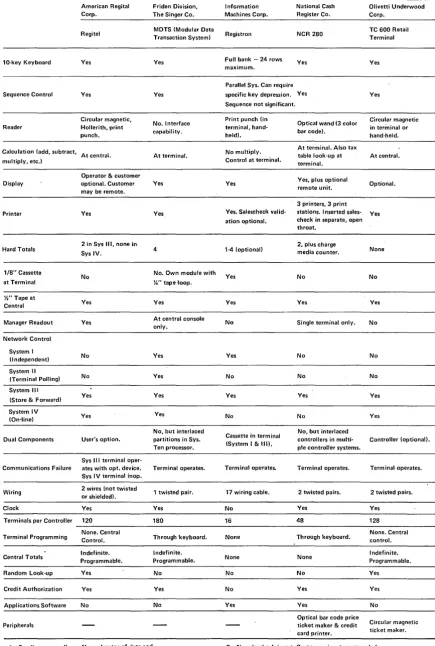
22 Retail Terminals ... a POS Survey
WILLIAM D. POWER. POS terminals are similar in basics, but vary in their capability to perform certain key functions. Here are some ground rules to help you begin to find your way around this volatile, dynamic market.
42 An Impartial Look at Semiconductors
H. FREDERICK KOEHLER. Although they may never
become Numero Uno, semiconductors are becoming complementary, if not competitive, to core technology.
ANAGEMENT
32 EDP Technology and Retail Planning
JACK A. FHENCH. Highly sophisticated point-of-sale / order / receipt hardware is now available, but the timing of your company's conversion calls for equally sophisticated planning.
ENERAL
36
SJCC Report
F. BARRY NELSON. Exhibitors down, attendance
down, but booth inhabitants reported brisk business on the floor and plenty of influential prospects.
DMMENTARV
48
Perspective
72
IBM's second major price cut in six months has been met with price adjustments by the competing inde-pendents; but many of these will suffer in the money market. IBM's action lowers the already-shrinking profit margins of the competition. Users, however, find big savings as extra shift charges on peripherals come to an end. Look for some big bargains in data trans-mission rates, if Mel, Datran, Western Union and Ma Bell carry forward their plans to build huge data transmission networks.
The Forum: COMmentary
CHARLES ASKANAS. Doubts have been expressed
in edp trade publications as to the state of health of the COM subindustry. A manufacturer of COM (sur-prise!) disagrees.
About the Cover
In today's business environment, the dollar is pulled and fragmented by the growing need to make full and efficient use of its power. One good place to begin is the point of sale. Design is by our art director.
4
We are a publicly owned leasing
organization with the desire to
lease your new IBM
System/370
equipment. We offer what we
believe to be the most attractive
and flexible lease plans in the
in-dustry, including:
• Terms ranging from one year
to long-term full-payout.
• Substantial savings over
IBM rental charges.
• Purchase and upgrade
options.
eHloienti leasing oorp_
2460 Lemoine Avenue I Fort Lee, New Jersey 07024
(201) 461·6600
CIRCLE 21 ON READER CARD
HOW MANY
MILLIONAIRES
ARE THERE IN THEUNITED STATES?
JOHN SAUER, Pres.
... and how many NEW milliunaires join the ranks every year? How did they acquire their wealth? The number and the reasons may astonish you! This amazing story is revealed in a valuable new booklet,
"NEW ROADS TO OPPORTUNITY AND WEALTH."
Even more exciting are the factual details about a specific business opportunity that is nothing short of a gold mine. Why? Because, as an associate of the organization providing the opportunity, you help others to succeed.
For your free copy of "New Roads to Opportunity and Wealth," phone, wire, or write immediately to:
Yes, Rush me "New R()adsto~~atth & Opportunity" Today!
NAME PHONE _ _ _ _ _
ADDRESS _ _ _ _ _ _ _ _ _ _ _ _ _ _ _ _ _ _ _ ___ CITY _ _ _ _ _ _ _ _ STATE _ _ _ _ ZIP _ _ _ John Sauer. President
D.A.T.K. Inc. - P.O. Box 22125, Denver. Colorado 80222
(303) 757·5500
CIRCLE 38 ON READER CARD
DATAMATION@
.JULY
~51 197~volume 17
number 14
This issue
110,424 copies
EDITOR
ROBERT B. FOREST
EDITORIAL STAFF
Managing Editor Senior Associate Editors Associate Editors
Copy Editor Assistant Editors
Special Features Editor Eastern Editor New England Editor Washington Editor Midwestern Editor Southwestern Editor European Editor Australian Editor Contributing Editors
Editorial Adviser Technical Consultant
EDWARD K. YASAKI WILLIAM J. ROLPH, TOM McCUSKER RICHARD A. McLAUGHLIN, EDITH D. MYERS, JOHN T. WATERHOUSE JANET EYLER MICHAEL WILLIAM CASHMAN ALMA O'STEEN ANGELINE PANTAGES F. BARRY NELSON W. DAVID GARDNER PHIL HIRSCH LAWRENCE RAGAN ROBERT F. ALEXANDER PEARCE WRIGHT FREDERICK A. BLAND HOWARD BROMBERG, ROBERT V. HEAD, PHILIP H. DORN, LOUIS B. MARIENTHAL, MILTON M. STONE, F. G. WITHINGTON, PAUL ARMER, ROBERT P. BIGELOW ROBERT L. PATRICK LOWELL AMDAHL
EDITORIAL OFFICES
HEADQUARTERS: 94 S. Los Robles Ave., Pasadena, Calif. 91101, Phone: (213) 681·8486; EASTERN: 35 Mason St., Greenwich, Conn. 06830, (203) 661·5400; 19
Marlborough St., Boston, Mass. 02116, (617) 267·9414; 9805 Singleton Dr., Bethesda, Md. 20034. (301) 365·8671; MIDWESTERN: 407 S. Dearborn St., Chicago, III. 60605, (312) 922·8245; SOUTHWESTERN: 2711 Cedar Springs, Dallas, Texas
75201, (214) 744·0161. FOREIGN: 65, Hill Road, Chelmsford, Essex, England; 322,
Park RegiS, Park St., Sydney, NSW 2000, Australia.
GRAPHIC DESIGN
AND PRODUCTION
Art & Production Director Production Manager Production ASSistant
CIRCULATION
35 Mason Street Greenwich, Conn. 06830
Circulation Manager Marketing Research Director
PUBLISHER
GARDNER F. LANDON ASSISTANT PUBLISHER
JAMES M. MORRIS
Circulation audited by ~
Business Publications Audit
Iiiii!IIiI
CLEVE MARIE BOUTELL MARILEE PITMAN GLORIA J. FASANA
MAE VAN RENNES DOUGLAS DeCARLO
~
--AS"'"
Member, American-..~ Business Press, Inc.
tp
DATAMATION is published twice monthly on or about the first and fifteenth day of every month by Technical Publishing Company, 1301South Grove Ave., Barrington, Illinois 60010; Arthur L. Rice Jr., Presi-dent; Gardner F. Landon, Executive Vice President. Executive, Circu-lation and Advertising offices, 35 Mason Street, Greenwich, Conn. 06830 (203) . 661·5400. Editorial offices, 94 So. Los Robles Avenue, Pasadena, California
91101. Published at Chicago. III.
DATAMATION is circulated without charge by name and title to certain qualified individuals who are employed by companies inVOlved with automatic information handling equipment. Available to others by subscription at the rate of $25
annually in the U.S. and Canada. Reduced rate for qualified students. Foreign subscriptions are on a paid basis only at a rate of $38 annually. No subscription agency is authorized by us to solicit or take orders for subscriptions. Controlled circulation paid at Columbus, O. and Form 3579 to be sent to Technical Pub· lishing Company, P.O. Box 2000, Greenwich, Conn. 06830. Copyright 1971, Tech· nical Publishing Company. Microfilm copies of DATAMATION may be obtained from UniverSity Microfilms, A Xerox Company, 300 North Zeeb Road, Ann Arbor, Michigan 48106.
Printed by Beslow Associates, Inc.
We'll take the job-for
$60
a week!
That's all it costs for a whole
staffof instructors under
a new Advanced Systems Leasing Plan for Video
Assisted Instruction (VAl) in-house training systems.
VAl systems can train one individual or an entire
data processing staff. Video lectures by
reco~nizedspecialists, well organized student guides and
effi-cient testing methods allow each individljal to learn
at his own pace. Advanced Systems in-house
train-ing programs have speeded and improved traintrain-ing
in more than 800 corporations, government agencies
and universities. Now, for as little as $60 a week, you
may have access to a $30,000 library of training
courses. Write or call our nearest sales
representa-tive or call Bob Hopkins at corporate headquarters.
Grow your own data pro'cessing people
CORPORATE SALES OFFICES:
327 South LaSalle Street
Chicago, Illinois 60604 • 312/427-7277
SALES OFFICES IN:
ATLANTA. BOSTON. CHICAGO. DALLAS. DETROIT. LOS ANGELES. NEW YORK. PITTSBURGH. SAN FRANCISCO. WASHINGTON, D.C.
Our COM graphics capability
lets
you
do
some great card tricks.
See that aperture card? It contains
a precise, microfilm image of
stored computer data. Time lapse
from data input to processed
output? Less than a minute.
Our new Microfilm Plotter lets you do some
other impressive tricks, too. A single-data input
command can produce a circle, arc, line or
vec-tor in solid, dashed or broken lines.
Other capabilities include overplotting.
Pre-viewing on monitor scope. Optional
alpha-numeric character generator. Plus
other options depending on your
particular application.
Price? You'll be surprised how little
it costs.
So if you're still plotting computer data on
paper, chances are our Microfilm Plotter is just
what you need. to cut that work load down to size.
For details, contact The Bendix Corporation,
Compute~
Graphics, 23850 Freeway Park D,rive,
Farmington, Michigan 48024. (313) 477-3700.
Computer
Graphics
You'd get more out
of your
computer,
if more people could get to it.
Your computer can solve a problem
in a split second. So how come your
peo-ple have to wait so long for the answer?
Because every question has to find its
way through a whole maze of people,
procedures and processes to get to the
computer. And then the answer has to
find its way back again. Which can take
days. Even weeks.
You'd save a lot of time if you could
cut through that maze and give everyone
in your company direct access to
yo~rcomputer. So they could ask it questions
and get answers back immediately.
GTE Information Systems, Inc. can do
it for you. We know all about getting
people to computers.
Take stockbrokers, for example. Right
now, GTE Information Systems .is
run-ning·a 100,000-mile international stock
and commodity quotation and
informa-tion network. A network which puts
brokers on six continents in direct touch
with computers filled with
up-to-the-second information on stock prices,
earnings, news, etc. All without mazes.
Without waiting. Just instant
informa-tion at the touch of a button.
Stockbrokers are only part of the
pic-ture. All across the country, in schools,
on the railroads, in clinical pathology
labs, in all kinds of businesses, GTE
In-formation Systems is helping the right
person get the right information from
the computer at the right time.
We can put your people in touch with
your computer too.
We can give you anything from a
single remote terminal to a complete
syst~m
designed and engineered to help
your people get more from your
com-puter. Without the aggravation and
bother of buying bits and pieces and
patching it all together. Because we
make all the data communications
hard-ware and programming softhard-ware that
makes a system work.
And if it ever stops working, we've
even got a trained service organization
to get it going again.
To get more out of your computer, just
write Vice President-Marketing, GTE
Information Systems, Inc., Four
Corpo-rate Drive, White Plains, N.Y. 10604.
I
#j
i
~
InFORmATiOn SYSTEmS
Our BI 2600 gives you less bother and more
performance th';ln any competitive mag tape unit
made today.
In it, we've sensibly eliminated all electronic
mechanical adjustments. Normal equipment .
maintenance is just a simple bit of
clean~up,
with
virtually no downtime.
We've cleverly developed a rigid, one-piece tape
deck panel that never gets out of alignment.
We've ingeniously eliminated tape cupping with
a technique that provides uniform tape tension no
matter what the buffer arm position.
We've meticulously ensured uniform packing
density and tape speed by tying
all timing and spacing to the
capstan encoder.
Then we wrapped up all this
thinking in our BI 2600 Mag Tape
Unit: Precise bidirectional tape
travel at 4 to 37.5 ips, with a
maxi-mum data transfer rate of 60 kHz.
Uniform packing densities up to
1600 bpi. A tape path completely
to IBM specifications.
8V2"
reels
(also available as our Model
BI 2610 with 10
1/2"
reels).
Industry compatible interfaces.
High reliability with plug-in
DTL/TTL electronics that have
no one-shots and no
differenti-ators. No program restrictions, no
delays under any circumstances.
10
~~~" ~~.~
And we've priced it all at under
B1--ig·ht.
~.. - 111
$3000 in OEM quantities.
Bright?
Bright Industries Inc.
One Maritime Plaza, San Francisco· 94111
Telephone: (415) 391-9794
Bright Industries is an affiliate of ll'acor Inc.
I~I
~~
LETTERS
Grounds gripping
Sir:Please let me add a clarification of our challenge. We in Computer Pro-fessionals Against ABM assert that no computer professional has ever pub-licly disputed our technical argument against the ABM software. Nobody has ever said, "Well, I am a computer
profe~~ional, too, and I say it will
work.
This is not at all the same thing as saying, "Of course it won't work, but I think we ought to build it anyway," or, "I don't know whether it will work or not, but I think we ought to
build it anyway." Both of these are
perhaps rational positions to take (al-though we disagree), but they do not come to grips with our technical ar-gument.
On the basis of a long series of correspondence and a recent phone call, I believe that myoId friend, Bob Head, has been misrepresented in the April 1 News Scene story about us (p. 46). He has not "provided tech-nical assurance that it will work." He does indeed think it should be built on other grounds, but he takes no position whether it will work or not. DANIEL D. MCCRACKEN
Ossining, New York
Bad timing
Sir:Fifteen years ago it was a popular sport to display the absurdities one could find when a FORTRAN compiler would read 5.0 from a data card and treat it as 4.99999. Today most of the manufacturers. have improved their software so that simple numbers look the same when read in and printed out. But what about functions such as INTEGER (N) which is supposed to give the integer part of a real num-ber? What does a manufacturer mean when he says his system han-dles reall1umbers to a precision of six or eight decimal digits? Does he mean we can expect to add 0.4 and
0.6 and take the integer part of it
correctly? Try these examples on your time-sharing computer.
A) INT(O.4
+
0.6) =B) INT ( 0.1
+
1. 9) =C) INT(0.2
+
1.8)=
D) INT(0.3
+
1.7) =July
15, 1971
E) INT(O.4
+
1.6)=
F) INT (0.5
+
1.5)=
All three of the different systems these examples were tried on gave the sum of the two numbers
correct-ly. But General Electric's Mark II
service gave the answers to examples C and E as 1. IBM'S CALLI os system also got two wrong, but a different two, examples Band C. A third ser-vice, Tymshare, Inc., gave wrong an-swers for the first five casesl How far have we really come since the days of the first compilers?
THEODORE SHAPIN
Orange, California
Revisited revised
Sir:We wish to thank you for including the MAC 16 and MAC Jr. in the sur-vey, "The Minicomputers Revisited"
(May 15, p. 24).
Enclosed is an updated MAC com-puter specification for your future reference. We would especially like to bring to your attention two of our software packages-a real-time exec-utive (RTEX) and a disc operating system (MBEX)-both of which have been available since January of 1971. GARY P. BOOTH
Lockheed Electronics Co., Inc. Los Angeles, California
Sight/performance
Sir:Some of your recently published let-ters have shown an interest in the legibility, for human use, of symbol fonts designed for optical character recognition. About three years ago Mrs. Glennis Bell did two experi-ments on the relative legibilities of
USASCOCR X 3.17 (which I believe
is OCR-A), Farrington 12L2/12F2
(which I believe is like OCR-B), and IBM Manifold 72 (which is a conven-tional typewriter font). Since the studies have not been published, a brief report here may be of interest to your readers.
One experiment compared the er-rors made by five subjects who were shown the symbols one at a time, in random order, with the viewing time shortened to 15, 10, and 8 msec. The results showed significantly
few-er few-errors with X 3.17 than with the
other two.
The other experiment compared the speed and errors made by 12 skilled typist-secretaries who copied both English text and random ma te-rials in all three fOllts. Speed and accuracy were Significantly best for Manifold 72, next best for
12L2/12F2, and least for X 3.17; but the differences were small. There was some evidence that more practice might have reduced, or possibly elim-inated, the differences she found.
While her experimental results are not decisive, we believe that they raise serious doubts about the valid-ity of predicting or judging human performance from visual inspections of a font's appearance, from opinions about a font's legibility in the ab-sence of data on performance, or from subjective ideas about "distrac-tion," "familiarity," and the like. Since the main concern of everyone seems to be with the performance of users, then why not collect data .on the performance itself?
We have done many other experi-ments on the performance of people in reading and symbol-identification tasks during the past few years, and we would be happy to answer in-quiries.
GLENN C. KINNEY
The Mitre Corporation Bedford, Massachusetts
Scratching back
Sir:In response to Samuel Gordon's in-quiry (Letters, May 15), we have found the following uses for used continuous-form printer and plotter paper:
l. Scratch paper (many of us
never use "new" paper for first drafts) ;
2. Packing material in shipping department;
3. Paper for posters made by stu-dent and other nonprofit groups;
4. The local ecology group picks up our used printout and finds uses for the paper;
5. We have given stacks of used paper to nursery schools-children like big pieces of paper to draw on; 6. Unfortunately, a few times we found it necessary to use the "other" side of plotter paper, as we had run out.
MARY FOWLER
Physics International San Leandro, California
~eroing
in
Sir:Please advise Messrs. Theis and Hobbs ("The Minicomputers Revis-ited") and your staff that Xerox is not spelled with a "Z"! See top column of p. 32 of the May 15, 1971, issue. RAYMOND S. PERRY
Xerox Corporation Rochester, New York
The XZ affair
Sir:I have enjoyed the enclosed cartoon for several months. However, p. 32 of
"Miss Caulkins, come quick! There's a xebra going into the Xerox building."
© DATAMATION ®
your May 15 issue is much more amusing.
MICHAEL WOODARD
Sacramento, California
Feed need
Sir:In reference to the March 1 article titled "At Last: Standards for Key-boards" (p. 32), I would like to make the following comment. A
12
standard which doesn't meet the needs of the community will not be accepted. There is a need for a stan-dard for the New Line (NL ) func-tion. The European standards in-clude this control by eliminating the control for Form Feed (FF) and as-signing the code which was used for FF to the control for Line Feed (LF) and assigns to the new control New Line the code which was previously used for Line Feed. The rationale for this suggestion is:
l. The New Line control is
needed and is used much more than the control Form Feed.
2. The FOlm Feed function can be accomplished by repeated use of the Line Feed control function, and hence the assignments of LF to the previous code for FF.
3. Many systems currently use the code LF to perform the function of NL.
I would support a standard which recognizes the existence of the New Line function and hope that it isn't too late for agreement.
]. M. WINETT
Lexington, Massachusetts
Deafusion
Sir:This is in reference to the May 1
article, "Computing Signs Help
Train the Deaf," by Fred Gruenber-ger and Robert Teague (p. 36).
Being deaf myself, gainfully em-ployed as an associate programmer with IBM Corp., I can't see how the authors measure the success of the program when such authors fail to have a degree in the education of the deaf. As far as interpreters are con-cerned, how can a deaf person, in a
normal classroom, learn more, if any,
of the concepts of a subject when such person is torn into three concur-rently receptive worlds? How can one learn when he has, at the same time: to look at the blackboard (re-ception 1); to look at the interpreter who takes up most of the deaf stu-dent's attention (reception 2); and fails to accept a learning stimulus by not writing down learned and
ex-traordinary notes ( reception 3) ?
Note takers, depending on their style, will take notes for themselves, which could be very irrelevant to the learn-ing desires of a deaf person.
I do applaud the authors for tak-ing a part in creattak-ing new signs. Such signs will be helpful in a deaf environment, only to the extent the
teacher is using it! This method is the best method and widely accepted among the deaf today. "Total com-munication," as it is called, is being used in more learning institutions for the deaf than before. '
My formal education was obtained at Gallaudet College, Washington, D.C. This college, being the only lib-eral college for the deaf in the world, gave me a good foothold in my learn-ing process. There were no interpre-ters in classes, because the instruc-tors, be they deaf or normal, have to use the sign language. This process was a big boost in my learning de-sires.
Concluding, I fail to see what re-sults were obtained by the authors' project and would very much
appre-ciate knowing the job placements, if
any, of such students in the program-ming field.
KENNETH S. ROTHSCHILD
Poughkeepsie, New York
Intensive care
Sir:In. the article in the May 1 issue, "Computing Signs Help Train the Deaf," the authors state: "Ideally, a subject like computing should be taught by some:-ne who knows the language of signs himself (and who knows computing too) and to a class consisting entirely of deaf students." These ideal conditions actually exist right now at the National Technical Institute for the Deaf on the Roches-ter Instit~te of Technology campus. Four full-time data processing pro-fessionals are training 20 deaf stu-dents via sign language in such courses as basic computer concepts,
flowcharting, operating concepts,
RPG, BAL, COBOL, FORTRAN IV, PL/!, advanced programming, and systems desigrl. Within three y.ears, when the NTID is fully operational with 750 students, the number of students in this program is proj((cted to grow to 50. We share the philosophy of the authors· that the greatest hurdle for deaf programmers is getting inten-sive training-an area ih which we have been quite successful to date. While for us the use of specialized signs is not so critical-our
instruc-tiorial approach and pace is geared to a deaf-only group-these new signs will indeed be a most welcome addi-tion to the sign language vocabulary of our instructors.
E. MARSHALL WICK
Rochester, New York •
the test features alone make this new
modem the best you can buy
CollIns new TE-236 24do-bps data modem is
making the competition lower its price. It's the
only modem on the market with the test
capa-bility of isdiating in seconds a malfunction in
the te1ephone line circuit, the terminal
equip-ment,
df'
the modem - thereby permitting
im-mediate remedial action. And with a reliabIlity
of 20,000 hours (MTBF), odds are excellent
the problem will not be with the TE-236.
Collins new modem is priced considerably
lower than competitive units approaching its
quality and features. Among these fea'tures are
fast acquisition time, low system bit error rate,
and advanced MOS/LSI circuitry. End user or
OEM versions available now. Call or write your
Collins rep or Collins Radio Company, Dept.
600, Newport Beach, California 92663. Phone:
(714) 833-0600.
COMMUNICATION / COMPUTATION / CONTROL
We don't have a crystal ball. And rarely resort to mystic means in recommend-ing what terminal should be used for a particular data communications appli-cation.
Some of the things, we at Teletype look at, that make the job a little easier are these:
Distribution
Urgency of message Frequency of use
Volume Language Accuracy
The diagram below demonstrates how you can fit a number of Teletype
termi-REGIONAL OFFICE
r/
13:t~
f
DEPARTMENT
!
~
ACCOUNTING DEPARTMENT
~
COST ACCOUNTING
§--§
BILLING
§--§
PAYROLL
14
nals into a system based on function and usage requirements. Magnetic tape makes the speed and language of vari-ous tetminals compatible. In this hypo-thetical case we use one computer program, one major line cO,ntrol proce-dure, one computer port, one type of data set per link. And deliver greater data through-put per on-line dollar. Using terminals that offer the best capabilities within each station's com-munication situation.
Using Teletype magnetic tape data ter-minals, combined with various Teletype keyboard send-receive sets, you obtain
STANDARD SPEED LINK.
MEDIUM SPEED LINK
COMPUTER
... try
a
Teletype® 37
... and look
into mag tape!
some unique system flexibility. And the on-line time saving aspects of operation are really dramatic. Magnetic tape data terminals can keep data flowing on-line at up to 2400 wpm.
In the example shown, the manufacturer has linked sales, engineering, account-ing and inventory control departments to a central office computer. As well as manufacturing plants, warehouse and regional offices. He's covered all critical data points with a common medium speed link, using a variety of terminals. Magnetic tape data terminals make it possible.
'1
MANUFACTURINGPLANT ttl
~
~
1
PRINTERINVENTORY CONTROL
~
.
~1
DEPARTMENT ENGINEERING~
;~
. MT: MAGNETIC TAPE DATA TERMINALS 33 MTMANUFACTURING PLANT ~2
STANDARD SPEED LINK
Routine aspects of the system are main-tained in standard speed links. Branch offices are tied into the reg ional office terminals on standard speed networks. Regional offices batch routine branch office data on one magnetic tape. Trans-mit the data to the central office proces-sor at one time. Saving a number of additional computer port requirements. Since data generated at manufacturing plants is urgently needed, but volume is low, low-cost model 33 terminals are used here. The warehouse data volume is higher, but not complex, so a heavy-duty model 35 is working here. Volume requirements are heaviest in the accounting department. Cost ac-counting, payroll, billing and invoice payment functions generate data all day long. Here magnetic tape is pr"e-pared off-line at various terminals. And an on-line stand-alone magnetic tape terminal is used to transmit data to and receive data from the central processor. Sales and engineering departments are equipped with Teletype 37 terminals. But for different reasons.
model 33 series: An extremely low-cost 100 wpm terminal line. Uses ASCII. The most widely used terminal in time-sharing systems today.
InKtronic® data terminals: A unique electronic, solid state terminal. Prints up to 1200 wpm. Forms characters through electrostatic deflection (no typebox). ASCII compatible.
DATA COMMUNICATIONS
equipment for on-line, real-time processingThis terminal offers engineering people some unique format flexibility. Half-line and fUll-line forward and reverse line feed can be used to communicate com-plex equations and engineering formu-lae to the processor. It is possible to add special graphic engineering symbols to the normal compliment of letters, numbers and punctuation marks found in the typebox (up to 32).
The sales department uses the model 37 for order processing. It has on-line vertical and horizontal tab set control, and form feed platen (optional) which makes data transmission and reception on multiple copy business forms easy and economical.
At the inventory control point, this man-ufacturer has an urgent need to obtain printed page copy of large volumes of inventory items. Magnetic tape is used to feed data to the processor and a Teletype Inktronic® KSR set receives data and prints page copy on-line up to 1200 words per minute.
As you can see, Teletype's modular terminal design allows you to use
vari-model 35 series: A rugged, heavy-duty line of 100 wpm terminals. Uses ASCII.
magnetic tape data terminals: Use compact reusable tape cartridges. Operate on~/ine
at up to 2400 wpm, and connect "locally" to lower speed Teletype terminals using ASCII.
ous units as building blocks to meet the most demanding system needs. Teletype also has the station and error control accessories necessary for more efficient and economical data commu-nications operations. Since cost is a very important part of the mix, Teletype offers greater terminal capabilities on a price/performance basis than any other manufacturer.
If you're involved in designing a tele-processing, time-sharing, remote batch or ,computer switched system; looking into a multi-point private line, point-to-point private line or switched data com-munications network; talk to Teletype about terminals. For ideas, equipment and understanding. you'll find no better - source. Anywhere.
Teletype data communications equip-ment is available in send-receive capa-bilities of up to 2400 words per minute. If you would like specific information about any of the equipment described here, write: Teletype Corporation, Dept. 81-16,5555 Touhy Ave .. Skokie, III. 60076.
model 37 series: One of the most versatile heavy-duty terminal lines gOing. Generates all 128 characters of ASCII. Operates at 150
wpm. Prints in upper and lower case.
Slunlronic™ accessories: Electronic solid state terminal logic devices offering many control options. Such as, automatic station control, error detection and correction capabilities.
Teletype is a trademark registered in the U.S. Pat. Office
T E L E T V P E
machines that make data move
tD~
And the
1971
Datamation Industry Directory is a new product in a sense ... the first issue of a wholly new kind of edp directory, designed to make life easier for the installation manager and OEM buyer by providing a means to check out competing products and vendors. To give you a glimpse of how the information is organized, we're reproducing here the first part of the introduction to Chapter I, Com-puters, plus some sample listings of the very small and the very large computers. From these, we think you can get an idea of what'sChapter I ...
Introduction
The computers included in Chapter I range from relatively simple-minded controllers through special-ized missile or fire control devices to super-scale scientific and commercial data processing configura-tions. The computers, generally speaking, are arranged in order from smallest to largest on the basis of their low-end prices. The minimum prices quoted are gen-erally for mainframes with a minimal number of
con-Product identification
Manufacturer_
" - M O D E L 1000- ABC COMPUTERS CORP
good advice when
you're considering a
new product
r(~). 0.·-~'\. [~I':J r(~)""
...
J.[-.'('J(:_~~~
II~ )~'-0
I
~\~-,
1 .... ,~17~n.
) j /
,,0)
l
u
n'
1 - / '... . \ /
[~~:(.l
[
..
'\\/7
r ./
r
in between ... the hundreds of machines that have been analyzed and correlated to simplify your screening before selection.
trollers and the smallest main memory; the prices quoted as the high ends of the ranges may include a very broad range and large number of peripherals.
Following is a sample composite listing for this chapter that shows most of the information given for every type of computer. The variable information that is not self-explanatory will be described later in this introduction under the appropriate section headings.
12/70
Date of first /acceptance
Compattbility claim · ~ /Logic compatible DEC/PDP8/1 Plug compatible DEC/PDP8/1 & & DEC/PDP8/L DEC/PDP8/L
Scientific/engineering, on-line control---Primary applications Operating system options _~ F~xed multiprog. T-S, Real-tir:ne .
/ Simultaneous batch, remote Jobs, t-s, real-time
Languages: FORTRAN, BASIC, ALGOL, FOCAL - - - Principal programming
/ $ 2 3 5 0 to $150,000 (Main!. $100/month)
languages
Purchase price range and minimum maintenance charge
Using the labeled composite entry as a key
to the compressed information in the listings,
DIGITAL COMPUTERS
Under $5000
MODEL Home-Ec VII APPLIED SYSTEMS, INC Home and personal use $400 to $1200 (Maint $NG/month) MODEL CP-8
UNICOM INC
Scientific/engineering, on-line control Languages: Assembly
$970 to $7000 (Maint $NG/month)
from the
very
small
04170
to the very
large
~
$500,000
MODEL 3500 BURROUGHS CORP
09/67 Commercial data processing, Scientific/engineering Variable multiprog, T-S
Simultaneous batch, remote jobs, t-s Languages: COBOL, FORTRAN, BASIC $500,000 to $1,500,000 (Maint $140/month) MODEL 5700 --170
BURROUGHS CORP
Commercial data processing, T-S Variable multiprog, T-S Simultaneous batch, t-s Languages: COBOL, FORTRAN
$500,000 to $2,000,000 (Maint $700Imonth) MODEL 8561 A-1/2 C-System 06/67 COLLINS RADIO CO
Commo/message switching
Fixed multiprog
Simultaneous batch, remote jobs Languages: FORTRAN
$500,000 to $2,000,000 (Maint $11 OO/month)
MODEL M400 Micro 400 MICRODAT A CORP
Commo/message switching, on-line control
Languages: Assembly
$3250 to $3750 (Maint $NG/month) MODEL SPC-12
GENERAL AUTOMATION, INC On-line control
Real-time
Simultaneous real-time Languages: Assembly
$3600 to $18,000 (Maint $40/month) Omnus-1
12170
12/67
OMNICOMP COMPUTER CORP
Scientific/engineering, Commo/message switching T-S, Real-time
Simultaneous batch, t-s, real-time Languages: Assembly
$3800 to $35,000 (Maint $NG/month) MODEL 20 GRI-909
GRI COMPUTER CORP
MODEL 4200
HONEYWELL INFORMATION SYSTEMS INC Commercial data processing
Variable multiprog, T-S, Real-time
Simultaneous batch, remote jobs, t-s, real-time Languages: COBOL, FORTRAN, BASIC $567,005 to $1,203,410 (Maint $632/month) MODEL 6200
CONTROL DATA CORP
03170
11170
Commercial data processing, Scientific/engineering Variable multiprog, T-S, Real-time
Simultaneous batch, remote jobs, real-time Languages: COBOL, FORTRAN, ALGOL $589,580 to $1,301,900 (Maint $2478/month) MODEL DPE-411
TELEFILE COMPUTER CORP T-S, on-line control T-S, Real-time
Simultaneous batch, remote jobs, real-time Languages: COBOL
$600,000 to $1,300,000 (Maint $1128/month) MODEL 615-300 Century 300
NATIONAL CASH REGISTER CO Commercial data processing, on-line control Fixed multiprog, Variable multiprog, Real-time Simultaneous batch, remote jobs, t-s, real-time Languages: COBOL, FORTRAN, NEAT/3 $605,900 to $2,566,800 (Main! $1035/month)
DIGITAL COMPUTERS
MODEL 100 Elbit 09/66 ELECTRONIC PRODUCTS INTL CORP (EPIC) Commercial data processing, SCientific/engineering T -S, Real-time
Simultaneous t-s, real-time
Languages: Assembly, Industrial control $4800 to $6000 (Maint $NG/month)
$5000
MODEL 18
COMPUTER LOGIC SYSTEMS, INC Scientific/engineering, T-S Variable multiprcJ, T-S, Real-time
Simultaneous batch, remote jobs, t-s, real-time Languages: Assembly
$5000 to $30,000 (Maint $600/month)
MODEL SAL-l00 Satellite 06170
DATASERV
Commercial data processing, on-line control T-S, Real-time
Simultaneous batch, remote jobs, real-time Languages: Assembly, FORTRAN $5000 to $70,000 (Maint $NG/month)
MODEL 3155 System 370/155
INTERNATIONAL BUSINESS MACHINES CORP Commercial. data processing, Scientific/engineering Fixed multiprog, Variable multiprog
Simultaneous batch, remote jobs Languages: COBOL, FORTRAN, PLll $888,000 to $1,015,200 (Maint $2160/month) MODEL 8610 Sigma 9
XEROX DATA SYSTEMS Commercial data processing, T-8 . Variable multiprog, T-S, Real-time
Simultaneous batch, remote jobs, t-s, real-time Languages: COBOL, FORTRAN, BASIC $927,000 to $2,000,000 (Maint $3160/month)
$1,000,000
MODEL 4500 BURROUGHS CORP
Commercial data processing, T-S Variable multiprog, T-S
Simultaneous batch, remote jobs, t-s Languages: COBOL, FORTRAN, BPL - BASIC $1,000,000 to $2,500,000 (Maint $245/month) MODEL 6700
BURROUGHS CORP
Commercial data processing, Scientific/engineering Variable multiprog, T-S, Real-time
Simultaneous batch, remote jobs, t-s, real-time Languages: COBOL, FORTRAN, PLll, ALGOL, ESPOL $1,000,000 to $9,000,000 (Maint $1,264/month)
now ...
when you've found some of the products that could warrant further evaluation, turn to Chapter IX ... for a complete listing of vendors for each product ... including information on the size and nature of the manufacturer, location of his service outlets, and the other key facts to help you select before you request detailed product specifications....
DATAMATIDN®
INDUSTRY DIRECTORY
Technical Publishing Company, DID Order Dept. 1301 Grove Avenue, Barrington, III. 60010
D7 - 15
Send me _ _ _ _ _ _ copies of the 1971 Datamation Industry Directory at $25* a copy. _ _ Check enclosed _ _ Co. purchase order enclosed .•
("in U.S,A. and Canada; $35 elsewhere)
We think the
datamation
indUstry directory
will save you time, trouble, and money if you use it this way. For your own copy, clip and mail the coupon today, with check or company purchase order enclosed.Name _ _ _ _ _ _ _ _ _ _ _ _ _ _ _ Title _ _ _ _ • Department _____________________ _
Company ________________________ __ • Address _________________________________ __
•
: City _______ _ State _ _ _ _ _ Zip ____ __
•
UCI
•
sCle
com
•
PI FORT turns any System 3 with 12K into a scientific computer. All that engineering you're now doing at a service bureau can now be done in-house at tremendous savings. Programmatics' ANSI FORTRAN is full-fledged, fast, does not require a disk and, most important, is available right now. (The poop says that IBM's
FORTRAN for the System 3 will not be ready until late '72.) All this for only $100 a month. Try it out for 30 days free. You'll see.
•
IC
r---~---,
Programmatics, Inc.
11661 San Vicente Blvd., Los Angeles, Calif. 90049
o
I would like to take advantage of the 30 day free trial offer for PI FORT (System 3). Please send all necessary paperwork.o
I would like further information including complete system description and manual before taking advantage of the free trial offer.Name Title Company Address
City State Zip Code
L ____________________________________ ~
I
p~
I
~~~~o~~,~!:!~!.~~~
11661 San Vicente Blvd., Los Angeles, California 90049 (213) 826-6503
PURCHASERS HANDED
ANOTHER IBM BONUS
370 PRICE BOOST
IS NOT IMMINENT
LOSING FACE IN JAPAN
UP WIMMIX?
GROSCH WOULD LIKE END
TO NAS COMPUTER GROUP
IBM, handing another bonus to purchasers of its
equipment, made a series of changes to its maintenance
agreements last month_
Particularly significant is a
reduction on charges for "optional weekday periods."
In other words, those who need maintenance beyond the
basic nine-hour period (unchanged) are getting a
break that could save them thousands a year. The
greatest cuts, which vary, are on the 20- and 24-hour
agreements and would most seem to benefit users of
tele.processing systems.
The obvious negative impact (besides on IBM's
computer competitors) is on third-party maintenance
firms, although it's not clear at writing how serious
that is. Comma Corp., for example, is still 10%
cheaper on the basic nine hours but says IBM comes
"closer" to it on the optional periods. Whether and
how Comma will change its fees was unknown at press
time.
Scratch those rumors that IBM might raise its prices
on 370 mainframes.
We hear there's no such action
planned -- at least for now.
Too much slick pricing
maneuvering on the part of IBM just could arouse the
Justice Dept., which has maintained a deafening
silence in the wake of IBM's recent actions (price
cuts, etc.) that have sent shock waves throughout the
industry.
Digital Equipment Corp. has been trying to save face
in Japan ever since its arch rival and spin-off, Dat.a
General Corp., signed a franchising agreement with
Nippon Mini-Computer Co. for the manufacture of Data
General's minis in Japan (see July 1, p.55). Digital
remains inscrutable on its activities -- at this
writing saying only that it has been negotiating to
improve its Japanese business and will continue to do
so.
If Digital is to save its face in the booming
Japanese market, there are many who feel that the
firm must pull off a franchising agreement just as .
juicy as Data Generalts.
An
option to acquire 40 or 45 more systems for the
World Wide Military Command and Control System
(Wimmix) is being "discussed" by DDR&E with other
Pentagon offices. DOD controller Bob Moot is said to
oppose the option that would boost the maximum order
to 75 or 80 systems from the present 35.
If
an.add-on is OK'd, the feds may have to accept additian.add-onal
bids. At least one rebid is probable -- from
Burroughs, which was declared nonresponsive the first
time around because its discs weren't ready.
If the
option is added, the winning Wimmix bidder won't be
known for six months.
\
MEMORY EXTENSION FIRM
OPENS HONG KONG PLANT
MARSHALL SURFACES, BUT
DIRKS STAYS IN HIDING
RUMORS AND
RAW RANDOM DATA
Grosch, the industry's well-known gadfly.
He accused
the board of interfering with the computer activities
of the National Bureau of Standards; of lending its
prestige to academic members trying to wangle federal
money for pet projects; and of acting as a foil for
Pentagon efforts to restrict computer exports. The
charges were detailed .in a letter Grosch addressed
primarily to 12 recently appointed members of the
24-member CSEB.
He recommended that they disband the
group.
Anticipating stiff competition in the main memory
extension market, front-runner Data Recall Corp. of
El Segundo is setting up facilities in Hong Kong.
President Stuart Lotwin says the firm will make
nearly all of the components it's been buying
elsewhere and save 40%.
The firm is one of seven
making core memory extensions to the IBM 360/30/40,
and 50.
It has installed 115 systems since February
of 1970. Lotwin said competition will come not only
from independents, but from IBM, who may react
through maintenance maneuvering instead of price cuts.
Its first key/disc data preparation system will be'
delivered in November by Marshall Industries, latest.
entry into the crowded data entry market.
Up to 64
keyboards, renting at $65 a month each, can be used
on the shared-processor system ($i150/mo. with
controller), whose first public showing is the Las
Vegas FJCC.
Meanwhile, mysterious four-year-old
Dirks Electronics of Sunnyvale has decided not to
announce its first product, Which also happens to be
a key/disc system (the model 001 64-station system),
that had been scheduled for introduction next month.
President G.F. Pilcher won't say' why •. Nor will he
discuss published reports of, Dirks' proposed $40,000
Datastreamer computer and a 9 x 4-inch crt terminal
priced at from $3000 to $6000.
Says
Pilch~r,who
joined Dirks this spring from Memorex where he was
vp-finance: "We're going into hiding for three months."
Key/disc data preparation system manufacturers are
confident IBM won't enter their market for at least
another 18 months.
Their reasoning: IBM wants to
protect its estimated 400,000 keypunch systems.
IBM's
threshold of pain is 30.000 keyboards, and that
shouldn't be reached by the key/disc makers for
another 18 months.
But there are others who say IBM
will never enter because it can't afford to dent its
keypunch revenues, estimated at $50 million a month
That fretting about layoffs at RCA Computer
Systems~
headquarters in Marlboro, Mass., may be
unnecessary: The personnel department there has been
told to gear up to prepare to double employment at the
plant over the next 18 months. • •
IBM, we hear, has
taken its systems engineering force off quota, easing
the .strain of a couple of poor years for making quotas.
It's also changed its sales commissions policies so
that some, if not all, will get a percentage of
Data ba.le:
beFote you
inve.l~
inve.lti9ate.
The most exciting concept in computer usage today is the data base information system. The most talked-about data base management system is IMS-2.
But the most widely and successfully used DBMS is Cincom Systems' TOTAL.
With all of its power, TOTAL is applicable on 64K systems and up, and in any environment.
That says a lot for TOTAL. And it tells you some-thing of great importance if you're thinking data base.
Because the most critical decision for the ulti-mate success of information system implemen-tation is your choice of data base management systems.
It will serve you well to investigate TOTAL. (More
••
than 80 blue-chip customers are achieving their information system goals using TOTAL.)
Even if you've already started to implement, TOTAL's design approach will allow you to ac-celerate your current progress and enhance the effectiveness of your investments in time and energy for future success.
In fact, it will pay you to consider TOTAL no matter what your status: if you're thinking data base; are in the decision-making stage; imple-menting; or just curious.
Write today for full information about TOTAL, the most powerful system in existence. Currently available for use with IBM DOS or OS, Honey-well and RCA. Cincom Systems, Inc.l2181 Victory Parkway/Cincinnati, Ohio 45206 .
• •
Cincom
Jy/~emJ,
Inc: We
c,eQ~e
eFFiciency.
Cincom offices also located in Palo Alto, California and Toronto, Ontario, Canada.
22
Same ground rules to help you
begin to find your way around this
volatile, dynamic market
Retail Terminals ...
"The retail industry is on the threshold of
a conversion to electronic point-of~sale
ter-minals from mechanical cash registers." That statement mayor may not go unchal-lenged, depending on who hears it. First, the term "retailer" is often used loosely to include food chains, discounters, department stores, drug chains, specialty stores, etc., whereas most of these present different problems from a terminal point of view. Then there are the big retailers as opposed to the small ones. The
NCR, with the lion's share
of the conventional cash
register market (which
won't disappear overnight),
has to be a factor ...
former are considered prospects for in-house systems where the latter probably will depend on services, leased terminals, etc.-which may be a long time coming and being accepted.
A second consideration is the definition of "thresh-old." Some say that retailers have been poised at the threshold for a number of years. Others argue that they will remain poised there for many years to come. Regardless of what point of view you take, you will have to agree that there is a lot of action in the retail terminal field at present-principally in the point of sale and credit authorization areas.
What is the reason for this situation? And why is it occurring just now?
The answer to number one is that retailing is a "trallsaction-oriented" industry (like banking, for ex-ample) and a natural for a terminal system that provides large-scale data collection capabilities and some on-line characteristics. The answer to number two is simply that the technology is just becoming available at prices that can be afforded by the indus-try. Retailers in general have been accused of being
nonprogressive (or even "cheap") in their attitude toward advanced electronic systems. This sort of judgment is probably harsh when you consider the volatile marketplace they live in and the narrow margins they must deal with.
The move to electronic terminal systems in retail-ing was predictable a number of years ago. In 1963, when the National Retail Merchants Association
asked Touche Ross & Co. to consider the long-range
implications of edp in retailing from the chief execu-tive's point of view, a two-day seminar was developed called the Retail President's Conference which took as lofty and long range a view of the problem as was considered warranted under the circumstances. Prob-ably the most interesting part of that seminar was a session called "The Store of 1970" in which a terminal-oriented department store system was postulated to-gether with a cost structure that seemed reasonable
for the industry. It is interesting to note that the
terminal systems for department stores that are being offered today by most manufadurers can be de-scribed quite accurately by "The Store of 1970"
sys-tem. It is not so much that Touche Ross was
clairvoy-ant in its predictions. Rather, the nature of the prob-lem tends to lead to a particular solution.
The department store group is a good basis for discussion in this article because it represents what is probably the most complex systems situation in retail-ing and also because it is the area in which the most work on terminals is being done at the present time. This type of retailing represents, according to its name" department" store, a diverse collection of mer-chandise items brought together under one roof. "One roof" has to be a figure of speech because one of the characteristics of the industry has been its enormous expansion in numbers of locations (stores) in recent years.
\"hen a store sells hundreds of thousands of items in 15 or 20 locations (branches), at literally thousands of points of sale, it generates a substantial data col1ec-tion problem. The term "item" requires some precise
definition because a blue tea kettle is differen t from a
red one, and a size 8 dress is different from a size 10.
a
POS Survey
Retailers have coined the tenn Stockkeeping Unit (or
SKU, as it is called in the trade) to indicate this level of
description which defines an article uniquely for pur,-poses of ordering, inventory control, etc.
Creating a system which will keep track of the
large number of SKU'S in an orderly fashion is only one
part of the problem. There is also the element of time to be considered as a system constraint. Because of
the emphasis on fashion elements in a wide variety of
products, the selling life of an article can vary substan-tially. Reordering (or marking down, which is the opposite alternative for the retail buyer) can present
a problem with big financial consequences. It is
neces-sary, therefore, to identify the trend in sales (or, say, the on-hand position) very rapidly. This is one of the pressures for faster reporting which, in the extreme cases, can run all the way to on-line systems.
Sales recording is not the only part of the transac-tion that requires handling at the time of and at the point of sale. The whole credit situation, which has been the subject of so much attention in the press recently, can be a nightmare to the retailer who does a large credit business (and most of them do). Be-cause of stolen or forged cards and other fraudulent practices, retailers have experienced increases in loss of merchandise and in bad debts. Credit authoriza-tion has gotten increased attenauthoriza-tion in the last two or three years, and more money is being spent on it now than would ever have been dreamed of a few years ago. This defensive move on the part of retailers rep-resents a cost that they have little control of if they are to act to minimize their exposure and loss.
Once again, the systems requirements are fairly rigid here because a conscientious retailer will try to maximize the service aspects of the situation and handle a customer in a minimum amount of time. A fast and accurate identification must be made of the customer, and an inquiry must be made into a very large file (of all customers) if an up-to-the-minute, positive status of credit standing is to be detennined. But, because of limitations on file capacity and in-quiry capability, the common method today is to refer to a "negative list" (bad accounts only, rather than
July
15, 1971
by William D. Power
the whole file). This method is less than pedect, but it is the most practical solution from a current point of view of cost and capability.
If the user of a "hot" card is out to take a store, he
will make a number of purchases in rapid succession in a very short period of time. With present methods
it is difficult, if not impossible, to detect this type of "load up" (as it is called in the trade). Actually, what is needed in this situation (and is now being offered by several manufacturers) is an on-line system that at least records the fact that a card has been used "X" times during a day, or an hour, or what-have-you.