The professionals who originally specified disk packs bearing the Caelus® trademark have continued to reorder. And reorder. Not because Caelus is lowest
in cost, but because Caelus is highest in value. This same commitment to excellence stands behind the new series of Caelus disk cartridge drives.
~
Jell a friend about
Colorado Instruments.
Better yet-send us his name.
We·1I send him complete literature
and tell him ourselves.
We're the best in source data collection sys-tems, although most of your friends probably don't know we exist. We've been "off in a corner" perfectin~!
But we've proven ou rselves to a number of the country's leading companies. * By solving some problems in simple ways that would intrigue you. So we're ready to widen our circle-show a lot more people how we can
they eliminate man-hours. Increase accu-racy. Decrease costs.
They are simply designed. And easily op-erated. Modularly designed. And
easily adapted.
Here, we can only touch upon a . few of the advantages of our brand of source data collection. At your convenience we'll dem-onstrate them all.
fill the gap between them and So you can tell a friend about
their computers. Colorado Instruments.
Our systems are uniquely de- You can tell him how we've
signed for speed, accuracy and helped others solve their
prob-reliability. They collect data di- lems. With time and attendance
rectly from its source - the man recording. With production
re-on the job - and transmit it to porting. With inventory control
the. computer. On-line. Or off- and materials ordering. With
line. 3120 BADGE READING STATION purchasing and receiving.
By eliminating the need for keypunching, More important, you can tell him how we can record keeping and pad-in-hand inventories, help him! *Names available upon request
Filling the gap between people and computers.
COLORADO
Ilj
INSTRUMENTS
ONE PARK STREET. BROOMFIELD, COLORADO 80020. (303) 466-1881
CI-342
DATAMATIIaN®
FEBRUARV 1S
J1971
volume 17 number 4
departments
Letters to th~ Editor
9
Look Ahead
17
Perspective
47
News Scene
52
Hardware
62
Software
73
Literature
81
Washington Report
85
People
89
Index to Advertisers
94
February 15, 1971
l~ENERAL
22 Nippon Computing Nears Take-off
Time
Late to enter the edp field, Japan is now showing signs of being ready to move.
26
Software in Japan: Supported Growth
Industry takes advantage of a new law as they team with government to expand and develop edp.
30
A Mixed Tale, of EDP in Taiwan
Their systems analysts and programmers are skilled, but the applications remain low-leveled on Taiwan.
41
IFIP in Amsterdam
A Conference Report.
[~]ANAGEMENT
36
Credit Clearance's Slow Change
to EDP
A little positive thinking may enable you to re-deploy your old resources when you switch to edp - and speed the conversion in the bargain. A close look at one industry that's in the process.
[~]OMMENTARV
47 Perspective
Possibly the only "computer genius" who is also president of a leading educational institution, Dartmouth's John C. Kemeny talks about the college's time-sharing service, its use by students and faculty, its future in both education and bus-iness, and wonders how any executive can get by without a computer.
About the Cover
With its bold fusion of old and new symbols, Barbara Benson's design reminds' us that while the way to the good life for the ancients lay through tranquility and contemplation, the com-puter is pointing toward a new way for the orient today. The watchword: make way.
4
DATA ENTRY TERMINAL
DOES DATA ENTRY COST YOU LOTS OF $$$ ? If you don't have a terminal at all points of data origin-data handling and preparation may be costing you more than it should.
The Model 360 is finding applications in accounting, bank-ing, libraries, schools, hospitals, production shops and many others.
Data entry is with a 12 key keyboard and an electro-optical card reader. Data transmission is through any standard tele-phone.
The terminal is available now-with or without the card reader. Prices starting from $236.00 to $495.00.
Hytek Technology, Inc.
13239 Northrup Way Bellevue, Wash. 98005
(206) 747-5627
CIRCLE 22 ON READER CARD
This terminal can be
equipped to "carryon"
automatically- at any hour
and without an operator. It
can transmit data, or receive
data at high speed from a
computer and print at night
to be ready for the next day.
Ask about Unattended
Operation capability.
Novar Corporation • 2370 Charleston Road Mountain View, Calif. 94040 • (415) 964-3900 Nationwide Service In 56 Cities
A Member of GT&E Information Systems, Inc. CIRCLE 29 ON READER CARD
DATAMATION®
FEBRUARY 15. 1971
volume 17
number 4
This issue
110,901
copies
EDITOR
ROBERT B. FOREST
EDITORIAL STAFF
Managing Editor Senior Associate Editors Associate Editors
Copy Editor Assistant Editors
SpeCial Features Editor Eastern Epitors New England Editor Washington Editor Midwestern Editor European Editor Australian Editor Contributing Editors
Editorial Adviser Technical Consultant
EDWARD K. YASAKI WILLIAM J. ROLPH, TOM McCUSKER AUBREY DAHL, RICHARD A. McLAUGHLIN, EDITH D. MYERS, JOHN T. WATERHOUSE JANET EYLER MICHAEL WILLIAM CASHMAN ALMA O'STEEN ANGELINE PANTAGES JOHN WESSLER, F. BARRY NELSON W. DAVID GARDNER PHIL HIRSCH LAWRENCE RAGAN PEARCE WRIGHT FREDERICK A. BLAND HOWARD BROMBERG, ROBERT V. HEAD, PHILIP H. DORN, LOUIS B. MARIENTHAL, DANIEL D. McCRACKEN, F. G. WITHINGTON, PAUL ARMER, ROBERT P. BIGELOW ROBERT L. PATRICK LOWELL AMDAHL
EDITORIAL OFFICES
HEADQUARTERS: 94 S. Los Robles Ave., Pasadena, Calif. 91101, Phone: (213) 681-8486; EASTERN: 35 Mason St., Greenwich, Conn. 06830, (203) 661-5400; 19 Marlborough St., Boston, Mass. 02116, (617) 267-9414; 9805 Singleton Dr., Bethesda, Md. 20034, (301) 365-8671; MIDWESTERN: 407 S. Dearborn St., Chicago. III. 60605, (312) 922-8245. FOREIGN: 65, Hill Road, Chelmsford, Essex, England; 322, Park Regis, Park St., Sydney, NSW 2000, Australia.
GRAPHIC DESIGN
AND PRODUCTION
Art & Production Director CLEVE MARIE BOUTELL
Production Manager MARILEE PITMAN
Production Assistants GLORIA J. FASANA, LOUISE T. O'CONNOR
CIRCULATION
35 Mason Street Greenwich, Conn. 06830 Circulation Manager Marketing Research Director
PUBLISHER
GARDNER F. LANDON ASSISTANT PUBLISHER
JAMES M. MORRIS
Circulation audited by ~ Business Publications Audit ~
MAE VAN RENNES DOUGLAS DeCARLO
--AB~
Me;"ber, American-...~ Business Press, Inc.
tp
DATAMATION is published twice monthly on or about the first and fifteenth day of every month by Technical Publishing Company, 1301 South Grove Ave., Barrington, Illinois 60010; Arthur L. Rice Jr., Presi-dent; Gardner F. Landon, Executive Vice President. Executive, Circu-lation and Advertising offices, 35 Mason Street, Greenwich, Conn. 06830 (203) 661-5400. Editorial offices, 94 So. Los Robles Avenue, Pasadena, California 91101. Published at Chicago. III.DATAMATION is circulated without charge by name and title to certain qualified individuals who are employed by companies inVOlved with automatic information handling equipment. Available to others by subscription at the rate of $25 annually in the U.S. and Canada. Reduced rate for qualified students. Foreign subscriptions are on a paid basis only at a rate of $38 annually. No subscription agency is authorized by us to solicit or take orders for subscriptions. Controlled circulation paid at Columbus, O. and Form 3579 to be sent to Technical Pub-lishing Company, P.O. Box 2000, Greenwich, Conn. 06830. Copyright 1971, Tech-nical Publishing Company. Microfilm copies of DATAMATION may be obtained from University Microfilms, Inc., 313 No. First St., Ann Arbor, Michigan. Printed by Beslow Associates, Inc.
How you see
it.
•
How we see
it.
Sigma 9 is a powerful computer-up to 2,048,000 bytes of directly addressable memory. It is
fast-up to 1,200,000 instructions per second. It performs equally well in transaction-oriented,
multiprogramming business environments and in real-time scientific/engineering applications.
Following are some of the features we've put into Sigma 9 to make it a remarkable
hardware-softwa re system:
Two proven operating systems. A system for the batch-oriented
us~rwho needs extensive
file-management and communications capability, plus time-sharing, and one for the customer who
wants a lot of time-sharing terminals (up to 128) and also has batch and real-time requirements.
In addition, all the software systems proven on Sigmas 5, 6 and 7 run on Sigma 9.
Multi-use. Sigma 9 is
a
true multi-purpose system. It can perform commercial data processing,
scientific operations, extensive time-sharing, and real-time monitoring and control-all
concur-rently, with responsiveness, flexibility and efficiency. It can be configured to precisely suit each
user's requirements and easily reconfigured as needs change or grow.
Fail-soft hardware and software. Sigma 9 is designed for maximum availability. If a failure
occurs in an element of the system, the error can be quickly identified and the system
reconfig-ured to continue operating. Parity checking is provided on all bus transmissions. Snapshot
regis-ters
~nablequick diagnoses of error conditions.
More throughput per dollar. Sigma 9 is priced in the medium range, but its performance
sur-passes far more expensive systems. Its architecture is memory-oriented. All input/output is
han-dled by independent, asynchronous I/O processors, leaving the CPU free to compute. Hardware
mapping registers provide highly efficient memory management.
Compatibility and growth. Sigma 9 is upward-compatible with Sigmas 5, 6 and 7. Alluser
soft-ware for the smaller Sigmas runs unmodified on Sigma 9, and the peripherals are also compatible.
Thus Sigma 5,.6 or 7 users can move up to Sigma 9 without growth pains, and Sigma 9 users can
grow too-adding memory, peripherals-and eventually even CPU's, for Sigma 9 is designed for
multi-processing.
Sigma 9 deliveries will begin in mid-1971, but you needn't wait to enjoy the
unique Sigma advantages. You can order a Sigma 9 now, and we will install a
Sigma 7 immediately. Then when your Sigma 9 is ready you can switch over
. h
.
Xerox Data SystemsWit out missing a byte.
Xerox is a registered trademark of Xerox Corporation EI Segundo. CaliforniaIe eb.in fhe reol-filUe ",felU
geu need, ,eu lUu,f fDlMrf
IreIU
INK
fe
1\ . . .
I\M
fe
111\11, ..
I'I\M fe
'(1\11,
.. fe
(HJ,
erfe 1M'.
s o ; "> <sU/
I\ndo
wof(hed pef nfter boil§.
A major liability inherent in most real·time installations is the seemingly endless necessity for conversion. This is because the previously available software has all been stopgap.
There's a better way: an operating system called ENVIRON/I, the first of the 4THWARE products from ISS. It is designed to grow as you grow without reprogramming. ENVIRON/I can hold your System/360's response time down to three seconds regardless of how often you enlarge the
system - or how many terminals you add. !
ENVIRONIl does more than improve your terminal system. In actual use the ENVIRONIl data management system has shown a 30% increase in job throughput over IBM's ISAM. And our sequential access method shows improvement of 3 to 40 times over IBM's sequential access methods.
If you'd like to get your terminal system out of the dark ages and see the response time you were promised, contact us.
Information Storage Systems, Inc.
SOFTWARE PRODUCTS 0 10435 North Tantau Avenue 0 Cupertino, Ca. 95014 0 (408) 257·6220
LETTERS
Smutter's day
Sir:
In the Nov. 15 issue, you carried a letter complaining of a dirty article published in the Sept.~ 15 issue under the title "A New Constrained Art Form: The Hexadecimal Core Dump." This is to inform you that we have reviewed the article in question and find that any pornography con-tained is purely an octal illusion. JAMES W. Cox
Vancouver, British Columbia
Is Dorn going ape?
Sir:
Mr. Philip A. Dornsays (Jan. 1, p. 22) that "the computer is becoming a standard target for ... hypersensi-tive civil libertarians . . . " I wish to take exception to that statement. I think that the thing bothering today's civil libertarians is the uses that com-puters have been put to in certain cases.
Most of us (computer profession-als and civil libertarians alike) are well aware of the excesses of some computer users in this area. For every one of the common stories about computer foulups in everyday busi-ness (D.D. McCracken, same issue) there could be related a story about the abuse of individual rights and violations of privacy due to such noncaring users.
Examples abound: The various armed forces have been in the news recently for maintaining files on dis-senters (not criminals, just those who are outspokenly opposed to whatever policy happens to be). DATAMATION has published an article showing how, by clever application of the theory of sets, one can gain access to information that would otherwise be restricted. It has been reported that people who reject junk mail from a computer list are placed on a crank list, only to be the unwilling targets of advertisements for guard dogs, tear gas pens, alarms, and the like.
As any reasoning being does, I ap-plaud mankind's progress. However, the computer, like any new tool, must be applied with sound judg-ment in moral areas, as in all other areas. A growing number of persons
February
15, 1971
associated with computers have these concerns in mind. Hence, the found-ing of Computer People for Peace (which also concerns itself with so-cial implications and applications of computers that may be against the public interest). The computer is un-like any of mankind's other tools in that it is often an aid to thought, planning, and calculation. I suggest that Mr. Dorn read Aldous Huxley's
Ape and Essence; perhaps he'll
be-come a little hypersensitive himself. DAN TANNER
Indian Mills, New Jersey
Unmasked
Sir:
I am concerned about an inference in the first paragraph of the new prod-uct announcement of the Dest Data Corp. model 220 scanner/digitizer (Dec. 15, p. 80). Readers may as-sume by the use of the word "mas-querading" that our firm attempted to "pass the unit off" as an OCR de-vice. Our device is a scanner and digitizer which does not require any special. or organized input to func-tion. The DSD-220 will function as an OCR input unit only with appropriate software packages, which we do not currently provide.
MARVIN C. MARKER
Dest Data Corp. Sunnyvale, California
Seven year scratch
Sir:
R. A. McLaughiin ("Fading Spe-cies," Nov. 1) erred when he re-ported that an operational UNIVAC n still exists at the New York Tele-phone Co. in N ew York.
It is with deep regret that I must advise you that our "old faithful" has, after almost seven years with us, passed to an ignominious demise; namely, the scrap heap.
At 1600 on July 15, 1970, Mr. John Lowe, General Methods Engi-neer, cut the main power· to our "adopted" friendly giant. This giant was originally saved from an earlier demise when we purchased it from the U.S. Dept. of Agriculture back in
Sept. 1963. In recent times it was kept alive by devoting one out of three shifts entirely to maintenance. HOWARD E. Ross
New York, New York
Five the hard way
Sir:
As I peruse your latest (Nov. 1), I notice that on pp. 41-43, "Fading Species," Mr. McLaughlin finds only four remaining u-n's. If you count the fully operational u-u that Univac Federal Systems Div. keeps in its Minnehaha Ave. plant (Plant #2) in St. Paul, the count should be re-vised upward to five.
CHARLES J. CONNOY
Morris Plains, New Jersey
Now museum, now y'don't
Sir:
The article "Fading Species" in your Nov. 1 issue is a most interesting treatment of the gradual fadeaway of the first generation UNIVAC I's and u's. We would like to point out that Univac contacted science museums-throughout the country when we learned early in October that the last UNIVAC I was scheduled to be dis-mantled. The Smithsonian Institution requested a complete section of vac-uum tubes from the walk-in central computer, plus a UNISERVO magnetic tape unit, a UNIPRINTER, which trans-lated the data to printed form,
a
UNI-TYPER, which was the first keyboard to tape unit, and six tape reels.The requested portions, including a complete thousand-pound vacuum tube bay, were donated by Life and Casualty Insurance Co. of Tennessee, Nashville, Tenn., where the installa-- tion was located, and shipped to the
Smithsonian's National Museum of History and Technology by Univac. They are expected to be added to the present display of portions from the original Bureau of the Census UNI-VAC I.
We have also preserved a Mercury tank from the Mercury delay line memory. In addition, a delay line
store, section of circuitry, and tape reel are being supplied to the Science Museum in London.
PETER R. SIGMUND
Sperry Rand, Univac Division Blue Bell, Pennsylvania
(Continued on page 11)
MOS.
You get
less, .
but
it
does more.
MOS encoding, coupled
with proven solid state switch
modules, brings new
minia-turization and flexibility to
MICRO SWITCH keyboards.
What you get less of are the
things that can go wrong. Like
discrete components. We've
eliminated more than a
hundred. Reducing
behind-panel
space.
And we've also reduced the
number of solder connections.
All of which results in a
simpler, more reliable
key-board. At a lower cost to you.
What you get more of is the
ability to generate just about
any code. Because there's
no need for logical
pairing. And
speak-ing of codes, up
to four levels
HONEYWELL INTERNATIONAL: Sales and service offices in all principal cities of the world.
10 CIRCLE 43 ON READER CARD
can be produced from the
same key.
Keyboard interaction with
your system is expanded with
features such as
one-charac-ter storage, keyboard output
inhibit and system shift. More
than was ever possible before
from a single keyboard.
You can get more
informa-tion by calling or writing your
MICRO SWITCH Branch Office.
MICRO SWITCH
FREEPORT. ILLINOIS 61032
A DIVISION OF HONEYWELL
Letters ...
Riding the range
Sir:
In the interest of accurate reporting to your readers I am writing to you about your lead article in the News Scene feature of the Dec. 15 issue. The UNIVAC 1710 does rent for $155 a month. The UNIVAC 1701 VP does not rent for $150 . . . it is $102 a month.
The UNIVAC rental range is there-fore $102 to $155 compared to the IB:M range of $125-$150/month.
We have shipped over 20,000 units, and the market is holding very well for the VP and VIP.
A. GEILFUSS
Univac
Blue Bell, Pennsylvania
The pun is mightier ...
Sir:
I don't wish to antagonize anyone,
but in reading your letters (Dec. 15), I need to make this observation. I believe it is Mr. Doody who is missing the point of the Census. He has stretched his concern to the point of absurdity in wondering what sort of precedent we are setting in ceding "to the government the right to make us criminals . . . "
If Mr. Doody Jr. hasn't yet the decency of mind and character to
cooperate in a tremendously huge,
difficult, and worthwhile endeavor, I still hold hope that he will come to his census.
CAPT. CHARLES T. MILLER
Sunnyvale, California
Another for the net
Sir:
An item in the Nov. 15 issue under "Mergers and Acquisitions" refers to three companies that have organized an APL network. There are actually four companies: the three listed and APL Services, Trenton, N.J.
It will be much appreciated if you print this correction.
JOEL A. LAMB
APL Services, Inc. Trenton, New Jersey
The Kapur caper
Sir:
Re: "The Instant Programmer" (The
February 15, 1971
Forum, Nov. 15, p. 220). . Hurrah for Mr. Kapur!
Don't think for a moment that this sort of thing isn't having a very detrimental effect on the service bu-reau industry, also. "Black eye" might be more appropriate. I recent-ly secured three bids from service organizations to do a relatively sim-ple series of business-oriented re-ports. The programming bids ranged from $3000 to $15,000, and monthly processing charges from $1100 to $1900. Need I say more?
PAUL EDMONDS
St. Paul, Minnesota
Hart attack
Sir:
I would like to correct an error which appeared in Mr. L. E. Hart's "The . User's Guide to Evaluation Products" (Dec. 15, p. 32). The monitoring program PROGLOOK was developed by us. However, we do not distribute it. It is distributed by COSMIC at the Univ. of Georgia.
Along another line, I wish Mr. Hart had made the point that it is greatly to an installation's advantage to be able to do its own measure-ment. After all, a manufacturer like
IBM is not likely to recommend less hardware to a customer as the result of measurements done by IBM ana-lysts. Whoever pays the piper calls the tune!
RICHARD H. JOHNSON
Stanford Linear Accelerator Center Stanford, California
Big time operators
Sir:
The article by Mr. Edward Yourdon in your Nov. 1 issue is of interest, not least to the many operators of com-puter bureaus in the USA and Europe. The conclusions he reaches must go a long way towards explaining the failures or withdrawals that are con-tinuing to take place in the bureau field.
May I make the following com-ments:
On p. 26, Mr. Yourdon suggests a marketing approach designed to at-tract the larger cllstomer as a possible
me~ns of achieving profitability. This suggestion touches on the key issues implicit in the whole paper, namely: 1) How much income can be
generated from the normal customer? 2) How is a customer defined-can he be larger?
H ow much income can be
gener-ated from the normal customer?
The relationship between connect time and compute time is one of the key ratios in this field. Time-sharing bureaus generally charge for the computer facilities required by the terminal user for the execution of his work plus a relatively small charge for connect time. The connect time charge is designed to cover the over-head costs involved in the operating system within the computer servicing the terminals which are connected to it.
A relationship of 60: 1 between connect time and compute time is by no means unusual; i.e., for every hour that a user is connected by a terminal to a time-sharing bureau he is charged for one minute's worth of the computer facilities.
Such a relationship must mean that the income that can be gener-ated from a terminal customer can-not be but low.
H ow is a customer defined-can he be larger?
The definition of a customer is not straightforward in itself. It is hard to avoid the conclusion that each ter-minal represents a separate customer since, with the growth of time-shar-ing services, it is increastime-shar-ingly possible for the terminal user at any particu-lar time to switch from one bureau to another simply by dialing a new number.
This ability to switch around so easily may also explain the attrition rate of 5% per month. I would sus-pect that Mr. Yourdon's model does not allow for the customer just as easily switching back without any sales effort.
May I suggest that the solution to the problem of making time-sharing bureaus profitable lies in:
1) The ability of the bureau to generate more income per hour of connect time
2) The ability to handle concen-trated remote batch or local batch work simultaneously with the time-sharing service and without degrada-tion of either service.
BASIL COUSINS
New Malden, Surrey
Eng~nd •
Now, it's safely protected
in the Wilson Jones Microform
Retention and Retrieval System.
Ever hear the story of the microfiche that was lost? Or scratched? Or mis-filed? Not a chance if it's enclosed in a Wilson Jones transparent Mylar':' jacket. Each jacket has a panel for an identifying right-reading title; and is thumb-cut for easy insertion.
In viewers of all kinds you see the micro-images with maximum clarity without removing the fiche from the jacket.
The Wilson Jones system includes 200 jackets, visible-punched for retention in the easel ring binder. Each holds 10 banks of 19 jackets ... that's almost 19,000 24X (NMA) micro-images (or more at greater reductions) in one binder! And because titles of all jackets are in full view in seconds, quick reference and retrieval is a certainty. Indispensable for organizing modern microform libraries.
Talk to your office products dealer about the Wilson Jones Microform Hetention and Retrieval System best for you. Or fill out the coupon at the right.
. TM of E. I. Dupont Co.
r---~WILSON
'"'ONES
,m,
A",'''' •••'S~
,.<
®
Dept. 0-2
6150 Touhy Avenue· Chicago, Illinois 60648
Please send me your complete catalog describing 21 prod-ucts for Microform Retention and Retrieval.
Name ____________________________________ __
Add ress ________________________________ _
Firm __________________________________ _
City State Zip
I'
L ______________________
J
Press the lever in our new heavyweight Accodata binder and it springs open. Insert Forms.
Push the lever down and Accogrip bar locks sheets in: burst or unburst. Instantly. No pin feed
hole
threading. A great time-saver for updating daily reports. Even different size sheets can be
combined. In beautifully-textured 90 pt. Accohide* or genuine pressboard. In 5 popular sizes.
In 2 colors: blue and executive red. When you want binding as advanced as your computer,
your Acco dealer has the details and so does our new 4/color catalog.
You'll like the new
Accodata-grip binder. Puts print-out in place. Properly.
ACCO
<
OJ]]]
5150 N. Northwest H '''way, Chicago, illinois 60630, New York, los Angeles, Boston/Cmda/England/Holland/Mexlcol'lenezuela/EI Salvador/Jamaica/Japan14
We'll give you our
no strings attached.
We'll give you a Cogar System 4™.
The data-entry system with a heart.
And a heart-shaped cartridge of
magnetic tape. That snaps into the
Cogar 4 tape deck. And programs
the system at the touch of a key. So
that the Cogar 4 becomes an
ad-vanced replacement foryour present
data-conversion equipment.
In your keypunch room, the Cogar
4 is the best of both worlds. It has all
the automatic features of modern
key-to-tape equipment. And all the
advanced operator functions of
soph isticated key-processor
sys-tems. But it comes with no strings. It
doesn't have to be tied to a
proces-sor because it has its own procesproces-sor
built into each data-entry station. So
there's no risk of a single failure
shutting down your whole data-entry
operation.
No strings means even more. It
means, when you're ready, you can
move your Cogar 4 out of the
key-punch room. Back to remote
loca-tions where the source documents
originate.
Now, at the·touch of a key, you can
program Cogar 4 for interactive
operator instructions. And for fi
II-in-the-blanks data-entry. So that it can
be used by shipping clerks,
pur-chasing agents, secretaries. People
who don't know computers. But do
know what the source document is
all about.
.<
And finally, the Cogar4 can
be-come an on-line communications
terminal. So that you can send data
from a Cogar 4 in the field to a Cogar
4 at headquarters. That means
instant access to data originating at
remote locations.
Keypunch replacement. Remote
data-collection system.
Communica-tions terminal. Plus countless other
business functions you can program
into the system.
That's quite a lot for one desktop
unit.
With no stri ngs attached.
Cogar System 4:
The data-entry system
with a heart.
r
-Cogar Corp., Information Systems Div. Cosby Manor Road, Schuyler, N. Y. 13502 (315) 797-5750
Please send me additional information on the Cogar 4 data-entry system.
Name __________________ _
Title. __________________ _
Company ______________ _
Address, _ _ _ _ _ _ _ _ _ _ _ _ _ _
_ _ _ _ _ _ _ _ Zip, _ _ _ _
Phone _ _ _ _ _ _ _ _ _ _ _ _ __
o
I am interested in remote data entryo
I am interested in keypunch replacemento
I am interested in key-to-tape replacementL _ _ _ _ _ _ _ _ _ _ _ _ _ _ _ _ ~
heartwith
15
Our DTS
xoxo.
The data system
problem solver!
Your sophisticated, on-line data
communi-cations system can cause complex
mainte-nance problems. But, maintemainte-nance
respon-sibility often is divided. Trouble isolation is
hard to coordinate. Down time can be a
pro-longed - and costly - problem.
That's why our DTS 1010 is so important to
you. It isolates data communications
sys-tem hardware problems. DTS 1010 is the
advanced data test set now available from
Noller - the computer extender people. It's
the lightweight, compact field test
instru-ment with laboratory accuracy that
section-alizes the data communications system. To
help you find problems. In the terminal, data
modem or the transmission circuit. So you
can call the right people to restore service.
Fast. To save you time and money.
DTS ,1010 has some other great features,
too. And, it gives you far more for your
money. If you don't know about it, you
should. Write for our bulletin number 1013.
Or call us. We'll be happy to send you the
facts.
Contact our Manufacturing Facility and
Main Sales Office at 150 East
StandardAv-enue, Richmond, California 94804,
Tele-phone (415) 233-8220 or our Central Sales
Office at 4545 West Brown Deer Road,
Mil-waukee, Wisconsin 53223, Telephone (414)
355-0400.
r-..IIOLLER
a diVISion 01 Badger MeIer Manulaclurmg Companv
DTS 1010 - the field data test instrument with laboratory accuracy. 0 Lightweight, easily stored under aircraft seat.
o
Fully interactive: provides bridging, termination or source simulation on 14 EIA-RS232 Band C leads; source simulation to and load simulation for data sets and terminals. 0 Simultaneously operates all leads independently.o
Asynchronous data source is self-contained; bit rates are selectable. 0 Marginal control voltages and short cir-cuits are positively indicated; marginal test voltages selectable for all leads. 0 Provides direct reading of bias dis-tortion and peak jitter (characteristic disdis-tortion) as recommeded in CCITT 3rd Plenary Assembly, volume 8. 0 Self-contained DB meter provides accurate line level measurements; balanced or unbalanced, bridging or terminating selectable on meter panel. 0 Furnished with audio speaker monitor plus headset jacks and test jacks for both EIA-RS232 Band C control and data leads and communications circuits.LOOK~AHEAD
HONEYWELL'S BIG DRIVE
MAY COME FROM MEMOREX
IBM TAKING MAXI TIME
TO STUDY MINI MARKET
WANT AD PLACED
FOR SDC CHIEF EXEC
HONEYWELL FACES T-S
DECISIONS VIS-A-VIS GE
What's all the commotion between Honeywell and
Memorex?
At this writing, neither company would
comment on reported negotiations over a disc drive
similar to IBM's
3330.
One report is that Memorex
will produce a disc drive for Honeywell with specs
similar to those of the
3330,
but with a lower price
tag.
Some expect Honeywell to unveil the machine
this month.
Even if the Honeywell-Memorex disc drive
does get the go-ahead, IBM should have no trouble
delivering its
3330
first.
IBM is aiming for late
1971,
while Honeywell will probably be shooting for a
third quarter
1972
delivery--assuming that IBM's suit
to restrain Memorex from building a
3330
for
30
months is unsuccessful.
One reason for that lengthy lead time for IBM's
minicomputer, the System 7: the computer colossus
wants a good deal of time to study the mini market,
a new business for IBM.
If it likes it IBM will
introduce at least one more of the minis it has on
the shelf. The
7has no user-oriented language and
can only be used with large host IBM machines. Many
believe there could be another IBM mini announced
before the company starts deliveries of the
7
in
November.
One indication of where System Development Corp. is
going was the recent appearance of a blind ad in the
"Positions Available" section of the Wall Street
Journal asking for applications for the post of chief
executive officer of the firm.
It isn't known what
this portends for board chairman Bill Zisch, who is
reported ailing, or president Wes Melahn, but in a
recent president's letter to the employees, Melahn
indicated that SDC had turned around in the push for
profits, reported
a
net income of
$637K
on gross
revenues of
$22
million for the last six months of
'70,
compared to a loss of
$500K
on revenues of
$28
million for the previous six months.
The firm stated
military business is down
19%,
space is holding even,
commercial is up.
One of the unanswered questions in the formation of
Honeywell Information Systems is the future of its
overseas time-sharing operation. We hear HIS is now
hammering out its plans. With the transfer of the GE
computer operations to Honeywell, the ex-GE
affiliates abroad kept their licensing agreements to
market GE Information Systems Div. (ISD) packages on
their own t-s systems. The guess is that HIS will
set up a timetable of declining use of that
arrangement, lasting until it can establish its own
international centers. Of course, if it does, it will
face GE overseas, which is certain to fan out abroad.
Latest guesstimated tally on GE's ISD intake for
LOOK AHEAD
DEC PROVIDES BITS OF
ITS OWN COMPETITION
LIBERALIZED
DEPRECIATION CAN'T HURT
ABOUT FACE FOR
LOGIC CORP.
RUMORS AND
RAW RANDOM DATA
ago. An ISD spokesman said that its network plans
are right on schedule and a sign of stability is the
lack of personnel cutbacks since early '70.
Honeywell's time-sharing revenues, by the way, are
currently about one-tenth of GE's.
Digital Equipment Corp. is faced with something of a
dilemma: the low-cost 16-bit version of the PDP-II
it is readying for announcement may be so cheap that
it may impact its 12-bit machine, the
PDP~8line. As
a solution, DEC has made a bargain-basement model of
the PDP-8 which will help protect that 12-bit
machine, if DEC decides to market it. The king of
the minicomputer market has good reason to protect
its i2-bit line. Unofficial computer census data
from DEC is that the company is pumping out 250
PDP-8s and about 90 PDP-lIs each month.
Liberalized depreciation rules--allowing up to 20%
faster writeoffs--probably won't have much impact on
the computer industry, though they can't help but do
a little good.
And they could influence the lease
vs. purchase decision, by making purchases--or full
payout leases which permit equivalent
amortization--more attractive. About the only certainty is that
firms which had already planned purchases can get a
slight windfall.
This assumes that the suit by Ralph
Nader's law firm, charging that the Treasury acted
illegally in changing the rules without advanced
notice and public hearings, doesn't block the
liberalization.
A small keyboard entry system is due for introduction
in the next quarter by Logic Corp., Cherry Hill, N.J.
This is a switch for the company which up to now has
confined its efforts to big systems, one of them a
46-terminal key-to-disc configuration installed at
an RCA facility near Cherry Hill. The company also
claims it will turn the profitability corner next
quarter after surviving five years with three public
offerings, the latest gleaning $1 million last
September.
Those who were expecting IBM to announce a virtual
memory for the 145 may not be disappointed after all.
The machine was designed with virtual memory in mind
--it's built into the microcode--and IBM can
announce it at will. Some think it would make a
particularly interesting product in time-sharing
installations • • • We hear that announcement of the
IBM 370/135 will come Feb. 16 • • • A video
cassette terminal user who says the unit's
o
-+--' 0. ::J Co
'';=ro
E
~o
-
c
Uc
:>.
Q) (f) $
~
o
Q) Q)
..:Y.
>
ro m
-+--,£
o
Q) -+--' $(f)
U Q) Q)-+--' Q) ::J
C S;
Q)
E
.S:2
~~ Q)
o
0.~ (f) ::JU
o
~> , 0
_
$
°
°
N
.,--r.-< I C - ~ ~
6.
en
\V~
m 0 Q)Q) C mO C - o .
~
E 0 £ C 'E- £ (f)0. (f) 0 0 o~
U C uo-+--, m~Q)
~ m Q)Om -+--,mt5
m
.!=
" 2 o EQ)~m
O C m
O-~
£~
DO-+--, 0 0 0 -+--'Cm
~'U5
m
L.[) - -m
£mQ)(f)u ~.,--C ( f ) 0 0
C .Y
'E- -
~
U. - U 0 (f) 0 Q) Q) ro
23
EQ)(f)-+--, _ £
~£O
~ Q) C (f) U >, -+--' -+--'
. Q) 0. m 0 Q) -+--' Q) (f) E ~
r=-
(f).!=
0 .~'0
0 £ _Q) ~ m Q) Q) m C O)(f) 0
0. > -+--' £ . 0 0. 0 . _ .
-mom-+--, (f)Q) m £ C Q )
r-u(f)Q)~oQ) -+--'~ro
o C Q) Q).S; u D m 0 ~
'';= Q) C 0 - C m m 0) Q) m
Q)Q):"=::JQ) (f)(f) C +--'
C $ I U C m m::J '';= E m
~(j)§~~c£~ ~Q)Q)
\V D -+--' ~ Q) +--' . . _ (f) 0.
:2:
u . - 0. (f) m (f) D C ~ ctS(~ 0. Q) Q) Q) £ Q)::J Q) -+--'
b
m Q) E Q).~
-+--' Q) D E > Q)Q) 0)0. -+--' Q) 0.Q) Q)£
Q) Q) ~ '';= ~ ro 0) ~ Q) EO:-+--'
0 . £ £ Q) m £ u Q) C 0'-... C
(f) +--' 0) E ::J -+--' .;:: ~ 0 u 0
m (f) ' - m -+--' £ ~
-+--'Q)£cuO)-+--,~-+--'Q)(f)mctS
m 0) u (f) Q) ctS m u 0) Q) $ ro
OucQ):=DOcc~~D
~ .;:: m £ Q) Q) t5 « 0 (f) ~
::J Dc+--' > £ m . 0 Q)
.5:2
0.=
0 « Or---o.~
cCOctS~
.;= C E.8(f) (f)Q)
~
0
0
0 . -m
0.m
'U5
0 m .~ £ (f)+--' Q)
~D
OO)+--, I ~ 0)+--'>ctS ::J 0 >
ctS .
-Q) C
~
m
ctS 0 -(f) D Q)
0.
(f) Q) ~ ::J
D
0)o
o
~ 0.(f) ->~
~ ctS·- 0
0) _00)0
+--' 0) r--'\
o ~~Q) 0) 0)
ctS \..JJ ~ 0
~
m
$
D-5
~(f)(f)CL
o Q ) c m O ) EctS+--,(f)
L
c§
c O m.8O)O)
o (f) (f) C
-.;= 0) C "0 0) 0
o c £ . 8 D £
0) -~ (f) C 0...
t:
ctS $ ::J ctScU
8 : : J u " O ° r o " o Q ) m c O
0) -- +--' 0
C
>
0 0) -- '---'-:.0
Q)D (f) (f) E~ (f)
C ~ C -- 0)
::J 0 m E C
CJ) 0) 0 0 CJ)
c~"O-cO)
0-_ C
m m
Cy(f)mC~o
O)E"OE - £
E _::J-+--,O)Oo)0) Q ) L O o . +--'Em-+--'+--'O) 0
D 0 0)
>.
+'--C O >
D C -- - £ ctS L L
C « E >, r--- 0 ctS 0)
o - --::J (f)
o ctS
'U5
ro 0) 0)Q) octS E O ) c
(f) +--,Q) L:'=
I I
c L E ~Q)
0~0) c >
0.
:::J (f)
O'-+--' (f) m o o . L
(f)~8
EO.
D
0)C ctS E
o
L.=~
0---~
.- c
J0
0)
0.
(f)
ctS 0 __ 0
5:2
'';=t5
£ +--' +--'C
0) -- 0. 0)::J
~
@
~ -~
ctS 0) +--'E
m
LO)~
E
o:::::::::J 0 ) 0
ctS
o
(f) 0:::::::::0 Q)$
O)OOL~
r=-C
:::J
ro ::J C "0
L ~ 0 -- C
L C > £ m
:::J ctS >
--0 --0 . --0
$
0)£ E £ C
I "0 0
L 0 C 0)
O)Oo+--' £
~ C 0.
m 0) C 0)
C
0)t5
oco
.Q
+--' 0) . - . -E
0)~
y m Em o.gj C
> 0 E"OctS
>
0
L 0) 0o -
0 .- L -;::L'+-O)LO) ro :::J .S; D O E
o
'----'
c~Lcm«
O)_Or.-<E
+--' _ '+- \V
O
'+- ctS +--' 0 +--'
jg
O c - : : : J L . . .
ctSctS o '
-+ - - ' c £
~
E
-~
0.
E
gs
E
..:Y. 0
~ 0
C :::J
ctS u) 0
o.c~
-E 0 0).8
o -.;= c ::J
O
m .- c
o
0.--_ 'c
0)E
O)::J£ L COE~Q)DO.
ctS E 0) CJ)
O O E " O
o
0 LQ) -~ 0
~
c
.~
$
0 0 £ 0
~£r---O
"'T"'\ 0. N
\...J 0)
.,--C
-ctS.8 +--'
o
22
ToraJtoraJtora!
Nippon Computing
In 1959 I rode a Boeing Stratocruiser that whisked me from California to Tokyo at the incredible speed of almost 250 miles per hour. When I boarded the Boeing time machine in California, the period was well into the second-generation computers. When I disem-barked in Japan, the period was between the relay computer and the first-generation computer. Japan's first and only large relay computer used for calcula-tions was completed in November 1955.
One's natural reaction to this situation is to wonder
if some of the seemingly unnecessary stages that were blindly stumbled through in the original evolution of computers could be eliminated when the ultimate goal was known. My experience has indicated that although they cannot be eliminated, they can be passed through in a fraction of the time when the goal is known. The reasons for this are varied and com- /' plicated and perhaps in each geographical location and culture they differ considerably. The situation and conditions in Japan are certainly unique. An understanding of the culture and history will help in understanding this uniqueness and how it has affected the development of the computer industry. Most foreigners have difficulty understanding the close relationship between the government and indus-try in Japan. From the outside it is difficult to know if
it is the industrialist or the government that charts the path of industrial development. Through apparently unimportant talks, conflicts are settled, a· path is chosen, and the full resources and effort of both industry and government are applied to the project. The unfaltering support the government has given
and is giving to the computer industry in the form of high import. duty and import restrictions is an exam-ple of this. Another examexam-ple is the formation of JECC
(Japan Electronic Computer Company) by the gov-ernment to buy computers from the manufacturers and then lease them to the user to relieve the manu-facturer of a large capital requirement. This strong government support for industry is unique among the democratic governments of the world.
Influence and freedom
While the government does have a great influence on industry (by consent), let there be no mistake; industry is free to pursue its best interests in Japan. How else can we explain six companies squeezing into this one profitless, but potentially profitable, field. Each of these six companies has its own reasons for entering the competition, and these reasons have influenced their development and product line.
Three of these companies, Fujitsu, Nippon Electric and Oki, can be classified as manufacturers of com-munication equipment. They work closely with NTT
(Nippon Telephone and Telegraph), a government monopoly. So long as this monopoly is maintained the business of these companies will be controlled by the movements of NTT. They are now, as you might surmise, directing their attentions toward data com-munications work. These three companies must, in their own manner, make computers effective in com-munications applications or lose the blessing of their
number one customer, NTT.
The other group consists of the manufacturers of
Nears Take-off Time
heavy equipment, which includes Hitachi, Toshibaand Mitsubishi Electric. These companies have come to the realization that most heavy equipment installa-tions now include a computer to control them; i.e., power plants, iron and steel plants. The computer becomes the heart of the system and therefore an important subsystem. To compete each must have the technical know-how to build and use effective control computers. It is difficult to imagine anyone of these companies dropping out of the stiff competition for practical and company image reasons.
All six of these companies are competing to gain their share of the information processing industry. Their product line must not only meet special re-quirements imposed by their position, but must also offer some competitive advantages in information processing. All six at the present time have a tiger by the tail and can't let it go. All have been suffering from unprofitable computer divisions. As Toshiba's president recently said, "This is the transitional pe-riod and it is not yet the time to talk about its profitability."
These companies are making long strides and are gaining on the leader. In terms of cpu and memory technology they have just about caught up and may in the near future pass the U.S. in these areas.
Terms used in the computer industry have different meanings to different people, so let me start by defin-ing the terms as I will use them. A "time-shardefin-ing" computer is one that is capable of being used by more than one person at the same time in such a way that each user feels he is the only user. Implicit in this definition is the need for an independent terminal for
February
1.5, 1971by Joseph C. Berston each user. This terminal may vary from a simple typewriter to another computer. Remote time-sharing means the terminals for the users are not in the proximity of the time-sharing computer. Remote ter-minals over 4,000 miles and an ocean away from the computer have been sucessfully used. Terminals at this distance are usually for demonstration only; how-ever, there are installations using remote terminals 3,000 miles away in daily use throughout the United States. The general limit on a practical distance is about 1,000 miles,. but special conditions can make any distance economically practical. No city in Japan is over 1,000 miles from Tokyo and therefore distance is no real problem.
Time-sharing service centers have come of age in the United States. In talks with authorities on my last trip, it was said that about 8% of the computers in the U.S. are used part time as time-sharing computers. The time used in the time-sharing mode may vary from a few hours to full time.
There has been an explosion in demand and instal-lation of time-sharing computers. The number of cen-ters has increased at such a rapid rate that ADAPSO has
formed a separate group for time-sharing service cen-ters to prevent the formation of a new organization. Some authorities have estimated that by 1973 as high as 80% of all computers will be used as time-sharing computers.
Time-sharing in Japan
\Vhat is the status of time-sharing in Japan? At present there is one commercial time-sharing service
24
Nippon Computing ...
center in Japan. It started limited operation 'on Sep-tember 1, 1970. The banks, some of the universities, and a few companies are struggling to do some time-sharing, but it is certainly limited. Japan is presently eight or nine years behind the
u.s.
in developing time-sharing capability and is six to seven years be-hind Europe.The Japanese government has carefully nurtured and encouraged the computer industry. Then why this delay in the introduction of time-sharing comput-ers? What an embarrassing position to be in; on the one hand fostering modernization and on the other hand restricting the development of a service that is forecast to account for up to 80% of future sales.
The strict monopoly practices and attitudes of NTT to reserve this apparently profitable business exclusive-ly for itself is, of course, the reason. The government must share in the responsibility because of its support of the NTT monopoly. Private capital has been ready to develop this field for the past six years. Talks were conducted with NTT and the government as early as 1964, but the results were not favorable. As a result no private capital has been used and the re-SOUrces of NTT, both financial and personal, have not been sufficient to develop time-sharing .
. Utilizing its existing telecommunication network, NTT is now' developing a National Datacommunica-tions Service (NDS) on which it plans to spend $450 million through JFy'72. A simple version was offered to the public in the Tokyo area from September 1. It is scheduled to be expanded in scope and to include the Osaka area by the second half of JFy'70 and extended to Nagoya at a still later date. The system will eventually offer the following services:
l. Simple computer service. According to NTT
offi-cials, this service is designed primarily to eliminate the electronic desk calculator (and perhaps even the abacus) of the small shopkeeper and business office. The user's only terminal equipment will be a special telephone which can be used both for placing ordi-nary calls and for making relatively simple arith-metic calculations.
2. Sales/inventory service. This service will enable
a manufacturer or seller handling a limited number of easily coded items to keep track of sales and inven-tories on a current basis. The cost of the service will be based on a flat charge for each invoice or transaction processed through the system. The service would not be useful to a supermarket or other organization han-dling hundreds or thousands of different items not easily coded for individual transactions.
3. Scientific computations. This service will provide
the use of "canned programs" with standard formats to be charged to subscribers on the basis of actual ma-chine time utilized. Probable examples include linear programming (transportation models, etc.), statistical correlation programs, standard engineering models, etc. Since only standard programs may be run, termi-nal computers will not be needed. The use of existing telephone circuits will limit the speed of input and output to 1,200 bps (too slow for major scientific problems). According to NTT officials, machine time will be too expensive for using this service for payroll automation or other administrative tasks.
A major concern of computer users and manufac-turers along with government planners is that NTT'S
financial resources will be insufficient to develop time-sharing and make it available, at reasonable rates, to the large number of potential end users. In part this concern stems from the fact that there are 2.5 million Japanese who have previously applied for installa-tions of ordinary telephones and are still waiting. All these applicants are willing to buy a $280-420 user bond to obtain a telephone. The concern is if NTT cannot adequately supply the demand for telephones, its basic service, how can it provide adequate time-sharing? Because of this experience, many doubt that NTT will be able to single-handedly provide an ade-quate data communication system for Japan. NTT officials themselves admit that the $450 million the company plans to spend during JFy'68-'72 on its NDS is "not enough"; as in the case of its telephone ser-vices, the corporation plans to finance a significant proportion of development cost by mandatory user bonds.
Of strength and weakness
Strength can foster weakness. The strong govern-ment control and support that have made possible the rapid strides in developing the Japanese computer industry now threaten to stifle development of time-sharing in Japan. Nippon Telephone and Telegraph is able to maintain a monopoly in developing time-sharing because they control the communications cir-cuits throughout Japan and are steadfast in their refusal to allow others to offer time-sharing services to the public over their circuits. A number of companies have requested communication lines linking their computer to customers. All such requests to date have been denied. Although the government is presently allowing NTT to refuse such requests, this support is showing some signs of weakening and a change in attitude seems to be in the process of being made.
My last trip to Japan was again in a Boeing-this time a 747. The improvement in speed and comfort \vas notable. The Japanese computer industry is no more likely to allow itself to be trapped in an ana-chronistic second-generation position by the NTT monopoly than were the airlines. Like the airlines, the computer industry knows the big, fast;' commodious new machines are there-and they're ready to fly. •
Mr. Berston, vice president, Far East Region of Com-Stute Inc., is responsible for the activities of the com-pany in Japan. He has been assigned to various com-puter projects in the Far East since 1959. He is a member of the Association for Computing Machinery and the British Computer Society, as well as the In-formation Processing Soci-ety of Japan. He holds a BS in mathematics from Mich-igan State Univ. and an MS from Purdue Univ.
ters, up to one-quarter inch high; fonts can be changed in the field in minutes.
February 15, 1971
These characters illustrate only a few of the elegant, distinctive type faces you can select on the Bright Industries' BI 1215 Bar Printer. Bodoni, Century, Cooper, Futura, Franklin - each imparts its ow~ flavor to a faultless printout.
These characters permit you, through your selection of typeface, to express the lifestyle of your company in every communication,
in a way never before possible. With the Bright Industries BI.1215 Bar Printer, computer printout comes of age.
These characters print with such an exact vertical and horizontal alignment that the BI 1215 can go back to overprint, underline or add phonetic symbols. Only an oscillating bar printer with an individual hammer for each column can achieve a printout so exceptional you'd be proud to sign your name to it.
These characters were brought to you by the Bright BI 1215 Bar Printer, shown on the right. There's nothing else like it in the world. Please write for full information. Bright Industries Inc. One Maritime Plaza, San Francisco· 94111 Telephone: (415) 391-9794
CIRCLE 42 ON READER CARD
Bright
INDUSTRIES INC.
26
Unique teaming of
industry and government
pushes edp development
Saft\Nare
The Japanese government has encouraged
G
and supported software companies. AI-.. though Japan is a private enterprise societylike the United States, there is a much greater degree of interdependence between industry and government than you would expect in an ad-vanced industrial country. The government exerts influence over the private sector of the economy through its various agencies. A good example of this influence is the special law that was enacted last spring to promote the information processing industry. This law has been an impetus for the expansion and accelerated developments of future plans. Many new steps are being considered and taken using this law for support and as the background. One of these steps is the establishment of a new organization which will purchase software packages from compa-nies that develop them and will then lease the software packages to the usei'. This organization is expected to promote the development of packaged software and those companies that produce the packages. The market for software packages in Japan is ambiguous, but through this organization the government will assume the majority of the risk until the market is better understood.
Another example of the government's influence is the examination for information processing engineers given by them last winter. The test was for computer hardware and design as well as computer software and applications. In the test for programming the examinee could choose FORTRAN, COBOL, or assembly
language for his language in solving the problems. Last year more than 30,000 people were tested. As a result of this test about 2,600 engineers were regis-tered as fully qualified engineers. The engineers can he registered in two classes according to their level of competence. ~!lore than 30,000 applicants are ex-pected to take the test this year.
The Japanese government has launched an
ambi-•
In
.Japan:
tious five-year project to upgrade the technology of the Japanese infonnation processing industry. This project, Large Industrial Engineering Development
(LIED), has programs that are being developed by many organizations separately and cooperatively. The participants in the development of these programs are expected to upgrade their staffs' ability and con-tribute to the overall upgrading of the industry.
One of the important programs in project LIED
is centered around the development of a large com-puter software system using a new approach that distinguishes it from other systems. The fundamental philosophy of this new approach is the idea of com-mon software, which was developed by Electro-Technical LaboratOlY (now reorganized as General Electronic Research Laboratory). The implementa-tion of the program is being carried on by Fujitsu, Hitachi, Nippon Electric, and Nippon Software. The pilot system is scheduled for completion by the end of 1971.
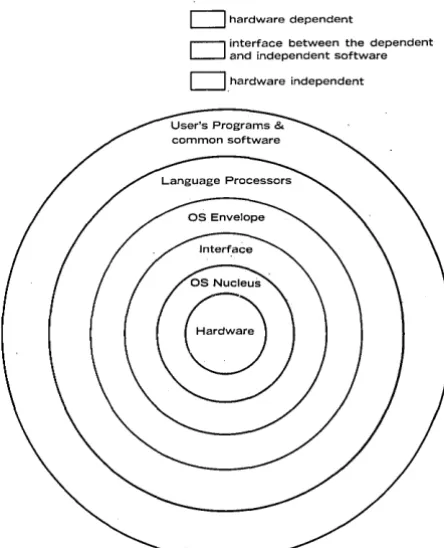
The philosophical structure of this software system is indicated in Fig. l. The common software portion is in the outer ring along with the user's programs. The inner circle,' as nucleus, contains the coi'e of the operating system. This area is hardware dependent and is developed to fit the hardware specifications. As we move out from the center, to the interface it becomes less dependent on the hardware. The areas beyond the interface ring are independent of the hardware design.
To implement this philosophical idea of an interfac-ing rinterfac-ing between the dependent and independent portions, special technology in two areas had to be developed. The first involved the selection of macro instructions which transfer control back and forth hetween the common portion and the nucleus por-tion. The second was to develop a special language for describing the compilers. A subset of PL/I was decided on as the language for descrihing the