.. ,:====w. ..
J
uly,
1967
CD
CoInputer Installations: Experiences and Lessons
....
-because The Kelly-Springfie Company gets the right tire' right place at the right time, ' modern communications and
processing system, that's wh~
And they sell over 2600 diff sizes and types of tires in the Canada and 66 other countrie:
Here's how the system work each warehouse Bell System
type® machines use master t,
to enter standard informatior customers and their purcha while the variable sale informc is typed in manually. The mach make printed orders and by-pro(
Why not?
J\u'ro-ata from each of the 26 warehouses prepared for factory production ;heduling.
The resu It: I nformation flow is ster, more accurate. Customers !t the best possible service, every-lere in the Kelly-Springfield mar-!ting world.
For more information, call your !II Telephone Business Office and k for a talk with one of our Com-.Jnications Consultants. And don't
sitate to call us early-because 3t way we can serve you best. Vhen you work with data
commu-ations, work with the Bell System.
- - - . .
-Skull practice for
creative prograDlDlers
This CalComp/Computer portrait of a growing boy is extremely helpful to anthropologists.
Drawn from X-rays, it graphically reveals changes in bone structure in a normal child over
a period of years.
It's also a handy example of the kind of challenging assignments which creative
pro-grammers face week after week at CalComp.
If you are a talented programmer with a large innovational "bump" (we just can't get away
from the phrenological), CalComp would like to show you what's ahead (oops) in computer
graphics.
Challenges are coming out of our ears.
Telephone, wire or write in confidence to Dept. A-7 California Computer Products, Inc.,
305 Muller, Anaheim, California 92803. (714) 774-9141.
•••
8<+> ••
And we know where it is to an
ac-curacy of a thousandth of a degree in
azimuth and elevation, on this frame,
and the next, and the next - as long
as the theodolite follows it.
The positional information is on the
film, in those dials at the upper
cor-ners. But getting the information off
of the film into useable form -
auto-matically - is a task so formidable
that only our Programmable Film
Reader -3 does it. (Some other pretty
big outfits are still trying.)
Think for a moment what is involved.
First the computer-controlled
scan-ning system has to locate the dials
(they're not always in the same
posi-tion on the film). Then
ithas to find
Hey,
you dropped
something!
and recognize two sets of arabic
numbers. Then it has to determine
where a tiny marker is on the linear
scale and convert this into a number
of three place accuracy. The last step
is to find the parachute and correct
for theodolite aiming error.
Sophistication fit for a human, but
our Programmable Film Reader -3 is
faster, more accurate and more
reliable.
This kind of capability - to find,
recognize, analyze, and convert visual
information -
can be applied to any
problem, because the Programmable
Film Reader -3 is just that:
program-mable. And the ultra-precise CRT in
the optical system can record on film,
too, with the same sophistication.
Other exciting new ideas in visual
information processing are taking
form at Information International. If
you want to drop something yourself,
how about in for an honest to
good-ness demonstration?
Information International Inc.
545 Technology Square, Cambridge,
Massachusetts 02139 (617) 868-9810
11161 West Pi co Boulevard,
Los Angeles, California 90064
(213) 478-2571
JULY, 1967 Vol. 16, No.7
13 c&a problem corner
by Walter Penney, C.D.P.
37 across the editor's desk
Computing and Data Process-ing Newsletter
48 new contracts 49 new installations 50 computer census
53 calendar of coming events 54 books and other publications 57 new patents
by Raymond R. Skolnick
58 advertising index
editor and publisher
Edmund C. Berkeley
auistanteditors
Moses M. Berlin, Charlene J. Hofer, Linda
Ladd Lovett, Neil D. MacDonald
contributing editors
John Bennett, Andrew D. Booth, Dick H. . Brandon, John W. Carr, III, Ned Chapin, Alston S. Householder, Peter Kugel, Rod E. Packer
Special Feature:
Computer Installations -
Experiences and Lessons
14 PRODUCTION CONTROL FROM ORDER TO SHIPMENT - FOR COMPUTERS, BY COMPUTERS, by
John D. Davis
How a computer-based order and assembly system has reduced in-process time and maintained a rigorous delivery schedule in manufacturing a new and complex computer system.
18 COMPUTERIZING THE MANUFACTURING COST SYSTEM IN A SMALL PRODUCTION SHOP, by John P. Malloy
A firm with an annual sales volume of approximately $2 million computerizes its factory cost system to good advantage.
22 COMPUTER INSTALLATIONS: EXPERIENCES AND LESSONS Sheldon J. Dansiger
SOME PERSONAL NOTES, by
A veteran EDP consultant proposes a reasonable compromise in the running battle between computer programmers and computer operators.
24 THIRD GENERATION: HARDWARE OR FUNCTION?, by Sol Zasloff
A look at the conceptual design of third generation computers, with emphasis on flexibility.
28 COMPUTERS AND SOME MORAL QUESTIONS - ROUNDUP I
7
What 28 computer people think on computers and some moral questions, and how 145 people voted on our March ballot.
editorial,
by Edmund C. BerkeleyTabu, Loaded Words, and Computer Applications
26
market report,
by Michel FeucheEDP Supplies Industry Tops Billion Dollar Annual Volume
27
capital report,
by Senter Stuartadvisory committee Controversy rises over the $114 million Air Force award to IBM; the proposed National Data T. E. Cheatham, Jr., James J. Cryan, Richard Center is debated at an ACM Chapter symposium.
W. Hamming, Alston S. Householder, Victor Paschkis
art director
Ray W. Hass
fulfilment manager
William J. McMillan, 815 Washington St., Newtonville, Mass. 021&0, &17 DE 2·5453
advertising representatives
NEW YORK 10018, Bernard Lane, 37 West 39 St., 212-BRyant 9·7281
CHICAGO 60611, Cole, Mason and Deming, 737 N. MichiEan Ave., 312-SU 7·&558
LOS ANGELES 90005, Wentworth F. Green, 300 S. Kenmore Ave., 213·DUnkirk 7-8135
NOVATO, CALIF. 94947, Richard C. Alcorn P.O. Box 734, 415-897-1620
ELSEWHERE, The Publisher, .15 Washin&ton St., &17·DEcatur 2-5453 NewtonYille, Mass. 02110
36
world report -
Great Britain,
by Ted SchoetersBritain approaches the ·continent with computers; computers reach the steel industry in the U.K.; time-sharing services to be expanded in Britain.
52
world report -
Australia,
by W. R. CooperAustralia to playa key role in watching the world's weather; University of Sydney expands computer facilities.
multi-access forum
10 Soviet Automation for Farms
10 "Time Sharing, Batch Processing, and Direct Access" - Comments
11 368 Candidates Receive Certificate in Data Processing
12 "Computers and Scientific Models" - Comments
13 Indexing of Data Processing Literature: How Shall It Be Done?
13 Zip Codes - The Base of the Modern United States Post Office
13 Soldier Anticipates Return to the United States - Seeks Job
14 Computer Association Formed in Taiwan
21 IFIP Technical Committee Activities
.~'- COMPUTERS AND AUTOMATION IS PUBLISHED MONTHLY AT B15 WASHINGTON ST., NEWTONVILLE, MASS. 02160, BY BERKELEY ENTERPRISES, INC. PRINTED IN U.S.A. SUBSCRIPTION RATES: UNITED : ~,: STATES, $15.00 FOR 1 YEAR, $29.00 FOR 2 YEARS, INCLUDING THE JUNE DIRECTORY ISSUE; CANADA, ADD SOc A YEAR FOR POSTAGE; FOREIGN, ADD $3.50 A YEAR FOR POSTAGE. ADDRESS ALL
-'" . . ,,0 EDITORIAL AND SUBSCRIPTION MAIL TO BERKELEY ENTERPRISES, INC., 815 WASHINGTON ST., NEWTONVILLE, MASS., 02160. SECOND CLASS POSTAGE PAID AT BOSTON, MASS.
The new, small DECdisk provides 32K words extra memory for the PDP-8 for $6,000. Additional 32K DECdisk units cost $3,000 each. Since a basic $18,000 PDP-8 computer has 4096 words in core, with four DECdisk units, that could give you a high speed computer with 135,16812 bit words for $33,0001
DECdisk is compatible with the $10,000 PDP-8/S, too. Adding four DECdisk units gives you a slightly slower computer with 135,16812 bit words.
More memory for less cost than any other computer.
At last count, more than 700 PDP-8 computers have been sold to scientists and equipment manufacturers. The PDP-8 is, by far, the most successful and proven on-line, real time,
small computer in the world. And that was before DECdisk.
DECdisk was developed, like all DIGITAL peripherals, to customize a basically inexpensive computer to special appli-cations. Yours. DECtape was developed the same way. The unique 3
X"
reels of magnetic tape not only provide low cost storage, but permit you to carry your program library in your pocket. And displays - did you know that DIGITAL was the first computer manufacturer to put a CRT on a computer?Computer manufacturers who worry about what the cus-tomer needs, worry a great deal about peripherals. DIGITAL has one of the largest lines of peripherals in the industry. Write, and we'll send you a free "Small Computer Handbook" and tell you all about our peripherals.
New, low cost, small computer disk.
Thanks for the memory, PDP·8.
DIGITAL EQUIPMENT CORPORA TION, Maynard, Massachusetts 01754. Telephone: (617) 897·8821 • Cambridge, Mass .• New Haven. Washington, D.C .• Parsippany, N.J .• Rochester, N.Y .• Philadelphia. Huntsville. Pittsburgh. Chicago. Denver. Ann Arbor. Houston. Los Angeles. Palo Alto. Seattle. Carleton Place and Toronto,
c&a
EDITORIAL
Loaded
and Computer Appli'cations
In another part of this issue appears Roundup I of re-spons'es on the dialog "Computers and Some Moral Ques-tions", which was begun in our March issue by a ballot and an editorial. (For those who did not see this, the editorial and the ballot are reprinted at the back of this issue.) In Roundup I a good deal of pro and con has been argued, and we shall have more to say about the substance of the argument at a later time.
Two aspects of the argument are, however, so important to this dialog (and to the discussion of many other questions) that they need to be clarified here. We shall call these aspects the issues of TABU and LOADED WORDS.
One of the principles of tabu is that (for various anthro-pological reasons differing from one society to another) some subjects must not be questioned or discussed at all, and other subjects must only be discussed in accordance with certain approved procedures or accepted attitudes (or rituals). The enforcement of tabus enrolls a fair portion of society,. includ-ing official force exercised by the government, the courts, and the police, and unofficial force including social discriminations, blacklisting, and extra-legal actions - and the voluntary con-formity of "What will people think?" The word "tabu" comes from the Tonga Islands in the South Pacific, and means "a system or act of setting things apart as sacred or cursed."
One of the ways in which the principle of tabu shows it-self clearly in some modem societies is in the doctrine that if a man is outstanding in one field such as astronomy, or relativity, or nuclear physics, or civil rights, and then engages in public discussion in another field, a controversial one, such as politics or military affairs, many voices are at once raised saying:
"He is not qualified for ,discussing this subject." "He has done a disservice t;o the cause of. " "He should mind his own business."
"It is inappropriate for him to discuss this."
Such statements are the functioning of tabus. Clearly, a man who has distinguished himself in one field by substantial in-tellectual achievements, is ·more likely and not less likely to be able to apply his intellectual abilities in other fields, includ-ing political questions. Certainly, his views are likely to be as important as polls of public opinion that include many ig-norant people as well as some informed ones. Whatever his views, they should be judged on their merits, and not by in-voking tabu.
In fact, in every society there is always a struggle between contending groups, and the stronger group quickly tries to take to itself the exclusive right to discuss controversial sub-jects on its own terms. It quickly invokes tabu.
T.o say that a relevant subject should not be discussed, that so and so is not entitled to talk about it, that such and such a magazine should not discuss a relevant subject in its pages - is to invoke tabu. This position is basically unsound, and is illogical for intelligent and educated people to take. Clearly, we have to tum the searchlights of scientific inquiry and free discussion on all topics relevant to a subject without exception. To conform instead with the principle of tabu is not rational.
In a computer field magazine it makes sense to discuss ali kinds of applications of computers, with a judicious and sen-sible allocation of space: applications to business; applications to management; applications to science; applications to engi-neering; applications to privacy, dictatorship, war, arms con-trol, peace, democracy, moral questions, and so on. A ju-dicious and sensible allocation of space should not imply the complete elimination of a relevant topic.
The basic principle of LOADED WORDS is that if, when you are arguing, you use words with the right kind of emo-tional overtones, you can call forth emotions in your audience whereby they will like what you want them to like and hate what you want them to hate. In the United States today we can all think of epithets that are used to try to convert argu-ments into rabble-rousing, and thinking into non thinking.
In fact, we often find three grades of words for human characteristics and actions:
Favorable
• firm, resolute
• liberate, borrow
Neutral
determined
take without permission
Un/av.orable
obstinate, stubborn, pigheaded
steal, purloin
voday in most of the world, we live in societies which in-creasingly try to control the flow of public information. This control is mainly in the hands of governments and establish-ments. So one of the techniques we need to learn early in life and do largely learn is to translate arguments from loaded words into neutral ones.
To say that an argument about anything is expressed in loaded words, does not dispose of the argument. What we need to do is to translate the argument into words that are as neutral as we can manage, and then consider its meaning and judge its worth.
As we have said before and, will say many times again, the basic profession of the computer person, the data processing manager, the systems analyst, and all the other essential occu-pations developing in the field of computers and data process-ing is:
INFORMATION ENGINEERING
The responsibilities of the information engineer include the professional responsibilities of any engineer, and also include some special social responsibilities besides, because of the crucial importance of reliable information for the good of society and for real progress, world-wide.
These professional responsibili,ties include not being taken in or deceived by the logical fallacies of tabu and loaded words.
Just a few little bumps
can
make a
magnetic tape a dropout.
We make new Celanar Low Profile polyester film with a
surface three times as smooth as other leading
pre-mium polyester films. Because the smoother the film
base, the smoother the computer tape can be made.
And the fewer "bumps" in the tape, the fewer
drop-outs and data error.
That's not all. The far smoother profile of Celanar
LP film permits thinner coatings. It also gives extreme
resistance to computer "snow" or backing debris.
Celanar LP filr:n has unusual flexibility. Durability.
Tensile s.trength. And scratch resistance. We designed
OTHER POLYESTER FILMS.
So we smooth even
micro-bumps out
of new Celanar LP Polyester film.
CELANAR LOW PROFILE FILM.
FAR GREATER SMOOTHNESS. AB. SENCE OF SURFACE IRREGULARI-TIES. (400X UNRETOUCHED PHOTO-MICROGRAPH.)
it to provide just about everything you could ask for in
a tape material.
You can buy major-brand magnetic tapes based on
new Celanar LP polyester film right now. We'll gladly
tell you where. And supply the facts . .
about what Celanar LP film can do for
your computer-and you. Please write
to: Celanese Plastics
Co~pany,Dept.
T22-G , P.O. Box
629,
Linden, N.
J.
07036.
CeJanese®CELANESE
c&a
MULTI-ACCESS FORUM
SOVIET AUTOMATION FOR FARMS
Warren Peter The Calgary Herald Calgary, Alber'ta,Canada
One of the recent English-language publications available from the Foreign languages publishing house in Moscow is a book entitled Automation Serves Man, oy A. Merkulov. One interesting chapter is devoted to automatic machines in crop and livestock farming on Soviet farms. The section on tractors controlled by feeler devices (which follows) provides an interesting insight into the sci~ntific principles practiced by professional agriculturists there,:
.: ..
A tractor moves across a' f1eld. The shares of a heavy five-bottom plough turn over the rich soil of the Kazakh-stan virgin lands. At the edge of the field the tractor turns by itself. Yes, by itself, for there is no driver in the cab; the levers are there, but there is nobody to manipulate them. The tractor is controlled by auto-matic governors which have better "sense organs" than man and react faster than the human brain. They can work in fog, rain, or storm. Nor is the impenetrable darkness of the night an obstacle to them. Such human failings as overstrain, sudden illness, 'or irresistible sleepi-ness are alien to these machines. They are always on the alert.
The devices and appliancell have been designed by I van Loginov, a tractor driver from the Irtyshsky Grain State Farm, Pavlodar region.
"It is not so easy to shift the levers of a tractor all day long," says Mr. Loginov. "I had an idea one day of turning the tractor into a self-propelled machine. At first
I decided to solve a much simpler problem, that of re-placing levers by push-button control. I designed a con-trol panel with buttons for starting and stopping the tractor, turning it right and left and accelerating it. The controls were hydraulically operated, which made my work much easier."
"A little later I solved another, more complicated prob-lem. I designed a feeler device, which made it possible to fully automate the control of the tractor. The auto-mated tractor began to work on its own. The feeler mechanism moves in front of the tractor guiding it along a furrow. If the furrow turns aside, the feeler guiding does the same and closes the contacts. A servomotor brings the tractor back on its course parallel to the furrow, after which it continues straight on.
"Two drivers, one at each end of the field, can op-erate several tractors. The main requirement is to cut the first furrow and then direct the feeler wheel along this furrow. All the tractor drivers have to do is to turn the machines as they approach the edge of the field.
"In sowing and harvesting, the feeler device can be 'replaced by remote control of the tractor from the
trailed combine or drill.
"The power driving the tractor engine is also remote-controlled. An automatic controller keeps watch over the lubrication system. A special automatic device stops the tractor if there is any danger of collision," Mr. Loginov concludes.
"TIME SHARING, BATCH PROCESSING, AND DIRECT ACCESS" - COMMENTS
I. From B. A. M. Moon, Director University of Canterbury
Christchurch, 1, New Zealand
Thank you for the copy of Computers and Automation for April 1967 which I just received. I read the'editorial with great interest. It makes good sense to me.
II. From John R. Sollberger Somerset, N.J.
I feel that the real potential of time-shared computers still seems to be overlooked. Computer development has two distinct aspects:
1. Technological advances have shrunk the physical size of the machines, have substantially decreased the in-vestment (in terms of utility), and have boosted de-vice reliability to a high (but not terminal level), which has resulted in ever larger installations. 2. These factors have shrunk the size and price of
com-puters available a decade ago to a level where unit record installations are becoming uneconomical and small computers with sophisticated I/O routines are taking their place.
To date, I/O routines have not been able to keep pace with the calculating capacity of the central processing unit. There-fore, satellite operations to bundle input and output to use the central processor efficiently have developed. This is obviously not a true time-sharing concept.
Information dissemination today is so rapid and of such enormous bulk that good assimilation by decision-makers is hardly any longer possible. A different approach for data handling on the decision level is needed. The technology,
hardware and software, to provide decision-makers with re-mote consoles in the office is increasingly available.
It is easy to visualize a business environment where data evolution is continuous, resulting in automatically produced "health barometer" summaries, which place emphasis on not yet accomplished goals rather than on static measurements. This environment gives the engineer access to the central processing unit by a remote installation (including plotters) to suit his needs.
"Direct access" describes this concept a little more clearly than "time sharing," which really only implies technical sophis-tication of clustered computing for simultaneous processing.
Almost certainly there will always be a need for batch processing to handle jobs such as investigative procedures, program development, certain educational needs, and record restoration from accidental destruction.
But I would tend to disagree with your statement that "the pendulum of that fashion (time sharing) has swung too far." If anything it has not swung far enough because of an ap-proach which is too centered around the individual rather than taking into account the elements of communal well-being. The tool is available; let us not be unwilling to use it.
368 CANDIDATES RECEIVE CERTIFICATE IN DATA PROCESSING
R. Calvin Elliott
Data Processing Management Association 505 Busse Highway
Park Ridge, III. 60068
The sixth annual examination for the "Certificate in Data Pro'cessing" (CDP) was given at 64 university test centers throughout the United States and Canada in February. Of 646 candidates who sat for the comprehensive three-hour examination, a total of 368 received passing scores and have been awarded the Certificate in Data Processing.
The CDP examination has been given annually at accred-ited universities, in the U.S. and Canada, since 1962. To date, more than 7600 candidates have been awarded the Cer-tificate, which is generally regarded as a high measure of knowledge of data processing concepts and technology.
To qualify for the Certificate, a candidate must' have suc-cessfully completed a prescribed course of academic study, have three years of work experience in data processing, and pass the CDP examination.
The general areas covered by the examination include:
• automatic data processing equipment; • computer programming and software systems; • data processing systems, concepts, design, and
imple-mentation; and • quantitative methods.
IICOMPUTERS AND SCIENTIFIC MODELSII - COMMENTS
I. From Clifford A. Woodbury, Jr.
Provident Mutual Life Ins. Co. of Philadelphia Philadelphia, Pa.
In your May, 1967 editorial, "Computers and Scientific Models," the following sentence appears: "To believe 'what the scientists say' is perhaps not quite as dangerous as to believe what 'the computers say'."
I believe that those in cybernation want to avoid any state-ment that gives the impression that there is any basis for thinking that computers can do anything more than their human creators. All the computers can do is to perform a greater number of operations than humans can in a given time period. All the "thinking" that a camputer can do is only what it is told to do by its programmer.
I hope no one would ever claim that programmers in gen-eral are any more accurate or any more moral in their thinking than scientists in general.
In spite of the above comment, I am grateful that the idea presented in the editorial received this publicity and I am very much in agreement with the entire essay.
II. From the Editor
Thank you for your comments. vVe are sending you a copy of the January, 1967 editorial, "LIES (Lying Invalidates Ex-cellent Systems) ," which you may not have seen, since it also refers to what "the computers say."
INDEXING OF DATA PROCESSING LITERATURE: HOW SHALL IT BE DONE?
I. From Philip R. Bagley University City Science Center Philadelphia, Pa. 19104
This is to ask you, as editor of ComjJuters and Automation,
to consider an editorial addition to your publication which will eventually aid in the production of indexes to technical literature in the data processing field. The addition is that of printing index terms as part of each technical article. Such terms would: (1) serve as the basis for a centralized index file; and (2) aid a reader in deciding whether an article or paper might be of interest to him.
Index terms are defined here as words or phrases which characterize the subject matter of an article; and they should include proper names such as the names of systems, devices, and programs'.
The first obvious question is: Who is to supply these index-ing terms? Editors understandably are hesitant about such a chore; but research has shown that author-supplied indexing terms can generally be adequate. Some persons have sug-gested that index terms be chosen from a "standard" thesau-rus; but author-indexers object to being constrained to a limited number of terms.
If a system of printing index terms in publications such as yours is to be implemented, it is up to editors to require the submission of index terms by an author just as they now fre-quently require an abstract. The editor would have to take some responsibility for seeing that adequate index terms are supplied. Terms that are too broad or too narrow should be revised.
I t seems clear that of all fields, the field of data processing ought to put its own house in order by applying data process-ing techniques to the literature of the field. The inclusion of index terms as suggested should be a step in that direction.
The Defense Documentation Center has already accepted and put into practice the concept of author-supplied index
terms. They are now mandatory for all reports submitted under government contract. IEEE-TEC has just announced that it is instituting author-supplied index terms, but it is too early to have seen published examples.
Please give this matter your serious consideration.
II. From the Editor
Unquestionably there is a valid argument for a standard-ized system of indexing literature in the data processing field. But we are not certain that the method you propose would accomplish that.
Our objections to the system you outline are basically these: (1) It would be difficult and sometimes impossible -to obtain author-supplied index terms. (2) We do provide cap-sule summaries in our Table of Contents and lead-in quotes for each article; these aid the reader in deciding quickly whether or not he wants to read a particular article; so pub-lishing index terms at the beginning of an article would not be of particular value to us. (3) We do publish in each January issue an annual index whi~h is thoroughly cross-referenced and which includes all information published in our magazine. We refer you to the January, 1967, index as an example. It seems to us that a central indexing station that would utilize indexes such as we publish (and would survey the literature itself) could provide an index that contained considerably more meaningful and extensive information than could be ob-tained by the method you outline.
We invite your comments and comments from our readers ..
ZIP CODES -
THE BASE OF THE MODERN UNITED STATES POST OFFICE
I. From Mr. Ira Kapenstein Information Service
Post Office Department Washington, D.C. 20260
Much of the correspondence in scientific circles is prompted by articles printed in scientific journals with a notation giving the location of the author(s). In many instances, the listed addresses do not contain zip codes. The zip code system is the base upon which the modern Post Office Department is being built, and it is essential to the continued existence of adequate postal service.
Mail volume is rising at a spectacular rate; it has increased over 100 per cent in the past 20 years.
Your assistance in encouraging the use of zip code in addresses listed in your publication would be appreciated.
II. From the Editor
We shall do our best to publish zip codes in the addresses of all persons and organizations that we refer to in our pages. This data-processing innovation we fully support.
SOLDIER ANTICIPATES RETURN TO UNITED STATES; SEEKS JOB
I. From Donald C. Shumate HHC 4th Transportation Command APO 96307, San Francisco, Calif.
May I ask a favor of you? I hope it will not be too difficult to grant.
In three months, at the end of my present assignment in Vietnam, I will have completed my obligated two years of military service. I would like to begin looking for a civilian job now, but here in Vietnam we have no access to informa-tion re employment opportunities.
I would like to have a list of companies who employ en-gineers interested in applying computers to solve physical problems. Could you give me assistance by sending me a list of such firms located in the San Francisco area?
II. From the 'Editor
Thank you for your letter.
Following is a list of several companies in the San Francisco area which we know of, and which might be interested in employing computer engineers:
Friden, Inc., 2350 Washington Ave., San Leandro, Calif. 94577 Hewlett-Packard, 1501 Page Mill Rd., Palo Alto, Calif. 94304 Memorex Corp., 1180 Shulman Ave., Santa Clara, Calif. 95052 Pacific Electro Magnetics Co. Inc., 942 Commercial St., Palo
Alto, Calif. 94304
COMPUTER ASSOCIATION FORMED IN TAIWAN
Kenneth K. Fan Utah State University Logan, Utah 84321
The first computer association in Taiwan was formed in June, 1966, and has the name "The Chinese Society for Auto-mation and Electronic Data Processing." The object of the association is to promote the study of the practical applications of Electronic Data Processing. The functions of the Society are:
1, To undertake the study of EDP, supplemented by seminars, group discussions, training classes, inspection tours, etc.
2. To assist public and private enterprises in the appli-cation of EDP.
3. To collect books, p.eriodicals, and reference materials relative to EDP and make available to the interested public.
4. To publish a magazine quarterly and pocket books relative to EDP and Automation.
c&a
PROBLEM CORNER
Walter Penney, C.D.P. Problem Editor
Computers and Automation
Readers are invited to submit problems (and their solutions) for this column to: Problem Editor, Computers and Automa-tion, 815 'Washington St., Newtonville, Mass. 02160.
Problem 677: A Conversion Headache
AI's forehead had the typical corduroy appearance indica-tive of deep concentration when John Lawthorne came into the computing laboratory.
Al looked up from the piles of punched cards on the table. "Conversion is such a headache. These were punched with two columns for every symbol instead of the usual two holes in a column for alphabetical charact~rs and one for numbers. Now we have to get the data in a form we can use."
John picked up one of the cards. "That shouldn't be too difficult; the alphabetical code seems .to be the same only with the upper punch in the first column and the lower punch in the next."
"These are the ones I'm trying to straighten out," Al said, pointing to the largest pile. "These have only numerical data, and that blank for alphabetical data in front of every number is fouling things up. Look at this one, for example. It would come out 07060503, but it's actually 7653. Removing the zeros is proving to be a bigger job than I thought, and there are too many cards for repunching."
COMPUTERS and AUTOMATION for August, 1967
5. To keep i~ constant touch with the international de-velopment and application of EDP.
6. To discuss and translate terminology relative to EDP.
The use of computers in Taiwan is in its infancy, though several government-owned and private enterprises have com-puters including IBM 360, 1620, 1440, and Univac II. Before industry can be encouraged to utilize these computers, there must be a marked increase in trained programmers; and the general public needs to be informed of the operation and functions of computers.
The address of the society is:
c/o Prof.
J.
T. R. LiuTaiwan Provincial Chung Hsing Univ. Taipei, Taiwan, China
(Please turn to page 21)
"Why don't you just arrange things so that only alternate columns are read?", John suggested.
"\Vell," replied AI, "sometimes the zeros are in even col-umns, and sometimes they are in odd columns. I've been trying to work out a formula for converting something like the 07060503 I showed you into 7653, but so far I haven't been able to figure it out."
John had been writing something on the back of a blank card. He handed it over to AI. "This should be what you're after. One FORTRAN statement could do the trick."
What did John write?
Solution to Problem 675 (May, 1967 issue of Computers and
Automation) :
The following formula will place 1 's in the form of a Greek Cross in the nine center squares of a
7
x7
array and O's elsewhere:F (I,
J)
=
15
PRODUCTION CONTROL FROM O,RDER TO
SHIPMENT - FOR COMPUTERS, BY COMPUTERS
John D. Davis
Manager, Production Control
Systems ,Manufacturing Division
IBM Corp.
Endicott, N.Y.
"Rapidly increasing production volume, inevitable alterations by
cus-tomers during the manufacturing cycle, introduction of new p,roducts,
and development of new systems of products in the future, all mean that
any production control system must be complex yet flexible."
Successful manufacture of any com-plex assembled product requires that a vast amount of information be recorded, transmitted, and updated, just to keep production going from day to day. No matter how simple the assembly may be, the information-handling job becomes complex when production control must span the full time from the moment the order is first placed to ultimate shipment - and must also include the necessary business data for management evaluation and planning. Computer-based produc-tion-control systems are therefore being more and more widely applied to improve' manufacturing performance t h r 0 ugh faster, more accurate, and more eco-nomical information handling.
A particularly challenging industry for production control is computer manu-facturing itself. This industry for many reasons, needs unusually tight control and at the same time presents many ob-stacles to achieving it.
The number of features available to a computer user has grown, making the ordering and production system com-plex; at International Business Machines Corporation the number of plants manu-facturing computer equipment also has grown, further complicating the control problem.
Therefore, several years ago, a com-puter-based order and assembly system was designed at the Endicott, N.Y., Di-vision to carry out the incredibly com-plicated infor:mation handling task that was building up. This system, first used to control IBM 1401 production, is now in full use in producting System/360 Model 30 central processing units (CPU s) at Endicott and in controlling production of input/output equipment,' components and materials, both by other IBM plants and by independent suppliers. It has contributed substan-tially to reducing in-process time and to maintaining a rigorous delivery ,schedule
in manufacturing an entirely new and far more complex computer system.
Considerations in Planning
In planning the production control system, the Systems Engineering staff at Endicott faced some special manufac-turing conditions that are common every-where in the computer industry, others ,that resulted directly from IBM policy,
and still other conditions that were sim~
ply demanded as matters of good busi~
ness practice.
Here are some considerations they faced:
• A modem general-purpose com-puter, particularly one in the System/ 360 series, must be manufactured as a custom system to each customer's order. The large variety of I/O devices and special operating features available means that it is not economically feasible to maintain a finished machine inven-tory. Each Model 30 machine in the computer assembly line (as seen in the photograph) is markedly different from all the others.
• As in many other industries, the combination of incoming customer or-ders and outgoing CPU shipments causes peaks and valleys in the production load in final assembly. A method for leveling or smoothing work is then needed both to maintain a high productivity level in a constant work force and to insure meeting customer commitments.
• Endicott's production control pro-cedures had to be extremely precise be-cause of decentralized manufacturing and continual product improvement dur-ing production. The various boxes and components in a particular computer system are made in nine plants located throughout the United States.
• Another complexity in control is a concept that has been particularly effec-tive in reducing the total in-process pro-duction time. Usually I/O equipment and other peripheral devices made at other plants are all shipped to the CPU production plant for testing together be-fore shipment to the customer. In the manufacture of System/360 Model 30 computers, however, the CPU and other equipment are shipped independently to the customers' plant. Their compatibil-ity in an operating computer system is tested separately through several new testing programs. Thus in all System/ 360 computers, the production control system must see to it that the CPU and all other units shipped separately from different plants arrive at the customer's location within the same calendar week.
Good Business Practice The systems engineers responsible for developing the new production control system also had these programming goals which represent good business practice in any type of manufacture:
Low in-pr:ocess CPU inventory. A low CPU inventory, of course, mini-mizes the inves~ment in capital and space. In addition, the disrupting effect of constant engineering changes are. minimized. The most
direct method of reducing CPU in-ventory is to start CPU production on the latest day which will safely meet customer commitments.
Easyadapt.ability to change.
Rapid-ly increasing production volume, in-evitable alterations by customers during the manufacturing cycle, in-troduction of new products, and de-velopment of new computer systems in the future all mean that any pro-duction control system must be flex-ible .in both the scope of its influ-ence and the detailed con trol criteria.
Better management information.
The production control system should provide accurate, up-to-date information for both short-term and long-term management planning.
User ,orientation. The nature of
in-formation flow, format of report documents and control language should match the needs of the various groups involved in computer manufacture. No special knowledge of computer programming should be necessary for anyone using the system.
The Overall Production Control'
System
To fulfill these manufacturing objec-tives, the order and assembly system· at
the Endicott plant has three basic func-tions: ( 1) order management, (2) in-formation management, and (3) process management.
These three functions have been as-signed separately to three interlocking production control subsystems - COS-MOS, COP, and ACS. COSMOS
(Corr..puter Oriented System for Manu-facturing Order Synthesis) automatical-ly enters, audits, anaautomatical-lyses, and controls customer equipment orders, primarily up to the point where production begins. COP (Customer Order Processing) first organizes and disseminates information (i.e., order changes, reschedules, can-cellations, engineering changes) that varies the condition of an order before or after production begins. Secondly, COP stores and distributes statistical in-formation for management control at all levels. ACS (Assembly Control System) controls assembly of the computer from the moment production begins to "field-merge" shipment to the customer. The COSMOS and ACS subsystems have been specifically designed to treat each customer order separately, while the COP system is capable of producing combined analytical data among all ac-tive customer orders.
The flow diagram in Figure 1 shows each of the three production control subsystems in relation both to the cus-tomer and to the many manufacturing departments and plants involved in pro-ducing his particular computer system. A few of the major production control reports prepared and printed out by computer are shown (the several reports that are shaded will be illustrated and described briefly below).
Figure 1: Flow diagram of overall production conlrol system al EndicoH.
[image:15.615.243.561.489.710.2]Computer-Oriented System for Manufacturing Order Synthesis
(COSMOS)
The major elements of the COSMOS subsystem are shown in the simplified flow diagram in Figure 2. COSMOS begins to function, as does the entire production control system, when a cus-tomer order is first entered at one of the 250 domestic IBM branch offices. All the special operating features and I/O devices for the particular computer system are recorded, together with the appropriate shipping date, and for-warded to one -of four regional offices. There, the orders are put on magnetic tape and transmitted first to White Plains, N ew York, then to the Systems Mar.lUfacturing Division headquarters in Harrison, New York; finally System/360 Model 30 orders are sent to Endicott.
COSMOS's first job is to audit and analyze all the data previously recorded manually at the salp.s offices. The many different computer- configurations and varieties of equipment which can be combined to fulfill a customer's special needs require that each customer order tape be analyzed to determine that the components recorded for the proposed system are mutually compatible and up-to-date. If the COSMOS audit of a customer order detects any incompatibil-ity, an exception report is printed out and the information is wired to the re-gional office for action.
COSMOS then converts the Sales Manual feature codes to Bills of Mate-rial feature codes contained in the Ma-chine Feature Index (MFI). The order is now in a form to allow parts planning, procuring, and building of the machine.
COSMOS SUBSYSTEM
Region Tapes
New York Woshington Chicago Los Angeles
Systems Audit
Sales Order to Mfg. Order Interpretation
COP Subsystem
Manufactur ing Order
Alteration Notice
New Orders Alterations B/M Detail
Exception Report
Order Control Information
Figure 2: Flow diagram of COSMOS subsysrem.
While computer orders were originally transmitted in handwritten form and later in machine-prepared paper docu-ments, they are now sent tJJ Endicott on reels of magnetic tape - in a form ac-tually usable by a computer. Use of machine-readable magnetic tape as the primary form of input information con-tributes a great deal to the success of the production control system.
The major function of COSMOS is: to insure the accuracy of order informa-tion received on the tapes; to translate order detail into Bill-of-Material Codes; and to speed information flow through-out the production control system by taking over many information-handling tasks that otherwise would have to be done manually.
Flexibility
These two order preparation tasks of COSMOS must be flexible in order to account immediately for the frequent engineering changes (involving different MFI codes) and to react properly to further variations caused by new feature and product announcements. The neces-sary flexibility has been attained by bas-ing the COSMOS system design on the application of externally controlled de-cision tables. A Systems Audit Table
( SAT) checks for the completeness and validity of the order configuration, while an additional MFI table handles conver-sion of sales code data into Bills-of-Ma-terial. Clerical personnel can easily and quickly make changes in both the SAT
and MFI tables, without any special knowledge of computer programming.
Decision Tables
Experience has shown that the COS-MOS decision tables provide substan-tially greater accuracy and permit cleri-cal auditing personnel to concentrate on exception conditions. In addition, the use of decision tables in order control contributes substantially to shortening the order processing cycle time.
Once COSMOS has converted the order to feature Bills of Material, it is prepared to print out the detailed Manufacturing Order. The order print time is controlled by one of two meth-ods: ( 1) control by a table using the shipping date as the trigger, or (2) con-trol by a message received from ACS requesting that the Manufacturing Or-der be prepared. Until the orOr-der is printed, it is constantly updated on tape as alterations are received from the re-gions. After the order is printed, any subsequent alteration activity is printed out in the form of an Alteration Notice. COSMOS continues to track this activ-ity until the order is shipped. The Manufacturing Order (shown in Fig-ure 3) is the basic original production document which will follow the cus-tomer order through the plant. While COSMOS performs such other activities as providing backlog statistics on re-quest, once the order is converted to fea-ture Bills of Material, the COP and ACS subsystems take over.
Customer Order Processing (COP) The COP subsystem is indicated in the flow diagram in Figure 3. This sys-tem encompasses much of the informa-tion flow between departments, plants and offices that is needed to keep the production control system in operation. The information handling functions of the COP subsystem are:
( 1) Receiving rescheduled orders from the sales regions and the Systems Manufacturing Divi-sion headquarters, t h r 0 ugh
transceiver communications ter-minals, and updating customer orders.
(2) Accumulating and printing out statistical information (such as number of orders of different types) for sales analysis, man-agement and the Order De-partment.
[image:16.620.75.370.278.518.2]COP SUBSYSTEM
Customer Order Master
Management
Figure 3: Flow diagram of COP subsystem.
( 4) Printing out actIvIty reports, including complete order status reports once a month and ex-ception reports daily.
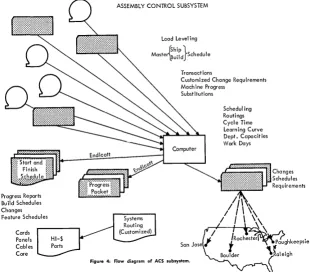
functions of ACS in controlling each production order are: to establish and maintain start and finish dates in each department at Endicott and at other IBM plants; and to feed the Require-ments System, which sets up necessary shipping dates for components and ma-terials from outside vendors. Starting and finishing dates for all operations in each department are printed out on the basis of the established shipping date, the specific process flow, and the known time needed for each operation. The
start date for the first department in-volved, as might be expected, is the triggcr datc for COSMOS to produce the Manufacturing Order.
One of the most critical production control functions of ACS is load leveling, which insures maximum productivity of personnel and equipment while main-taining "planned shipping schedules. The ACS Master File is assigned an Original Start Date for each order. If needed to help level the prodllction load, the ACS Master File also includes a Leveled Start Date, which for each order may be weeks earlier than the Original Start Date.
The ACS subsystem produces a Mas-ter Building Schedule which lists the quantities of CPUs and other products that must be produced in particular weeks to meet the Master Shipping Schedule. If there is an imbalance of the load indicated by the Master Build-ing Schedule for any particular week, appropriate customer orders may be shifted to the Leveled Start Date in order to smooth out production. The se-lection of the optimum customer orders for shifting to Leveled Start Dates is done entirely within the ACS subsystem and printed out for review by the Order Department management.
During assembly and test of a comput-er, a corollary system insures that cur-rent engineering changes are incorpo-rated and that all customer changes are added to the original order. This sys-tem, called Machine Level Control, also maintains a lifetime record of the status of each computer.
One of the major reports produced regularly by the COP subsystem is the Load Report, which compares planned production ("Prod") with actual pro-duction ("Load") and tabulates the dif-ference (plus or minus). The planned production listed in the Load Report is. derived from the Master Shipping Schedule, which lists for a period of two years the projected quantities of various types of computer eql.lipment and com-ponents that are planned for production at the plant. The Master Shipping Schedule is revised at regular intervals, as indicated by trends in order and ship-ment. The Load Report is useful to the Order Department in maintaining bal-anced-load against master schedule. The Load Report is also useful in reporting to the sales regions how their production loads compare with their order position.
ASSEMBLY CONTROL SUBSYSTEM
COP data is also supplied indirectly in managing the Endicott Perpetual In-ventory Control system. On the basis of the Master Shipping Schedule and COP data on short-term order and shipping status, it is possible to plan delivery of components and aevices from other IBM plants and vendors from six to twelve months ahead.
Assembly Control System (ACS) The ACS subsystem (Figure 4) can start the production process on a given customer order by triggering the COS-MOS subsystem so that the Manufactur-ing Order is printed out in prepamtion for an upcoming start date. The primary
Progress Reports Build Schedules Changes Feature Schedul es
Cards Panels Cables Core
Load Level ing
J5hiP} Master@uild Schedule
Transact ions
Customized Change Requirements Mach ine Progress
Substilutions
Schedul ing Routings Cycle Time Learning Curve Dept. Capacities Work Days
,",=;;;;;;U
ChangesFigure 4: Flow diagram of ACS subsystem.
[image:17.613.61.398.53.292.2] [image:17.613.246.556.454.726.2]COMPUTERIZING THE MANUFACTURING COST
SYSTEM IN A SMALL PRODUCTION SHOP
] ohn P. Malloy
Modern Machine Works, Inc.
Cudahy, Wise.
".Top management decided to plunge towards the heart of the
informa-tzon system -
and its first computer application was the installation of
a complex system for reporting manufacturing cost."
Much attention has been focused on the development of computers and computer applications for large manufacturing firms, but relatively little has been published concerning suc-cessful application of computers in small firms. This article describes the approach used and the results achieved when a firm with an annual sales volume of approximately $2 million computerized significant portions of its information system.
A Non-Typical Approach
The typical approach used by most manufacturing firms when computerizing information systems is to convert pay-rolls, financial reports; and other relatively routine applications.
A very "different approach was taken in the instaIlation de-scribed here, where the first computer application was the installation of a complex system for reporting manufacturing cost. Top management in the firm decided to plunge towards the heart of the information system in this first installation in the belief that a larger and vital cost/profit improvement program could not be effected, unless "clean" cost data were available from the Man~facturing Cost System. The com-puterization of the information system was part of a four-year program for improvement of profits, and was aimed at re-juvenating a small, well-established firm which was suffering from lack of vitality and the erosion of assets and net worth.
The Firm
The firm supplies precision metal shafts for equipment for air conditioning, refrigeration, air compressors, internal com-bustion engines, pumps, and farms. It is forty years old, has a good reputation for quality and integrity, and is well estab-lished in its markets. The firm employs 135 people. It pur-chases forgings, castings, and bar stock. . It produces finished precision products in lot sizes varying from fifty to five thou-sand pieces. It is a production shop as opposed to a job shop.
After a boom period during World War
II,
this firm was suffering from reduced productivity, inadequate marketing, and lack of valid, 'on-time, financial information. These factor~ helped set the stage for a near catastrophe for the corporation between 1959 and 1964. Sales volume dropped; losses accel-erated; equipment was obsolete; and management effort was inadequate, .18
In the summer of 1964, a number of capable and tested managers and technicians for all levels in the firm were re-cruited. This group, combined with the best of the old, set for themselves the task of rebuilding the firm.
The Master Plan
An intensive survey of the corporation was made by a group of specialists from manufacturing, accounting, finance, market-ing, and general management. From their reports a detailed five-year financial plan was formulated; and from this, long-range programs were developed in marketing, manufacturing, finance, and human relations.
An integral and key part of this effort involved the develop-ment of a new management information system. Study
re-vealed that five major subsystems of the corporate information system were required: ( 1) A Financial Planning System;
(2) A Marketing and Sales Information and Control System; (3) A Production Planning System; (4) A Production Sched-uling and Operation Control System; and (5) An Accounting Information Feedback System.
Parts of these newly-planned systems were functioning and could be utilized. In general, however, an almost totally new system for each of the five subsystems was deemed necessary for good decision-making and improved operational control. The Manufacturing Cost Performance System was given the highest priority for development, installation and
computeri-lation. It was· a subsystem of the Accounting Information Feedback System.
Why Choose the Manufacturing Cost Performance System?
There were several reasons for the high prIOrIty of the Manufacturing Cost Performance System: (1) The sales. dol-lar contained a high direct labor component. Profits thus
were quite sensitive to changes in labor costs. (2) A significant and rapid improvement in shop productivity was needed be-cause of the competitive markets served. Working capital needs required faster shipments and improved profits, and the rate of inventory turnover had to be accelerated. (3) The existing actual cost system was highly unreliable because of the relative lack of coverage of measured day work. Substan-tial errors also were introduced into cost and financial data by the existing timekeeping system. ( 4) The price structure of the firm was hazarded by the unreliability of the existing factory cost system. (5) The development and initiation of other systems would depend on the validity of data gener-ated for or by the Manufacturing Cost Performance System.
(6) Substantial groundwork already had been laid for the required work measurement system and for the new cost system. Valid work standards obviously are an important part of any Manufacturing Cost System.
System Development
After the decision was made to install the Manufacturing Cost Performance System, it was determined that there were six important steps in the program:
1. The development of additional standards for esti-mated work for a day, to be used wherever incentive standards were not yet available.
2. A totally new timekeeping system aimed at taking the handling of time cards entirely from the hands of the worker.
3. The development of a punched card input/output document format for the Manufacturing Cost System, and for subsidiary output reports which would be derived from the basic data generated by the Manu-facturing Cost Report (i.e., man costs, job costs, machine costs, and material costs).
4. Initiation of the programming necessary to compu-terize the system.
5. Orientation and training of all management and pro-duction workers affected.
6. Translation of all instructions and practices in the system into written standard practices.
Timekeeping
One it was determmea that a computer would be needed, a survey was made of the card volume, and the time needed to key punch ~nd verify cards was establisl].ed. A review was then made of computer time available on a rental basis, and it was decided to program the system for a 1401 IBM computer.
Because of the peculiar demands of the timekeeping system, a Manufacturing Control Center was constructed on the shop floor. It contains the dispatching and timekeeping functions and the daily produ~tion scheduling inform4tion center.
Included in the system was the Universal Time Punch -a job-cost time recorder th-at punches st-art -and stop time in a standard 80-column tab card. In this application, each employee is punched in and out by the timekeeper. The Key Punch was used to add certain other variable data. After each employee is punched out, the piece count is added and per-sonally verified by the operator. In effect, the basic data for the Manufacturing Cost Performance System is completed and verified and no further key punching is required.
A separate data preparation center was also established. It contains the remaining hardware as well as files, work area, etc. In this center, master routings are key punched and other data for a variety of computer applications are pre-pared and verified.
Control Reports
Approximately six months were required to complete the installation of the system. However, during the year which followed, there was a continuous upgrading and additional sophistication of the system. In the second six-month period the shop payroll was computerized as were various other sys-tems including all monthly corporate financial reports.
Computer runs are made once a week. The total computer time used for the following information is approximately two hours. The reports prepared include:
1. Individual Earnings Registe~. This report itemizes all jobs which each productive operat0r works on during the pay period. Ninety-eight percent of all direct labor jobs have either an engineered incentive standard or a measured day work standard. Indi-vidual operator efficiency on each job and his total pay period performance is computed. A distribution of all non-productive time is itemized.
2. Departmental Labor Control Report. This report summarizes the performance of each operator in each department. It supplies the distribution of operators' time according to elapsed hours, direct labor, indirect labor, percent of time measured, operator efficiency while working on incentive and on day work, the sales dollars produced, and the dollar portion of this which was productive la:bor and which was set up labor. It also gives the dollar distribution of the remainder of the productive operator's time in four accounts: indirect, unearned guarantee; non-produc-tive work; rework; and non-standard work. The dollar volume of scrap produced is also summarized. 3. Factory Labor Control Report. This report provides
a department-by-department cost summary of the en-tire factory including the indirect departments (tool room, inspection, maintenance, etc. ) . I t includes: total elapsed hours paid to members of the work force for the weekly pay period; the measured hours; labor dollars produced; departmental efficiency; both incentive and measured day work; the distribution of payroll; and the dollar value of scrap by operator and by department. This report also summarizes the total variable labor cbst for each pay period. Total value of labor sales produced and shipped provide the corporate inventory positions at the conclusion of each weekly pay period.
4. Manufacturing Engineering Profit Report. This re-port summarizes productivity according to those parts which are assigned as the profit responsibility of each manufacturing engineer.
5. Actual Cost Performance by Part and by Customer. When a production lot is closed, a summary of the cost performance by part is available to management (including the sales engineer). Periodically, these data can be summarized by customer to examine cost performance for a particular part by lot or by manu-facturing process.
6. Machine Utilization Report. Quarterly time cards can be processed and the actual tiI;lle utilization and productivity results on each machine tool can be determined. Such data are utilized in: (a) evaluating production capaclty, down time, and machine effi-ciency; (b) purchasing new equipment and evaluating effectiveness of maintenance; and (c) verifying and up-dating the machine hour rate schedule.