Abstract—The incorporation of nanosilica (SiO2) derived from rice husk ash on corn oil-based polyurethane (PU) and the effect of NCO/OH ratio as well as the silica loading were investigated. PU synthesis was carried out via polyaddition reaction between the activated polyol from corn oil and hexamethylene diisocyanate (HMDI). For the PU/SiO2 fabrication, the nanosilica was incorporated before the completion of the PU synthesis. Infrared spectral analyses showed the presence of characteristic bands for PU and SiO2. The mechanical properties of the composite material were strengthened with increasing NCO/OH up to 2:1 ratio and SiO2 content at 5% loading.
Index Terms—Corn oil, polyurethane, rice husk ash, silica nanoparticles
I. INTRODUCTION
OLYURETHANE is a broad class of polymer which is known for its versatility in terms of properties and applications [1]. Polyurethane demonstrates excellent tensile strength, high wear resistance and resilience, high flexibility even at low temperatures and is capable of enduring harsh environment conditions [2]. In terms of its usage, PU is being utilized in various applications including but not limited to construction and automotive materials, furniture, coating and biomaterials.
To further extend the applicability of PU, several studies are being done to improve its performance and one of which is the incorporation of fillers. By doing so, remarkable enhancements in mechanical, dielectric, magnetic, thermal, optical, and acoustic properties can be achieved due to the improved filler-polymer matrix interaction [3].
The SiO2 particles have been widely used as nanofillers
into polymers to improve their physicochemical properties such as electrical, heat resistance, radiation, and mechanical properties [4]. One possible source of silica is rice husks ash
Manuscript received March 18, 2016.This work was supported by the University of the Philippines, College of Engineering and Semirara Mining Corporation through the Professorial Chair Award.
E. R. Magdaluyo, Jr. is a faculty member from the Department of Mining, Metallurgical and Materials Engineering, University of the Philippines, 1101 Diliman, Quezon City, Philippines. (e-mail: [email protected]).
J.D. Bayani and J.R.M. dela Pena were former students from the Department of Mining, Metallurgical and Materials Engineering, University of the Philippines, 1101 Diliman, Quezon City, Philippines. (e-mail: [email protected]; [email protected]).
which can be locally obtained and is very easy to procure at a very low price.
The synthesis of polyurethane from the polyaddition reaction between corn oil-based polyol and diisocyanate was earlier reported [5]. In this study, the reinforcement of silica nanoparticles derived from rice husk ash to the polyurethane derived from corn oil was investigated. The infrared spectra and mechanical properties of the composite material was studied with varying NCO/OH ratio and silica loading.
II. EXPERIMENTAL
The extraction of silica nanoparticles from rich husk ash involved the incineration of the starting material for three hours at 900oC to yield rice husk ashes (RHA). A solution of 1.5L of 1M NaOH and 250g of RHA were mixed then boiled for an hour with constant stirring. The resulting mixture was filtered then the filtrate was collected and cooled to room temp. Afterwards, a 2M HCl was added dropwise into the sodium silicate solution (filtrate) until pH 7.0 before incubation for 10 hours. The resulting silica gel was crushed, washed with distilled water, then was centrifuged. After three washings, the gels were oven dried at 80°C for 24 hours. The extracted silica was then ground until uniform powder size was achieved [6].
For the synthesis of the polyurethane, a calculated amount of 0.05 mol of corn oil in a three-necked round bottom flask was heated to 90°C with constant stirring. Then, a corresponding amount of 1.5 mol 30% H2O2 in a 60mL
solution with water was added dropwise followed by the addition of 0.3 mol formic acid in a 60mL solution with water. The reaction temperature was maintained at 90°C for 6 hours, after which, the less dense epoxidized oil was collected. After epoxidation, the oil was heated to 64°C in the same set-up followed by the addition of stoichiometric amounts of distilled water, formic acid, and methanol. This epoxide ring opening procedure was held for 30 minutes. The mixture was left to cool and settle for the collection of the denser organic polyol [5,7].
The activated corn oil-based polyol was reacted with hexamethylene diisocyanate (HDI) to synthesize PU with the following NCO/OH ratios: 1:1, 2:1, and 3:1. The total volume of PU and PU/SiO2 was kept at 6.5mL, and the
Infrared Spectra and Mechanical Properties of
Corn Oil-based Polyurethane Reinforced with
Silica Nanoparticles from Rice Husk Ash
Juchris D. Bayani, John Ralou M. Dela Pena, and Eduardo R. Magdaluyo, Jr., Member, IAENG
reaction was carried out at 90oC for 3.5 hours with constant stirring. Varying amounts of silica, 5 and 10 wt%, was added an hour before the completion of the PU synthesis reaction. The synthesized PU and PU/SiO2were casted and cured at
room temperature followed by oven curing.
The extracted silica from rice husk ash was characterized under Fourier Transform Infrared Spectroscopy (FTIR) in order to verify the presence of silica and Brunauer-Emmett-Teller (BET) test for the particle size. The synthesized PU and PU/SiO2materials were analyzed via Fourier Transform
Infrared Spectroscopy (FTIR) for the compositional analyses and Universal Testing Machine (UTM) for the mechanical properties.
III. RESULTS AND DISCUSSIONS
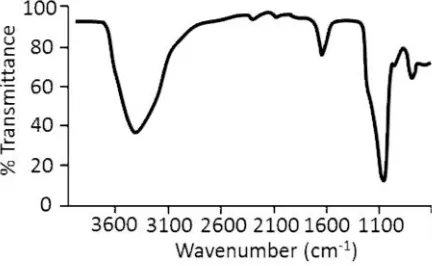
[image:2.612.322.546.51.180.2]The infrared spectral analysis of the nanosilica extracted from the RHA is shown in Figure 1. The peak at 800 cm-1 denotes the Si-O-Si stretch backbone of the nanosilica particles. The O–H and Si-O vibration absorptions were ascribed at around 3300 cm-1and 1100 cm-1respectively and these two bands correspond to the silanol groups [7-9]. The peak found at around 1600 cm-1is attributed to the bending vibration absorption of physically adsorbed water [7]. The average particle size determined through BET test is around 410 Å.
Fig. 1. Infrared spectrum of nanosilica derived from RHA
[image:2.612.327.536.333.458.2]The infrared spectra of pristine corn oil-based PU are shown in Figure 2. The characteristic peak at 2900 cm-1is within the C-H stretch region and at around 3400 cm-1 corresponds to a secondary amine group. Various peaks include C=O (around 1700 cm-1), C-H (around 1400 cm-1) and N-H (around 1500 cm-1), as well as C-N (around 1200 cm-1) and C-O-C (1000 cm-1) bonds. The presence of N-H and C=O corresponds to the amide groups present in polyurethane [10-11]. Comparing the spectra of the synthesized PU at different NCO/OH ratio, the peak of the N-H bond at 3400 cm-1is more distinct in the sample with 2:1 NCO/OH. Otherwise, there is no significant difference in terms of the spectral behavior of the synthesized PU at different NCO/OH ratio.
Fig. 2. Infrared spectra of pristine PU at different NCO/OH ratio
Representative infrared spectra of the PU/SiO2composite
with 2:1 NCO/OH ratio are shown in Figure 3. The bonds within 900 cm-1to 1300 cm-1were amplified with increasing amount of silica which is attributed to the Si-O bond absorption. The peak at around 3200 cm-1 to 3500 cm-1 diminishes as silica content increases.
Fig. 3. Infrared spectra of PU/SiO2with 2:1 NCO/OH ratio
at different silica loading
The mechanism involves in the incorporation of silica into the PU structure is given in the schematic reaction as shown in Figure 4. The extracted silica nanoparticles were surrounded by silanol (-OH) groups. Considering the rapid reaction between –NCO and –OH groups, these silanol groups can react with the terminal –NCO groups of the formed PU pre-polymer. The reaction between these two groups binds the PU pre-polymer to the SiO2particle, thus
aiding to the increase in crosslink density of the growing polymer structure as well as the viscosity of the PU/SiO2
mixture [12].
The stress-strain diagram of the synthesized PU/SiO2 at
[image:2.612.76.294.373.506.2]Fig. 4. Proposed polymer reaction mechanism of PU/SiO2interaction
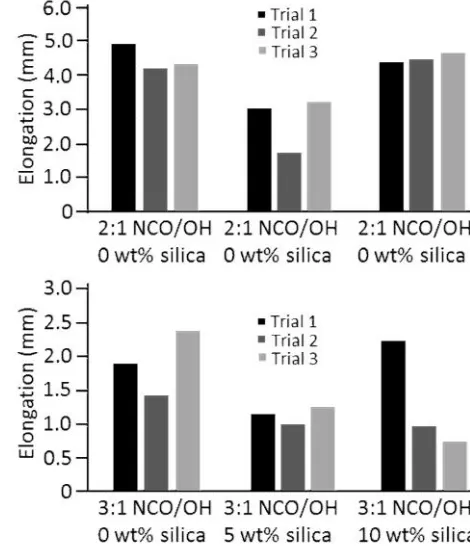
ratio. This strengthening is associated with the increase in crosslinking density of the hard segment of the material. However, the increase in rigidity compromises the materials ductility as reflected by the decrease in the material’s maximum elongation.
[image:3.612.321.549.412.690.2]maximum elongation is inversely proportional with the silica content. This could be associated with increasing attraction between silica particles which could cause a decrease in silica–PU matrix adhesion.
Fig. 4. Stress-strain plot of PU/SiO2with 5% loading at
varying NCO/OH ratio
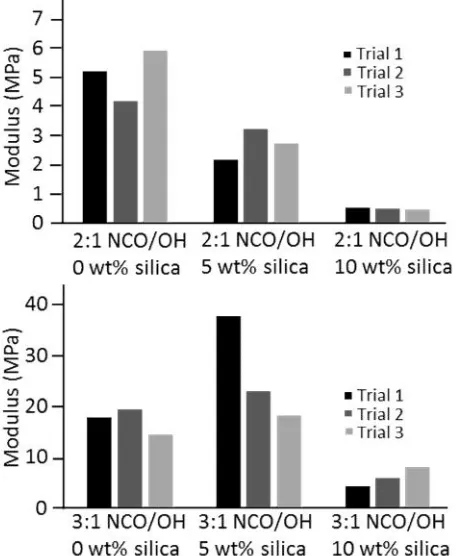
The effect of silica content on the modulus, ultimate tensile stress and maximum elongation of the PU/SiO2
materials was illustrated in Figures 5, 6 and 7 respectively. The 10% silica loading can cause the decrease of the mechanical properties of the composite material. Higher loading of filler can lessen the interaction of the polymer-nanosilica system. Considering the polyurethane samples with 3:1 NCO/OH ratio at 5 wt% silica, the modulus and ultimate tensile stress of the PU and PU/SiO2 materials
increases with increasing silica content. Moreover, the
Fig. 5. Modulus of PU and PU/SiO2with varying
[image:3.612.68.282.438.567.2]Fig. 6. Tensile strength of PU and PU/SiO2with varying
NCO/OH ratio and silica loading
[image:4.612.66.298.63.336.2]Higher NCO/OH ratio can lead to higher mechanical properties of the material. The silanol groups of silica particles react with terminal isocyanate groups of PU. Thus, at higher NCO/OH ratio, more silanol–isocyanate bond could be formed, which increases the silica–PU matrix adhesion. Furthermore, with more of these bonds present, the effect of silica as reinforcing material is well demonstrated.
Fig. 7. Elongation of PU and PU/SiO2with varying
NCO/OH ratio and silica loading
The mechanical properties such as hardness, tensile strength, and modulus of polyurethane can be dictated by the increase of NCO/OH ratio. However, the maximum ratio with desirable properties is only up to 2.4. Further increase in the content of the hard segment in the polyurethane can now cause a decrease in the mechanical properties [13].
IV. CONCLUSION
The nanosilica derived from rice husk ash was successfully incorporated in the corn oil-based polyurethane materials. The effect of the NCO/OH ratio and the amount of silica reinforcement on the fabricated PU and PU/SiO2were determined. With the increasing NCO/OH ratio, the PU and PU/SiO2 were strengthened but with
compromised ductility.
ACKNOWLEDGMENT
The authors would like to extend their appreciation to the support of the University of the Philippines–College of Engineering and the Semirara Mining Corporation.
REFERENCES
[1] P. Cinelli, I. Anguillesi and A. Lazzeri,“Green synthesis of flexible polyurethane foams from liquefied lignin”, European Polymer
Journal, vol. 49, pp. 1174-1184, 2013.
[2] J. Zhang, T. Weiping and D. Zilin.“Synthesis and characterization of
transparent and high impact resistance polyurethane coatings based on polyester polyols and isocyanate trimmers”, Progress in Organic
Coatings, vol. 75, pp. 579-583, 2012.
[3] X. Gao, Z. Yanchao, X. Zhao, Z. Wang, D.An, Y. Ma, S.Guan, Y. Du and B. Zhou, "Synthesis and characterization of polyurethane/SiO2
nanocomposites", Applied Surface Science, vol. 257, pp. 4719-4724, 2011.
[4] J. Lin, X. Wu, C. Zheng, P. Zhang, B. Huang, N. Guo and L. Jin,
“Synthesis and properties of epoxy-polyurethane/silica nanocomposites by a novel sol method and in-situ solution polymerization route”,Applied Surface Science, vol. 303, pp.67-75,
2014.
[5] F. L. Fajardo, J.R. dela Pena, J. Bayani and E.Magdaluyo, Jr., "Preparation and characterization of polyurethane films using corn (Zea mays L.) oil-based polyol”,MATEC Web of Conferences , vol.
[6] U. Kalapathy, A. Proctor and J. Shultz, "An improved method for production of silica from rice hull ash", Bioresource Technology, vol. 85, pp. 285-289, 2002.
[7] A. Hazmi, S. Ahmad, M.M. Aung, L.C. Abdullah, M.Z. Salleh and M.H. Mahmood, "Producing jatropha oil-based polyol via epoxidation and ring opening," Industrial Crops and Products, vol.
50, pp. 563–567, 2013.
[8] X. Ying-Mei, Q. Ji, H. De-Min, W. Dong-Mei, C. Hui-Ying, G. Jun, and Z. Qiu-Min, “Preparation of amorphous silica from oil shale
residue and surface modification by silane coupling agent”, Oil
Shale, vol. 27, pp. 37-46, 2010.
[9] X. Gao, Y. Zhu, X. Zhao, Z. Wang, D. An, Y. Ma, S. Guan, Y. Du and B. Zhou, "Synthesis and characterization of polyurethane/SiO2 nanocomposites", Applied Surface Science, vol. 257, pp. 4719-4724, 2011.
[10] A. Asefnejad, M.T. Khorasani, A. Behnamghader, B. Farsadzadeh and S. Bonakdar, “Manufacturing of biodegradable polyurethane
scaffolds based on polycaprolactone using a phase separation method: physical properties and in vitro assay”, International Journal of
Nanomedicine, vol. 6, pp. 2375-2384.
[11] University of Colorado at Boulder, Department of Chemistry and
Biochemistry. “IR Spectroscopy Tutorial: How to analyze IR spectra.” August 31, 2015. Available from:
http://orgchem.colorado.edu/Spectroscopy/irtutor/analyzeir.html [12] L. Chen, X. Wang, Z. Jia, Y. Luo and D. Jia, “Use of precipitated
silica with silanol groups as an inorganic chain extender in
polyurethane”,Material and Design, vol. 87, pp. 324-330.
[13] M. Mohammed, M. AL-Jarrah and A. Abdul Lateef, “Effect of NCO/OH on the Mechanical properties of Polyurethane Elastomers.”
The 1stRegional Conference of Eng. Sci. NUCEJ Spatial, vol. 3, pp.