Abstract— Industrie 4.0 is increasingly entering the
industrial landscape of German Small and Medium-sized Enterprises (SME). However, the right introduction to the subject for the affected enterprises proves to be difficult. For this reason, the "Generic Procedure Model to introduce Industrie 4.0 in Small and Medium-sized Enterprises" (GPMI4.0) is presented in this paper. The purpose of this model is to give SMEs a guidance on how to address Industrie 4.0 in order to identify enterprise-specific technology solutions, to optimize existing processes, to advance existing business models and to exploit new business models.
Index Terms— Industrie 4.0, Generic Procedure Model,
Small and Medium-sized Enterprises (SME), Industrie 4.0 Business Models
I. INTRODUCTION
Industrie 4.0 is increasingly gaining importance in the German manufacturing industry. Industrie 4.0 is usually regarded as the prospective for large global enterprises. Nowadays, SMEs are also recognizing the impact of Industrie 4.0 to the future industry. Platform Industrie 4.0, which is the leading institution of German Industrie 4.0, is dedicating to research in Industrie 4.0 for German industry and supporting realization of this vision in manufacturing enterprises. In 2013 Platform Industrie 4.0 announced 17 technology development areas covering all the Industrie 4.0-related aspects in “Recommendations for implementing the strategic initiative INDUSTRIE 4.0”. An implementation roadmap for Industrie 4.0 is described in this recommendation [1].
As the extension of the first three industrial revolutions the technical innovation for Industrie 4.0 is based on the emergence of cyber-physical systems (CPS) and the development of modern internet technology [2]. Industrie 4.0 supplies enterprises with the opportunities by means of
Manuscript received July 19, 2016; revised August 05, 2016. This work was supported in part by the project CypIFlex. CypIFlex is a research project funded by Hessischen Ministerium für Wirtschaft, Energie, Verkehr und Landesentwicklung (HMWEVL). The fund is granted under the operational program for the funding of regional competitiveness and employment in Hesse and comes from European Union funding for regional development (EFRE).
Yübo Wang is with the Department of Computer Integrated Design of the Technische Universität Darmstadt, 64287 Darmstadt, Germany (phone: +49 (0) 6151-16-21845; fax: +49 (0) 6151-16-21793; email: [email protected]).
Gong Wang is with the Department of Computer Integrated Design of the Technische Universität Darmstadt, 64287 Darmstadt, Germany (email: [email protected]).
Reiner Anderl is Head of the Department of Computer Integrated Design of the Technische Universität Darmstadt, 64287 Darmstadt, Germany (email: [email protected]).
equipping their products and manufacturing environment with these new technologies, so that the current products will increase in value and new business models will be created [3]. According to the existing experiences of the Department of Computer Integrated Design (DiK), the Industrie 4.0 competences of communication technology, digitalization and IT infrastructure in enterprise, which are considered as key break technologies for Industrie 4.0, should be analyzed and evaluated [4]. Subsequently, based on the current conditions and analysis results single use case concepts for implementation will be identified and developed. This kind of approach matches the SMEs especially well, because it builds a progressive resource-efficient process [5]. However, in the exploration course the enterprises are facing the questions, which technical solutions would facilitate the development of the enterprise, if these solutions meet the future requirements of the enterprises and how to implement Industrie 4.0 efficiently. This paper takes these questions into account and puts emphasis on methods and solutions to help enterprises by illustrating their own vision of Industrie 4.0 and to find their holistic strategy to Industrie 4.0.
II. CHALLENGES OF THE GERMAN SMALL AND MEDIUM -SIZED ENTERPRISES
HE production of German SMEs is continually evolving. For many years, German manufacturers have to deal with the issue of small batches. On the one hand, many forms of order have evolved to the result in the effect that batch sizes reduce from series production up to a batch size of 1. On the other hand, the decrease in production volumes over the number of variants for individualization is accompanied by the enlargement of the production process figures. Enterprises are faced with the challenge to optimize their production costs, at the same time they also have to satisfy the requirements of individualization as well as to optimize their production process figures [6-8].
Therefore, German SMEs are faced with a new level of organization and the control of the entire value chain over the product life cycle. How this challenge with the aid of so-called CPS and modern internet technologies introduce the way into Industrie 4.0 will be explained by the GPMI4.0. This approach pursues a gradual introduction in Industrie 4.0. The GPMI4.0 has been developed within the framework of the research project Cyber-physical Intralogistics systems for Flexible medium-volume production (CypIFlex).
Generic Procedure Model to Introduce Industrie
4.0 in Small and Medium-sized Enterprises
Yübo Wang, Gong Wang, and Reiner Anderl
III. GENERIC PROCEDURE MODEL
A. Structure of GPMI4.0
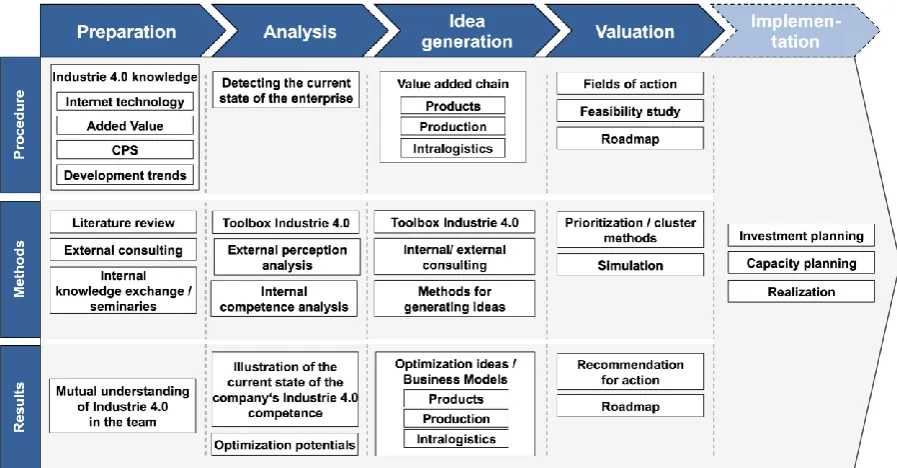
GPMI4.0 starts with the preparation phase. Then the analysis phase follows in which the enterprise competencies in Industrie 4.0 are identified. Based on these findings, ideas to optimize existing processes focusing on advancing business models are developed in the idea generation phase. In the subsequent evaluation phase the trends for future business developments are prepared so that they can be applied in the implementation phase of the enterprise. Figure 1 shows an overview of the GPMI4.0. Hereinafter, the procedure, the methods and the target results will be presented and explained in the GPMI4.0 in more detail.
B. Preparation for the introduction of Industrie 4.0 The preparation phase is used to obtain a uniform understanding of Industrie 4.0. Industrie 4.0 changes the strategic position in the value creation network on the market for all enterprises along the value chain. The conversion makes it necessary to timely think about possible changes. A good understanding of Industrie 4.0 and the development of corresponding technologies forms the starting point for GPMI4.0. In the preparation phase literature reviews, external consultations and internal exchange of experiences have to be used as methods. A profound literature review about the state of current research and application scenarios provides not only the foundation for scientific discussions but also the practical exchange of experience. The own knowledge base can be extended by external consultations. Inspections of best practice application examples and scenarios of various research institutes and enterprises encourage creativity. Here, lectures and symposia are conducted to highlight new ways and achievements. In addition to literature review and external consultation the internal exchange of experiences in an interdisciplinary project team is useful.
An early involvement of a board of directors promotes the formation of an internal corporate strategy alignment. External consultants may belong to this project team, so that their professional skills support the exchange of experiences. At the end of the preparatory phase, the enterprises recognize the benefits and the potential of Industrie 4.0, so that they are motivated to proceed with first projects on their own initiative.
C. Analysis of the enterprise
GPMI4.0 provides within the framework of the analysis phase that a project team analyzes all the necessary aspects of the current enterprise state in terms of its competence to Industrie 4.0. From this the subsequent potential for optimization emerges. In order to identify the initial situation and the market position of the enterprise regarding Industrie 4.0 and its potential for optimization, the analysis has to be conducted over all business sectors from the perspective of the actors in the business environment.
The external perception analyses and the internal competence analysis have to be used as methods in the analysis phase. The external perception analysis focuses on product-related areas of the product portfolio and examines these areas in terms of their Industrie 4.0 competence. The public presentation, the inclusion of the customer perception and supplier perspective as well as the competitors marketing of Industrie 4.0 have to be placed at the forefront of this analysis.
[image:2.595.72.521.540.774.2]In contrast to the external perception analysis the internal competence analysis focuses not only on product-related areas, but also production-related areas in terms of available competence for Industrie 4.0. For both analysis, the approach of the Toolbox Industrie 4.0 in the Guideline Industrie 4.0 is used [4]. The Toolboxes are key elements of the analysis phase. In addition to the areas of products and production the DiK has developed further Toolboxes of Intralogistics, Assembly, Engineering and IT-Security.
Structure of the Toolboxes
All Toolboxes are structured in application level vertically and development stage horizontally. Application level displays Industrie 4.0 themes, where every application level is broken down in five technological and sequential stages. The highest level represents the vision Industrie 4.0. In the following, further details about the Toolboxes Product, Production, Intralogistics and Assembly are given. Concepts for the Toolbox IT-Security and the Toolbox Engineering in Industrie 4.0 are developed. The purpose is to generate automatically a Toolbox IT-Security, which assigns protection measures to threats and vulnerabilities of a system for Industrie 4.0. Based on similar algorithms a customized Toolbox Engineering will be created with respect to the objective function.
Industrie 4.0 Toolbox Product
The first application level is the integration of sensors and actuators. The development stage starts with the product having no use of sensors and actuators and the Industrie 4.0 vision is that the product responds independently based on gained data. The second application level is the communication and connectivity. The development stage starts with the product having no interfaces and the Industrie 4.0 vision is that the product having access to the internet. The third application level is the functionalities for data storage and exchange of information. The development stage starts with the product having no functionalities and the Industrie 4.0 vision is that the data and information exchange as integral part of the product. The fourth application level is the monitoring. The development stage starts with no monitoring by the product and the Industrie 4.0 vision is the independently adopted control measures of the product. The fifth application level
is the product-related IT services. The development stage starts with no services and the Industrie 4.0 vision is that the complete integration into an infrastructure of IT services. The sixth application level is the business models around the product. The development stage starts with gaining profits from selling standardized products and the Industrie 4.0 vision is the sale of product functions [4].
Industrie 4.0 Toolbox Production
The first application level is data processing in the
production. The development stage starts with no
processing of data and the Industrie 4.0 vision is that the automatic process planning and control. The second application level is the machine-to-machine-communication. The development stage starts with no communication and the Industrie 4.0 vision is web services. The third application level is the company-wide networking with the
production. The development stage starts with no
networking of production with other business units and the Industrie 4.0 vision is inter-divisional, fully networked IT solutions. The fourth application level is the information
and communication technology infrastructure in
production. The development stage starts with information exchange via mail and telecommunication and the Industrie 4.0 vision is that suppliers and customers are fully integrated into the process design. The fifth application level are the man-machine interfaces. The development stage starts with no information exchange between user and machine and the Industrie 4.0 vision is augmented and assisted reality. The sixth application level is the efficiency with small batches. The development stage starts with rigid production systems and a small proportion of identical parts and the Industrie 4.0 vision is component-driven, modular production in value-adding networks [4].
Fig. 3. Toolbox Intralogistics b) – full lined/ dotted: current/advanced enterprise Industrie 4.0 competence of the intralogistics area
Industrie 4.0 Toolbox Intralogistics
The first application level is the integration of sensors and actuators. The development stage starts with no use of sensors and actuators and the Industrie 4.0 vision is that the logistics system independently responds based on the gained data. The second application level is the machine-to-machine-communication. The development stage starts with no communication and the Industrie 4.0 vision is the use of web services in the intralogistics system. The third application level is the man-machine interfaces. The development stage starts with no information exchange between user and machine and the Industrie 4.0 vision is augmented and assisted reality. The fourth application level is the transport system. The development stage starts with manual transport and the Industrie 4.0 vision is autonomous transport. The fifth application level is the transport unit as an information carrier. The development stage starts with no functionality and the Industrie 4.0 vision is autonomous responsive transport unit as an information carrier [9]. The sixth application level is the storage system. The development stage starts with no functionality and the Industrie 4.0 vision is an autonomous flexible storage system.
Industrie 4.0 Toolbox Assembly
The first application level is the architecture of assembly
systems. The development stage starts with mapping of one
assembly step to one assembly station and the Industrie 4.0 vision are flexible assembly processes in adaptive assembly networks. The second application level is linking cyber and
physical components. The development stage starts with no
linking and the Industrie 4.0 vision is linking over global Internet of Things, Internet of Data and Internet of Service.
The third application level is information storage of assembly processes. The development stage starts with no storage of assembly processes and the Industrie 4.0 vision is decentralized product-, resource- and factory memory. The fourth application level is the influence of process participants. The development stage starts with process participants that have no influence and the Industrie 4.0 vision is self-organization and self-controlling capability of process participants. The fifth application level is the
communication during assembly processes. The
development stage starts with no communication and the Industrie 4.0 vision is a global cross-enterprise communication. The sixth application level is decision process control for assembly. The development stage starts with manual decision and the Industrie 4.0 vision is a communication based cross-order autonomous decision [10, 11].
How to use the Industrie 4.0 Toolboxes
D. Idea generation of the enterprise
The common understanding of Industrie 4.0 and the current enterprise state of the Industrie 4.0 competence build the basis for the idea generation phase of the GPMI4.0. The idea generation phase thus requires a strong input from employees from different disciplines and different levels of hierarchy. Internal seminaries, single and group work encourage creativity and innovativeness of idea generation. In addition, external presentations such as workshops or consultations support the idea generation. The Industrie 4.0 Toolboxes and classical methods like Kata-Coaching, St. Gallen Business Model Generator and Business Model Canvas have to be used as methods to optimize existing processes to advance the own business model. In the following these methods will be described shortly:
Based on the full lined profile all Toolboxes support the generating of ideas to advance the current state of every application level for the enterprise areas. In figure 2 and figure 3 the dotted profile represents the advanced enterprise Industrie 4.0 competence of the intralogistics area.
Kata-Coaching is a method that derives from Lean Production. Kata-Coaching searches for optimization potential in all enterprise processes. Here, five key questions have to be answered in order to identify optimization. First, the current and target status have to be identified. Thereafter, it has to be clarified, which obstacles may arise on the way to the target state. Finally, the tasks and results of the single steps and the benefits of optimization have to be summed up [12].
The St. Gallen Business Model Generator allows an enterprise to advance their ideas and potential for optimi-zation of business models by considering ideas separately with the help of the generator. Similar to the Kata-Coaching, the analysis includes four key questions. First it has to be clarified who are the target customers in the business model and what is offered to them. Then it will be analyzed how the service and business value are achieved [13].
The Business Model Canvas defines a business model and describes its innovation by using variable properties. During the advancement of existing business models and the generation of new business models nine different properties of a business model are considered. Each property includes four characteristics of an enterprise. All properties as well as their characteristics are defined gradually with the help of a template [14].
After the presented methods had been conducted, ideas to optimize existing enterprise processes and business models have been generated. With the results of this phase the enterprise has taken a further step of introducing Industrie 4.0.
E. Reviewing the fields of action
Based on the results of the analysis phase the fields of action have to be defined, which have formed from the results of the collection of ideas during the idea generation phase. Besides the definition of the fields of action, their
costs have to be analyzed simultaneously by using a cost-benefit analysis. Subsequently, a roadmap for the gradual implementation of the defined fields of action has to be created that accompanies the implementation of Industrie 4.0 in the enterprises. The evaluation phase includes the clustering and prioritizing of the results of the idea generation phase and the implementation of a simulation in order to validate the results. The classification of the results of the idea generation phase has to be conducted by using the growth-share matrix [15]. Another method in the evaluation phase is the utilization of calculation and simulation tools. In order to validate the data, the calculation and simulation in the fields of economic analysis, geometry and function of a product or a factory has to be applied.
After the evaluation phase, the specifications of the Industrie 4.0 implementation are generated. Their endorsement is strengthened by the results of the simulations and economic analysis. A framework for the implementation roadmap of Industrie 4.0, which is derived from these results, is now available for the enterprise.
F. Implementation of the recommended actions
GPMI4.0 ends with the implementation phase. After the benefit of Industrie 4.0 has been recognized as well as the preparations for the implementation by means of the recommendation are set, the board of directors initiates the start of the implementations. An early start of initial projects and a successful implementation of the recommended actions will secure the future of the enterprise.
IV. VALIDATION OF THE GPMI4.0
The validation of methods and the verification of GPMI4.0 were conducted in four project formats. The first one is a holistic project format over one year, which includes the strategic positioning of the enterprises in the value creation network on the market, such as project CypIFlex. In CypIFlex the project consortium comprises pilot enterprises from IT, automation and production area and the department DiK of Technischen Universität Darmstadt. With the GPMI4.0 the medium-sized manufacturing enterprise of the project consortium was able to develop specific solutions and to subsequently implement these solutions successfully in a real production and intralogistics environment.
The second format is a compact GPMI4.0 as a workshop concept, which supports the enterprise to generate their own framework to implement Industrie 4.0. This format is validated in four pilot enterprises ARBURG GmbH & Co. KG, HAWE Hydraulik SE, SCHUNK GmbH & Co. KG and SMS Group with the VDMA project Guideline Industrie 4.0 [4].
The third format transfers GPMI4.0 to regular competence-building events in the project “Mittelstand Industrie 4.0 - Kompentenzzentrum” (MiT 4.0). MiT 4.0 is focusing on knowledge transformation from research projects to industrial approach with respect to Industrie 4.0.
Industrie 4.0 workshop. This format is validated in several Industrie 4.0 train the trainer seminaries.
V. CONCLUSION
GPMI4.0 provides an introduction to Industrie 4.0 for the enterprises. Thereby, enterprises obtain a guide for identifying fields of action of Industrie 4.0, which are adapted to their own enterprise. For this purpose, methods and Toolboxes are presented, that allow enterprises to understand their value chain in the context of Industrie 4.0 and to develop solutions. The start of initial projects reveals the potential of Industrie 4.0, reflects the benefits of Industrie 4.0 and secures the future perspectives of the enterprise.
REFERENCES
[1] H. Kagermann, W. Wahlster, and J. Helbig, Recommendations for implementing the strategic initiative INDUSTRIE 4.0. Securing the future of German manufacturing industry, Apr, 2013.
[2] R. Anderl, “Industrie 4.0 – technological approaches, use cases, and implementation,” at – Automatisierungstechnik 2015, vol 63, pp. 753-765.
[3] BITKOM,VDMA, ZVEI, Umsetzungsstrategie Industrie 4.0 – Ergebnisbericht der Plattform Industrie 4.0, Apr, 2015 https://www.bitkom.org/Publikationen/2015/Leitfaden/Umsetzungsstr ategie-Industrie-40/150410-Umsetzungsstrategie-0.pdf, [accessed on Juli 10, 2016].
[4] R. Anderl, A. Picard, Y. Wang, J. Fleischer, S. Dosch, B. Klee, J. Bauer, “Guideline Industrie 4.0 - Guiding principles for the implementation of Industrie 4.0 in small and medium sized businesses,” VDMA Forum Industrie 4.0, Frankfurt, 2015.
[5] E. Abele, R. Anderl, J. Metternich, A. Wank, O. Anokhin, A. Arndt, T. Meudt, M. Sauer, “Effiziente Fabrik 4.0 - Einzug von Industrie 4.0 in bestehende Produktionssysteme,” ZWF – Zeitschrift für wirtschaftlichen Fabrikbetrieb, pp. 150-153, 2015.
[6] Plattform Industrie 4.0, Neue Chancen für unsere Produktion – 17 Thesen des Wissenschaftlichen Beirats der Plattform Industrie 4.0, http://www.its-owl.de/fileadmin/PDF/Industrie_4.0/Thesen_des_ wissenschaftlichen_Beirats_Industrie_4.0.pdf, [accessed on Juli 10, 2016].
[7] BMBF, Zukunftsbild Industrie 4.0, http://www.bmbf.de/pubRD/Zukunftsbild_Industrie_40.pdf., 2014, [accessed on Juli 10, 2016]
[8] BMWi, Autonomik für die Industrie 4.0, http://www.autonomik.de/de/1003.php, [accessed on Juli 10, 2016]. [9] A. Picard, Integriertes Werkstückinformationsmodell zur Ausprägung
werkstückindividueller Fertigungszustände. Aachen. Shaker Verlag, 2015.
[10] D. Strang, Kommunikationsgesteuerte cyber-physische Montagemodelle. Aachen, Shaker Verlag, 2016.
[11] Final Report of the project SmartF-IT – Cyber-physische IT-Systeme zur Komplexitätsbeherrschung einer neuen Generation multiadaptiver Fabriken (FKZ: 01|S13015), 2016
[12] M. Rother, Die Kata des Weltmarktführers. Toyotas Erfolgsmethoden., Frankfurt and New York, Campus Verlag, 2013. [13] O. Gassmann, K. Frankenberger, M. Csik, M, Geschäftsmodelle
entwickeln. 55 innovative Konzepte mit dem St. Galler Business Model Navigator. München, Carl Hanser Verlag. 2013.
[14] A. Osterwalder, Y. Pigneur, Business Model Generation. Ein Handbuch für Visionäre. Frankfurt, Campus Verlag, pp.18-47, 2011. [15] B. Henderson, The Product Portfolio,