Ergot, caused by Claviceps purpurea (Fr.) Tul., attacks many grasses, including species grown for seed. Over 20 years of observations in the Czech Republic have shown that varieties of Kentucky bluegrass (Poa praten-sis L.) belong to the most important host plants (CAGAŠ 2001). Ergot is one of the basic diseases in grass seed growing in the northwestern part of the USA (Oregon, Washington). It causes not only a decrease in seed yield and quality (e.g. poorer storability) of Kentucky blue-grass, but also an increase in production costs (cleaning) and restricted export possibilities (CHASTAIN 1992). Under European conditions, ergot belongs to the impor-tant grass diseases, but not to the limiting factors of seed growing. Its occurrence differs between growing areas and years.
The amount of ergot bodies (sclerotia), which affects the intensity of seed cleaning, differs very strongly be-tween the years. It could be assumed that this variation of occurrence is influenced by the following factors:
1. Age of the grass sward (number of harvest years) – with the age of the grassland increases the concentration of ergot sclerotia on the soil surface where they are able to produce ascospores.
2. Favourable climatic conditions in spring stimulate the germination of sclerotia, formation of asci and spread-ing of ascospores and conidia into grass inflorescences. MÜHLE et al. (1971) counted in humid years 6000 scle-rotia in 100 g of seed of Poa pratensis, which is about 4.5 g of ergot bodies.
3. Storage conditions of contaminated seed – HORN (1989) found that ergot sclerotia in harvested grass seed that was stored in dry and cold conditions lost the abil-ity to germinate. When sown together with grass seed such ergot sclerotia were of no epidemiologic impor-tance.
4. Variety – CAGAŠ (1996), in greenhouse and field trials, detected large differences in the degree of resis-tance between various cultivars of Poa pratensis.
Supported by the National Agency for Agricultural Research (NAZV), Project No. EP 0960006034.
Different Pathogenicity of Ergot Isolates (Claviceps purpurea [Fr.] Tul.)
on Kentucky Bluegrass (Poa pratensis L.)
BOHUMÍR CAGAŠ and RADEK MACHÁČ
OSEVA PRO Ltd., Grassland Research Station Rožnov-Zubří, Czech Republic
Abstract
CAGAŠ B., MACHÁČ R. (2002): Different pathogenicity of ergot isolates (Claviceps purpurea [Fr.] Tul.) on Kentucky bluegrass (Poa pratensis L.). Plant Protect. Sci., 38: 18–22.
Ergot, caused by the fungus Claviceps purpurea (Fr.) Tul., belongs to the main constraints in seed production of Kentucky bluegrass (Poa pratensis L.). The level of ergot occurrence depends on the weather conditions during the growing period, harvest year, storage conditions of seed, and post-harvest treatment. The degree of resistance of the grown cultivar plays an important role. Based on greenhouse trials with four different ergot populations (Zubří, Czech Republic; Leutewitz and Munich, Germany; Pullman, Washington, USA) during 3 years, we found pathogenicity to be one of the most important factors. There were significant differences in the amount of ergot bodies formed between the Central European populations (Zubří, Leutewitz) and the American one from Washington State. The degree of pathogenicity has a major impact on the occurrence of ergot sclerotia in seed of Poa pratensis.
5. Method of cultivation – Kentucky bluegrass grown for seed under irrigation is more attacked by ergot than under standard conditions (JOHNSTON et al. 1995).
6. Type of post-harvest management – low cutting and burning of the grass sward after the seed harvest de-crease the level of ergot infection in the next seeding year. These factors can only partially explain the differences in ergot occurrence in various geographical zones, coun-tries and growing areas. It is well known that within Clavi-ceps purpurea there exist many specialised strains or populations with different properties and different host ranges (PAŽOUTOVÁ et al. 2000), but it is not known how large an impact the different pathogenicity of these populations (strains) have on the severity of ergot inci-dence. There is no reliable information about the impact of isolates of C. purpurea that differ in place of origin on the intensity of creation of ergot bodies. The main aim of this study was, therefore, to investigate the influence of different ergot isolates on the intensity of infection of Poa pratensis. It could help to explain the different lev-els of ergot incidence in various geographical regions.
MATERIAL AND METHODS
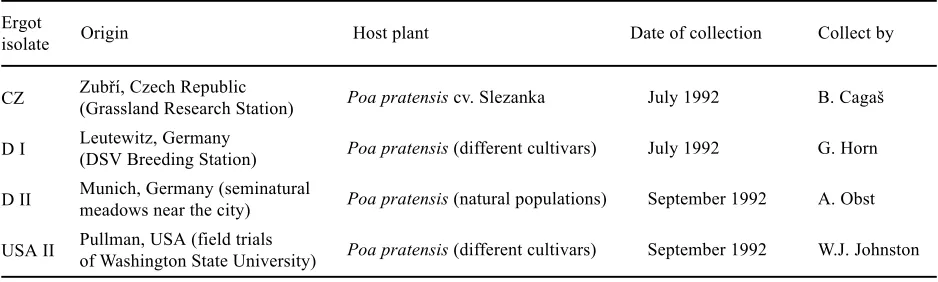
Four different isolates of C. purpurea were used for artificial inoculation in the greenhouse. Their character-istics are summarised in Table 1.
The sclerotia (six to eight from each origin) were cul-tured on malt agar in a growth chamber (room tempera-ture); the medium had been modified as follows: brewery malt, casein acid hydrolysate 1%, MgSO4.7H2O 0.1%, agar 3%. Developed mycelium with conidia were used to prepare the inoculum. Before inoculation the number of conidia was checked and standardised (25 million conidia in 1 ml).
Based on the field observations of a large assortment of Kentucky bluegrass cultivars (CAGAŠ & HORN 1994), seven cultivars differing by degree of resistance to ergot in field conditions were chosen for the glasshouse trials. Flowering plants of these cultivars (Haga, Krasa, Lovegreen, Moravanka, Rožnovská, Sheba, Slezanka) were inoculated in 1993 on May 27–31, in 1994 on May 26–June 1, in 1995 on June 2–9 in a greenhouse with a
Table 1. Characteristics of four ergot isolates used in the glasshouse trials
Ergot
isolate Origin Host plant Date of collection Collect by
CZ Zub(Grassland Research Station)ří, Czech Republic Poa pratensis cv. Slezanka July 1992 B. Cagaš
D I Leutewitz, Germany(DSV Breeding Station) Poa pratensis (different cultivars) July 1992 G. Horn
D II Munich, Germany (seminaturalmeadows near the city) Poa pratensis (natural populations) September 1992 A. Obst
[image:2.595.56.525.397.538.2]USA II Pullman, USA (field trialsof Washington State University) Poa pratensis (different cultivars) September 1992 W.J. Johnston
Table 2. Pathogenicity of four different ergot isolates, expressed by number and weight of sclerotia
Ergot Sclerotia (per 100 spikelets) Ergot Sclerotia (per 100 spikelets)
isolate Year number weight (mg) isolate Year number weight (mg)
CZ 1993 3.29 1.05 D II 1993 7.23 3.42
1994 2.67 1.46 1994 6.02 5.73
1995 4.97 3.43 1995 3.71 2.50
Mean 3.64 1.98 Mean 5.65 3.88
D I 1993 1.78 0.37 USA II 1993 10.74 8.94
1994 1.44 1.52 1994 5.54 6.47
1995 3.67 3.80 1994 15.02 14.16
[image:2.595.57.526.606.762.2]conidial suspension in water between 7 and 10 h at 2-day intervals. The plants used in the trials were transferred from the plant nursery of the Grassland Research Station at Zubří one month before the inoculation (age of plants: sown in April 1992). The inoculated plants were covered with paper bags after honeydew formation. There were four replicates per cultivar, each replicate consisting of 100 spikelets from which the ripe sclerotia were harvest-ed and the number and weight of sclerotia were deter-mined. Differences between the isolates (in number and weight of sclerotia) were analyzed by ANOVA and the significance expressed.
RESULTS AND DISCUSSION
The greenhouse trials with seven cultivars of Kentucky bluegrass with different degrees of susceptibility to ergot and four different ergot isolates carried out under stan-dardised conditions in three years brought the following results (summarised in Table 2):
– the American isolate (USA II) caused the highest pro-duction of sclerotia (with one exception in 1994); that production differs significantly or highly significantly from the Czech isolate, highly significantly from the iso-late D I and significantly from the isoiso-late D II (weight) – no significance was found in number of sclerotia be-tween the American isolate and isolate from Bavaria (D II) – Table 3. The results of single years 1993–1995 were similar (Table 4);
– two Central European isolates (CZ and D I) produced very low amounts of sclerotia;
– the isolate from Bavaria (D II) caused a relatively high production of sclerotia, and is one of the proofs of er-got differentiation within the European continent. Although the trials were carried out under standard-ised conditions in the greenhouse (the differences between the isolates could not be evaluated on the field because of the strong influence of natural conditions) and the lev-el of pathogenicity (expressed by the number and weight of sclerotia) varied between the years, the ability of the USA isolate to cause a higher production of sclerotia was evident (Table 2). The glasshouse trial brought new knowledge about the direct relationship between the de-gree of pathogenicity and the intensity of formation of ergot sclerotia. The degree of pathogenicity influences very strongly the degree of ergot incidence in grasses grown for seed. That factor was not mentioned in the pre-vious investigations explaining the different incidence of ergot bodies in grasses in various countries.
SITTON et al. (2001) investigated similarly the differ-ences in pathogenicity between the USA ergot isolates and the Czech isolate from Zubří; the assortment of Amer-ican and Czech Kentucky bluegrass cultivars showed a lower harvest of ergot sclerotia after inoculation with the Czech isolate than with USA isolates. The high resistance of cultivar Slezanka to isolates with high pathogenicity was confirmed there.
[image:3.595.69.543.531.714.2]Based on these investigations it should be recommend-ed to avoid growing Kentucky bluegrass in those areas where populations of the fungus with high pathogenicity occur. To other, non-chemical control possibilities belongs the growing of cultivars with a higher degree of resistance.
Table 3. Significances between four ergot isolates expressed by number of sclerotia in 100 spikelets and weight of sclerotia (mg per 100 spikelets)
1993 1994 1995 Mean CZ
Number of sclerotia (in 100 spikelets)
CZ 3.29 2.67 4.97 3.64 D I 0
D I 1.78 1.44 3.67 2.30 D II 0 0
D II 7.23 6.20 3.71 5.65 USA II * ** 0
USA II 10.74 5.54 15.02 10.43 CZ D I D II USA II
Weight of sclerotia (mg per 100 spikelets)
CZ 1.05 1.46 3.43 1.98 D I 0
D I 0.37 1.52 3.80 1.90 D II 0 0
D II 3.42 5.73 2.50 3.88 USA II ** ** *
USA II 8.94 6.47 14.16 9.86 CZ D I D II USA II
Number of sclerotia Weight of sclerotia sd0.05 5.15; sd0.01 7.97 sd0.05 4.52; sd0.01 7.01
R e f e r e n c e s
CAGAŠ B. (1996): Study of differential resistance of Kentucky bluegrass varieties to ergot (Claviceps purpurea [Fr.] Tul.). Genet. Šlecht., 32: 161–168.
[image:4.595.58.526.116.641.2]CAGAŠ B. (2001): Harmful and beneficial microorganisms in grasses. In: VOLKER H.P., DAPPRICH P.D. (eds): Proc. 3rd
Table 4. Number of sclerotia and weight of sclerotia after inoculation with four different ergot isolates in 1993, 1994 and 1995
Varieties Significance
Year Isolate
Number of sclerotia (per 100 spikelets)
1993 CS 3.34 0.85 8.45 2.57 3.52 1.50 2.81 3.29
D I 2.15 0.33 4.08 2.02 1.88 0.29 1.73 1.78 0
D II 8.11 5.96 12.56 7.14 6.65 6.10 4.07 7.23 * ** USAII 8.85 9.80 17.62 20.64 6.47 8.51 3.30 10.74 ** ** *
1994 CS 6.06 4.30 0.13 2.15 2.74 3.24 0.21 2.67
D I 1.40 1.62 0.02 3.15 2.50 1.17 0.22 1.44 0
D II 5.13 5.72 4.18 10.96 4.89 9.67 1.56 6.02 ** **
USAII 6.62 8.66 1.46 10.07 4.50 5.28 1.63 5.54 * ** 0
1995 CS 4.32 5.26 6.34 5.95 5.86 5.50 1.58 4.97
D I 5.49 0.26 8.28 3.20 2.78 3.65 2.01 3.67 0
D II 4.35 0.54 6.90 7.08 1.76 3.86 1.58 3.71 0 0
USAII 10.74 7.46 31.60 19.36 12.57 17.62 5.79 15.02 ** ** **
Weight of sclerotia (mg per 100 spikelets)
1993 CS 1.42 0.37 2.56 0.63 1.16 0.48 0.75 1.05
D I 0.54 0.07 0.78 0.57 0.30 0.09 0.27 0.37 0
D II 5.28 3.61 5.89 2.36 2.90 2.21 1.68 3.42 0 *
USAII 8.16 8.39 15.93 15.49 5.91 6.57 2.11 8.94 ** ** **
1994 CS 3.65 1.41 0.09 1.36 1.63 1.09 0.12 1.46
D I 2.05 1.57 0.06 3.22 2.27 1.28 0.21 1.52 0
D II 4.59 5.96 3.43 9.85 5.72 9.48 1.08 5.73 ** **
USAII 7.74 8.86 2.47 13.29 5.88 5.95 1.11 6.47 ** ** 0
1995 CS 3.58 4.59 4.42 4.34 4.00 2.54 0.56 3.43
D I 7.45 0.21 7.42 3.62 3.09 3.64 1.14 3.80 0
D II 3.87 0.31 4.78 4.52 1.05 2.21 0.74 2.50 0 0
USAII 14.72 8.55 20.05 21.80 11.58 19.52 2.88 14.16 ** ** **
Number of sclerotia Weight of sclerotia
1993: sd0.05 3.15 1994: sd0.05 2.23 1995: sd0.05 4.57 1993: sd0.05 2.92 1994: sd0.05 2.37 1995: sd0.05 3.73
sd 0.01 4.31 sd0.01 3.06 sd0.01 6.25 sd0.01 4.00 sd0.01 3.24 sd0.01 5.11
0 = not significant; significant at * P < 0.05, ** P < 0.01
Lovegreen Sheba Haga Moravanka Rožnovská Krasa Slezanka Mean CS D I D II USA II
Int. Conf. Harmful and Beneficial Microorganisms in Grass-land, Pastures and Turf. Soest (Germany), 26 September 2000: 7–16.
Int. Conf. Harmful and Beneficial Microorganisms in Grass-land, Pastures and Turf. 17: 251–258.
HORN G. (1989): Untersuchungen zur Wärmebehandlung und zur epidemiologischen Bedeutung von Mutterkornsklerotien in Wiesenrispesaatgut zum Vermehrungsanbau. (Report – unpublished). VEB Saat- und Pflanzgut Landwirtschaftliche Kulturpflanzenarten, PSF 532, Halle (Saale), Germany. CHASTAIN T.G. (1992): Relationship of ergot to Kentucky
blue-grass seed production and quality. J. Appl. Seed Product., 10: 7–10.
JOHNSTON W.J., GOLOB C.T., SITTON J.W. (1995): Control of ergot in Kentucky bluegrass seed fields using SDI fungicides and a surfactant. In: Proc. 3rd Int. Herbage Seed Conf. Yield
and Quality in Herbage Seed Production. June 18–23, Halle (Saale), Germany: 309–311.
Souhrn
CAGAŠ B., MACHÁČ R. (2002): Rozdílná patogenita izolátů námele (Claviceps purpurea [Fr.] Tul.) z lipnice luční (Poa pratensis L.). Plant Protect. Sci., 38: 18–22.
Námel, vyvolaný houbou Claviceps purpurea (Fr.) Tul., patří k nejzávažnějším problémům v semenářství lipnice luční. Množ-ství sklerocií námele v osivu závisí na mnoha faktorech, především na klimatických poměrech ve vegetačním období, stáří porostu, skladovacích podmínkách a posklizňovém ošetření osiva. Důležitou roli hraje i stupeň odolnosti pěstované odrůdy. Na základě tříletých skleníkových pokusů se čtyřmi různými izoláty námele (Zubří, ČR; Leutewitz a Mnichov, SNR a Pullman, Washington, USA) bylo zjištěno, že i patogenita jednotlivých populací může hrát významnou úlohu. Byly zjištěny významné rozdíly v množství sklerocií tvořených po inokulaci izoláty ze střední Evropy (Leutewitz, Zubří – nízká tvorba sklerocií) a americkým izolátem (vysoká tvorba sklerocií). Stupeň patogenity má tedy výrazný dopad na výskyt sklerocií námele u lipnice luční pěstované na semeno.
Klíčová slova: lipnice luční; Claviceps purpurea (Fr.) Tul.; izoláty; patogenita
Corresponding author:
Ing. BOHUMÍR CAGAŠ, CSc., OSEVA PRO, s.r.o., Výzkumná stanice travinářská Rožnov-Zubří, Hamerská 698, 756 54 Zubří, Česká republika
tel.: + 420 651 65 82 94, fax: + 420 651 65 81 97, e-mail: [email protected]
MÜHLE E., FRAUENSTEIN K., SCHUMANN K., WETZEL T. (1971): Krankheiten und Schädlinge der Futtergräser. S. Hir-zel Verlag, Leipzig.
PAŽOUTOVÁ S., OLŠOVSKÁ J., LINKA M., KOLÍNSKÁ R., FLIE
-GER M. (2000): Claviceps purpurea populations: biotope, specificity and chemoraces. Appl. Envir. Microbiol., 66: 5419– 5425.
SITTON J.W., CAGAŠ B., JOHNSTON W.J., GOLOB C.T., KLIME
-SOVA A., JOHNSON R.C. (2001): Identification of ergot patho-genicity and resistance in Kentucky Bluegrass accessions in the U.S.A. and Czech Republic. Plant Disease (in print).