Abstract—Heat treatment is considered to be one of the most common methods in food drying. However, the problem with this conventional method is that the texture of the food sample is often altered from its original state, just like in brown rice. Superheated steam treatment system (SSTS) is introduced as an effective method to remove the moisture of the sample. In order to perform process control, a programmable logic controller (PLC), which served as the main controller, is employed to automate the process. To code the PLC program, combination of ladder logic diagrams (LLD), structured texts (ST) and function block diagrams (FBD) were employed using Omron CP1L. The developed controller is also adaptable to different SSTS setting parameters like pressure, temperature (through the temperature controller) and the speed of the transport or conveyorized-driven bed system (through inverter or variable frequency drive).
Index Terms— adaptive control, programmable logic controller (PLC), superheated steam treatment system (SSTS), stabilized brown rice (SBR)
I. INTRODUCTION
ICE is considered as the most widely consumed staple food in many parts of the world, especially in Asia. Despite the fact that brown rice contains more essential nutrients than white rice, most Southeast Asians prefer the well-polished or white rice rather than the unpolished or brown rice. As a result, many children and adults have weak immune system, poor growth rate and malnourished.
The best solution to counteract the nutrient deficiency is to shift from white rice to brown rice. Brown rice has high nutritional value because of its bran. Brown rice contains magnesium that balances the action of calcium in the body by regulating the nerve and muscle tone and lowers bad cholesterol. Because of its many health benefits, eating brown rice has been a recommended food for diabetic
Manuscript received December 11, 2014; revised February 02, 2015. This work, “A PLC-Based Adaptive Control of Superheated Steam Treatment System (SSTS) for Stabilized Brown Rice (SBR)”, was supported in part by the Department of Science and Technology, Republic of the Philippines.
D. S. Guevarra is with the Metals Industry Research and Development Center, Taguig 1631 Philippines (phone: 632-837-0431; e-mail: [email protected]).
J. L. Luces is with the Metals Industry Research and Development Center, Taguig 1631 Philippines (e-mail: [email protected]).
R. G. Baldovino is with the Manufacturing Engineering and Management Department, De La Salle University, Manila 1004 Philippines (e-mail: [email protected]).
M. L. Vista is with the Metals Industry Research and Development Center, Taguig 1631 Philippines (e-mail: [email protected]).
patients. Moreover, statistical reports of SL Agritech in 2011 shows that brown rice helps lower the risk of having cancer.
However, there are some setbacks in regards to brown rice, such as prolonged cooking time due to slow liquid absorption because of its fiber. Furthermore, the oil content in the bran shortens its shelf life. Due to its short shelf life of only two (2) months, brown rice results to significant drawback to its availability and affordability. Brown rice is also susceptible to microbial and insect damage. Despite the nutritional advantage and health benefits, brown rice remains unappealing to consumers. The reason why efforts to encourage brown rice consumption could not take-off easily in the market.
For the past years, the Food and Nutrition Research Institute (FNRI), an agency of the Department of Science and Technology (DOST), conducted a research to extend the shelf life of brown rice to a minimum of six (6) months through process optimization. Using a combination of steaming and force-draft drying, the shelf life improved remarkably from 5-9 months without using chemicals. The only problem with this process is that it took more than an hour to dry the brown rice. For millers and traders, this process is considered too long to dry. To increase the process efficiency, superheated steam treatment system (SSTS) was introduced.
SSTS involves the use of a superheated steam in a direct dryer in place of combustion as the drying medium. This technology is difficult to implement because of the process complexity and the conversion of saturated steam to superheated steam is not simple. That’s the reason why process control is one of the main components needed to be addressed in this system. This can be done by using an appropriate controller that can adapt to its process parameters like pressure and temperature. Therefore, this study aims to develop an adaptive controller for the superheated steam treatment system using a programmable logic controller (PLC).
With PLC, the system will become reliable, flexible and robust. Complex systems of the SSTS will not be a major problem since PLC can operate with higher efficiency and accuracy as compared to microcontrollers. PLC systems are also easy to install and maintain. Moreover, the testing and evaluation of the system can be done before actual runs through online and offline simulations. Thus, saving valuable time in fault detection and troubleshooting.
A PLC-Based Adaptive Control of Superheated
Steam Treatment System (SSTS) for Stabilized
Brown Rice (SBR)
Dominic S. Guevarra, Joein L. Luces, Renann G. Baldovino and Melvin L. Vista, Member, IAENG
II. SUPERHEATED STEAM TREATMENT SYSTEM (SSTS)
In recent years, superheated steam has been identified as a new heating method due to its rapid surface heating. Also, superheated steam treatment differs from saturated steam because it does not increase the moisture of the sample. Furthermore, the sample in superheated steam is not oxidized because the oxygen content in superheated steam is
low (Hosaka, 1999). This technology has been widely used
as a food processing equipment, specifically, in sterilization and deodorization.
A continuous type apparatus for superheated steam consists of a drying enclosure, open-ended inlet and outlet ducts and a conveyor system for transporting the material to be dried along the inlet, through the enclosure and along the outlet duct.
The superheated steam is generated in the enclosure from the moisture in the material by circulating the initial gas within the enclosure between a heat source and the material.
A. SSTS Classification
[image:2.595.308.548.51.212.2]SSTS can be classified in terms of operating pressure, as seen in Figure 1 (Mujumdar, 2000).
Fig. 1. SSTS classification based on operating pressure.
For every corresponding operating pressure, the temperature of the material exceeds the saturation temperature of the steam. To benefit the usefulness of SSTS, it is not always necessary to operate the system above its inversion temperature. Thus, reducing the required energy consumption and lessening the effect of greenhouse gases emissions, like CO2, making SSTS particularly
advantageous.
B. SSTS Basic Operation
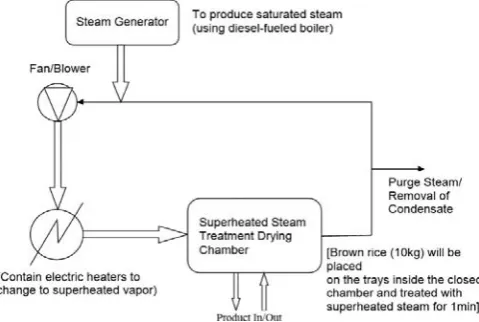
A flowchart diagram of the superheated steam treatment system (SSTS) for stabilized brown rice (SBR) is shown in Figure 2.
The saturated steam, produced by the boiler or steam generator, is heated up in an electric superheater to produce superheated steam. The drying process takes place through conduction between the superheated steam and the material or product to be dried inside a chamber where the product transported in a conveyor bed.
The superheated steam has heat transfer properties superior to air at the same temperature. The drying rate of the system is only dependent on the heat transfer rate.
Fig. 2. Flowchart off SSTS for SBR.
C. SSTS developed in MIRDC
[image:2.595.305.548.339.493.2]Figure 3 displays the 3D drawing design of the developed superheated steam treatment system (SSTS) developed in Metals Industry Research and Development Center (MIRDC) using Siemens NX.
Fig. 3. Design of superheated steam treatment system (SSTS).
In this figure, the boiler is the one that produces the superheated steam to the bed where the brown rice is fed. Also, a conveyorized bed system is employed to transport the brown rice from the inlet to the outlet.
In this system, a programmable logic controller (PLC) is installed that digitally automate the sequential and process control of the system. It automatically adjust its parameters to meet its desired set point values.
III. PROGRAMMABLE LOGIC CONTROLLER (PLC)
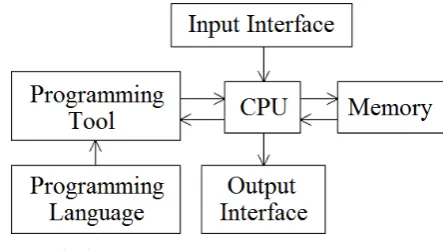
A programmable logic controller (PLC) is a digital controller mainly used in industrial automation system. The PLC hardware consists of an input/output (I/O) interface, central processing unit (CPU) and a memory storage as seen in Figure 4.
Treatment Chamber Steam Generator
[image:2.595.46.293.339.462.2]Fig. 4. PLC hardware components.
The superheated steam is generated in the enclosure from the moisture in the material by circulating the initial gas within the enclosure between a heat source and the material.
A. PLC Basic Operation
The I/O interface provides the physical connection and link to devices, machines or processes being controlled. Its main function is to transform the electrical signals into discrete data form. This data will be read and process by the CPU which will be stored in the PLC memory. The CPU is also responsible in executing a certain command instructions loaded by the user to a PLC programming software. Due to its flexibility, PLC can communicate with other devices such as I/O devices, sensors, networks and other PLC systems.
B. PLC Programming
In terms of PLC programming, according to IEC 61131-3, this digital controller can be program using five (5) different languages: ladder logic diagram (LLD), sequential flow chart (SFC), instruction list (IL), function block diagram (FBD) and structured text (ST).
LLD is a programming language that displays a program through a graphical-based circuit diagram. This is considered to be the most widely used programming language in PLC due to its simplicity in sequential control operations (Kamen, 1999). ST programming is a very powerful high-level textual language. Compared to ladder logic, ST has the ability to simplify complex mathematical functions in a single line as compared to LLD. Furthermore, FBDs were also created to simplify the representation of the input and output SSTS parameters.
IV. METHODOLOGY
In this study, the proposed controller block diagram is shown in Figure 5. Combination of ladder logic diagrams (LLD), structured texts (ST) and function block diagrams (FBD) were used to design and code the PLC program. In LLD, advanced instructions were employed making the controller to perform mathematical calculations and logical decisions.
Fig. 5. Controller block diagram.
In the block diagram, the computer inputs the sequential program and instructions for the PLC through a programming software. In this system, PLC served as the main controller. Other devices that communicate with the controller are the inverter drives and the temperature controllers that monitor the process parameters.
A. PLC Integration
[image:3.595.302.553.49.161.2]Figure 6 shows the PLC brand (Omron) used in the study. The PLC has 20 I/O ports and has USB-interface. The software used to program the PLC is the Omron CX-One with LLD, ST and FBD.
Fig. 6. Omron PLC.
B. Inverter Drive System
The conveyor-bed is motor-driven that is controlled by an inverter or variable frequency drive (VFD). The inverter is integrated with the PLC in analog signal communication via common voltage connection (0 – 10 VDC). A motor control
[image:3.595.305.549.337.452.2]function block (FB) was created to control the forward and reverse action of the induction motor (see Fig. 7).
[image:3.595.305.547.571.688.2]C. Analog Scaling Block
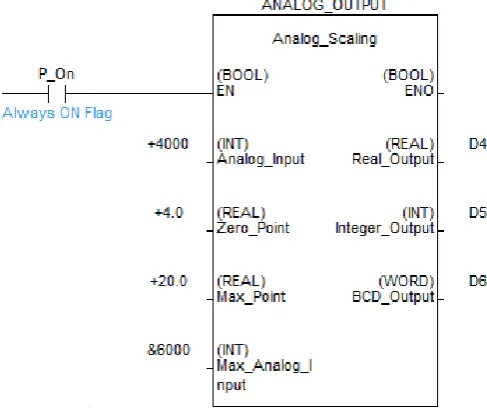
Figure 8 displays the analog scaling block used for the data conversion of the motor speed and temperature using the analog voltage communication of 0 – 10VDC signal for
[image:4.595.304.550.125.273.2]the temperature control and speed control. Given the analog resolution, this FB is used to transfer the signal between the PLC and the VFD.
Fig. 8. Analog scaling function block.
[image:4.595.46.290.138.343.2]The analog output can be computed using slope-intercept form to get the desired y-value. Computing the slope, the formula is (Max_Point – Zero_Point) / Max_Analog_Input. Getting the intercept will be simply Max_Point – Slope * Max_Analog_Input. The output of this FB is available in three (3) data types: Real, Integer and Word (see Fig. 9).
Fig. 9. Analog scaling conversion.
V. RESULTS
[image:4.595.48.292.451.587.2]Simulation was made in the CX-One’s Work Online Simulator and Data Trace Tool, as shown in Figure 11. Using these tools, the PLC program becomes easy to debug and troubleshoot as compared with traditional relay-based wiring system.
Fig. 10. PLC online testing.
A. Temperature Profile
From the temperature profile of the system, it shows that the controller can maintain the temperature located at different points in the SSTS in 1-minute treatment time (see Fig. 10).
Fig. 11. Temperature profile.
B. Physicochemical Properties
This test was conducted to evaluate the physicochemical analysis, chemical & microbiological evaluation of brown rice sample treated in SSTS. After milling, the brown rice was immediately treated, since enzyme activity will start after the bran layer of the brown rice has been exposed. Previous study shows that six (6) hours was the minimum allowable treatment time to obtain optimum results. The physicochemical analyses performed for the samples were moisture content, pH, water activity, color and free fatty-acid content.
1) Moisture content is the measurement of the total water contained in a food. In rice, this parameter is important in determining the amount of water of the grain since this could affect its texture, taste, appearance and stability. From Figure 12, it was observed that the moisture content of brown rice treated by the superheated steam is higher (10.45%) compared to the untreated brown rice (9.24%).
Fig. 12. Moisture content (%) of brown rice as exposed to different temperatures and time durations.
[image:4.595.306.548.504.640.2] [image:4.595.46.291.668.772.2]Fig. 13. pH value of brown rice as exposed to different temperatures and time durations.
[image:5.595.55.284.49.170.2]3) Water activity refers to the amount of unbound water in a food which can support the growth of bacteria, yeast and molds. It was observed that the brown rice exposed to superheated steam in shorter time had higher water activity than those exposed to higher temperature and time (see Fig. 14).
Fig. 14. Water activity of brown rice as exposed to different temperatures and time durations.
4) Color is an important quality attribute in the food industries, and it influences consumer’s choice and preferences. The color of the samples were measured using Minolta Chroma meter and from the results, the treatment did not significantly affect its color.
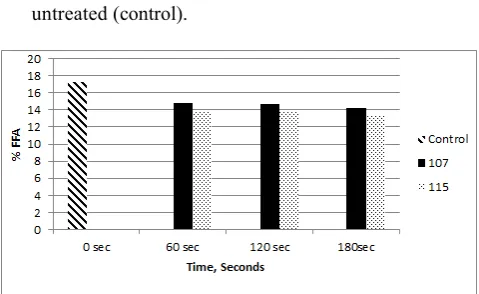
5) Free fatty acid (FFA) is the measure of rancidity caused by the lipolytic hydrolysis in brown rice. Based on FFA results from Figure 15, all the treated brown rice samples have lower free fatty acid compared to the untreated (control).
Fig. 15. FFA (%) of brown rice as exposed to different temperatures and time durations.
VI. CONCLUSION
In this study, the application of programmable logic controller, or PLC, in superheated steam treatment system (SSTS) was successfully demonstrated. From the results, the controller was able to adjust its parameters depending on the
temperature of the product or material being tested, chamber, saturated and superheated steam. Also, physicochemical results display optimum result using SSTS as compared with the untreated (control) brown rice.
Moreover, the PLC was able to communicate successfully with the temperature controllers and the inverter drive through analog voltage (0 – 10VDC) communication.
ACKNOWLEDGMENT
The authors would like to thank the Philippine Council for Agriculture, Aquatic and Natural Resources Research and Development (PCAARRD) of the Department of Science and Technology (DOST) for funding this research. This is also a joint project of the Metals Industry Research and Development Center (MIRDC) and the Food and Nutrition Research Institute (FNRI).
REFERENCES
[1] S. L. Agritech Corporation, “Strategies to increase the availability of brown rice in the market,” Policy workshop on mainstreaming brown rice to low and middle income families, 2011.
[2] H. M. Corpuz, “Ways to improve acceptability of brown rice to consumers,” 2011.
[3] E. Q. Javier, “Let’s promote brown rice to combat hidden hunger,” Rice Today, January 2004.
[4] DOST S&T Programs on Irrigated Rice, 2012-2016.
[5] DOST S&T Programs on Irrigated Rice, FNRI-DOST, 2012-2013. [6] Satou, “Effect of superheated steam treatment on enzymes related to
lipid oxidation of brown rice,” Food Sci. Technol. Res., vol. 16, issue 1, pp. 93-97, 2010.
[7] S. Devahastin, “Superheated steam drying: a brief introduction”. [8] A. Mujumdar, “Superheated steam drying: an emerging technology,”
[image:5.595.50.288.254.402.2] [image:5.595.49.289.537.684.2]