Performance of Three Preconditioners for Image
Deblurring Problem in Primal-Dual Formulation
F. Fairag and A. Al-Mahdi
Abstract—In this paper, we consider the generalized saddle point linear system of equations which is obtained from dis-cretizing the Euler Lagrange equations associated with image debulrring problem. This system is ill-conditioned and is of huge size. Moreover, the (2,2) block of the coefficient matrix of this system contains summation of two terms. One of these terms is a product of a Toepelitz matrix with Toepelitz blocks (BTTB) and its transpose. This structure needs a prconditioner to speed up the iterative method such us the minimal residual (MINRES) method. Hence, we devolve three block diagonal preconditioners which are of Murphy, Golub and Wathen [MGW] type for this saddle point system. The first preconditioner is based on approximating the product of the (BTTB) matrix and its transpose by a symmetric BTTB matrix while in the second one, we approximate the BTTB matrix by the Strang circulant. In the the third preconditioner, we approximate the BTTB matrix by the optimal circulant. We investigate the efficiency of these three preconditioners by several numerical computations in term of CPU time, iteration numbers and the quality of the reconstruction images.
Index Terms—Preconditioning technique, saddle-point prob-lems, Image deblurring, Krylov subspace method, Strang cir-culant, optimal circulant.
I. INTRODUCTION
I
N this paper, we consider the following generalized saddle point system[
αD −αB
−αB∗ −K∗K ]
| {z }
C
[ V U
]
=
[
0 −K∗Z
]
, (1)
resulted from discretizing the Euler Lagrange equations associated with image debulrring problem. HereZis a given data,[V U]T is the solution vector. In the coefficient matrix,
C, of the above system (1), the matricesK, B and D are of sizes n ×n, m ×n and m ×m, respectively. Here
n = n2x and m = 2nx(nx −1)) where nx denotes the number of equispaced partitions in thexory directions and the parameter α > 0 is small number which is called the regularities parameter. Both K∗K and L = B∗D−1B are symmetric positive semi definite matrices [21]. The matrix
K and its transpose have the block Toeplitz with Toeplitz block (BTTB) structures but K∗K need not be BTTB. It is know that image debulrring problem requires solving a large, dense, ill-conditioned linear system of equations. For example an image with256×256resolution requires solving system of size2564. Hence the only choice of linear solver to the above system is the iterative method such as Krylov
Manuscript received December 28, 2014. This work was supported by the Deanship of Scientific Research (DSR) at King Fahd University of Petroleum and Minerals (KFUPM) under Grant No. IN131044.
F. Fairag is with the Department of Mathematics and Statistics, KFUPM, 31261 Saudi Arabia e-mail: ([email protected]).
A. Al-Mahdi is with the Department of Mathematics and Statistics, KFUPM, 31261 Saudi Arabia e-mail: ([email protected]).
subspace method. Unfortunately, Krylov subspace method as conjugate gradient (CG) method or minimal residual (MINRES) method are very slow with ill-conditioned lin-ear system of equations. One technique to overcome this slowness properties is using an appropriate preconditioner. A good preconditioner which accelerates the convergence needs to be easy to construct and cheap to invert. Moreover, the preconditioned matrix should have eigenvalues clustering behavior. Many preconditions in [2] are developed for a spital linear system such as a saddle point problem. In this research work, we convert the linear system resulted from image debulrring problem into a saddle point problem and then we develop three block preconditioners for this saddle point problem. These preconditioners are of Murphy, Golub and Wathen [MGW] type [15] and they involve a Schur complement matrix which contains a product of a Toeplitz matrix with Toeplitz blocks (BTTB) and its transpose. The first preconditioner is based on approximating this product, this product may not be a BTTB, by a symmetric BTTB matrix [17] while the second is based on approximating a Toepelitz matrix by Strang circulant (see [20], [7]). In the third preconditioner, we use the optimal circulant approxima-tion for a Toeplitz matrix [8]. In this paper, we investigate the efficient of these preconditioners by several numerical computations in term of CPU time, iteration numbers and the quality of the reconstruction image. This paper is organized as follows: In section II, we introduce the problem and invert it into a saddle point problem. In section III, we devolve a block diagonal preconditioner that involves a Schur complement matrix which contains a product of a Toeplitz matrix with Toeplitz blocks (BTTB) and its transpose. In sections IV, we give some numerical examples and show the algorithm performance. Finally, in section V, we give some conclusions.
II. PROBLEM SETUP
To debulr an image, we need a mathematical model of how it was blurred. Bulrring and noise affect the quality of the received image. The recorded image z and the original imageuare related by the equation
z=Ku+ε (2) where K denotes the blurring operator and ε denotes the noise function. Kis typically a Fredholm first kind integral operator,
(Ku)(x) =
∫
Ω
defined.x= (x, y)denotes location inΩ;|x|=
√ x2+y2 denotes Euclidean norm, and ∥ · ∥ denotes the norm in L2(Ω). To stabilize problem (2) the total variation (TV) regularization functional, which was introduced in [18] by Rudin, Osher, and Fatemi, is often used. The problem is then to find auwhich minimizes the functional
T(u) = 1
2 ∥Ku−z∥
2+αJ(u), (4) with positive parameterαand the total variational functional is given by
J(u) =
∫
Ω
|▽u|. (5)
However, the derivative of integrand in equation (5) does not exist at zero. One remedy of this issue [1], [21] is to add a constantβ as follows
Jβ(u) =
∫
Ω
√
|▽u|2+β2. (6) Then the functional to be minimized is
T(u) = 1
2 ∥Ku−z∥ 2+α
∫
Ω
√
|▽u|2+β2, (7) withα, β >0. The well-posedness of this minimization is established in [1]. The Euler-Lagrange equations associated with the above minimization problem are
K∗(Ku−z) +αL(u)u= 0 x∈Ω, (8)
∂u
∂n= 0 x∈∂Ω (9)
whereK∗ is the adjoint operator of the integral operatorK. The deferential operator L(u)is given by
L(u)w=−▽.(√ 1
|▽u|2+β2▽w). (10) Note that (8) is a nonlinear integro-differential equation of elliptic type. It can be expressed as a nonlinear first order system [9]
K∗Ku−α▽.⃗v=K∗z (11)
−▽u+√|▽u|2+β2⃗v=⃗0, (12)
with the dual, or flux, variable
⃗v=√ ▽u
|▽u|2+β2 (13) Applying Galerkin’s method to (11-12) together with mid-point quadrature for the integral term and cell center finite difference method (CCFD) for the derivative part [11], one obtain the following dual-system
Kh∗KhU+αB∗hV =Kh∗Z, (14)
αBhU−αDhV = 0 (15) For the simplicity we eliminate the subscripthequipped with the matrices in (14-15) and then one can re-write them after rearrangement the unknowns as
[
αD −αB
−αB∗ −K∗K ]
| {z }
C [ V U ] = [ 0 −K∗Z
]
, (16)
Here Z is the given data, [V U]T is the solution vector. The matrixKis a dense matrix and has the BTTB structure
while the matrixK∗K may not be BTTB. The matrixD is a diagonal with positive diagonal entries
D=
[
Dx 0 0 Dy
] ,
where Dx is an (nx−1)×nx and Dy an nx×(nx − 1) matrices with diagonal entries obtained by discretize the expression√|▽u|2+β2. The matrix B is given by
B= 1
h [ B1 B2 ] ,
whereh= n1
x and the matrices B1 (nx(nx−1)×n) and B2 (nx(nx−1)×n)have the following structures
B1=
−I I 0 0 0
0 −I I 0 0
0 0 . .. . .. 0
0 0 0 −I I
,
whereI is the identity matrix of sizenx bynx.
B2=
E 0 0 0 0
0 E 0 0 0
0 0 . .. 0 0
0 0 0 0 E
,
whereE ((nx−1)×nx)is given by
E=
−1 1 0 0 0
0 −1 1 0 0
0 0 . .. . .. 0
0 0 0 −1 1
Since the coefficient matrixC is symmetric but not positive definite, the suitable Krylov subspace method for this system is MINRES method [16] but the convergence of this method well be slow. This slowness is resulted from the huge size of
C. To over come this problem the preconditioning technique is needed. In our paper, we provide three block digonal preconditioners for the generalized saddle point problem given in (16).
Note that one can eliminate V from (14,15) to get the following primal system
(K∗K+αL)U =K∗Z, (17) where K∗K is full matrix and L = B∗D−1B is sparse matrix . In (17), the matrix H =K∗K+αL is symmetric positive definite (SPD) but it is extremely large. SinceH is (SPD), then on can use the CG method but the convergence of this method well be slow. This slowness is resulted from the huge size of H. Hence, preconditioning technique is needed. In [21], Vogel et al. introduced product precondi-tioner for the system (17) with approximating the BTTB matrix by block circulant with circulant block (BCCB). Chan et al. [5] introduced cosine-transform based preconditioners for the system (17).
III. THE BLOCK DIAGONAL PRECONDITIONERS
At the beginning, we introduce the following symmetric positive definite preconditioner
where S = (K∗K+αL) is the Schur complement of the matrix C. Hence, the appropriate iterative method is pre-conditioned MINRES which minimizes the residual over the shifted Krylov subspace. For more detail in preconditioning technique we refer to [2] and [3].
The following theorem [12] gives upper and lower bounds for the positive and negative eigenvalues of the precondi-tioned matrixP−1C.
Theorem 3.1: The m+n (µ−n≤µ−n+1 ≤...≤µ−1< 0 < µ1 ≤ µ2 ≤ ... ≤ µm) eigenvalues of the generalized eigenvalue problem,
[
αD −αB
−αB∗ −K∗K ] [ x y ] =λ [ αD 0 0 S ] [ x y ] (19)
satisfy the following:
µi ∈
[
1,1 +
√
1 + 4ασm 2
]
i= 1, ..., m, (20)
µ−j ∈
[
−1, −1
1 +ατ ]
j= 1, ..., n, (21) where σm is the maximum eigenvalue of (S−1/2LS−1/2) andτ=ρ(S−1/2LS−1/2), the spectral radius.
The above cluster of the preconditioned matrixP−1C gives grantees of the convergence of the PMINRES method. It is known in each PMINRES iteration we need to solve a linear system of the form P x = y. Since, the (2,2) block of P contains a full matrix K∗K, then we lock for some circulant approximations to K∗K to ease the computations and to reduce the storages. The mean contribution of our paper is that we introduce three circulant approximations to the product K∗K in the preconditioner given in (18). The advantage of these approximations is to apply the fast Fourier transformation (FFT) and the Convolution Theorem.
A. Approximating K∗K
An n×nmatrix M is Toeplitz if the entries along each diagonal are the same. A circulant matrix is a Toeplitz matrix for which each column is a circular shift of the elements in the preceding column (so that the last entry becomes the first entry). In our problem, K is BTTB matrix and it has the block form
K=
T0 T−1 · · · T1−n
T1 T0 T−1 · · · ..
. . .. . .. T−1
Tn−1 · · · T1 T0
(22)
where each block Tj is a Toeplitz matrix. The first row and the first column are uniquely define a Toeplitz matrix. Circu-lant preconditioning for Toeplitz systems was introduced by Strang [20] and extended by others to block Toeplitz systems [10]. Many researchers use a Toeplitz preconditioners and block Toeplitz preconditioners for Toeplitz systems see for instance [6] and [13]. Band Toeplitz preconditioner and band BTTB preconditioner are proposed in Chan [4] and Serra Capizzano [19]. In [14], BTTB preconditioners for BTTB systems are discussed. In our preconditioner given in (18), note thatK is a BTTB matrix but K∗K may not a BTTB. So, the first approach that we follow is to approximateK∗K
given in the preconditioner matrix P by a symmetric BTTB matrix T (see [17]) because symmetric BTTB matrices can
always be extended to form symmetric BCCB matrices. The benefit of this approximation is that the matrix-vector products that involve n×n matrices can be computed in
O (nlogn)operations instead of O (n2). This reduction is due to the FFT and the Convolution Theorem. Moreover, all that is needed for computation is the first column of the matrix, which decreases the amount of required storage. The second approach that we follow is that we approximate then
bynToeplitz matrixKgiven in the preconditioner matrixP
by the well known Strang circulant matrixS with diagonals
sk by copying the central diagonals ofKand circulate them around to complete the circulant (see [7] page 17–18). More precisely, ifn= 2m+ 1the diagonalssk of S are given by
sk =
kk, 0≤k≤m,
kk−n, m < k < n−1, ¯
s−k, 0<−k < n−1,
(23)
whereki is the ith diagonal of the matrix K. Ifn = 2m, we get the Strang matrix S as above. In this case, we define sm = 0 or sm =
km+k−m
2 . In the last approach, we also approximate the Toeplitz matrix K given in the preconditioner matrixP by an optimal circulant matrixC.
If Cn denote the set of n×n circulant matrices. The optimal circulant approximation to K ∈ Cn×n in the Frobenius norm is given byC = arg min
B∈Cn
∥ B−K∥F ro. In this case, the value of the entries ck of the matrix C is obtained by averaging the corresponding diagonal of K
(extended to lengthnby a wraparound [8]). Then the matrix
C, whose entries are given byck=
kT−(n−k)+(n−k)Tk
n , k=
−(n−1), ...,0, ...,(n−1). So our preconditioner is being in the forms
PT =
[
αD 0
0 T+αL
]
, PS =
[
αD 0
0 S∗S+αL ]
, PC=
[
αD 0
0 C∗C+αL ]
,
(24)
IV. NUMERICALEXPERIMENT
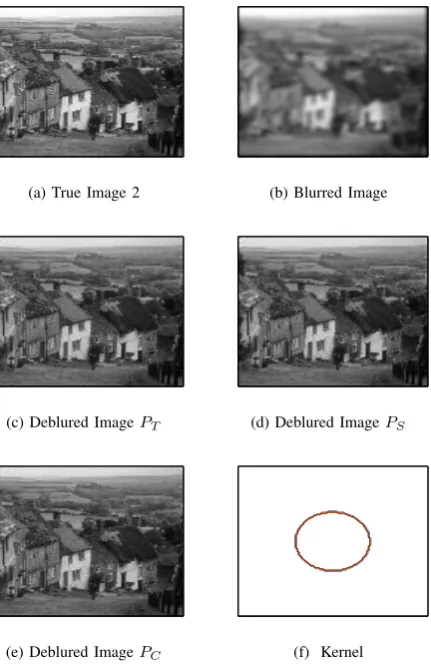
The aim of this section is to investigate the efficiency of the three preconditioners described above for several blurry images. Two images are considered the first one is a retinal image of a diabetic patient (see Fig. 2(a) ) and the second one is goldhill image (see Fig. 3(a)). We start by blurred the two images by a certain kernel given in Figs. 2(f) or in Figs. 3(f) and then we deblurred the images back and solving the linear system by preconditioned MINRES method using these three preconditioners and we use the well known fixed point iteration method to linearized the non-linear term. We watch the cpu time and the number of MINRES iterations. It is known that in each PMINRES iteration, we solve a linear system of the formP x=y. To solve this system, we use the conjugate gradient method (CG) for the (2,2) block. All numerical computations were obtained using MATLAB 7 installed on HP-laptop with intel Core 2 Duo CPU processer and with RAM of 4 GB.
TABLE I: The Preconditioner PT
Fixed Point nx dof PMINRES PSNR Iteration Number Iteration
1 128 48896 >100 40.6813 2 128 48896 >100 42.2709 3 128 48896 14 42.5842 4 128 48896 3 42.5841 5 128 48896 1 42.5841
TABLE II: The PreconditionerPS
Fixed Point nx dof PMINRES PSNR Iteration Number Iteration
1 128 48896 >100 40.6510 2 128 48896 78 42.6645 3 128 48896 6 42.6688 4 128 48896 1 42.6688 5 128 48896 1 42.6688
TABLE III: The PreconditionerPC
Fixed Point nx dof PMINRES PSNR Iteration Number Iteration
1 128 48896 >100 40.6493 2 128 48896 81 42.6535 3 128 48896 6 42.6577 4 128 48896 1 42.6577 5 128 48896 1 42.6577
TABLE IV: Comparison betweenPT,PS andPC
nx dof CPU Time CPU Time CPU Time ofPT ofPS ofPC
128 48896 74.706 39.243 42.653
Firstly, we start by using the preconditioner PT. Table I shows the degree of freedom (dof), the PMINRES iterations and the PSNR in each iteration of the fixed point method.
Secondly, we use preconditionerPS with the same blurred image and the same parameters given above. Table II shows the degree of freedom (dof), the PMINRES iterations and the PSNR in each iteration of the fixed point method.
Finally, we use preconditionerPC with the same bulurred image and the same parameters given above. Table III show the degree of freedom (dof), the PMINRES iterations and the PSNR in each iteration of the fixed point method. For the qualities of the reconstruction images using these three preconditioners, see Fig. 2(c-e). In this example, the second computations carried out for the second data (blurred image) given in Fig. 3(b) which is blurred by the same kernel given in Fig. 3(f). The qualities of the reconstruction images are shown in Fig. 3(c-e).
Example 2: In this example we compare the CPU-time of the three PMINRES preconditioned. In Table (IV), we list the CPU-time of the PMINRES spends to do 5 fixed point iterations.
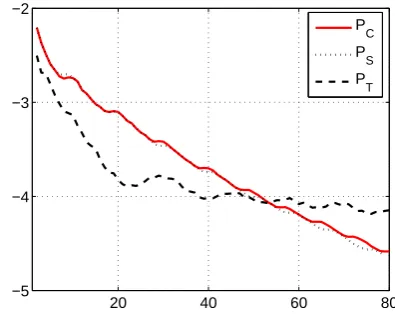
Example 3: In this example, we compare the iteration numbers of the three PMINRES preconditioners with the same bulurred image and the same parameters given in the above examples. Fig. 1 shows the convergence of the
meth-20 40 60 80
−5 −4 −3 −2
P
C
P
S
PT
Fig. 1: Iterations Number v.s. the Residual
ods. From Fig. 1, it can be seen that the preconditionerPSis the fastest one followed byPC and thenPT. It is clear that
PS needs 78 iterations to reach the tol= 1e−2,PC needs 81 while PT needs more than 100 iterations to reach the same tolerance. Note that we take the PMINRES iterations for these three preconditioners at the second iteration of the fixed point iteration method.
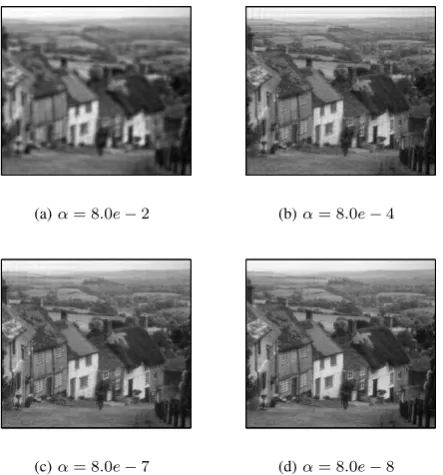
Example 4: In this example, we use the true image given in Fig. 3(a) and the blurred images given in Fig. 3(b), (it is blurred by using the kernel given in Fig. 3(f)), and we fix the preconditioner to be PT. We watch the quality of the deblurred images in each fixed point iteration. Fig. 4(a-d) show the deblurred images for iteration 1, 5, 10 and 13. The second computations carried out for different values of the regularization parametersα. Fig. 5(a-d) show the deblurred images forα= 8e−2,8e−4,8e−7,8e−8.
V. CONCLUSION
Three different preconditioners for the generalized saddle point system resulted from discretizing the Euler Lagrange equations associated with image debulrring problem are presented. In these preconditioners, three approximations for the product of the BTTB matrix and its transpose are considered. From the computations, we observe that thePS preconditioner is the most effective one followed byPC and then byPT.
ACKNOWLEDGMENT
The authors would like to thank the support provided by the Deanship of Scientific Research (DSR) at King Fahd University of Petroleum and Minerals (KFUPM) for funding this work.
REFERENCES
[1] Robert Acar and Curtis R Vogel. Analysis of bounded variation penalty methods for ill-posed problems. Inverse problems, 10(6):1217, 1994. [2] Michele Benzi, Gene H Golub, and Jorg Liesen. Numerical solution
of saddle point problems. Acta numerica, 14(1):1–137, 2005. [3] Zhi-Hao Cao. A note on constraint preconditioning for nonsymmetric
indefinite matrices. SIAM Journal on Matrix Analysis and Applica-tions, 24(1):121–125, 2002.
[image:4.595.325.523.62.219.2][5] Raymond H Chan, Tony F Chan, and Chiu-Kwong Wong. Cosine transform based preconditioners for total variation deblurring. Image Processing, IEEE Transactions on, 8(10):1472–1478, 1999. [6] Raymond H Chan and Kwok-Po Ng. Toeplitz preconditioners for
hermitian toeplitz systems. Linear algebra and its applications, 190:181–208, 1993.
[7] Raymond Hon-Fu Chan and Xiao-Qing Jin. An introduction to iterative Toeplitz solvers, volume 5. SIAM, 2007.
[8] Tony F Chan. An optimal circulant preconditioner for toeplitz systems. SIAM journal on scientific and statistical computing, 9(4):766–771, 1988.
[9] Tony F Chan, Gene H Golub, and Pep Mulet. A nonlinear primal-dual method for total variation-based image restoration. SIAM Journal on Scientific Computing, 20(6):1964–1977, 1999.
[10] Tony F Chan and Julia A Olkin. Circulant preconditioners for toeplitz-block matrices.Numerical Algorithms, 6(1):89–101, 1994.
[11] Richard E Ewing and Jian Shen. A multigrid algorithm for the cell-centered finite difference scheme. InNASA Conference Publication, pages 583–583. NASA, 1993.
[12] F Fairag Ke chen and A Al-Mahdi. Preconditioning technique for image deblurring problem.Numerical Linear Algebra, 60(1):153–167, 2014.
[13] Fu-Rong Lin. Preconditioners for block toeplitz systems based on circulant preconditioners. Numerical Algorithms, 26(4):365–379, 2001.
[14] Fu-Rong Lin and Chi-Xi Wang. BTTB preconditioners for bttb systems.Numerical Algorithms, 60(1):153–167, 2012.
[15] Malcolm F Murphy, Gene H Golub, and Andrew J Wathen. A note on preconditioning for indefinite linear systems. SIAM Journal on Scientific Computing, 21(6):1969–1972, 2000.
[16] Christopher C Paige and Michael A Saunders. Solution of sparse indefinite systems of linear equations. SIAM Journal on Numerical Analysis, 12(4):617–629, 1975.
[17] Kyle Lane Riley.Two-Level Preconditioners For Regularized Ill-Posed Problems. PhD thesis, Montana State University-Bozeman, 1999. [18] Leonid I Rudin, Stanley Osher, and Emad Fatemi. Nonlinear total
variation based noise removal algorithms. Physica D: Nonlinear Phenomena, 60(1):259–268, 1992.
[19] Stefano Serra. Preconditioning strategies for asymptotically ill-conditioned block toeplitz systems. BIT Numerical Mathematics, 34(4):579–594, 1994.
[20] Gilbert Strang. A proposal for toeplitz matrix calculations.Studies in Applied Mathematics, 74(2):171–176, 1986.
[21] Curtis R Vogel and Mary E Oman. Fast, robust total variation-based reconstruction of noisy, blurred images. Image Processing, IEEE Transactions on, 7(6):813–824, 1998.
(a) True Image (b) Blurred Image
(c) Deblured ImagePT (d) Deblured ImagePS
[image:5.595.317.540.69.405.2](e) Deblured ImagePC (f) Kernel Fig. 2: Retinal Image of a Diabetic Patient
(a) True Image 2 (b) Blurred Image
(c) Deblured ImagePT (d) Deblured ImagePS
[image:5.595.323.539.432.766.2](a) 1st Fixed Point Iteration (b) 5th Fixed Point Iteration
[image:6.595.62.284.433.671.2](c) 10th Fixed Point Iteration (d) 13th Fixed Point Iteration
Fig. 4: Fixed Point Iteration
(a)α= 8.0e−2 (b)α= 8.0e−4
(c)α= 8.0e−7 (d)α= 8.0e−8