Effects of different variants of the FASN gene
on production performance and milk fatty acid
composition in Holstein × Simmental dairy cows
Maja Mauric
1, Tomislav Masek
2, Darija Bendelja Ljoljic
3, Jozo Grbavac
4,
Kristina Starcevic
5*
1Department of Animal Husbandry, Faculty of Veterinary Medicine, University of Zagreb, Zagreb, Croatia
2Department of Animal Nutrition and Dietetics, Faculty of Veterinary Medicine, University of Zagreb, Zagreb, Croatia
3Department of Dairy Science, Faculty of Agriculture, University of Zagreb, Zagreb, Croatia 4Faculty of Agricultural and Foodbiotechnology, University of Mostar, Mostar, Bosnia and
Hercegovina
5Department of Forensic and Judicial Veterinary Medicine, Faculty of Veterinary Medicine, University of Zagreb, Zagreb, Croatia
*Corresponding author: [email protected]
Citation: Mauric M, Masek T, Ljoljic DB, Grbavac J, Starcevic K (2019): Effects of different variants of the FASN gene on production performance and milk fatty acid composition in Holstein × Simmental dairy cows. Veterinarni Medicina 64, 101–108.
Abtract: Crossbreeding of Holstein cattle with bulls of other breeds has garnered increasing interest with respect to efforts to improve performance traits and to decrease problems with fertility and health. Therefore, the objec-tive of this study was to compare the effects of the fatty acid synthase (FASN) gene on milk production traits and fatty acid composition of Simmental and first-generation Holstein × Simmental crossbred cows. A total of 105 cows (72 Simmental and 33 crossbred Holstein) were genotyped using the PCR-RFLP method and their fatty acid profiles were analysed. The crossbredHolstein cows withdiplotype TW/ARhadsignificantlyhigherfat content and yield compared to the purebred Simmental cows of the same diplotype. The Holstein × Simmental cows with the diplotype AR/AR were also characterised by significantly lower content of C16:0 and saturated fatty acids, but higher C18:1n9, monounsaturated fatty acid and monounsaturated fatty acid/saturated fatty acid con-tent compared to the same diplotype of the Simmental cattle. These results indicate that with accurate breeding plans, crossbreeding Holstein cows with Simmental bulls could be directed towards a more desirable fatty acid composition of milk and dairy products.
Keywords: milk production; fatty acid synthase; crossbreeding
Cow milk accounts for more than 80% of world milk production and is one of the most common raw materials used for processing (Barlowska et al. 2011). Consequently, milk and dairy products are commonly included in a healthy and balanced diet (Pereira 2014). However, great importance is
diseases (Markiewicz-Keszycka et al. 2013; Pereira 2014). For instance, myristic (C14:0) and palmitic (C16:0) acids are hypercholesterolaemic and raise concentrations of both low-density lipoprotein and high-density lipoprotein cholesterol (Temme et al. 1997). On the other hand, a diet high in monoun-saturated fatty acids is considered favourable, as monounsaturated fatty acids tend to lower plasma cholesterol, low-density lipoprotein and triacylg-lycerol concentrations (Haug et al. 2007). Oleic acid (C18:1n9), the monounsaturated fatty acid found in milk in the highest proportion, has a positive effect on the concentration of high-density lipoprotein and reduces the concentration of low-density lipo-protein (Temme et al. 1997; Markiewicz-Keszycka et al. 2013). Consequently, fatty acid composition has become an important trait in dairy produc-tion. Multiple genes control fatty acid composition; therefore, candidate genes involved in fat synthesis and metabolic pathways could be investigated in order to improve production and milk composition traits (Matsumoto et al. 2012). Fatty acid synthase, a multifunctional enzyme complex that catalyses the de novo biosynthesis of long-chain fatty acids, has been mentioned as a promising candidate gene for fat composition of milk and beef (Roy et al. 2006; Schennink et al. 2009; Matsumoto et al. 2012; Li et al. 2016). From 13 identified SNPs (single-nucleotide polymorphisms) on this gene, two non-synonymous SNPs with a potential link to lactation traits were found on exon 34. The A/G substitu-tion at posisubstitu-tion 5848 was predicted to cause an amino acid substitution from threonine to alanine (T1950A) and the T/C at position 5863 to result in a tryptophan to arginine substitution (W1955R; Matsumoto et al. 2012).
The breeding of cattle is managed to improve the genetic capacity of animals, and ensure that future generations will produce milk in a more efficient way. The mating of genetically similar animals has led to an increase in inbreeding effects which could result in the appearance of undesirable outcomes associated with fertility production, growth and carcass traits (Malchiodi et al. 2014). Therefore, the crossbreeding of dairy cattle has attracted consid-erable interest in response to concerns regarding fertility and health (Buckley et al. 2014; Puppel et al. 2018).
In the view of the facts mentioned above, the purpose of this study was to compare performance and milk production traits by determining allelic
frequencies and identifying the effects of the FASN gene on the fatty acid composition of Simmental and first-generation Holstein × Simmental cross-bred bulls.
MATERIAL AND METHODS
Animals.A total of 105 milk samples were tak-en from 72 Simmtak-ental and 33 crossbred Holstein (Holstein × Simmental) clinically healthy multipa-rous (2nd and 3rd lactation) cows from two private
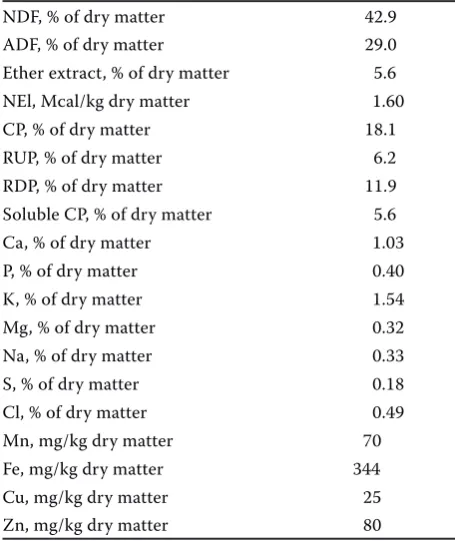
[image:2.595.304.532.427.698.2]farms in Croatia. Information about milk produc-tion traits (i.e. milk yield, fat yield, protein yield, fat content and protein content over 305 days) were provided by the Croatian Agricultural Agency, following the regulations of the International Committee for Animal Recording (ICAR 2011). All cows were fed a basal total mixed ratio (TMR) diet (Table 1), consisting of haylage and corn concen-trate and had constant access to drinking water. Dry matter intake was not significantly different among
Table 1. Chemical composition of the experimental total mixed ratio diet
NDF, % of dry matter 42.9
ADF, % of dry matter 29.0
Ether extract, % of dry matter 5.6
NEl, Mcal/kg dry matter 1.60
CP, % of dry matter 18.1
RUP, % of dry matter 6.2
RDP, % of dry matter 11.9
Soluble CP, % of dry matter 5.6
Ca, % of dry matter 1.03
P, % of dry matter 0.40
K, % of dry matter 1.54
Mg, % of dry matter 0.32
Na, % of dry matter 0.33
S, % of dry matter 0.18
Cl, % of dry matter 0.49
Mn, mg/kg dry matter 70
Fe, mg/kg dry matter 344
Cu, mg/kg dry matter 25
Zn, mg/kg dry matter 80
C18:0 – stearic acid;
MUFA – monounsaturated fatty acid; n3 – n3 fatty acids;
n6 – n6 fatty acids.
C14:0 + C16:0 + C18:0
TI =
0.5 × MUFA + 0.5 × n6 + 3 × n3 + n3/n6 (2)
where:
TI – thrombogenicity index; C14:0 – myristic acid;
C16:0 – palmitic acid; C18:0 – stearic acid;
MUFA – monounsaturated fatty acid; n3 – n3 fatty acids;
n6 – n6 fatty acids.
Statistical analysis. Calculation of allele and genotype frequencies, polymorphism deviation from Hardy-Weinberg equilibrium and population genetic indices (observed heterozygosity – HO, ex-pected heterozygosity – HE, effective allele number – NE and fixation index – FIS) were performed us-ing POPGENE32 software, version 1.32 (Yeh et al. 2000). Polymorphism information content (PIC) was calculated according to Botstein et al. (1980). Statistical analyses were performed using Statistica v. 13 (TIBCO Software Inc 2017, USA). The model included breed and genotypes of the FASN SNP as fixed effects. Data were assessed for significance using analysis of variance (ANOVA), followed by Tukey’s test, in order to determine statistical dif-ferences between the group means. Significance was determined at P < 0.05.
RESULTS
The allelic frequencies, genotypic frequencies and Hardy-Weinberg equilibrium of the FASN gene experimental cows. They were milked twice a day.
One morning milk sample per cow was collected for DNA isolation and fatty acid analysis.
Genotyping.DNA was isolated from milk samples (350 μl) using the PathoProof™ DNA Extraction Kit (Thermo Fisher Scientific, Finland), following the protocol instructions as described in Thermo Scientific (2015). The primers used in amplifica-tion and the PCR reacamplifica-tion were used according to Matsumoto et al. (2012). The PCR products (5 µl) were digested with Hha I (T1950A) and Nci I (W1955R) restriction enzymes following the suppli-er’s manual. The resulting fragments for both SNPs (T1950A – allele A: one uncut fragment of 336 bp, allele G: two fragments of 262 and 74 bp; W1955R – allele T: one uncut fragment of 336 bp, allele C: two fragments of 247 and 89 bp) were separated on a 3% agarose gel (3 hours/140 V). As the genotypes of T1950A corresponded to those of W1955R, as earlier reported by Matsumoto et al. (2012), they were subsequently analysed as diplotypes (TW/TW, TW/AR, AR/AR).
Milk production parameters and fatty acid composition analysis.Milk quantity, fat and pro-tein content and fatty acid composition were deter-mined. Milk fat extraction and fatty acid analysis were undertaken according to Masek et al. (2014). The composition of each fatty acid was expressed as a percentage of the total fatty acids.
Atherogenicity and thrombogenicity indices. Indices of atherogenicity and thrombogenicity were calculated using the following equations (Ulbright and Southgate 1991):
4 × C14:0 + C16:0 + C18:0 AI =
MUFA + n6 + n3
(1)
where:
[image:3.595.64.534.662.757.2]AI – atherogenicity index; C14:0 – myristic acid; C16:0 – palmitic acid;
Table 2. Allelic frequencies, genotypic frequencies and Hardy-Weinberg equilibrium of the FASN gene
Breed Haplotype Haplotype frequency Diplotype n Diplotype frequency χ2 P-value
Simmental TWAR 0.150.85 TW/TWTW/AR 201 0.010.28 0.32 0.57
AR/AR 51 0.71
Holstein Simmental crossbreed TWAR 0.140.86 TW/TWTW/AR 09 0.000.27 0.72 0.40
are presented in Table 2. The AR haplotype (allele G of SNP T1950A) frequencies observed in this study were 0.85 in Simmental cattle and 0.86 in Holstein Simmental crossbreeds. The most frequently found diplotype was AR/AR in both Simmental (0.71) and crossbred Holstein cattle (0.73), whereas diplo-type TW/TW was not found in the crossbreeds (Table 2). Hence, the frequencies of TW haplotype were low in both groups.
The distribution of genotypes was in Hardy-Weinberg equilibrium in both Simmental (χ2 = 0.32,
P = 0.57) and crossbred cattle (χ2 = 0.72, P = 0.40;
Table 2). In the examined groups, a very slight ex-cess of heterozygosity was found (FIS = –0.07 in Simmental cattle and –0.16 in crossbreds; Table 3). This result was also supported by the values of ef-fective allele number(NE; 1.35 in Simmental cattle and 1.31 in crossbreds; Table 3); in fact, there was an inverse relationship between the value of NE and the homozygosity of the studied alleles. According to the classification of PIC (PIC value < 0.25 – low polymorphism; 0.25 < PIC value < 0.50 – interme-diate polymorphism; and PIC value > 0.50 – high polymorphism), the studied locus possessed low genetic diversity (Table 3).
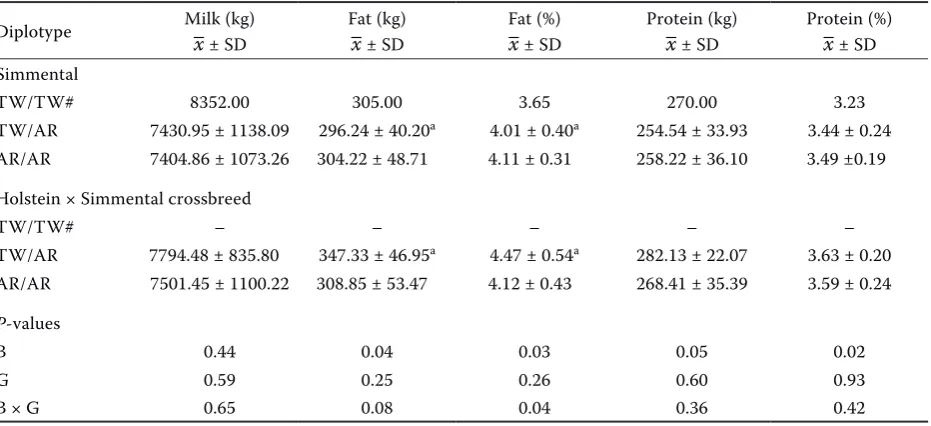
The effects of the SNPs on milk production traits were analysed and are presented in Table 4. The breed had a significant effect on both fat content and yield (P = 0.03 and P = 0.04, respectively). Also,
it was found that breed and genotype interaction had a significant effect on fat content (P = 0.04). The Holstein Simmental crossbred cows with diplo-type TW/AR had significantly higher fat content and yield compared to the Simmental cows of the same diplotype (P < 0.05).
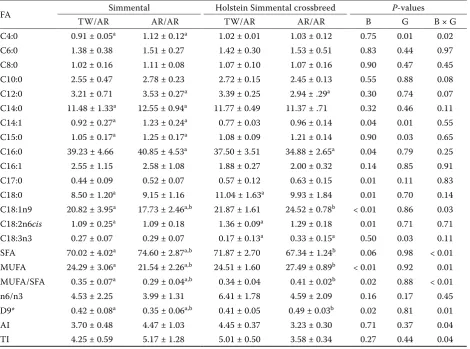
Associations between the studied T1950A and W1955R FASN polymorphisms and fatty acid com-position in Holstein × Simmental crossbreeds are presented in Table 5. Individual fatty acids were significantly influenced by genotype and breed. The content of hypercholesteraemic fatty acid SFA (C14:0 and C16:0) was found to be significantly lower in Holstein crossbred cows. The Holstein crossbred cows with the AR/AR diplotype had a significantly lower content of C16:0 fatty acid compared to the Simmental cattle with the same diplotype (P < 0.05). Also, Holstein crossbred cows with the AR/AR diplotype had lower saturated Table 3. Genetic indices
Breed HO HE NE FIS PIC
Simmental 0.28 0.26 1.35 –0.07 0.22
Crossbreed 0.27 0.24 1.31 –0.16 0.24
[image:4.595.66.532.513.726.2]FIS = fixation index; HE = expected heterozygosity; HO = observed heterozygosity; NE = effective allele number; PIC = polymorphism information content
Table 4. Effect of T1950A and W1955R diplotypes on milk (305d), fat and protein yield and fat and protein content in Simmental cattle and Holstein Simmental crossbreeds. Values are expressed as mean ± standard deviation
Diplotype Milk (kg)–x ± SD Fat (kg)–x ± SD Fat (%)–x ± SD Protein (kg)–x ± SD Protein (%)–x ± SD
Simmental
TW/TW# 8352.00 305.00 3.65 270.00 3.23
TW/AR 7430.95 ± 1138.09 296.24 ± 40.20a 4.01 ± 0.40a 254.54 ± 33.93 3.44 ± 0.24
AR/AR 7404.86 ± 1073.26 304.22 ± 48.71 4.11 ± 0.31 258.22 ± 36.10 3.49 ±0.19
Holstein × Simmental crossbreed
TW/TW# – – – – –
TW/AR 7794.48 ± 835.80 347.33 ± 46.95a 4.47 ± 0.54a 282.13 ± 22.07 3.63 ± 0.20 AR/AR 7501.45 ± 1100.22 308.85 ± 53.47 4.12 ± 0.43 268.41 ± 35.39 3.59 ± 0.24 P-values
B 0.44 0.04 0.03 0.05 0.02
G 0.59 0.25 0.26 0.60 0.93
B × G 0.65 0.08 0.04 0.36 0.42
B = breed; B × G = breed × genotype; G = genotype
fatty acid and higher C18:1n9 and monounsatu-rated fatty acid than Simmental cows with the same diplotype, and consequently, the AR/AR diplotype showed a higher monounsaturated fatty acid/satu-rated fatty acid ratio. In contrast, Simmental cows with the TW/AR diplotype had higher C18:1n9 and lower saturated fatty acid content than cows with the AR/AR diplotype. These results show the significant interaction of breed and genotype for the studied traits (P-values of < 0.01, 0.03, 0.01 and < 0.01, respectively). In addition, the content of lin-oleic acid (C18:2n6cis) was significantly influenced by breed (P < 0.05). The Holstein crossbred cows had significantly higher values for linoleic acid in comparison to purebred Simmental cattle. The genotype had no statistically significant effect on linoleic acid, in contra to linolenic acid (C18:3n3)
[image:5.595.64.535.365.714.2]content, which was influenced by genotype but not by breed (P = 0.03). However, there were no sig-nificant differences between the examined groups. The D9 desaturation index was significantly influ-enced by breed (P = 0.02) and by the interaction of breed and genotype (P = 0.01). The Holstein crossbred cows with the AR/AR diplotype had a significantly higher D9 desaturation index com-pared to the Simmental cattle with the same diplo-type (P < 0.05). Also, within the Simmental breed, cows with the TW/AR diplotype had a significantly higher D9 desaturation index compared to the cows with the AR/AR diplotype. Regarding the values of atherogenicity index and TI, a significant influence of genotype and breed was observed (P < 0.05). The crossbred Holstein × Simmental cows showed lower atherogenicity and thrombogenicity index
Table 5. Effect of T1950A and W1955R diplotypes on fatty acid composition in Simmental cattle and Holstein Sim-mental crossbreeds. Values are expressed as mean ± standard deviation
FA Simmental Holstein Simmental crossbreed P-values
TW/AR AR/AR TW/AR AR/AR B G B × G
C4:0 0.91 ± 0.05a 1.12 ± 0.12a 1.02 ± 0.01 1.03 ± 0.12 0.75 0.01 0.02
C6:0 1.38 ± 0.38 1.51 ± 0.27 1.42 ± 0.30 1.53 ± 0.51 0.83 0.44 0.97
C8:0 1.02 ± 0.16 1.11 ± 0.08 1.07 ± 0.10 1.07 ± 0.16 0.90 0.47 0.45
C10:0 2.55 ± 0.47 2.78 ± 0.23 2.72 ± 0.15 2.45 ± 0.13 0.55 0.88 0.08
C12:0 3.21 ± 0.71 3.53 ± 0.27a 3.39 ± 0.25 2.94 ± .29a 0.30 0.74 0.07
C14:0 11.48 ± 1.33a 12.55 ± 0.94a 11.77 ± 0.49 11.37 ± .71 0.32 0.46 0.11
C14:1 0.92 ± 0.27a 1.23 ± 0.24a 0.77 ± 0.03 0.96 ± 0.14 0.04 0.01 0.55
C15:0 1.05 ± 0.17a 1.25 ± 0.17a 1.08 ± 0.09 1.21 ± 0.14 0.90 0.03 0.65
C16:0 39.23 ± 4.66 40.85 ± 4.53a 37.50 ± 3.51 34.88 ± 2.65a 0.04 0.79 0.25
C16:1 2.55 ± 1.15 2.58 ± 1.08 1.88 ± 0.27 2.00 ± 0.32 0.14 0.85 0.91
C17:0 0.44 ± 0.09 0.52 ± 0.07 0.57 ± 0.12 0.63 ± 0.15 0.01 0.11 0.83
C18:0 8.50 ± 1.20a 9.15 ± 1.16 11.04 ± 1.63a 9.93 ± 1.84 0.01 0.70 0.14
C18:1n9 20.82 ± 3.95a 17.73 ± 2.46a,b 21.87 ± 1.61 24.52 ± 0.78b < 0.01 0.86 0.03 C18:2n6cis 1.09 ± 0.25a 1.09 ± 0.18 1.36 ± 0.09a 1.29 ± 0.18 0.01 0.71 0.71
C18:3n3 0.27 ± 0.07 0.29 ± 0.07 0.17 ± 0.13a 0.33 ± 0.15a 0.50 0.03 0.11
SFA 70.02 ± 4.02a 74.60 ± 2.87a,b 71.87 ± 2.70 67.34 ± 1.24b 0.06 0.98 < 0.01 MUFA 24.29 ± 3.06a 21.54 ± 2.26a,b 24.51 ± 1.60 27.49 ± 0.89b < 0.01 0.92 0.01 MUFA/SFA 0.35 ± 0.07a 0.29 ± 0.04a,b 0.34 ± 0.04 0.41 ± 0.02b 0.02 0.88 < 0.01
n6/n3 4.53 ± 2.25 3.99 ± 1.31 6.41 ± 1.78 4.59 ± 2.09 0.16 0.17 0.45
D9* 0.42 ± 0.08a 0.35 ± 0.06a,b 0.41 ± 0.05 0.49 ± 0.03b 0.02 0.81 0.01
AI 3.70 ± 0.48 4.47 ± 1.03 4.45 ± 0.37 3.23 ± 0.30 0.71 0.37 0.04
TI 4.25 ± 0.59 5.17 ± 1.28 5.01 ± 0.50 3.58 ± 0.34 0.27 0.44 0.04
for the AR/AR genotype compared with purebred Simmental cattle.
DISCUSSION
There is not a large amount of data on the in-fluence of DNA polymorphisms on milk fatty acid composition, whether in purebred or crossbred cat-tle. Unlike the data on milk fat percentage and fat yield, data on milk fatty acid composition are not collected routinely or recorded. Therefore, in our study we explored breed and genotypic frequencies for the FASN gene and their influence on the fatty acid composition of milk in purebred Simmental and crossbred Holstein × Simmental cows. Both FASN mutations observed in this study are non-synonymous SNPs, leading to amino acid changes (T1950A causing a threonine to alanine and substi-tution and W1955R causing a tryptophan to arginine substitution). Genotypes of T1950A corresponded to those of W1955R in both Simmental cattle and Holstein Simmental crossbreeds. As these results confirm those already reported by Matsumoto et al. (2012) in Holstein cattle, and by Abe et al. (2009) in Japanese Black cattle, it may be suggested that these SNPs are completely linked. In our research, AR was the more frequent haplotype in both groups. Consequently, the TW haplotype frequencies were low in both groups. Similar results for the TW hap-lotype were reported by Abe et al. (2009) in Holstein (0.171), Angus (0.015) and Hereford (0.071) cattle, while the same authors found a frequency of 0.667 in Japanese Black. The same allele was also found in a frequency of 0.37 (Ciecierska et al. 2013) in the Holstein breed. This wide range of frequencies indi-cates the great genetic variability of the mentioned SNP in different breeds (Ciecierska et al. 2013).
Regarding the fat content and yield observed in this study, it was evident that breed and interac-tion of breed and genotype had a significant effect on both traits. The TW/AR diplotype of Holstein crossbreed cows had significantly higher fat content. These results are in accordance with Puppel et al. (2018) who reported that Simmental and Holstein crossbreed cattle had higher concentrations of pro-tein and fat in milk compared with Holspro-tein cattle. A higher protein content and a higher milk yield was reported by Dechow et al. (2007) for crossbreeds of Holstein and Brown Swiss cattle compared with Holstein cows. In contrast, Matsumoto et al. (2012)
reported that the T1950A and W1955R mutations had a significant impact on fat content in Holstein cattle and that the AR/AR diplotype had a higher fat content than the TW/AR diplotype (TW/TW diplotype was excluded from analysis due to an in-sufficient number of samples). Similar results were reported by Roy et al. (2006). The authors found an association of allele A (from SNP T1950A, re-sulting in alanine) with increased milk fat content, while animals homozygous for the threonine variant (genotype T/T) were found only in the low-fat group and the allele frequency was low (0.03). In contrast to these findings, Ciecierska et al. (2013) found that first lactation cows with the T/T genotype had high-er milk, fat and protein yield than cows with the T/A genotype. From all this, it may be concluded that the association of this FASN SNP with milk production traits varies depending on breed and population.
our study, the Δ9 desaturation index was influenced by breed and interaction between breed and geno-type, but not by genotype. In accordance with this, Schennink et al. (2009) found no influence of the FASN gene on the desaturation indices at all, while Matsumoto et al. (2012) reported that they found that the FASN gene influenced the C14 desatura-tion index, but not the C16 and C18 desaturadesatura-tion indices. Dairy products with lower atherogenicity and thrombogenicity index represent potentially healthier food for humans (Puppel et al. 2012). Lower atherogenicity and thrombogenicity index in the AR/AR genotype was observed in crossbred Holstein × Simmental cows in comparison with purebred Simmental cattle.
In this study, fatty acid composition and milk production traits were assessed for the T1950A and W1955R FASN polymorphisms in crossbred Holstein × Simmental cattle. Holstein crossbred cows with the AR/AR diplotype had lower saturated fatty acid and higher C18:1n9, C18:2n6cis, mono-unsaturated fatty acid and monomono-unsaturated fatty acid/saturated fatty ratios than Simmental cows with the same diplotype. With the proviso that ad-ditional research is needed, the results indicate that the F1 generation of Holstein × Simental cross-breeds expressed better production traits, and this could be useful information for cattle breeding and for the production of milk and dairy products with more desirable fatty acid compositions.
REFERENCES
Abe T, Saburi J, Hasebe H, Nakagawa T, Misumi S, Nade T, Nakajima H, Shoji N, Kobayashi M, Kobayashi E (2009): Novel mutations of the FASN gene and their effect on fatty acid composition in Japanese Black beef. Biochem-ical Genetics 47, 397–411.
Barlowska J, Szwajkowska M, Litwinczuk Z, Krol J (2011): Nutritional value and technological suitability of milk from various animal species used for dairy production. Comprehensive Reviews in Food Science and Food Safety 10, 291–302.
Botstein D, White RL, Skolnick M, Davis RW (1980): Con-struction of a genetic linkage map in man using restric-tion fragment length polymorphisms. The American Journal of Human Genetics 32, 314−331.
Buckley F, Lopez-Villalobos N, Heins BJ (2014): Crossbreed-ing: implications for dairy cow fertility and survival. Animal 8, 122–133.
Ciecierska D, Frost A, Grzesiak W, Proskura WS, Dybus A, Olszewski A (2013): The influence of fatty acid synthase polymorphism on milk production traits in Polish Hol-stein-Friesian cattle. Journal of Animal and Plant Sciences 23, 376–379.
Dechow CD, Rogers GW, Cooper JB, Phelps MI, Mosholder AL (2007): Milk, fat, protein, somatic cell score, and days open among Holstein, Brown Swiss, and their crosses. Journal of Dairy Science 90, 3542–3549.
Haug A, Hostmark AT, Harstad OM (2007): Bovine milk in human nutrition – a review. Lipids in Health and Disease 6, doi:10.1186/1476-511X-6-25.
ICAR – International Committee for Animal Recording (2011): Guidelines approved by the General Assembly held in Riga, Latvia. 229–256.
Li C, Sun D, Zhang S, Alim MA, Zhang Q, Li Y, Liu L (2016): Genetic effects of FASN, PPARGC1A, ABCG2 and IGF1 revealing the association with milk fatty acids in a Chi-nese Holstein cattle population based on a post genome-wide association study. BMC Genetics 17, doi: 10.1186/ s12863-016-0418-x.
Malchiodi F, Cecchinato A, Penasa M, Cipolat-Gotet C, Bittante G (2014): Milk quality, coagulation properties, and curd firmness modeling of purebred Holsteins and first- and second-generation crossbred cows from Swed-ish Red, Montbeliarde, and Brown Swiss bulls. Journal of Dairy Science 97, 4530–4541.
Markiewicz-Keszycka M, Czyzak-Runowska G, Lipinska P, Wojtowski J (2013): Fatty acid profile of milk a review. Bulletin of Veterinary Institute in Pulawy 57, 135–139. Masek T, Krstulovic L, Brozic D, Vranic M, Mauric M,
Ba-jic M, Starcevic K (2014): Cow colostrum and early milk enriched with eicosapentaenoic and docosahexaenoic fatty acid. European Food Research and Technology 238, 635–640.
Matsumoto H, Inada S, Kobayashi E, Abe T, Hasebe H, Sasazaki S, Oyama K, Mannen H (2012): Identification of SNPs in the FASN gene and their effect on fatty acid milk composition in Holstein cattle. Livestock Science 144, 281–284.
Morris CA, Cullen NG, Glass BC, Hyndman DL, Manley TR, Hickey SM, McEwan JC, Pitchford WS, Bottema CDK, Lee MAH (2007): Fatty acid synthase effects on bovine adipose fat and milk fat. Mammalian Genome 18, 64–74.
Palladino RA, Buckley F, Prendiville R, Murphy JJ, Callan J, Kenny DA (2010): A comparison between Holstein-Friesian and Jersey dairy cows and their F1 hybrid on milk fatty acid composition under grazing conditions. Journal of Dairy Science 93, 2176–2184.
Puppel K, Nalecz-Tarwacka T, Kuczynska B, Golebiewski M, Grodzki H (2012): Influence of combined supplemen-tation of cows’ diet with linseed and fish oil on the throm-bogenic and atherogenic indicators of milk fat. Animal Science Papers and Reports 30, 317–328.
Puppel K, Bogusz E, Golebiewski M, Nalecz-Tarwacka T, Kuczynska B, Slosarz J, Budzinski A, Solarczyk P, Kunow-ska-Slosarz M, Przysucha T (2018): Effect of dairy cow crossbreeding on selected performance traits and quality of milk in first generation crossbreds. Journal of Food Science 83, 229–236.
Roy R, Ordovas L, Zaragoza P, Romero A, Moreno C, Altar-riba J, Rodellar C (2006): Association of polymorphisms in the bovine FASN gene with milk-fat content. Animal Genetics 37, 215–218.
Sasanti B (2014): The effect of Fleckvieh crossbreeding in dairy cattle on the conjugated linoleic acid content of milk produced in intensive and pasture-fed systems. [MSc Thesis.] Cape Peninsula University of Technology, South Africa.
Schennink A, Bovenhuis H, Leon-Kloosterziel KM, van Arendonk JAM, Visker MHPW (2009): Effect of polymor-phisms in the FASN, OLR1, PPARGC1A, PRL and STAT5
genes on bovine milk-fat composition. Animal Genetics 40, 909–916.
Temme EHM, Menskink RP, Hornstra G (1997): Effects of medium chain fatty acids (MCFA), myristic, and oleic acid on seru lipoproteins in healthy subjects. Journal of Lipid Research 38, 1746–1754.
Thermo Scientific (2015): Protocol book – Thermo Scientific PathoProof Complete-16 kit Intructions for Use. Thermo Fisher Scinetific Inc., Massachusetts. Available at tools. thermofisher.com/content/sfs/manuals/D14910-02-Path-oProof%20Complete-16%20IFU.pdf
Ulbright TLV, Southgate DAT (1991): Coronary heart dis-ease: seven dietary factors. Lancet 338, 985–992. White SL, Bertrand JA, Wade MR, Washburn SP, Green JT,
Jenkins TC (2001): Comparison of fatty acid content of milk from Jersey and Holstein cows consuming pasture or a total mixed ration. Journal of Dairy Science 84, 2295–2301.
Yeh FC, Yang R, Boyle TJ, Ye Z, Xiyan JM (2000): POPGENE 32, Microsoft Window-based Freeware for Population Genetic Analysis, Version 1.32. Molecular Biology and Biotechnology Centre, University of Alberta, Canada.