The photosynthetic capacity of maize (Zea mays L.) is subject to a wide range of external abiotic fac-tors (water, temperature, sunlight, etc.) and in-ternal biotic (photosynthetic enzymes, genotype, molecular mechanism, etc.) factors (Kakani et al. 2003, Arena et al. 2011, Pengelly et al. 2011, Benesova et al. 2012, Sharwood et al. 2014). The abiotic factors are the initial drivers in controlling maize photosynthetic process; water, sunlight and temperature are the three main abiotic factors.
It is recognised that photosynthetic inhibition (significant decline in photosynthesis) often oc-curs due to drought stress because of stomatal closure and damage to the photosynthetic
ap-paratus (Lawlor and Uprety 1993, Flexas et al. 2012). Lack of sunlight (solar radiation) usually causes photoinhibition (light-induced decline in photochemical activity) (Aro et al. 1993, Terashima et al. 1994, Sharwood et al. 2014). It is reported that photosynthesis is significantly inhibited at both low and high temperatures, which usually resulted in an impaired photosynthetic apparatus and a depressed photosynthetic capacity (Janda et al. 1998, Crafts-Brandner and Salvucci 2002, Naidu and Long 2004, Ben-Asher et al. 2008, Suwa et al. 2010).
Although the single effects of sunlight, tem-perature and water on maize photosynthesis are
Variable photosynthetic sensitivity of maize (
Zea mays
L.)
to sunlight and temperature during drought development
process
Yu-He JI, Guang-Sheng ZHOU*, Xue-Yan MA, Qiu-Ling WANG, Tao LIU
State Key Laboratory of Severe Weather, Chinese Academy of Meteorological Science,
Beijing, P.R. China
*Corresponding author: [email protected]
ABSTRACT
Ji Y.-H., Zhou G.-S., Ma X.-Y., Wang Q.-L., Liu T. (2017): Variable photosynthetic sensitivity of maize (Zea mays L.) to sunlight and temperature during drought development process. Plant Soil Environ., 63: 505–511.
The complex interaction process of the abiotic factors (sunlight, air temperature and soil water) in regulating maize (Zea mays L.) photosynthesis has not been fully understood. Our field experiment explored the changed sensitivity (or role) of the abiotic factors in regulating maize photosynthesis under a drought development process. The exper-iment established a scenario with a long-term drought and an instantaneous cloud cover. The results revealed that long-term drought stress causes the sensitivity (or role) of sunlight and temperature exchanged in regulating maize photosynthesis. The maize photosynthesis was more sensitive to instantaneous sunlight rather than temperature in the absence of drought. However, a diminishing photosynthetic sensitivity to sunlight but an increasing photosyn-thetic sensitivity to temperature was observed with drought development process. The variable photosynphotosyn-thetic sen-sitivity indicated that the roles of temperature and sunlight in regulating maize photosynthesis were exchanged, so it is expected that higher photosynthetic rate could be achieved by adjusting temperature rather than sunlight after severe drought. Nevertheless, further studies are needed to provide more evidence and mechanism explanations.
Keywords: shading experiment; photosynthetic inhibition; environment stress; soil moisture; photoinhibition
fairly well understood, the complex interaction process of multiple abiotic factors in regulating photosynthesis has not been understood fully, especially under natural conditions. The main aims of the paper are to (1) clarify the interaction process of abiotic factors (sunlight, temperature and water) in regulating maize photosynthesis by a field experiment; (2) identify the variable photosynthetic sensitivity (or role) of sunlight and temperature during drought development process, so as to select a way to enhance photosynthesis when there is no way to avoid drought.
MATERIAL AND METHODS
Experimental site. The experimental site
was located at the Gucheng Ecological and Agrometeorological Experiment Station (115°48'E, 39°08'N), North China, where wheat (Triticum aestivum L.)-maize rotations are typically prac-ticed. The maize is often sown in late June, and grain is harvested in late September. Annual mean temperature is 12.2°C. Soil texture is loam, and the average field water capacity is 23.4%. The total nitrogen, total phosphorus and total potassium at 0–30 cm soil depth are 0.9753 g/kg, 1.0196 g/kg and 17.2624 g/kg, respectively. Annual precipita-tion is sufficient for maize growth in normal years, because annual mean precipitation is 475.4 mm and 70% of the precipitation occurs during the growing season (July–September) (Ren et al. 2010). However, severe drought disasters often occur in some years due to the unstable monsoon climate (Xue et al. 2014).
Experimental design. Field experiment was
designed to simulate natural environments. To
create a continuous drought, a large electric mov-able shelter was used to shield the maize from natural precipitation. The electric movable shelter would be used to cover the maize if it is rainy, and then the electric movable shelter would be moved away for the maize to receive sunlight if there is not rain. Twelve rectangular pools of 2 × 4 m were established with cement walls of 3 m depth to stop soil water flow (Figure 1). Prior to cultivating maize, all the pools ensure the same soil moisture and nutrient conditions. Maize was sown on 24 June, 2014. Three pools were assigned to no drought (rain-fed condition), and nine pools were assigned to a continuous drought by shielding from natural rainfall after seedling establishment.
[image:2.595.307.533.548.704.2] [image:2.595.65.293.596.716.2]To establish the scenario with instantaneous cloud cover, an artificial shading experiment was conducted between 8:00 and 16:00 on sunny days at three growing stages (8 August at jointing stage, 21 August at silking stage, 4 September at grain-filling stage) in 2014. White mesh fabric (allowing some sunlight transmission) was used to obtain different levels of sunlight. After one layer of the mesh fabric was added over the crop, measure-ment with portable gas exchange system (LI-6400, Li-cor, Lincoln, USA) was taken immediately to obtain photosynthetic active radiation (PARi), air temperature (Tair) and net photosynthetic rate (Pn) values of the fully expanded maize leaves (Figure 2). Adding another layer of the mesh fabric, measurement was taken immediately again. This process was continued until eight measurements were obtained with eight layers of the mesh fabric over the crop. The eight measurements make up a
Figure 1. 2 m × 4 m pools cultivating maize, and the electric movable shelter shielding the maize from natu-ral precipitation
round of measurement. Another round was taken after approximately a half an hour interval for the same maize leaf.
RESULTS
The variable photosynthetic sensitivity of
maize to sunlight and temperature. In the absence
of drought, it was observed that the correlation between maize photosynthesis (net photosynthetic rate) and sunlight (photosynthetic active radia-tion) was significant, with Pearson’s correlation coefficients of 0.787 (P < 0.01), 0.683 (P < 0.01) and 0.778 (P < 0.01) at the stages of jointing, silk-ing and grain-fillsilk-ing, respectively. The significant correlations suggested that maize photosynthesis is highly sensitive to sunlight for the normal maize without drought stress. However, in the case of drought stress, the Pearson’s correlation coeffi-cients between maize photosynthesis and sunlight were 0.359 (P < 0.01), 0.276 (P < 0.01) and 0.239 (P < 0.05) at the stages of jointing, silking and grain-filling, respectively (Table 1). The less significant correlations indicated a lower photosynthetic sensitivity to sunlight under drought stress.
In the absence of drought, only a slightly signifi-cant correlation between maize photosynthesis and air temperature was observed in the early growing season (jointing stage), with a Pearson’s correla-tion coefficient of 0.429 (P < 0.01). No significant correlation was observed during the later growing season (silking and grain-filling stages). Therefore, the maize photosynthesis has no significant sensi-tivity to air temperature in the absence of drought, generally. However, in the case of drought stress,
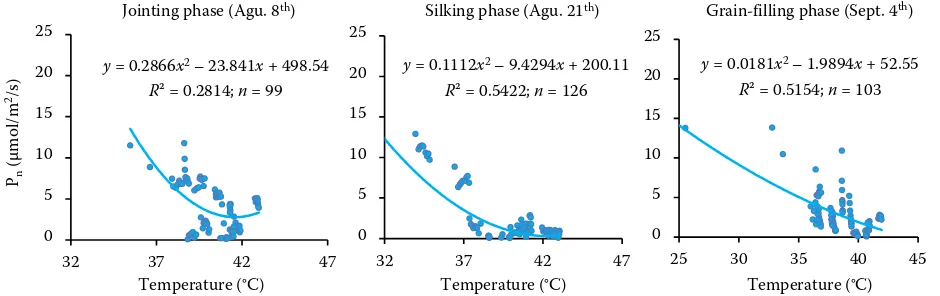
the maize photosynthesis became sensitive to air temperature with the development of drought. Under a slight drought stress (0–30 cm topsoil moisture 9.5%), a slight correlation between maize photosynthesis and air temperature was observed, with a Pearson’s correlation coefficient of 0.387 (P < 0.01) in the early growing season (jointing stage). After a severe drought (0–30 cm topsoil moisture 6.2%), the Pearson’s correlation coef-ficient increased to 0.665 (P < 0.01) at the silking stage, and then increased to 0.707 (P < 0.01) at the grain-filling stage after the worst drought (0–30 cm topsoil moisture 5.4%) (Table 1).
In general, drought caused a diminishing photo-synthetic sensitivity to sunlight but an increasing photosynthetic sensitivity to temperature with the development of drought.
Changed process of maize photosynthetic sensitivity to sunlight with increased drought
stress. To reveal the changed process of maize
photosynthetic sensitivity to sunlight, non-linear regression between photosynthesis and sunlight was examined. The regression curves described a clearly increasing photosynthesis with increasing sunlight in the absence of drought stress. Moreover, the higher fitting accuracy (R2 = 0.617, R2 = 0.6305
and R2 = 0.6188 at the jointing, silking and
grain-filling stages, respectively) showed a clear func-tional relationship between photosynthesis and sunlight (Figure 3). The results confirmed the significant photosynthetic sensitivity to sunlight, indicating the important role of sunlight in con-trolling maize photosynthesis in the absence of drought.
Under drought stress (0–30 cm topsoil mois-ture 0.54–9.5%), no significant correlations
be-Table 1. Pearson’s correlation between net photosynthetic rate (Pn) and air temperature (Tair) and photosynthetic active radiation (PARi) under drought and no drought conditions at the three growing stages of the maize. Top-soil (0–30 cm) moisture was 9.5, 6.2 and 5.4% at jointing stage, silking stage and grain-filling stage, respectively
Jointing stage (2014-8-8) Silking stage (2014-8-21) Grain-filling stage (2014-9-4) Pearson’s
correlation (2-tailed)sig. N correlationPearson’s (2-tailed)sig. N correlationPearson’s (2-tailed)sig. N
No drought Tair 0.429** P < 0.01 99 −0.094 P = 0.296 126 0.127 P = 0.202 103
PARi 0.787** P < 0.01 99 0.683** P < 0.01 126 0.778** P < 0.01 103
Drought Tair −0.387** P < 0.01 99 −0.665** P < 0.01 127 −0.707** P < 0.01 103
PARi −0.359** P < 0.01 99 0.276** P < 0.01 127 −0.239* P < 0.05 103
[image:3.595.64.532.630.741.2]tween photosynthesis and sunlight were observed by the lower fitting accuracy of the regression curves (R2 = 0.2302, R2 = 0.155 and R2 = 0.2058 at the jointing,
silking and grain-filling stages, respectively) (Figure 4). Therefore, the maize photosynthesis became less sensitive to sunlight under drought stress.
Generally, a clearly increasing photosynthesis was observed with increasing sunlight, indicating significant photosynthetic sensitivity to sunlight in the absence of drought. However, the significant photosynthetic sensitivity was no longer apparent in the case of severe drought.
Changed process of maize photosynthetic sen-sitivity to temperature with increased drought
stress. In the absence of drought, the non-linear
regression curves showed lower fitting accuracy (R2 = 0.177, R2 = 0.0234 and R2 = 0.1538 at the
jointing, silking and grain-filling stages, respec-tively) between photosynthesis and air temperature (Figure 5). No significant functional relationship
between photosynthesis and air temperature was observed in the absence of drought.
It is interesting that significant functional re-lationship between photosynthesis and air tem-perature was observed evidently under severe drought stress, because the non-linear regression curves exhibited higher fitting accuracy (slight drought R2 = 0.2814, severe drought R2 = 0.5422 and R2 = 0.5154 at the jointing, silking and grain-filling
stages, respectively) (Figure 6). The results indi-cated that the maize photosynthesis became more sensitive to temperature due to drought.
In summary, there was no significant functional relationship between photosynthesis and tempera-ture in the absence of drought, but a significant functional relationship between photosynthesis and temperature was observed in the case of drought. Therefore, the photosynthetic sensitivity (role) of temperature was enhanced with the development of drought.
y = 9E–06x2 + 0.0075x + 9.6274 R² = 0.617; n = 99 0 5 10 15 20 25 30
0 500 1000 1500
Pn (µ m ol /m 2/s)
PARi (µmol/m2/s) Jointing phase (Agu. 8th)
y = –3E–05x2 + 0.0598x – 8.4489 R² = 0.6305; n = 126
0 5 10 15 20 25 30 35
0 500 1000 1500
PARi (µmol/m2/s) Silking phase (Agu. 21th)
y = –3E–06x2 + 0.0173x + 1.976 R² = 0.6118; n = 103
0 5 10 15 20 25 30 35
0 1000 2000
[image:4.595.66.530.99.238.2]PARi (µmol/m2/s) Grain-filling phase (Sept. 4th)
Figure 3. In the absence of drought, regression curves between photosynthesis (net photosynthetic rate, Pn) and sun-light (photosynthetic active radiation, PARi) revealed the higher fitting accuracy (R2 > 0.6118), indicating a significant
photosynthetic sensitivity to sunlight at the three growing stages of the maize
y = 2E–05x2 – 0.0302x + 16.101 R² = 0.2302; n = 99
–5 0 5 10 15 20 25
0 500 1000 1500
Pn (µ m ol /m 2/s )
PARi (µmol/m2/s) Jointing phase (Agu. 8th)
y = –1E–05x2 + 0.0148x – 2.2074 R² = 0.155; n = 126
–5 0 5 10 15 20 25
0 500 1000 1500
PARi (µmol/m2/s) Silking phase (Agu. 21th)
y = 7E–06x2 – 0.0143x + 8.7337 R² = 0.2058; n = 103
0 5 10 15 20 25
0 1000 2000
PARi (µmol/m2/s) Grain-filling phase (Sept. 4th)
[image:4.595.67.534.574.714.2]DISCUSSION
Our experimental conditions ensured a real diurnal course of the interdependent abiotic fac-tors (temperature, solar radiation, etc.). The con-tinuous drought process was established using a large electric movable shelter. The real-time air temperature between 8:00 and 16:00 was obtained at the experimental sites. The instantaneous cloud cover was established by shading the maize with a white mesh fabric that represented a rapid change in photon flux density. Therefore, the experimental conditions ensured a realistic interaction between abiotic factors.
Long-term drought caused a declined photosyn-thetic sensitivity to sunlight in our experiment. The declined photosynthetic sensitivity may be
attributed to the damaged photosynthetic appara-tus. It was reported that drought usually leads to a reduction of important photosynthetic pigments, particularly chlorophyll (Ashraf and Harris 2013), and damages the photosystem II reaction centre (Zhang et al. 2011). Generally, it is relatively easy to understand the declined photosynthetic sensitivity to sunlight (Bai et al. 2006, Saglam et al. 2014).
The increased photosynthetic sensitivity to tem-perature is interesting after a long-term drought. In the absence of drought, it is likely that the natural temperature is just within the optimal favourable temperature range for the maize photosynthesis, as indicated by previous studies that maize pre-fers an optimal temperature range of 10 ~ 32°C (Crafts-Brandner and Salvucci 2002, Ben-Asher et al. 2008, Suwa et al. 2010, Wen et al. 2014), so y = 0.1553x2 – 11.228x + 216.35
R² = 0.177; n = 99 0
5 10 15 20 25 30
32 37 42 47
Pn
(µ
m
ol
/m
2/s)
Temperature (°C)
Jointing phase (Agu. 8th)
y = 0.0818x2 – 6.4387x + 137.3 R² = 0.0234; n = 126
0 5 10 15 20 25 30 35
32 37 42 47
Temperature (°C)
Silking phase (Agu. 21th)
y = 0.1138x2 – 7.7543x + 143.24 R² = 0.1538; n = 103
0 5 10 15 20 25 30 35
25 30 35 40 45
Temperature (°C)
[image:5.595.63.532.97.252.2]Grain-filling phase (Sept. 4th)
Figure 5. In the absence of drought, regression curves between photosynthesis (net photosynthetic rate, Pn) and temperature (air temperature, Tair) revealed the lower fitting accuracy (R2 < 0.1659), indicating no significant photosynthetic sensitivity to temperature at the three growing stages of the maize
y = 0.2866x2 – 23.841x + 498.54 R² = 0.2814; n = 99
0 5 10 15 20 25
32 37 42 47
Pn
(µ
m
ol
/m
2/s)
Temperature (°C) Jointing phase (Agu. 8th)
y = 0.1112x2 – 9.4294x + 200.11 R² = 0.5422; n = 126
0 5 10 15 20 25
32 37 42 47
Temperature (°C) Silking phase (Agu. 21th)
y = 0.0181x2 – 1.9894x + 52.55 R² = 0.5154; n = 103
0 5 10 15 20 25
25 30 35 40 45
Temperature (°C) Grain-filling phase (Sept. 4th)
[image:5.595.65.535.556.704.2]the maize photosynthesis is not constrained by temperature, resulting in a lower photosynthetic sensitivity to temperature.
To explain why the maize photosynthetic sen-sitivity to temperature was strengthened after a long-term drought, the maize canopy temperature was examined in our experiment. It was discovered that the canopy temperature was usually higher than 35°C for the maize under drought stress, but less than 35°C for the normal maize (Figure 7). The drought resulted in a higher canopy temperature, which might go beyond the optimal temperature range for the arid maize. Another possibility is that the optimum temperature range might have been changed by drought stress, and then led to a stronger constraint (inhibition effect) on maize photosynthesis. Consequently, the sensitivity (or role) of temperature in regulating maize photosyn-thesis was boosted due to the stronger constraint. Our results confirm that sunlight became less important, while temperature became more and more important in regulating maize photosyn-thesis after a long time drought. Therefore, the results provide a theoretical possibility that higher photosynthetic rate will be achieved by adjusting temperature to the optimal temperature range, but it is unhelpful to improve maize photosynthesis by regulating sunlight in the case of drought. However, more evidence and mechanism explanations are necessary. Further studies are needed to iden-tify the physiological, biochemical and molecular mechanisms under the complexed interdependent environment conditions (Benešová et al. 2012, Saglam et al. 2014).
REFERENCES
Arena C., Vitale L., Virzo de Santo A. (2011): Influence of irradi-ance on photosynthesis and PSII photochemical efficiency in maize during short-term exposure at high CO2 concentration. Photosynthetica, 49: 267–274.
Aro E.-M., Virgin I., Andersson B. (1993): Photoinhibition of photosystem II. Inactivation, protein damage and turnover. Biochimica et Biophysica Acta (BBA) – Bioenergetics, 1143: 113–134.
Ashraf M., Harris P.J.C. (2013): Photosynthesis under stressful environments: An overview. Photosynthetica, 51: 163–190. Bai L.-P., Sui F.-G., Ge T.-D., Sun Z.-H., Lu Y.-Y., Zhou G.-S.
(2006): Effect of soil drought stress on leaf water status, mem-brane permeability and enzymatic antioxidant system of maize. Pedosphere, 16: 326–332.
Ben-Asher J., Garcia y Garcia A., Hoogenboom G. (2008): Effect of high temperature on photosynthesis and transpiration of sweet corn (Zea mays L. var. rugosa). Photosynthetica, 46: 595–603. Benešová M., Holá D., Fischer L., Jedelský P.L., Hnilička F., Wilhel-mová N., Rothová O., Kočová M., Procházková D., Honnerová J., Fridrichová L., Hniličková H. (2012): The physiology and proteomics of drought tolerance in maize: Early stomatal clo-sure as a cause of lower tolerance to short-term dehydration? PLoS One 7: e38017.
Crafts-Brandner S.J., Salvucci M.E. (2002): Sensitivity of photo-synthesis in a C4 plant, maize, to heat stress. Plant Physiology, 129: 1773–1780.
Flexas J., Gallé A., Galmés J., Ribas-Carbo M., Medrano H. (2012): The response of photosynthesis to soil water stress. In: Aroca R. (ed.): Plant Responses to Drought Stress. Berlin, Heidelberg, Springer-Verlag.
[image:6.595.74.522.97.254.2]Janda T., Szalai G., Ducruet J.-M., Páldi E. (1998): Changes in photosynthesis in inbred maize lines with different degrees
Figure 7. Maize canopy temperature (at 13:30~14:30) measured by the infrared camera (FLIR systems, Therma CAM, P65), revealing higher canopy temperature under drought stress
15 20 25 30 35 40 45
Agu.8th Agu.21th Sept.4th
C
an
opy
tem
per
at
ur
e (
℃
)
maize with drought maize without drought
of chilling tolerance grown at optimum and suboptimum tem-peratures. Photosynthetica, 35: 205–212.
Kakani V.G., Reddy K.R., Zhao D., Sailaja K. (2003): Field crop responses to ultraviolet-B radiation: A review. Agricultural and Forest Meteorology, 120: 191–218.
Lawlor D.W., Uprety D.C. (1993): Effects of water stress on pho-tosynthesis of crops and the biochemical mechanism. In: Abrol Y.P., Mohanty P., Govindjee (eds.): Photosynthesis: Photoreac-tions to Plant Productivity. Dordrecht, Springer.
Naidu S.L., Long S.P. (2004): Potential mechanisms of low-temper-ature tolerance of C4 photosynthesis in Miscanthus × giganteus: An in vivo analysis. Planta, 220: 145–155.
Pengelly J.J.L., Kwasny S., Bala S., Evans J.R., Voznesenskaya E.V., Koteyeva N.K., Edwards G.E., Furbank R.T., von Caemmerer S. (2011): Functional analysis of corn husk photosynthesis. Plant Physiology, 156: 503–513.
Ren S.X., Zhao H.R., Jiang C.Y., Tan K.Y. (2010): Effect of water stress on photosynthetic characteristics of flag leaves in winter wheat. Meteorological Science and Technology, 38: 114–119. Saglam A., Kadioglu A., Demiralay M., Terzi R. (2014): Leaf roll-ing reduces photosynthetic loss in maize under severe drought. Acta Botanica Croatica, 73: 315–332.
Sharwood R.E., Sonawane B.V., Ghannoum O. (2014): Photosyn-thetic flexibility in maize exposed to salinity and shade. Journal of Experimental Botany, 65: 3715–3724.
Suwa R., Hakata H., Hara H., El-Shemy H.A., Adu-Gyamfi J.J., Nguyen N.T., Kanai S., Lightfoot D.A., Mohapatra P.K., Fujita K. (2010): High temperature effects on photosynthate partitioning and sugar metabolism during ear expansion in maize (Zea mays
L.) genotypes. Plant Physiology and Biochemistry, 48: 124–130. Terashima I., Funayama S., Sonoike K. (1994): The site of pho-toinhibition in leaves of Cucumis sativus L. at low temperatures is photosystem I, not photosystem II. Planta, 193: 300–306. Wen W.L., Zheng Y.K., Ai L., Liu H.L., Kong W.Q., Ai J., Yang
D.G., Zhang Z.W. (2014): Research progress on cold resistance of maize. Crops, 4: 16–21.
Xue C.Y., Liu R.H., Ma Z.H. (2014): Drought grade classification of summer maize in Huang-Huai-Hai area. Transactions of the Chinese Society of Agricultural Engineering, 30: 147–156. Zhang R.H., Xue J.Q., Pu J., Zhao B., Zhang X.H., Zheng Y.J., Bu
L.D. (2011): Influence of drought stress on plant growth and photosynthetic traits in maize seedlings. Acta Agriculturae Sinica, 37: 521–528.