Selenium (Se) is an essential micronutrient for hu-mans and other animals. It plays crucial roles in sele-noproteins such as glutathione peroxidases by forming the active site as selenocysteine (SeCys) (Rayman 2002). Human Se is mainly acquired from plant foods in the diet, especially cereals. The recommended dietary al-lowance of Se is 50–60 µg/day for males and females (Institute of Medicine 2000). However, the majority of the world’s population consumes less Se than the op-timal amounts required for protection against cancer, cardiovascular diseases, and other severe infectious diseases, including HIV disease (Haug et al. 2007). It is estimated that one billion people worldwide suffer from Se deficiency (Combs 2001).
Wheat is one of the staple foods around the world and is, therefore, a major dietary source of Se for humans. Se is predominantly found as selenomethio-nine (SeMet) in wheat grains (Combs 2001, Cubadda et al. 2010). SeMet is much more effective for hu-man health than inorganic Se and is well-retained in the human body because it is incorporated into proteins by replacing methionine (Met) (Combs 2001). Therefore, the production of Se-enriched wheat is an efficient, inexpensive, and simple strategy for humans to supplement Se intake in their diets. Se-enriched wheat would be required to achieve a minimum grain concentration of 100 µg/kg (Curtin et al. 2006). The Se concentration in crop grains is
Pathway and driving forces of selenite absorption in wheat
leaf blades
Jinyong Yang
1,2, Feiyan Yu
1, Zihao Fu
1,2, Yihan Fu
3, Sinan Liu
1,2, Menglin
Chen
1,2, Yajuan Li
1,2, Qizhuang Sun
1,2, Huiqing Chang
1,2, Wenli Zhou
1,2,
Xugang Wang
1,2, Lianhe Zhang
1,2*
1Agricultural College, Henan University of Science and Technology, Luoyang, Henan, P.R. China 2Luoyang Key Laboratory of Plant Nutrition and Environmental Ecology, Luoyang, Henan, P.R. China 3Agricultural College, Henan Agricultural University, Zhengzhou, Henan, P.R. China
*Corresponding author: [email protected]
Citation: Yang J.Y., Yu F.Y., Fu Z.H., Fu Y.H., Liu S.N., Chen M.L., Li Y.J., Sun Q.Z., Chang H.Q., Zhou W.L., Wang X.G., Zhang
L.H. (2019): Pathway and driving forces of selenite absorption in wheat leaf blades. Plant Soil Environ., 65: 609–614.
Abstract: Selenium (Se) deficiency in the human diet is a widespread problem. Se biofortification of wheat crop by spraying foliage with selenite could effectively increase Se intake by enhancing the Se concentration in wheat grains. However, pathway and driving forces of selenite absorption in wheat leaf blades are not fully understood. In this study, the effects of selenite-applied concentration, selenite-exposed duration, stomatal inhibitors, respiratory inhi-bitors, and competitive anions on selenite absorption in wheat leaf blades were investigated. The results indicated that the selenite absorption rate increased linearly with increasing selenite concentrations, but it decreased greatly and reached a low level with treatment times of 4 h and longer. Stomatal inhibitors significantly inhibited selenite absorption. Respiratory inhibitors and inorganic phosphate (Pi) strongly inhibited selenite absorption. Therefore, selenite passively enters wheat leaf blades via cuticle and stomata, and then enters mesophyll cells via Pi transpor-ters. Concentration gradients and selenite uptake by mesophyll cells provide continual driving forces for selenite absorption in leaf blades.
Keywords: Se fortification; active uptake; foliar fertilisation; passive uptake; rate-limiting step
generally affected by factors such as Se bioavail-ability in the soil, cultivar, agronomic measures, and the application of Se fertiliser. Among these factors, the Se concentration in soils is positively correlated with that in wheat grains. The Se con-centration generally varies between 10 µg/kg and 200 µg/kg in most soils. Some parts of the world, such as Denmark, Finland, New Zealand, and eastern and central Siberia are well-known for having very low amounts of Se in their soils (Combs 2001). In China, a long Se-deficient belt extends geographically from the northeast to the southwest regions, including parts of Heilongjiang, Jilin, Liaoning, Hebei, Shanxi, Shaanxi, Sichuan and Zhejiang provinces and Inner Mongolia. Since the concentration of bioavailable Se in Se-deficient soils is very low, it is very difficult for wheat plants to accumulate high levels of grain Se; thus, the application of Se fertilisers is the only practical choice to increase grain Se concentrations.
Compared with applying fertilisers to the soil, the spraying of foliage with fertilisers has potential benefits, such as improving the efficiency of nutrient utilization by reducing fixation and the likelihood of leaching residues into the soil 2015 (Miao et al. 2015, Wang et al. 2015, 2016). Agronomic fortification, such as spraying the foliage with Se or supplying soils with Se fertilisers, could effectively increase the grain Se concentration (Deng et al. 2017). However, soil amend-ment with Se fertilisers is not efficiently taken up by plants because of selenite-Se adsorption onto oxides of iron and aluminium or selenate-Se leaching loss in wet seasons, resulting in a large fraction of applied Se remaining in the soil (Curtin et al. 2006). The total recovery of applied Se obtained under field conditions was found to be only 20–35%. The residual Se might be leached, volatilized by soil microbes, or retained in the soil as unavailable forms to plants (Curtin et al. 2006, Broadley et al. 2010). In contrast, spraying the foliage with Se is likely to be a more effective method of increasing the wheat grain Se concentration.
Previous studies revealed that nutrients predomi-nantly penetrated through the cuticle and stomata in the leaf blades before being taken up by mesophyll cells (Schönherr et al. 2005, Schreiber 2005). Although selenite absorption has been well investigated in plant roots (Zhang et al. 2010, 2014), how selenite is taken up by mesophyll cells is not fully understood after it penetrates through the cuticle and stomata. In addi-tion, the effect of selenite uptake by mesophyll cells on penetration through the cuticle also needs to be further explored. In this study, we investigated the effects of
selenite-applied concentration, selenite-exposed dura-tion, stomatal inhibitors, respiratory inhibitors, and competitive anions on selenite absorption in wheat leaf blades to improve our understanding of Se absorption in leaf blades and to inform future approaches for increasing Se concentration in grains.
MAteriAl And Methods
Plant materials and growth conditions. Wheat (winter wheat Aikang 58 was planted in the fields in Kaiyuan campus of Henan University of Science and Technology and harvested in 2017) seeds were surface-sterilized with 2% NaClO for 15 min, thoroughly rinsed with flowing tap water, and then soaked in distilled water (25°C) in the dark for 12 h. The seeds were germinated on moist filter paper in an incubator at 35°C. Uniform wheat seedlings were transplanted to full-strength Hoagland solution and cultured in a growth chamber. The light temperature was maintained at 24°C for 14 h, and the dark temperature was 18°C for 10 h. The rela-tive humidity was controlled at 67%, and the light intensity at the top of plants was approximately 300 µmol/m2/s photosynthetic photon flux. The nutrient
solutions were aerated every 4 h with an air compres-sor and renewed every 3 days. The pH was adjusted to 5.5 every day with 1 mmol/L NaOH and 1 mmol/L HCl. Leaf-blades were excised at the base for selenite absorption after 20 days of growth in the full-strength nutrient solutions (Zhang et al. 2010).
experiment of concentration- and time-depend-ent kinetics of selenite absorption. Excised leaf blades were transferred to absorption solutions con-taining 5.0 mmol/L 2-(N-morpholino) ethanesulfonic acid (MES), 0.5 mmol/L Ca(NO3)2 and different selenite levels (0, 1.0, 2.0, 3.0, 4.0, 5.0, 6.0, 7.0, 8.0, and 9.0 µmol/L Na2SeO3, pH 5.0) for 3 h. Similarly, newly excised leaf blades were placed in an absorp-tion soluabsorp-tion containing 5 mmol/L MES, 0.5 mmol/L Ca(NO3)2 and 2 µmol/L Na2SeO3 for 1, 2, 3, 4, 5, 6, 7 or 8 h. After absorption for 3 h, leaf blades were rinsed, blotted and oven-dried at 80°C for Se analysis.
the experiment of selenite absorption affected by ABA and PeG-6000. Excised leaf blades were transferred to absorption solutions containing 5 mmol/L MES, 0.5 mmol/L Ca(NO3)2 and 2.0 µmol/L Na2SeO3 (pH 5.0), with 150 µmol/L abscisic acid (ABA) or 15% (v/v) polyethylene glycol-6000 (PEG-6000). After the termination of selenite absorption, the leaf blades were rinsed, blotted, and oven-dried at 80°C for Se analysis.
Competitive experiment of selenite absorption with anions. Excised leaf blades were transferred to an absorption solution containing 5 mmol/L MES, 0.5 mmol/L Ca(NO3)2, and 2 μmol/L Na2SeO3 (pH 5.0) with 5 mmol/L anion, including 5 mmol/L KNO3, 5 mmol/L K2SO4, 5 mmol/L KH2PO4, and 5 mmol/L K2HPO4, respectively, for 3 h. After termination of selenite absorption, the leaf blades were rinsed, blot-ted, and oven-dried at 80°C for Se analysis.
determination of se concentration. 0.5 g of dried samples were weighed and placed into 100 mL diges-tion tubes, and a 5-mL acid mixture (HNO3: HClO4; 4: 1, v/v) was added. The samples were predigested overnight and then completely digested at 150–165°C in a digestion oven. After cooling, a 2.5-mL 6 mol/L HCl was added to reduce SeO42– to SeO
32– at 100°C.
The digests were diluted with millipore water to a final volume of 25 mL. Se concentrations were determined by atomic fluorescence spectrometry (Beijing Purkinje General Instrument CO., LTD, PF32, Beijing, China) (Zhang et al. 2010).
statistical analysis. One-way analysis of varian-ce (ANOVA) was performed using SPSS 13.0 for Windows (SPSS Inc., Chicago, USA) to determine the significant differences (P < 0.05) between control and treatments.
resUlts
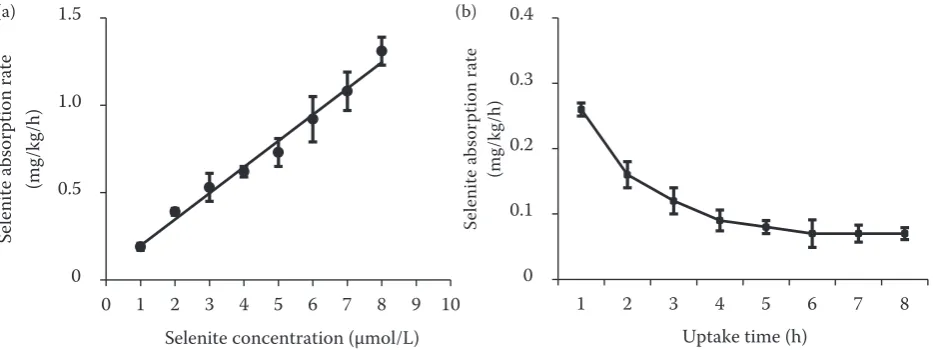
Concentration- and time-dependent kinetics of selenite absorption. The concentration-dependent absorption curve for selenite in leaf blades is shown in Figure 1a. The rate of selenite absorption increased in proportion to the Se concentration in the absorption solution. A linear equation was fit to the data with a regression coefficient of 0.96. The Se concentration in leaf blades increased as more time was allowed for selenite absorption. However, the selenite absorption rate in leaf blades decreased as absorption time was extended (Figure 1b). It declined sharply with the extension of absorption time from 1.0 h to 4.0 h, and selenite absorption rates remained low as absorption time was extended from 4.0 h to 8.0 h. These results indicated that selenite was predominantly taken up by leaf blades via a passive process. Concentration gradients provide continual driving forces for sel-enite penetration through the cuticle and stomata in leaf blades.
respiration inhibitors largely repressed selenite absorption. The effects of respiration inhibitors such as CCCP and DNP on selenite absorption were investigated in leaf blades. The results indicated that CCCP and DNP could inhibit selenite absorption in leaf blades by 67% and 50% at pH 5.0, respectively (Figure 2), suggesting that selenite absorption is partly associated with energy metabolism at pH 5.0.
ABA and PeG strongly inhibited selenite ab-sorption. The effects of ABA and PEG on selenite absorption in leaf blades were investigated to uncover whether leaf blades take up selenite via stomata. The results indicated that ABA and PEG could inhibit sel-enite absorption by 53% and 35% at pH 5.0 (Figure 3).
0 0.5 1.0 1.5
0 1 2 3 4 5 6 7 8 9 10
Sele
ni
te
a
bs
orp
tio
n
ra
te
(m
g/
kg
/h
)
Selenite concentration (µmol/L)
0 0.1 0.2 0.3 0.4
1 2 3 4 5 6 7 8
Uptake time (h) 0
0.5 1.0 1.5
0 1 2 3 4 5 6 7 8 9 10
Sele
ni
te
a
bs
orp
tio
n
ra
te
(m
g/
kg
/h
)
Selenite concentration (µmol/L)
0 0.1 0.2 0.3 0.4
1 2 3 4 5 6 7 8
[image:3.595.66.533.566.741.2]Uptake time (h) Figure 1. Concentration (a)- and time (b)-dependent selenite adsorption kinetics
(a)
Se
lenit
e a
bs
or
ption ra
te
(mg/kg/h)
This revealed that the opening and closure of the stomata affected selenite absorption.
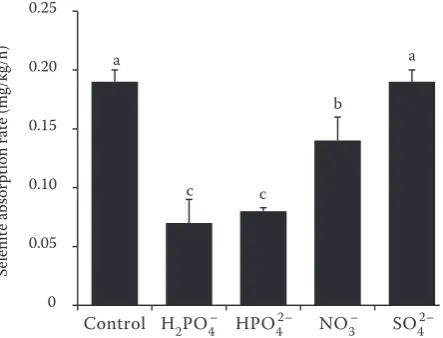
Competitive inhibition on selenite absorption by anions. The potential effects of anions on selenite absorption in leaf blades were investigated. It was found that H2PO4– and HPO
42– strongly inhibited
selenite absorption by 42% and 39%, respectively, followed by NO3–, which inhibited selenite
absorp-tion by 26%, while SO42– did not inhibit selenite
absorption (Figure 4).
disCUssion
Previous studies revealed that nutrients predomi-nantly penetrated the stomata and cuticle before being taken up by mesophyll cells (Schlegel and Schönherr 2002, Schönherr et al. 2005). Stomata are important pathways for the absorption of foliar-applied substances (Eichert et al. 2008). Stomatal permeability for nutrients depends on the state of stomatal opening (Schlegel and Schönherr 2002). ABA and PEG treatment can induce stomatal closure (Huang et al. 2009, Li et al. 2017). In this study, ABA and PEG were applied to induce stomatal closure. The result indicated that selenite absorption was greatly inhibited. It suggested stoma closure was consistent with the inhibition of selenite absorp-tion. Thus, the opening and closure of the stomata affect selenite absorption. Selenite can partly diffuse across the stomata.
The cuticle is an important protective layer that prevents uncontrolled water loss and increases re-sistance to pathogen invasion (Xue et al. 2017). The cuticle membrane is composed of the depolymerizable biopolymer cutin, the non-depolymerizable poly-mer cutan, and cuticular waxes. The cuticle waxes form the transport barrier by dispersing in the cutin polymer and depositing on the outer surface (Xue et al. 2017), as evidenced by the cuticle becoming more permeable to water and organic compounds upon wax extraction (Schreiber 2005). The cuticle 0
0.05 0.10 0.15 0.20 0.25
Control CCCP DNP
Sele
ni
te
a
bs
orp
tio
n
ra
te
(
m
g/
kg
/h
)
a
b
[image:4.595.69.288.91.266.2]c
Figure 2. Effects of respiration inhibitors on selenite absorp-tion. Values are the means of three replicates. Error bars represent standard deviation (n = 3). Different letters of a, b, and c indicate differences among different treatments in the same experiment (P < 0.05); CCCP – carbonyl cyanide m-chlorophenylhydrazone; DNP – 2,4-dinitrophenol
Figure 3. Abscisic acid (ABA) and polyethylene gly-col-6000 (PEG) inhibit selenite absorption. Values are the means of three replicates. Error bars represent standard deviation (n = 3). Different letters of a, b, and c indi-cate differences among different treatments in the same experiment (P < 0.05)
0 0.06 0.12 0.18 0.24 0.30
Control ABA PEG
Sele
ni
te
a
bs
orp
tio
n
ra
te
(
m
g/
kg
/h
)
a
c
[image:4.595.307.528.97.267.2]b
Figure 4. Competitive absorption of selenite with anions. Values are the means of three replicates. Error bars represent standard deviation (n = 3). Different letters of a, b, and c indicate differences among different treat-ments in the same experiment (P < 0.05)
0 0.05 0.10 0.15 0.20 0.25
Se
le
ni
te
ab
so
rp
tio
n
ra
te
(m
g/
kg
/h
)
a a
b
c c
H2PO4- HPO42- NO3- SO4
2-Control
[image:4.595.69.291.518.687.2]permeability for nutrients depends on the lipophilic and hydrophilic pathways occurring in leaf cuticles. Water is a small, polar and uncharged molecule that diffuses across the lipophilic path (Schönherr 2006). Ions are lipid-insoluble and diffuse through aqueous pores in cuticles (Schlegel et al. 2005). The size of the aqueous pores largely affects the ion permeability. The average pore radii range from 0.45 nm to 1.18 nm (Schönherr 2006), while the radius of selenite is approximately 0.05 nm. The radius of selenite is far below the aperture of the aqueous pore. Thus, selenite can diffuse across aqueous pores in cuticles and enter mesophyll cells.
As ions penetrate through the aqueous pores in cuticles, the rates of diffusion depend on humidity (Schönherr et al. 2005). For example, the permeability of poplar cuticles to ionic glyphosate salts increased by a factor of 5.3–10.5 when the relative humidity was increased from 70% to 100% (Schönherr 2002). The permeability of pear leaf cuticles to Ca2+ and
K+ increased with increasing humidity (Schönherr
and Luber 2001). Thus, it is generally preferred to spray selenite solutions in the evening to maintain higher humidity for a longer time. Since the stomata are closed at night, selenite mainly diffuses across the cuticles. The cuticle covering stomatal cells has an obviously higher permeability to polar, ionized salts (Schlegel and Schönherr 2002). The penetration rates of all substances through stomatous cuticles far exceeded those through astomatous cuticles (Kannan 1969). Thus, even though stomata were closed at night, selenite could penetrate through stomatous cuticles at a higher rate.
The absorption rate of selenite in the leaf blades increased linearly with increasing exogenous sel-enite concentrations, indicating that the leaf blades mainly took up selenite through passive processes. However, selenite absorption was largely suppressed by respiration inhibitors such as CCCP and DNP, indicating that the absorption of selenite by wheat leaf blades was an energy-dependent process. The results of these two experiments were not contradic-tory because selenite passively penetrated across the cuticular membrane and then was actively taken up by the mesophyll cells. Previous studies demonstrated that Pi transporters were responsible for selenite uptake in plants (Zhang et al. 2014). Competitive absorption of selenite with anions indicated that Pi strongly inhibited selenite absorption, while SO42–
did not inhibit selenite absorption. It suggested that selenite shared common transporters with Pi. Thus,
selenite was postulated to be taken up by Pi trans-porters localized to the membrane of mesophyll cells. However, the absorption rate of selenite in the leaf blades increased linearly with increasing exogenous selenite concentrations and did not exhibit a tendency to saturate at higher Se concentrations, suggesting that the rate of selenite absorption in mesophyll cells depended on the rate of penetration through the cuticle. Penetration through the cuticle is a rate-limiting step for selenite uptake in mesophyll cells. Concentration-dependent selenite absorption ki-netics revealed that the absorption rate of selenite in leaf blades increased with increasing exogenous selenite concentrations, suggesting that the pen-etration rate of selenite depends on the concentra-tion gradient as the driving force. The inhibiconcentra-tion of selenite absorption by CCCP and DNP suggested that selenite uptake by mesophyll cells provided the continuous driving force for selenite diffusion across the cuticle. As longer selenite absorption times were allowed, the absorption rate of selenite in leaf blades decreased gradually and reached a low level at 4 h. The decrease in the selenite absorption rate should be attributed to the gradual decrease in the concentration gradient of selenite across aqueous pores in leaf blades.
In conclusion, selenite mainly enters wheat leaf blades through a passive process, which is a rate-limiting step. Selenite enters mesophyll cells via Pi transporters. Concentration gradients and selenite uptake in mesophyll cells provide continual driving forces for selenite penetration through the cuticle and stomata in leaf blades. This study increases our understanding of the physiological characteristics of selenite absorption in wheat leaf blades. It provides novel insights into enhancing the efficiency of Se utilization in wheat via foliar application.
referenCes
Broadley M.R., Alcock J., Alford J., Cartwright P., Foot I., Fairweather-Tait S.J., Hart D.J., Hurst R., Knott P., McGrath S.P., Meacham M.C., Norman K., Mowat H., Scott P., Stroud J.L., Tovey M., Tucker M., White P.J., Young S.D., Zhao F.J. (2010): Selenium biofortification of high-yielding winter wheat (Triticum aestivum L.) by liquid or granular Se fertilisation. Plant and Soil, 332: 5–18.
Combs G.F.Jr. (2001): Selenium in global food systems. British Jour-nal of Nutrition, 85: 517–547.
se-lenium in wheat grain. Journal of Agricultural and Food Chem-istry, 58: 2295–2301.
Curtin D., Hanson R., Lindley T.N., Butler R.C. (2006): Selenium concentration in wheat (Triticum aestivum) grain as influenced by method, rate, and timing of sodium selenate application. New Zealand Journal of Crop and Horticultural Science, 34: 329–339. Deng X.F., Liu K.Z., Li M.F., Zhang W., Zhao X.H., Zhao Z.Q., Liu
X.W. (2017): Difference of selenium uptake and distribution in the plant and selenium form in the grains of rice with foliar spray of selenite or selenate at different stages. Field Crops Research, 211: 165–171.
Eichert T., Kurtz A., Steiner U., Goldbach H.E. (2008): Size exclu-sion limits and lateral heterogeneity of the stomatal foliar uptake pathway for aqueous solutes and water-suspended nanoparti-cles. Physiologia Plantarum, 134: 151–160.
Haug A., Graham R.D., Christophersen O.A., Lyons G.H. (2007): How to use the world’s scarce selenium resources efficiently to increase the selenium concentration in food. Microbial Ecology in Health and Disease, 19: 209–228.
Huang A.X., She X.P., Cao B., Zhang B., Mu J., Zhang S.J. (2009): Nitric oxide, actin reorganization and vacuoles change are in-volved in PEG 6000-induced stomatal closure in Vicia faba. Physiologia Plantarum, 136: 45–56.
Institute of Medicine (2000): Dietary Reference Intakes for Vitamin C, Vitamin E, Selenium, and Carotenoids, Washington, National Academies Press.
Kannan S. (1969): Penetration of iron and some organic substances through isolated cuticular membranes. Plant Physiology, 44: 517–521. Li J., Li Y., Yin Z., Jiang J., Zhang M., Guo X., Ye Z., Zhao Y., Xiong
H., Zhang Z., Shao Y., Jiang C., Zhang H., An G., Paek N.C., Ali J., Li Z. (2017): OsASR5 enhances drought tolerance through a sto-matal closure pathway associated with ABA and H2O2 signalling in rice. Plant Biotechnology Journal, 15: 183–196.
Miao Y.F., Wang Z.H., Li S.X. (2015): Relation of nitrate N accumu-lation in dryland soil with wheat response to N fertilizer. Field Crop Research, 170: 119–130.
Rayman M.P. (2002): The argument for increasing selenium intake. The Proceedings of the Nutrition Society, 61: 203–215.
Schönherr J. (2002): A mechanistic analysis of penetration of glyphosate salts across astomatous cuticular membranes. Pest Management Science, 58: 343–351.
Schönherr J. (2006): Characterization of aqueous pores in plant cu-ticles and permeation of ionic solutes. Journal of Experimental Botany, 57: 2471–2491.
Schönherr J., Fernández V., Schreiber L. (2005): Rates of cuticular penetration of chelated Fe(III): Role of humidity, concentration,
adjuvants, temperature, and type of chelate. Journal of Agricul-tural and Food Chemistry, 53: 4484–4492.
Schönherr J., Luber M. (2001): Cuticular penetration of potassium salts: Effects of humidity, anions, and temperature. Plant and Soil, 236: 117–122.
Schlegel T.K., Schönherr J. (2002): Selective permeability of cuticles over stomata and trichomes to calcium chloride. ISHS Acta Hor-ticulturae, 594: 91–96.
Schlegel T.K., Schönherr J., Schreiber L. (2005): Size selectivity of aqueous pores in stomatous cuticles of Vicia faba leaves. Planta, 221: 648–655.
Schreiber L. (2005): Polar paths of diffusion across plant cuticles: New evidence for an old hypothesis. Annals of Botany, 95: 1069– 1073.
Wang Z.H., Miao Y.F., Li S.X. (2015): Effect of ammonium and ni-trate nitrogen fertilizers on wheat yield in relation to accumu-lated nitrate at different depths of soil in drylands of China. Field Crops Research, 183: 211–224.
Wang Z.H., Miao Y.F., Li S.X. (2016): Wheat responses to ammo-nium and nitrate N applied at different sown and input times. Field Crops Research, 199: 10–20.
Xue D.W., Zhang X.Q., Lu X.L., Chen G., Chen Z.H. (2017): Mo-lecular and evolutionary mechanisms of cuticular wax for plant drought tolerance. Frontiers in Plant Science, 8: 621.
Zhang L.H., Hu B., Li W., Che R.H., Deng K., Li H., Yu F.Y., Ling H.Q., Li Y.J., Chu C.C. (2014): OsPT2, a phosphate transporter, is involved in the active uptake of selenite in rice. New Phytologist, 201: 1183–1191.
Zhang L.H., Yu F.Y., Shi W.M., Li Y.J., Miao Y.F. (2010): Physiologi-cal characteristics of selenite uptake by maize roots in response to different pH levels. Journal of Plant Nutrition and Soil Sci-ence, 173: 417–422.