Evaluating the Potential Role of Sustainable Banking as
a Vehicle for Socio-economic and Environmental
Development
1Policy Paper2
December 2011
1
Corresponding Author: [email protected]
2
Acknowledgements
Comhar SDC would like to gratefully acknowledge and pay recognition to those people that have
contributed their expertise and provided valuable input to this report. First of all to the Comhar
Council members and particularly Mairead Cirillo (Small Firms Association), Sue Scott
(Economic and Social Research Institute) and David Korowicz (FEASTA). There interest in the
project and insights were most appreciated. I would also like to express my sincere thanks to
Matthew Kennedy (Sustainable Energy Authority of Ireland) and Paul Harris (Bank of Ireland)
for their expert contributions along with the useful information provided by Dermot O’Sullivan
(Bank of Ireland), Jacqui McCrum (Allied Irish Bank) and Pauline McKiernan (Ulster Bank).
Finally, I would like to acknowledge the direction and guidance provided by Mairead Ryan
(Director of Comhar SDC) throughout the course of the project.
Eoin McLoughlin,
Research Director,
1. Context
“Only by changing finance, we will be able to finance change.”
- Peter Blom, CEO of Triodas Bank upon accepting his invitation to join the Club of
Rome, July 2010.
1.1 Introduction
The global financial crisis and the subsequent banking failures have left many people ambiguous towards the current financial system. This is not surprising considering that such developments precipitated the sharp demise of the Celtic Tiger and indebted the Irish nation with a legacy that will take some time to overcome. It also begs the question as to whether there may be alternatives to the existing banking mainstream that offer different perspectives and values as to how finance can be used in a more sustainable way and not predominantly focused on short-term profit-making to the detriment of society at large.
With that in mind, the aim of this policy paper is to provide an overview of developments in relation to the area of sustainable banking and assess the potential role that financial institutions can play in socio-economic and environmental development. It has been argued that such bodies are needed to address market barriers associated with investing in a low-carbon and resource efficient society and also to enable individuals and businesses to use money more consciously in ways that benefit people and the environment and which promotes sustainable development. In undertaking the analysis, the paper draws on existing international examples and case studies and seeks to build on best practice found in other countries that are leading the way in this field. It is intended that this policy briefing will help stimulate further debate, dialogue and innovation around these emerging ideas.
Although it is important to consider the wider picture in relation to the role of finance in achieving sustainable development, this paper mainly focuses on the commercial banking sector and therefore does not address other key areas of the finance industry such as the investment and insurance divisions. To undertake this further work would require more detailed analysis that is beyond the scope and capacity of this initial assessment.
The overarching objectives of the paper are as follows:
To outline and explain the concept of sustainable banking;
To make the case and rationale as to why sustainable banking should be looked at as an alternative to the mainstream;
To highlight and demonstrate international best practice in this field;
To examine the current and potential role of the public and private sector in relation to providing sustainable banking in Ireland;
1.2 National Policy Context
Financial Crisis
Ireland, like many of our European partners, has suffered badly as a result of the global economic downturn. However, the extent and scale of the financial crisis has had more profound implications in a country with such an open economy and one which became overly dependent on the construction sector for employment and revenue generation. Following the collapse of the housing boom during 2007, government finances started to come under increasing pressure. By mid-2008 the impact of the property crisis had resulted in rising unemployment and increasing government deficits. In November 2010, Ireland became the second European member state after Greece to seek an EU/IMF bailout after the bond markets downgraded the country’s creditworthiness to a point where the Government was unable to borrow to raise its own funds.
At the heart of the problem has been the Irish banking sector which became over exposed to the Irish property market and which came under severe pressure once the global financial crisis hit. Their precarious situation forced the State into a position of having to bail out the Irish owned banks and provide them with sufficient capital liquidity. This resulted in a national crisis with the Government on several occasions being required to pump more money into the insolvent banks at the expense of the taxpayer. The ‘stress tests’ have attempted to put a final figure on the cost of the bank bailout and provide some certainty to the markets as to the absolute requirements needed to recapitalise the banks. The Government at the same time has announced plans to reform the banking sector which includes consolidating the existing Irish banks into two remaining “pillar” institutions3.
As a consequence of these developments, it is understandable that many people have lost a certain amount of confidence in our existing banking system amid the imprudent lending practices that contributed to Ireland’s current difficulties. The Programme for Government 2011 echoes this sentiment by highlighting the need ‘to make our banking system an engine of economic recovery by restoring public and market confidence in its financial health, management competence and ethical integrity4.’ In fact, although unwelcome, the current banking crisis affords us the opportunity to reassess what it is we wish to use finance for and to consider whether there may be alternative models that offer a different perspective.
National Recovery Plan and NewERA
The National Recovery Plan 2011-2014 provides the framework for returning the Irish economy to the path of sustainable growth and restoring the public finances. It sets out the areas which will contribute to economic development and employment creation and specifies the programmes and measures that the Government will put in place to ensure growth in those key sectors is achieved. One of the sectors referenced in the plan for development is the green economy with job creation possibilities identified in areas such as energy, waste, water and the establishment of a Green IFSC (GIFSC). In addition, as an action point under the plan the Government is committed to ‘exploiting the potential of green financial services’5.
3
See http://www.finance.gov.ie/viewdoc.asp?DocID=6749&CatID=79&StartDate=1+January+2011
4
Government Publications (2011), Government for National Recovery 2011-2016 pg.6. 5
The Government’s own plan for economic development and investment, NewEra, provides for an investment programme in key networks of the economy to support demand and employment in the short-term, and to provide the basis for sustainable, export-led jobs and growth for the next generation. This includes investment in a number of areas relating to the green economy, including a new water network, a 21st century ‘smart grid’ and bio-energy and forestry. These investments are to be managed and financed by a New Economy and Recovery Authority (NewERA) which will operate under the National Treasury Management Agency.
Challenging EU Targets on Climate Change and Energy
Ireland, as an EU member state, is subject to meeting targets which have been set as part of the EU Climate Change and Energy Package. The EU targets to be achieved by 2020 include:
20% reduction in greenhouse gas emissions based on 1990 levels6
20% of final energy consumption7 to be produced by renewable energy resources 20% improvement on energy efficiency
The implications of this package for Ireland are significant. As a member of the European Community, Ireland is legally bound to meeting the new targets that have been set for greenhouse gas emissions and renewable energy. These targets are without question challenging and cut across all sectors of the economy. The greenhouse gas emissions target is divided between those sectors involved in emissions trading (mainly power generation and large industry) and those sectors outside of the scheme (mainly transport, agriculture, waste and buildings). For the non-trading sector, Ireland has been allocated a demanding reduction target of 20% on 2005 levels to be achieved by 2020. For renewables, Ireland has been assigned an equally challenging target for renewable energy to constitute 16% of final energy consumption by 20208.
The achievement of these targets will require significant investment in developing the infrastructure (grid, interconnection, electric vehicle charging points etc.) needed for building a low-carbon and resource efficient economy and also putting in place and delivering the necessary policy support mechanisms (feed-in tariffs, grant programmes etc.) to address market barriers and incentivise technology adoption9. The scale of the challenge is such that both private and public sector capital is required to finance the transition and deliver the required level of investment.
National Sustainable Development Strategy
The first National Sustainable Development Strategy was published in 1997 andled to progress in the development and implementation of policies and action across most sectors. However, key challenges remain across policy areas, governance, implementation mechanisms and measuring and communicating progress. A new Framework for Sustainable Development in Ireland (FSDI)
6
30% reduction if the international community signs up to undertake similar commitments
7
Final Energy Consumption in the Renewables Directive is defined as the energy commodities delivered for energy purposes to manufacturing industry, transport, households, services, agriculture, forestry and fisheries, including the consumption of electricity and heat by the energy branch for electricity and heat production and including losses of electricity and heat in distribution.
8
The latest figures available for 2009 show Ireland currently at 4.9%.
9
is under preparation and will seek to identify areas where further effort is required and will put forward practical measures aimed at achieving added value in key sectors. It also intends to set out proposals for the effective implementation of the Framework and proposed performance indicators which will measure progress on sustainable development. The FSDI will serve as a key national policy driver to ensure that sustainable development concerns are taken into account and acts as an important input to policy formulation.
1.3 International/EU Policy Developments
EU Policy Initiatives on a Low-Carbon Economy and Resource Efficiency
The European Commission (EC) has adopted a Roadmap for transforming the EU into a competitive low carbon economy by 2050. The Roadmap describes a cost-effective pathway to reach the EU's objective of cutting greenhouse gas emissions by 80-95% of 1990 levels by 2050. It estimates that building a low carbon EU economy will require, over the next 40 years, additional annual investment equivalent to 1.5% of EU GDP (€270 billion) on top of overall current investment of 19% of GDP. The benefits from such an investment result from reducing Europe's dependence on energy imports, and thus its vulnerability to potential oil price shocks, and in stimulating new sources of growth and employment.
The EC has also launched its Flagship Initiative and Roadmap on Resource Efficiency. This serves as a guiding principle for EU policies in a number of different areas such as energy, transport, climate change, industry, agriculture and biodiversity. By using synergies across these different policy-areas, the strategy plans to help meet a variety of EU objectives, from reducing European greenhouse gas emissions to reforming the agricultural and fisheries sectors, from reducing food insecurity in developing countries to making the Union more resilient to future rises in global energy and commodity prices.
International Developments
On the international front, negotiations will continue to try and reach an agreement on global climate change commitments at the U.N. backed climate change conference (COP 17) taking place in Durban in December 2011. This should continue the process of negotiation for a post-2012 Kyoto framework and result in developed countries committing to significant greenhouse gas emission reductions. The findings from the Fourth Assessment Report of the Intergovernmental Panel on Climate Change show that an 80-95% reduction in industrialised countries’ greenhouse gas emissions from 1990 levels is required by 2050 in order to reduce the risk of dangerous and potentially catastrophic climate change. The international community is also gearing up to mark the 20th anniversary of the Rio Earth Summit in 2012. Despite significant progress since the concept of sustainable development entered international debate, the problems discussed at Rio still endure. Unsustainable trends in relation to climate change and energy use, land use, threats to public health, poverty and social exclusion and biodiversity loss still persist, while new challenges have emerged.
environmental issues, designed to build sustainable development practices into Chinese industries. The new targets intend to lower energy intensity by a further 16% over the next five years. Other goals include China’s ambition to boost the proportion of non-fossil fuels in overall primary energy use from the current 8% up to 11.4%; to cut CO2 emissions by 17% overall; and to reduce major pollutant emissions, such as heavy metal and chemical waste from manufacturing processes, by around 8% to 10%10.
1.4 Summary
There are a number of significant developments taking place at both a national and international level that are acting as driving forces towards creating a paradigm shift in how we seek to grow our economies and increase our overall standard of living while at the same time managing to live within our ecological means. This includes prioritising efforts to develop the green economy that not only provides job opportunities but also helps to sustain and advance environmental and social well-being. Such a transformation requires significant amounts of capital investment in order to make it happen. At the same time, the financial crisis has prompted many people to reassess the role of finance and how best it can be used to address the most pressing challenges of our time. This confluence of factors provides an ideal opportunity to evaluate the contribution that sustainable banking can make to the process in order to provide the financing necessary to meet current and future challenges. Simultaneously it is equally as important to get the prices right so that the polluter pays principle is fully reflected and ensures that the business case is there to attract the required level of capital and investment.
10
2. Concept of Sustainable Banking
2.1 What is Sustainable Banking?
As intermediaries between borrowers and lenders, financial institutions hold a special position in an economic system. The extent and significance of this role cannot be overstated as evidenced by the recent financial crisis where the Irish Government had to intervene to rescue insolvent banks from going bust. In fact, the crisis provided a clear demonstration of just what ‘unsustainable banking’ looks like: too much irresponsible lending to businesses and individuals who could not afford to repay their debts and too much focus on risky derivatives and structured products.
As an outcome of the crisis, new regulations for the banking sector are being discussed and implemented in order to prevent similar events from happening in the future. These regulations are focused on limiting the potential negative impact that the financial sector can have on the economy. The underlying difference between these financial institutions and what are classed as ‘sustainable banks’ is that the latter turn this perspective around to see how they can use their special position in the economic system for addressing some of the most pressing challenges of our time such as poverty alleviation and climate change.
So with this in mind, what exactly is sustainable banking? In essence, it is a philosophy that underpins everything about banking, a value system that says a bank’s commercial activities must not only benefit its staff and shareholders, but also its customers and the wider economy, while at the same time preventing, or at least minimising, any undue effects on society and the natural environment. It also requires banks, where appropriate, to be proactive and take steps to improve society and the environment. For example, banks can play an influential role in encouraging the shift to a low-carbon society – providing access to capital and measuring risk of investments. Considering environmental and social factors in those investment decisions can have a significant role in shifting the global economy toward sustainable business practices (SAS, 2010).
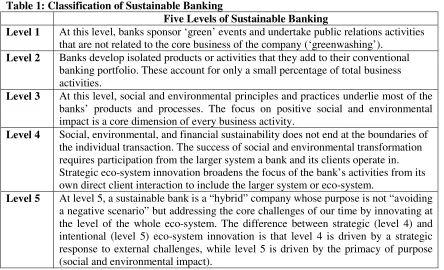
According to research currently being conducted at MIT11, there are generally considered to be five levels in the classification of sustainable banking which are summarised in Table 1. These include:
Level 1→ Unfocused corporate activities
Level 2→ Isolated business projects or business practices
Level 3→ Systemic business practices
Level 4→ Strategic ecosystem innovation
Level 5→ Intentional (purpose-driven) eco-system innovation
To be considered a sustainable bank requires attaining and operating at Level Five in the classification. This is where the sole purpose of the bank is to bring about positive societal and environmental change by focusing its operations on the core challenges of our time.
11
Table 1: Classification of Sustainable Banking
Five Levels of Sustainable Banking
Level 1 At this level, banks sponsor ‘green’ events and undertake public relations activities that are not related to the core business of the company (‘greenwashing’).
Level 2 Banks develop isolated products or activities that they add to their conventional banking portfolio. These account for only a small percentage of total business activities.
Level 3 At this level, social and environmental principles and practices underlie most of the banks’ products and processes. The focus on positive social and environmental impact is a core dimension of every business activity.
Level 4 Social, environmental, and financial sustainability does not end at the boundaries of the individual transaction. The success of social and environmental transformation requires participation from the larger system a bank and its clients operate in. Strategic eco-system innovation broadens the focus of the bank’s activities from its own direct client interaction to include the larger system or eco-system.
Level 5 At level 5, a sustainable bank is a “hybrid” company whose purpose is not “avoiding a negative scenario” but addressing the core challenges of our time by innovating at the level of the whole eco-system. The difference between strategic (level 4) and intentional (level 5) eco-system innovation is that level 4 is driven by a strategic response to external challenges, while level 5 is driven by the primacy of purpose (social and environmental impact).
Source: Adapted from Kaeufer (2010)
The Global Alliance for Banking on Values12 considers a sustainable bank to be either a publicly or privately owned financial institution whose central mission is investment in a society that values human development, social cohesion and responsibility for our natural environment. Generally it adheres to the following principles:
Using money as a tool for enhancing the quality of life through human, social, cultural and environmental development;
Responsibility for the long term impact of efforts to improve interdependent environment and communities;
Transparency, trust, clarity, and inclusiveness in delivering sustainable finance products and services.
There are multiple examples of sustainable banks currently in operation throughout the world. A number of these are members of the Global Alliance for Banking on Values. This independent network of fourteen of the world's leading sustainable banks was launched in 2009 in the Netherlands with the banks involved committing to support the expansion of $2 billion in lending to underserved communities and green projects around the world. Appendix 1 provides more information on this Global Alliance and the participating financial institutions.
12
2.2 What Type of Products and Services do Sustainable Banks Offer?
Although business models may vary, sustainable banks all use banking products to deliver sustainable development for individuals and communities. They offer straightforward, inclusive and transparent banking products and services for individuals and businesses, providing savings and investment opportunities for their clients. They finance entrepreneurs, companies, and other organisations delivering long-term benefits for people, communities and the environment. While their members and clients are not immune to the impact of financial crises, they offer compelling evidence that a values-driven approach to banking is a viable alternative to current mainstream banking business models.
The standard type of products and services that sustainable banks would generally offer include:
Financing projects with sustainable development goals;
Using their shareholder power to improve the social, environmental and governance performance of the companies in which they invest;
Refuse investment opportunities based on ethical concerns;
Provide for transparency and openness in their banking operations; and
Show leadership through putting in place a sustainability policy within their own organisation.
The following two sections assess in more detail some of the finance mechanisms and governance arrangements used by both public and private sector bodies in other countries to support and deliver on sustainable development goals and considers whether these same instruments and administrative structures could be deployed in Ireland.
3. Role of the Public Sector and Sustainable Banking
“Our guiding philosophy commits us to sustainability. Environmental and social
guidelines to implement this framework were developed that apply to all areas of the
bank; they ensure that promotional projects in Germany and abroad that we co-finance
do not present any unacceptable environmental and/or social risks.”
- Dr Ulrich Schröder, Chairman, KfW Bankengruppe, Sustainability Report 2009
3.1 Introduction
The public sector has a key role to play in creating the right policy framework and environment that supports sustainable development and which encourages and stimulates private sector investment. This includes putting in place the appropriate regulatory structure and procurement procedures and through using fiscal measures in order to incentivise behavioural change. One of the most compelling cases for public intervention is the need to scale up investment in the low-carbon economy in order to meet international and EU targets and support green enterprise opportunities. A well structured public sustainable bank is one potential option to help address current market failures and barriers through use of innovative finance mechanisms. It can also help to leverage private sector investment and provide a focal point for policy activity.
3.2 Review of Public Finance Mechanisms
Supportive regulatory and tax policies are important in the development and financing of new technologies, however, these alone are not always enough to create the environment needed for investing in sustainable development projects. For this reason, the use of public finance mechanisms has been deployed in many countries as a means to stimulate investment and activity in a range of different sectors. The objectives of these public finance mechanisms are to mobilise and leverage private financing, build commercially sustainable markets and increase capacity to deliver sustainable development projects.
These public finance mechanisms can take many different forms and include the following:
Grants – to share project development costs; Debt financing;
Private equity funds – investing risk capital in companies and projects; Venture capital funds – investing risk capital in technology innovations;
Carbon finance – provide facilities that monetise the advanced sale of emissions reductions to finance project investment costs.
Table 2: Summary of Public Finance Mechanisms
Mechanism Description Barriers Example
Credit Line for Senior Debt
Credit line provided to banks for on-lending to projects in the form of senior debt
Banks lack funds and have high interest rates
Thailand energy efficiency revolving fund; CORFO credit line programme
Credit Line for
Mezzanine Debt
Credit line to banks for on-lending to projects with subordinated repayment obligations
Debt-Equity gap, whereby project sponsors lack sufficient equity to secure senior debt
E+Co CAREC Fund, FIDEME Fund
Guarantee Shares project credit (i.e. loan) risks with banks
High credit risks, particularly perceived risks
IFC/GEF Hungary Energy Efficiency Co-Financing Programme
Project Loan Facility
Debt facilities organised by entities other than commercial banks and providing project financing to projects
Banks unable to address the sector
India Renewable Energy Development Agency; Bulgaria Energy Efficiency Fund D eb t Soft Loan Programmes
Provide debt capital at favourable interest rates
Financing gap during project development stages Massachusetts’ Sustainable Energy Economic Development Initiative Private Equity Fund
Equity investments in companies or projects
Lack of risk capital; restrictive
debt-to-equity ratio
ADB Clean Energy Private Equity Investment funds
E q u it y Venture Capital Fund
Equity investments in technology companies
Lack of risk capital for new technology development
China Environment Fund, Carbon Trust VC Fund
C a rb o n Carbon Finance
Monetisation of future cash flows from the advanced sale of carbon credits to finance project investment costs
Lack of project development capital; lack of cash flow for additional security; uncertain delivery of carbon credits
ADB Asia Pacific Carbon Fund
Project Development Grants
Grants “loaned” without interest or repayment until projects are financially viable
Poorly capitalised developers; costly and time consuming development process
Canadian Green Municipal Funds
Loan Softening Programmes
Grants to help banks begin lending their own capital to end-users initially on concessional terms
Lack of banks interest in lending to new
sectors; limited knowledge of market demand
MNRE/IREDA SWH interest subsidy
programme, UNEP Indian Solar Loan Programme In n o v a ti v e G ra n ts Grants for Technical Assistance
Funds aimed at building the capacities of market actors. Technical assistance programmes include marketing, staff training and incubation costs
(i) lack of investment ready project (ii) lack of skills and knowledge among market actors
GEF, WB, ADB, UNEP, UNDP TA Programmes
Carbon Trust Incubator Programme
3.3 Potential for a Publicly Backed Sustainable Investment Bank
Support for the concept of a publicly owned sustainable investment bank has been building in many countries for some time. In the UK, a number of different reports have called for the establishment of such an institution in order to finance the transition to a low carbon economy13,14,15. Similarly, in the US, a non-profit organisation has been formed called ‘Coalition for Green Capital’ that backs the creation of a federal Green Bank and the concept has also received support amongst the policy think-tank community 16. In Ireland, it has been acknowledged that such an institution may have a key role to play for example in providing financing arrangements for the retrofitting of the existing housing stock or in extending credit for clean technology projects and new business ventures17,18.
The case and rationale for establishing a sustainable investment bank has received much attention. It has been argued that the current financial system is not geared or resourced adequately to deal with the significant challenges that lie ahead. For example, financing low carbon technologies and energy efficiency projects of the scale required demands a specialised knowledge of the area and the technologies concerned. From an economies of scale perspective it also makes sense to rationalise and streamline available resources together rather than having them dispersed over a range of different bodies. Furthermore, as these technologies by their nature tend to carry greater short term risks to the private investor than existing conventional energy, the government has to look at all means possible to reduce the costs of those risks in order to attract private investment. That is where the use of public finance mechanisms can have a key role to play.
Specifically, the hurdles a sustainable investment bank can potentially help overcome are:
• The risk resulting from fluctuating fossil fuel and carbon prices;
• The still debilitating credit crunch and high cost of capital;
• The need for large-scale, predictable financing;
• The lack of a financing track record for new low-carbon technologies;
• The lack of scalable and standardised finance models for existing energy-efficiency technologies.
Existing grant schemes and tax incentives are important, but they are not the panacea given the scale of the transition ahead and the financing obstacles that must be overcome. As grant programmes and tax incentives are subject to extensions by government they also lack the certainty that medium to long-term debt financing requires. A sustainable bank could potentially provide the flexibility so crucial in addressing critical barriers to investments.
If a publicly backed sustainable investment bank were to be established, it is important that it would only provide finance where market barriers prevent the private capital market from doing so as otherwise it would simply be displacing private investment, or ‘crowding out’. Some of the possible roles for a sustainable investment bank include:
13
Royal Bank of Sustainability (2009). Available at:
http://www.wdm.org.uk/sites/default/files/RBSreport19102009.pdf
14
Green Alliance (2009), Establishing a Green Investment Bank for the UK. 15
Aldersgate Group (2009), Financing the Transition 16
Center for American Progress (2009), The Green Bank. 17
See IIEA (2009), Greenprint for a National Energy Efficiency Retrofit Programme. 18
• Helping to structure, in partnership with the private sector, the financing of major projects to deliver the energy, transport and other infrastructure investment necessary to enable the delivery of the smart green economy;
• Providing some initial capital or guarantees, as part of multi-bank project financing for large-scale renewable energy, if it is clear that the private capital markets are unwilling to take on the whole risk;
• Working closely with both government policy makers and the investment community to come up with innovative ways to finance energy efficiency, domestic retrofitting, large and small-scale renewables, grid improvements and public transport links that will be required to deliver a low-carbon society;
• Providing loans, equity or venture capital to companies seeking to bring a proven and demonstrated low carbon technology, project or service to full commercialisation;
• Offering innovative products to its customers such as green SSIAs in the case where the bank is allowed to raise its own capital;
• Providing advice to Government on matters relating to green financing.
3.3.1 Existing Business Models
UK Green Investment Bank
The UK Budget 2010 signaled the Government’s plans for the establishment of a commercially independent Green Investment Bank (GIB). It was proposed that the bank would be set up with an initial budget of £2bn and a mandate to invest in low-carbon infrastructure. Since February 2010, the Green Investment Bank Commission (GIBC), serving as an independent advisory group brought together by the Chancellor of the Exchequer, has been working to identify how Britain can better support and accelerate the private sector investment required to deliver the UK’s transition to a low carbon economy. The Commission produced their first report in June 2010 which provides a blueprint for the early establishment of a Green Investment Bank to address current market failures and barriers to investment.
In its report19, the Commission recommends that the GIB be charged with:
Identifying and addressing market failures which are limiting private investment in carbon reduction activities;
Providing coherence to public efforts to support innovation in relation to climate change by rationalising existing Government-established bodies and funds;
Advising on financing issues in central and local government policy making.
The UK Budget 2011 and a subsequent progress report20 published by the Business Secretary provided further details on the Government’s plans for the Green Investment Bank. It will become fully operational in 2012-13 with an initial capitalisation of £3 billion. From 2015-16 onwards the bank will be able to borrow money and raise capital of its own accord provided the government’s debt target is met. Initial sectors which have been targeted for investment include offshore wind, non-domestic energy efficiency and waste.
19
Green Investment Bank Commission (2010), Unlocking investment to deliver Britain’s low carbon future.
20
The GIB will initially be owned by the Government and will operate as a separate institutional unit with full independence. Its governance model will allow for a possible eventual transfer of ownership from Government to the private sector of some or all of its activities. It will offer a broad range of products tailored to the needs of different sectors. The initial product mix is envisaged to consist of equity and debt instruments designed to address specific financing needs.
KfW Bankengruppe
KfW Bankengruppe is an example of an existing publicly backed financial institution that has a strong mandate to support projects and programmes that have sustainable development as a guiding principle. The bank was originally founded in 1948 as a Promotional bank of the Federal Republic of Germany and received funding under the Marshall Plan. Due to its public ownership and government guarantee it has a ‘AAA’ credit rating which enables it to raise new funds from the capital markets at beneficial rates. However, it does not raise finance from private individual investors.
KfW Bankengruppe gives impetus to economic, social and ecological development worldwide. As a bank owned by the German government and the federal states, KfW gears its decisions towards the goal of sustainable development in line with the sustainability strategy of the German Federal Government. It lends to commercial banks, who in turn lend to households, community groups and small businesses for environmental, climate change and other schemes which meet the previously Government-approved criteria for loans.
It has set up a comprehensive environmental management system with guidelines for all fields of activity. Based on this, KfW promotes environmental investments, assesses the environmental impact of its finance projects and makes sure that its offices are run to environmental standards. In its Sustainability Reports21, KfW presents its activities in environmental and climate protection and reports on all activities that fall under the heading of ‘sustainable action’. In 2009, approximately 28% of KfW’s overall business volume (€20 billion) went to projects operating in the area of sustainable development which was an increase of 20% from 2006 levels.
KfW, on behalf of the German Government, supports energy efficiency in housing. It launched the "Housing, Environment, Growth" initiative in 2006, which primarily funds building retrofit measures that lead to energy savings and the construction of new, low-energy homes. The initiative was highly popular from the start. In the years 2006 and 2007 promotional loans totaling €32.9 billion were granted for such modernisation measures.
KfW developed a 'sustainability indicator' in 2007. The indicator was recast and extended in 2010 and uses a wide range of sub-indicators, some of which are part of the federal government's sustainable development reporting. The aim of the indicator is the yearly progress assessment of sustainable development in Germany. It monitors trends over time in economic, environmental and social aspects of sustainability. KfW uses its sustainability indicator in order to increase public awareness of the importance of sustainability as a political and economic consideration and as a tool for internal evaluation of the sustainability of its loan schemes.
21
KfW is also involved in providing funds through the EU’s ELENA programme. This supports local and regional authorities in the financing of sustainable energy projects. The new KfW-ELENA facility offers a complementary approach in order to mobilise sustainable investments of small and medium sized municipalities and, where appropriate, Energy Service Companies (ESCOs). It consists of three innovative financing schemes:
• Grant subsidy from the European Commission for Technical Assistance;
• Global loans to local participating financial intermediaries (PFIs) in order to target smaller investments (volume up to €50 million); and
• Carbon crediting as a new financing element.
Clean Energy Finance and Investment Authority
The State of Connecticut in June 2011 passed wide-ranging legislation that among other things will see the establishment of the first state-level green bank in the US. The enacted Bill revamps the state’s existing clean energy fund to create a quasi-public green bank called the Clean Energy Finance and Investment Authority (CEFIA). CEFIA’s mission is to promote, develop and invest in clean energy and energy efficiency projects in order to grow jobs, strengthen Connecticut’s economy, protect community health, improve the environment, and promote a secure energy supply for the state. The Bill allows CEFIA to: (1)finance energy efficiency projects; (2)support projects that seek to use electric, hybrid, or alternative fuel vehicles, associated infrastructure and related storage; and (3)provide low-cost financing for clean energy technologies.
Under the Bill, CEFIA is required to establish the following programmes in the area of clean energy and energy efficiency:
a pilot programme to provide financial incentives for installing combined heat and power systems with a generating capacity of up to 2 megawatts;
a pilot programme to assist farmers in using organic waste with on-site anaerobic digestion facilities to generate electricity and heat;
a residential photovoltaic (PV) solar programme that will result in 30 MW of new PV generating capacity. This includes offering financial incentives for the purchase or lease of qualifying residential PV systems;
a programme that provides grants to residential condominium associations and owners to purchase renewable energy sources;
a loan guarantee programme which helps finance energy efficiency and renewable energy projects for individuals, non-profits, and small businesses.
Unlike the UK GIB, CEFIA will be able to raise its own capital immediately with the initial funds being generated from a surcharge on electricity bills. It will seek to leverage private sector capital but may finance up to 80 percent of the cost of clean energy projects and 100 percent of the cost of energy-efficiency projects. The other funding sources for CEFIA include:
• Regional Greenhouse Gas Initiative auction allowance proceeds;
• Private capital in the form of contracts entered into with investors;
• Special obligation bonds or bond anticipation notes;
• Federal funds, charitable gifts and grants;
• Earnings and interest from financing activities backed by the authority.
3.4 Public Sector and Sustainable Banking in Ireland
[image:17.612.90.535.210.381.2]Presently, there is no public sector bank or government-linked financial institution in Ireland that is charged with the responsibility of promoting and financing sustainable development initiatives or developing a resource efficient and low carbon economy. However, there are a number of government departments and public sector agencies that disburse funds for such activities. Most of these are grant based schemes and are listed in Table 3 along with the relevant funding body.
Table 3: Summary of Existing Public Finance Mechanisms
Policy Measure Instrument Funding Body
Renewable Energy RD&D Programme Grant SEAI
Electric Vehicles Scheme Grant SEAI
Better Energy Homes Scheme Grant SEAI
Sustainable Energy Incubator Programme* Grant SEAI Ocean Energy Prototype Development Fund Grant SEAI STRIVE Environmental Technologies Programme Grant EPA Sustainable Energy and Energy-Efficient Technologies Grant SFI Charles Parsons Energy Research Awards Grant SFI
Cleantech Supports Grant EI/IDA
Bioenergy Scheme Grant DAFM
Smarter Travel Project Fund Grant DTTS
*This programme has funded companies in the past though is currently inactive.
In addition to these funding sources, the energy state owned utilities also offer some financial support to projects in the area of sustainability. ESB has established a €200 million cleantech and renewable energy fund called ESB Novus Modus. Its aim is to provide capital, support and knowledge to companies, projects and management teams in the clean energy and energy efficiency sectors. The fund plans to invest over a five year time horizon and has already committed in excess of €38 million to a number of different projects. Apart from this investment fund, ESB, along with the other state owned energy utilities, has also invested directly in the area of wind energy in Ireland.
The need or desirability of setting up a dedicated financial institution in Ireland with a set mandate is not a new concept. In 1927, the Irish Free State established the Agricultural Credit Corporation (ACC) to provide capital to the agricultural economy. The bank proved successful and as a result led to the creation of the Industrial Credit Company (ICC) in 1933 which operated along similar lines and provided finance to industry. Could the same case now be made for a similar institution to be established to support the development of a low carbon and resource efficient economy? Appendix 2 provides a SWOT analysis of setting up a publicly backed sustainable investment bank in Ireland.
Fund and be channelled towards productive investment in the Irish economy. The fund is seen as a forerunner to the setting up of a strategic investment bank22.
It is feasible that some type of publicly backed Sustainable Investment Bank could be established to support the NewERA investment programme and operate along similar lines as to that proposed for the UK Green Investment Bank or the Clean Energy Finance and Investment Authority in Connecticut. It does not necessarily have to rely exclusively on exchequer funds but could instead be given powers to raise its own capital through the launch of various green investment products and through other channels of revenue raising such as contributions from pension funds and auction proceeds from emissions trading scheme allowances.
The type of instruments the bank could potentially offer may be similar to those proposed for the UK GIB. To date in Ireland, the main instrument that has been used by public bodies to fund projects is grant based schemes as can be seen from Table 3. However, there are many other potential public finance mechanisms that could be utilised to address specific funding gaps and barriers which may be more effective and better suited. Many of these mechanisms are listed in Table 2 and include a mix of both equity and debt instruments. Appropriate governance arrangements for the bank would need to be put in place and a not-for-profit model may be one approach to take with any earnings derived from the bank’s activities being reinvested to support it in its mission and goals.
There is also the potential for the bank to take a leading role in managing and protecting Ireland’s assets such as our natural resources through investing in risk resilience. The current banking system can be seen as being largely unstable as it depends on increased economic growth in order to service debt payments. However, growth itself is vulnerable to risk events and energy supply constraints pose a threat in this regard. By investing in our natural assets such as energy, forestry and food security we can help mitigate against these risks and base our economy on a more sustainable path. The money generated from these investments could be securitised in the bank and rather than offering a percentage return would instead offer a percentage of the asset. Furthermore, part of the NAMA portfolio of assets could also possibly be used to capitalise the new institution.
22
4. Role of the Private Sector and Sustainable Banking
“I believe sustainability must lie at the heart of any business if it is to achieve the
long-term success that allows it to contribute to the economic well-being of society. I view
sustainability as core to the way we operate at HSBC and recognise that we have a
responsibility that spreads far wider than simply being profitable.”
- Douglas Flint, Group Chairman, HSBC, Sustainability Report 2010
4.1 Introduction
The model of sustainable banking in the private sector has been growing gradually over the last few years though still remains underdeveloped when compared with the traditional banking model. This is despite the fact that many of these banks proved remarkably resilient throughout the course of the global economic collapse that exposed the failings of many of the more traditional financial institutions. These sustainable banks all share a common purpose: to use finance as a tool to improve social and environmental well-being as well as delivering economic profit.
Due to the financial crisis and the subsequent bailout of the banking system in Ireland, the Irish State currently has a majority stake if not full ownership in all of the main Irish owned banks. The current plan announced by the Government is to consolidate the banking system into two remaining ‘pillar’ banks consisting of Bank of Ireland and a merger between Allied Irish Bank and EBS. The final cost of the recapitalisation programme has been estimated at €70 billion. A number of reports23 have investigated the causes and effects of the banking crisis and each has in turn concluded that there were systemic failures in the governance and lending practices of the banks.
It is important in the context of banking in Ireland that the mistakes of the past are taken on board and that the sector manages to regain the trust and confidence of the public. This requires new systems of management and oversight to be put in place and the banks to operate according to a sustainable business model. The Government has the power and has already started to ensure that the Irish owned banks conduct their business along these lines and take on board best practice in relation to incorporating good Environmental, Social and Governance (ESG) procedures.
4.2 Privately Operated Sustainable Banks
There are a number of sustainable banks currently in operation internationally. Many of these are members of a new network called ‘The Global Alliance for Banking on Values’ (see Appendix 1). This independent network of fourteen of the world's leading sustainable banks was launched in March 2009. These banks, which represent seven million customers in 20 countries have
23
committed to support the expansion of $2 billion in lending to underserved communities and green projects around the world.
To qualify for membership of the Alliance, each institution has to meet three criteria:
They are independent and licensed banks with a focus on retail customers; They have a minimum balance sheet of $50 million
They should be committed to responsible financing and the triple bottom line of people, planet and profit.
The following three case studies provide examples of existing sustainable banks that are in operation. They serve as models for how such institutions can operate successfully and the role they can play in creating a more equitable and progressive society. There is the potential for Irish banks to link up with this network and learn from the techniques and tools which they employ.
Triodos Bank
Triodos Bank is an independent Dutch bank that promotes sustainable and transparent banking. The Bank, which was founded in 1980, does not see any conflict between a focus on people and the natural environment and a good financial return. On the contrary, it is convinced that they will reinforce each other in the long-term.
The mission of Triodas Bank is:
• To help create a society that promotes people’s quality of life and that has human dignity at its core;
• To enable individuals, institutions and businesses to use money more consciously in ways that benefit people and the environment, and promote sustainable development;
• To offer customers sustainable financial products and high quality service.
Triodos Bank was involved from the very beginning in fiscal promotion schemes for green, social-ethical and cultural projects in The Netherlands. It launched the first green fund and culture fund in The Netherlands and is a global authority in the field of microfinance in development countries, Central Asia and Eastern Europe. The Bank now has 225,000 individual customers and invests in over 9,500 projects.
As a result of its activities to date, Triodas Bank is widely considered to be the world's leading sustainable bank and won the Financial Time's Sustainable Banking Award in 200924. The Bank only finances enterprises creating social, environmental or cultural added value - ranging from large ethical enterprises to smaller, innovative organisations meeting local needs. Key sectors include organic food and farming, renewable energy, social housing and fair trade. Transparency is a core value: customers are informed about the bank's lending and can target their savings to particular areas of investment. A range of personal savings accounts is offered and full banking services are available for businesses and charities.
24
Triodos Bank’s most recent international issue of depository receipts for shares received an unprecedented level of demand25. Institutions and individuals across Europe responded to the issue by investing €102 million, well above a target of €90 million. The success of the issue demonstrates the extent to which the financial crisis has prompted people and institutions to look to sustainable banking as a positive alternative to the beleaguered mainstream.
The Co-operative Bank
The Co-operative Bank in the UK traces its origins back to 1872 and the formation of the Loan and Deposit Department of the Co-operative Wholesale Society. Four years later it changed its name to the CWS Bank and although in the early years it only took deposits and granted loans to local retail co-operative societies, it was not long before it was acting as a bank for personal customers.
The Co-operative Bank is the only UK Clearing Bank to publish an ethical stance whereby it clearly tells its customers who it will and will not do business with. Since launching its ethical positioning in May 1992, thousands of concerned people who do not wish their money to be used for unethical reasons have had the opportunity to choose a bank that will not do business with unethical companies and organisations. This includes companies involved in the arms trade, global climate change, genetic engineering, animal testing and use of sweated labour.
In 1997 The Co-operative Bank celebrated its 125th anniversary by launching its Partnership approach, becoming the first company in the UK to produce a social report involving all of the seven partners involved in The Co-operative Bank's activities. This was followed in 2004 with the publication of the Co-operative’s Financial Services Sustainability report which outlined the approach being taken to sustainable development within the activities of the organisation.
In 2009 Britannia merged with The Co-operative Bank. The joining of two strong, ethically minded businesses provides a real alternative to other banks on the high street. In addition to over four million customer accounts, The Co-operative Bank is banker to local authorities, many businesses and particularly the retail co-operative movement. It was the winner of the Financial Time’s Sustainable Banking Award in 2010.
New Resource Bank
The New Resource Bank is a California state-chartered institution which was opened in November 2006. The founding organisers are technology entrepreneurs, green business pioneers and banking executives who believe that green has evolved from a social movement into a market opportunity and that sustainability will happen through the economy in the growth of new market options that are healthier, cleaner and more efficient.
New Resource Bank is dedicated to providing a new standard in customer service while promoting sustainable and efficient resources. It does this by:
25
• Providing attentive full-service solutions to entrepreneurial businesses and personal banking clients;
• Developing new programmes to more efficiently finance green projects and green businesses and to introduce green incentives to everyday community banking clients that it serves;
• Being active in market development for green businesses and green projects through the engagement of its people in sustainability related policies and movements.
The organisers are joined by a board of directors and senior management team with over 200 years of banking experience. The collective experience draws from governance and executive leadership of major national banks as well as local community banks. Prior to opening, 240 founding shareholders subscribed to $24.75 million of the Bank’s stock offering. The offering was strongly supported by the community, with $35 Million in subscriptions representing a 60 per cent oversubscription from the original offering targets of $20 to $22 Million. This is one of the largest initial capitalisations for a start-up bank in Northern California.
In addition to operating as a full-service community bank, New Resource provides innovative loans for green projects, including alternative energy, clean tech, organic food production, and sustainable home and office construction. The bank also offers services and provides knowledge to its community clients that encourage more sustainable operations. For example, the bank helped facilitate an energy audit for a real estate lending client that will lead to financial savings as well as energy and pollution reduction.
UNEP Finance Initiative and Principles for Responsible Investment
The United Nations Environment Programme Finance Initiative (UNEP FI) is a unique global partnership between the United Nations Environment Programme (UNEP) and the global financial sector. UNEP FI works closely with nearly 200 financial institutions who are Signatories to the UNEP FI Statements, and a range of partner organisations to develop and promote linkages between sustainability and financial performance. Through peer-to-peer networks, research and training, UNEP FI carries out its mission to identify, promote, and realise the adoption of best environmental and sustainability practice at all levels of financial institution operations.
The UNEP FI Statements represent the backbone of the Initiative. By signing up to the Statements, financial institutions openly recognise the role of the financial services sector in making our economy and lifestyles sustainable and commit to the integration of environmental considerations into all aspects of their operations.
4.3 Private Sector and Sustainable Banking in Ireland
4.3.1 Current Situation
For financial institutions, sustainability has two main components. The first of these relates to managing social and environmental risks in strategic decision-making and lending. Financial institutions can strengthen their portfolio by systematically evaluating these risks in the loan or investment appraisal process. The other component is identifying opportunities for innovative product development in new areas related to sustainability. This entails creating financial products and services that support commercial development of products or activities with social and environmental benefits (IFC, 2007). Other key related areas include ensuring that the right reporting, governance and training structures are in place so that sustainability is at the heart of the organisation as well as incorporating environmental management practices into the businesses daily operations.
Currently there are no fully fledged sustainable banks operating in the Republic of Ireland. However, the Irish banks have proactively incorporated a number of sustainability practices into their operations. Table 4 below provides a summary of some of the main measures being implemented. Most of the banks undertake some element of reporting in relation to sustainability which usually takes the form of publishing information on their website or in their annual report. They have also introduced different environmental management measures though there is variation in terms of the level and depth of action being taken. In terms of governance, the banks generally have a committee in place to oversee implementation of their Corporate Social Responsibility (CSR) strategy though in some cases this is delegated to an existing committee rather than a specific one being established.
The banks also offer a number of products in the area of environmental and social finance. These include environmental funds or ‘green loans’ to invest in areas such as afforestation and to provide finance to business and personal customers for renewable energy, waste and energy efficiency projects26. Other schemes include providing subsidised loans and funds for community-based projects and for micro-enterprises as well as contributing towards the Social Finance Foundation27. The banks also factor in environmental and social criteria in their risk assessment process though most of them use their own procedures rather than subscribing to a set standard such as the Equator Principles. At present no formal training is provided to bank staff in relation to sustainability but instead is delivered through more informal channels such as awareness raising activities.
The Irish Banking Federation has also developed a set of climate change principles for the financial sector which all the main banks in Ireland have adopted. However, it is not clear the degree to which these principles are currently being applied and actively incorporated in the banks decision making process. Many of the leading Irish banks also participate in initiatives such as the Carbon Disclosure Project where they are reporting on their greenhouse gas emissions and specifying the governance arrangements in place within their organisation to address climate
26
As part of the recapitalisation programme those Irish banks included under the scheme were required by the Government to introduce a €100m fund to support environment friendly investments in energy efficiency and renewable energies. See
http://www.finance.gov.ie/viewdoc.asp?DocID=5609&CatID=1&StartDate=01+January+2008
27
change issues. For a more detailed analysis of the type of activities being undertaken by the main Irish banks in regard to sustainability see Appendix 4.
Table 4: Current Practice of Irish Banks in Relation to Sustainability
Key Headings Activities
Reporting Most of the Irish banks have some element of reporting in relation to sustainability. This generally takes the form of publishing information on their website or in their annual report as to the activities the bank is taking under the banner of CSR. Many of the banks are also participating in the Carbon Disclosure Project and other initiatives28 which require providing information on a range of ESG issues. The Irish Banking Federation also produces a bi-annual CSR report on behalf of its members covered under the terms of the Credit Institutions Scheme.
Environmental Management All of the banks have some form of an environmental management scheme in operation. However, there is some variation as to the level of action taken. For instance, in some cases it covers activities such as carbon footprinting, procurement of renewable electricity, energy efficiency initiatives and
recycling of waste while in other cases measures have been taken to achieve certification in standards such as ISO14001 and EN16001 for certain branch offices.
Governance Generally, the Irish banks have a committee in place to provide guidance and set direction for the company’s approach to CSR. In some banks this is the responsibility of a specific committee or group while in other cases it is delegated to the remit of an existing committee which also has other functions to fulfill. Environmental and
Social Finance Programmes
There are a number of programmes currently being offered by the Irish banks in the area of environmental and social finance. These include environmental funds and ‘green loans’ to invest in areas such as afforestation and to provide finance to business and personal customers for renewable energy, waste and energy efficiency projects. Other schemes include providing subsidised loans and funds for community-based projects and for micro-enterprises.
Risk Management Most of the Irish banks factor in environmental and social criteria in assessing credit risk though as of yet none of the Irish banks have adopted a formal standard such as the Equator Principles. Training Although training is provided to staff in a number of different
areas, currently the Irish banks do not have specific training courses on sustainability but are more focused on awareness raising activities.
28
4.3.2 International Best Practice
There are many different examples internationally as to how sustainability can be integrated within banking institutions. For example, many banks now produce their own sustainability reports highlighting how environmental and social considerations are being taken on board in their business operations (see Appendix 5). These reports are in most cases produced annually and focus on both internal and external operations. The majority of these sustainability reports are based on the Global Reporting Initiative G3 Guidelines29. These provide guidance on how organisations can disclose their sustainability performance and has been used by thousands of organisations worldwide as the basis for producing their sustainability reports.
On the basis of information contained in these reports it is possible to document activities that are currently underway to embed sustainability within the financial sector. This includes policies and measures in relation to key areas such as governance, risk and environmental management practices and skills and training. The following is a brief synopsis of the many activities and initiatives that are taking place under these different headings.
Good Governance
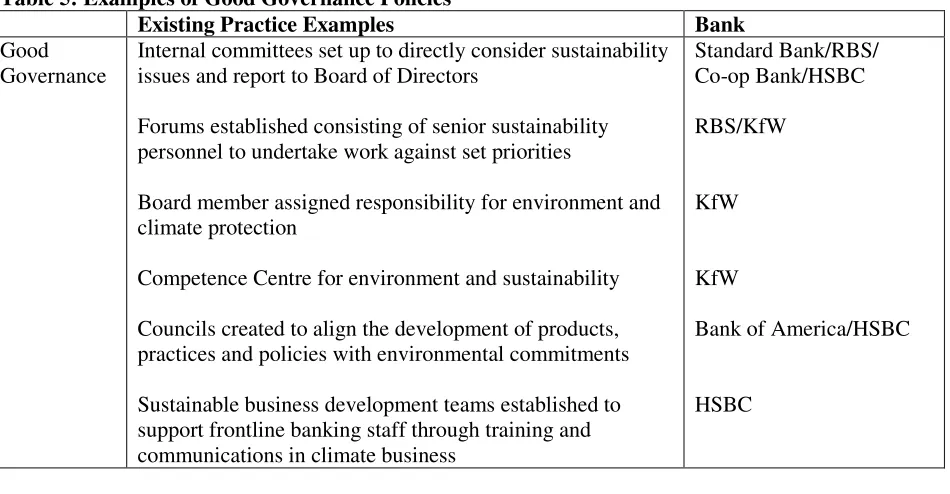
[image:25.612.90.565.451.698.2]A number of banks have taken measures to hardwire sustainability within the governance structures of their organisation. The most common approach taken has been to establish internal committees or councils that in most cases report directly to the Board of Directors on sustainability matters. In some instances forums have been set up to take forward the work of these committees and consist of senior sustainability managers and officers. Some banks such as KfW in Germany have also assigned a board member with direct responsibility for environment and climate protection while others such as HSBC have sustainable business teams in place that provide training and support to frontline staff on climate change issues.
Table 5: Examples of Good Governance Policies
Existing Practice Examples Bank
Good Governance
Internal committees set up to directly consider sustainability issues and report to Board of Directors
Forums established consisting of senior sustainability personnel to undertake work against set priorities
Board member assigned responsibility for environment and climate protection
Competence Centre for environment and sustainability
Councils created to align the development of products, practices and policies with environmental commitments
Sustainable business development teams established to support frontline banking staff through training and communications in climate business
Standard Bank/RBS/ Co-op Bank/HSBC
RBS/KfW
KfW
KfW
Bank of America/HSBC
HSBC
29
Environmental and Risk Management
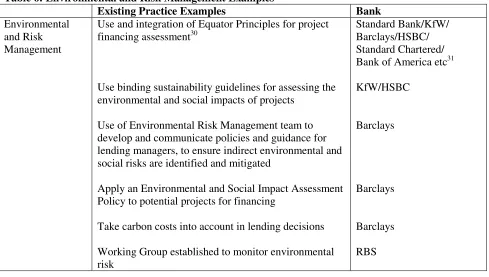
[image:26.612.86.575.259.536.2]Many banks use different techniques and methods for incorporating environmental and social factors into their risk assessment process. The most widely used approach within the industry is to employ the Equator Principles (EPs) which are based on the International Finance Corporation (IFC) Performance Standards on social and environmental sustainability and on the World Bank Group Environmental, Health and Safety Guidelines. These principles provide a credit risk management framework for determining, assessing and managing environmental and social risk in project finance transactions. The EPs commit participating institutions to not providing loans to projects where the borrower will not or is unable to comply with their respective social and environmental policies and procedures. Some banks have also developed their own set of sustainability guidelines for assessing projects on environmental and social grounds and established environmental risk management teams or working groups to take forward this work.
Table 6: Environmental and Risk Management Examples
Existing Practice Examples Bank
Environmental and Risk Management
Use and integration of Equator Principles for project financing assessment30
Use binding sustainability guidelines for assessing the environmental and social impacts of projects
Use of Environmental Risk Management team to develop and communicate policies and guidance for lending managers, to ensure indirect environmental and social risks are identified and mitigated
Apply an Environmental and Social Impact Assessment Policy to potential projects for financing
Take carbon costs into account in lending decisions
Working Group established to monitor environmental risk
Standard Bank/KfW/ Barclays/HSBC/ Standard Chartered/ Bank of America etc31
KfW/HSBC
Barclays
Barclays
Barclays
RBS
Training
Different forms of training related to sustainable development are also currently being provided and rolled out to staff members across a number of financial institutions. These cover areas such as evaluating social and environmental risk (E&S) in lending and financing, human rights, ethical policies and a programme for awareness raising on the social economy. Standard Chartered bank
30
While the industry norm is to apply the principles in the area of project finance, some banks such as HSBC and Standard Chartered have extended the application of the principles to other areas such as export credit loans and debt and equity finance.
31