Evolution of primary care databases in
UK: a scientometric analysis of research
output
Paraskevas Vezyridis, Stephen Timmons
To cite:Vezyridis P, Timmons S. Evolution of primary care databases in UK: a scientometric analysis of research output.BMJ Open2016;6:e012785. doi:10.1136/bmjopen-2016-012785
▸ Prepublication history for this paper is available online. To view these files please visit the journal online (http://dx.doi.org/10.1136/ bmjopen-2016-012785). Received 25 May 2016 Revised 27 July 2016 Accepted 12 September 2016
Centre for Health Innovation, Leadership and Learning (CHILL), Nottingham University Business School, Nottingham, UK
Correspondence to
Dr Paraskevas Vezyridis; Paraskevas.Vezyridis@ nottingham.ac.uk
ABSTRACT
Objective:To identify publication and citation trends, most productive institutions and countries, top journals, most cited articles and authorship networks from articles that used and analysed data from primary care databases (CPRD, THIN, QResearch) of pseudonymised electronic health records (EHRs) in UK.
Methods:Descriptive statistics and scientometric tools were used to analyse a SCOPUS data set of 1891 articles. Open access software was used to extract networks from the data set (Table2Net), visualise and analyse coauthorship networks of scholars and countries (Gephi) and density maps (VOSviewer) of research topics co-occurrence and journal cocitation. Results:Research output increased overall at a yearly rate of 18.65%. While medicine is the main field of research, studies in more specialised areas include biochemistry and pharmacology. Researchers from UK, USA and Spanish institutions have published the most papers. Most of the journals that publish this type of research and most cited papers come from UK and USA. Authorship varied between 3 and 6 authors. Keyword analyses show that smoking, diabetes, cardiovascular diseases and mental illnesses, as well as medication that can treat such medical conditions, such as non-steroid anti-inflammatory agents, insulin and antidepressants constitute the main topics of research. Coauthorship network analyses show that lead scientists, directors or founders of these databases are, to various degrees, at the centre of clusters in this scientific community.
Conclusions:There is a considerable increase of publications in primary care research from EHRs. The UK has been well placed at the centre of an expanding global scientific community, facilitating international collaborations and bringing together international expertise in medicine, biochemical and pharmaceutical research.
INTRODUCTION
Big data (analytics) refer to the aggrega-tion and interrogaaggrega-tion of—high volume, high velocity, high variety—data sets so as to reveal new, non-obvious, information and patterns.1This field is advancing because of
technological and scientific developments in information infrastructure and digitisation.2 For governments, opening up the data sets states hold about their citizens is believed to have, through computational and algorith-mic analyses, a disruptive and transformative effect on knowledge.3In the UK, big (open) data have been at the forefront of research activity and policymaking. Termed as one of the eight great technologies,4 UK has embraced the big (open) data movement more than many other developed countries (eg, USA, Australia, France).3 One area of particular relevance to big data analytics is healthcare.
In UK, the National Health Service (NHS) is organised around primary care and, unless there is an accident or emergency, whenever citizens would like to use the NHS they have to go through their primary care physician, known in the UK as a general practitioner (GP). From there, they can be referred to a specialist at a hospital if necessary. Secondary care clinicians can then feedback informa-tion to GPs. Since the vast majority of the population (98%) is registered with a general practice, GPs act not only as the main gatekeepers for the NHS but also as important custodians of a longitudinal elec-tronic health record (EHR).5There are now many ongoing primary care databases of
Strengths and limitations of this study
▪ First study to perform a scientometric analysis of research output from primary care databases of electronic patient records.
▪ We analysed articles published from 1995 to 2015 in order to explore the historical breadth and growth of this type of research.
▪ The analysis is limited to articles and structured data retrieved from the Scopus database.
▪ Some latest articles and related citations might not have appeared in Scopus when the data set was extracted.
Vezyridis P, Timmons S.BMJ Open2016;6:e012785. doi:10.1136/bmjopen-2016-012785 1
Open Access Research
group.bmj.com on December 5, 2016 - Published by
anonymised patient records in UK that can be used for healthcare research. These population-based databases contain data originating from routine general practice. Some newly established databases and research plat-forms of linked EHRs include ResearchOne6 and CALIBER.7 While there are more than 9600 general practices in UK that could potentially contribute data to these databases,8 it is usually 6–10% of these practices that do so.
Such databases are usually used for cross-sectional surveys, case–control or cohort studies and for epidemio-logical, drug safety, clinical and healthcare usage research purposes. They rely heavily on individual general practices voluntarily contributing data via the propriety clinical systems they use to maintain these patient records. The records are usually anonymised or pseudoanonymised at source by allocating a unique number to each patient to allow for the updates of the records as well as for their linkage to other data sets, such as national mortality, national cancer registration and hospital records as well as with socioeconomic, eth-nicity and environmental data sets. Access to these data sets is usually granted after scientific and ethics review and can be tailored to customer requirements. In this study, we examined the research output of three such databases that are well established in the research com-munity and have contributed to a substantial number of scientific studies and publications. These are the Clinical Practice Research Datalink (CPRD),9 The Health Improvement Network (THIN)10and QResearch.11
The CPRD (formerly known as the General Practice Research Database) is a not-for-profit research service funded by the NHS National Institute for Health Research (NIHR) and the Medicines and Healthcare products Regulatory Agency (MHRA). It is owned by the UK Department of Health and contains the records of 11 million patients (4.4 million active) from 674 general practices.5 There is a service cost associated with the preparation of the requested data. Unlike the other ser-vices described below, CPRD does not extract data from a particular propriety clinical system. Any general prac-tice can contribute data after a data sharing agreement with the software supplier. Importantly, it is the only database accessible online.12 The THIN database con-tains the health records of 12 million patients from around 600 general practices that use the Vision clinical system by In Practice Systems (INPS). IMS Health can provide access to data, for example, via a yearly subli-cense to an academic institution. THIN is the only data-base that can provide access to data for for-profit companies. QResearch is a research service located at the University of Nottingham. Its database contains the health records of 18 million patients from 1000 general practices that use the EMIS clinical system. Only aca-demics employed by a UK university can have (in site) access only to a sample of the data set (maximum 100 000 patients) that is sufficient to answer a specific research question or hypothesis. As this research service
is not-for-profit and entirely self-funded, there is usually a fee to be paid to cover the cost of the data extraction.
The strengths of these databases lie in their size, breadth, representativeness of the UK population, long-term follow-up and data quality.5 They include good information on morbidity and lifestyle, prescribing, pre-ventive care, current standards of care and interpractice variation.13 Since they are continually (and automatic-ally) updated, they are ideal for researchers to discover and monitor healthcare trends as well as the effectiveness of new interventions and treatments, with minimum cost. They are increasingly linked to secondary care and mor-tality data sets. In contrast, their weaknesses include the fact that data are extracted from propriety clinical systems developed for patient management and not for health-care research. There are issues of missing data (eg, from healthy patients), variable definitions for diagnoses and incomplete secondary care data (eg, hospital admis-sions). Wider health data (eg, treatment adherence, over the counter medication) and data about subpopulations (eg, prisoners, homeless people, refugees, travellers) are not captured adequately.5 Information governance and informed consent procedures around the data sharing of EHRs for research are still considered complex.14 These databases also require considerable clinical and scientific expertise, as well as technical capacity in data management to support research. When selecting a particular data resource for an observational study, researchers have to consider several other factors, such as the population covered and its geographical distribution, data capture and latency, linkage with other resources, privacy and security, quality and validation.15
Nonetheless, these databases are highly regarded within the research community since they have proved their value in helping researchers reach definitive answers in various healthcare debates of considerable public interest, particularly where other types of research have produced contradictory evidence. For example, in 2004 researchers from UK and Canada proved beyond doubt that measles–mumps–rubella (MMR) vaccination is not associated with autism in children.16 In contrast to expensive, time-consuming, and unrepresentative (of the population) traditional randomised trials,17 large-scale and randomised observational (comparative) evaluations of treatments and medications are minimally obtrusive for clinicians and patients and can support faster turn-around times for pragmatic evidence useful in clinical practice.18
overview of its knowledge base and an indication of what kind of network features, research activities and topics of interest are driving it.20 21To the best of our knowledge, this is thefirst study of a systematic mapping of primary care databases research output.
METHODS
In this study, Elsevier’s Scopus database (http://www. scopus.com) was selected as the source of structured data on articles. This database covers more scientific arti-cles than other databases (eg, Thomson Reuters Web of Science) and has the advantage of providing advance export functionality of structured data, including full cit-ation informcit-ation, abstracts, keywords and references. On 30 October 2015, we searched, using the document search functionality, for all articles containing the terms ‘General Practice Research Database (GPRD)’ OR ‘Clinical Practice Research Datalink (CPRD)’ OR ‘The Health Improvement Network (THIN)’OR ‘QResearch’ in article title, abstract and keywords.
The results were then limited toarticles,articles in press, conference papers, reviews, book chapters and short surveys. Notes,letters, editorials and erratawere excluded from the analysis. From there, we compared the resulted records with the bibliographic lists maintained by these data-bases22–24 so as to include articles that could not be retrieved using the above search queries. Data cleansing included the removal of duplicate records and records that were missing essential information for the analysis (eg, article title, journal). The fields of authors, year, source title, affiliations, author keywords and document type were used for the analysis.
The final bibliography retrieved from Scopus was imported toTable 2Net25 to extract networks of authors and contributing countries. It was then imported to Gephi26 where the ForceAtlas 2 algorithm27 was used to visualise the structural proximities for the communities of authors and contributing countries. The VOSviewer (V.1.6.3)28software was used to visualise bibliometric net-works and densities29 of frequent terms and journals. All other statistical analyses were performed using Microsoft Excel. We used the Journal Citation Reports ( JCR) Science Edition 2014 to extract impact factor values for the identified journal titles.
RESULTS
A total of 1891 papers from 1995 to 2015 were included in this bibliometric and scientometric analysis. The results are presented below.
Publication and citation trends
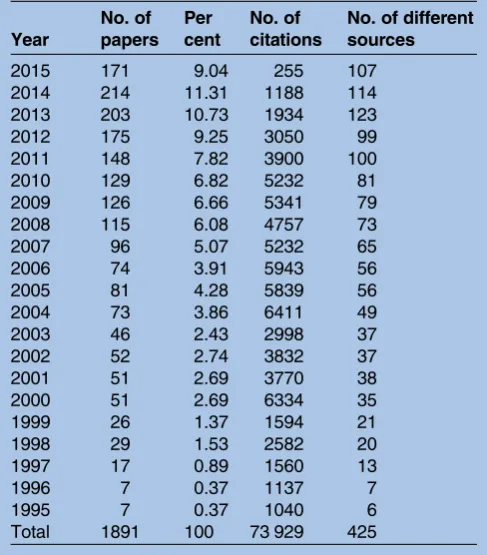
The literature related to the 3 primary care databases in England increased gradually from 7 papers in 1995 to 171 in 2015 (table 1). We estimated their compound annual growth rate (CAGR), for the years 1995–2014, to be 18.65%. The vast majority of papers were published in English across 425 different sources (16.76% CAGR
for 1995–2014). In total, these papers have already been cited 73 929 times. There is, however, a small percentage of 1.16% (n=163) papers that have not yet been cited yet. The average citation per year is∼3.52.
We explored the distribution of publications by docu-ment type. This is presented intable 2to identify the pre-ferences of scholars using these databases in their research to share knowledge. The vast majority of scholars prefer to publish the findings of their research through journals, particularly as original articles (96.5%).
[image:3.595.308.552.64.342.2]Next, we analysed the distribution of papers based on the academic discipline in which they have been cate-gorised by Scopus (table 3) and by which each paper may be attributed to more than one subject area.30 Since we analysed bibliographic data based on published research using primary care databases, it comes as no surprise that the vast majority of papers are under the medicine category. There is, however, a considerable number of papers (∼25%) under the categories biochem-istry, genetics and molecular biology and pharmacology,
Table 2 Distribution of scientific literature by document type
Type No. of papers Per cent
Article 1825 96.5
Conference paper 18 0.95
Book chapter 4 0.21
Review 41 2.16
[image:3.595.309.552.657.734.2]Short survey 3 0.15
Table 1 Distribution of scientific literature by year
Year
No. of papers
Per cent
No. of citations
No. of different sources
2015 171 9.04 255 107 2014 214 11.31 1188 114 2013 203 10.73 1934 123 2012 175 9.25 3050 99 2011 148 7.82 3900 100 2010 129 6.82 5232 81 2009 126 6.66 5341 79 2008 115 6.08 4757 73 2007 96 5.07 5232 65 2006 74 3.91 5943 56 2005 81 4.28 5839 56 2004 73 3.86 6411 49 2003 46 2.43 2998 37 2002 52 2.74 3832 37 2001 51 2.69 3770 38 2000 51 2.69 6334 35 1999 26 1.37 1594 21 1998 29 1.53 2582 20 1997 17 0.89 1560 13 1996 7 0.37 1137 7 1995 7 0.37 1040 6 Total 1891 100 73 929 425
Vezyridis P, Timmons S.BMJ Open2016;6:e012785. doi:10.1136/bmjopen-2016-012785 3
Open Access group.bmj.com
on December 5, 2016 - Published by http://bmjopen.bmj.com/
toxicology and pharmaceutics, which indicates an emphasis on the use of these databases for the study of medica-tions. It also indicates the potential interest in these databases from the pharmaceutical sector.
Most productive institutions and countries
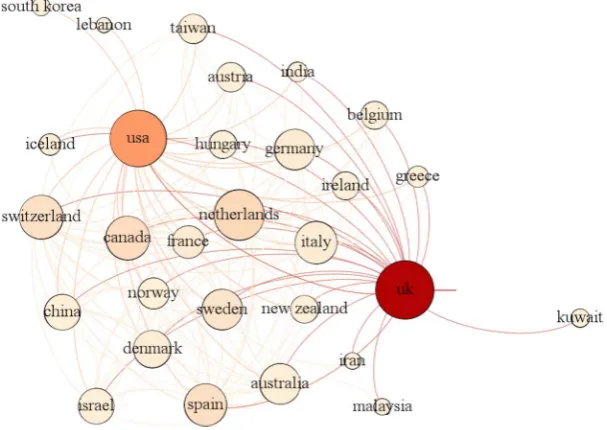
For a deeper insight into contribution patterns and sci-entific impact, we first identified the top 10 institutions (by number of papers) authors have used as affiliation and then we analysed citation patterns (table 4). We also analysed authors’ affiliations based on the country of their institution. For this, each publication was assigned to its authors’ respective affiliated countries so as to identify the network of multinational collaborations. The distribution of the top 10 contributing countries is presented intable 5. Finally, we visualised the network of contributing countries using Gephi. We ended up with a network of 29 nodes and 175 edges (figure 1). Each node represents a country, while its size denotes the country’s degree and the colour the number of papers.
The thickness of interconnected lines (edges) denotes the number of coauthored papers between the countries.
[image:4.595.309.552.58.197.2]The majority of the most productive institutions are universities. Top universities include the University of Nottingham, Boston University, University College London (UCL), the London School of Hygiene & Tropical Medicine and the University of Utrecht. Apart from these academic institutions, a research unit in Spain (CEIFE) and the MHRA in the UK are involved in primary care databases-based research. In this table, we also report the medians along with the IQRs. From this, it seems that scholars from CEIFE, University of Pennsylvania and Boston University are coauthors in publications that are highly cited compared to the other institutions in this list. Switzerland, Canada, Sweden, Germany, France and Italy had no institution among the top 10 list, although they were ranked among the top 10 productive countries. Most papers are published by scho-lars from UK (63.56%), followed by the USA and Spain. With the exception of USA and Canada, most of the productive countries are in Europe. What is particularly interesting in these two tables is that scholars in institu-tions from the USA and Spain produce not only a great Table 3 Distribution of scientific literature by discipline
Subject
No. of papers
Per cent
Medicine 1838 97.2
Biochemistry, genetics and molecular biology
266 14.1
Pharmacology, toxicology and pharmaceutics
197 10.4
Neuroscience 78 4.1
Immunology and microbiology 70 3.7 Agricultural and biological
sciences
53 2.8
Nursing 44 2.3
Psychology 21 1.1
Arts and humanities 13 0.7 Environmental science 10 0.5
Table 4 Most productive institutions
Rank Institution
No. of papers
Per cent
Total
citations Median (IQR) Country
1 University of Nottingham 266 14.06 11 540 18 (6–44.75) UK 2 Boston University 228 12.05 12 328 21.5 (6–57) USA 3 Centro Espanol de Investigacion
Farmacoepidemiologica (CEIFE)
163 8.62 8493 26 (7–59.5) Spain
4 University College London 156 8.25 5226 14 (4.75–37) UK 5 London School of Hygiene & Tropical
Medicine
124 6.55 3696 14 (4–40.5) UK
6 University of Utrecht 118 6.24 5067 17.5 (4–48.75) The Netherlands 7 University of Pennsylvania 110 5.81 7508 24.5 (10–64.25) USA 8 Medicines and Healthcare Products
Regulatory Agency
94 4.97 2623 14 (4–33.25) UK
9 King’s College London 92 4.86 2221 13 (4–32.75) UK 10 University of Oxford 86 4.54 1806 9.5 (3–23.25) UK
Table 5 Top contributing countries
Rank Country No. of papers Per cent
1 UK 1202 63.56
2 USA 563 29.77
3 Spain 192 10.15
4 Netherlands 164 8.67 5 Switzerland 115 6.08
6 Canada 112 5.92
7 Sweden 106 5.60
8 Germany 64 3.38
9 France 51 2.69
[image:4.595.44.562.545.736.2]number of publications but also publications that are widely recognised by this scientific community in terms of citations.
Taking into account the measurements of weighted degree, clustering, eigenvector centrality and betweenness centrality (table 6), we observe that once again the UK, followed by USA, is placed at the centre of this scientific community. With the highest degrees of all measurements, institutions from this country are the most well-connected and authoritative ones, facilitating the linking between institutions in other countries.
Top journals
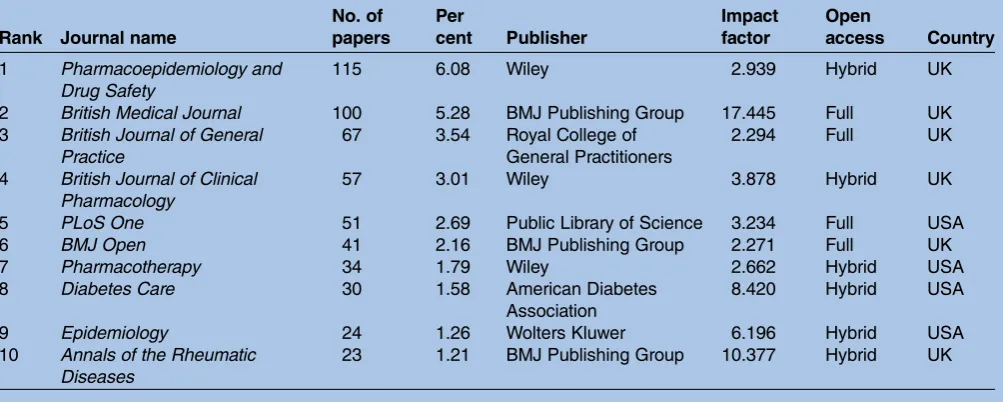
In table 7, we identify the top 10 journals where most research is published. Six of these journals are published by a UK publisher, and the rest are published in the USA. The journalPharmacoepidemiology and Drug Safetyfeatures at the top of list, followed by theBritish Journal of Clinical Pharmacology and Pharmacotherapy, which signifies the focus of research, produced from these primary care databases, on the safe use of medication. This focus can also be seen in table 3, where (apart from medicine)
most papers are published in thefields ofbiochemistry, gen-etics and molecular biology and pharmacology, toxicology and pharmaceutics (Scopus classification), but also in table 5, where most of the top-cited papers refer to potential risk for particular complications/conditions from the use of specific medication. More specialised journals, such as Diabetes CareandAnnals of the Rheumatic Diseases, are also featured in this list, indicating a particular focus of research activity in specific spectrums of diseases.
Four journals in this list are open access (BMJ, British Journal of General Practice, PLoS One, BMJ Open), which greatly facilitates the sharing of knowledge without lim-itations. The BMJ enjoys widespread recognition of the high quality of its published studies, as indicated by the high impact factor. The rest are behind a pay wall but offer authors an open access option to publish their research (hybrid access). An extra column with the Impact Factors of these top 10 journals from the 2014 JCR was also added in the table.
[image:5.595.251.555.50.265.2]What is also of particular importance in terms of sci-entific impact is that the 10 most cited papers identified (seetable 8) have not been published in journals in this Figure 1 Network of contributing
countries.
Table 6 Top countries by centrality
Rank Country Occurrences
Weighted degree
Page rank
Eigen centrality
Closeness centrality
Betweenness centrality
1 UK 5770 27.0 0.062 1.0 0.933 0.250
2 USA 2506 26.0 0.060 0.98 0.903 0.229
3 Netherlands 666 22.0 0.047 0.95 0.8 0.049 4 Canada 567 18.0 0.039 0.83 0.717 0.024 5 Switzerland 409 18.0 0.039 0.85 0.717 0.015
6 Italy 85 17.0 0.037 0.78 0.7 0.024
7 Spain 481 17.0 0.037 0.82 0.7 0.011
8 Australia 37 16.0 0.036 0.76 0.682 0.024 9 Sweden 315 16.0 0.036 0.77 0.682 0.023 10 Germany 121 16.0 0.036 0.71 0.682 0.020
Vezyridis P, Timmons S.BMJ Open2016;6:e012785. doi:10.1136/bmjopen-2016-012785 5
Open Access group.bmj.com
on December 5, 2016 - Published by http://bmjopen.bmj.com/
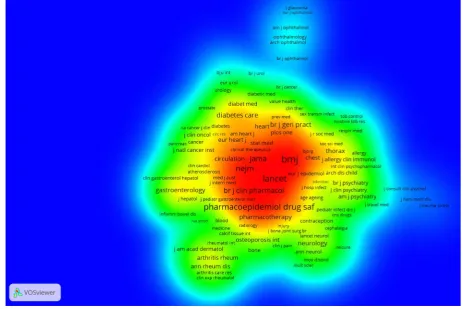
[image:5.595.44.555.582.736.2]list. However, by performing a (full counting) analysis of cocitation links in VOSviewer (figure 2) for journals cited in the Scopus data set (minimum number of cita-tions=10) we see that most of this list is represented here (blue—lowest density, red—highest density).
Most cited papers
Next, we focused on the top 10 papers31–40 and cal-culated the total count of citations for each paper (table 8) for the period 1995–2015. Citations totalled 7194 (1.02%) of all citations in this data set. It seems that these studies in dementia, psoriasis, fractures, car-diovascular diseases and gastrointestinal complications in relation to certain medications have been of great interest in this scientific community. The majority of the top 10 most cited papers (60%) are open access at the publisher’s website and can be freely read by anyone.
Of the 10 papers, 8 are single country papers, while none were singled authored. Again, the USA has a con-siderable presence in this list, producing papers that are highly cited. In addition, many of the highly productive authors identified (table 10) were also found in this list.
Authorship patterns and networks
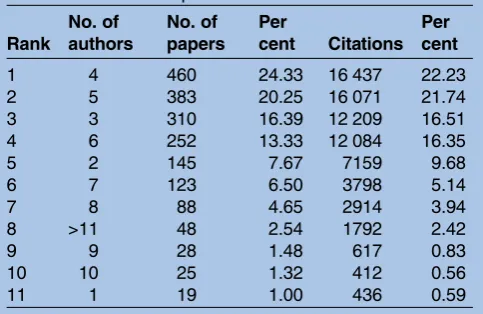
Authorship distributions varied from single to a maximum of 155 authors—for a study about the feasibil-ity of international collaboration to evaluate, based on a common protocol, the risk of Guillain–Barré syndrome following pH1N1 vaccination.41In total, there were 9385 authors involved in the 1981 papers during 1995–2015. In table 9, we can see that more than three-quarters of all papers were published by three or more authors. Only 1% of papers were written by a single author, while five papers did not have any authorship details. Almost a quarter of all papers was published by four authors, which have been widely cited across this scientific com-munity. This indicates the high degree of expert
collaboration in this field, that is necessary in analysing millions of primary care records.
Table 10 provides the ranking of the top 10 scholars, first, in terms of research productivity based on the overall number of coauthored papers. While, generally, most scholars are from the UK, the Director of the Spanish Centre for Pharmacoepidemiologic Research (CEIFE)42 is the scholar with the most published research from these primary care databases. Also, there are researchers in thisfield who do not necessarily come from the academic environment. The pharmaceutical sector is actively involved in knowledge production from electronic primary care records.
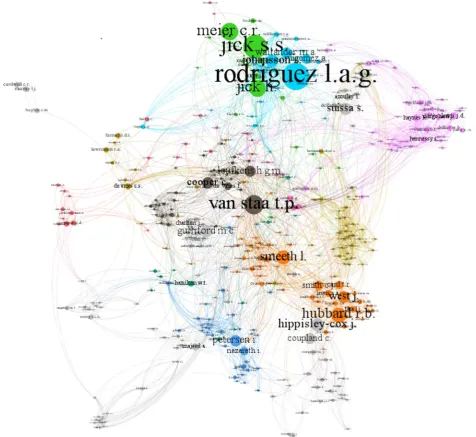
Considering only those scholars who have coauthored at least two papers in this data set, the analysis suggested a network (figure 3) with 1261 nodes and 6186 edges. Here, each node represents an author, while its size denotes the number of author’s papers. The intercon-nected lines (edges) denote the coauthored papers between those authors. For better visualisation, we limited the number of minimum degrees to 5 (maximum degrees=145). After a modularity measurement, to iden-tify community structure,43 we observe some established collaborative teams (clusters with different colours) around specific and highly productive scholars in the ana-lysis of data from primary care databases also found in table 10. We also observe a new (blue) cluster around the lead statistician for THIN44—one of the three primary care databases studied.
[image:6.595.49.551.65.266.2]Taking into account the measurements of weighted degree,clustering,eigenvector centralityandbetweenness central-ity (table 10), results indicate a cluster placed at the centre of this scientific community. With the lowest degree of clustering and the highest degrees of all the other measurements, its prominent scholar is the most well-connected, facilitating, more than any other scholar, linking between other scientific clusters and scholars. Table 7 Top journals of published research
Rank Journal name
No. of papers
Per
cent Publisher
Impact factor
Open
access Country
1 Pharmacoepidemiology and Drug Safety
115 6.08 Wiley 2.939 Hybrid UK
2 British Medical Journal 100 5.28 BMJ Publishing Group 17.445 Full UK
3 British Journal of General Practice
67 3.54 Royal College of General Practitioners
2.294 Full UK
4 British Journal of Clinical Pharmacology
57 3.01 Wiley 3.878 Hybrid UK
5 PLoS One 51 2.69 Public Library of Science 3.234 Full USA
6 BMJ Open 41 2.16 BMJ Publishing Group 2.271 Full UK
7 Pharmacotherapy 34 1.79 Wiley 2.662 Hybrid USA
8 Diabetes Care 30 1.58 American Diabetes
Association
8.420 Hybrid USA
9 Epidemiology 24 1.26 Wolters Kluwer 6.196 Hybrid USA
10 Annals of the Rheumatic Diseases
Table 8 Most cited papers
Rank Authors/title Year Country Journal
Impact
factor Citations Open access
1 Jick H, Zornberg GL, Jick SS, Seshadri S, Drachman DA 2000 USA Lancet 45.217 1322 No Statins and the risk of dementia
2 Gelfand JM, Neimann AL, Shin DB, Wang X, Margolis DJ, Troxel AB
2006 USA Journal of the American Medical Association
35.289 854 Yes
Risk of myocardial infarction in patients with psoriasis
3 Van Staa TP, Leufkens HGM, Abenhaim L, Zhang B, Cooper C 2000 UK Journal of Bone and Mineral Research
6.832 796 Yes Use of oral corticosteroids and risk of fractures
4 Henry D, Lim LLY, Rodriguez LAG, Perez Gutthann S, Carson JL, Griffin M, Savage R Logan R, Moride Y, Hawkey C, Hill S, Fries JT
1996 Australia, Spain, USA, New Zealand, UK
British Medical Journal 17.445 688 Yes
Variability in risk of gastrointestinal complications with individual non-steroidal anti-inflammatory drugs: Results of a collaborative meta-analysis
5 Yang YX, Lewis JD, Epstein S, Metz DC 2006 USA Journal of the American Medical Association
35.289 637 Yes Long-term proton pump inhibitor therapy and risk of hip fracture
6 Currie CJ, Poole CD, Gale EAM 2009 UK Diabetologia 6.671 629 Yes
The influence of glucose-lowering therapies on cancer risk in type 2 diabetes
7 Jick H, Jick SS, Gurewich V, Myers MW, Vasilakis C 1995 USA, UK Lancet 45.217 612 No Risk of idiopathic cardiovascular death and nonfatal venous
thromboembolism in women using oral contraceptives with differing progestagen components
8 Dial S, Delaney JAC, Barkun AN, Suissa S 2005 Canada Journal of the American Medical Association
35.289 582 Yes Use of gastric acid-suppressive agents and the risk of
community-acquiredClostridium difficile-associated disease 9 Smeeth L, Thomas SL, Hall AJ, Hubbard R, Farrington P,
Vallance P
2004 UK New England Journal of Medicine
55.873 546 Yes
Risk of myocardial infarction and stroke after acute infection or vaccination
10 Neimann AL, Shin DB, Wang X, Margolis DJ, Troxel AB, Gelfand JM
2006 USA Journal of the American Academy of Dermatology
4.449 528 No
Prevalence of cardiovascular risk factors in patients with psoriasis
V
ezyridis
P
,
Timmon
s
S.
BMJ
Open
2016;
6
:e012785
.
doi:10.1
136/bmjopen-2016-0127
85
7
Open
Acces
s
group.bmj.com
on December 5, 2016 - Published by
http://bmjopen.bmj.com/
What is also particularly interesting is the fact that some of the scholars (and their institutions) in this list are affiliated, to a certain extent, to these databases, having served or currently acting as their founders, directors, lead scientists or members of their scientific committee.45 46 For example, lead scientists from the Boston Collaborative Drug Surveillance Program in Boston University were among the first who developed the technical and scientific capacity of these databases in pharmacoepidemiological research.47 48
Research topics
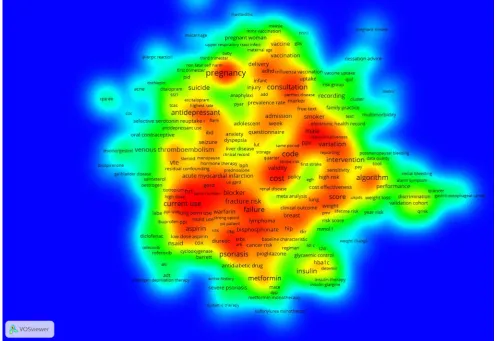
We conducted a keyword analysis to identify important topics of published research. For this, wefirst extracted from the bibliographic data set 5813 unique keywords as indexed by Scopus30 to base our analysis on more com-plete indexing information compared to authors’ key-words. We retrieved the top 30 keywords for two specific categories: medical conditions and medications/substances (tables 11and12). Next, we created a (full counting of ) term co-occurrence density map in VOSviewer (figure 4) by building a text corpus out of the title and abstract fields in the bibliographic data set (minimum number of a term occurrence=10). In this way, we were able to identify topics that not only appear more frequently in the literature, but that were also strongly related to each other, forming clusters of topics. Blue indicates a low density of terms and red indicates the highest density of
terms. In many cases, the density map represents the fre-quency of indexed keywords intables 11and12. Clearly, smoking, diabetes, cardiovascular diseases, mental ill-nesses, psoriasis, obesity, pregnancy and cancer as well as medication and substances that can treat these medical conditions, such as aspirin, insulin, antidepressants and non-steroid anti-inflammatory agents (NSAIDs), have been of great interest for scholars using EHRs in primary care.
DISCUSSION
[image:8.595.64.528.50.359.2]can be located, generally, in medicine, biochemical and pharmaceutical developments seem to be equally important, aimed at addressing widespread medical con-ditions, such as diabetes, cardiovascular diseases, mental illnesses, smoking, obesity and cancer.
The UK has been well placed in this scientific field. This is partly due to the fact that there is now more than 30 years of data available in GP information systems.49 The investment in developing primary care databases from EHRs for research purposes has placed the country at the centre of a network of collaborations across the globe, bringing together international expert-ise for the analysis of ever-expanding and increasingly interlinked clinical data sets from primary, secondary and tertiary care. Access to these data sets has also allowed researchers and institutions from other coun-tries to develop their own programmes of research to answer important clinical questions. Six of the most pro-ductive institutions are located in the UK, and 63.56% of publications were authored by scholars affiliated with this country, followed by the USA. Interestingly, the top institutions were not exclusively universities. Among them, we canfind a research unit in Spain (CEIFE) and the executive agency in UK that funds and runs the CPRD database (MHRA), while one of the most product-ive scholars is affiliated with a pharmaceutical company. This signifies the great interest of various actors, from aca-demic, governmental and private sectors, in research with primary care databases.
The geographical trend can also be observed from the location of journals with the most published papers. Six of the top 10 journals are published in the UK, followed by the USA. The journals with the most papers pub-lished included Pharmacoepidemiology and Drug Safety, BMJ,British Journal of General PracticeandBritish Journal of Clinical Pharmacology, which signifies the great interest of scholars in using data from EHRs for pharmaceutical research. This is partially because one of the oldest sets of routine information collected by GP practices in the UK and made available by these databases is drug histor-ies.47 Regarding restrictions on access to research outputs, only four journals in this list are fully open
[image:9.595.45.287.62.219.2]a- c- e-ss. T- h-is Table 9 Coauthorship distribution
Rank No. of authors No. of papers Per cent Citations Per cent
1 4 460 24.33 16 437 22.23 2 5 383 20.25 16 071 21.74 3 3 310 16.39 12 209 16.51 4 6 252 13.33 12 084 16.35 5 2 145 7.67 7159 9.68 6 7 123 6.50 3798 5.14 7 8 88 4.65 2914 3.94 8 >11 48 2.54 1792 2.42
9 9 28 1.48 617 0.83
10 10 25 1.32 412 0.56 11 1 19 1.00 436 0.59
T able 10 Mos t pr oductiv e authors Rank Au thor Affilia tion C ountr y No. of papers W eighted degr ee Clus tering Eigen centr ality Closeness centr ality Betw eenness centr ality 1 R odriguez LAG Spanish C entr e for Pharma coepidemiologic R esear ch (CE IFE) Spain 166 82.0 0.082 0.346 0.337 0.073 2 Jick SS Bos ton Univ ersity USA 142 90.0 0.066 0.327 0.329 0.078 3 V an Staa TP Univ ersity of Manches ter UK 115 144.0 0.063 1.0 0.403 0.217 4 Jick H Bos ton Univ ersity USA 98 55.0 0.098 0.217 0.322 0.032 5 Meier CR Univ ersity of Basel Switzerland 94 54.0 0.116 0.232 0.294 0.014 6 Hubb ard R Univ ersity of Nottingham UK 86 82.0 0.092 0.441 0.359 0.067 7 Sme eth L London School of Hyg iene & T ropical Medicine UK 79 89.0 0.101 0.578 0.366 0.067 8 Hipp isle y-C ox J Univ ersity of Nottingham UK 72 57.0 0.144 0.244 0.325 0.065 9 Johansso n S As tr aZeneca Sw eden 70 46.0 0.218 0.267 0.310 0.012 10 C ooper C Univ ersity of Southampton UK 65 67.0 0.139 0.414 0.342 0.035 W e s t J Univ ersity of Nottingham UK 65 42.0 0.213 0.230 0.310 0.012
Vezyridis P, Timmons S.BMJ Open2016;6:e012785. doi:10.1136/bmjopen-2016-012785 9
Open Access group.bmj.com
on December 5, 2016 - Published by http://bmjopen.bmj.com/
may limit access to knowledge to researchers and members of the public that cannot afford subscription costs. Interestingly, it is the more established journals in medicine, such as JAMA, Lancet and NEJM, that have published some of the most cited papers in this biblio-metric data set and enjoy a high level of cocitation activity.
Keyword analyses show that smoking, diabetes, cardio-vascular diseases, mental illnesses, psoriasis, obesity, pregnancy and cancer constitute the main topics of research activity using EHRs in primary care. Often, this research concentrates on developing algorithms to iden-tify risk of occurrence of a particular disease. Researchers are also interested in investigating medications that can treat these medical conditions, such as aspirin, other NSAIDs, insulin and antidepressants.
[image:10.595.59.536.48.485.2]more researchers, institutions and countries. Importantly, they have a clear and in-depth understand-ing of the kind of research activities these databases can support in terms of data quality, structure and EHR coding practices. As these databases are expected to open up in the future to more stakeholders from various disciplines around health and as universities prepare to incorporate training in data science skills (eg, statistics, biomedical informatics, biology and medicine)51 into their clinical curricula, so as to nurture the next gener-ation of clinical investigators,52 these established researchers could promote quality, reliable and ethically appropriate scientific research53 from complicated and highly contextual data sets.
Our study has the typical limitations of a scientometric study. We analysed articles published in a period of 20 years in order to explore the historical breadth and
[image:11.595.46.566.63.253.2]growth of research from electronic primary care records. However, this analysis is limited on structured data retrieved from one bibliometric database of peer-reviewed literature. Therefore, only articles published in journals in its index were analysed. Also, some of the latest articles and related citations might not have been retrieved at the time of the search, which might explain the decrease in the number of publications and citations particularly from 2010 onwards. It was beyond the scope of this quantitative study to assess the scientific quality and the socioeconomic impact of the large number of publications analysed here. These studies have deployed a range of study designs across many subfields of primary care research and with various research fi nd-ings. Our main objective was restricted to assessing one aspect of academic impact and research quality, that is, patterns and trends in research outputs.54 Future Table 11 Top keywords: medical conditions
Rank Keyword Occurrences Rank Keyword Occurrences
1 Smoking 328 16 Cardiovascular diseases 96 2 Diabetes mellitus 223 17 Myocardial infarction 94 3 Hypertension 223 18 Chronic obstructive lung disease 90 4 Non-insulin dependent diabetes mellitus 179 19 Heart failure 86 5 Depression 167 20 Cerebrovascular accident 85
6 Stroke 165 21 Rheumatoid arthritis 83
7 Asthma 158 22 Epilepsy 81
8 Diabetes mellitus, type 2 155 23 Breast cancer 78
9 Cancer risk 150 24 Fracture 75
10 Cardiovascular risk 147 25 Psoriasis 75 11 Cardiovascular disease 133 26 Gastrointestinal haemorrhage 69
12 Obesity 129 27 Hip fracture 68
13 Heart infarction 126 28 Osteoporosis 68
14 Pregnancy 125 29 Colorectal cancer 65
15 Ischaemic heart disease 104 30 Fractures, bone 65
Table 12 Top keywords: medications/substances
Rank Keyword Occurrences Rank Keyword Occurrences
1 Non-steroid anti-inflammatory agent 182 16 Proton pump inhibitor 75 2 Acetylsalicylic acid 154 17 Warfarin 71
3 Metformin 150 18 Antidiabetic agent 69
4 Corticosteroid 143 19 Anticonvulsive agent 68 5 Hydroxymethylglutaryl coenzyme a
reductase inhibitor
138 20 Serotonin uptake inhibitor 65
6 Insulin 133 21 Calcium channel blocking agent 64 7 Antidepressant agent 124 22 Antibacterial agents 62 8 βadrenergic receptor blocking agent 108 23 Hydroxymethylglutaryl-coA reductase
inhibitors
62
9 Hypoglycemic agents 91 24 Oral antidiabetic agent 61 10 Anti-inflammatory agents,
non-steroidal
90 25 Paracetamol 56
11 Dipeptidyl carboxypeptidase inhibitor 88 26 Diuretic agent 53 12 Antihypertensive agent 82 27 Ibuprofen 52 13 Neuroleptic agent 80 28 Simvastatin 52 14 Antibiotic agent 77 29 Tricyclic antidepressant agent 52
15 Hemoglobin A1c 75 30 Diclofenac 50
Vezyridis P, Timmons S.BMJ Open2016;6:e012785. doi:10.1136/bmjopen-2016-012785 11
Open Access group.bmj.com
on December 5, 2016 - Published by http://bmjopen.bmj.com/
[image:11.595.49.553.296.517.2]research could focus on the wider academic and socio-economic impact of these studies by examining the rela-tionship between publications, citation patterns and collaborations with the development of new scientific methods in the field or of new medical products and healthcare services.
In conclusion, output of primary care research from EHRs has consistently increased since their develop-ment. The development of these databases in the UK has placed the country and affiliated academic institu-tions at the centre of an expanding global scientific community, facilitating international collaborations and bringing together international expertise in medicine, biochemical and pharmaceutical research.
Contributors PV and ST conceived and designed the study. PV collected and analysed the data. PV and ST interpreted the findings, drafted the manuscript and approved the final manuscript for submission.
Funding PV is supported by a Marie Skłodowska-Curie Individual Fellowship from European Commission (2014-IF-659478). ST is partially supported by the National Institute for Health Research (NIHR) Collaboration for Leadership in Applied Health Research and Care (East Midlands).
Disclaimer The views expressed are those of the authors and not necessarily those of the EC, NHS, the NIHR or the Department of Health.
Competing interests None declared.
Provenance and peer review Not commissioned; externally peer reviewed.
Data sharing statement No additional data are available.
Open Access This is an Open Access article distributed in accordance with the terms of the Creative Commons Attribution (CC BY 4.0) license, which permits others to distribute, remix, adapt and build upon this work, for commercial use, provided the original work is properly cited. See: http:// creativecommons.org/licenses/by/4.0/
REFERENCES
1. Richards MR, Anderson S, Hinde J,et al.The collection, linking and use of data in biomedical research and health care: Ethical issues. London, UK: Nuffield Council on Bioethics, 2015.
2. Goffey A, Pettinger L, Speed E. Politics, policy and privatisation in the everyday experience of big data in the NHS. In: Hand M, Hillyard S, eds.Big data? Qualitative approaches to digital research. Emerald Group Publishing Limited, 2014:31–50. http://www.emeraldinsight. com/doi/abs/10.1108/S1042-319220140000013003 (accessed 22 Oct 2015).
3. Verhulst S, Noveck B, Caplan R,et al.The open data era in health
and social care. New York: The GOVLAB (NYU), 2014. http:// images.thegovlab.org/wordpress/wp-content/uploads/2014/10/ nhs-full-report-21.pdf (accessed 10 May 2015).
4. Willetts D.Eight great technologies. London, UK: Policy Exchange,
2013. http://www.policyexchange.org.uk/images/publications/eight% 20great%20technologies.pdf
5. Herrett E, Gallagher AM, Bhaskaran K,et al. Data resource profile: Clinical Practice Research Datalink (CPRD).Int J Epidemiol 2015;44:827–36.
6. Crossfield SSR, Clamp SE. Centralised electronic health records
research across health organisation types. In: Fernández-Chimeno M, Fernandes PL, Alvarez S,et al, eds.Biomedical engineering systems and technologies. Berlin, Heidelberg: Springer,
[image:12.595.49.548.50.391.2]2014:394–406. http://link.springer.com/10.1007/978-3-662-44485-6_ 27 (accessed 10 Apr 2016).
7. Denaxas SC, George J, Herrett E,et al. Data resource profile: cardiovascular disease research using linked bespoke studies and electronic health records (CALIBER).Int J Epidemiol
2012;41:1625–38.
8. HSCIC. General Practice Trends in the UK to 2014. 2014. http://
www.hscic.gov.uk/media/18173/General-Practice-Trends-in-the-UK-to-2014/pdf/gen-prac-trends-2014.pdf (accessed 14 Mar 2016).
9. Walley T, Mantgani A. The UK general practice research database.
Lancet Lond Engl1997;350:1097–9.
10. Bourke A, Dattani H, Robinson M. Feasibility study and methodology
to create a quality-evaluated database of primary care data.Inform Prim Care2004;12:171–7.
11. Hippisley-Cox J, Stables D, Pringle M. QRESEARCH: a new general
practice database for research.Inform Prim Care2004;12:49–50. 12. Williams T, van Staa T, Puri S,et al. Recent advances in the utility
and use of the General Practice Research Database as an example
of a UK Primary Care Data resource.Ther Adv Drug Saf
2012;3:89–99.
13. Gnani S, Azeem M.A user’s guide to data collected in primary care in England. Imperial College London, Eastern Region Public Health Observatory (erpho) on behalf of the Association of Public Health Observatories, 2006. https://www1.imperial.ac.uk/resources/ 579D8B09-C1C1-4026-A7BE-C3E936EE9567/ (accessed 15 Oct 2015).
14. van Staa TP, Dyson L, McCann G,et al. The opportunities and
challenges of pragmatic point-of-care randomised trials using routinely collected electronic records: evaluations of two exemplar trials.Health Technol Assess2014;18:1–146.
15. Hall GC, Sauer B, Bourke A,et al. Guidelines for good database
selection and use in pharmacoepidemiology research. Pharmacoepidemiol Drug Saf2012;21:1–10.
16. Smeeth L, Cook C, Fombonne E,et al. MMR vaccination and
pervasive developmental disorders: a case–control study.Lancet Lond Engl2004;364:963–9.
17. Freemantle N, Marston L, Walters K,et al. Making inferences on
treatment effects from real world data: propensity scores, confounding by indication, and other perils for the unwary in
observational research.BMJ2013;347:f6409.
18. van Staa TP, Goldacre B, Gulliford M,et al. Pragmatic randomised
trials using routine electronic health records: putting them to the test.
BMJ2012;344:e55.
19. Shahram F, Jamshidi AR, Hirbod-Mobarakeh A,et al. Scientometric
analysis and mapping of scientific articles on Behcet’s disease.Int J Rheum Dis2013;16:185–92.
20. Heilig L, Vob S. A scientometric analysis of cloud computing
literature.IEEE Trans Cloud Comput2014;2:266–78.
21. Uuskula A, Toompere K, Laisaar KT,et al. HIV research productivity
and structural factors associated with HIV research output in
European Union countries: a bibliometric analysis.BMJ Open
2015;5:e006591.
22. CPRD. Research papers. https://www.cprd.com/Bibliography/
Researchpapers.asp
23. QResearch. QResearch research articles. http://www.qresearch.org/
SitePages/publications.aspx
24. IMS Health. Bibliography. http://www.epic-uk.org/bibliography/ bibliography_01.shtml
25. Jacomy M. Table2Net MediaLab Tool. Sci.-Po Medialab. http://tools.
medialab.sciences-po.fr/table2net/
26. Bastian M, Heymann S, Jacomy M. Gephi: an open source software
for exploring and manipulating networks. 2009. https://gephi.github.io
27. Jacomy M, Venturini T, Heymann S,et al. ForceAtlas2, a continuous
graph layout algorithm for handy network visualization designed for
the Gephi software.PLoS One2014;9:e98679.
28. van Eck NJ, Waltman L. Software survey: VOSviewer, a
computer program for bibliometric mapping.Scientometrics
2010;84:523–38.
29. van Eck NJ, Waltman L. Visualizing bibliometric networks. In: Ding
Y, Rousseau R, Wolfram D, eds.Measuring scholarly impact. Cham:
Springer International Publishing, 2014:285–320. http://link.springer. com/10.1007/978-3-319-10377-8_13 (accessed 5 Jan 2016).
30. Scopus.Scopus content coverage guide. Elsevier, 2016. https://
www.elsevier.com/__data/assets/pdf_file/0007/69451/scopus_ content_coverage_guide.pdf (accessed 10 Mar 2016).
31. Neimann AL, Shin DB, Wang X,et al. Prevalence of cardiovascular
risk factors in patients with psoriasis.J Am Acad Dermatol 2006;55:829–35.
32. Smeeth L, Thomas SL, Hall AJ,et al. Risk of myocardial infarction
and stroke after acute infection or vaccination.N Engl J Med 2004;351:2611–18.
33. Dial S, Delaney JAC, Barkun AN,et al. Use of gastric
acid-suppressive agents and the risk of community-acquired Clostridium difficile-associated disease.JAMA2005;294: 2989–95.
34. Jick H, Jick SS, Gurewich V,et al. Risk of idiopathic cardiovascular death and nonfatal venous thromboembolism in women using oral
contraceptives with differing progestagen components.Lancet Lond
Engl1995;346:1589–93.
35. Currie CJ, Poole CD, Gale EA. The influence of glucose-lowering
therapies on cancer risk in type 2 diabetes.Diabetologia 2009;52:1766–77.
36. Yang YX, Lewis JD, Epstein S,et al. Long-term proton pump
inhibitor therapy and risk of hip fracture.JAMA2006;296: 2947–53.
37. Henry D, Lim LL, Garcia Rodriguez LA,et al. Variability in risk of gastrointestinal complications with individual non-steroidal anti-inflammatory drugs: results of a collaborative meta-analysis.
BMJ1996;312:1563–6.
38. Van Staa TP, Leufkens HGM, Abenhaim L,et al. Use of oral
corticosteroids and risk of fractures. June, 2000.J Bone Miner Res 2005;20:1487–94; discussion 1486.
39. Gelfand JM, Neimann AL, Shin DB,et al. Risk of myocardial
infarction in patients with psoriasis.JAMA2006;296:1735–41. 40. Jick H, Zornberg GL, Jick SS,et al. Statins and the risk of dementia.
Lancet Lond Engl2000;356:1627–31.
41. Dodd CN, Romio SA, Black S,et al. International collaboration to assess the risk of Guillain Barré Syndrome following Influenza A
(H1N1) 2009 monovalent vaccines.Vaccine2013;31:4448–58.
42. CEIFE. Home. http://www.ceife.es/index.html# (accessed 15 Oct
2015).
43. Newman MEJ, Girvan M. Finding and evaluating community
structure in networks.Phys Rev E Stat Nonlin Soft Matter Phys 2004;69(Pt 2):026113.
44. UCL. People. https://www.ucl.ac.uk/pcph/research-groups-themes/
thin-pub/staff
45. van Staa TP. Professor Tjeerd Van Staa. http://www.
population-health.manchester.ac.uk/staff/158950/
46. QResearch. QResearch Organisation. http://www.qresearch.org/
SitePages/Organisation.aspx (accessed 15 Oct 2015).
47. Lawson DH, Sherman V, Hollowell J. The general practice research
database. Scientific and ethical advisory group.QJM 1998;91:445–52.
48. Boston University. The Clinical Practice Research Datalink. https:// www.bu.edu/bcdsp/gprd/
49. Chisholm J. The Read clinical classification.BMJ1990;300:1092.
50. Azoulay P, Fons-Rosen C, Zivin JSG.Does science advance one
funeral at a time?Cambridge (MA): National Bureau of Economic Research, 2015. http://www.nber.org/papers/w21788.pdf (accessed 5 Jan 2016).
51. Margolis R, Derr L, Dunn M,et al. The National Institutes of Health’s Big Data to Knowledge (BD2K) initiative: capitalizing on biomedical
big data.J Am Med Inform Assoc2014;21:957–8.
52. Krumholz HM. Big data and new knowledge in medicine: the
thinking, training, and tools needed for a learning health system. Health Aff (Millwood)2014;33:1163–70.
53. Ioannidis JPA, Greenland S, Hlatky MA,et al. Increasing value and
reducing waste in research design, conduct, and analysis.Lancet 2014;383:166–75.
54. Penfield T, Baker MJ, Scoble R,et al. Assessment, evaluations,
and definitions of research impact: a review.Res Eval 2014;23:21–32.
Vezyridis P, Timmons S.BMJ Open2016;6:e012785. doi:10.1136/bmjopen-2016-012785 13
Open Access group.bmj.com
on December 5, 2016 - Published by http://bmjopen.bmj.com/
scientometric analysis of research output
Evolution of primary care databases in UK: a
Paraskevas Vezyridis and Stephen Timmons
doi: 10.1136/bmjopen-2016-012785
2016 6: BMJ Open
http://bmjopen.bmj.com/content/6/10/e012785
Updated information and services can be found at:
These include:
References
#BIBL
http://bmjopen.bmj.com/content/6/10/e012785
This article cites 34 articles, 11 of which you can access for free at:
Open Access
http://creativecommons.org/licenses/by/4.0/
use, provided the original work is properly cited. See:
others to distribute, remix, adapt and build upon this work, for commercial the Creative Commons Attribution (CC BY 4.0) license, which permits This is an Open Access article distributed in accordance with the terms of
service
Email alerting
box at the top right corner of the online article.
Receive free email alerts when new articles cite this article. Sign up in the
Collections
Topic
Articles on similar topics can be found in the following collections(184) Health informatics
(610) Evidence based practice
Notes
http://group.bmj.com/group/rights-licensing/permissions
To request permissions go to:
http://journals.bmj.com/cgi/reprintform
To order reprints go to:
http://group.bmj.com/subscribe/