TODD-COXETER METHODS FOR INVERSE MONOIDS
Andrew Cutting
A Thesis Submitted for the Degree of PhD
at the
University of St Andrews
2001
Full metadata for this item is available in
St Andrews Research Repository
at:
http://research-repository.st-andrews.ac.uk/
Please use this identifier to cite or link to this item:
http://hdl.handle.net/10023/15052
I
m
Todd-Coxeter Methods for Inverse Monoids
i
By Andrew CuttingProQuest Number: 10166193
All rights reserved
INFORMATION TO ALL USERS
The quality of this reproduction is dependent upon the quality of the copy submitted.
In the unlikely event that the author did not send a com plete manuscript and there are missing pages, these will be noted. Also, if material had to be removed,
a note will indicate the deletion.
uest
ProQuest 10166193
Published by ProQuest LLO (2017). Copyright of the Dissertation is held by the Author.
All rights reserved.
This work is protected against unauthorized copying under Title 17, United States C ode Microform Edition © ProQuest LLO.
ProQuest LLO.
789 East Eisenhower Parkway P.Q. Box 1346
Declarations
I Andrew George Cutting hereby certify that this thesis has been composed by myself, that it is a record of my own work, and that it has not been accepted in partial or complete fulfillment of any other degree of professional qualification.
Signed... Date
I was admitted to the Faculty of Science of the University of St Andrews under Ordinance General No 12 on October 1996 and as a candidate for the degree of Ph.D. on October 1997.
Signed... Date .J.Z/JÆI..
In submitting this thesis to the University of St Andrews I understand that I am giving permission for it to be made available for use in accordance with the regula tions of the University Library for the time being in force, subject to any copyright vested in the work not being affected thereby. I also understand that the title and abstract will be published, and that a copy of the work may be supplied to any bona fide library or research worker.
Signed... Date
I hereby certify that the candidate has fulfilled the conditions of the Resolutions and Regulations appropriate to the degree of Ph.D.
Acknowledgements
I would like to express my gratitude to my supervisors Edmund Robertson and Mike Atkinson and also to Werner Nickel, Nikola Ruskuc, Andrew Solomon, Steve Linton, Robert Wainwright, Haymllah Ayik, Robert Aithur, Brunnetto Pi- ochi and Allessandra Cherubini who helped me with so many mathematical ideas. I would like to thank B. P. S. R. C. for the financial support.
Abstract
Let P be the inverse monoid presentation {X\U) for the inverse monoid M, let 7T be the set of generators for a right congruence on M and let u € M. Using the work of J. Stephen [15], the current work demonstrates a coset enumeration technique for the 7^-class Ru similar to the coset enumeration algorithm developed by J. A. Todd and H. S. M. Coxeter for groups. Furthermore it is demonstrated how to test whether Ru ~ fot u,v
e
M and so a technique for enumerating inverse monoids is described. This technique is generalised to enumerate the R-classes of M.Contents
Introduction 1
Chapter 1 - Preliminaries 4
1.1 - Free Groups, Free Semigroups, Monoids and Groups 4
1.2 - Presentations 8
1.3 - Todd-Coxeter Coset Enumeration for Monoids 10 1.4 - Enumeration of Right Congruence Classes 16 1.5 - The Todd-Coxeter Algorithm for Groups 17
Chapter 2 - Inverse Monoids 19
2.1 - Green’s Relations 19
2.2 - Regular Semigroups and Monoids 22
2.3 - Introduction to Inverse Semigroups 23
2.4 - Wagner Representation Theorem 27
2.5 - Inverse Monoid Presentations 30
Chapter 3 - Problems with Enumerating Inverse Monoids 32 3.1 - An Approach to Enumerating Free Objects 32
3.2 - Word Trees 37
3.3 - Free Group Representatives 46
3.4 - An Attempt at Enumerating Inverse Monoids 49
Chapter 4 - The Word Problem for Inverse Monoids 57
4.1 - Inverse Word Graphs and Automata 57
4.2 - Schiitzenberger Graphs 61
4.3 - Graph Productions 69
Chapter 5 - Inverse Monoid Enumerator 79
5.1 - 7^-CIass Enumerator 79
5.2 - Examples 85
5.3 - Generating the Set of 7^-Classes 88
5.4 - Comments and Improvements 91
5.5 - Right Congruences 94
5.6 - Enumerating Hu 96
Chapter 6 - Some Concrete Examples of Inverse Semigroups 98
6.1 - Monogenic Inverse Monoids 99
6.2 ■ Coxeter Presentations 110
6.3 - Symmetric Presentations 114
6.4 - Free Products Involving a Semilattice 117 6.5 - Inverse Semigroups with Infinite 7^-Classes 121 6.6 - Inverse Semigroups with an Infinite 7^-Class 122
Chapter 7 - On the Automaticity of the Free Inverse Monoid 127
7.1 - Introdnction 127
7.2 - The Monogenic Free Inverse Semigroup is not Rational 135
7.3 - Application and Discussion 144
Bibliography 146
Chapter 0
Introduction
In 1936, J. A. Todd and H. S. Coxeter [29] developed a systematic method for enumerating the cosets of a subgroup of a finitely presented group. This is one of the most important and usefull procedures in computational group theory and provides a vital link between group presentations and permutations. It was one of the first group theoretic algorithms to be implemented on a digital computer by C. B. Hazelgrove in 1953.
Although the algorithm is for groups it also generalises quite naturally to monoids (see B. H. Neumann [17] and A. Jura [12]). The current work describes an im plementation of a Todd-Coxeter style algorithm for inverse monoids based on the work of J. Stephen [27]. There are, however, important differences in this proce dure to the previous procedures such as the fact that the inverse monoid is divided into subsets which are enumerated seperately rather enumerating the entire struc ture in one go and also that in each of these subsets the enumeration terminates before the coset table is filled.
The inverse monoid enumeration procedure is of necessity split into two parts - the enumeration of each 71-class and the enumeration of the 7^-classes. The enumeration procedure for groups and monoids is only reminscent of the first of these paits. This splitting is, I believe, necessaiy and is related to the fact that the free inverse monoid over X cannot be finitely presented as a monoid. In essence we are dealing with two superimposed congruences - the one generated by an infinite number of relations for the monoid presentation of the free inverse monoid and the one generated by the extra relations from the inverse monoid presentation. This work is primarily of use for those who wish to study inverse monoid presen tations. It allows a detailed investigation into each of the 72-classes of an inverse monoid, with the only finiteness conditon being that each 72-class contains a fi nite number of 72-classes. It may also be of use for developing a technique to enumerate any algebraic structure whose word problem is solvable.
Chapter 1 is an introduction to Todd-Coxeter coset enumeration and details the worldng of the algorithm for monoids. This algorithm is based on Neumann’s algorithm although I do not give an exact replica. Monoids aie very general alge braic structures and it is partly my goal to understand the application of the coset enumeration method in its most general form.
Chapter 2 is an introduction to inverse monoid theory. Naturally the emphasis is on the computational and presentation theory side of inverse monoid theory. Chapter 3 details W. D. Munn’s work [16] on word trees and the solution of the word problem in the free inverse monoid. I then go on to apply Munn’s ideas to constmct an inverse monoid enumerator. The purpose of this chapter is entire ly for the sake of explaining and exploring my reasoning about inverse monoid enumeration. The algorithm in Section 3.4 is inferior in several respects to the algorithm in Chapter 5. Chapter 3 can be skipped when reading this thesis. Chapter 4 details Stephen’s work [27] on the solution of word problem for gen eral inverse monoids. I add a slight generalisation to do with right congruences. Chapter 5 details the inverse monoid coset enumeration algorithm proper. I pro vide a proof that it terminates and produces the coiTect result and I also detail some valuations for enumerating individual 72-classes and right quotients of 72-classes and a variation which enumerates M/72.
inverse semigroup products of finite inverse semigroups with semilattices, inverse semigroups with infinite 72-classes and inverse semigroups with an infinite 72- class.
Chapter 7 Contains a paper I wrote with Andrew Solomon concerning the auto maticity of free inverse semigroups.
Chapter 1
Preliminaries
In this chapter I introduce some of the basic ideas involving groups and semi groups. In paiticular I am interested in free groups and semigroups, words in these structures, presentations of groups and semigroups and ultimately Todd-Coxeter coset enumeration.
1.1 Free Semigroups, Monoids and Groups
It is worth recalling some basic definitions before we proceed.As I am interested in insights into enumeration techniques in the most general terms I shall talk about algebraic structures. By these I shall mean a set. A, with certain operations. An n-ary operation (with n > 1) being a mapping from the Cartesian product of n copies of A into A. If n = 0 then this nullary operation is a simply a specific element in A. Almost all algebraic structures that mathe maticians are interested in only involve binary, unary and nullary operations. In particular if * is a binary operation on A and x^y € A then the image of {x,y) under * is written multiplicatively as a; * y. I shall talk about certain standard no tions such as homomorphisms and substructures and would refer the reader to a standai'd algebra textbook such as Burris and Sankappanavar [2],
Definition 1.1.1. A semigroup, S, is a set with a binaiy operation * such that * is associative that is
A monoid, M, is a semigroup with an identity cm ^ M such that
G2 a: * 6m = ÊM * a; = æ , Væ G M.
A group, G, is a monoid with inverses, that is it has a unary operation such that
G3 æ * x~^ — x~^ ^ X = eo, E G.
Where there is no confusion we write xy instead of æ * y and we write e in instead of €m- The equations in the axioms Gl, G2 and G3 are called identities.
Definition 1.1.2. A variety, V, is a collection of algebraic structures with the fol lowing characteristics:
VI V is closed under homomoiphisms. That is if O G V and O' is a homomor phic image of O then O' G V.
V2 V is closed under talcing of substructures. That is if O' is a substructure of O G V then O' G V.
V3 V is closed under taking direct products. That is if {Oi\i G / } Ç V then the
Cartesian product Hiej ^
The collection of semigroups, the collection of monoids and the collection of groups are varieties. We call elements (eg. single groups, single semigroups etc.) of a variety objects.
N otation: I shall refer to S as the variety of semigroups, M. as the variety of monoids and Ç as the variety of groups.
Definition 1.1.3. Given a variety V and a set X , then an object, F is said to b&free over X in V if X C. F and for every object O G V and any mapping (f) : X O
there is a unique homomorphism (j)' -. F O which extends (j) ie. xcj) = x(j)' for æ G X.
In particular we have/re^ groups, free semigroups and free monoids.
Lemma 1.1.4. Given a variety V and a set X then the free object over X inV exists and is unique.
N otation: The free object over X in variety V is denoted by Fv(X) .
The definition of a free object is quite abstract so I shall introduce some notions to help “concretise” them for semigroups, monoids and groups.
Definition 1.1.5. Let X be a set. A word over X is a string of elements of X. The elements of X are refered to as letters. We call the string of zero length the empty word and denote it by e. If w = XiX2...Xn is a word then all the words of the form X{Xi+i...Xj (1 < i < j < n) are all subwords ofw. The set of all words (including the empty word) over X is denoted by X*. We denote X*\{e} by X+.
If we define a binary operation, *, on X* and X"^ by concatenation ie. (^XiX2...Xn) * (yiî/2”*2/m) “ X\X2...Xjiyiy2...ym
where 2:2, -, a;», yi, 3/2, 3/m G X then it is easy to check that X* is a monoid with the empty word as the identity, and that X+ is a semigroup.
Given a monoid M and a set X with a map (j) : X M, then we define (j)' : X* M by
{x iX 2 .. .X n )( p ' - {Xi(j)){X2j>)...{Xn(l)) and
e f =
It is easy to see that <j)'is a homomorphism which extends (j). Moreover by the definition of homomorphism {uv)6 = {u9){v9) for any homomorphism ^ : X* -A M and e9 = cm and so we see that ÿ is unique. Hence X* is the free monoid over X. Similarly X+ is the free semigroup over X.
A right congruence p on a semigroup/monoid/group S is consistent with “right multiplication” ie. if xpy then xzpyz. We also have the dual left congruence so that a congruence is both a left congruence and a right congruence. The set of equivalence classes of a right congruence p on a semigroup/monoid/group only form a new semigroup/monoid/group when pis a congruence.
It would be no exaggeration to say that this thesis is about congruences and right congruences on semigroups. In particular we may define X* as being isomorphic to a congruence p of (X U {e})"^ by using axiom G2. If we define a relation on
(XU{€})+
T)= {(a;e, ex), {xe, x)\x € X},
then we can construct p by finding the intersection of all equivalence relations,
etai, i e I on {X U {e})+ which contain rj such that for each (u, t;) G r]i and for every s ,t e (X U then {sut, svt) e pi (i E I). Now this is a convoluted way of saying, “you may cross out the e’s in any word in (X + U {e})"^,” but it is
the Idnd of construction we will be looldng at.
We now turn our attention to the free group on X. Let X"^ be a set of symbols with the same cardinality as X such that X f~l X~^ — 0. We define a bijection
: X —)• X~^ so that for x E X , x~^ is the image of x under We extend to bijection of (X U X~^)* onto itself so that {x~^)~^ = x for each æ G X U X~^ and
{XiX2...Xn)~^ = X~^X~li...X^^.
We call an involution. It may be characterised by the following identities:
11 = X
12 {xy)~^ — y~^x~^
Define a congruence a on (X U X~^)* (or p U a on (X U X ~ ^ U where p
is the free monoid congruence) by first defining the relation
C — x~^x), (a;æ“ \ e)|a; G X U X “ ^} U {(w ,u )|u G (X U X “ ^)*}
on (X UX”^)*. Define a to be the intersection of all equivalence relations Q ,i E I
containing Ç such that i f u , v E Q and s ,t E {X U X~^)* then {sut, svt) E Q.
It is a non-trivial fact that (X U X~^)*/a is isomorphic to the free group over X
which is the intersection of all congruences which satisfy the identities in axiom G3 (see for example D.L. Johnson [11] for a proof of this).
Given a word w E {X U X~^)*, we define w to be the unique word in wa such that there are no subwords which contain xx~^ or x~^x. We say that w is freely reducedand w is the free reduction of w. The free group on X is the set of freely reduced words. The multiplication is defined by concatenation followed by free reduction.
I shall summarise. We aie interested in varieties which are subclasses of the vari ety of semigroups. Each variety, V, has a unique free object for any given set X. The free object is defined as being isomorphic to the quotient of X+ by the con gruence which is defined as the intersection of all congruences pon X+ such that X ^ ! p E V. In the cases of monoids and groups this intersection of congruences can be defined as a finite (if X is finite) relation which generates the congruence. This last fact is very convenient and is not true of other varieties such as inverse semigroups and completely regular semigroups.
1.2 Presentations
Consider a variety V Ç 5. Any object O 6 V is a homorphic image of Fv(X) for some set X . Equivalently O is isomorphic to Fv(X )/p for some set X and some congruence p. It is therefore natural to regard an object as a set of generators, X and a congruence on Fy(X).
Definition 1.2.1. A semigroup presentation P is the pair of a set X and a relation U on X+. It is written (X\U) and {u,v) E U is often written u ~ v. Here X is called the set of generators, while U is called the set of relations. Similarly a monoid presentation P — {X\U) is the pair of a set X and a relation U on X*. A group presentation P = (X|[/) is the pair of a set X and a relation U on (XUX-^)*.
refer to equality in the free semigroup and the free monoid as “= ” so as to avoid confusion.
Example: The semigroup defined by the semigroup presentation {x\x‘^ = x"^) is {x}^! pwhere pis the intersection of all congruences which identify x^ with x"^. Take the word x^ G X ^. Now we know that {x^^x"^) G p therefore x^ —
[x‘^)x‘^p{x'^)x^ — x'^px'^ and so [x^, x"^) G p that is x^ is in the same congruence
class as We would write x^ = x^.
As every object O in variety V is isomorphic to a quotient of a free object then there is a (non unique) presentation which will define an object which is isomor phic to O.
A semigroup presentation can be regai'ded as a rewriting system. Given a semi group presentation P — {X\U) and given a word w G X+ with a subword u such
that {u, v) e U (or {v,u) E U) then we may replace the subword u with -y in to to create a new word z. We would say that w ~ z. In the above example x^ can be rewritten as In a confluent rewriting system a word w can be rewritten in its canonical form. The latter is some special element in the congruence class of w - usually the length-by-lexicographic least element in wp. In the above example x^ is rewritten as x"^which is length-by-lexicographic less than x^.
If V Ç «S is a variety then Fy(X) can be presented as a semigroup. In particular
we have:
F_A4(X) = (X U {e}\xe ~ ex, xe — x) and
Fg(X) = (X U X~^ U {e}|rce = ex, xe ~ x, xx~^ ~ x~^x, xx~^ — e). Of course the group (monoid) presentation of the free group (monoid) is simply (X|0).
Suppose that P — {X\U) is a V presentation for object O and Q = (y |y ) is the semigroup presentation for Fy(X) then the semigroup presentation for O is (y |t/ U y). In this sense monoid presentations and group presentations are short hand for semigroup presentations.
presentation {X\U) of O so that both X and U are finite. It is difficult to perform any computations with infinitely generated objects and I will not touch upon these. Likewise finite presentability is highly desirable. If in particular O is finite then O is finitely presented as we can take the generators to be the elements of O itself and the relations to be its multiplication table.
An important question is the word problem. This asks whether, given a certain semigroup presentation {X\U) for the semigroup S, it is generally possible to tell whether w = v in 5 for u, y G X+. As our concern is with enumerating semigroups, we must be able to solve the word problem to be able to distinguish between elements, and so a soluble word problem is a pre-requisite for coset enu meration.
It is an interesting question whether there is always a systematic enumeration process for a semigroup presentation with solvable word problem. This question, though, is dependent on the exact meaning of “systematic”. In the case of inverse semigroup presentations (see Chapter 2 for a description of inverse semigroups and Chapter 5 for the enumeration technique) , we must be willing to generate subsets of the inverse semigroup a number of times which is not the case for group and semigroup presentations. It is, however, clear that there must be some sort of enumeration process for any semigroup where the word problem is solvable as we can list the elements of X+ in length-by-lexicographic order and work our way down them using the solution to the word problem to eliminate any words which are equal to any of the previous words. This method, though, is inferior to the coset enumeration described in the following section as clearly it is necessary to first find a method for solving the word problem, which is not always easy and is perhaps computationally inefficient.
1.3 Todd-Coxeter Coset Enumeration for Monoids
This section is based on the work but not the teiminology of A. Jura [12] and B. H. Neumann [17].The Todd-Coxeter algorithm for monoids provides us with a basic, stripped down technique. It is a useful introduction to coset enumeration although the classical algorithm was for groups.
the transformation monoid over A. If A = {1, 2 , n} then we denote the trans- foiTnation monoid over A by T^. Similarly the set of bijections of a set A onto it self defines a group. We call this the symmetric group over A. If A = {1,2,..., n} then we denote the symmetric group over A by 5^.
Given a monoid M, and m G M, we define a map : M -> M by : w i-^
um . The map composition o ; w i-)> u m n and so p,uoprn = Therefore T = {pml'tn G M} is a monoid with ct ~ the map f : M ~ ^T defined
by : m i-A /iyn is an epimorphism. M can therefore be embedded in T\m\ where
|M| is the number of elements in M. We call T along with mapping f the right regular representation of M.
In exactly the same way a group G can be embedded in S\g\ s o that for y G G we define the bijection pg : G G by pg : u ug. In the group case all the mappings have inverses - Pg~^ ~ Pg~^. This result was first discovered by Cayley and both the case for groups and the case for monoids are refered to as the Cayley theorem.
We now focus on monoids. If we start with a finite monoid presentation P = {X\U) for a monoid M we wish to find the following:
1. The number of elements in M.
2. The right regular representation of M acting on M.
The gist of the algorithm is that it defines cosets (that is cosets of the trivial sub monoid {e} of M) by post-multiplying each of the already defined cosets by each of the generators. The algorithm then “applies relations” to the cosets it has de fined and identifies them with each other. The algorithm terminates if and only if M is finite.
E xam ple: If M is presented by (%,y|0) then the algorithm will start with the coset representing e - call this coset “1”. We define a new coset of 1 under the image px which we shall call “2” 2 Ipx. Similarly we define 3 := Ipy. We then proceed to apply x and y to coset 2 to define cosets 4 and 5. The coset table will look like this:
Where ± indicates that the table is still incomplete. Clearly this procedure will not teiTninate as in this case M is not finite.
Cosets X y
1 2 3
2 4 5
3 X X
4 X X
5 X X
4 := 2>px = we then notice that we can “trace both sides of the relation through our table” and we come to the conclusion that “4 = 3”. We then “delete” coset 4 and replace all occurrences of coset 4 in the table with coset 3. The table is now complete.
Cosets X
1 2
2 3
3 3
I shall proceed to describe this algorithm more rigorously.
1.3.1 The Data Structures
• The presentation P stored as the immutable pair of a list of generators, X and a list of pairs of words in those generators, U.
• The set of cosets, C which is a mutable set of positive integers. Initially C ;= {!}.
• The coset table, T which is an incomplete mutable array. The columns of T are labeled by the generators in X and the rows are labeled by C. The entries are elements of C U {_L} where X is a symbol which tells us that the entry has yet to be considered. Entries in the table are refered to as T{c,x) where c E C and x E X . We define T{±,x) X for all
X E X. For any w = XiX2-..Xn E X* we recursively define T{c,w) :=
• The mutable coincidence set K Ç C x C. This is the set of identities of cosets which are derived from applying the relations in U.
• The replacing function r : C -4 C U {0} with r(c) < c, Vc G C.
1.3.2 The Subroutines
The full names of the subroutines are given in bold while the part of the names in italics are their shorthand names. Some procedures simply change the data structures while others return a value, others will do both.
Replace
Description: During the computation various cosets will get deleted and replaced by other cosets. Rather than physically replacing the cosets it is simpler to use a pointer (the function r) to the replacing coset (and if that coset is deleted then its pointer is used and so on). If r{c) = 0 then the coset c has not been deleted.
• Parameter: c G C
• Locals: None
• While r(c) > 0 then c := r(c) • Return c
Create a NewDefinition
Description: For coset c and generator x this routine defines a new coset for T(c, x), modifies the data structures accordingly and returns the value of T(c, x).
• Parameters: c E C, x E X. • Local: d
Do the following in order:
• Define r{d) := 0. • Define T(c, x) := d. • Return d.
Identify Coincidences
Description: This routine works its way through the set of coincidences and mod ifies the data structures accordingly.
• Parameters: None. • Locals: di, dg
• While K is not empty do the following - Pop (ci, C2) from K.
- Let di :=Replace(ci) and let ^ 2 •= Replace(c2).
- If di 7^ d2 then (assuming without loss of generality that di < CÎ2) do the following
* For each entry equal to ^ 2 in T, replace ^ 2 by di.
* For each æ G X, if T{di,x) = X then replace T{di,x) by T{d2,x) otherwise replace T{di,x) by min(T(di,a;),T(d2,a:)) and add (T(di, x),T(d2, x)) to K,
* Replace all pairs (s, d2) and (d2, s) in K with (s, di) and (di, s) respectively.
- Let r{d2) := di
1.3.3 The Main Procedure
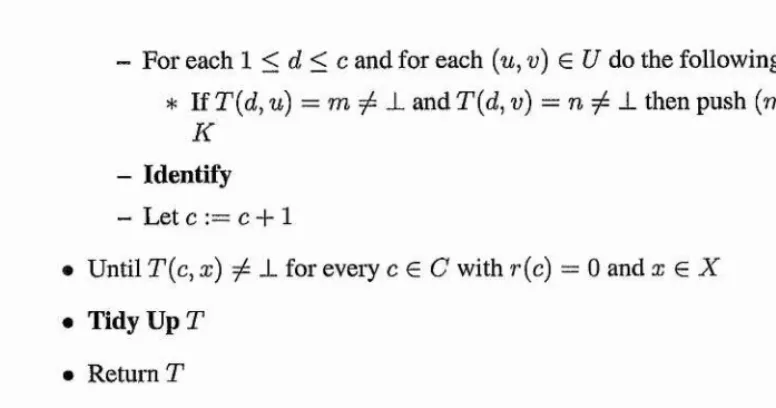
• Input: A presentation P = {X\U) • Let c := 1• Repeat
- For each 1 < d < c and for each [u, v) e U dothe following
* If T(d, «) = m 7^ X and T{d,v) = n ^ 1.then push (m, n) onto K
- Identify - Let c ;= c + 1
• Until T{c, x) ^ A-for every c E C with r(c) = 0and x E X • Tidy Up T
• Return T
1.3.4 Comments
There are several other points to make about the enumeration algorithm.
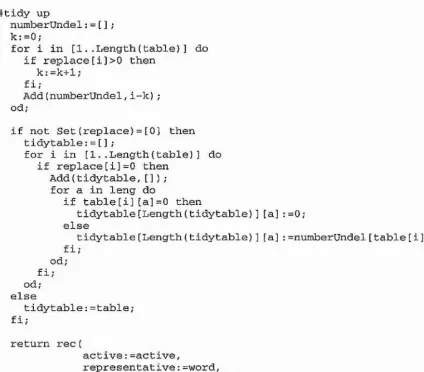
• The Tidy Up procedure simply removes the rows of deleted cosets from T and renumbers C so that the rows of T are numbered 1,2,3...
• The For loop over which the variable d runs is necessary because changes in
the data structures made in Identify mean that some cosets in {d G C |d < c}
may now trace relations.
[image:24.613.79.467.104.308.2]• It is very easy to adapt this algorithm to semigroup presentations. It is only necessary to remove the first coset, which represents the identity, from the table. The monoid algorithm is more general than the semigroup algorithm in the sense that it allows presentations which involve the identity.
The proof of the following can be found in Jura [12].
Briefly the proof shows that given any word in w G X* there exists a positive in teger Nu, such that after a finite number of iterations, T{l,w) = Ny^. Furthermore the first k rows of table T will stabilze in a finite number of iterations as the holes will fill up and the entries will only ever be replaced by lesser values. Therefore for each w after a finite number of iterations there will be a stable row labelled by Nyj such that T(l, w) = Ny,.
1.4 Enumeration of Right Congruence Classes
In the last section I described how to enumerate M by enumerating the cosets of the trivial submonoid {e}. In other words the monoid enumeration algorithm enumerates M /p where pis the trivial (right) congruence. The algorithm naturally extends to right congruences in general.
The new algorithm will describe the action of each generator a; G X on {mp\m G
M} and will do so by producing a table similar to the one in the standard algo rithm.
Assume we are given a monoid M presented by P = {X\U) and a right con gruence p on M. If m G M then we define the map pm : M /p M/p by
Pm ' up ^ {um)p. The composition of maps pm pn ' up {umn)p and so Pm ® Pn ~ Pmri'
Note: It should be noted that T = {pm\fti G M} and M/p are not “isomorphic”,
indeed M /p is not even necessarily a monoid even though T is. To see this con sider the map 0 : T ^ M/p where 9 : pm ^ rnpfor m G M. If (m , n) G p
and Pm 7^ Pn then Pm9 = mp — np — pn9 and so if this happens 9is not an injection.
The right congruence monoid algorithm starts with two inputs.
1. A finite presentation P = {X\U) for the monoid M.
2. A finite set tt of pairs in X* x X* which generate the right congruence p. That is p is the intersection of all right congruences which contain t t.
The main procedure is modified thus:
• Let c := 1 • Repeat
- For each x E X do New(c, cc) - For each (w, v) G t t do the following
* If T(l, u) = m ^ P and T(l, t») = n 7^ L then Push (m, n) onto K
- For each 1 < d < c and for each {u,v) E U do the following
* If T{d, u) — X and T{d, v) = n ^ X then Push (m, n) onto K
- Identify - Let c := c + 1
• Until T{c, x) X for every c E C and every x E X.
» Tidy Up T • Return T
The only change is the addition of the second For loop. In essence it is only necessary to check the application of a right congruence generator on the first coset. The reason for this is that the first coset, 1, represents the p-class containing the identity. If upv then clearly eupev and indeed e is the only element of M which we can a priori multiply on the left with. If, in the above case, wupwv for some
w E X* then eventually the algorithm will generate cosets representing either wu
or wv and so it will discover that T(l, wu) = T{1, wv).
1.5 The Todd-Coxeter Algorithm for Groups
is that the order of a subgroup of a finite group G divides the order of G. This does not hold for monoids and semigroups.
The differences with the monoid algorithm (without the right congruence) are as follows:
1. The columns of the coset table are labelled by % U X~^,
2. For every new definition made, d ;= T(c, æ), then we set T{d, x~^) c.
There are certain things to note about the group algorithm and its use:
1. It is usual to write a relation ia = as the relator uv~^ ~ e, and so the presentation becomes a set of generators and a set of words. The algorithm therefore checks an individual word, u and forces T(c, u) = c for each coset c e G. Given any relator u = XiX2...Xn then any cyclic permutation of u is simply
Xi...XnX\...Xi-i = { X i - i ~ ^ . . . X i ~ ^ ) u { x i . . . X i - i ) p{xi^i~^ ...Xi~'^)e{xi...Xi^i) = e,
and so we may replace any relator with any of its cyclic permutations. 2. There is an algorithm for enumerating equivalence classes of a right congru
ence on a group which works exactly the same way as the right congruence on a monoid algorithm works.
3. If p is a right congruence on the group G then ep is a subgroup of G. We may therefore think of the right congruence algorithm as enumerating the cosets of a subgroup. Hence the origins of the term coset enumeration. 4. The group algorithm has the same terminating conditions as the monoid
Chapter 2
Inverse Monoids
In this chapter I intend to get to grips with what inverse monoids are and
sketch a theory of computing in inverse monoids. All proofs are taken from Pet- rich [18].
2.1 Green’s Relations
There are several important structural properties of semigroups and monoids which are worth reminding ourselves about.
N o ta tio n : If 5 is a semigroup then is the semigroup S with an extra element, e added to it which obeys the identity law G2. Clearly is always a monoid. Note that if S is already a monoid with identity 77 then er) ~ rje = rj in S^.
Definition 2.1.1. Let 5 be a semigroup. If e e S and e = then we call e an
idempotent. We denote the set of idempotents in S hy Es.
Definition 2.1.2. Let S' be a semigroup and let s,t e S. We define the following equivalence relations on S.
sTZt if and only if there exists u,v
e
such that su = t and tv — s. We write Rs for the 7^-class containing s.• s j t if and only if there exists u , v , w , x e such that w su = t and x tv — s. We write Jgfor the jT-class containing s.
• H = CnTZ, We write Hg for the 7^-class containing s.
These equivalences are called Green’s relations.
Lemma 2.1.3. If S is a semigroup then C is a right congruence on S and IZ is a left congruence on S.
P ro o f: Suppose sCt in S then s = ut and t — vs for some u ,v e S^. We therefore have sw = {ut)w and tw = {vs)w and therefore swCtw for any w e S. £ is therefore a right congruence on S and dually 7^ is a left congruence on S. ■
Lemma 2.1.4. £ o % = % o £
Proof: Let sCu and uRt for s, w G S. Now 5 = wu, t = ux, u = ys = tz for some w, x,y^z G S^. Let v = sx = wt, s — wu ~ wtz — v z,t = ux = ysx — yv and so sRv and vCt so that C o R C R o C and dually C o R C R o C. ■ Finally we define the Green’s relation V = R o C. For any given semigroup
n c R C V G j . Dually R C C C V C J .
J
V
/
\
£ R
\
/
n
7^-classes and £-classes of a semigroup, S have certain desirable features when they contain idempotents. The two following somewhat technical lemmas will be important when we consider the notion of inverses in semigroups. The proofs are not difficult and I would refer the reader to a standard text on semigroup theory, for example J. M. Howie [9].
Lemma 2.1.5. Let S be a semigroup and let s^tG S. Then st e RgC\ Lt if and
only if Lg Pi Rt contains an idempotent. In such a case,
Lemma 2.1.6. Let e, / G Es. For every s G i?e H L /, there exists a unique
t e R f C\ Lq such that st = e and ts = /.
Corollary 2.1.7. If S is a semigroup and e G Es, then is a group.
Proof: By Lemma 7.1.3 we have He^ = He so He is closed under semigroup multiplication. Given s e He then by letting / — e in Lemma 2.1.6 we know that there exists a unique t e He such that st = ts ~ e. Thus se = s{ts) — {st)s = es and we know that because site that there exists u e such that s = eu and so es = e^u = eu = s and so e is an identity for He and t is an inverse for s. M It is at first quite surprising that the variety of semigroups which is so general has some definite, general structural properties. In particular it is important to understand that different 7^-classes (and dually £-classes) within a given D-class are structurally identical. We have the following vital lemma.
Lemma 2.1.8 (Green’s lemma). Let s and t be C-related elements of a semi
group S. By hypothesis there exist w, u' G such that us = t and u't — s. The
mappings
a X ux {x ^ Rs)
and
a' '. y u'y {y G Rt),
are mutually inverse, C-class preserving bijections of Rg and Rp
P r o o f : If æ g then uxRus. A s t = us so ux G Rt. Hence a maps Rs into Rt. Similarly a' maps Rt into Rs.
For any a; G i?s, we have x — sv for some v e and thus
xaa' — u'ux = u'u{sv) ~ u'{us)v — u'tv = sv = x.
Hence aa' is the identity mapping on Rs. Similarly a'a is the identity mapping on Rt. If æ G Rs, then xa ~ ux and x = u'(xa) so that xCxa. Hence a is £-class
preserving. Similarly a' is also £-class preserving. ■ Even at this stage it is worth noting that Green’s lemma could be used to “run through” the 7^-classes in any given D-class. If we start with R^ we may define other 7^-classes in Du by {vRu\v G V} where V is some sort of “canonical set”
of left multipliers which includes the identity.
C-2.2 Regular Semigroups and Monoids
Definition 2.2.1. Let 5 be a semigroup and let s E S. We say that s is regular if there exists a' E S such that aa'a = a and a'aa' = a'. In such a case a' is an inverse of a. The set of inverses for a is denoted V(a). We say that 5 is a regular
semigroup if every a G S' is regular. If S is also a monoid then we say that Sis a
regular monoid.
Given any semigroup S then an example of a regular element is any idempotent e E Es. It is easy to see that e is its own inverse.
Lemma 2.2.2. Let S be a semigroup and let a E S be regular with a' E V(a).
Then the following hold:
(i) aRaa'. (ii) aCa'a. (iii) aVa'.
(iv) aa' and
Proof: (i) We need to find u and v in S^ such that au = aa' and aa'v = a. Let
u = a'and v = a.
(ii) We need to find u and v in S^ such that ua = a'a and vEa — a. Let u — a' and V = a.
(iii) By (i) and (ii) and noting that ais an inverse of a', aRaa'Ca' and so aVa'. (iv) {aa'){aa') = {aa'a)a' = aa', (a 'a )(a 'a ) = (a 'a a ')a = a'a. ■ Theorem 2.2.3. Let S be a semigroup, the following two statements are equiva lent.
(i) S is a regular semigroup.
Pr o o f; (i) =>- (ii). This follows from Lemma 2.2.2 parts (i), (ii) and (iv).
(ii) => (i). Let a E S, let e be an idempotent in La and let / be an idempotent in
Ra. Now ua = e, ve = a, ax = f and fy = a for some u, v ,x,y E S^. I want to show that uax is an inverse for a. We have
a{uax)a — a{ua)xa = aexa = {ve)exa = vexa — [ax)a — fa = f{ fy ) ~ a and
{uax)a{uax) — u{ax){a){ua)x = u f{fy)ex = uaex = u(ve)ex = uax
as required. ■
If we recall Todd-Coxeter enumeration methods for groups, the action of the group on itself on the right is examined systematically. Now there is no free regular semi group over a set X and so there are no regular semigroup presentations, so there is special Todd-Coxeter method for regular semigroups as a class as Todd-Coxeter requires a presentation for the input. However before moving on to inverse semi groups let us have a quick look at 7^-classes of regular semigroups.
Let 5* be a regular semigroup. Let a E S and let a' E V{a). Now aa'Ra by Lemma 2.2.2 (i) and so Ra = Raa> • Consider the subset of S
Ua = {u\ao!'RaUu^ E V{u) such that aa'uu' — uu'aa'}.
For u E Ua, aa'uu' — uu'aa'Caa' and so for some v E where aa'uv = aa' we
have:
aa'uu' ~ uu'aa' — uu'aa'uv = aa'uu'uv — aa'uv = aa'.
Hence within Ra we have inverses working somewhat like inverses in groups as long as we only act on the right within this subset Ua of S. This is not strong enough for the systematic approach of Todd-Coxeter style algorithm for 7^-classes special to regular semigroups and monoids because of the multitude of inverses any particular element has. We need a more refined class of semigroups before we can approach this question.
2.3 Introduction to Inverse Semigroups
No te: If a g 5 then by definition (a ^ = a.
There are two alternative definitions of inverse semigroups (inverse monoids) e- quivalent to the above definition summarized in the following theorem.
Theorem 2.3.2. Let S be a semigroup, the following statements are eqivalent:
(i) S is an inverse semigroup.
(ii) S is regular and its idempotents commute.
(iii) Every C-class and every IZ-class of S contain exactly one idempotent.
P r o o f : (i) => (ii). Let e , / g Es and a = (ef)~^. Now (a e )(e /)(o e ) =
(a (e /)a )e = ae and ( e /) ( a e ) ( e /) = ( e /) a ( e /) = e f and so ae = ( e / ) “ \ like
wise fa = ( e / ) “ ^ and so a = ae = fa. But then a^ = (a e )(/a ) = a{ef)a = a
so that e f = a~^ — a e Es by Lemma 2.2.1 (vi). Symmetrically fe G
Es-Consequently (e / ) ( / e ) ( e / ) = e / e / = e f and ( / e ) ( e / ) ( / e ) = / e / e = fe and
so ( e / ) " i = fe. But we loiow that (e / ) “ ^ = e f and so fe = ef.
(ii) (iii). By way of contradiction let e, / G % be ^-related. Then e = u f and
f — ve for some u,v G S^, sothat e f = /e ^ = e /e = u f^u f — (uf)^ = = e
and similarly e f — e/^ = ve^ve = (ve)^ = /^ = / as required. Similarly e R f
implies e — f.
(iii) (i). By Theorem 2.2.3 we know that S is regular. Let x and y be inverses of an element aof S. Then xa, ya G Es and xaCaCya and thus by hypothesis,
xa = ya. Symmetrically, we get ax — ay. Hence x = xax = yay = y as
required. ■
Corollary 2.3.3. Let S be an inverse semigroup and let D be a V-class of S. Then the R-classes and C-classes of D are in one-to-one correspondence with each other.
We can now write a universal algebra style definition for inverse semigroups. Definition 2.3.4. An inverse semigroup, S, is a semigroup with a unary operation
so that for any x,y e S the following axioms hold:
(151) (æ-^)-^ = X
(153) X ^ X ^ ^ X = X
(154) X * x ~ ^ * y * y ~ ^ = y * y ~ ^ * a; * a;"^
An inverse monoid, M is an inverse semigroup with an identity eu which satisfies G2.
By examining the latter definition it is clear that both inverse semigroups and inverse monoids form varieties.
No ta t io n: The variety of inverse semigroups is denoted XS and the variety of
inverse monoids is denoted XM .
It is clear that all groups are inverse monoids and all inverse monoids are inverse semigroups. So we have the lattice of varieties:
<S
/
\
A4
\
/
Using Definition 2.3.4 we can define homomorphisms between inverse semi groups and inverse monoids.
Definition 2.3.5. If S and T are two inverse semigroups, an inverse semigroup homomorphism is a map p,: S - y T such that for x,y G S:
(1) [xy)p = xpyp
(2) x~~^p = {xp)~^
If M and N are two inverse monoids then an inverse monoid homomorphism
V M N will satisfy the above properties as well as
Lemma 2.3.6. Given two inverse semigroups (inverse monoids) S and T, and a map p : S ^ T then p is an inverse semigroup (inverse monoid) homomorphism if
and only if{xy)p = xpyp, \fx,y G S (and esp = ct). That is it is only necessary
to check conditions (1) and (3).
Proof: I shall check condition (2) assuming condition (1). Let x e S. Define
y = x~^p. Now xp = {xx~^x)p = (xp)y{xp) and y = x~^p — {x~^xx~^)p ~
y{xp)y and so y is an inverse of xp in T, hence by uniqueness of inverses x~^p =
y = {xp)~'^. ■
Lemma 2.3.7. Let S be an inverse semigroup then
(i) each idempotent in S is its own inverse,
(ii) for each a E S, aa~^ is an idempotent,
(iii) each idempotent in S is the product of an element and its inverse.
(iv) the set of idempotents of S forms a semilattice, that is it is a closed algebraic
structure where every element is idempotent and e f = fefo r e , f E Eg.
Pr o o f:
(i) Let e G Eg. By Definition 2.3.1 we have a unique inverse e~^ of e satisfying
ee~^e = e and e “ ^ee“ ^ = however e satisfys these conditions for e“ ^
and so = e by uniqueness of inverses.
(ii) Given a E S then by (IS3) in Definition 2.3.4,
(aa~^){aa~^) = {aa~^a)a~'^ = aa~^.
(iii) Let e G By (i), e” ^ = e and so ee“ ^ = = e.
(iv) Given any e, / G Eg, by (iii) e and / are the products of elments and their
inverses and by (IS4) in Definition 2.3.4, (e/)^ = e / e / = e^/^ = e f and
■
At the end of Section 2.2 we defined a subset of a regular semigroup S as follows:Ua = {u\aa'7laa'u, 3u' G U(u) such that aa'uu' — uu'aa'}.
If S is an inverse semigroup then Ua is more simply
Ua ~ {u\aa~^7laa~^u}.
For inverse semigroups aa~^Ua = Ra, whereas for regular semigroups aa'Ua is only a subset of Ra, suggesting that enumerating Ra is similar to enumerating a group providing that we have a test for ^-equivalence. Indeed this conjecture is bom out even further by the Wagner representation theorem which shows how inverse semigroups can be represented when they act on themselves.
2.4 Wagner Representation Theorem
Analagous to the Cayley theorem for groups and the Cayley theorem for semi groups we have the Wagner representation theorem [31] for inverse semigroups which states the intimate relation between inverse semigroups and partial injec tions. Firstly though, some definitions are needed.
Definition 2.4.1. Given a set X, a partial transformation, r : X —)■ X, is a mapping of a subset of X into X. Likewise a partial injection, a : X —>• X, is an injection of a subset of X into X. Let a be a partial transformation on X we denote the domain of a by d(a) and the range of a by r(a).
Definition 2.4.2. For a set X, the symmetric inverse monoid over X is the set of all partial injections a : X X with composition written on the right. It is denoted Z(X). The set of all partial transformations over X is denoted Z*(X).
Note: The similar set where the compositions are written on the left is antiiso morphic to Z(X). (See Lemma 2.4.3 below for the proof that Z(X) is a monoid.)
(Cayley’s theorem). One sometimes refers to partial injections as partial symme tries.
Given a set of symbols, X , let us add another symbol 0 and call the new set Xq.
Given a partial transformation, a on X we may convert this to a transformtion a!
on Xq by defining a' : Xq \ d(a) -4- {0} and a! \ x x a ,\ix G d(a). We
may therefore think of partial transformations on X as tranformations on Xq such that 0 is always mapped to 0, and throughout this thesis I shall treat them as such objects.
Lemma 2.4.3. Z’(X) is a monoid. Z(X) is an inverse submonoid ofT{X ).
PROOF: Considering partial transformations on X as transformations on Xq it
is easy to see that they are well defined and that the composition is associative. To see that the composition of two partial transformations gives another partial transformation notice that all that is needed is that the compostion maps 0 to 0 and
as both partial transformations map 0 to 0 then the composition certainly does.
Finally note that the identity transformation is a partial transformation and we have that Z’(X) is a monoid, or to be more precise a submonoid of Tx^.
Consider a G X(X). Now a restricted to d(a) is a bijection from d(a) to r(a) and hence has an inverse, a|d(a)~^, we construct an inverse, a!for a by extending «|r(o:)~^ to Xo by defining xa! ~ 0 for a; G Xq \ r(o;). Note that xa! = 0 if and only if a; G Xo \ r ( a ) . To check that a a 'a = a we need to consider the following
two cases:
• æ G Xo \ d(a) in which case it is easy to see that both sides of the equation
map Xto 0.
• X E d(o') in which case x a ^ b and so x a a ' = x and so x a a 'a —
{x a a ')a = x a as required.
To check that a 'a a ' = a' we need to consider the following two cases:
• a: G Xo \ r ( a ) in which case it is easy to see that both sides of the equation
map X to 0.
• X E r(o;) in which case x a ' ^ 0 and so x a 'a ~ x and so x a 'a a ' =
We now have a method for constructing an inverse for every element of Z(X) which we may consider a unary operation (although these inverses are not neces sarily unique). We may talk about a' and /3' as inverses of a and /3.
Observe that both ao>' and a!a will either map an element of Xqto itself or to 0.
These maps are both identities on a subset of X and map the rest of X to 0. It is therefore clear that the product of aa' and /3/7' will commute. The unary operation of constructing inverses thus fulfills axioms (ISl), (IS3) and (IS4) of Definition 2.3.4 and by the note on (IS2) this is all that is required to show that X{X) is an
inverse monoid. ■
Lemma 2.4.4. Given a set X and a,/3e %(X) then d(cK^) = (r(a) D d(^))a;~^
andr{a^) — (r(a) nd{^))/3.
Pr o o f: Let x e d{a/3) then clearly xa G r(a) and xa G d(/3) hence x G
(r(a) n d(^))û'“^. Conversely let x G (r(a) H d(j0))a~^ then xa G r(a) and
xa G d(^) and so æ G d{a/3). Hence d(a/3) = (r(a) H d(^))a“^
Similarly it follows directly from definition that r(ap) = {r(a) n d{P))/3. ■ The Wagner Representation Theorem essentially declares that the action of an inverse semigroup, 5, on itself gives partial symmetries of S.
Theorem 2.4.5 (Wagner Representation Theorem). Let S be an inverse semi group. For each a E S then we construct the partial symmetry on S, w°' as follows:
7/;® : a; xa, {x E Sa~^) w°' : X 0,{x E S q\ Sa~^). The mapping
w : a ^ U)®5 (a G S)
is a monomorphism of S into X{S).
P r o o f : First note that for a E S, d(w'^) = = Saa~^ and r(7t;®) = Sa = Sa~^a.
If X , y E Saa~^ with xa = y a then xaa~^ = yaa~^ but as# G Saa~^ then
Let a, 6 € S. Consider æ € d(u;“^) = S{ab){ab) ^ = Sabb Then æ =
xabb~^a~^ and so
xaa~^ = x{abb~^ a~^)aa~^ = xabb~^a~^ = x
and
xabb~^ = x{abb~^ a~^)abb~^ = xa{bb~^){a~^a){bb~^) = x{abb~^a~^)a = xa
and so xa 6 Sabb~^ so that x = xaa~^ G Sabb~^a~^ and therefore x G Saa~^ Pi Sabb~^ — [Sa~^a (T Sbb~^)w°‘~^ and from Lemma 2.4.4 it follows that x G d(w'^w^). Conversely let x G d(w'^w^). Then by Lemma 2.4.4 x ~ xaa~^ and
xa = xabb~^. Hence
X = xaa~^ = xa{bb~^)a~^ = a ; ( a 6 )(a 6 )“ ^
and thus x G d(w°^). We have that d(w'^w^) = and it is clear that if æ G d(-u;“7n^) = d(w^^) then xw^w^ = xab — xw^^ and if æ ^ d{w^w^) — d(w°^)
then xw°’w^ — 0 = Hence — w°‘^ and w is an inverse semigroup homomorphism.
Assume that ~ for some a,b E S. Then Saa~^ ~ Sbb~^ and so
(aa~^){bb~^) = (aa~^){aa~^) ~ aa~^
and
{aa~^){bb~^) — {bb~^){aa~^) — (bb~^){bb~^) = bb~^
that is aa~^ = bb~^. Since aa~^^ E Sa~^, it follows that aa~^a = aa~^b, which implies a — aa~^b = bb~^b = b. Hence w is one-to-one and so is a monomor
phism of S into X{S). ■
2.5 Inverse Monoid Presentations
Having discussed inverse semigroups as partial symmetries, we shall now begin to look at the theory of presentations for these objects.
Given that is an involution then F%g(X) is presented as a semigroup by
{X U X~^\uu~^u = u, uu~^vv~^ = vv~^uu~^ Vw, 7; G (X U X “^)'*')
Similarly Fx^vt(X) is presented as a monoid by the same presentation.
The congruence generated by these relations is called the Wagner congruence and is denoted by px or more simply just p when there is no confusion.
Now unfortunately this is an infinite presentation as there are an infinite number of elements in (X U X “^)’^. Worse still, this is the best we can possibly do. See Petrich [18] for a proof of the fact that Fi^(X) cannot be finitely presented. At first sight this is disaterous, because Todd-Coxeter is applicable only to finite pre sentations. I shall show how this problem is overcome in Chapter 3 and Chapter 4.
Definition 2.5.1. An inverse semigroup presentation is a presentation {X\U), where [7 Ç (X U X~^)+ X (X U X “^)+. If T is the congruence generated by pUU then
the inverse semigroup correponding to the inverse semigroup presentation {X\U)
is (X U X -i)+ /t.
Similai'ly:
Definition 2.5.2. An inverse monoid presentation is a presentation (X|C7), where t/ Ç (X U X~^)* X (X U X~^)*. If r is the congruence generated by p\JU
then the inverse monoid coiTeponding to the inverse monoid presentation (X|?7) is (A: u
As with group and monoid presentations we may think of invserse semigroup and inverse monoid presentations as being shorthand for a semigroup presentation which includes p in its relations.
Definition 2.5.3. Given two inverse semigroups S and T with presentations (X | U)
and (y |y ) so that (X U X “^) n (F U Y~^) ~ 0 then the inverse semigroup free product is the inverse semigroup 5 * T which is presented by {X UY\U UV).
Chapter 3
Problems With Enumerating
Inverse Monoids
As I have commented, the results of the previous chapter are largely negative as far as computation is concerned. For a Todd-Coxeter style enumeration for some object O in variety V a presentation of O is required. This means that a thorough understanding of free objects in V is needed. As we have seen in Chapter 1, semigroups and monoids have very simple free objects where there is only one representation of any particular element in terms of the free generators. For groups the free object is only slightly more complicated. The normal form for any particular element is found by free cancellation and in Todd-Coxeter this cancellation is implicit in the computation and actually makes the process easier. For inverse semigroups and inverse monoids there is a normal form for any word in a free object but this is not trivial to find.
No ta t io n: We will want to be talking about varieties with an associative binary
operation such that the free object has a unique noimal form for every element. I will call these varieties UNF-varieties.
gaining insights into inverse monoid enumeration, which I will attempt in Section 3.4 and again more thoroughly in Chapter 5.
In general Todd-Coxeter style coset enumeration has three subroutines:
(1) Making a new definition.
(2) Checking a relation or a right congruence. (3) Processing coincidences.
A free inverse monoid is a monoid with an infinite number of relations and so process (2) has to be applied an infinite number of times. However, remem bering the universal algebra definition of inverse monoids, the free inverse monoid obeys only a handful of identities,that is equations which hold true throughout the variety. So instead of looking at the infinite relations, we might look at identities which a certain word 7n G (X U X~^)* must satisfy.
Supposing that variety V must satisfy the identity p{xi ,X2,...,Xm) = q{yi,y2,
then for any object O G V generated by the set X, O will satisfy the set of relations
IL2, ...J Uiffi) — qipi, 772, •••5 77^) I^Uij 7^2 ) •••) Ujyi,7^1, 7^2 j •••3'^n C F y (X") j",
which is finite only when Fy(X) is finite.
For example any G E Qsatisfies the identity xx~^ — e which is to say that for every element x E G then the relation xx~^ = e is implicitly satisfied. Let us call these relations which are implicit in identities implicit relations and any other relations explicit relations. For a free object of variety V generated by X all relations are implicit over the set of free generators.
How is it that free groups can be finitely presented as monoids if there are an infinite number of implicit relations from the identities? The simple answer is that only a finite number of relations aie necessary. The “crude” monoid presentation ofFg(X) is:
(XU% -'|(Vw e = £, =
however the standard presentation is
which is clearly finite when X is finite. To see that this is a presentation of Fg(X) consider any word w = XiX2...Xn G (X U then
WW~^ = XiX2...XnXn~^Xn-l~^ ...Xi~^
and it is easy to see that this will cancel down to e by repeated application of the relations in the standard presentation.
For inverse monoids the implicit relations cannot be reduced to a finite number of monoid relations (for a proof of this see Petrich [18]). This does not necessarily make our task impossible, as given any word G (X U X~^)* there are only a finite number of implicit relations whose left or right side are sub words of w.
There are two important points about free groups. One is that they can be finitely presented, the other is that words in free groups have a unique normal form which is very easily found. This means that given two words u,v G (X U X"^)* it is possible, indeed very easy, to tell whether u — v inFg{X). That is to say that the
word problem is soluble.
Let us look at a variety where a normal form is easily found (and so the word problem is solvable) in the free objects. My example is that of semilattices with an identity, which form a variety SC^ c XM. with a binary operation A and a nullary operation e satisfying the following identities
(SLI) associativity [x Ay) /\ z = x /\{y /\ z)
(SL2) idempotency x A x = x
(SL3) commutativity x A y = y A x
(SL4) identity e A x — x A e — x
Let X be a finite set and Fg^^i (X) be the free semilattice with identity over X. Let there be a total order < on X. Given a word w = xi A X2 A ... A Xn EX*,
let Y = {xi, X2,...,Xn} G X then a unique normal form for w is the product of
all the elements of Y ordered in ascending order by <. It is not hard to see how
w can be manipulated using (SL2) and (SL3) to do this and that this new word is unique. Let U{w) be this unique normal form of w.
• The immutable set of generators, X.
• The coset set C which is a mutable set of positive integers. At the start of the algorithm G := {!}.
• The mutable coset table T which is an array of elements of GU{_L} (where _L is the empty symbol) with rows labelled by elements of G and columns labelled by elements of X . Entries in T are referred to by T(c, x) where
ceC and x E X . Initially T is a single row of empty symbols. • The mutable representative set P Ç X*. Initially P := {e}. • A surjection t/j : G P with 1t/> = e.
• A mutable coincidence set iP C G x G.
• The replacing function r : G -4 G U {0} with r(c) < c, Vc e G.
Define the following subroutines: Replace
• Parameter: c eC • Locals: None
• While r(c) > 0 then c := r(c) • Return c
Create a New definition
• Parameters: c eC and x E X . • Local: d
• Add d := max(G) + 1 to G.
• AddU{{c'ip) A x) to P.
• Define dip = U{{cip) A x)
• Define T{c,x) d
Check a Coset.
• Parameter: cE C
• Local : d
• For each d E C if cip — dipthen add (c, d) to K.
Identify Coincidences
• Parameters: None
• Locals: ci, cg, d\, dg, s, x
• While K is not empty do the following - Pop (ci, cg) from K.
- Let d\ = Replace(ci) And Let dg = Replace(cg)
- If dx dg then (assuming without loss of generality that di < dg) do the following
* For each entry equal to dg in T, replace dg by di.
$ For each x E X , if T[dx,x) — _L then replace T[di,x) by T(dg;æ) otherwise replace T{di,x) by min(T(di, æ),T(dg,a;)) and add ((di,a;),r(d2,a;)) ioK.
* For each pair (s, dg) or (dg, s) in K, replace with (s, di) or (di, s) respectively.
- Let r(dg) := di
The main algorithm proceeds as follows:
• Repeat
- If T(c, a;) = ± Then
- New(c,rc) ~ Check(c) - Identify
• Until Vc G G and Væ G X, T{c, æ) ^ _L
This algorithm will enumerate free semilattices with identities and it is easy to see that it applies just as easily to any free object of a UNF-variety although it will only terminate when the free object is finite.
It should be noted that this algorithm applies only to free objects. A procedure for enumerating general semilattices with identity is a simple generalisation as every finitely generated semilattice with identity is finite and hence has a unique normal form. Having said that, I have no general approach to enumerating any object of any UNF-variety.
The point is, though, that having a systematic method for enumerating free objects is a step towards enumerating general objects of that variety. Certainly if one has no method for enumerating the free object then there is no hope of anything approaching a Todd-Coxeter style enumeration for quotients of the free object. As we noted there is a unique normal form for inverse semigroups. For our pur poses it suffices to be able to find a unique representation of some Idnd.
3.2 Word Trees
In this section I will be working from W.D. Munn’s paper Free Inverse Semigroups
[16]. This is a graph theoretic approach to handling Fx;^(X) which shows how to solve the word problem.
As I will be talking consistently about F%;^(X) in this section, I will refer to the Wagner congruence on X* by p.