DEPENDENTLY TYPED PROGRAMMING LANGUAGES
Franck Slama
A Thesis Submitted for the Degree of PhD
at the
University of St Andrews
2018
Full metadata for this thesis is available in
St Andrews Research Repository
at:
http://research-repository.st-andrews.ac.uk/
Please use this identifier to cite or link to this thesis:
http://hdl.handle.net/10023/16451
This item is protected by original copyright
This item is licensed under a
Creative Commons Licence
Terms in Dependently Typed
Programming Languages
by
Franck Slama
This thesis is submitted to the
U
niversity of
S
t
A
ndrews
in conformity with the requirements for the
degree of
D
octor of philosophy in computer
science
submitted on
02-03-2018
Dependent type theories are a kind of mathematical foundations investigated both for the formalisation of mathematics and for reasoning about programs. They are implemented as the kernel of many proof assistants and programming languages with proofs (Coq, Agda, Idris, Dedukti, Matita, etc). Dependent types allow to encode elegantly and constructively the universal and existential quantifications of higher-order logics and are therefore adapted for writing logical propositions and proofs. However, their usage is not limited to the area of pure logic. Indeed, some recent work [7, 10, 32, 33, 35, 36, 44] has shown that they can also be powerful for driving the construction of programs. Using more precise types not only helps to gain confidence about the program built, but it can also help its construction, giving rise to a new style of programming calledType-Driven Development[9].
However, one difficulty with reasoning and programming with de-pendent types is that proof obligations arise naturally once programs become even moderately sized. For example, implementing an adder for binary numbers indexed over their natural number equivalents natur-ally leads to proof obligations for equalities of expressions over natural numbers. The need for these equality proofs comes, in intensional type theories (like CIC and ML) from the fact that in a non-empty context, the propositional equality allows us to prove as equal (with the induction principles) terms that are not judgementally equal, which implies that the typechecker can’t always obtain equality proofs by reduction.
degree of PhD, which is approximately 60000 words in length, has been written by me, and that it is the record of work carried out by me, or principally by myself in collaboration with others as acknowledged, and that it has not been submitted in any previous application for any degree.
I was admitted as a research student at the University of St Andrews in November 2012.
I received funding from an organisation or institution and have acknow-ledged the funder(s) in the full text of my thesis.
Signature of Candidate: . . . .
Date: 02-03-2018
Supervisor’s Declaration
I hereby certify that the candidate has fulfilled the conditions of the Resolution and Regulations appropriate for the degree of Doctor of philosophy in computer science in the University of St Andrews and that the candidate is qualified to submit this thesis in application for that degree.
Signature of Supervisor: . . . .
that we are giving permission for it to be made available for use in ac-cordance with the regulations of the University Library for the time being in force, subject to any copyright vested in the work not being affected thereby. We also understand, unless exempt by an award of an embargo as requested below, that the title and the abstract will be published, and that a copy of the work may be made and supplied to any bona fide library or research worker, that this thesis will be electronically accessible for personal or research use and that the library has the right to migrate this thesis into new electronic forms as required to ensure continued access to the thesis.
I, Franck Slama confirm that my thesis does not contain any third-party material that requires copyright clearance.
The following is an agreed request by candidate and supervisor regarding the publication of this thesis:
No embargo on any electronic nor print copy.
Signature of Candidate: . . . .
Date: 02-03-2018
Signature of Supervisor: . . . .
I, Franck Slama, hereby certify that no requirements to deposit original research data or digital outputs apply to this thesis and that, where appropriate, secondary data used have been referenced in the full text of my thesis.
Signature of Candidate: . . . .
I’d like to sincerely thank the following people:
Edwin, for giving me the freedom and the encouragements to in-vestigate what I wanted to, for your constant support throughout these years, and for always being so positive and motivating. It sincerely was a pleasure to work with you and I can’t express how grateful I am.
Kevin, for accepting to be my second supervisor, and also for the work you are doing within the Functional Programming group at St Andrews to make it grow healthy.
The examiners Thorsten Altenkirch and Susmit Sarkar, for accepting the extra load of work to review this thesis, and for many improvements that you suggested. Also, thank you Susmit for letting me lecture parts of the module on computational complexity to the third year students. I’ve really enjoyed doing it.
Roy Dyckhoff for the feedback you gave me on an early version of my work and for the discussions we had at several seminars across Scotland. My office mates Chris, Matus and Adam, and myalmostoffice mates David C. (who visited us regularly from the end of the corridor) and Jan (who even had a chair at his name in our office) for all the interest-ing discussions, for your help, but also for the laughs and the needed distractions, especially the boardgames at Matus’ place.
The technicians and the administrative team of the School of Com-puter Science for your support in many daily tasks, and for making our department such a nice and pleasant place to work.
been hacking on, and also for the good time we’ve had talking about so many things around some infused rums.
Ludovic, for reminding me to sometimes forget about my research, and for coming on some hiking trips around Scotland with me. Not to forget all the pubs and restaurants we visited in St Andrews!
Nikitas, alias Mouglon for playing some video games with me despite my poor skills at gaming, for all the interesting discussions we regularly have, and for the good ales we had together.
David S. for all the good time we had together sharing this house in St Andrews, and for helping me to improve my English when I first arrived in the UK five years ago.
Cyril, Charlotte, Lionel, Chloé, Adrien and Justine for all the good time we had when we were students in Toulouse. I can’t believe it was many years ago.
Christine Maurel for your amazing lecture on lambda calculus that got me into it, Ralph Matthes, Sergei Soloviev and Celia Picard for my first internships and for introducing me to Coq, coinduction and category theory. And of course many thanks to Armelle Bonenfant for being the one who encouraged me to move to St Andrews for doing this PhD with Edwin; it was indeed a beautiful experience.
Alain Prouté for all the interesting discussions we had about the formalisation of mathematics, and for inviting me to the very first meeting on the Saunders system at your home by a sunny afternoon of July 2013.
Frédéric Blanqui and Gilles Dowek for the post-doc in your group that I am now about to start. I’m really looking forward to work with you in the Deducteam research group at École Normale Supérieure.
My Mother, my Father, my Brother, my Sister, and my Grandparents for your constant encouragements and support, and for your understand-ing when I am terrible at givunderstand-ing news.
you properly for your unwavering support, or to express how thrilled I am to have you in my life. I love you.
Contents 15
1 Introduction 19
1.1 The need of formal certification . . . 19
1.1.1 Critical software and formal methods . . . 19
1.1.2 Proof assistants and programming languages . . . 25
1.1.3 Programming and proving in Idris . . . 28
1.2 Dependent types . . . 37
1.2.1 What dependent types are . . . 37
1.2.2 Dependent types’ expressivity . . . 40
1.2.3 Strong specification as dependent types . . . 42
1.2.4 Common problems with dependent types . . . 44
1.3 How proof obligations arise on a small example . . . 48
1.4 Contributions and outline of the thesis . . . 53
2 Logic, Type Theory and Equality 55 2.1 Lambda calculus and simple types . . . 55
2.2 Propositions as types : the Curry-Howard correspondence 57 2.3 Constructive logic and type theory . . . 58
2.4 Basic notions of type theory . . . 60
2.5 Type theory and verification of proofs . . . 61
2.6 Terms transformation along equality proofs . . . 64
2.7 Equalities in intentional type theory . . . 65
2.7.1 Definitional and propositional equalities . . . 65
2.7.2 Equality proofs in non-empty contexts . . . 66
2.8.1 Proof engineering . . . 69
2.8.2 State of the art in proof automation . . . 71
3 Automating Proofs by Reflection 73 3.1 Working by reflection . . . 74
3.2 Type-safe reflection . . . 76
3.3 A correct by construction approach . . . 77
3.4 Usage of the “tactic" . . . 84
3.5 Construction of the reflected terms . . . 85
3.6 Summary . . . 89
4 Equivalences in Algebraic Structures 91 4.1 Generalising the problem . . . 91
4.2 Proving equivalences instead of equalities . . . 93
4.3 The hierarchy . . . 96
4.3.1 Hierarchy of interfaces . . . 100
4.3.2 Reflected terms . . . 104
4.3.3 A bit of notation . . . 106
4.4 Deciding equivalence . . . 107
4.5 Automatic reflection . . . 108
4.6 Normalisations functions and re-usability of the provers . 111 4.6.1 Normal form shape . . . 112
4.6.2 Computing the normal form . . . 116
4.6.3 Normalization of terms in semi-groups . . . 117
4.6.4 From a semigroup prover to a monoid prover . . . 119
4.6.5 From a monoid prover to a group prover . . . 119
4.6.6 From a group prover to a commutative group prover 121 4.6.7 From a commutative group prover to a ring prover 122 4.7 Properties and results . . . 122
4.7.1 Correctness . . . 122
4.7.2 Completeness . . . 123
4.7.3 Termination . . . 126
4.7.4 Results . . . 130
4.7.5 Complexity and performances . . . 132
4.8.1 A naive approach . . . 136
4.8.2 Coq’s implementation . . . 138
4.9 Summary . . . 141
5 Programming with Dependent Types 143 5.1 Using views to gain structural information . . . 143
5.2 Using indexed types to build structures on trusted ones . 149 5.3 Refinement types and restricted forms of dependent types 151 6 Predicate Testing in Formal Certification 155 6.1 Believing in machine-checked proofs . . . 156
6.2 Usual approaches to the adequacy problem . . . 159
6.3 Predicate testing by automatic generation of terms . . . 162
6.4 Summary . . . 165
7 Conclusions 169
Introduction
There are two ways of constructing a software design. One way is to make it so simple that there are obvi-ously no deficiencies. And the other way is to make it so complicated that there are no obvious deficiencies. —C.A.R. Hoare
1.1
The need of formal certification
1.1.1
Critical software and formal methods
let the call go through. We’re used to being annoyed by software that doesn’t work as intended when we really need them, and we usually accommodate it. Sometimes, and when we can, turning them off and on again make them back to work. We’re used to losing data, time or some money because of them. However, there are software on which we rely completely and that take vital decisions for ourselves, and the situation is completely different with these ones. These software are called critical software. Many of them are embedded, like the one implemented in airplanes and rockets. For this kind of software, it would definitely be a bad idea to try to restart them suddenly: no one wants to restart the flight system of an airplane in the middle of a flight, or to restart the control program of a nuclear plant. These software are absolutely vital, and we can’t accept any bugs in them, as the consequences of a single failure can be disastrous. Therefore, these software need more care, more time and more energy to develop. But they need more than that : they also need new methods.
The usual approach for making sure that a software effectively fulfils its specification is to test it. There are several types of tests, but the general idea of a test is to run a component of a program on various inputs, and to compare the results produced by the program with the expected ones. This activity can be automated to some extent in order to perform a large number of tests that would be otherwise beyond reach. But even with a big number of tests, tests are still incomplete : it is impossible to test all the situations that can happen and all the input that could be processed, because usually the domains of functions are infinite (think of a function taking a number in input for instance). Thus, "testing can be used to show the presence of bugs, but never to show their absence" [Dijkstra-1970], and that’s the reason why new methods for critical software have been developed in the last decades. We can divide these methods that bring more confidence about the correctness of programs into the following categories : model checking, abstract interpretation, static typing, and formal certification within logical frameworks.
abstraction, and is based on the study of such automatons. This technique has appeared in the early 80s. The goal is to verify if some properties (like the program is free of deadlocks, a pointer is never null, etc) are verified by the model of a system. These properties are often written in temporal logic, a logic that enables to qualify propositions in terms of time, for expressing things like "the system always verifies P", or "P will be true until the system reaches the state S". The general goal of model checking is to check if these formulae are valid on an automaton that models the system, and these verification can often be done automatically. When a proposition doesn’t hold on the model, we are generally interested in producing a counter-example, i.e. an execution of the system that invalidates the proposition. Model-checking is nowadays one of the most used formal technique in the industrial sphere, as it can often be relatively well automated, compared to the other approaches.
• Abstract interpretation : This is a technique that aims to compute an approximation of the semantics of a program which can be used for answering some questions, like "may this pointer be null" or "may this value be bigger than X". There is necessarily a loss of information between the concrete semantic (that describes the real execution of the program) and the approximated one, which is the price to pay in order to have a computable semantic. Abstract inter-pretation was originally conceived by Patrick and Radhia Cousot in the late 70s, and is based on monotonic functions over ordered sets. It can be viewed as a partial execution of a program which gains information about its semantics without performing all the calculations. This technique is used when computing the exact semantics is impossible or too expensive. Abstract interpretation isn’t only used in formal certification, but is also used in compilers to decide if certain transformations (mostly optimisations) can be done.
This thesis will however completely focus on the next two methods :
and restrictive notion of type. In these statically typed languages, types are semantic entities that ensures that the programmer is not mindlessly mixing objects of different sorts, as it is known to cause many bugs. All the operations will be only applicable to the objects of the right type, without any implicit conversion of type. Therefore, in these languages, it is impossible to write a completely senseless operation.
The benefits of having a strong and statictype systemare now well known, as they eliminate at the root –by simply rejecting ill-typed programs– many bugs that are otherwise hard to debug. Types can also be a guide for the programmer, since the typechecker will automatically report all programming mistakes that are related to the sort of objects that are manipulated and the operations that can be applied to them. For instance, ifnis a natural number, the
expressionif n then 0 else 1won’t typecheck asnshould be a boolean but is here a natural number. The expression0 + True
will also be rejected by the typechecker asTrue is expected to be a natural number, but is a boolean. In most programming languages (like C) that do not have such a powerful notion of types, these examples would be unfortunately valid code, and the latter would typically be evaluated to 1 because the valueTruewould have been
implicitly converted to the integer 1.
Typing is a kind of static analysis, done at the first stage of the compilation process : the source of the program is analysed, without being executed, and this analysis decides if the program will be compiled or rejected. As these types become richer, the more bugs can be avoided. We will see in this thesis some very rich types, called dependent types, that enable to capture very precise informations about the sort of object manipulated, so precise that we will be able to use these types to carryproofs.
• Logic, formal specifications and proofs :
a complement to static typing. Such proofs are made within a logical theory (simply called a logic) that is suited for talking and reasoning about programs. Some logics, like Hoare logic [24] and its variants, are designed to reason about imperative programs, and constructive logics, like the Calculus of Constructions (CoC) [15] and Martin Löf type theory (ML) [29], are shaped to reason about functional programs. We will explain the meaning of the adjective "constructive" later. For both imperative and functional programs, the general idea is to express a formal specification within this logic, and to prove that the program fulfils this formal specification. Sometimes, the program is instead derived from the specification, by iterative refinements. This thesis will focus on this activity of proving.
For imperative programs, the specification is often expressed as pre and post conditions, which can be seen as a contract. If the caller of a function respects the conditions expressed in the pre-conditions, then we have the guarantee that the properties expressed by the post-conditions will be valid after the execution of this function. This idea comes from Hoare in 1969, and originally these verifications were done on paper. It’s only a few decades ago that tools like the B-toolkit [1] appeared (in 1996), with the goals of helping the construction of the proof, and, more essentially, of verifying the complete proof.
For functional programs, the formal specifications and the proofs are made within a logical framerwork called type theory. Type theory is, in modern presentations, a formal system that contains computational rules (defining a rewriting system) and typing rules (defining a logic). The computational rules express how the computations are performed in order to reduce expressions to their results, and the typing rules describe how the different objects of the theory can be manipulated and combined (and which ones are valid objects). Because of a deep correspondence between types and logical propositions (described in 2.3), these typing rules also describe the kind of logical properties that can be expressed and proven about these programs.
extensional, with or without cumulativity of universes, univalent or not, etc), and many different implementations of them, they all share some basic concepts [2]. This situation can be compared to set theory, where concrete systems like ZF, ZFC and Kripke-Platek set theory, all share the same intuitive notion ofset, which comes directly from naive set theory. In type theory, typesare used as a way to discriminate the "valid objects". This is used in every type system as a way to reject badly behaving terms (like Ω= (λx. xx) (λx. xx), which reduces to itself), and as a way to avoid paradoxes, like Russell’s paradox, where self-references create inconsistencies. Type theory is even a branch of mathematics that has initially been developed for this purpose, when in 1908 Russel proposed his "ramified theory of types" in order to address the paradox that he discovered when he studied the book [20] on logic written by Frege.
Type theory has gained momentum after Howard and Curry dis-covered independently (in 1958 and 1969) that proofs correspond to computable functions (lambda-terms or combinators), and logical formu-lae to types. This discovery has reunited two pieces considered previously as separate : logic and computations. Because with this correspondence a logical proposition can be represented by a type, any type theory embeds a logic, and the rules of this logic are expressed by the typing rules of the theory considered. Different flavours of type theory have been developed and explored since then, with different inference rules and axioms, that has lead to various expressivity and different usages. We will say more about type theory and the Curry-Howard correspondence in section 2.2.
1.1.2
Proof assistants and programming languages
Proof assistants are software that enable the writing of code, logical statements and proofs. Each proof assistant is based on a formal system (or theory), which is often a type theory. On top of this trusted kernel, they can offer various features and automations that aim to help the construction of programs and proofs, but their most important aspect is the automatic verification of proofs. A proof done on paper can be wrong, because a wrong assumption can be made or a theorem badly applied. This is not something specific to proofs about programs, as some theorems in maths have had false proofs for quite a while before that the mathematical community realised that the proof was actually false. The paper never complains about a false proof, which makes these mistakes hard to spot, and they can ruin the efforts done to make a software safe. Thus, the great advantage of proof assistants is that they make sure that the proof built by the user is valid and effectively proves the statement claimed by the lemma. The way they verify the validity of proofs will be described later, in 2.5.
For proof assistants based on constructive logics, Coq [6] and Agda [35] are certainly the two most famous nowaday. They are based on fairly similar type theories (CIC [14] and an extension of ML respectively), but their spirit is slightly different. Coq is a proof assistant in the tra-ditional sense : the proofs are often done in a proof mode by applying tactics, that have an effect on the current context and on the goal to prove. If we want to prove the following lemma of propositional logic :
∀(P Q:Prop), P∧Q→P∨Q, the proof goes like this :
1. We use intros P Q, the context becomes Γ = {P : Prop, Q :
Prop}, and the goal P∧Q→P∨Q.
2. We useintro H to introduce the hypothesis P∧Qin the context, which is now Γ = {P : Prop, Q : Prop, H : P∧Q}. The current goal becomes P∨Q.
destruct H as [H1 H2], and the context becomes Γ = {P :
Prop, Q : Prop, H1 : P, H2 : Q}. The goal is unchanged.
4. Now that we have a proof of P and a proof of Q available in the context, we have two possibilities for proving P∨Q. We can prove it by proving only P, and in this case we apply the tacticleft, and the goal will become P, or we can prove it by proving only Q, and in this case we apply the tactic right, and the goal will become Q.
5. If we’ve chosen to prove Pat the previous step, then we can simply
exact H1, which is a proof of P. If we’ve chosen to prove Q, then
we canexact H2. In both cases, that finishes the proof.
Once the proof is complete (i.e. when there is no more subgoals to prove), we must tell the system that the proof is finished, and it will verify it. This is done by the command Qed. Therefore, a tactic could be wrongly implemented, it would not create any inconsistency in the system, as anyway, the complete proof –represented by a lambda-term that has been built by the application of these tactics– is going to be completely checked at the end.
Lemma and_imp_or : forall (P Q : Prop), P /\ Q -> P \/ Q. Proof.
intros P Q. intro H.
destruct H as [H1 H2]. left.
exact H1. Qed.
Figure 1.1: A proof script in Coq
andImpliesOr : {P Q : Set} → (P ∧ Q) → (P ∨ Q)
andImpliesOr (∧-intro p q) = ∨-intro-left p
This proof is written as a function that does pattern matching on its only argument. Since the type ∧ contains only one constructor called
∧-intro, of type P → Q →P∧Q, the only possibility for being a proof of (P ∧ Q) is that the input is (∧-intro p q) wherep andq
are respectively proofs of P and Q. In order to build a proof of P∨Q, we can use either the constructor ∨-intro-left or the constructor ∨-intro-rightthat are the two constructors of the type∨. The former
one expects a proof of P, like p, and the latter a proof of Q, like q. That’s
why the term ∨-intro-left p has the right type, i.e. is a valid proof of the lemma.
For inductive proofs, that are done with the induction tactic in Coq, they are directly written as a recursive function in Agda, where the recursive call on the smaller argument produces the induction hypothesis. That does not changes much the lambda-term that we obtain in both cases at the end, but the intellectual gymnastic of producing a proof is a bit different. Sometimes, the "script-style" of proofs in Coq is more efficient or seems more natural, and sometimes, writing directly the corresponding program in the Agda-style seems more straightforward. Note that this second style of proofs (writing them directly as lambda-terms) is also doable in Coq, but it is often more cumbersome than using the interactive proof mode.
Proof assistants like Coq and programming languages like Agda have in common the fact that they enable the writing of formal specifications and proofs that are verified by type-checking within the theory that they implement. The differences between these two categories are more cosmetic : in proof assistants, the emphasis is on the writing of proofs, while it is on the writing of programs in programming languages.
the family of proof assistans like Coq. However, all these tools share the essential property that proofs are verified by a small trusted kernel, which is absolutely needed for believing in machine-checked proofs. In Idris, proofs are usually directly written as a function (i.e. as a lambda-term), even though Idris also has a proof mode with a few tactics available. However, unlike Coq and Agda, Idris is intended to be a general purpose programming language, suited for developing real-world applications, and therefore includes support for things like system programming and network programming. We describe briefly the basics of Idris in the next subsection.
1.1.3
Programming and proving in Idris
The use of proof assistants is currently limited to researchers trained in type theory and logic, and systems like Coq and Agda haven’t really penetrated the industrial sphere, and aren’t particularly suited for "real" industrial applications. Idris [8] is a functional programming language that has been created in order to address these shortcomings, and has been designed from the start with the aim to bring formal verification to programmers. The intention behind it is to convince programmers that type-based verification can greatly enhance software’s safety, even for real world applications, like the one interacting with the system and the user, communicating through the network, etc. We start by presenting the basics of this language with proofs.
Functions definitions in Idris
Idris’ syntax is heavily influenced by Haskell. For instance, the definition of a function that composes two functions given in input is very similar to its Haskell equivalent :
compose : {A:Type} → {B:Type} → {C:Type}
→ (A → B) → (B → C) → (A → C)
compose f g x = g (f x)
First, the type ofcompose is claimed by the programmer, and then
representing implicit arguments, i.e. arguments that won’t have to be passed to the function because they can be inferred automatically from the other arguments. Here, in order to call compose, we will only have to provide two functions fandg1such that the domain ofgcoincides
with the co-domain of f. The typesA, B, andCcan be retrieved from the
type signatures of these functions.
It is interesting to notice a first advantage of static typing : the type of the function composebrings the guarantee that it won’t be possible to compose two functions that do not have a corresponding domain and co-domain, as the typechecker will make sure -by unification- that this constraint is preserved. Of course, this function compose is completely useless as we can always directly use the composition g (f x). In order to write more interesting functions, we need to introduce some types like
Bool, Natand List.
Inductive types and recursive functions
These datatypes Bool, Nat and List are defined as inductive types,
which are sometimes also called (recursive) sum types, disjoint union or more occasionally variant types and tagged union in the literature. An inductive type contains some data constructors, that all have a type, and that represent the different way of constructing terms of this type. One of the easiest example, that has two constants constructors, isBool. There are two possibilities for being a boolean : being either True or False. This leads to the following definition in Idris2
data Bool : Type where
True : Bool
False : Bool
Both constructors True and False are constants in the sense that they do not expect any parameter. Thus, both can generate only one inhabitant of this type, leading to a type with only two inhabitants, often 1and eventually an elementxof typeA, depending on if we want to get as a result
the composed function itself, or its application tox(composeis a curried function, and the resultcompose f gis itself a function)
2The definition ofBoolby the user is not needed, as this type is already provided
called 2 in type theory. We can see such a type with only constant constructors as an enumeration.
A bit more interesting thanBool is the case of the natural numbers
Nat. A natural number is either the number zero, or the successor
of another natural number. The first case gives a constant constructor, called Zin Idris (of arity 0, likeTrue andFalse), and the second case a
recursive constructor calledS, as an abbreviation of "successor".
data Nat : Type where
Z : Nat
S : Nat → Nat
This definition is in fact an encoding of numbers in a unary numeral system, which generates the termsZ, S Z, S (S Z), S (S (S Z)), and so on, respectively representing the numbers 0, 1, 2, 3, etc.
There are some restrictions, and not all inductive definitions are ac-ceptable, because the system could become otherwise inconsistent. In an inductive definition of a type T, each constructor must be strictly positive, which means that all occurrences of the typeT must be strictly positive. An occurrence is strictly positive if and only if it used in output position, but not in input position. This can be syntactically checked by not allowing T to appear directly at the left of an arrow. For instance, the occurrence of T in (T →nat) is negative. Thus, the following data constructor for T would be rejected by the system :
isRejected:(T → nat) → T. These positivity restrictions are needed in order to avoid non-terminating programs.
A type can also be parametrised by another type, and this is a case of polymorphism. For example, polymorphic lists are parametrised by the type of their elements, and their definition in Idris is in all aspects similar to what we find in Haskell or Ocaml :
data List : Type → Type where
Nil : {T:Type} → List T
(::) : {T:Type} → (h:T) → (t:List T) → List T
Nil represents the polymorphic empty list. The second constructor,
written with the infix notation(::), is calledCons. It takes an element
a lists made ofhfollowed by t. In order to facilitate the writing of lists, Idris, like many other functional languages, uses the traditional concrete syntax for lists, where [a, b]represents the list a::b::Nil.
Many functions that operate on an inductive type are recursive : they solve a problem by calling themselves on a smaller instance of the problem, and eventually by doing some additional treatments. With
List, one of the first function we want to write is usually a function that computes the length of a given list.
length : {T:Type} → List T → Nat
length Nil = Z
length (h::t) = S (length t)
When the input list is the empty listNil), its length is zero (denoted
by Z). When the input list is a Cons of a head h and a tail t, we can
determine its length by computing recursively the length of the sublistt,
and by adding one to this number, which is done by taking the successor of that number.
Another typical function with lists isappend, which takes two lists
l1 and l2 with elements of type T, and produces another list : the concatenation of the two input lists, often denoted l1++l2.
append : {T:Type} → List T → List T → List T
append Nil l2 = l2
append (h::t) l2 = h :: (append t l2)
When the first list is the empty list Nil, we can simply return the
second list l2. When the first list is aCons of a headhand a tailt, we can do it by appending ttol2(which is done by the recursive call), and then by addinghat the head of this intermediate result.
Predicates and proofs
should now formally specify the behaviour of these functions3, and prove the correctness of these functions according to these formal specifications. These formal specifications will use predicates and logical connectors. A predicate is a logical formulae that takes (at least) a parameter in input, and that can be proven for some of its possible inputs. Often, the predicates are themselves defined inductively, and we call theminductive predicates. Sometimes, and especially when the function being proven is very primitive, its lemma of correctness will use predicates that are extremely similar to the definition itself. This can become a problem, which is discussed more in depth in chapter 6. For example, the predicate "is the length of this list" will match very precisely the computational definition of the lengthfunction :
data HasLength : {T:Type} → List T → Nat → Type where
NilHasLengthZero : HasLength [] Z
ConsHasOneMoreElement : {T:Type} → (t:List T)
→ (n:Nat) → (pr:HasLength t n) → (h:T)
→ HasLength (h::t) (S n)
Even though the predicateHasLengthis very similar to the function
length, they shouldn’t be confused : lengthis a function that can be
immediatelycomputed in order to return the length of the input list, but
hasLength is a predicate that has to beproven on a given list. Its first constructor says that[]has length Z, and it precisely stands as a proof of it. As this definition is a logical one, the second constructor must be read by thinking of its arguments as universal quantifications. Its logical meaning is therefore :
∀ (T:Type) (t:List T) (n:Nat) (pr:HasLength t n) (h:T),
hasLength (h::t) (S n)
which can be expressed in English by “for any typeTand any listtofT, if n is the length oft, then for any elementh, the list (h::t)has size
(S n)".
3Some people would object that in fact, this activity of specification should have
The correctness lemma forlength simply says that any list l has for length (according to the predicate HasLength) the result of the computation length l. This is expressed in Idris as :
length_correct : (l:List T) → HasLength l (length l)
The proof is not difficult and can be done by induction on the input list l. WhenlisNil, we have to proveHasLength [] (length []),
which reduces toHasLength [] Zaslength []reducesZ. But
build-ing a proof of HasLength [] Z is an easy task, because we have the first constructor of HasLength, calledNilHasLengthZero, that says precisely what we need. Therefore, we can build the desired proof by simply returning this constant4, which is the proof we need :
length_correct [] = NilHasLengthZero
The case where the input listlis aCons h tis the inductive step. length_correct, although expressing a logical statement, is still an
ordinary function that can be used as any other function. In particular, we can call it recursively on the smaller argumentt, and if we do so, we will get the induction hypothesis, of type HasLength t (length t), which states thatthas provably the lengthlength t, or said differently that the functionlengthis behaving correctly on this smaller input t. Thus, according to the constructor ConsHasOneMoreElement, if we add any element in front of t, the result will provably have a length of one more, which is S (length t). This can be applied to the
abstract element h that we have, and this is precisely what we need,
as the computation length (Cons h t) precisely returns the value S (length t) according to the second pattern of the definition of the length function. Thus, we can get the proof that we need by simply doing :
length_correct (Cons h t) =
ConsHasOneMoreElement t (length t)
(length_correct t) h
4This constructor takes in fact a parameter,T, but as this parameter is only a type
We realise that this proof, in both cases, was really easy, and this is no surprise as the logical specificationHasLength and the computational definitionlengthare saying exactly the same thing. The only difference between the function lengthand the predicateHasLengthis that the
former one is a function that can be computedon a given list to produce a natural number, when the later can only be provenfor a given list and a given natural number.
We could now do the same kind of work for append, by defining a formal specification for it with a predicate isAppend, that will take three lists in input, and that will be provable only when the third one is the concatenation of the first two lists. The definition of this predicate
isAppend and the proof of correctness of appendwould not be more complicated than it was for length. However, it appears that for very
primitive functions, likelengthandappend, such proofs of correctness
do not really bring any valuable guarantee because their specifications match too closely their definitions. For this kind of functions, highlighting logical links between these definitions would certainly give us a much more valuable guarantee than the actual proof of correctness that we just did, which connects two things (a logical definition and a computational one) that are too similar.
So far, we haven’t expressed any link between these functionslength
formalisation of lists, such as the one found in the Coq proof assistant, is expected to highlight many of these logical links.
An example of such a link is the fact that, for any listsl1andl2, the length of the append(l1++l2)must be(length l1)+(length l2).
We can state this property by writing a lemma, expressed in Idris as an ordinary function that has this type :
append_length : {T:Type} → (l1:List T) → (l2:List T)
→ length (l1 ++ l2) = length(l1) + length(l2)
We won’t show the proof of this lemma as it would require some notions about equality that will be presented later in chapter 2, but this proof would again be done by induction on its first argument l1, and would consist of checking that in both cases (Nil and Cons) the computation of the length unfolds to two expressions that are equal.
Types can express more
If the type of lists would encapsulate their length, we could state this logical property directly in the type of the function append, instead of having to define this auxiliary lemma append_length. Having this kind of property expressed directly in the type would be interesting because it would help the definition of the function : types can drive the development of software, as this is something we already know from Haskell and Ocaml, where having a strong type –that expresses more than its usual C or Java equivalent– leads to less errors and less debugging work, and can even drive the construction of the program. Here, that would mean that if the definition written forappenddoesn’t verify this property about the sizes, then the definition would simply be rejected by the typechecker. Also, having the property about the size expressed in the type itself leads to less code and proof duplication, as the proof ofappend_lengthis looking at the definition ofappend, and is in fact following precisely the same recursive pattern.
In order to be able to express these links, dependently typed languages like Coq, Agda and Idris enable the manipulation of types that are indexed over some values. This enables to define the type Vect, that
natural number (in addition of being still polymorphic on a type T). We will describe dependent types more precisely in the next section, but we first give just a taste of what we can do with them. When an element v
has typeVect n T(wherenis a natural number andTa type), it means
thatv is a vector of sizen, with elements of type T. The type of Vector
indexed over their length can be written like this in Idris :
data Vect : Nat → Type → Type where
Nil : {T:Type} → Vect Z T
(::) : {T:Type} → {n:Nat} →
(h : T) → (t : Vect n T) → Vect (S n) T
The first constructor,Nil, is still polymorphic overT, but it has now an encapsulated size, which is Z (denoting zero). The meaning is that
Nil is a vector of size zero. The second constructor (::)can build an
element of typeVect (S n) T, i.e. a vector of size (S n), when given
in parameter a headhof typeT, and a tailtof type(Vect n T), i.e. a
vector of sizen.
Thanks to this index, the type of functions –likeappend– that work with vectors can be a lot more informative. For example, we can now state directly in the type of appendthat when applied to a Vectof size
n1and aVectof size n2, the result must have sizen1+n2:
append : {T:Type} → {n1:Nat} → {n2:Nat}
→ (Vect n1 T) → (Vect n2 T) → Vect (n1+n2) T
With this stronger type, there are several mistakes that can be avoided in the definition ofappend, since only an algorithm that builds a vector of
1.2
Dependent types
1.2.1
What dependent types are
Dependent types informally
The biggest novelty in functional programming compared to imperative or object-oriented programming is the fact that functions are first-class values5. In the same way, in dependently-typed programming languages, the novelty is that types –that were previously only a compile-time information– are now first-class values. They are something that can be computed, which means that they can be taken in parameter and returned by a function, just as any other value. It is for example possible to write this function :
NatOrList : (b:Bool) → Type
NatOrList False = Nat
NatOrList True = List Nat
This function returns a type, so for a given boolean b, the expression
(NatOrList b) is a type, and this type depends on the valueb : ifb
isFalsethen this type isNat, ifbisTruethen this type isListofNat.
With this, we can write a function that produces a value that can have two different possible types, depending on the actual value of the input.
ZeroOrNil : (b:Bool) → NatOrList b
ZeroOrNil False = Z
ZeroOrNil True = []
Thetypeof the output of this function depends on thevalueof the input, and therefore this function has adependent type.
With dependent types, not only a function can have the type of its output depend on the value of one of its input, but also pairs of values can become dependently typed, which means that the type of the second component y of a pair (x,y) can depend on the value of the first component. Thesedependent pairsare written(x ** F(x)) in Idris. We 5Imperative and object-oriented languages are now starting to get some of the
can for example define the type of pairs where the first component is a natural number n, and the second a vector of booleans of sizen:
PairNatVect : Type
PairNatVect = (n:Nat ** Vect n Bool)
The value(2 ** [True, True]) is an inhabitant of this type, but
(2 ** [True, True, True]) is not, because the second component has type Vect 3 Bool while it is expected to have typeVect 2 Bool.
As we’ve seen in the previous section with the example of the type
Vect of "lists" indexed by their size, an inductive type can be indexed over a value. This is possible because inductive types are not different from other types in regard to dependent types, and it is therefore possible to inductively define IndexedType of type TypeIndex → Type. If i has type TypeIndex, then(IndexedType i) is a type. Therefore,
IndexedType describes a family of types, indexed overTypeIndex. In practice, in order to define inductively such a family of types, we still use constructors, and each constructor targets a part of the family of types, by specifying what the index is for this constructor. To make things clearer, ifTypeIndexis a type that contains the constantsI1andI2, an indexed type can be defined inductively like this :
data IndexedType : TypeIndex → Type where
Constr1 : ... → indexedType I1
Constr2 : ... → indexedType I2
...
This definition means thatConstr1targets the part that is indexed overI1, i.e. it builds values that have type(indexedType I1), while
Constr2 builds values that have type (indexedType I2).
Dependent types more formally : Π types andΣtypes
changes, and the most important of them is that there is no longer a separation between terms and types. In non dependently-typed systems, the relationx:T relates a termxand a typeT, and these two things live at different levels. However, in dependently-typed systems, there is no longer such a strict separation, and everything is a term. That means that types are no longer just a semantic information about a term, but they are ordinary values that can be computed. Being given a type A, we’ve seen that we can write a family of types B:A→Type which assigns to each terma:Aa typeB(a):Type. The functionNatOrListthat we’ve written above was such a family of type. We’ve also seen that we can use such a family of type in order to build a dependent function, i.e. a function where there is no fixed codomain. Formally, the type of such a function is a pi-type, denoted Π(x:a)B(x). In Idris, the type of such a function is
simply written(x:a) → (B x), and the fact that the right-hand side
of the arrow uses the value x makes it explicit that this is a dependent
function. The function ZeroOrNilthat we’ve defined above was such a
dependent function.
When B : A → Type is a constant function, the type Π(x:A)B(x)
becomes completely equivalent to A →B, which means that dependent functions and "ordinary" functions coincide when the type of the output doesn’t change with the value of the input.
In the same way that the ordinary function space has been generalised with pi-types, ordinary pairs are generalised with sigma-types, that are written Σ(x:A)B(x), where Bis still a family of types. For example, the
type of dependent pairs with a natural number n as first component and a vector of booleans of size n as second component –that we’ve defined above in Idris as(n:Nat ** Vect n Bool)– is formally writ-tenΣ(n:Nat)(Vectn Bool) in type theory. This generalisation of pairs is
completely equivalent to ordinary pairs when the type of the second com-ponent does not change with the value of the first : the type Σ(x:A)B(x)
1.2.2
Dependent types’ expressivity
One of the great advantages of dependent types is that they enable the programmer to be a lot more precise about the sort of elements that are being manipulated. That avoids the situation where one has to use a type containing more inhabitants than needed (which means that the type therefore contains junks), as using too-large types is often a source of bugs. For example, if one defines an integer division function as divide : Nat → Nat → Nat, then what should be the result when it is called with zero as the second argument? The answer is that there is no good value to produce for this case, since we’ve left an unwanted value come in. The traditional solution is to use excep-tions, or to change the type of the output type fromNat to the monad
Either Nat Error6, but that still doesn’t make explicit that the error
appears only when the second argument is zero, and it still doesn’t pre-vent it to happen, it just deals with it. Instead of making the output type more complicated –and therefore complicating the use of this function, as we would have to check if the result is aNat or anError–, dependent types allow us to simply reject the value zero by being more precise about the type of this second argument. This second argument can become a dependent pair Σb:Nat(b>0), which carries a natural number b and a
proof thatb is strictly greater than zero. With this type, the problem of dividing by zero won’t happen at all, since it is impossible to pass to the function a proof of b>0 when bis zero. We see here that dependent types allow us to define very precise types by cutting down unwanted values with logical formulae.
It is now important to mention that the ability to write logical formulae also comes from the fact that types are first class objects. These logical formulae (like b>0 that we’ve just encountered) are made of predicates (> in this example), and these predicates themselves use types as first class objects : the predicate > is defined as a family of types, of type
Nat→Nat→Type. For any xand yof type Nat, the expression x>y is a type, and if this type is inhabited, then x is effectively greater thany, and 6These two possibility are semantically equivalent. The difference is that exceptions
all the inhabitants of this type stand as proofs of this fact.
The predicate "strictly greater than" is defined by using the other predicate "strictly lower than" : (a>b) := b<a. Then, the predicate "strictly lower than" is defined using the predicate "lower or equal" :
(a<b) := (S a)≤b. Finally, the predicate "lower or equal" is defined inductively, and as usual, each constructor targets a part of the family. In Idris, this predicate≤is called LTEand is defined as follow :
data LTE : Nat → Nat → Type where
LTEZero : LTE 0 right
LTESucc : LTE left right → LTE (S left) (S right)
While it is defined like this in Coq:
Inductive le (n:nat) : nat → Prop :=
le_n : n≤n
le_S : ∀m:nat, n≤m→n≤Sm
It is interesting to realize that the same predicate can often be defined in different ways, as it is the case for this≤predicate : although these two definitions are logically equivalent, they are two different constructions that are not only syntactically different.
Let’s mention that in Coq, these predicates have type Nat→Nat→
Prop, because Coq separates the world of computations (that lie inType) from the world of logical formulae (that lie in the impredicative sort
Prop). That’s not the case in Idris which only has a predicative Type, but in which x>ymust still be thought of as a logical proposition.
In summary, in dependently typed theories, we have the following properties :
• We can now return a type or pass a type as parameter
• Because of the first point, we can now write family of types, with the signature A→B→...→Type, where A, B, ... are types. And when such a family is inductively defined, we talk more often of an indexed type, rather than a family of types. The type Vect,
• We can now write dependent functions (Π-types), like the function
ZeroOrNiland dependent pairs (Σ-types), like
Σ(n:Nat)(VectnBool), where the type of an argument/component
depends on the value of a previous argument/component.
• We can write predicates as indexed types, as we’ve seen with the predicate "greater than", of type Nat→Nat→Type.
• Thanks to dependent pairs and predicates, we can specify more precisely a type, for example in order to avoid unwanted values in input of a function. More generally, dependent types enable to reason about programs, as any dependently-typed theory contains a logical counterpart, as we will show in the next subsection.
1.2.3
Strong specification as dependent types
We’ve just seen that in this kind of dependently-typed language, we can write predicates (like ">"), and expressions (like b>0), that help to create pre-conditions that will be verified at compile-time by the ma-chine. The activity of specifying formally the behaviour of a function doesn’t stop here. In fact, we have all the necessary bricks for writing any logical formulae that can be expressed in higher-order logic, which gives us the ability to write post-conditions as well. If one wants to completely specify the behaviour of the previous integer division func-tion, one would usually write the logical formulae ∀a:Nat, ∀b:Nat, ∀p:
of the second argument (the denominator b), and more significantly because the type of the output (which is divide a (b,p)) ∗ b ≤
a ∧ ((divide a (b,p)) +1) ∗ b > a) uses the values of all the in-puts. Therefore, this logical formulae becomes the following pi-type:
divide_correct : Π(a:Nat) Π(b:Nat) Π(p:GT b0) (divide a(b,p))∗b≤
a∧((divide a (b,p)) +1) ∗ b > a. A proof of it will be any inhabitant of this type, i.e. any dependent function that has this type.
We’ve just encountered the logical side of the dependent function space : pi-types Πx:A(P x) can be read as universal quantifications
∀x: A, P x when they are used to state a logical proposition. There was no existential quantification in this formulae, but we can note that
(∃x:T, P x)would become a sigma-typeΣ(x:T)P x that carries both the
value xand the proof that x is conform, i.e. an inhabitant of(P x). The logical formula that we have expressed above can be expressed as a lemma after the definition of the function. This approach is what we call the "usual approach" for formal certification, where we first write a function, and later complete the type of the function by one or a few additional lemmas, that all together specify completely the behaviour of the function. This is what we’ve done for thelengthfunction for lists, with the lemma length_correctthat we’ve presented in section 1.1.3 and this is what is usually done with the Coq proof assistant. When the behaviour of a function has to be specified by one or more additional lemmas like length_correctanddivide_correct, we say that the
type of the function is a weak type. It is weak in the sense that it is not sufficient for specifying completely the expected behaviour of the function.
However, now that we have dependent types, it becomes possible to write strong types that will specify completely the behaviour of a function. The type becomes of course more complicated, and the same goes for the definition of the function itself, but it has the advantage to ensure from the start that the function being defined is exactly what we need. With the usual approach it was possible to only realise that the function is incorrect when we’re trying to prove its correctness in vain. However, with stronger types, this risk is reduced. In the case ofdivide, a possible
a)∧ ((c+1)∗b > a)). The output is a dependent pair, whose first componentcis the result of the division, and the second is the proof that this result has all the properties that we need in order to consider this function as correct.
We have to be careful with dependent types and strong specification as dependent types, as they can make both types and definitions a lot more complicated and hard to maintain. Putting all the properties directly into the type is not necessarily always the best thing to do. Instead, trying to find some important properties, that are easy enough to express, and powerful enough for ensuring a good level of safety is often more interesting. Dependent types bring the possibility to add logical properties into our types, but we are not limited to have nothing or everything into them, and the difficult but rewarding goal is to find a good compromise. Often, the entire correctness isn’t what really matters. Ensuring some properties or invariants can already give some very strong guarantees and dependent types are very useful for this task.
Let’s recall that everything is not only about post-conditions. There’s also the fact that some functions are not defined if their inputs does not verify some conditions (called pre-conditions), as we have seen with the function dividethat is not defined when the denominator is zero. We can also mention the traditional zip function for lists, because the two lists in input must have the same length. In a more traditional language that does not have dependent types (like Haskell or Ocaml), we usually return an error, raise an exception, or do the treatment partially and as much as possible, stopping when the end of the shortest list is reached. But when working in a dependently-typed theory, we can write the most precise typezip : Vect n A → Vect n B → Vect n (A*B).
Here, the typechecker will (statically) make sure that the two vectors are always forced to have the same size, and it will do that by inspecting their type, as their size is a part of their type.
1.2.4
Common problems with dependent types
these new possibilities also bring new problems. The first of them is that dependent types induce logical links between values and their types, and therefore obtaining an information about the shape of a term might give an information about some other terms. If the system doesn’t support these logical links, we will run into problems when defining functions. For example, when a function manipulates a natural number n and a
vectorvof typeVect n T, in the case wherenis zero, we know that v
has typeVect 0 T. However, in many systems, including the Coq proof assistant –outside of the proof mode–,vwill still be seen as an element of typeVect n T. Said differently, Coq doesn’t natively propagate the informations that we get from the shape of a value to the other types involved in the function. In Coq, one possiblity is to switch to the proof-mode and to do the case analysis with the tactic "destruct", or to still do it in the language-mode, but with the "match ... as ... return ..." construct which makes the definition slightly more complicated. Idris doesn’t have this complication, and if the shape of a term gives us informations about some other values, the system will know and use these informations. For example, the following (incomplete) code will typecheck :
f : (x:Nat) → (v: Vect x Bool) → Vect 0 Bool
f Z v = v
And that typechecks because Idris knows that v has effectively type
Vect0 Bool in the case wherex is zero.
This good support for dependent types that Idris has does not only propagate the information that we get by inspecting some values into the types of other values, but it also uses these informations to en-force the shape of these other values. For example, if a vector of type
Vect x Bool happens to be a Nil then x is forced to be Z, and the system knows it.
Every time that a term t of a dependent type (often a predicate) contains some information about some components of t, the system will collect this information and they will be facts that can then be used during the type-checking. For example, one way to define an Evenpredicate is :
data Even : Nat → Type where
We can use an element ofEven nin order to know that nhas the shape
x+xfor some x. This is extremely powerful because, as we notice here, the information about the shape isn’t forced to be a constructor : it can be a "non-primitive shape", such as x+x. Let’s use this information in the
definition of a function that divides by two any even natural number :
divideByTwo : {n:Nat} → (Even n) → Nat
divideByTwo {n=k+k} IsEven = k
We see that this definition of Even is particularly useful when the point of view being taken is that an even number can be divided by two7. Such a definition is possible because we have this powerful dependent pattern-matching which reveals informations not only about the shape of the expression which is being matched (here, the value of type Even n),
but also about other expressions (nin this case). We will see in chapter 5 that this powerful dependent matching also enables matching on some intermediate computations (still on the left hand side of definitions), and that it can deduce even more informations about the other expressions, with what will be calledviews.
In Coq, because there isn’t such a powerful dependent pattern match-ing built to its core type-theory, some functions are very difficult to define, and often, the last hope will be to define them in the proof-mode, as one would prove a theorem. However, the definition of a function done in proof-mode is very opaque, hard to understand and hard to maintain.
The presence of this powerful dependent pattern matching in Idris makes the definitions of many functions easier, especially the ones that manipulate terms of dependent types which contain links between several values, because the system will take in account the fact that knowing the shape of a term can affect the forms of other terms. This feature brings more structure to the programming activity, as the links between various data are becoming explicit.
However, there is still an important problem that will be encountered frequently when defining a function that returns a value of a dependent type. Often, the type of the function makes the claim that the output
7Another definition, more conventional but which does not help for defining the
has some specific indices (i.e. the output has type T i1 i2 ...in), but the
definition creates a term that has some different indices (i.e. a term of type T i01 i02...i0n), and the typechecker will simply reject this definition, as it produces something that does not have the expected type. If the definition makes sense, of course, the corresponding indices must be equal. By "equal", we mean something very specific called propositional equality, that will be detailed in chapter 2, but intuitively this equality means "provably equal", and implies "replaceable". This is in fact the very common and intuitive equality used in mathematics, where the left and right hand side of an =symbol can be written down differently, but must describe objects that are replaceable by each other. A propositional equality is therefore something that has to be proven, and in the case of such a function definition, the user of the system will have to prove that each index ik is equal to its corresponding i0k produced in the definition,
1.3
How proof obligations arise on a small
example
Proving that one term is equal to another is common in formal verification, and proof obligations arise naturally in dependently typed programming when indexing types over values in order to capture some logical proper-ties. To demonstrate this, we revisit8an example from previous work [11] which shows how proof obligations arise when a type is indexed by natural numbers. Our goal is to implement a verified library of binary numbers. To ensure functional correctness, we define the types Bitand
Binary indexed over the value they represent (expressed as a natural number):
data Bit : Nat → Type where
b0 : Bit Z
b1 : Bit (S Z)
data Binary : (width : Nat) → (value : Nat) → Type where
zero : Binary Z Z
(#) : Binary w v → Bit bit
→ Binary (S w) (bit + 2 * v)
The constructor b0 represents the single bit 0, so it builds a Bit
indexed over the natural number zero. Similarly, the constructor b1
represents the single bit 1, therefore it builds a Bit indexed over the natural number one.
The type Binary allows the representation of a binary number of width and value zero with the constructorzero, and the representation of larger numbers with the constructor#, which extends a binary number
bin by adding a digit to its right, and the value represented by this new binary number is two times the value (v) represented by bin plus the
value (bit) represented by the added digit.
We will write a function to add two binary numbers. To do so, we begin with an auxiliary function, which adds three bits (the third is a
carry bit), and produces the two bits of the result, where the first is the more significant bit:
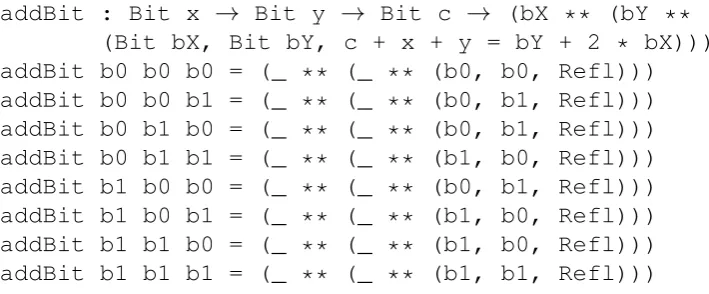
addBit : Bit x → Bit y → Bit c → (bX ** (bY **
[image:52.595.127.482.169.316.2](Bit bX, Bit bY, c + x + y = bY + 2 * bX))) addBit b0 b0 b0 = (_ ** (_ ** (b0, b0, Refl))) addBit b0 b0 b1 = (_ ** (_ ** (b0, b1, Refl))) addBit b0 b1 b0 = (_ ** (_ ** (b0, b1, Refl))) addBit b0 b1 b1 = (_ ** (_ ** (b1, b0, Refl))) addBit b1 b0 b0 = (_ ** (_ ** (b0, b1, Refl))) addBit b1 b0 b1 = (_ ** (_ ** (b1, b0, Refl))) addBit b1 b1 b0 = (_ ** (_ ** (b1, b0, Refl))) addBit b1 b1 b1 = (_ ** (_ ** (b1, b1, Refl)))
Figure 1.2: Addition of three bits
The syntax (n ** t) denotes a dependent pair, where the type of the second argument t can refer to the first argument n. So, we can read this type as: “there exists a number bX, and a number bY, such
that we have two bits Bit bX and Bit bY and the sum of the input
bitsc, xandyequals bY + 2 * bX.” For example, on the second line,
which corresponds to the computation 12+02+02= (01)2, the function
produces this bitsb0and b1, and a proof that 1+0+0=1+ (2×0). It should be pointed that the proof part of the output is systematically produced by using only Refl. Indeed, for each of the eight patterns,
a simple computation reduces the two expressions to the same value, andRefl therefore stands as a proof of equality of these two identical entities. Also note the usage of the underscore symbol for inferable terms, which let the system fill in these holes.
There is no need to produce any lemma of correctness aboutaddBit
afterwards as the correct by construction style in which it is written already gives the needed property: the two bits produced effectively represent the addition of the three bits given in input.
We then define the functionadcthat adds two binary numbers and
the value c + x + y, wherec represents the value of the input carry bit, and xandyrepresent the values of the two binary numbers given in input. We would like to write:
adc : Binary w x → Binary w y → Bit c
→ Binary (S w) (c + x + y)
adc zero zero carry = zero # carry
adc (numx # bX) (numy # bY) carry
= let (vCarry0 ** (vLsb ** (carry0, lsb, _))) = addBit bX bY carry in
adc numx numy carry0 # lsb
The first pattern performs the addition between the values zero, zero and a carry. In this simple case, we simply have to produce the one-digit valuezero # carry. The second pattern is when the two binary numbers are respectively(numx # bX)and(numy # bY)wherenumx
and numy are smaller binary numbers and bX andbY are two bits. In this case, we start by adding the least significant bits bX and bY with the carry, and this is performed by calling the function addBit. It
will essentially produce 2 bits, the first one representing the carry of the result (calledcarry0), and the second one the least-significant bit of the
result (called lsb). Once we have this intermediate result, we can call
resursively adc on the smaller terms numx and numy with carry0as the carry that we need to propagate, and finally add lsbto the right of this result.
Unfortunately, this definition is rejected by idris’ type-checker because the types do not match for both patterns. The result of the first line adc zero zero carry is expected to have the type :
Binary 1 ((c + 0) + 0)
but we provide a term of type :
Binary 1 (c + 0).
For the second case, the expected index is:
((c + (bit2 + (v1 + (v1 + 0)))) + (bit + (v + (v + 0))))
while we’re trying to provide a term indexed over:
vLsb + (((vCarry0 + v1) + v) + (((vCarry0 + v1) + v)