A New Descent Nonlinear Conjugate Gradient Method for
Unconstrained Optimization
Hao Fan, Zhibin Zhu, Anwa Zhou
School of Mathematics and Computing Science, Guilin University of Electronic Technology, Guilin, China E-mail: 540103003@qq.com
Received June 15, 2011; revised July 10, 2011; accepted July 17, 2011
Abstract
In this paper, a new nonlinear conjugate gradient method is proposed for large-scale unconstrained optimiza-tion. The sufficient descent property holds without any line searches. We use some steplength technique which ensures the Zoutendijk condition to be held, this method is proved to be globally convergent. Finally, we improve it, and do further analysis.
Keywords: Large Scale Unconstrained Optimization, Conjugate Gradient Method, Sufficient Descent Property, Globally Convergent
1. Introduction
The nonlinear conjugate gradient method is designed to solve the following unconstrained optimization problem:
min ( ),f x xn
where is a smooth nonlinear function, and
the gradient of
: n
f
f at x is denoted by g x( ). The it-erative formula of the conjugate gradient methods is given by
1
k k k k
x x t d , k0,1,..., (1.1) where k is a steplength which is computed by carrying out some line search, is the search direction defined by
t
k
d
1
, 1
, 2
k k
k k k
g if k
d
g d if k
,
, (1.2) where k is a scalar, gk denotes g x( )k .
There are some well-known formulas for k, which
are given as follows:
1 2 1
T PRP k k k
k g y
g
, (Polak-Ribiere-Polyak [1]), (1.3)
2 2 1
k FR k
k g g
, (Fletcher-Reeves [2]), (1.4)
where yk1gkgk1, and stands for the Euclid-ean norm of vectors.
In addition, the sufficient descent condition is defined
as follows:
2
T
k k k
g d c g , (1.5)
where , has often been used in the literature to
analyze the global convergence of conjugate gradient methods with inexact line searches.
0 c
Generally, the PRP method was much better than the FR method judging from the numerical calculation. When the objective function was convex, Polak and Ri-bie`re proved that the PRP method with the exact line search was globally convergent. But Powell showed that there existed nonconvex functions on which the PRP method did not converge globally. He suggested that k
should not be less than zero. Under the sufficient descent condition, Gilbert and Nocedal proved that the modified
PRP method max 0,
PRP
k
k was globally
conver-gent with the Wolfe-Powell line search.
Recently, G. Yu [3] proposed a modified FR (MFR) formula such as
2 1
k 2
2 1 3 1
( ) k ,
MFR
T
k k k
g
g d g
(1.6)
where1(0,), 2
1 1,
, 3
0,
and 1 was an any given positive constant. They proved that for any line search, (1.6) satisfied the condition (1.5), in
which 1
2
1
c
weight placed on conjugacy versus descent. Along this way, G. Yu [3] proposed a new nonlinear conjugate gra-dient formula such as
2
1 2
1 2
k ( ) 1 1 ,
0 otherwis
T
k k k T
k k k
N T
k k k
g g g
if g g g
g d g
e, (1.7) in which 1. It possessed the sufficient descent property for any line search, and had an advancement that the directions would approach to the steepest descent directions while the steplength was small. They also proved the algorithm which possed the global conver-gence property with the weak Wolfe-Powell.
Z. Wei [4] proposed a new nonlinear conjugate gradi-ent formula such as
1 1 * 2 1 k T
k k k
k k
k g
g g g
g g
, (1.8)
In [4], a new conjugate gradient formula *
k
was
given to compute the search directions for unconstrained optimization problems. It was discussed some general convergence results for the proposed formula with some line searches such as the exact line search, the Wolfe- Powell line search and the Grippo-Lucidi line search.
The given formula , and had the similar form
with * 0 k PRP k .
Combining the algorithms above, in this paper, we propose a new modified scalar formula N( )
k
, denoted
( )
MN k
, the new algorithm calls MN algorithm, where
2 1 1 k 2 1 1 ( ) k T k k k MN T
k k k
g
k
g g g
g
g d g
(1.9)
in which 1. We add some parameters for MN( )
k
so that it is generalization, then we have VMN algo-rithm
2
1 1
1
k 2
2 1 3 1
( ) k T k k k VMN T
k k k
g
g g g
g
g d g
k
, (1.10)
in which 1 (0,), 2
1 1,
, 3 (0,), and 1 is any given positive number, calls VMN algo-rithm.In the next section, we present the global convergence of MN algorithm and establish some good properties for which. The global convergence results of VMN algo-rithm are given in Section 3. Finally, we have a conclu-sion section.
2. The Global Convergence of MN Algorithm
Firstly, we can prove MN( )
k
in (1.9) is non-negative, 2 1 1 2 1 1 2 1 1 2 1 1 ( ) 0 , k T
k k k
k MN
k T
k k k
k
k k k
k T
k k k
g
g g g
g
g d g
g
g g g
g
g d g
The following theorem shows that MN algorithm pos-sesses the sufficient descent property for any line search.
Theorem 2.1. Consider any method (1.1) and (1.2),
where MN( )
k k
.Then for all k1
2 1 1
T
k k k
g d g
. (2.1)
Proof. If g dTk1 k 0, for 1, then we have
2 2
1 1 1 1
1 1
T
k k k k
g d g g
.
Otherwise, from the definition of kMN( ) , we can Obtain
2 1
1
( ) k
MN k T k k g g d ,
and then we have
1 1
2
1 1 1
2
2 1 2
1 1 1 ( ) 1 1 . T k k MN T
k k k k
k T
k T k k
k k g d
g g d
g
g g d
g d
gk1
From 1 1 12 0
T
g d g , we can deduce that (2.1) holds for all k1.
In order to establish the global convergence result for MN algorithm, we will impose the following assumptions.
Assumption A.
1) The level set
( ) ( )0
nx R f x f x
is bounded.
2) In some neighborhood N of ,
f
is differenti-able and its gradient g is Lipschitz continuous, that is to say, there exists a constant L0 such that( ) ( ) ,
g x g y L x y x y N, . (2.2) By using the Assumption A, we can deduce that there exists B and M 0 such that
,
The following important result is obtained by Zoutendijk [5].
Lemma 2.2. Suppose that Assumption A holds. Con-sider any iteration method of the form (1.1) and (1.2), and
is obtained by the Wolfe line search (1.4). Then
k
t
2 2 0 . T k k k k g d d
(2.4)Then we will analyse the global convergence property of MN algorithm.
Gilbert and Nocedal [6] introduced the following Prop-erty A which pertains to the PRP method under the suffi-cient descent condition. Now we will show that this Prop-erty A pertains to the new method.
Property A. Consider a method of form (1.1) and (1.2). Suppose that
0 gk . (2.5) We say that the method has Property A, if for all , there exist constants
k
1,
b 0 such that k b
and we have
1 2
k b
if sk1 .
The following lemma shows that the new method has the Property A.
Lemma 2.3. Consider the method of form (1.1) and (1.2) in which k kMN( ) . Suppose that Assumption A holds, then the method has Property A.
Proof. Set
2 2
3 1, 4
b L b .
By (1.9) and (2.5) we have
2 1 1 k 2 1 1 1 2 1 2 2 2 3 ( ) . k Tk k k
k MN
T
k k k
k k k
k
g
g g g
g
g d g
g g g
g b
By the Assumption A (2) and (2.2) hold, if sk1 , then
1 1 1
1 2 1 1 2 1 1 2 1 2 2 1 ( )
2 2 1
.
2 k
k k k k k
k MN
k
k
k k k
k
k k k
k k k
g
g g g g g
g g
g L g g
g
g L g g
g
L g L
b g
The proof is finished.
If (2.5) holds and the methods have Property A, then the small steplength should not be too many. The following lemma shows this property.
Lemma 2.4. Suppose that Assumption A and (1.5) hold. Let
xk and
dk be generated by (1.1) and (1.2) inwhich tk satisfies the Wolfe-Powell line search, k
has Property A. If (2.5) holds, then, for any 0, there exist Nand k0 N
, for all kk0, such that
, 2
k
, where
, : 1, 1
k i Z k i k si
, k,
denotes the number of the k,.Lemma 2.5. Suppose that Assumption A and (1.5) hold. Let
xk be generated by (1.1) and (1.2), k satisfiesthe Wolfe-Powell line search, and
t
0 k
has Property
A. Then,
lim inf k 0.
k g
The proofs of Lemmas 2.4 and 2.5 had been given in [7]. By the above three lemmas, it is easy to obtain the follow-ing convergence result.
Theorem 2.6. Suppose that Assumption A holds. Let
x
k be generated by (1.1) and (1.2), satisfies the kWolfe-Powell line search,
t
k
is computed by (1.9),
then
lim inf k 0.
k g
3. The Global Convergence of VMN
Algorithm
In this section we will add some parameters of MN( )
k
so that it is generalization, then we have VMN algorithm
2
1 1
1 2
2 1 3 1
( ) , k T k k k VMN k T
k k k
g
g g g
g
g d g
k
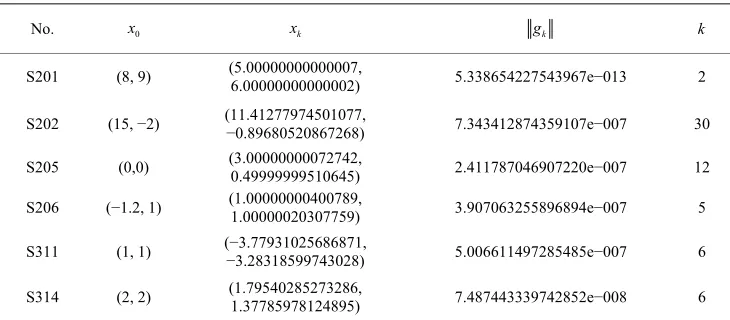
Table1.The detail information of numerical experiments for MN algorithm.
No. x0 xk gk k
S201 (8, 9) (5.00000000000007, 6.00000000000002) 5.338654227543967e−013 2
S202 (15, −2) (11.41277974501077, −0.89680520867268) 7.343412874359107e−007 30
S205 (0,0) (3.00000000072742, 0.49999999510645) 2.411787046907220e−007 12
S206 (−1.2, 1) (1.00000000400789, 1.00000020307759) 3.907063255896894e−007 5
S311 (1, 1) (−−3.28318599743028) 3.77931025686871, 5.006611497285485e−007 6
S314 (2, 2) (1.79540285273286, 1.37785978124895) 7.487443339742852e−008 6
in which
1 (0, ),
2
1 1,
, 3( ,1 ), 1 is any given positive number.
Theorem 3.1. Suppose that Assumption A holds. Let Let
xk be generated by (1.1) and (1.2), k satisfiesthe Wolfe-Powell line search, and
t
0 k
has Property
A. Then,
lim inf k 0
k g
Similar to the second part of the discussion for the above general algorithm VMN( )
k
, we can get .
And the algorithm possesses the sufficient descent prop-erty, in which
( ) 0
MN k
1 2
1
c
The proof is similar as the one of Theorem 2.1 in Sec-tion 2.
4. Numerical Experiments
In this section, we carry out some numerical experiments. The MN algorithm has been tested on some problems from [8]. The results are summarized in Table 1. For the test problem, No. is the number of the test problem in [8],
0
x is the initial point, xk is the final point, is the
number of times of iteration for the problem.
[image:4.595.115.480.96.256.2]k
Table 1 shows the performance of the MN algorithm relative to the iteration. It is easily to see that, for all the problems, the algorithm is very efficient. The results for each problem are accurate, and with less number of times of iteration.
5. Conclusions
In this paper, we have proposed a new nonlinear conjugate gradient method-MN algorithm. The sufficient descent
property holds without any line searches, and the algorithm satisfys Property A. We also have proved, employing some steplength technique which ensures the Zoutendijk condi-tion to be held, this method is globally convergent. Judging from the numerical experiments in Table 1,compared to most other algorithms, MN algorithm has higher precision and less number of times of iteration. Finally, we have proposed VMN algorithm, it also have the sufficient de-scent property and Property A, and it is global convergence under weak Wolfe-Powell line search.
6. References
[1] M. Al-Baali, “Descent Property and Global Convergence of the Fletcher-Reeves Method with Inexact Line Search,” IMA Journal of Numerical Analysis, Vol. 5, No. 1, 1985, pp. 121-124. doi:10.1093/imanum/5.1.121
[2] Y. F. Hu and C. Storey, “Global Convergence Result for Conjugate Gradient Method,” Journal of Optimization Theory and Applications, Vol. 71, No. 2, 1991, pp. 399-405. doi:10.1007/BF00939927
[3] G. Yu, Y. Zhao and Z. Wei, “A Descent Nonlinear Con-jugate Gradient Method for Large-Scale Unconstrained Optimization,” Applied Mathematics and Computation, Vol. 187, No. 2, 2007, pp. 636-643.
doi:10.1016/j.amc.2006.08.087
[4] Z. Wei, S. Yao and L. Liu, “The Convergence Properties of Some New Conjugate Gradient Methods,” Applied Mathematics and Computation, Vol. 183, No. 2, 2006, pp. 1341-1350. doi:10.1016/j.amc.2006.05.150
[5] G. Zoutendijk, “Nonlinear Programming, Computational Methods,” In: J. Abadie, Ed., Integer and Nonlinear Pro-gramming, North-Holland Publisher Co., Amsterdam, 1970, pp.37-86.
[6] J. C. Gilbert and J. Nocedal, “Global Convergence Prop-erties of Conjugate Gradient Methods for Optimization,”
SIAM Journal Optimization, Vol. 2, No. 1, 1992, pp. 21- 42. doi:10.1137/0802003
Methods,”Shanghai Scientific and Technical Publishers, Shanghai, 1998, pp. 37-48.
[8] W. Hock and K. Schittkowski, “Test Examples for