INSTRUMENT DEVELOPMENT AND VALIDATION OF A QUALITY SCALE: ICT ENABLED DEVICES
FOR DIFFERENTLY ABLED STUDENTS
*
School for Home Sciences, Babasaheb Bhimrao Ambedakar University, Lucknow
ARTICLE INFO ABSTRACT
The present study is focused on instrument development and validation of a quality scale. There are limited measures to
usage of various devices. Hence the study aimed to validate and standardize the schedule to assess ICT enabled devices used by differently abled. Market survey was conducted to check
of various ICT and assistive devices for differently abled students. With the help of relevant literature and market survey a questionnaire was developed for pilot study. The pilot study was conducted in disabled institutes using 30 respon
impaired, hearing impaired & locomotor impaired). With the help of pilot study the tool was developed and many parameters were added to the questionnaire. In the last phase, a group of 3 experts were consulted in the related and allied fields to validate the questionnaire. The experts were asked to evaluate the instrument in terms of clarity of items, linguistic accuracy and appropriateness of the instrument to achieve the purpose of the
help of experts using 3 point likert scale was evaluated. Each item was scored as 3, 2, 1 i.e. highly relevant, moderately relevant and irrelevant. Revisions and suggestions made by experts were taken into account. After validation of the instrument, some parameters were added and some were deleted for its relevance and appropriateness. Thus, the tool was finalized and the finding of this study indicates good reliability and validity of the schedule.
Copyright©2016, Garima Mishra and Kiran. This is an open access article distributed under the Creative Commons Att unrestricted use, distribution, and reproduction in any medium, provided the original work is properly cited.
INTRODUCTION
Information and communication technology (ICT) has the potential to enhance participation in educational activities for students with physical disabilities. Even though incorporating ICTs into teaching and learning in education has become an important issue but it is not clear what evidences research has provided. (Lidstrom et al., 2014) In today’s society, where information plays an important role, being able to use Information and Communication Technologies opens up opportunities for holding more responsible social positions. It is also more convenient for governments, institutions, publ and private enterprises to use the Internet to provide information services. Moreover, ICT offers great opportunities of social inclusion. Technological development can enable people with disabilities to improve their quality of life. They can accomplish tasks that would be impossible to do without the computer, such as: writing a letter, communicating, drawing a picture, etc. Moreover, the digitalization of many
*Corresponding author: Garima Mishra,
School for Home Sciences, Babasaheb Bhimrao Ambeda Lucknow
ISSN: 0975-833X
Article History:
Received 21st May, 2016
Received in revised form
10th June, 2016
Accepted 15th July, 2016
Published online 20th August,2016
Key words:
Differently Abled, Instrument, Scale, Validation.
Citation: Garima Mishra and Kiran, U.V. 2016.
students”, International Journal of Current Research, 8, (0
RESEARCH ARTICLE
INSTRUMENT DEVELOPMENT AND VALIDATION OF A QUALITY SCALE: ICT ENABLED DEVICES
FOR DIFFERENTLY ABLED STUDENTS
*Garima Mishra and Kiran, U. V.
School for Home Sciences, Babasaheb Bhimrao Ambedakar University, Lucknow
ABSTRACT
The present study is focused on instrument development and validation of a quality scale. There are limited measures to assess PWD’s ICT needs, purpose of using ICT devices and problems in the usage of various devices. Hence the study aimed to validate and standardize the schedule to assess ICT enabled devices used by differently abled. Market survey was conducted to check
of various ICT and assistive devices for differently abled students. With the help of relevant literature and market survey a questionnaire was developed for pilot study. The pilot study was conducted in disabled institutes using 30 respondents (10 respondent’s form each category of disability i.e. visually impaired, hearing impaired & locomotor impaired). With the help of pilot study the tool was developed and many parameters were added to the questionnaire. In the last phase, a group of 3 experts were consulted in the related and allied fields to validate the questionnaire. The experts were asked to evaluate the instrument in terms of clarity of items, linguistic accuracy and appropriateness of the instrument to achieve the purpose of the study. In this phase the items for relevance with the help of experts using 3 point likert scale was evaluated. Each item was scored as 3, 2, 1 i.e. highly relevant, moderately relevant and irrelevant. Revisions and suggestions made by experts were taken into account. After validation of the instrument, some parameters were added and some were deleted for its relevance and appropriateness. Thus, the tool was finalized and the finding of this study indicates good reliability and validity of the schedule.
is an open access article distributed under the Creative Commons Att use, distribution, and reproduction in any medium, provided the original work is properly cited.
Information and communication technology (ICT) has the potential to enhance participation in educational activities for students with physical disabilities. Even though incorporating ICTs into teaching and learning in education has become an e but it is not clear what evidences research has In today’s society, where information plays an important role, being able to use Information and Communication Technologies opens up opportunities for holding more responsible social positions. It is also more convenient for governments, institutions, public and private enterprises to use the Internet to provide information services. Moreover, ICT offers great opportunities of social inclusion. Technological development can enable people with disabilities to improve their quality of life. They h tasks that would be impossible to do without the computer, such as: writing a letter, communicating, drawing a picture, etc. Moreover, the digitalization of many
School for Home Sciences, Babasaheb Bhimrao Ambedakar University,
public services such as education (school, university), shopping, banking, library, or even sending a letter allows people with disabilities to live in much the same way as those who are not disabled. They can acquire an “independ
and achieve social integration. However, the prospective promised with the digital era often has not become the reality for most people with disabilities.
like India where the disabled population is 2.21 percentages (a per census 2011) of the total population, access to ICT remains neglected for many disabled. In such cases, creating self sufficiency and independence through the fruits of technology would play a pivotal role towards ensuring their basic rights and dignity. It is imperative that people with disabilities are entitled equal access to education and employment, equal rights to parenthood, property ownership, political rights, and legal representation. Computers, adaptive technology and the internet can help disabled people take advantage of education and employment opportunities leading to sustainable long term empowerment opportunities.
scenario, the society where we live in is called a Global Society and the gradual development of
Communication Technologies (ICT) contributes to its change
International Journal of Current Research
Vol. 8, Issue, 08, pp.35760-35765, August, 2016
INTERNATIONAL
“Instrument development and validation of a quality scale: ICT enabled devices for differently Abled , 8, (08), 35760-35765.
INSTRUMENT DEVELOPMENT AND VALIDATION OF A QUALITY SCALE: ICT ENABLED DEVICES
School for Home Sciences, Babasaheb Bhimrao Ambedakar University, Lucknow
The present study is focused on instrument development and validation of a quality scale. There are assess PWD’s ICT needs, purpose of using ICT devices and problems in the usage of various devices. Hence the study aimed to validate and standardize the schedule to assess ICT enabled devices used by differently abled. Market survey was conducted to check the availability of various ICT and assistive devices for differently abled students. With the help of relevant literature and market survey a questionnaire was developed for pilot study. The pilot study was conducted in dents (10 respondent’s form each category of disability i.e. visually impaired, hearing impaired & locomotor impaired). With the help of pilot study the tool was developed and many parameters were added to the questionnaire. In the last phase, a group of 30 experts were consulted in the related and allied fields to validate the questionnaire. The experts were asked to evaluate the instrument in terms of clarity of items, linguistic accuracy and appropriateness study. In this phase the items for relevance with the help of experts using 3 point likert scale was evaluated. Each item was scored as 3, 2, 1 i.e. highly relevant, moderately relevant and irrelevant. Revisions and suggestions made by experts were taken into account. After validation of the instrument, some parameters were added and some were deleted for its relevance and appropriateness. Thus, the tool was finalized and the finding of this study
is an open access article distributed under the Creative Commons Attribution License, which permits
public services such as education (school, university), shopping, banking, library, or even sending a letter allows people with disabilities to live in much the same way as those who are not disabled. They can acquire an “independent life” and achieve social integration. However, the prospective promised with the digital era often has not become the reality for most people with disabilities. (Arrigo, 2005) In a country like India where the disabled population is 2.21 percentages (as per census 2011) of the total population, access to ICT remains neglected for many disabled. In such cases, creating self sufficiency and independence through the fruits of technology would play a pivotal role towards ensuring their basic rights ity. It is imperative that people with disabilities are entitled equal access to education and employment, equal rights to parenthood, property ownership, political rights, and legal representation. Computers, adaptive technology and the disabled people take advantage of education and employment opportunities leading to sustainable long term empowerment opportunities. (Hossain, 2010) In present scenario, the society where we live in is called a Global Society and the gradual development of Information and Communication Technologies (ICT) contributes to its change
INTERNATIONAL JOURNAL OF CURRENT RESEARCH
and development. Disability is inevitably associated with several limitations with regard to electronic accessibility and individuals with various forms of disability cannot be excluded from technological evolution. Therefore, it is imperative that they benefit from such technologies, should fulfill the need of the disabled and should promote their digital inclusion, communication and autonomy.
The benefits of the ICT tools for resource discovery should reach the disabled users without any barrier. They should also be able to handle the tools without any difficulty. Their hidden talents should also be expressed through the modern ICTs for the welfare of the society. The disability should not be a hurdle for exposure of their talents. The ICT tools should be modified or new accessories may be invented, to attach with the existing tools, to rectify the defect (Nagarajan et al., 2001). The information and communication technology will be helpful to reduce the discrimination of the differently abled and will make a suitable environment for them to work along with the other ICT tool users. Employment opportunities should be created for persons with disability to expose their talents and make them independent. Therefore, the usage of ICT tools for resource discovery should be made available to all the citizens including the physically disabled so that the full- fledged global access can be achieved. Assistive technology for disabled is defined as any equipment or system that assists people who have difficulties, due to age or disability, in carrying out everyday activities. The Foundation for Assistive Technology (FAST) 19 uses a similar definition: “a product or service that enables independence for older or disabled people”. Assistive technology is coming to be the preferred term for all such devices rather than “disability equipment” or “technical aids”. It covers simple items such as walking sticks, bath seats and grab rails, as well as electro-mechanical equipment (e.g. powered wheelchairs), electronic aids (e.g. digital hearing aids and environmental controls), or equipment used by care takers such as lifting aids. (Curry et al., 2002)
Technology can reduce the effects of impairment by improved activity and greater participation, to promote inclusion of students with disabilities. Access to ICT for students with disabilities may require more (and more costly) resources than are provided for other students. Different technologies are adopted or adapted for use for students with hearing, vision, communication, physical and intellectual disabilities. Technology issues arise in two ways for students with disability. First, the emphasis has been on the costs of providing services to people with disability in the form of assistive technologies. Second, with the introduction of ICT as a new mode of pedagogy, access to computers enables students with disabilities to participate more fully in learning activities. (Nanda et al., 2012) Fichten et al. (2009) developed the POSITIVES Scale (Postsecondary Information Technology Initiative Scale), a brief, bilingual, reliable, and valid measure to allow staff at postsecondary and rehabilitation institutions a means to assess the extent to which the information and communication technology (ICT)-related needs of students with various disabilities are met. The researcher found that students participants were relatively old (mean age was 28) and about half of the sample reported a learning disability, about a third reported a psychological/psychiatric disability,
and over a third reported more than one disability. This implies that different adaptive computer technologies meant to support people with different disabilities need to be able to operate together. Akbulut et al. (2007) has conducted a study to analyze psychometric features of a scale which was developed to measure indicators of Information and Communication Technologies (ICTs) at an undergraduate institution in Turkey. Questionnaire items for each factor were prepared and verified through expert panels. The questionnaire was administered to 359 education college students at a Turkish state university. Exploratory factor analysis eliminated 13 of 54 questions in the scale, identified 10 factors accounting for 51.557 % of the variance. The internal consistency was also high (α=.888). Al-Natour et al. studied the status quo of using ICT among special education teachers in Amman- Jordan schools. This study focused to the extent to which ICT has been made available to teachers and students, and obstacles that hinder their use. The researcher developed a questionnaire and 137 teachers were participants in the study. 97 questionnaires were returned, representing 70% of the total population. Results of this study indicated that availability of tools and devices was limited. The output of this research shows that educational programs available in resource rooms were Word Processor, PowerPoint, graphic related programs, and educational games. Difficulty in accessing the internet, lack of educational programs for students with special needs, and lack of educational devices were the obstacles encountered by special education teachers. Results of this study showed significant differences among special education teachers based on their educational qualifications.
Objective
Validate and standardize the schedule to assess ICT enabled devices used by differently abled students.
Rationale
and engages them in their societal activities especially when they find themselves in a position where they can directly get into contact and interact with those around them. To ensure that the ICT-related needs of students with visual impairment, hearing impairment and loco-motor impairment are well met, using the tool; A study on customization of ICT enabled devices for differently abled students, needs to become an institutional priority for colleges, universities, tutoring centers, and rehabilitation facilities. The outcome of this tool will result in majority of the ICT- related needs of the students being met; contribute to remove the barriers face by students while using ICT devices, and equip students with some challenges with the skills needed to succeed in the increasingly ICT-driven world of daily living, college work, community, and leisure.
MATERIALS AND METHODS
The process of developing a scale and testing its validity was being carried out in four phases. In the first phase, a market survey was conducted to check the availability of various assistive and ICT devices for differently abled. Checklist was prepared for market survey. With the help of market survey and relevant literature, an open ended questionnaire was designed for pilot study. The purpose of designing open ended question was to determine the appropriate parameters for the study. As the study aims to explore various ICT enabled devices for persons with visual impairment, persons with hearing impairment and persons with loco-motor impairment, so the questionnaire consisted of 3 sections as A, B and C.
ICT DEVICES STUDIED
Visual Impairment
Hearing Impairment
Locomotor Impairment
Mobile phones
Computers/ laptops
Tactile devices
Screen readers radio
Smart cane/white cane
Abacus
Braille slate
Tracing wheel
Braille kit
Talking computer terminal
Kurzweil reading machine
Computer driven braille
printer
Talking books/ daisy books
Dictation devices and
description
Standalone reading machine
Braille watch
Hearing aids
Speech trainer
Group hearing aid system
Interactive video discs
Loop induction system
Computers/ laptops
Voice carry over (vco) telephones
Closed captioning tvs
Cochlear implants
Wheelchair
Vans or other assistive vehicles
Walker
Caliper
Artificial limb
Tricycle
Elbow stick
Prosthetic devices
Orthotic devices
Mobile phones/Smart phones
Computers/ Laptops
Radio
Tape recorders
Proper
Functioning
Section A deals with the kind of ICT devices used by the respondents, section B deals with the purpose of using various devices and section C deals with the problems faced by the respondents in the usage of ICT devices. In the second phase, a pilot study was conducted in the disabled institutes by selecting a sample of 10 from each disability to make a total of 30. With the help of pilot study many new parameters were identifies to construct the tool.
In the third phase, the tool was developed incorporating all the parameters. Many parameters were added to the questionnaire. Open ended questions were made into closed ended questions. So the items were generated for content evaluation with the help of pilot study. The questionnaire consists of 3 sections as A, B and C. In the section A, focus was to assess the knowledge regarding ICT enabled services. Respondents had to answer in Yes or No. In the section B respondents were asked to respond about the purpose of using various ICT related devices. Multiple choice questions were asked in this section. In the section C, questions were designed to know the problems faced by the respondents while using ICT related devices. Thus, the instrument was developed based on extensive review of literature, market survey and pilot study. In the fourth phase, a group 30 experts were consulted in the related and allied fields to validate the questionnaire. The experts were asked to evaluate the instrument in terms of clarity of items, linguistic accuracy and appropriateness of the instrument to achieve the purpose of the study. In this phase the items for relevance with the help of experts using 3 point likert scale was evaluated. Each item was scored as 3,2,1 i.e. highly relevant, moderately relevant and irrelevant. Revisions and suggestions made by experts were taken into account. After validation of the instrument, some parameters were added and some were deleted for its relevance and appropriateness. Thus, the tool was finalized. The questionnaire consists of 5 sections as A,B,C,D&E. Section A consists of uses of various ICT devices, Respondents have to answer in Yes, No and Sometimes, section B consists of purpose of using various ICT devices; respondents were asked to choose one option as questions in this section were multiple choice questions. Section C consists of problems faced by the differently abled students in the usage of ICT devices. Section D and E deals with the open ended questions as what features they feel to be incorporated in any of the ICT devices and what other devices they feel to have to improve their quality of life. Thus, the scale was developed and validated.
DATA ANALYSIS
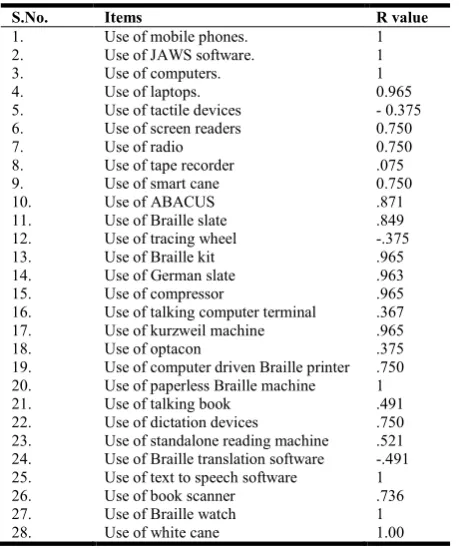
Principal component factor analysis was used to assess construct validity (Elsaadani, 2012). Data presented in the table 1, clearly revealed that instrument provides a great deal of information about the respondents. Majority of the items in instruments scored ‘r’ value 0.75 or >0.75 means items are relevant to collect information. Seven items in the table shows perfect positive correlation as ‘r’ value is +1. In the line of above, five items scored ‘r’ value +0.9, these items shows very high degree of positive co-relation. Seven items from the table scored ‘r’ value +0.75 or > 0.75 indicates items framed in the instrument are positively correlated. Only three items in the table shows negative correlation as ‘r’ value is – 0.375 and -
[image:4.595.320.550.166.441.2]0.49, means items are relevant to collect information. Individual with visual impairment rely on JAWS software, computers/laptops and Braille language in writing and reading which can only be used by special machine for paper dotting. Therefore, feeling or touching is the main sense by which Braille enables them to learn and teach (Al-Natour et al., 2008).
Table 1. Use of ICT devices by persons with Visual Impairment
S.No. Items R value
1. Use of mobile phones. 1
2. Use of JAWS software. 1
3. Use of computers. 1
4. Use of laptops. 0.965
5. Use of tactile devices - 0.375
6. Use of screen readers 0.750
7. Use of radio 0.750
8. Use of tape recorder .075
9. Use of smart cane 0.750
10. Use of ABACUS .871
11. Use of Braille slate .849
12. Use of tracing wheel -.375
13. Use of Braille kit .965
14. Use of German slate .963
15. Use of compressor .965
16. Use of talking computer terminal .367
17. Use of kurzweil machine .965
18. Use of optacon .375
19. Use of computer driven Braille printer .750
20. Use of paperless Braille machine 1
21. Use of talking book .491
22. Use of dictation devices .750
23. Use of standalone reading machine .521
24. Use of Braille translation software -.491
25. Use of text to speech software 1
26. Use of book scanner .736
27. Use of Braille watch 1
[image:4.595.321.549.472.587.2]28. Use of white cane 1.00
Table 2. Use of ICT devices by persons with Hearing Impairment
S.No. Items R value
1. Use of hearing aids. .404
2. Use of speech trainer. 1
3. Use of group system. 1
4. Use of interactive video discs. .937
5. Use of loop induction system -.761
6. Use of computers/laptops .404
7. Use of videophones .937
8. Use of captel .474
9. Use of voice carry over telephones .474
10. Use of closed captioning .529
participate in daily activities (Agree and Freedman, 2011). Thus, above table shows that some questions are highly relevant and some questions moderately relevant to collect information from hearing impaired respondents.
Table 3. Use of ICT devices by persons with Loco-motor Impairment
S.No. Items R value
1. Use of wheelchair. 1
2. Use of vans or other assistive vehicles. 1
3. Use of walker. 1
4. Use of caliper. 1
5. Use of artificial limb 1
6. Use of tricycle 1
7. Use of elbow stick 1
8. Use of prosthetic devices 1
9. Use of orthotic devices 1
10. Use of cochlear implant 1
11. Use of mobile phone 1
12. Use of computers/laptops 1
13. Use of radio 1
14. Use of tape recorder 1
[image:5.595.310.556.184.273.2]Table 3 describes use of assistive and ICT devices by locomotors. Pearson Correlation was used to check the relevance of items constructed in instrument for persons with physical disability. As far as ‘r’ value of the items is concerned, all the items scored ‘r’ value +1 and it shows perfect positive correlation. From the above table it can be interpreted that ICT related and assistive technologies as computers, laptops, radio, television, mobile phone, calipers, tricycle and elbow stick are more common devices used by persons with physical disabilities. These measures appeared to perform substantially better than questions about the role of assistive technology in reducing pain, the extent to which activities were tiring, the amount of time needed to carry out activities, and reliance on other people (Agree and Freedman, 2011).
Table 4. Purpose of Using ICT devices by persons with Visual Impairment
Snow. Items R value
1. Purpose of using mobile phones 1
2. Purpose of using computers 1
3. Purpose of using laptops 1
4. Purpose of using radio .500
5. Purpose of using screen readers .500
6. Purpose of using tape recorders .500
7. Purpose of using Braille translation software .655
8. Purpose of using Braille embosser .655
9. Purpose of using Braille E books .655
10. Purpose of using audio text books 1
11. Purpose of using handheld magnifiers 1
12. Purpose of using stand magnifiers 1
13. Purpose of using spectacle magnifiers 1
14. Purpose of using tactile materials 1
15. Purpose of using optacon 1
It was anticipated that questions on the assessment instrument would address three categories of the theoretical framework (highly relevant, moderately relevant, and irrelevant) used to construct the assessment instrument (Fitzallen, 2006). As the study aims to validate and standardized the schedule to assess ICT enabled devices used by differently abled, Table 3 shows the purpose of using various ICT devices. Nine items in the table shows perfect positive correlation as scored ‘r’ value +1.
These items are highly relevant for the purpose of collecting information from blind or partially blind. Remaining items in the table shows ‘r’ value 0.5, 0.6, these items are also relevant for data collection. In the light of above result, it can be concluded that information technologies as mobile, computer, laptop, Braille e books, audio text books handheld magnifiers, tactile material and optacon are more common devices used by persons with visual impairment.
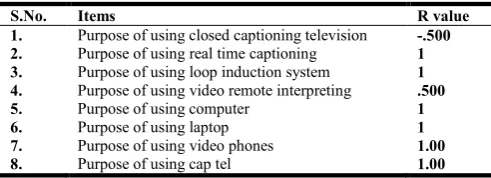
Table 5. Purpose of Using ICT devices by persons with Hearing Impairment
S.No. Items R value
1. Purpose of using closed captioning television -.500
2. Purpose of using real time captioning 1
3. Purpose of using loop induction system 1
4. Purpose of using video remote interpreting .500
5. Purpose of using computer 1
6. Purpose of using laptop 1
7. Purpose of using video phones 1.00
8. Purpose of using cap tel 1.00
[image:5.595.326.535.459.532.2]Table 5 is concerned with purpose of using ICT devices by hearing impaired and the table indicates that majority of the items are highly relevant. Only one item in the table shows negative correlation as ‘r’ value is – 0.5. Rest of the items shows positive correlation in the items. Devices that are reducing the barriers and improving the quality of life of the respondents are laptop, computer, video phones, loop induction system and real time captioning. Moreover, such items can increase their efficiency of work and create barrier free environment for them. This implies that different assistive and ICT technologies meant to support persons with differently abled need to be able to operate together (Fichten et al., 2009).
Table 6. Purpose of Using ICT devices by persons with Loco-motor Impairment
S.No. Items R value
1. Purpose of using wheelchair 1
2. Purpose of using tricycle 1
3. Purpose of using mobile phones .309
4. Purpose of using laptop .271
5. Purpose of using radio .527
6. Purpose of using television .790
In order to investigate the use of ICT by physically disabled, an exploratory factor analysis was conducted through PAS for windows (Akbulut, et al., 2007). Factor analysis is used as a data reduction technique, which takes a large set of variables, and reduces or summarizes the data using a smaller set of components (Pallant, 2001). The table shows that two items out of six are highly relevant (r= +1) and one item is relevant as ‘r' value + 0.79. Wheel chair and tricycle are the assistive vehicles mostly used by the respondents. These vehicles are mainly used for going to institute and market. ICT related devices as mobiles are used for the purpose of communication. Radio and television are used for the purpose of information gathering. Laptop and computers are used basically for academic purpose.
Conclusion
[image:5.595.46.288.507.660.2]gap. The assessment instrument can be used in variety of ways to assess the ICT services used, purpose of using various ICT services and problems faced while using these services by disabled. The instrument will also provide an avenue to customize need based assistive devices to overcome the barriers faced by them. With the help of validated and standardized the schedule, it will be easier to measure the ICT enabled services for differently abled independently.
Acknowledgements
This research is funded by INSPIRE Fellowship issued from Department of Science and Technology.
REFERENCES
Agree, E. M. and Freedman, V. A. 2011. A quality-of-life scale for assistive technology: results of a pilot study of aging and technology. Physical Therapy, 91(12), 1780-1788.
Akbulut, Y., Kesim, M. and Odabasi, F. 2007. Construct validation of ICT Indicators Measurement Scale (ICTIMS). International Journal of Education and Development using Information and Communication Technology, 3(3): 60-77. Al-Natour M., Alkhamra H. and Jordan K. 2015. The Status
Quo of Using ICT in Teaching among Special Education Teachers in Amman, Jordan Schools. Available at http://www.itdl.org/Journal/Aug_08/article02.htm April. Al-Natour, M., Alkhamra, H. and Ajlouni, K. 2008. The Status
Quo of Using ICT in Teaching among Special Education Teachers in Amman, Jordan Schools.
Arrigo M. 2005. E-Learning Accessibility for blind students. Recent Research Developments in Learning Technologies. FORMATEX 2005. m-ICTE2005 http://www.formatex. org/micte2005.
Curry R., Tinoco M. and Wardle D., 2002. The Use of Information and Communication Technology (ICT) to Support Independent Living for Older and Disabled People. Available at http://ii.tudelft.nl/pub/olivier/Med-e-Tel_ BlansonHenkemansetal.pdf
Elsaadani, A. P. D. M. 2012. Teaching staff ‘attitude toward ICT: Is Gender a factor? Volume 1 Number 2, 21.
Fichten, C. S., Asuncion, J. V., Nguyen, M. N., Wolforth, J., Budd, J., Barile, M. and Amsel, R. 2009. Development and Validation of the POSITIVES Scale (Postsecondary Information Technology Initiative Scale). Online Submission.
Fitzallen, N. 2006. A model of students statistical thinking and reasoning about graphs in an ICT environment. In P. Grootenboer, R. Zevenbergen, and M. Chinnappan (Eds.), Identities, cultures and learning spaces (Proceedings of 29th annual conference of the Mathematics Education Research Group of Australasia, pp. 203-210). Sydney: MERGA.
Fitzallen, N. 2008. Validation of an assessment instrument developed for eliciting student prior learning in graphing and data analysis. Navigating currents and charting directions, 203-209.
Hossain M. 2010. ICT for Persons with Disabilities: Bridging the Digital Divide in Bangladesh. Springer-Verlag Berlin Heidelberg. Volume 6179, 2010, pp 527-530. Available at http://link.springer.com/chapter/10.1007/978-3-642-14097-6_84.
http://www.itdl.org/Journal/Aug_08/article02.htm accessed on 24 April, 2015.
Lidstrom H. and Hemmingsson H. 2014. Benefits of the usage of ICT activities by students with motor, speech, visual and hearing impairment: A Literature review. Scandinavian Journal of Occupational Therapy, Early Online, 1-16. Nagarajan M. and Surianarayanan S. 2001. Creation and
management of digital resources: Services Assistive technology for the digital resource Discovery tools for the disabled users. INFLIBNET Centre. Available at http://ir.inflibnet.ac.in/handle/1944/125.
Nanda A. and Ramesh D. 2012. Assessment of Information and Communication Technology (ICT) Literacy among Teachers and Practitioners in the Field of Disability. International Journal of Information Dissemination and Technology. Vol. 2 Issue 1.
Pallant, J. 2001. SPSS survival manual. Maidenhead, PA: Open University Press.