Generating and Validating Abstracts of Meeting Conversations: a User
Study
Gabriel Murray
Giuseppe Carenini
Department of Computer Science, University of British Columbia Vancouver, Canada
Raymond Ng
Abstract
In this paper we present a complete sys-tem for automatically generating natural language abstracts of meeting conversa-tions. This system is comprised of com-ponents relating to interpretation of the meeting documents according to a meet-ing ontology, transformation or content selection from that source representation to a summary representation, and gener-ationof new summary text. In a forma-tive user study, we compare this approach to gold-standard human abstracts and ex-tracts to gauge the usefulness of the dif-ferent summary types for browsing meet-ing conversations. We find that our auto-matically generated summaries are ranked significantly higher than human-selected extracts on coherence and usability crite-ria. More generally, users demonstrate a strong preference for abstract-style sum-maries over extracts.
1 Introduction
The most common solution to the task of summa-rizing spoken and written data is sentence (or ut-terance) extraction, where binary sentence classi-fication yields a cut-and-paste summary compris-ing informative sentences from the document con-catenated in a new, condensed document. Such extractive approaches have dominated the field of automatic summarization for decades, in large part because extractive systems do not require a natu-ral language generation (NLG) component since the summary sentences are simply lifted from the source document.
Extrinsic evaluations have shown that, while ex-tractive summaries may be less coherent than hu-man abstracts, users still find them to be valuable tools for browsing documents (He et al., 1999; McKeown et al., 2005; Murray et al., 2009). How-ever, these previous evaluations also illustrate that
concise abstracts are generally preferred by users and lead to higher objective task scores. A weak-ness of typical extractive summaries is that the end user does not know why the extracted sentences are important; exploring the original sentence con-text may be the only way to resolve this uncer-tainty. And if the input source document consists of noisy, unstructured text such as ungrammatical, disfluent multi-party speech, then the resultant ex-tract is likely to be noisy and unstructured as well. Herein we describe a complete and fully auto-matic system for generating abstract summaries of meeting conversations. Our abstractor maps input sentences to a meeting ontology, generates messages that abstract over multiple sentences, selects the most informative messages, and ulti-mately generates new text to describe these rele-vant messages at a high level. We conduct a user study where participants must browse a meeting conversation within a very constrained timeframe, having a summary at their disposal. We compare our automatic abstracts with human abstracts and extracts and find that our abstract summaries sig-nificantly outperform extracts in terms of coher-ence and usability according to human ratings. In general, users rate abstract-style summaries much more highly than extracts for these conversations.
2 Related Research
Automatic summarizaton has been described as consisting of interpretation, transformation and generation (Jones, 1999). Popular approaches to text extraction essentially collapse interpretation and transformation into one step, with genera-tion either being ignored or consisting of post-processing techniques such as sentence compres-sion (Knight and Marcu, 2000; Clarke and Lapata, 2006) or sentence merging (Barzilay and McKe-own, 2005). In contrast, in this work we clearly separate interpretation from transformation and in-corporate an NLG component to generate new text to describe meeting conversations.
ap-proach to text summarization, one application in which abstractive summarization is widely used is data-to-text generation. Summarization is critical for data-to-text generation because the amount of collected data may be massive. Examples of such applications include the summarization of inten-sive care unit data in the medical domain (Portet et al., 2009) and data from gas turbine sensors (Yu et al., 2007). Our approach is similar except that our input is text data in the form of conversations. We otherwise utilize a very similar architecture of pattern recognition, pattern abstraction, pattern selectionandsummary generation.
Kleinbauer et al. (2007) carry out topic-based meeting abstraction. Our systems differ in two major respects: their summarization process uses human gold-standard annotations of topic seg-ments, topic labels and content items from the on-tology, while our summarizer is fully automatic; secondly, the ontology they used is specific not just to meetings but to the AMI scenario meetings (Carletta et al., 2005), while our ontology applies to conversations in general, allowing our approach to be extended to emails, blogs, etc.
In this work we conduct a user study where par-ticipants use summaries to browse meeting tran-scripts. Some previous work has compared ex-tracts and absex-tracts for the task of a decision au-dit (Murray et al., 2009) , finding that human ab-stracts are a challenging gold-standard in terms of enabling participants to work quickly and cor-rectly identify the relevant information. For that task, automatic extracts and the semi-automatic abstracts of Kleinbauer et al. (2007) were found to be competitive with one another in terms of user satisfaction and resultant task scores. Other research on comparing extracts and abstracts has found that an automatic abstractor outperforms a generic extractor in the domains of technical ar-ticles (Saggion and Lapalme, 2002) and evalua-tive reviews (Carenini and Cheung, 2008), and that human-written abstracts were rated best overall.
3 Interpretation - Ontology Mapping
Source document interpretation in our system re-lies on a general conversation ontology. The on-tology is written in OWL/RDF and contains upper-level classes such as Participant, Entity, Utterance, and DialogueAct. When additional information is available about participant roles in a given domain, Participant subclasses such as ProjectManager can
be utilized. Object properties connect instances of ontology classes; for example, the following entry in the ontology states that the object property has-Speakerhas an instance of Utterance as its domain and an instance of Participant as its range.
<owl:ObjectProperty rdf:about="#hasSpeaker"> <rdfs:range rdf:resource="#Participant"/> <rdfs:domain rdf:resource="#Utterance"/> </owl:ObjectProperty>
The DialogueAct class has subclasses cor-responding to a variety of sentence-level phe-nomena: decisions, actions, problems, positive-subjective sentences, negative-subjective sen-tences and general extractive sensen-tences (important sentences that may not match the other categories). Utterance instances are connected to DialogueAct subclasses through an object propertyhasDAType. A single utterance may correspond to more than one DialogueAct; for example, it may represent both a positive-subjective sentence and a decision. Our current definition of Entity instances is simple. The entities in a conversation are noun phrases with mid-range document frequency. This is similar to the definition of concept proposed by Xie et al. (2009), where n-grams are weighted by tf.idf scores, except that we use noun phrases rather than any n-grams because we want to refer to the entities in the generated text. We use mid-range document frequency instead ofidf (Church and Gale, 1995), where the entities occur in be-tween 10% and 90% of the documents in the col-lection. We do not currently attempt coreference resolution for entities; recent work has investi-gated coreference resolution for multi-party dia-logues (Muller, 2007; Gupta et al., 2007), but the challenge of resolution on such noisy data is high-lighted by low accuracy (e.g. F-measure of 21.21) compared with using well-formed text.
We map sentences to our ontology classes by building numerous supervised classifiers trained on labeled decision sentences, action sentences, etc. A general extractive classifier is also trained on sentences simply labeled as important. We give a specific example of the ontology mapping using the following excerpt from the AMI corpus, with entities italicized and resulting sentence classifica-tions shown in bold:
• A: And you two are going to work together on aprototypeusingmodelling clay.[action]
• A: You’ll getspecific instructions from your personal coach.[action]
• A: Um did we decide on achip?[decision]
• A: Let’s go with a simple chip. [decision, positive-subjective]
The ontology is populated by adding all of the sentence entities as instances of the Entity class, all of the participants as instances of the Participant class (or its subclasses such as Pro-jectManager when these are represented), and all of the utterances as instances of Utterance with their associated hasDAType properties indicating the utterance-level phenomena of interest. Here we show a sample Utterance instance:
<Utterance rdf:about="#ES2014a.B.dact.37"> <hasSpeaker rdf:resource="#IndustrialDesigner"/> <hasDAType rdf:resource="#PositiveSubjective"/> <begTime>456.58</begTime>
<endTime>458.832</endTime> </Utterance>
3.1 Feature Set
The interpretation component as just described re-lies on supervised classifiers for the detection of items such as decisions, actions, and problems. This component uses general features that are ap-plicable to any conversation domain. The first set of features we use for this ontology mapping are features relating to conversational structure. They include sentence length, sentence position in the conversation and in the current turn, pause-style features, lexical cohesion, centroid scores, and features that measure how terms cluster between conversation participants and conversation turns.
While these features have been found to work well for generic extractive summarization (Murray and Carenini, 2008), we use additional features for capturing the more specific sentence-level phe-nomena of this research. These include character trigrams, word bigrams, part-of-speech bigrams, word pairs, part-of-speech pairs, and varying in-stantiation n-grams, described in more detail in (Murray et al., 2010). After removing features that occur fewer than five times, we end up with 218,957 total features.
3.2 Message Generation
Rather than merely classifying individual sen-tences as decisions, action items, and so on, we also aim to detect larger patterns – or messages – within the meeting. For example, a given par-ticipant may repeatedly make positive comments about an entity throughout the meeting, or may give contrasting opinions of an entity. In or-der to determine which messages are essential for
summarizing meetings, three human judges con-ducted a detailed analysis of four development set meetings. They first independently examined previously-written human abstracts for the meet-ings to identify which messages were present in the summaries. In the second step, the judges met together to decide on a final message set. This resulted in a set of messages common to all the meetings and agreed upon by all the judges. The messages that our summarizer will automatically generate are defined as follows:
• OpeningMessage and ClosingMessage: Briefly de-scribes opening/closing of the meeting
• RepeatedPositiveMessage and RepeatedNegativeMes-sage: Describes a participant making positive/negative statements about a giv en entity
• ActionItemsMessage: Indicates that a participant has action items relating to some entity
• DecisionMessage: Indicates that a participant was in-volved in a decision-making process regarding some entity
• ProblemMessage: Indicates that a participant repeat-edly discussed problems or issues about some entity
• GeneralDiscussionMessage: Indicates that a partici-pant repeatedly discussed a given entity
Message generation takes as input the ontology mapping described in the previous section, and outputs a set of messages for a particular meeting. This is done by identifying pairs of Participants and Entities that repeatedly co-occur with the var-ious sentence-level predictions. For example, if the project manager repeatedly discusses the inter-face using utterances that are classified as positive-subjective, a RepeatedPositiveMessage is gener-ated for that Participant-Entity pair. Messages are generated in a similar fashion for all other sage types except for the opening and closing mes-sages. These latter two messages are created sim-ply by identifying which participants were most active in the introductory and concluding portions of the meeting and generating messages that de-scribe that participant opening or closing the meet-ing.
Messages types are defined within the OWL on-tology, and the ontology is populated with mes-sage instances for each meeting. The following message describes the Marketing Expert making a decision concerning the television, and lists the relevant sentences contained by that decision mes-sage.
<DecisionMessage rdf:about="#dec9">
<messageSource rdf:resource="#MarketingExpert"/> <messageTarget rdf:resource="#television"/>
4 Transformation - ILP Content Selection for Messages
Having detected all the messages for a given meet-ing conversation, we now turn to the task of transforming the source representation to a sum-mary representation, which involves identifying the most informative messages for which we will generate text. We choose an integer linear pro-gramming (ILP) approach to message selection. ILP has previously been used for sentence selec-tion in an extractive framework. Xie et al. (2009) used ILP to create a summary by maximizing a global objective function combining sentence and entity weights. Our method is similar except that we are selecting messages based on optimizing an objective function combining message and sen-tence weights:
maximize(1−λ)∗X i
wisi+λ∗ X
j
ujmj (1)
subject to X
i
lisi< L (2)
where wi is the score for sentence i, uj is the score for message j, si is a binary variable in-dicating whether sentence i is selected, mj is a binary variable indicating whether message j is selected, li is the length of sentence i and L is the desired summary length. Theλterm is used to balance sentence and message weights. Our sentence weight wi is the sum of all the poste-rior probabilities for sentence i derived from the various sentence-level classifiers. In other words, sentences are weighted highly if they correspond to multiple object properties in the ontology. To continue the example from Section 3, the sen-tenceLet’s go with the simple chipwill be highly weighted because it represents both a decision and a positive-subjective opinion. The message score
uj is the number of sentences contained by the message j. For instance, the DecisionMessage at the end of Section 3.2 contains two sentences. We can create a higher level of abstraction in our summaries if we select messages which contain numerous utterances. Similar to how sentences and concepts are combined in the previous ILP ex-traction approach (Xie et al., 2009; Gillick et al., 2009), messages and sentences are tied together by two additional constraints:
X
j
mjoij ≥si∀i (3)
mjoij ≤si ∀ij (4)
whereoij is the occurence of sentenceiin mes-sagej. These constraints state that a sentence can only be selected if it occurs in a message that is selected, and that a message can only be selected if all of its sentences have also been selected.
For these initial experiments,λis set to 0.5. The summary length L is set to 15% of the conver-sation word count. Note that this is a constraint on the length of the selected utterances; we ad-ditionally place a length constraint on the gener-ated summary described in the following section. The reason for both types of length constraint is to avoid creating an abstract that is linked to a great many conversation utterances but is very brief and likely to be vague and uninformative.
5 Summary Generation
The generation component of our system fol-lows the standard pipeline architecture (Reiter and Dale, 2000), comprised of a text planner, a micro-planner and a realizer. We describe each of these in turn.
5.1 Text Planning
nodes. Our text planner is implemented within the Jena semantic web programming framework1.
5.2 Microplanning
The microplanner takes the document plan as in-put and performs two operations: aggregation and generation of referring expressions.
5.2.1 Aggregation
There are several possibilities for aggregation in this domain, such as aggregating over participants, entities and message types. The analysis of our four development set meetings revealed that ag-gregation over meeting participants is quite com-mon in human abstracts, so our system supports such aggregation. This involves combining mes-sages that differ in participants but share a com-mon entity and message type; for example, if there are two RepeatedPositiveMessage instances about the user interface, one with the project manager as the source and one with the industrial designer as the source, a single RepeatedPositiveMessage instance is created that contains two sources. We do not aggregate over entities for the sole reason that the text planner already clustered messages according to entity. The entity clustering is in-tended to give the summary a more coherent struc-ture but has the effect of prohibiting aggregation over entities.
5.2.2 Referring Expressions
To reduce redundancy in our generated abstracts, we generate alternative referring expressions when a participant or an entity is mentioned multiple times in sequence. For participants, this means the generation of a personal pronoun. For entities, rather than referring repeatedly to, e.g.,the remote control, we generate expressions such asthat issue orthis matter.
5.3 Realization
The text realizer takes the output of the microplan-ner and gemicroplan-nerates a textual summary of a meet-ing. This is accomplished by first associating ele-ments of the ontology with linguistic annotations. For example, participants are associated with a noun phrase denoting their role, such asthe project manager. Since entities were defined simply as noun phrases with mid-frequency IDF scores, an entity instance is associated with that noun phrase. Messages themselves are associated with verbs,
1to be made publicly available upon publicaton
subject templates and object templates. For exam-ple, instances of DecisionMessage are associated with the verbmake, have a subject template set to the noun phrase of the message source, and have an object template[NP a decision PP [concern-ing ]]where the object of the prepositional phrase is the noun phrase associated with the mes-sage target.
To give a concrete example, consider the fol-lowing decision message:
<DecisionMessage rdf:about="#dec9"> <rdf:type rdf:resource="&owl;Thing"/> <hasVerb>make</hasVerb>
<hasCompl>a decision</hasCompl>
<messageSource rdf:resource="#MarketingExpert"/> <messageSource rdf:resource="#ProjectManager"/> <messageTarget rdf:resource="#television"/>
<containsUtterance rdf:resource="#ES2014a.D.dact.55"/> <containsUtterance rdf:resource="#ES2014a.D.dact.63"/> </DecisionMessage>
There are two message sources,
ProjectManager and MarketingExpert, and one message target, television. The subjects of the message are set to be the noun phrases associated with the marketing expert and the project manager, while the object template is filled with the noun phrase the television. This message is realized as The project manager and the marketing expert made a decision about the television.
For our realizer we use simpleNLG2. We tra-verse the document plan output by the microplan-ner and gemicroplan-nerate a sentence for each message leaf. A new paragraph is created when both the message type and target of the current message are different than the message type and target for the previous message.
6 Task-Based User Study
We carried out a formative user study in order to inform this early work on automatic conversation abstraction. This task required participants to re-view meeting conversations within a short time-frame, having a summary at their disposal. We compared human abstracts and extracts with our automatically generated abstracts. The interpre-tation component and a preliminary version of the transformation component have already been tested in previous work (Murray et al., 2010). The sentence-level classifiers were found to perform well according to the area under the receiver op-erator characteristic (AUROC) metric, which eva-lutes the true-positive/false-positive ratio as the
posterior threshold is varied, with scores ranging from 0.76 for subjective sentences to 0.92 for ac-tion item sentences. In the following, we focus on the formative evaluation of the complete sys-tem. We first describe the corpus we used, then the materials, participants and procedure. Finally we discuss the study results.
6.1 AMI Meeting Corpus
For our meeting summarization experiments, we use thescenario portion of the AMI corpus (Car-letta et al., 2005), where groups of four partici-pants take part in a series of four meetings and play roles within a fictitious company. There are 140 of these meetings in total. For the sum-mary annotation, annotators wrote abstract sum-maries of each meeting and extracted sentences that best conveyed or supported the information in the abstracts. The human-authored abstracts each contain a general abstract summary and three subsections for “decisions,” “actions” and “prob-lems” from the meeting. A many-to-many map-ping between transcript sentences and sentences from the human abstract was obtained for each an-notator. Approximately 13% of the total transcript sentences are ultimately labeled as extracted sen-tences. A sentence is considered a decision item if it is linked to the decision portion of the ab-stract, and action and problem sentences are de-rived similarly. We additionally use subjectivity and polarity annotations for the AMI corpus (Wil-son, 2008).
6.2 Materials, Participants and Procedures
We selected five AMI meetings for this user study, with each stage of the four-stage AMI scenario represented. The meetings average approximately 500 sentences each. We included the follow-ing three types of summaries for each meetfollow-ing: (EH) gold-standard human extracts, (AH) gold-standard human abstracts described in Section 6.1, and (AA) the automatic abstracts output by our abstractor. All three conditions feature man-ual transcriptions of the conversation. Each sum-mary contains links to the sentences in the meet-ing transcript. For extracts, this is a one-to-one mapping. For the two abstract conditions, this can be a many-to-many mapping between abstract sen-tences and transcript sensen-tences.
Participants were given instructions to browse each meeting in order to understand the gist of the meeting, taking no longer than 15 minutes per
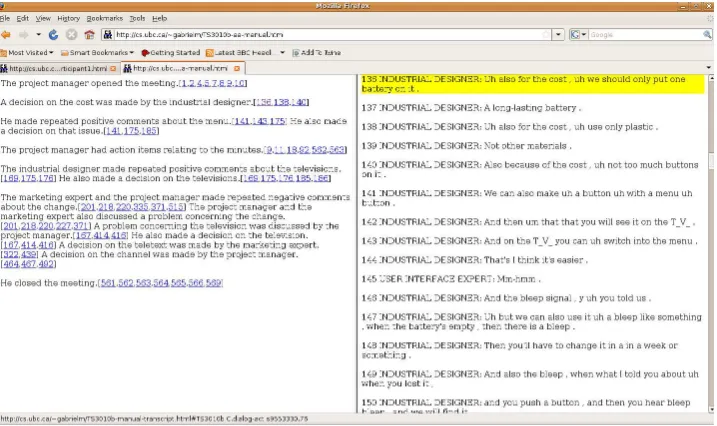
meeting. They were asked to consider the sce-nario in which they were a company employee who wanted to quickly review a previous meet-ing by usmeet-ing a browsmeet-ing interface designed for this task. Figure 1 shows the browsing interface for meeting IS1001d with an automatically generated abstract on the left-hand side and the transcript on the right. In the screenshot, the user has clicked the abstract sentenceThe industrial designer made a decision on the cost and has been linked to a transcript utterance, highlighted in yellow, which readsAlso for the cost, we should only put one bat-tery in it.Notice that this output is not entirely cor-rect, as the decision pertained to the battery, which impacted the cost. This sentence was generated because the entity cost appeared in several deci-sion sentences.
The time constraint meant that it was not fea-sible to simply read the entire transcript straight through. Participants were free to adopt whatever browsing strategy suited them, including skim-ming the transcript and using the summary as they saw fit. Upon finishing their review of each meet-ing, participants were asked to rate their level of agreement or disagreement on several Likert-style statements relating to the difficulty of the task and the usefulness of the summary. There were six statements to be evaluated on a 1-5 scale, with 1 indicating strong disagreement and 5 indicating strong agreement:
• Q1: I understood the overall content of the discussion.
• Q2: It required a lot of effort to review the meeting in the allotted time.
• Q3: The summary was coherent and readable.
• Q4: The information in the summary was relevant.
• Q5: The summary was useful for navigating the dis-cussion.
• Q6: The summary was missing relevant information.
Participants were also asked if there was any-thing they would have liked to have seen in the summary, and whether they had any general com-ments on the summary.
Figure 1: Summary Interface
be equal to the length of the human abstract for each meeting. This ranges from approximately 190 to 350 words per meeting summary.
6.2.1 Results and Discussion
Participants took approximately 12 minutes on av-erage to review each meeting, slightly shorter than the maximum allotted fifteen minutes.
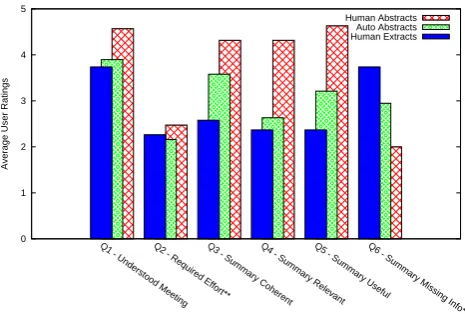
Figure 2 shows the average ratings for each summary condition on each Likert statement. For Q1, which concerns general comprehension of the meeting discussion, condition AH (human abstracts) is rated significantly higher than EH (human extracts) and AA (automatic abstracts) (p=0.0016 and p=0.0119 according to t-test, re-spectively). However, for the other statement that addresses the overall task, Q2, AA is rated best overall. Note that for Q2 a lower score is better. While there are no significantly differences on this criterion, it is a compelling finding that automatic abstracts can greatly reduce the effort required for reviewing the meeting, at a level comparable to human abstracts.
Q3 concerns coherence and readability. Condi-tion AH is significantly better than both EH and AA (p<0.0001 and p=0.0321). Our condition AA is also significantly better than the extractive con-dition EH (p=0.0196). In the introduction we men-tioned that a potential weakness of extractive sum-maries is that coherence and readability decrease when sentences are removed from their original contexts, and that extracts of noisy, unstructured source documents will tend to be noisy and
un-structured as well. These ratings confirm that ex-tracts are not rated well on coherence and readabil-ity.
Q4 concerns the perceived relevance of the summary. Condition AH is again significantly bet-ter than EH and AH (both p<0.0001). AA is rated substantially higher than EH on summary rele-vance, but not at a significant level.
Q5 is a key question because it directly ad-dresses the issue of summary usability for such a task. Condition AH is significantly better than EH and AA (both p<0.0001), but we also find that AA is significantly better than EH (p=0.0476). Ex-tracts have an average score of only 2.37 out of 5, compared with 3.21 and 4.63 for automatic and human abstracts, respectively. For quickly review-ing a meetreview-ing conversation, abstracts are much more useful than extracts.
Q6 indicates whether the summaries were miss-ing any relevant information. As with Q2, a lower score is better. Condition AH is significantly bet-ter than EH and AA (p<0.0001 and p=0.0179), while AA is better than EH with marginal signif-icance (p=0.0778). This indicates that our auto-matic abstracts were better at containing all the relevant information than were human-selected extracts.
0 1 2 3 4 5
Q1 - Understood MeetingQ2 - Required Effort**Q3 - Summary CoherentQ4 - Summary RelevantQ5 - Summary UsefulQ6 - Summary Missing Info**
Average User Ratings
[image:8.595.63.296.64.221.2]Human Abstracts Auto Abstracts Human Extracts
Figure 2: User Ratings (** indicates lower score is better)
summaries are too vague (e.g. “more concrete would help”) and that the phrasing can be repet-itive. There is a potential many-to-many map-ping between abstract sentences and transcript sentences, and some participants felt that it was unnecessarily redundant to be linked to the same transcript sentence more than once (e.g. “quite a few repetitive citations”). Several participants felt that the sentences regarding positive-subjective and negative-subjective opinions were overstated and that the actual opinions were either more sub-tle or neutral. One participant wrote that these sen-tences constituted “a lot of bias in the summary.” On the positive side, several participants consid-ered the links between abstract sentences and tran-script sentences to be very helpful, e.g. “it re-ally linked to the transcript well” and “I like how the summary has links connected to the transcript. Easier to follow-up on the meeting w/ the aid of the summary.” One participant particularly liked the subjectivity-oriented sentences: “Lifting some of the positive/negative from the discussion into the summary can mean the discussion does not even need to be included to get understanding.”
The written comments on the extractive condi-tion (EH) were almost wholly negative. Many par-ticipants felt that the extracts did not even con-stitute a summary or that a cut-and-paste from the transcript does not make a sufficient summary (e.g. “The summary was not helpful @ all be-cause it’s just cut from the transcript”, “All copy and paste not a summary”, “Not very clear sum-mary - looked like the transcript”, and “No ef-fort was made in the summary to put things into context”). Interestingly, several participants
criti-cized the extracts for not containing the most im-portant sentences from the transcript despite these being human-selected extracts, demonstrating that a good summary is a subjective matter.
The comments on human abstracts (AH) were generally very positive, e.g. “easy to follow”, “it was good, clear”, and “I could’ve just read the summary and still understood the bulk of the meet-ing’s content.” The most frequent negative criti-cisms were that the abstract sentences sometimes contained too many links to the transcript (“mas-sive amount of links look daunting”), and that the summaries were sometimes too vague (“perhaps some points from the discussion can be included, instead of just having topic outlines”, “[want] spe-cific details”). It is interesting to observe that this latter criticism is shared between human abstracts and our automatic abstracts. When generalizing over the source document, details are sometimes sacrificed.
7 Conclusion
We have presented a system for automatically gen-erating abstracts of meeting conversations. This summarizer relies on first mapping sentences to a conversation ontology representing phenomena such as decisions, action items and sentiment, then identifying message patterns that abstract over multiple sentences. We select the most informa-tive messages through an ILP optimization ap-proach, aggregate messages, and finally generate text describing all of the selected messages. A formative user study shows that, overall, our auto-matic abstractive summaries rate very well in com-parison with human extracts, particularly regard-ing readability, coherence and usefulness. The automatic abstracts are also significantly better in terms of containing all of the relevant information (Q6), and it is impressive that an automatic ab-stractor substantially outperforms human-selected content on such a metric. In future work we aim to bridge the performance gap between automatic and human abstracts by identifying more specific messages and reducing redundancy in the sentence mapping. We plan to improve the NLG output by introducing more linguistic variety and better text structuring. We are also investigating the impact of ASR transcripts on abstracts and extracts, with encouraging early results.
References
R. Barzilay and K. McKeown. 2005. Sentence fusion for multidocument news summarization. Computa-tional Linguistics, 31(3):297–328.
G. Carenini and JCK Cheung. 2008. Extractive vs. nlg-based abstractive summarization of evaluative text: The effect of corpus controveriality. InProc. of the 5th International Natural Generation Confer-ence.
J. Carletta, S. Ashby, S. Bourban, M. Flynn, M. Guillemot, T. Hain, J. Kadlec, V. Karaiskos, W. Kraaij, M. Kronenthal, G. Lathoud, M. Lincoln, A. Lisowska, I. McCowan, W. Post, D. Reidsma, and P. Wellner. 2005. The AMI meeting corpus: A pre-announcement. InProc. of MLMI 2005, Edinburgh, UK, pages 28–39.
K. Church and W. Gale. 1995. Inverse document fre-quency IDF: A measure of deviation from poisson.
InProc. of the Third Workshop on Very Large
Cor-pora, pages 121–130.
J. Clarke and M. Lapata. 2006. Constraint-based sentence compression: An integer programming ap-proach. InProc. of COLING/ACL 2006, pages 144– 151.
D. Gillick, K. Riedhammer, B. Favre, and D. Hakkani-T¨ur. 2009. A global optimization framework for meeting summarization. InProc. of ICASSP 2009, Taipei, Taiwan.
S. Gupta, J. Niekrasz, M. Purver, and D. Jurafsky. 2007. Resolving ”You” in multi-party dialog. In
Proc. of SIGdial 2007, Antwerp, Belgium.
L. He, E. Sanocki, A. Gupta, and J. Grudin. 1999. Auto-summarization of audio-video presentations.
In Proc. of ACM MULTIMEDIA ’99, Orlando, FL,
USA, pages 489–498.
K. Sp¨arck Jones. 1999. Automatic summarizing: Fac-tors and directions. In I. Mani and M. Maybury, editors,Advances in Automatic Text Summarization, pages 1–12. MITP.
T. Kleinbauer, S. Becker, and T. Becker. 2007. Com-bining multiple information layers for the automatic generation of indicative meeting abstracts. InProc.
of ENLG 2007, Dagstuhl, Germany.
K. Knight and D. Marcu. 2000. Statistics-based sum-marization - step one: Sentence compression. In
Proc. of AAAI 2000, Austin, Texas, USA, pages 703– 710.
K. McKeown, J. Hirschberg, M. Galley, and S. Maskey. 2005. From text to speech summarization. InProc.
of ICASSP 2005, Philadelphia, USA, pages 997–
1000.
C. Muller. 2007. ResolvingIt,ThisandThat in un-restricted multi-party dialog. InProc. of ACL 2007,
Prague, Czech Republic.
G. Murray and G. Carenini. 2008. Summarizing spo-ken and written conversations. InProc. of EMNLP
2008, Honolulu, HI, USA.
G. Murray, T. Kleinbauer, P. Poller, S. Renals, T. Becker, and J. Kilgour. 2009. Extrinsic sum-marization evaluation: A decision audit task. ACM Transactions on SLP, 6(2).
G. Murray, G. Carenini, and R. Ng. 2010. Interpre-tation and transformation for abstracting conversa-tions. InProc. of NAACL 2010, Los Angeles, USA.
F. Portet, E. Reiter, A. Gatt, J. Hunter, S. Sripada, Y. Freer, and C. Sykes. 2009. Automatic gener-ation of textual summaries from neonatal intensive care data. Artificial Intelligence, 173:789–816.
E. Reiter and R. Dale. 2000. Building Natural
Lan-guage Generation Systems. Cambridge University
Press, Cambridge, GB.
H. Saggion and G. Lapalme. 2002. Generat-ing indicative-informative summaries with sumum.
Computational Linguistics, 28(4):497–526.
T. Wilson. 2008. Annotating subjective content in meetings. InProc. of LREC 2008, Marrakech, Mo-rocco.
S. Xie, B. Favre, D. Hakkani-T¨ur, and Y. Liu. 2009. Leveraging sentence weights in a concept-based op-timization framework for extractive meeting sum-marization. InProc. of Interspeech 2009, Brighton, England.