Proceedings of the EACL 2009 Workshop on Language Technologies for African Languages – AfLaT 2009, pages 81–88,
Towards an electronic dictionary of Tamajaq language in Niger
Chantal Enguehard
LINA - UMR CNRS 6241
2, rue de la Houssinière
BP 92208
44322 Nantes Cedex 03
France
[email protected]
Issouf Modi
Ministère de l'Education Nationale
Direction des Enseignements du Cycle
de Base1
Section Tamajaq.
Republique du Niger
[email protected]
Abstract
We present the Tamajaq language and the dic-tionary we used as main linguistic resource in the two first parts. The third part details the complex morphology of this language. In the part 4 we describe the conversion of the dictio-nary into electronic form, the inflectional rules we wrote and their implementation in the Nooj software. Finally we present a plan for our fu-ture work.
1. The Tamajaq language
1.1 Socio-linguistic situation
In Niger, the official language is French and there are eleven national languages. Five are taught in a experimental schools: Fulfulde, Hausa, Kanuri, Tamajaq and Soŋay-Zarma. According to the last census in 1998, the Tama-jaq language is spoken by 8,4% of the 13.5 mil-lion people who live in Niger. This language is also spoken in Mali, Burkina-Faso, Algeria and Libya. It is estimated there are around 5 millions Tamajaq-speakers around the world.
The Tamacheq language belongs to the group of Berber languages.
1.2 Tamajaq alphabet
The Tamajaq alphabet used in Niger (Republic of Niger, 1999) uses 41 characters, 14 with dia-critical marks that all figure in the Unicode stan-dard (See appendix A). There are 12 vowels: a, â, ă, ə, e, ê, i, î, o, ô, u, û.
1.3 Articulary phonetics
Consonants Voiceless Voiced
Bilabial Plosive b
Nasal m
Trill r
Semivowel w
Labiodental Fricative f
Dental Plosive t d
Fricative s z
Nasal n
Lateral l
Pharyngeal Plosive ṭ ḍ Fricative ṣ ẓ
Lateral ḷ
Palatal Plosive c ǰ
Fricative š j
Semivowel y
Velar Plosive k g, ğ
Fricative ɣ x
Nasal ŋ
Glottal Plosive q
[image:1.595.306.513.334.718.2]Fricative h
Vowels Close Close-mid Open-mid Open Palatal i e
Central ə a a
[image:2.595.72.277.70.141.2]Labial u o
Table 1b: Articulary phonetics of Tamajaq vowels
1.4 Tools on computers
There are no specific TALN tools for the Tama-jaq language.
However characters can be easily typed on French keyboards thanks to the AFRO keyboard layout (Enguehard and al. 2008).
2
Lexicographic resources
We use the school editorial dictionary "diction-naire Tamajaq-français destiné à l'enseignement du cycle de base 1". It was written by the SOUTEBA1 project of the DED2 organisation in 2006. Because it targets children, this dictionary consists only of 5,390 entries. Words have been chosen by compiling school books.
2.1 Structure of an entry Each entry generally details :
- lemma,
- lexical category, - translation in French, - an example,
- gender (for nouns), - plural form (for nouns).
Examples:
« ăbada1: sn. bas ventre. Daw tǝdist. Bărar wa
yǝllûẓăn ad t-yǝltǝɣ ăbada-net. tǝmust.: yy. igǝt: ibadan. »
« ăbada2: sn. flanc. Tasăga meɣ daw ădăg ǝyyăn. Imǝwwǝẓla ǝklăn dăɣ ăbada n ǝkašwar. Anammelu.: azador. tǝmust.: yy. Ǝsǝfsǝs.: ă. Igǝt: ibadan. »
Homonyms are described in different entries and followed by a number, as in the above example.
2.2 Lexical categories
The linguistic terms used in the dictionary are written in the Tamajaq language using the
abbre-1Soutien à l'éducation de base. 2DED: Deutscher Entwicklungsdienst.
viations presented in table 2. In addition, this ta-ble gives information about the number of entries of each lexical category.
Lexical category Tamajaq English Abbrevi-ation Number of entries
əḍəkuḍ number ḍkḍ. 3
ənalkam deteminant nlkm. 1
anamal verb nml. 1450
samal adjective sml. 48
əsəmmadaɣ ən təla
possessive pronoun
smmdɣtl. 5
isən noun sn. 3648
isən n ənamal Verbal noun snnml. 33
isən an təɣərit name of shout
sntɣrt. 2
isən xalalan proper noun snxln. 29
isən iẓẓəwen complex noun
snẓwn. 137
əstakar adverb stkr. 8
əsatkar n adag adverb of lo-cation
stkrdg. 10
əṣatkar n igət Adverb of quantity
stkrgt. 1
tə əritɣ
ono-matopoeia
tɣrt. 8
[image:2.595.306.526.122.564.2]tənalkamt particle tnlkmt. 2
Table 2: Tamajaq lexical categories
3 Morphology
The Tamajaq language presents a rich morpholo-gy (Aghali-Zakara, 1996).
3.1 Verbal morphology
Verbs are classified according to the number of consonants of their lexical root and then in dif-ferent types. There are monoliteral, biliteral trilit-eral, quadriliteral verbs...
Three moods are distinguished: imperative, sim-ple injunctive and intense injunctive.
- non accomplished: simple, intense or negative; - aorist future: simple or negative.
Examples :
əktəb (to write): triliteral verb, type 1. əṣṣən (to know): triliteral verb, type 2 (ṣṣn). əməl (to say): biliteral verb, type 1
akər (to steal): biliteral verb, type 2 awəy (to carry): biliteral verb, type 3 ašwu (to drink): biliteral verb, type 4 aru (to love): monoliteral verb, type 2 aru (to open): monoliteral verb, type 3
Each class of verb has its own rules of conjuga-tion.
3.2 Nominal morphology a. Simple nouns
Nouns present three characteristics: - gender: masculine or feminine; - number: singular or plural;
- annexation state is marked by the change of the first vowel.
Terminology Abbreviation
təmust gender tmt.
yey masculine yy.
tənte feminine tnt. awdəkki singular wdk.
iget plural gt.
əsəfsəs annexation
[image:3.595.70.292.415.545.2]state sfss. Table 3: Tamajaq terminology for nouns
Example :
« aṭrǝkka: sn. morceau de sucre. Akku: ablǝɣ n°2. tǝmust.: yy. Ǝsǝfsǝs.: ǝ. Igǝt: ǝṭrǝkkatăn. »
"aṭrǝkka" is a masculine noun. Its plural is "ǝṭrǝkkatăn". It becomes "ǝṭrǝkka" when annexation state is expressed.
The plural form of nouns is not regular and has to be specifically listed.
b. Complex nouns
Complex nouns are composed by several lexical units connected together by hyphens. It could in-clude nouns, determiners or prepositions as well as verbs.
Examples:
Noun +determiner + noun
"ejaḍ-n-əjḍan", literally means "donkey of birds" (this is the name of a bird).
Verb + noun
"awəy-əhuḍ" literally means "it follows harmattan" (kite).
"gaẓẓay-təfuk" literally means "it looks at sun" (sunflower).
Preposition + noun
"In-tamaṭ" means "the one of the tree aca-cia" (of acacia).
Verb + verb
"azəl-azəl" means "run run" (return).
We counted 238 complex nouns in the studied dictionary.
4 Natural Language Processing of
Tamajaq
4.1 Nooj software (Silberztein, 2007)
« Nooj is a linguistic development environment that includes tools to create and maintain large-coverage lexical resources, as well as morpho-logical and syntactic grammars. » This software is specifically designed for linguists who can use it to test hypothesis on real corpus. « Dictionaries and grammars are applied to texts in order to lo-cate morphological, lexical and syntactic patterns and tag simple and compound words. » Nooj put all possible tags for each token or group of to-kens but does not disambiguate between the mul-tiple possibilities. However, the user can build his own grammar to choose between the multiple possible tags. The analysis can be displayed as a syntactic tree.
This software is supported by Windows.
We chose to construct resources for this software because it is fully compatible with Unicode.
4.2 Construction of the dictionary
We convert the edited dictionary for the Nooj software.
nouns, 23 complex nouns, 2 adjectives and 7 ver-bo-nouns.
We created morphological rules that we ex-pressed as Perl regular expressions and also in the Nooj format (with the associated tag).
a. Annexation state rules
Thirteen morphological rules calculate the an-nexation state.
Examples:
The 'A1ă' rule replaces the first letter of the word by 'ă'.
'A1ă' rule
Nooj <LW><S>ă/sfss
Perl ^.(.*)$ → ă$1
Table 4: Rule 'A1ă'
The 'A2 ' rule replaces the second letter ofǝ the word by ' '.ǝ
'A2 ' ruleǝ
Nooj A2 =<LW><R><S> /sfssǝ ǝ
Perl ^(.).(.*)$ → $1 $2ǝ
Table 5: Rule 'A2 'ǝ
b. Plural form rules
We searched formal rules to unify the calculation of plural forms. We found 126 rules that fit from 2 up to 446 words. 2932 words could be associat-ed with, at least, one flexional rule.
Examples:
'I4' rule deletes the last letter, adds "-ăn" at the end and "i-" at the beginning.
Nooj I4=ăn<LW><S>i/Iget
Perl ^(.*).$ → i$1ăn
[image:4.595.312.525.75.306.2]# 446 words
Table 6: Rule 'I4'
'I2' rule deletes the last and the second letters and includes "-en" at the end and "-i-" in the second position.
Nooj I2=<B>en<LW><R><S>i/Iget
Perl ^(.).(.*).$ → $1i$2en
# 144 words
Table 7: Rule 'I2'
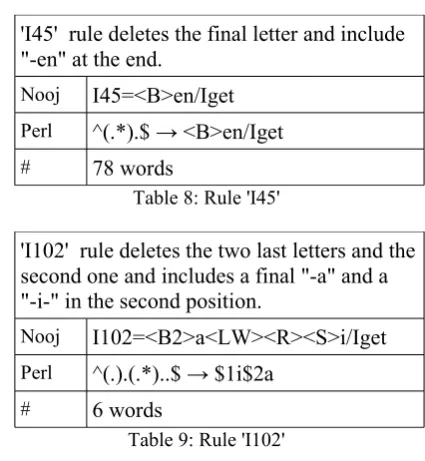
'I45' rule deletes the final letter and include "-en" at the end.
Nooj I45=<B>en/Iget
Perl ^(.*).$ → <B>en/Iget
# 78 words
Table 8: Rule 'I45'
'I102' rule deletes the two last letters and the second one and includes a final "-a" and a "-i-" in the second position.
Nooj I102=<B2>a<LW><R><S>i/Iget
Perl ^(.).(.*)..$ → $1i$2a
# 6 words
Table 9: Rule 'I102'
c. Combined rules
When it was necessary, the above rules have been combined to calculate singular and plural forms with or without annexation state.
We thus finally obtained 319 rules.
Example: I2RA2ă =
[image:4.595.321.509.457.558.2]:Rwdk + :I2 + :Rwdk :A2ă + :I2 :A2ă
Fig. 1: Rule I2RA2ă
This rule recognizes the singular form (:Rwdk), the plural form (:I2), the singular form with the annexation state (:Rwdk :A2ă) and the plural form with the annexation state (:I2 :A2ă).
25 words meet this rule.
For instance, "taḍlǝmt" (accusation, provoca-tion), is inflected in:
[image:4.595.84.295.537.757.2]- tăḍlǝmt,taḍlǝmt,SN+tnt+wdk+sfss
d. Conjugaison rules
Verb classes are not indicated in the dictionary. We only describe a few conjugaison rules, just to check the expressivity of the Nooj software
[image:5.595.319.527.75.295.2]Here is the rule of the verb "əṣṣən" (to know), intense accomplished aspect, represented as a transducer.
Fig. 2: Verb "əṣṣən", intense accomplished aspect
We obtain, in the inflected dictionary, the correct conjugated forms.
əṣṣanaɣ+əṣṣən,V+accompli+wdk+1 təṣṣanaɣ+əṣṣən,V+accompli+wdk+2 iṣṣan+əṣṣən,V+accompli+wdk+yy+3 təṣṣan+əṣṣən,V+accompli+wdk+tnt+3 nəṣṣan+əṣṣən,V+accompli+gt+1 təṣṣanam+əṣṣən,V+accompli+gt+yy+2 təṣṣanmat+əṣṣən,V+accompli+gt+tnt+2 əṣṣanan+əṣṣən,V+accompli+gt+yy+3 əṣṣannat+əṣṣən,V+accompli+gt+tnt+3
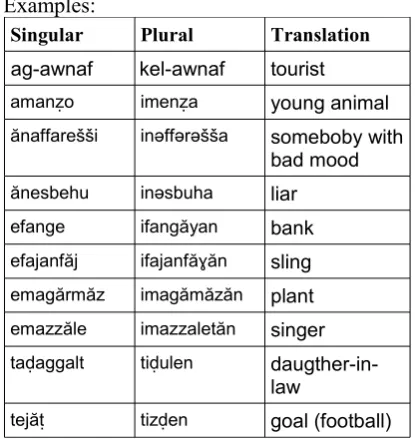
e. Irregular words
Finally, the singular and plural forms of 2,457 words were explicitly written in the Nooj dictio-nary because they do not follow any regular rule.
Examples:
Singular Plural Translation
ag-awnaf kel-awnaf tourist
aman oẓ imen aẓ young animal
ănaffarešši in ff r ššaǝ ǝ ǝ someboby with bad mood
ănesbehu in sbuhaǝ liar
efange ifangăyan bank
efajanfăj ifajanfă ănɣ sling
emagărmăz imagămăzăn plant
emazzăle imazzaletăn singer
ta aggaltḍ ti ulenḍ
daugther-in-law
[image:5.595.73.273.236.431.2]tejăṭ tiz enḍ goal (football)
Table 10: Examples of irregular plural forms
f. Result
There are 6,378 entries in the Nooj dictionary. The inflected dictionary, calculated from the above dictionary and with the inflectional and conjugation rules, encounters 11,223 entries.
Nooj is able to use the electronic dictionary we've created to automatically tag a text (see an example in appendix B).
4.3 Future work
a Conversion into XML format
We will convert the inflectional dictionary into the international standard Lexical Markup Framework format (Francopoulo and al., 2006) in order to make it easily usable by other TALN application,.
b Automatic search of rules
Due to the high morphological complexity of the Tamajaq language, we plan to develop a Perl program that would automatically determine the derivational and conjugation rules.
c Completion and correction of the resource The linguistic resource will be completed during the next months in order to add the class of verbs that are absent for the moment, and also to cor-rect the errors that we noticed during this study.
d Enrichment of the resource
Acknowledgement
Special thanks to John Johnson, reviewer of this text.
References
Aghali-Zakara M. 1996. Éléments de morphosyn-taxe touarègue. Paris : CRB-GETIC, 112 p. Enguehard C. and Naroua H. 2008. Evaluation of
Virtual Keyboards for West-African Lan-guages. Proceedings of the Sixth International Language Resources and Evaluation (LREC'08), Marrakech, Morocco.
Francopoulo G., George M., Calzolari N., Monachini M., Bel N., Pet M., Soria C. 2006 Lexical Markup Framework (LMF). LREC, Genoa, Italy.
République of Niger. 19 octobre 1999. Arrêté 214-99 de la République du Niger.
APPENDIX A : Tamajaq official alphabet (République of Niger, 1999)
Character Code Character Code
a U+0061 A U+0041
â U+00E1 Â U+00C2
ă U+0103 Ă U+0102
ǝ U+01DD Ǝ U+018E
b U+0062 B U+0042
c U+0063 C U+0043
d U+0064 D U+0044
ḍ U+1E0D Ḍ U+1E0C
e U+0065 E U+0045
ê U+00EA Ê U+00CA
f U+0066 F U+0046
g U+0067 G U+0047
ǧ U+01E7 Ǧ U+01E6
h U+0068 H U+0048
i U+0069 I U+0049
î U+00EE Î U+00CE
j U+006A J U+004A
ǰ U+01F0 J̌ U+004AU+ 030C
ɣ U+0263 Ɣ U+0194
k U+006B K U+004B
l U+006C L U+004C
ḷ U+1E37 Ḷ U+1E36
m U+006D M U+004D
n U+006E N U+004E
ŋ U+014B Ŋ U+014A
o U+006F O U+004F
ô U+00F4 Ô U+00D4
q U+0071 Q U+0051
r U+0072 R U+0052
s U+0073 S U+0053
ṣ U+1E63 Ṣ U+1E62
š U+0161 Š U+0160
t U+0074 T U+0054
ṭ U+1E6D Ṭ U+1E6C
u U+0075 U U+0055
û U+00FB Û U+00DB
w U+0077 W U+0057
x U+0078 X U+0058
y U+0079 Y U+0059
z U+007A Z U+005A
APPENDIX B : Nooj tagging Tamajaq text
Nooj perfectly recognizes the four forms of the word "awăqqas" (big cat) in the text:
"awăqqas, iwaɣsan, awaɣsan"
These forms are listed in the inflectional dictio-nary as:
awăqqas,awăqqas,SN+yy+wdk
awăqqas,awăqqas,SN+yy+wdk+FLX=A1a+sfss
iwaɣsan,awăqqas,SN+yy+iget
awaɣsan,awăqqas,SN+yy+iget+FLX=A1a+sfss
Fig.3: Tags on the text "awăqqas, iwa san,ɣ awa san"ɣ
On the figure 3, we can see that the first token "awăqqas" gets two tags:
- "awăqqas,SN+yy+wdk" (singular)
- "awăqqas,SN+yy+wdk+sfss" (singular and annexation state).