Deep Syntax Language Models and Statistical Machine Translation
Yvette Graham
NCLT
Dublin City University
[email protected] [email protected]
Josef van Genabith
CNGL
Dublin City University
Abstract
Hierarchical Models increase the re-ordering capabilities of MT systems by introducing non-terminal symbols to phrases that map source language (SL) words/phrases to the correct position in the target language (TL) translation. Building translations via discontiguous TL phrases increases the difficulty of lan-guage modeling, however, introducing the need for heuristic techniques such as cube pruning (Chiang, 2005), for example. An additional possibility to aid language modeling in hierarchical systems is to use a language model that models fluency of words not using their local context in the string, as in traditional language models, but instead using the deeper context of a word. In this paper, we explore the potential of deep syntax language mod-els providing an interesting comparison with the traditional string-based language model. We include an experimental evalu-ation that compares the two kinds of mod-els independently of any MT system to in-vestigate the possible potential of integrat-ing a deep syntax language model into Hi-erarchical SMT systems.
1 Introduction
In Phrase-Based Models of Machine Translation all phrases consistent with the word alignment are extracted (Koehn et al., 2003), with shorter phrases needed for high coverage of unseen data and longer phrases providing improved fluency in
target language translations. Hierarchical Mod-els (Chiang, 2007; Chiang, 2005) build on Phrase-Based Models by relaxing the constraint that phrases must be contiguous sequences of words and allow a short phrase (or phrases) nested within a longer phrase to be replaced by a non-terminal symbol forming a new hierarchical phrase. Tra-ditional language models use the local context of words to estimate the probability of the sentence and introducing hierarchical phrases that generate discontiguous sequences of TL words increases the difficulty of computing language model proba-bilities during decoding and require sophisticated heuristic language modeling techniques (Chiang, 2007; Chiang, 2005).
this context could add useful information about the fluency of the hypothesis as its constructed.
In addition, using the deep context of a word provides a deeper notion of fluency than the lo-cal context provides on its own and this might be useful to improve such things as lexical choice in SMT systems. Good lexical choice is very im-portant and the deeper context of a word, if avail-able, may provide more meaningful information and result in better lexical choice. Integrating such a model into a Hierarchical SMT system is not straightforward, however, and we believe be-fore embarking on this its worthwhile to evalu-ate the model independently of any MT system. We therefore provide an experimental evaluation of the model and in order to provide an interesting comparison, we evaluate a traditional string-based language model on the same data.
2 Related Work
The idea of using a language model based on deep syntax is not new to SMT. Shen et al. (2008) use a dependency-based language model in a string to dependency tree SMT system for Chinese-English translation, using information from the deeper structure about dependency relations be-tween words, in addition to the position of the words in the string, including information about whether context words were positioned on the left or right of a word. Bojar and Hajiˇc (2008) use a deep syntax language model in an English-Czech dependency tree-to-tree transfer system, and in-clude three separate bigram language models: a reverse, direct and joint model. The model in our evaluation is similar to their direct bigram model, but is not restricted to bigrams.
Riezler and Maxwell (2006) use a trigram deep syntax language model in German-English depen-dency tree-to-tree transfer to re-rank decoder out-put. The language model of Riezler and Maxwell (2006) is similar to the model in our evaluation, but differs in that it is restricted to a trigram model trained on LFG f-structures. In addition, as lan-guage modeling is not the main focus of their work, they provide little detail on the language model they use, except to say that it is based on
“log-probability of strings of predicates from root to frontier of target f-structure, estimated from
predicate trigrams in English f-structures”
(Rie-zler and Maxwell, 2006). An important prop-erty of LFG f-structures (and deep syntactic struc-tures in general) was possibly overlooked here. F-structures can contain more than one path of predicates from the root to a frontier that in-clude the same ngram, and this occurs when the underlying graph includes unary branching fol-lowed by branching with arity greater than one. In such cases, the language model probability as described in Riezler and Maxwell (2006) is incor-rect as the probability of these ngrams will be in-cluded multiple times. In our definition of a deep syntax language model, we ensure that such du-plicate ngrams are omitted in training and testing. In addition, Wu (1998) use a bigram deep syntax language model in a stochastic inversion transduc-tion grammar for English to Chinese. None of the related research we discuss here has included an evaluation of the deep syntax language model they employ in isolation from the MT system, however.
3 Deep Syntax
The deep syntax language model we describe is not restricted to any individual theory of deep syntax. For clarity, however, we restrict our ex-amples to LFG, which is also the deep syntax theory we use for our evaluation. The Lexical Functional Grammar (LFG) (Kaplan and Bres-nan, 1982; Kaplan, 1995; BresBres-nan, 2001; Dalrym-ple, 2001) functional structure (f-structure) is an attribute-value encoding of bi-lexical labeled de-pendencies, such as subject, object and adjunct for example, with morpho-syntactic atomic at-tributes encoding information such as mood and
tense of verbs, and person, number and case for
nouns. Figure 1 shows the LFG f-structure for En-glish sentence “Today congress passed Obama’s
health care bill.”1
Encoded within the f-structure is a directed graph and our language model uses a simplified acyclic unlabeled version of this graph. Figure 1(b) shows the graph structure encoded within the f-structure of Figure 1(a). We discuss the simpli-fication procedure later in Section 5.
1Morpho-syntactic information/ atomic features are
(a)
PRED pass
SUBJ PRED congress
OBJ
PRED bill
SPEC
h
POSS PRED Obamai
MOD
PRED care MOD PRED health
ADJ PRED today
(b) <s>
pass
today congress bill
</s> </s> obama care
</s> health
[image:3.595.73.492.71.236.2]</s>
Figure 1: “Today congress passed Obama’s health care bill.”
4 Language Model
We use a simplified approximation of the deep syntactic structure,de, that encodes the unlabeled dependencies between the words of the sentence, to estimate a deep syntax language model prob-ability. Traditional string-based language mod-els combine the probability of each word in the sentence, wi, given its preceding context, the se-quence of words from w1 to wi−1, as shown in
Equation 1.
p(w1, w2, ..., wl) = l
Y
i=1
p(wi|w1, ..., wi−1) (1)
In a similar way, a deep syntax language model probability combines the probability of each word in the structure, wi, given its context within the structure, the sequence of words from wr, the head of the sentence, towm(i), as shown in Equa-tion 2, with funcEqua-tionmused to map the index of a word in the structure to the index of its head. 2
p(de) = l
Y
i=1
p(wi|wr, ..., wm(m(i))wm(i)) (2)
In order to combat data sparseness, we apply the Markov assumption, as is done in traditional string-based language modeling, and simplify the probability by only including a limited length of history when estimating the probability of each
2
We refer to the lexicalized nodes in the dependency structure as words, alternatively the term predicate can be used.
word in the structure. For example, a trigram deep syntax language model conditions the probability of each word on the sequence of words consisting of the head of the head of the word followed by
the head of the word as follows:
p(de) = l
Y
i=1
P(wi|wm(m(i)), wm(i)) (3)
In addition, similar to string-based language modeling, we add a start symbol, <s>, at the root of the structure and end symbols, </s>, at the leaves to include the probability of a word be-ing the head of the sentence and the probability of words occurring as leaf nodes in the structure. Figure 2(a) shows an example of how a trigram deep syntax language model probability is com-puted for the example sentence in Figure 1(a).
5 Simplified Approximation of the Deep Syntactic Representation
(a) Deep Syntax LM (b) Traditional LM
p(e) ≈ p(pass|<s>)∗ p(e) ≈ p(passed|today congress)∗
p(today|<s>pass)∗ p(today|<s>)∗ p(</s>|pass today)∗
p(congress|<s>pass)∗ p(congress|<s>today)∗
p(</s>|pass congress)∗
p(bill|<s>pass)∗ p(bill|health care)∗
p(obama|pass bill)∗ p(obama|congress passed)∗
p(</s>|bill obama)∗
p(care|pass bill)∗ p(care|s health)∗ p(health|bill care)∗ p(health|’ s)∗
p(</s>|care health)
p(’|passed Obama)∗ p(s|obama ’)∗
p(.|care bill)∗
[image:4.595.95.498.68.302.2]p(</s>|bill .)
Figure 2: Example Comparison of Deep Syntax and Traditional Language Models
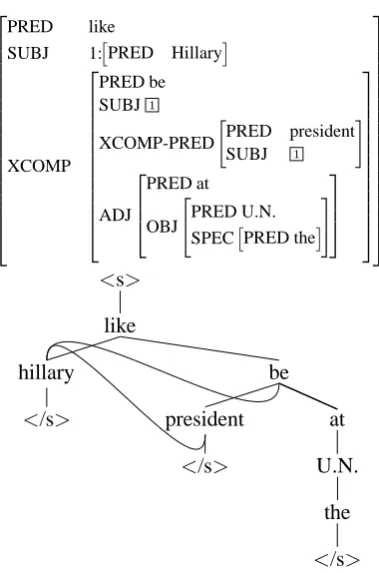
of both like, be and president is hillary. In our simplified structure, the dependency relations be-tween be and hillary and president and hillary are dropped. We discuss how we do this later in Sec-tion 6. Similar to our simplificaSec-tion for structure sharing, we also simplify structures that contain cycles by discarding edges that cause loops in the structure.
6 Implementation
SRILM (Stolcke, 2002) can be used to compute a language model from ngram counts (the -read option of the ngram-count command). Implemen-tation to train the language model, therefore, sim-ply requires accurately extracting counts from the deep syntax parsed training corpus. To simplify the structures to acyclic graphs, nodes are labeled with an increasing index number via a depth first traversal. This allows each arc causing a loop in the graph or argument sharing to be identified by a simple comparison of index numbers, as the in-dex number of its start node will be greater than that of its end node. The algorithm we use to extract ngrams from the dependency structures is straightforward: we simply carry out a depth-first traversal of the graph to construct paths of words that stretch from the root of the graph to words
PRED like
SUBJ 1:PRED Hillary
XCOMP
PRED be SUBJ1
XCOMP-PRED
PRED president SUBJ 1
ADJ
PRED at
OBJ
"
PRED U.N. SPECPRED the
#
<s>
like
hillary be
</s> president at
</s> U.N.
the
</s>
Figure 3: “Hillary liked being president at the
[image:4.595.311.501.367.654.2]
PRED agree
SUBJ PRED nobody
XCOMP
PRED with
OBJ
PRED point
ADJ
COORD and
(
PRED two,
PRED three
)
<s>
agree
nobody with
</s> point
and
two three
[image:5.595.79.271.69.329.2]</s> </s>
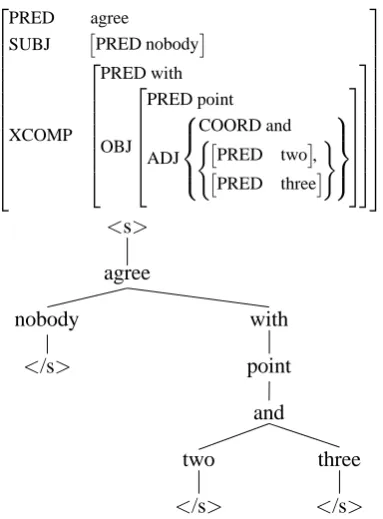
Figure 4: “Nobody agreed with points two and
three.”
at the leaves and then extract the required order ngrams from each path. As mentioned earlier, some ngrams can belong to more than one path. Figure 4 shows an example structure containing unary branching followed by binary branching in which the sequence of symbols and words “<s>
agree with point and” belong to the path ending
in two</s>and three </s>. In order to ensure that only distinct ngrams are extracted we assign each word in the structure a unique id number and include this in the extracted ngrams. Paths are split into ngrams and duplicate ngrams result-ing from their occurrence in more than one path are discarded. Its also possible for ngrams to le-gitimately be repeated in a deep structure, and in such cases we do not discard these ngrams. Legit-imately repeating ngrams are easily identified as the id numbers attached to words will be differ-ent.
7 Deep Syntax and Lexical Choice in SMT
Correct lexical choice in machine translation is extremely important and PB-SMT systems rely
on the language model to ensure, that when two phrases are combined with each other, that the model can rank combined phrases that are flu-ent higher than less fluflu-ent combinations. Con-ditioning the probability of each word on its deep context has the potential to provide a more meaningful context than the local context within the string. A comparison of the proba-bilities of individual words in the deep syntax model and traditional language model in Figure 2 clearly shows this. For instance, let us con-sider how the language model in a German to English SMT system is used to help rank the following two translations today congress passed
... and today convention passed ... (the word Kongress in German can be translated into
ei-ther congress or convention in English). In the deep syntax model, the important compet-ing probabilities are (i) p(congress|<s>pass)
and (ii) p(convention|<s>pass), where (i) can be interpreted as the probability of the word congress modifying pass when pass is the head of the entire sentence and, simi-larly (ii) the probability of the word
conven-tion modifying pass when pass is the head of
the entire sentence. In the traditional string-based language model, the equivalent compet-ing probabilities are (i)p(congress|<s>today), the probability of congress following today when
today is the start of the sentence and (ii)
p(convention|<s>today), probability of con-vention following today when today is the start of the sentence, showing that the deep syntax language model is able to use more meaningful context for good lexical choice when estimating the probability of words congress and convention compared to the traditional language model.
In addition, the deep syntax language model will encounter less data sparseness problems for some words than a string-based language model. In many languages words occur that can legiti-mately be moved to different positions within the string without any change to dependencies be-tween words. For example, sentential adverbs in English, can legitimately change position in a sentence, without affecting the underlying de-pendencies between words. The word today in
can appear as “Congress passed Obama’s health
bill today” and “Congress today passed Obama’s health bill”. Any sentence in the training
cor-pus in which the word pass is modified by today will result in a bigram being counted for the two words, regardless of the position of today within each sentence.
In addition, some surface form words such as auxiliary verbs for example, are not represented as predicates in the deep syntactic structure. For lexical choice, its not really the choice of auxiliary verbs that is most important, but rather the choice of an appropriate lexical item for the main verb (that belongs to the auxiliary verb). Omitting aux-iliary verbs during language modeling could aid good lexical choice, by focusing on the choice of a main verb without the effect of what auxiliary verb is used with it.
For some words, however, the probability in the string-based language model provides as good if not better context than the deep syntax model, but only for the few words that happen to be preceded by words that are important to its lexical choice, and this reinforces the idea that SMT systems can benefit from using both a deep syntax and string-based language model. For example, the proba-bility of bill in Figures 2(a) and 2(b) is computed in the deep syntax model as p(bill| <s> pass)
and in the string-based model usingp(bill|health care), and for this word the local context seems to provide more important information than the deep context when it comes to lexical choice. The deep model nevertheless adds some useful information, as it includes the probability of bill being an argu-ment of pass when pass is the head of a sentence. In traditional language modeling, the special start symbol is added at the beginning of a sen-tence so that the probability of the first word ap-pearing as the first word of a sentence can be included when estimating the probability. With similar motivation, we add a start symbol to the deep syntactic representation so that the probabil-ity of the head of the sentence occurring as the head of a sentence can be included. For exam-ple, p(be| <s>) will have a high probability as the verb be is the head of many sentences of En-glish, whereasp(colorless|<s>)will have a low probability since it is unlikely to occur as the head.
We also add end symbols at the leaf nodes in the structure to include the probability of these words appearing at that position in a structure. For in-stance, a noun followed by its determiner such as p(</s>|attorney a)would have a high probabil-ity compared to a conjunction followed by a verb p(</s>|and be).
8 Evaluation
We carry out an experimental evaluation to inves-tigate the potential of the deep syntax language model we describe in this paper independently of any machine translation system. We train a 5-gram deep syntax language model on 7M English f-structures, and evaluate it by computing the per-plexity and ngram coverage statistics on a held-out test set of parsed fluent English sentences. In order to provide an interesting comparison, we also train a traditional string-based 5-gram lan-guage model on the same training data and test it on the same held-out test set of English sen-tences. A deep syntax language model comes with the obvious disadvantage that any data it is trained on must be in-coverage of the parser, whereas a string-based language model can be trained on any available data of the appropriate language. Since parser coverage is not the focus of our work, we eliminate its effects from the evaluation by select-ing the trainselect-ing and test data for both the strselect-ing- string-based and deep syntax language models on the ba-sis that they are in fact in-coverage of the parser.
8.1 Language Model Training
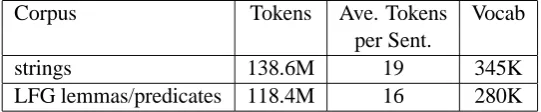
Corpus Tokens Ave. Tokens Vocab per Sent.
strings 138.6M 19 345K
[image:7.595.161.432.71.127.2]LFG lemmas/predicates 118.4M 16 280K
Table 1: Language model statistics for string-based and deep syntax language models, statistics are for string tokens and LFG lemmas for the same set of 7.29M English sentences
al., 2004; Riezler et al., 2002). Ngrams were auto-matically extracted from the f-structures and low-ercased. SRILM (Stolcke, 2002) was used to com-pute both language models. Table 1 shows statis-tics on the number of words and lemmas used to train each model.
8.2 Testing
The test set consisted of 789 sentences selected from WMT09 additional development sets3 con-taining English Europarl text and again was se-lected on the basis of sentences being in-coverage of the parsing resources. SRILM (Stolcke, 2002) was used to compute test set perplexity and ngram coverage statistics for each order model.
Since the deep syntax language model adds end of sentence markers to leaf nodes in the structures, the number of (so-called) end of sentence markers in the test set for the deep syntax model is much higher than in the string-based model. We there-fore also compute statistics for each model when end of sentence markers are omitted from training and testing. 4 In addition, since the vast majority of punctuation is not represented as predicates in LFG f-structures, we also test the string-based lan-guage model when punctuation has been removed.
8.3 Results
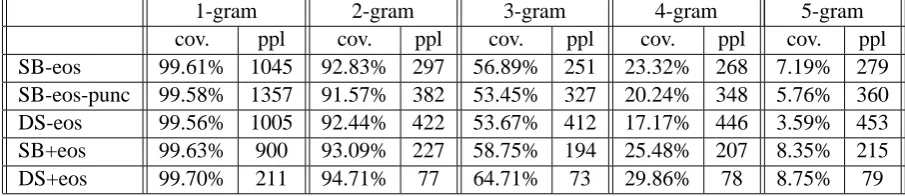
Table 2 shows perplexity scores and ngram cover-age statistics for each order and type of langucover-age model. Note that perplexity scores for the string-based and deep syntax language models are not directly comparable because each model has a dif-ferent vocabulary. Although both models train on an identical set of sentences, the data is in a dif-ferent format for each model, as the string-based
3
test2006.en and test2007.en
4
When we include end of sentence marker probabilities we also include them for normalization, and omit them from normalization when their probabilities are omitted.
model is trained on surface form tokens, whereas the deep syntax model uses lemmas. Ngram cov-erage statistics provide a better comparison.
Unigram coverage for all models is high with all models achieving close to 100% coverage on the held-out test set. Bigram coverage is high-est for the deep syntax language model when eos markers are included (94.71%) with next high-est coverage achieved by the string-based model that includes eos markers (93.09%). When eos markers are omitted bigram coverage goes down slightly to 92.44% for the deep syntax model and to 92.83% for the string-based model, and when punctuation is also omitted from the string-based model, coverage goes down again to 91.57%.
Trigram coverage statistics for the test set main-tain the same rank between models as in the bi-gram coverage, from highest to lowest as follows: DS+eos at 64.71%, SB+eos at 58.75%, SB-eos at 56.89%, DS-eos at 53.67%, SB-eos-punc at 53.45%. For 4-gram and 5-gram coverage a sim-ilar coverage ranking is seen, but with DS-eos (4gram at 17.17%, 5gram at 3.59%) and SB-eos-punc (4gram at 20.24%, 5gram at 5.76%) swap-ping rank position.
8.4 Discussion
Ngram coverage statistics for the DS-eos and SB-eos-punc models provide the fairest com-parison, with the deep syntax model achiev-ing higher coverage than the strachiev-ing-based model for bigrams (+0.87%) and trigrams (+0.22%), marginally lower coverage coverage of unigrams (-0.02%) and lower coverage of 4-grams (-3.07%) and 5-grams (2.17%) compared to the string-based model.
1-gram 2-gram 3-gram 4-gram 5-gram cov. ppl cov. ppl cov. ppl cov. ppl cov. ppl SB-eos 99.61% 1045 92.83% 297 56.89% 251 23.32% 268 7.19% 279 SB-eos-punc 99.58% 1357 91.57% 382 53.45% 327 20.24% 348 5.76% 360 DS-eos 99.56% 1005 92.44% 422 53.67% 412 17.17% 446 3.59% 453 SB+eos 99.63% 900 93.09% 227 58.75% 194 25.48% 207 8.35% 215 DS+eos 99.70% 211 94.71% 77 64.71% 73 29.86% 78 8.75% 79
Table 2: Ngram coverage and perplexity (ppl) on held-out test set. Note: DS = deep syntax, SB string-based, eos = end of sentence markers
in the test set in general being assigned relatively high probabilities by the model, and since several occur per sentence, the perplexity increases when the are omitted (453 for the 5gram model).
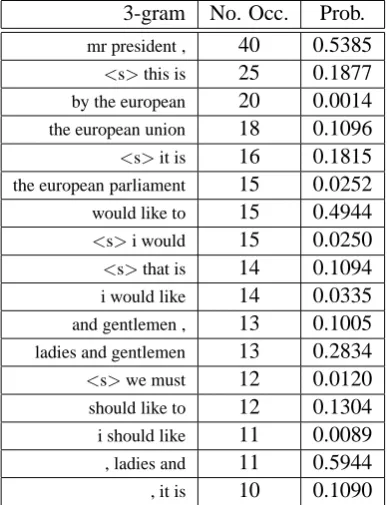
Tables 3 and 4 show the most frequently en-countered trigrams in the test data for each type of model. A comparison shows how different the two models are and highlights the potential of the deep syntax language model to aid lexical choice in SMT systems. Many of the most frequently oc-curring trigram probabilities for the deep syntax model are for arguments of the main verb of the sentence, conditioned on the main verb, and in-cluding such probabilities in a system could im-prove fluency by using information about which words are in a dependency relation together ex-plicitely in the model. In addition, a frequent tri-gram in the held-out data is <s>be also, where
the word also is a sentential adverb modifying
be. Trigrams for sentential adverbs are likely to
be less effected by data sparseness in the deep syntax model compared to the string-based model which could result in the deep syntax model im-proving fluency with respect to combinations of main verbs and their modifying adverbs. The most frequent trigram in the deep syntax test set is<s>
and be, in which the head of the sentence is the
conjunction and with argument be. In this type of syntactic construction in English, its often the case that the conjunction and verb will be distant from each other in the sentence, for example: Nobody
was there except the old lady and without thinking we quickly left. (where was and and are in a
de-pendency relation). Using a deep syntax language model could therefore improve lexical choice for such words, since they are too distant for a
string-3-gram No. Occ. Prob.
<s>and be 42 0.1251
<s>be this 21 0.0110
<s>must we 19 0.0347
<s>would i 19 0.0414
<s>be in 17 0.0326
<s>be that 14 0.0122
be debate the 13 0.0947
<s>be debate 13 0.0003
<s>can not 12 0.0348
<s>and president 11 0.0002
<s>would like 11 0.0136
<s>would be 11 0.0835
[image:8.595.322.497.226.427.2]<s>be also 10 0.0075
Table 3: Most frequent trigrams in test set for deep syntax model
based model.
9 Conclusions
We presented a comparison of a deep syntax language and traditional string-based language model. Results showed that the deep syntax lan-guage model achieves similar ngram coverage to the string-based model on a held out test set. We highlighted the potential of integrating such a model into SMT systems for improving lexical choice by using a deeper context for probabilities of words compared to a string-based model.
References
Work-3-gram No. Occ. Prob.
mr president , 40 0.5385
<s>this is 25 0.1877
by the european 20 0.0014 the european union 18 0.1096
<s>it is 16 0.1815
the european parliament 15 0.0252 would like to 15 0.4944
<s>i would 15 0.0250
<s>that is 14 0.1094 i would like 14 0.0335 and gentlemen , 13 0.1005 ladies and gentlemen 13 0.2834
<s>we must 12 0.0120
[image:9.595.84.278.71.324.2]should like to 12 0.1304 i should like 11 0.0089 , ladies and 11 0.5944 , it is 10 0.1090
Table 4: Most frequent trigrams in test set for string-based model
shop on Statistical Machine Translation, Columbus,
Ohio.
Bresnan, Joan. 2001. Lexical-Functional Syntax.,
Blackwell Oxford.
Chiang, David. 2007. Hierarchical Phrase-based Models of Translation In Computational
Linguis-tics, No. 33:2.
Chiang, David. 2005. A Hierarchical Phrase-Based Model for Statistical Machine Translation In
Pro-ceedings of the 43rd Annual Meeting of the Associa-tion for ComputaAssocia-tional Linguistics, pages 263-270,
Ann Arbor, Michigan.
Dalrymple, Mary. 2001. Lexical Functional
Gram-mar, Academic Press, San Diego, CA; London.
Kaplan, Ronald, Stefan Riezler, Tracy H. King, John T. Maxwell, Alexander Vasserman. 2004. Speed and Accuracy in Shallow and Deep Stochastic Pars-ing. In Proceedings of Human Language
Tech-nology Conference/North American Chapter of the Association for Computational Linguistics Meeting,
Boston, MA.
Kaplan, Ronald M., Tracy H. King, John T. Maxwell. 2002. Adapting Existing Grammars: the XLE Ex-perience. In Proceedings of the 19th International
Conference on Computational Linguistics (COL-ING) 2002, Taipei, Taiwan.
Kaplan, Ronald M. 1995. The Formal Architecture of Lexical Functional Grammar. In Formal Issues in
Lexical Functional Grammar, ed. Mary Dalrymple,
pages 7-28, CSLI Publications, Stanford, CA.
Kaplan, Ronald M., Joan Bresnan. 1982. Lexical Functional Grammar, a Formal System for Gram-matical Represenation. In J. Bresnan, editor, The
Mental Representation of Grammatical Relations,
173-281, MIT Press, Cambridge, MA.
Koehn, Philipp, Hieu Hoang. 2007. Factored Trans-lation Models. Proceedings of the 2007 Joint
Con-ference on Empirical Methods in Natural Language Processing and Computational Natural Language Learning, 868-876.
Koehn, Philipp, Hieu Hoang, Alexandra Birch, Chris Callison-Burch, Marcello Federico, Nicoli Bertoldi, Brooke Cowan, Wade Shen, Christine Moran, Richard Zens, Chris Dyer, Ondrej Bojar, Alexan-dra Constantin, Evan Herbst. 2007. Moses: Open Source Toolkit for Statistical Machine Translation.
Annual Meeting of the Association for Computa-tional Linguistics, demonstration session
Koehn, Philipp 2005. Europarl: A Parallel Corpus for Statistical Machine Translation. In Proceedings of
the tenth Machine Translation Summit.
Koehn, Philipp, Franz Josef Och, Daniel Marcu. 2003. Statistical Phrase-based Translation. In
Proceed-ings of Human Language Technology and North American Chapter of the Association for Computa-tional Linguistics Conference, 48-54.
Riezler, Stefan, John T. Maxwell III. 2006. Grammat-ical Machine Translation. In Proceedings of
HLT-ACL, pages 248-255, New York.
Riezler, Stefan, Tracy H. King, Ronald M. Kaplan, Richard Crouch, John T. Maxwell, Mark Johnson. 2002. Parsing the Wall Street Journal using Lexical Functional Grammar and Discriminitive Estimation Techniques . (grammar version 2005) In
Proceed-ings of the 40th ACL, Philadelphia.
Shen, Libin, Jinxi Xu, Ralph Weischedel. 2008. A New String-to-Dependency Machine Translation Algorithm with a Target Dependency Language Model. Proceedings of ACL-08: HLT, pages 577-585.
Stolcke, Andreas. 2002. SRILM - An Extensible Lan-guage Modeling Toolkit. In Proceedings of the
In-ternational Conference on Spoken Language Pro-cessing, Denver, Colorado.
Dekai, Wu, Hongsing Wong. 1998. Machine Trans-lation with a Stochastic Grammatical Channel. In
Proceedings of the 36th ACL and 17th COLING,