The Effects of Discourse Connectives Prediction on Implicit Discourse
Relation Recognition
Zhi Min Zhou†, Man Lan†,§, Zheng Yu Niu‡, Yu Xu†, Jian Su§ †East China Normal University, Shanghai, PRC.
‡Baidu.com Inc., Beijing, PRC.
§Institute for Infocomm Research, Singapore.
[email protected], [email protected]
Abstract
Implicit discourse relation recognition is difficult due to the absence of explicit discourse connectives between arbitrary spans of text. In this paper, we use lan-guage models to predict the discourse con-nectives between the arguments pair. We present two methods to apply the pre-dicted connectives to implicit discourse relation recognition. One is to use the sense frequency of the specific connec-tives in a supervised framework. The other is to directly use the presence of the predicted connectives in an unsupervised way. Results on PDTB2 show that using language model to predict the connectives can achieve comparable F-scores to the previous state-of-art method. Our method is quite promising in that not only it has a very small number of features but also once a language model based on other re-sources is trained it can be more adaptive to other languages and domains.
1 Introduction
Discourse relation analysis involves identifying the discourse relations (e.g., the comparison re-lation) between arbitrary spans of text, where the discourse connectives (e.g., “however”, “ be-cause”) may or may not explicitly exist in the text. This analysis is one important application both as an end in itself and as an intermediate step in var-ious downstream NLP applications, such as text summarization, question answering etc.
As discussed in (Pitler and Nenkova., 2009b), although explicit discourse connectives may have two types of ambiguity, i.e., one is discourse or non-discourse usage (“once” can be either a tem-poral connective or a word meaning “formerly”), the other is discourse relation sense ambiguity
(“since” can serve as either a temporal or causal connective), their study shows that for explicit discourse relations in Penn Discourse Treebank (PDTB) corpus, the most general 4 senses, i.e., Comparison (Comp.), Contingency (Cont.), Tem-poral (Temp.) and Expansion (Exp.), can be eas-ily addressed by the presence of discourse con-nectives and a simple method only considering the sense frequency of connectives can achieve more than 93% accuracy. This indicates the importance of connectives for discourse relation recognition.
However, with implicit discourse relation recognition, there is no connective between the textual arguments, which results in a very difficult task. In recent years, a multitude of efforts have been employed to solve this task. One approach is to exploit various linguistically informed fea-tures extracted from human-annotated corpora in a supervised framework (Pitler et al., 2009a) and (Lin et al., 2009). Another approach is to perform recognition without human-annotated corpora by creating synthetic examples of implicit relations in an unsupervised way (Marcu and Echihabi, 2002). Moreover, our initial study on PDTB implicit relation data shows that the averaged F-score for the most general4 senses can reach 91.8% when we obtain the sense of test examples by map-ping each implicit connective to its most frequent sense (i.e., sense recognition using gold-truth im-plicit connectives). This high F-score performance again proves that the connectives are very crucial source for implicit relation recognition.
model trained on large amount of raw data without any human-annotation. Then we use these pre-dicted connectives to generate feature vectors in two ways for implicit discourse relation recogni-tion. One is to use the sense frequency of the spe-cific connectives in a supervised framework. The other is to directly use the presence of the pre-dicted connectives in an unsupervised way.
We performed evaluation on explicit and im-plicit relation data sets in the PDTB 2 corpus. Ex-perimental results showed that the two methods achieved comparable F-scores to the state-of-art methods. It indicates that the method using lan-guage model to predict connectives is very useful in solving this task.
The rest of this paper is organized as follows. Section 2 reviews related work. Section 3 de-scribes our methods for implicit discourse relation recognition. Section 4 presents experiments and results. Section 5 offers some conclusions.
2 Related Work
Existing works on automatic recognition of im-plicit discourse relations fall into two categories according to whether the method is supervised or unsupervised.
Some works perform relation recognition with supervised methods on human-annotated corpora, for example, the RST Bank (Carlson et al., 2001) used by (Soricut and Marcu, 2003), adhoc anno-tations used by (Girju, 2003) and (Baldridge and Lascarides, 2005), and the GraphBank (Wolf et al., 2005) used by (Wellner et al., 2006).
Recently the release of the Penn Discourse TreeBank (PDTB) (Prasad et al., 2006) has sig-nificantly expanded the discourse-annotated cor-pora available to researchers, using a comprehen-sive scheme for both implicit and explicit rela-tions. (Pitler et al., 2009a) performed implicit re-lation classification on the second version of the PDTB. They used several linguistically informed features, such as word polarity, verb classes, and word pairs, showing performance increases over a random classification baseline. (Lin et al., 2009) presented an implicit discourse relation classifier in PDTB with the use of contextual relations, con-stituent Parse Features, dependency parse features and cross-argument word pairs. Although both of two methods achieved the state of the art perfor-mance for automatical recognition of implicit dis-course relations, due to lack of human-annotated
corpora, their approaches are not very useful in the real word.
Another line of research is to use the unsuper-vised methods on unhuman-annotated corpus.
(Marcu and Echihabi, 2002) used several pat-terns to extract instances of discourse relations such as contrast and elaboration from unlabeled corpora. Then they used word-pairs between argu-ments as features for building classification mod-els and tested their model on artificial data for im-plicit relations.
Subsequently other studies attempt to ex-tend the work of (Marcu and Echihabi, 2002). (Sporleder and Lascarides, 2008) discovered that Marcu and Echihabi’s models do not perform as well on implicit relations as one might expect from the test accuracy on synthetic data. (Gold-ensohn, 2007) extended the work of (Marcu and Echihabi, 2002) by refining the training and clas-sification process using parameter optimization, topic segmentation and syntactic parsing. (Saito et al., 2006) followed the method of (Marcu and Echihabi, 2002) and conducted experiments with a combination of cross-argument word pairs and phrasal patterns as features to recognize implicit relations between adjacent sentences in a Japanese corpus.
Previous work showed that with the use of some patterns, structures, or the pairs of words, rela-tion classificarela-tion can be performed using unsu-pervised methods.
In contrast to existing work, we investigated a new knowledge source, i.e., implicit connectives predicted using a language model, for implicit re-lation recognition. Moreover, this method can be applied in both supervised and unsupervised ways by generating features on labeled and unla-beled training data and then performing implicit discourse connectives recognition.
3 Methodology
3.1 Predicting implicit connectives via a language model
its most frequent sense. These high F-scores indi-cate that the connectives are very crucial source of information for both explicit and implicit relation recognition. However, for implicit relations, there are no explicitly discourse connectives in real text. This built-in absence makes the implicit relation recognition task quite difficult. In this work we overcome this difficulty by inserting connectives into the two arguments with the use of a language model.
Following the annotation scheme of PDTB, we assume that each implicit connective takes two arguments, denoted as Arg1 and Arg2. Typi-cally, there are two possible positions for most of implicit connectives, i.e., the position before
Arg1 and the position between Arg1 and Arg2. Given a set of implicit connectives{ci}, we
gen-erate two synthetic sentences, ci+Arg1+Arg2 and
Arg1+ci+Arg2 for each ci, denoted as Sci,1 and
Sci,2. Then we calculate theperplexity(an intrin-sic score) of these sentences with the use of a lan-guage model, denoted asP pl(Sci,j). According to the value ofP pl(Sci,j)(the lower the better), we can rank these sentences and select the connec-tives in top N sentences as implicit connectives for this argument pair. Here the language model may be trained on any large amount of unanno-tated corpora that can be cheaply acquired. Typi-cally, a large corpora with the same domain as the test data will be used for training language model. Therefore, we chose news corpora, such as North American News Corpora.
After that, we use the topN predicted connec-tives to generate different feature vectors and per-form the classification in two ways. One is to use the sense frequency of predicted connectives in a supervised framework. The other is to directly use the presence of the predicted connectives in an un-supervised way. The two approaches are described as follows.
3.2 Using sense frequency of predicted discourse connectives as features
After the above procedure, we get a sorted set of predicted discourse connectives. Due to the pres-ence of an implicit connective, the implicit dis-course relation recognition task can be addressed with the methods for explicit relation recognition, e.g., sense classification based only on connectives (Pitler et al., 2009a). Inspired by their work, the first approach is to use sense frequency of
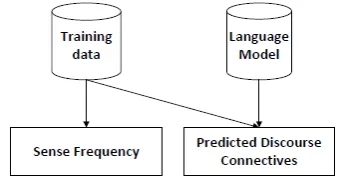
[image:3.595.330.501.236.326.2]pre-dicted discourse connectives as features. We take the connective with the lowest perplexity value (i.e., top 1 connective) as the real connective for the arguments pair. Then we count the sense frequency of this connective on the training set. Figure 1 illustrates the procedure of generating predicted discourse connective from a language model and calculating its sense frequency from training data. Here the calculation of sense fre-quency of connective is based on the annotated training data which has labeled discourse rela-tions, thus this method is a supervised one.
Figure 1: Procedure of generating a predicted dis-course connective and its sense frequency from the training set and a language model.
Then we can directly use the sense frequency to generate a 4-feature vector to perform the clas-sification. For example, the sense frequency of the connective but in the most general 4 senses can be counted from training set as 691, 6, 49,
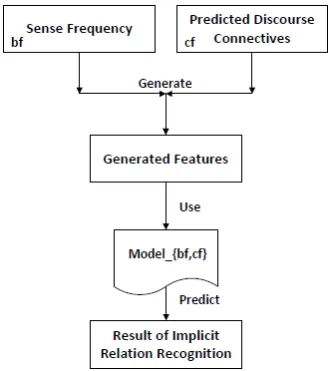
2, respectively. For a given pair of arguments, if but is predicted as the top 1 connective based on a language model, a 4-dimension feature vec-tor (691,6,49,2) is generated for this pair and used for training and test procedure. Figure 2 and 3 show the training and test procedure for this method.
Figure 3: Test procedure for the first approach.
3.3 Using presence or absence of predicted discourse connective as features
(Pitler et al., 2008) showed that most connectives are unambiguous and it is possible to obtain high-accuracy in prediction of discourse senses due to the simple mapping relation between connectives and senses. Given two examples:
(E1) She paid less on her dress,butit is very nice. (E2) We have to harry up becausethe raining is getting heavier and heavier.
The two connectives, i.e., but in E1 andbecause
in E2, convey the Comparison and Contingency senses respectively. In most cases, we can easily recognize the relation sense by the appearance of a discourse connective since it can be interpreted in only one way. That means the ambiguity of the mapping between sense and connective is quite low. Therefore, the second approach is to use only the presence of the topNpredicted discourse con-nectives to generate a feature vector for a given pair of arguments.
4 Experiment
4.1 Data sets
We used PDTB as our data set to perform the eval-uation of our methods. The corpus contains anno-tations of explicit and implicit discourse relations. The first evaluation is performed on the annotated implicit data set. Following the work of (Pitler et al., 2009a), we used sections 2-20 as the training set, sections 21-22 as the test set and sections 0-1 as the development set for parameter optimiza-tion (e.g.,Nvalue). The second evaluation is
per-formed on the annotated explicit data set. We fol-low the method used in (Sporleder and Lascarides, 2008) to remove the discourse connective from the explicit instances and consider these processed in-stances as implicit ones.
We constructed four binary classifiers to recog-nize each main senses (i.e., Cont., Cont., Exp., Temp.) from the rest. For each sense we used equal numbers of positive and negative instances in training set. The negative instances were cho-sen at random from the rest of training set. For both evaluations all instances in sections 21-22 were used as test set. Table 1 lists the numbers of positive and negative instances for each sense in training, development and test sets of implicit and explicit relation data sets.
4.2 Evaluation and classifier
To evaluate the performance of above systems, we used two widely-used measures, F-score ( i.e.,F1)
and accuracy. In addition, in this work we used the LIBSVM toolkit to construct four linear SVM classifiers for each sense.
4.3 Preprocessing
We used the SRILM toolkit to build a language model and calculated theperplexityvalue for each training and test sample. The steps are described as follows. First, since perplexity is an intrin-sic score to measure the similarity between train-ing and test samples, in order to fit the restric-tion of perplexity we chose 3 widely-used cor-pora in the Newswire domain to train the language model, i.e., (1) the New York part of BLLIP North American News Text (Complete), (2) the Xin and (3) the Ltw parts of the English Gigaword Fourth Edition. For the BLLIP corpus with 1,796,386 automatically parsed English sentences, we con-verted the parsed sentences into original textual data. Some punctuation marks such as commas, periods, minuses, right/left parentheses are con-verted into their original form. For the Xin and Ltw parts, we only used the Sentence Detector toolkit in OpenNLP to split each sentence. Finally we constructed 3-, 4- and 5-grams language mod-els from these three corpora. Table 2 lists statis-tics of different n-grams in the different language models and different corpora.
Next, for each instance we combined its Arg1
paral-Table 1: Statistics of positive and negative instances for each sense in training, development and test sets of implicit and explicit relation data sets.
Implicit Explicit
Comp. Cont. Exp. Temp. Comp. Cont. Exp. Temp.
Train(Pos/Neg) 1927/1927 3375/3375 6052/6052 730/730 4080/4080 2732/2732 4609/4609 2663/2663 Dev(Pos/Neg) 191/997 292/896 651/537 54/1134 438/1071 295/1214 514/995 262/1247 Test(Pos/Neg) 146/912 276/782 556/502 67/991 388/1025 235/1178 501/912 289/1124
Table 2: Statistics of different n-grams in the dif-ferent language models and difdif-ferent corpora.
n-gram BLLIP - Gigaword-
Gigaword-New York Xin Ltw
1-gram 1638156 2068538 2276491 2-grams 26156851 23961796 33504873 3-grams 80876435 77799100 101855639 4-grams 127142452 134410879 159791916 5-grams 146454530 168166195 183794771
lel connectives (such as “not only . . . ,but also”). Since discourse connectives may appear not only ahead of the Arg1, but also between Arg1 and
Arg2, we considered this case. Given a set of possible implicit connectives {ci}, for a single
connective ci, we constructed two synthetic
sen-tences,ci+Arg1+Arg2andArg1+ci+Arg2. In case
of parallel connectives, we constructed one syn-thetic sentence likeci,1+Arg1+ci,2+Arg2.
As a result, we obtain 198synthetic sentences (|ci| ∗2 for single connective or |ci|for parallel
connective) for each pair of arguments. Then we converted all words to lower cases and used the language model trained in the above step to calcu-late its perplexity (the lower the better) value on sentence level. The sentences were ranked from low to high according to their perplexity scores. For example, given a sentence with arguments pair as follows:
Arg1: it increased its loan-loss reserves by $93
million after reviewing its loan portfolio,
Arg2: before the loan-loss addition it had operat-ing profit of$10million for the quarter.
we got the perplexity (Ppl) values for this argu-ments pair in combination with two connectives (but andby comparison) in two positions as fol-lows:
1. but+Arg1+Arg2:Ppl= 349.622
2. Arg1+but+Arg2:Ppl= 399.339
3. by comparison+Arg1+Arg2:Ppl= 472.206
4. Arg1+by comparison+Arg2:Ppl= 543.051
In our second approach described in Section 3.3, we considered the combination of connectives and their position as final features like mid but, first but, where the features are binary, that is, the presence or absence of the specific connective. According to the value ofP pl(Sci,j), we tried var-iousN values on development set to get the opti-malN value.
4.4 Results
Table 3 summarizes the best performance achieved using gold-truth implicit connectives, the previous state-of-art performance achieved by (Pitler et al., 2009a) and our approaches. The first line shows the result by mapping the gold-truth implicit connectives directly to the relation’s sense. The second line presents the best result of (Pitler et al., 2009a). One thing worth mentioning here is that for the Expansion relation, (Pitler et al., 2009a) expanded both training and test sets by including EntRel relation as positive examples, which makes it impossible to perform direct comparison. The third and fourth lines show the best results using our first approach, where the sense frequency is counted on explicit and implicit training set respectively. The last line shows the best result of our second approach only considering the presence of topN connectives.
Table 4 summarizes the best performance using gold-truth explicit connectives reported in (Pitler and Nenkova., 2009b) and our two approaches.
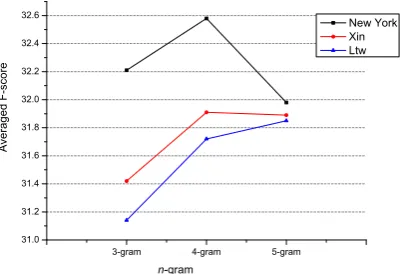
Figure 4 shows the curves of averaged F-scores on implicit connective classification with differ-ent n-gram language models. From this figure we can see that all 4-grams language models achieved around 0.5% better averaged F-score than 3-grams models. And except for Ltw corpus, other 5-grams models achieved lower averaged F-score than 4-grams models. Specially the 5-grams result of New York corpus is much lower than its 3-grams result.
[image:5.595.74.532.97.151.2]Table 3: Best result of implicit relations compared with state-of-art methods.
System Comp. vs. Not Cont. vs. Other Exp. vs. Other Temp. vs. Other Averaged
F1(Acc) F1(Acc) F1(Acc) F1(Acc) F1(Acc) Sense recognition using
gold-truth implicit connectives 94.08(98.30) 98.19(99.05) 97.79(97.64) 77.04(97.07) 91.78(98.02) Best result in (Pitler et al., 2009a) 21.96(56.59) 47.13(67.30) 76.42(63.62) 16.76(63.49) 40.57(62.75) Use sense frequency in explicit training set 26.02(52.17) 35.72(51.70) 64.94(53.97) 13.76(41.97) 35.10(49.95) Use sense frequency in implicit training set 24.55(63.99) 16.26(70.79) 60.70(53.50) 14.75(70.51) 29.07(64.70) Use presence of topNconnectives only 21.91(52.84) 39.53(50.85) 68.84(52.93) 11.91(6.33) 35.55(40.74)
Table 4: Best result of explicit relation conversion to implicit relation compared with results using the same method.
System Comp. vs. Not Cont. vs. Other Exp. vs. Other Temp. vs. Other Average
F1(Acc) F1(Acc) F1(Acc) F1(Acc) F1(Acc) Sense recognition using gold-truth
explicit connectives in (Pitler et al., 2009a) N/A N/A N/A N/A N/A(93.67) Use sense frequency in explicit training set 41.62(50.96) 27.46(59.24) 48.44(50.88) 35.14(54.28) 38.17(53.84) Use presence of topNconnectives only 42.92(55.77) 31.83(56.05) 47.26(55.77) 37.89(58.24) 39.98(56.46)
0 10 20 30 40 50 60 70 80 90100 110 120 130 140 150 160 170 180 190 200 30.0
30.5 31.0 31.5 32.0 32.5 33.0 33.5 34.0 34.5
NY 3-gram
NY 4-gram
NY 5-gram
Top N value
A
ve
r
a
g
e
d
F
-S
co
r
[image:6.595.149.451.301.492.2]e
Figure 5: Curves of averages F-score on New York 3-, 4- and 5-grams language models with different topN values.
trend of these curves cannot be summarized in one sentence. But we can see that the best aver-aged F-scores mostly appeared in the range from
100−160. For 4-grams and 5-grams models, the system achieved the top averaged F-scores when
N = 20as well.
4.5 Discussion
Experimental results on PDTB showed that using predicted connectives achieved the comparable F-scores of the state-of-art method.
From Table 3 we can find that our results are closely to the best performance of previous state-of-art methods in terms of averaged F-score. On
3-gram 4-gram 5-gram 31.0
31.2 31.4 31.6 31.8 32.0 32.2 32.4 32.6
New York Xin
Ltw
n-gram
A
ve
r
a
g
e
d
F
-sco
r
[image:7.595.86.289.74.211.2]e
Figure 4: Curves of averaged F-score on implicit connective classification with n-Gram language model.
with other approaches involving thousands of fea-tures, our method is quite promising.
From Table 4 we observe comparable averaged F-score (39.98% F-score) on explicit relation data set to that on implicit relation data set. Previ-ously, (Sporleder and Lascarides, 2008) also used the same conversion method to perform implicit relation recognition on different corpora and their best result is around 33.69% F-score. Although the two results cannot be compared directly due to different data sets, the magnitude of performance quantities is comparable and reliable.
By comparing with the above different systems, we find several useful observations. First, our method using predicted implicit connectives via a language model can help the task of implicit dis-course relation recognition. The results are com-parable to the previous state-of-art studies. Sec-ond, our method has a lot of advantages, i.e., a very small amount of features (several or no more than 200 vs. ten thousand), easy computation (only based on the trained language model vs. us-ing a lot of NLP tools to extract a large amount of linguistically informed features) and fast running, which makes it more practical in real world appli-cation. Furthermore, since the language model can be trained on many corpora whether annotated or unannotated, this method is more adaptive to other languages and domains.
5 Conclusions
In this paper we have presented an approach to implicit discourse relation recognition using pre-dicted implicit connectives via a language model.
The predicted connectives have been used for im-plicit relation recognition in two ways, i.e., super-vised and unsupersuper-vised framework. Results on the Penn Discourse Treebank 2.0 show that the pdicted discourse connectives can help implicit re-lation recognition and the two algorithms achieve comparable F-scores with the state-of-art method. In addition, this method is quite promising due to its simple, easy to retrieve, fast run and increased adaptivity to other languages and domains.
Acknowledgments
We thank the reviewers for their helpful com-ments and Jonathan Ginzburg for his mentor-ing. This work is supported by grants from National Natural Science Foundation of China (No.60903093), Shanghai Pujiang Talent Program (No.09PJ1404500) and Doctoral Fund of Ministry of Education of China (No.20090076120029).
References
J. Baldridge and A. Lascarides. 2005. Probabilistic head-driven parsing for discourse structure. Pro-ceedings of the Ninth Conference on Computational Natural Language Learning.
L. Carlson, D. Marcu, and Ma. E. Okurowski. 2001. Building a discourse-tagged corpus in the frame-work of rhetorical structure theory. Proceedings of the Second SIG dial Workshop on Discourse and Di-alogue.
B. Dorr. LCS Verb Database.Technical Report Online Software Database, University of Maryland, College Park, MD,2001.
R. Girju. 2003.Automatic detection of causal relations for question answering. In ACL 2003 Workshops.
S. Blair-Goldensohn. 2007. Long-Answer Ques-tion Answering and Rhetorical-Semantic RelaQues-tions. Ph.D. thesis, Columbia Unviersity.
M. Lapata and A. Lascarides. 2004. Inferring Sentence-internal Temporal Relations. Proceedings of the North American Chapter of the Assocation of Computational Linguistics.
Z.H. Lin, M.Y. Kan and H.T. Ng. 2009. Recognizing Implicit Discourse Relations in the Penn Discourse Treebank. Proceedings of the 2009 Conference on Empirical Methods in Natural Language Processing.
E. Pitler, M. Raghupathy, H. Mehta, A. Nenkova, A. Lee, A. Joshi. 2008. Easily Identifiable Dis-course Relations. Coling 2008: Companion vol-ume: Posters.
E. Pitler, A. Louis, A. Nenkova. 2009. Automatic sense prediction for implicit discourse relations in text. Proceedings of the 47th Annual Meeting of the Association for Computational Linguistics.
E. Pitler and A. Nenkova. 2009. Using Syntax to Dis-ambiguate Explicit Discourse Connectives in Text. Proceedings of the ACL-IJCNLP 2009 Conference Short Papers.
M. Porter. An algorithm for suffix stripping. In Pro-gram, vol. 14, no. 3, pp.130-137, 1980.
R. Prasad, N. Dinesh, A. Lee, A. Joshi, B. Webber. 2006. Annotating attribution in the Penn Discourse TreeBank. Proceedings of the COLING/ACL Work-shop on Sentiment and Subjectivity in Text.
R. Prasad, N. Dinesh, A. Lee, E. Miltsakaki, L. Robaldo, A. Joshi, B. Webber. 2008. The Penn Dis-course TreeBank 2.0. Proceedings of LREC’08.
M. Saito, K.Yamamoto, S.Sekine. 2006. Using Phrasal Patterns to Identify Discourse Relations. Proceeding of the HLTCNA Chapter of the ACL.
R. Soricut and D. Marcu. 2003. Sentence Level Dis-course Parsing using Syntactic and Lexical Informa-tion. Proceedings of the Human Language Technol-ogy and North American Association for Computa-tional Linguistics Conference.
C. Sporleder and A. Lascarides. 2008.Using automat-ically labelled examples to classify rhetorical rela-tions: an assessment. Natural Language Engineer-ing, Volume 14, Issue 03.
B. Wellner , J. Pustejovsky, C. H. R. S., A. Rumshisky. 2006. Classification of discourse coherence rela-tions: An exploratory study using multiple knowl-edge sources. Proceedings of the 7th SIGDIAL Workshop on Discourse and Dialogue.