Aligning Texts and Knowledge Bases with Semantic Sentence
Simplification
Yassine Mrabet1,3, Pavlos Vougiouklis2, Halil Kilicoglu1,
Claire Gardent3, Dina Demner-Fushman1, Jonathon Hare2, and Elena Simperl2 1Lister Hill National Center for Biomedical Communications
National Library of Medicine, USA
{mrabety,kilicogluh,ddemner}@mail.nih.gov
2Web and Internet Science Research Group University of Southampton, UK
{pv1e13,jsh2,es}@ecs.soton.ac.uk
3CNRS/LORIA, France [email protected]
Abstract
Finding the natural language equivalent of structured data is both a challenging and promising task. In particular, an efficient alignment of knowledge bases with texts would benefit many applications, includ-ing natural language generation, informa-tion retrieval and text simplificainforma-tion. In this paper, we present an approach to build a dataset of triples aligned with equiva-lent sentences written in natural language. Our approach consists of three main steps. First, target sentences are annotated auto-matically with knowledge base (KB) con-cepts and instances. The triples linking these elements in the KB are extracted as candidate facts to be aligned with the an-notated sentence. Second, we use tex-tual mentions referring to the subject and object of these facts to semantically sim-plify the target sentence via crowdsourc-ing. Third, the sentences provided by different contributors are post-processed to keep only the most relevant simplifi-cations for the alignment with KB facts. We present different filtering methods, and share the constructed datasets in the pub-lic domain. These datasets contain 1,050 sentences aligned with 1,885 triples. They can be used to train natural language gen-erators as well as semantic or contextual text simplifiers.
1 Introduction
A large part of the information on the Web is con-tained in databases and is not suited to be directly accessed by human users. A proper exploitation of these data requires relevant visualization tech-niques which may range from simple tabular pre-sentation with meaningful queries, to graph gener-ation and textual description. This last type of vi-sualization is particularly interesting as it produces an additional raw resource that can be read by both computational agents (e.g. search engines) and human users. From this perspective, the ability to generate high quality text from knowledge and data bases could be a game changer.
In the Natural language Processing community, this task is known as Natural Language Generation (NLG). Efficient NLG solutions would allow dis-playing the content of knowledge and data bases to lay users; generating explanations, descrip-tions and summaries from ontologies and linked open data1; or guiding the user in formulating
knowledge-base queries.
However, one strong and persistent limitation to the development of adequate NLG solutions for the semantic web is the lack of appropriate datasets on which to train NLG models. The diffi-culty is that the semantic data available in knowl-edge and data bases need to be aligned with the corresponding text. Unfortunately, this alignment task is far from straightforward. In fact, both hu-man beings and machines perform poorly on it.
Nonetheless, there has been much work on data-to-text generation and different strategies have been used to create the data-to-text corpora that are required for learning and testing. Two main such strategies can be identified. One strategy consists in creating a small, domain-specific cor-pus where data and text are manually aligned by a small group of experts (often the researchers who work on developing the NLG system). Typically, such corpora are domain specific and of relatively small size while their linguistic variability is often restricted.
A second strategy consists in automatically building a large data-to-text corpus in which the alignment between data and text is much looser. For instance, Lebret et al. (2016) extracted a cor-pus consisting of 728,321 biography articles from English Wikipedia and created a data-to-text cor-pus by simply associating the infobox of each ar-ticle with its introduction section. The resulting dataset has a vocabulary of 403k words but there is no guarantee that the text actually matches the content of the infobox.
In this paper, we explore a middle-ground ap-proach and introduce a new methodology for semi-automatically building large, high quality data-to-text corpora. More precisely, our ap-proach relies on a semantic sentence simplification method which allows transforming existing cor-pora into sentences aligned with KB facts. Con-trary to manual methods, our approach does not rely on having a small group of experts to iden-tify alignments between text and data. Instead, this task is performed (i) by multiple, independent con-tributors through a crowdsourcing platform, and (ii) by an automatic scoring of the quality of the contributions, which enables faster and more re-liable data creation process. Our approach also departs from the fully automatic approaches (e.g., (Lebret et al., 2016) ) in that it ensures a system-atic alignment between text and data.
In the following section we present work related to corpus generation for NLG. In section 3 we de-scribe our approach. Section 4 presents the exper-iments, evaluations, and the statistics on the initial corpora and the generated (aligned) datasets.
2 Related Work
Many studies tackled the construction of datasets for natural language generation. Several available datasets were created by researchers and
develop-ers working on NLG systems. Chen and Mooney (2008) created a dataset of text and data describ-ing the Robocup game. To collect the data, they used the Robocup simulator (www.robocup.org) and derived symbolic representations of game events from the simulator traces using a rule-based system. The extracted events are repre-sented as atomic formulas in predicate logic with timestamps. For the natural language portion of the data, they had humans comment games while watching them on the simulator. They manually aligned logical formulas to their corresponding sentences. The resulting data-to-text corpus con-tains 1,919 scenarios where each scenario consists of a single sentence representing a fragment of a commentary on the game, paired with a set of log-ical formulas.
The SumTime-Meteo corpus was created by the SumTime project (Sripada et al., 2002). The cor-pus was collected from the commercial output of five different human forecasters, and each instance in the corpus consists of three numerical data files produced by three different weather simulators, and the weather forecast file written by the fore-caster. To train a sentence generator, (Belz, 2008) created a version of the SumTime-Meteo corpus which is restricted to wind data. The resulting corpus consists of 2,123 instances for a total of 22,985 words and was used by other researchers working on NLG and semantic parsing (Angeli et al., 2012).
Other data-to-text corpora were proposed for training and testing generation systems, including WeatherGov (Liang et al., 2009), the ATIS dataset, the Restaurant Corpus (Wen et al., 2015) and the BAGEL dataset (Mairesse et al., 2010). Weath-erGov consists of 29,528 weather scenarios for 3,753 major US cities. In the air travel domain, the ATIS dataset (Dahl et al., 1994) consists of 5,426 scenarios. These are transcriptions of spontaneous utterances of users interacting with a hypotheti-cal online flight-booking system. The RESTAU-RANTS corpus contains utterances that a spoken dialogue system might produce in an interaction with a human user together with the correspond-ing dialog act. Similarly, the BAGEL dataset is concerned with restaurant information in a dialog setting.
mostly created artificially from sensor or web data rather than extracted from some existing knowl-edge base. As the data are often domain specific, the vocabulary size and the linguistic variability of the target text are often restricted.
Other approaches tackled the benchmarking of NLG systems and provided the constructed dataset as a publicly available resource. For instance, a Surface Realisation shared task was organised in 2011 to compare and evaluate sentence generators (Belz et al., 2011). The dataset prepared by the or-ganisers was derived from the PennTreebank and associates sentences with both a shallow represen-tation (dependency trees) and a deep representa-tion where edges are labelled with semantic roles (e.g., agent, patient) and the structure is a graph rather than a tree. While the data-to-text corpus that was made available from this shared task was very large, the representation associated with each sentence is a linguistic representation and is not related to a data schema.
The KBGen shared task (Banik et al., 2013) fol-lowed a different approach and focused on gener-ating sentences from knowledge bases. For this task, knowledge base fragments were extracted semi-automatically from an existing biology knowledge base (namely, BioKB101 (Chaudhri et al., 2013)) and expert biologists were asked to as-sociate each KB fragments with a sentence ver-balising their meaning. The resulting dataset was small (207 data-text instances for training, 70 for testing) and the creation process relied heavily on domain experts, thereby limiting its portability.
In sum, there exists so far no standard method-ology for rapidly creating data-to-text corpora that are both sufficiently large to support the training and testing of NLG systems and sufficiently pre-cise to support the development of natural lan-guage generation approaches that can map KB data to sentences. The procedures designed by individual researchers to test their own proposals yield data in non-standard formats (e.g., tabular information, dialog acts, infoboxes) and are often limited in size. Data used in shared tasks either fail to associate sentences with knowledge base data (SR shared task) or require extensive manual work and expert validation.
3 Methods
Our approach tackles the conversion of existing textual corpora into a dataset of sentences aligned
with<subject, predicate, object>triples collected from existing KBs. It is independent from the se-lected corpus, domain, or KB.
In the first step, we annotate automatically the target textual corpus by linking textual mentions to knowledge base concepts and instances (KB enti-ties for short). In the second step, we collect triples from the knowledge bases that link the entities mentioned in a given sentence. In the third step, we keep only the mentions that refer to the subject and object of the same triple and perform seman-tic simplification with a crowdsourcing task. Fi-nally we apply several post-processing algorithms, including clustering and scoring to keep the most relevant semantic simplifications of each sentence as a natural language expression of the set of col-lected triples.
The alignment that we aim to achieve is not bi-nary, as an output of our approach, one sentence could be aligned with N triples (N ≥ 1). This
property is particularly interesting for NLG as it allows training generation systems on expressing sets of triples in the same sentence; enabling the production of more fluent texts.
3.1 Corpus Annotation and Initial Sentence Selection
In the following we present our methods to obtain automatic initial annotations of the target corpora and to select the sentences that will be used in the final aligned dataset.
3.1.1 Corpus Annotation
In order to have varied empirical observations, we use two different methods for initial corpus an-notation. In the first annotation methodwe do not check if the candidate triples are actually ex-pressed in the sentence, only their subjects and ob-jects. This method is particularly suitable to dis-cover new linguistic expressions of triple predi-cates, and can provide actual expressions of the triple by accumulating observations from different sentences.
mention using KB relations.
In the second step we query the KB (e.g., SPARQL endpoint of DBpedia) to obtain the pred-icates that link the KB entities mentioned in the sentence and keep them as candidate facts. For instance, the 8 highlighted terms in figure 1 were linked to DBpedia entities, but only 4 terms men-tion KB entities that are linked in DBpedia triples. This first method is scalable w.r.t. the domain of interest as it can be ported to other KBs with the same implementation.
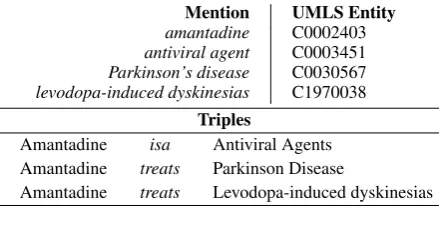
In the second annotation method, we per-form the automatic annotation by checking that the triples are actually expressed in the sentence. We use SemRep (Rindflesch and Fiszman, 2003), a biomedical relation extraction system. Sem-Rep extracts binary relations from unstructured texts. The subject and object of these relations are concepts from the UMLS Metathesaurus (Lind-berg et al., 1993) and the predicate is a relation type from an expanded version of the UMLS Se-mantic Network (e.g., treats, diagnoses, stimu-lates,inhibits). SemRep uses MetaMap (Aronson and Lang, 2010) to link noun phrases to UMLS Metathesaurus concepts. For example, the 4 high-lighted terms in figure 2 were linked to UMLS concepts and all terms mention either the subject or the object of a relation extracted with SemRep. In both methods, we keep only the annotations that refer to subjects and objects of candidate facts. 3.1.2 Initial Sentence Selection.
Due to the unsupervised aspect of automatic an-notation and the incompleteness of the KBs, some sentences are expected to be annotated more heav-ily than others, and some sentences are expected to have more triples associated with them than others. In practice, different targets of annotation (e.g. specific semantic categories) could also lead to similar discrepancies.
In order to train automatic sentence simplifiers with our datasets, we have to consider different levels of coverage that can correspond to different annotation tools and dissimilar annotation goals. Accordingly, once the initial corpus is annotated, we select three sets of sentences: (1) a first set of sentences that areheavily annotated w.r.t. the number of triples (e.g. between 5 and 10 tokens per triple), (2) a second set with average annota-tion coverage (e.g. between 10 and 20 tokens per triple), and (3) a third set of weakly annotated sen-tence (e.g. above 20 tokens per triple).
3.2 Semantic Sentence Simplification (S3) In order to obtain the final dataset of KB facts aligned with natural language sentences from the initial automatically annotated corpus, we define the task of Semantic Sentence Simplification (S3) and introduce the crowdsourcing process used to perform it.
Definition. Given a sentence S, a set of textual
mentions M(S) linked to a set of KB instances
and concepts E(S) and a set of triples T(S) =
{ti(ei1, pi, ei2), s.t.e1 ∈ E(S), e2 ∈ E(S), the semantic simplification task consists ofshortening the sentence S as much as possible according to
the following rules:
• Keep the textual mentions referring to the subject and object of candidate facts.
• Keep the relations expressed between these textual mentions in the sentence.
• Keep the order of the words from the original sentence as much as possible.
• Ensure that the simplified sentence is gram-matical and meaningful.
• Avoid using external words to the extent pos-sible.
Crowdsourcing. We asked contributors to
pro-vide simplifications for each sentence through a crowdsourcing platform. We highlighted the tex-tual mentions referring to subjects and objects of candidate facts in these sentences. The contribu-tors are then asked to follow the S3 requirements to shorten the sentences. The quality requirement that was set during the experiment is that each contributor should dedicate at least 15 seconds for each set of 3 sentences.
Saccoflew as apayload specialistonSTS-73, which launched onOctober 20,1995, and landed at theKennedy Space Center onNovember 5,1995.
Mention DBpedia Entity
Sacco dbr:Albert Sacco payload specialist dbr:Payload Specialist
STS-73 dbr:STS-73
October 20 dbr:October 20 1995 dbr:1995
Kennedy Space Center dbr:Kennedy Space Center November 5 dbr:November 5
Triples
dbr:Albert Sacco dbo:mission dbr:STS-73
[image:5.595.168.440.88.260.2]dbr:STS-73 dbp:landingSite dbr:Kennedy Space Center dbr:STS-73 dbp:launchSite dbr:Kennedy Space Center
Figure 1: Example sentence annotated with DBpedia entities and its candidate triples.
Theantiviral agent amantadinehas been used to manage Parkinson’s diseaseorlevodopa-induced dyskinesiasfor
nearly 5 decades.
Mention UMLS Entity
amantadine C0002403 antiviral agent C0003451 Parkinson’s disease C0030567 levodopa-induced dyskinesias C1970038
Triples
Amantadine isa Antiviral Agents Amantadine treats Parkinson Disease
Amantadine treats Levodopa-induced dyskinesias
Figure 2: Example sentence annotated with UMLS concepts and triples.
3.3 Selecting the best simplification
In order to select the most relevant simplification for a given sentence from the set ofN
simplifica-tions proposed by contributors, we test two base-line methods and two advanced scoring methods.
3.3.1 Baselines.
The first baseline method is simply the selection of the simplification that has more votes. We will refer to it asV otein the remainder of the paper.
The second baseline method, calledClustering,
is based on the K-Means clustering algorithm. It uses the Euclidean distance measured between word vectors to cluster the set ofNsimplifications
of a given sentence into K clusters. The
clus-ter with the highest cumulative number of votes is selected as the most significant cluster, and the shortest sentence in that cluster is selected as the candidate simplification.
3.3.2 Scoring Methods
Our first selection method scores a simplification according to the original sentence and to the simplification goals expressed in section 3.3. We define four elementary measures to compute a semantic score: lexical integrity, semantic preservation, conformity andrelative shortening. Given an initial sentence so and a simplification
si proposed forso, these measures are defined as follows.
Conformity (cnf). The conformity score
repre-sents how much the simplificationsi conforms to the rules of the S3 task. It combines lexical in-tegrity and semantic preservation:
cnf(si, so) =ζ(si, so)×ι(si, so) (1)
Lexical integrity (ι).ι(si, so)is the proportion of words insi that are inso. ιvalues are in the [0,1] range. The value is lower than 1 if new external words are used.
Semantic Preservation (ζ). Semantic
preserva-tion indicates how much of the textual menpreserva-tions that are linked to KB entities and KB triples are present in the simplification. More precisely,
ζ(si, so) is the ratio of annotations from so that are present insi.ζ values are in the [0,1] range.
Relative Shortening (η). Simplifications that are
[image:5.595.73.293.338.451.2]might be too close (or equal) to the original sen-tence. We represent both aspects through a Gaus-sian and make use of the “wisdom of the crowd” by setting the maximum value at the average length of the simplifications proposed by the con-tributors. In order to have a moderate decrease around the average, we set both the maximum value and the standard deviation to 1. Length is measured in terms of tokens.
η(si, so) =exp(−(length(si)−lengthavg) 2
2 )
(2)
Semantic score (ψ). We compute the
seman-tic score for a simplificationsi ofso by combin-ing the above elements. This combination, ex-pressed in equation 3, is based on the follow-ing intuitions: (1) between two simplifications of the same sentence, the difference in confor-mity should have more impact than the difference in shortening, (2) for the same conformity value, simplifications that are farther from the original sentence are preferred, and (3) simplifications that have a more common shortening extent should be better ranked.
ψ(si, so) =η(si, so)×exp(cnf(si, so)×euclidean(si, so))
(3) The Euclidean function is the Euclidean dis-tance between the original sentence and the sim-plification in terms of tokens. Oursecond scoring method relied first on the clustering of the con-tributors’ sentences. As the baseline it identifies the cluster with more votes as most significant. However, the representative sentence is selected according to the semantic scoreψ, instead of
sim-ply taking the shortest sentence of the cluster. We denote this in-cluster scoring methodξ.
4 Experiments and Results
In the first experiments, we build two datasets of natural language sentences aligned with KB facts.
Corpora and knowledge bases. Our first
dataset is built by aligning all astronaut pages on Wikipedia2(Wiki) with triples from DBpedia3.
The main motivation behind the choice of this cor-pus is to have both general and specific relations. We used KODA as described in section 3.1.1 to obtain initial annotations.
2https://en.wikipedia.org/wiki/List of astronauts by name 3http://dbpedia.org
Oursecond datasetis built by aligning the med-ical encyclopedia part of Medline Plus4 (MLP)
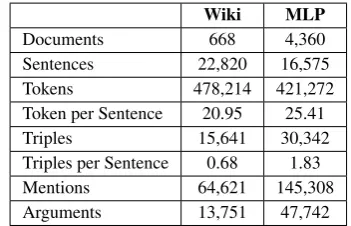
with triples extracted with SemRep. The motiva-tion behind the selecmotiva-tion of this corpus is twofold: a) to experiment with a domain-specific corpus, and b) to test the simplification when the triples are extracted from the text itself. Table 1 presents raw statistics on each corpus.
Wiki MLP
Documents 668 4,360
Sentences 22,820 16,575
Tokens 478,214 421,272
Token per Sentence 20.95 25.41
Triples 15,641 30,342
Triples per Sentence 0.68 1.83
Mentions 64,621 145,308
[image:6.595.327.503.181.294.2]Arguments 13,751 47,742
Table 1: Basic Statistics on Initial Corpora
Crowdsourcing. We used CrowdFlower5 as a
crowdsourcing platform. We submitted 600 anno-tated sentences for the Wiki corpus and 450 sen-tences for the MLP corpus.
Selection of relevant simplifications. We imple-mented several methods to select the best simpli-fication among the 15 contributions for each sen-tence (cf. section 3.3). To evaluate these methods we randomly selected 90 initial sentences from each dataset, then extracted the best simplifica-tion according to each of the 4 scoring metrics. The authors then rated each simplification from 1 to 5, with 1 indicating a very bad simplifica-tion, and 5 indicating an excellent simplification. One of the authors prepared the evaluation tables, anonymized the method names and did not partic-ipate in the evaluation. The remaining 6 authors shared the 180 sentences and performed the rat-ings. Table 2 presents the final average rating for each selection method.
Baselines Scoring
Vote Clustering ξ ψ
Wiki 3.62 3.06 3.51 3.22
MLP 3.51 2.87 3.61 3.30
Overall 3.56 2.97 3.56 3.26
Table 2: Evaluation of S3 Selection Methods (av-erage rating)
[image:6.595.309.526.608.672.2]Wiki MLP
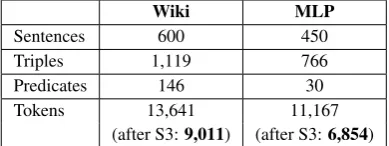
Sentences 600 450
Triples 1,119 766
Predicates 146 30
Tokens 13,641 11,167
[image:7.595.84.279.63.136.2](after S3:9,011) (after S3:6,854)
Table 3: Statistics on the Aligned Dataset
ating the selection methods we selected the most relevant simplification for each sentence in the dataset according toξ(i.e., in-cluster scoring), and
[image:7.595.75.287.322.522.2]generated the final datasets that link the best sim-plification to the facts associated with its original sentence. Table 3 presents the final statistics on the aligned datasets. Both datasets are made available online6.
Table 4 presents the 10 first predicate names and their distribution for each dataset.
Wiki MLP
Predicate % Predicate %
rdf:type 15.6 location of 24.93
dbo:type 10.18 is a 20.75
dbo:mission 9.11 process of 14.09
dbo:crewMembers 6.34 treats 7.04 dbo:birthPlace 5.45 causes 6.78
dbo:occupation 4.64 part of 5.87 dbo:nationality 3.30 administred to 3.13
dbo:rank 3.03 coexists with 2.61 dbp:crew2Up 2.94 affects 2.08
dbo:country 1.96 uses 1.43
Table 4: Top 10 predicates
5 Discussion
Automatic Annotation. From our observations
on both datasets, we came to the conclusion that uncertainty is required to some extent in the selec-tion of candidate triples. This is due to the fact that relations extracted from the text itself will fol-low the patterns that were used to find them (e.g., regular expressions, or classifier models) and that will not allow finding enough variation to enrich NLG systems. From this perspective, the best op-tion would be to rank candidate triples according to their probability of occurrence in the sentence
6https://github.com/pvougiou/
KB-Text-Alignment
and filter out the triples with very low probability. This ranking and filtering are planned for the final version of our open-domain corpus.
Initial sentence selection.The second goal of our datasets is to be able to train automatic semantic simplifiers that would reduce the need for manual simplification in the long term. Therefore, our first method took into account different levels of an-notation coverage in order to cope with different performance/coverage of annotation tools and dis-similar goals in terms of the semantic categories of the mentions. However, for NLG, it is also im-portant to have a balanced number of samples for each unique predicate. The first extension of our datasets will provide a better balance of examples for each predicate while keeping the balance in terms of annotation coverage to the extent possi-ble.
Crowdsourcing. Our crowdsourcing experiment
showed that it is possible to obtain relevant se-mantic simplifications with no specific expertise. This is supported by the fact that the V ote
base-line in the selection of the final simplification ob-tained the same best performance as our scoring method that relies on the semantics of the S3 pro-cess. Overall, the experiment cost was only $180 for 15,750 simplifications collected for 1,050 sen-tences. Our results also show that collecting only 10 simplifications for each sentence (instead of 15 in our experiments) would be more than adequate, which reduces the costs even further. The two jobs created for each dataset were generally well-rated by the contributors (cf. Table 5). The MLP corpus was clearly more accessible than the Wiki corpus with an ease of job estimated at 4.4 vs 3.8 (on a 5 scale). Interestingly, the identical instructions were also rated differently according to the dataset (4.2 vs. 3.8). The Wiki corpus was harder to pro-cess, due to the high heterogeneity of the relations and entity categories. There are also fewer argu-ments per sentence in the Wiki corpus: 0.68 triple per sentence vs. 1.83, for a close average length of 20.95 tokens per sentence vs. 25.41 (cf. Table 1).
Wiki MLP
Number of participants 48 41 Clarity of Instructions 3.8 4.2
Ease of Job 3.8 4.4
[image:7.595.335.499.663.727.2]Overall Rating of Job 3.9 4.4
6 Conclusions
We presented a novel approach to build a corpus of natural language sentences aligned with knowl-edge base facts, and shared the first constructed datasets in the public domain. We introduced the task of semantic sentence simplification that re-tains only the natural language elements that cor-respond minimally to KB facts. While our simpli-fication method relied on crowdsourcing, our mid-term goal is to collect enough data to train auto-matic simplifiers that would perform the same task efficiently. Besides the simplification aspect and the portability of the method, the shared datasets are also a valuable resource for natural language generation systems. Future work includes the ex-pansion of these datasets and the improvement of sentence selection using grammatical-quality fac-tors.
Acknowledgments
This work was supported by the intramural research program at the U.S. National Library of Medicine, National Institutes of Health.
References
Gabor Angeli, Christopher D Manning, and Daniel Ju-rafsky. 2012. Parsing time: Learning to interpret time expressions. InProceedings of the 2012 Con-ference of the North American Chapter of the ACL: Human Language Technologies, pages 446–455.
Alan R Aronson and Franc¸ois-Michel Lang. 2010. An overview of metamap: historical perspective and re-cent advances. JAMIA, 17(3):229–236.
Eva Banik, Claire Gardent, and Eric Kow. 2013. The kbgen challenge. Inthe 14th European Workshop on Natural Language Generation (ENLG), pages 94– 97.
Anja Belz, Michael White, Dominic Espinosa, Eric Kow, Deirdre Hogan, and Amanda Stent. 2011. The first surface realisation shared task: Overview and evaluation results. In 13th European workshop on natural language generation, pages 217–226.
Anja Belz. 2008. Automatic generation of weather forecast texts using comprehensive probabilistic generation-space models. Nat. Language Engineer-ing, 14(04):431–455.
Vinay K Chaudhri, Michael A Wessel, and Stijn Hey-mans. 2013. Kb bio 101: A challenge for tptp first-order reasoners. InCADE-24 Workshop on Knowl-edge Intensive Automated Reasoning.
David L Chen and Raymond J Mooney. 2008. Learn-ing to sportscast: a test of grounded language acqui-sition. InProceedings of the 25th ICML conference, pages 128–135. ACM.
Deborah A Dahl, Madeleine Bates, Michael Brown, William Fisher, Kate Hunicke-Smith, David Pallett, Christine Pao, Alexander Rudnicky, and Elizabeth Shriberg. 1994. Expanding the scope of the atis task: The atis-3 corpus. InProceedings of the work-shop on Human Language Technology, pages 43–48. Association for Computational Linguistics.
R. Lebret, D. Grangier, and M. Auli. 2016. Generating Text from Structured Data with Application to the Biography Domain.ArXiv e-prints, March.
Percy Liang, Michael I Jordan, and Dan Klein. 2009. Learning semantic correspondences with less super-vision. InProceedings of the Joint Conference of the 47th Annual Meeting of the ACL and the 4th Interna-tional Joint Conference on Natural Language Pro-cessing of the AFNLP: Volume 1-Volume 1, pages 91–99.
Donald A Lindberg, Betsy L Humphreys, and Alexa T McCray. 1993. The unified medical language system. Methods of information in medicine, 32(4):281–291.
Franc¸ois Mairesse, Milica Gaˇsi´c, Filip Jurˇc´ıˇcek, Simon Keizer, Blaise Thomson, Kai Yu, and Steve Young. 2010. Phrase-based statistical language generation using graphical models and active learning. In Pro-ceedings of the 48th Annual Meeting of the ACL, pages 1552–1561. Association for Computational Linguistics.
Yassine Mrabet, Claire Gardent, Muriel Foulonneau, Elena Simperl, and Eric Ras. 2015. Towards knowledge-driven annotation. InProceedings of the Twenty-Ninth AAAI Conference on Artificial Intel-ligence, January 25-30, 2015, Austin, Texas, USA., pages 2425–2431.
Thomas C Rindflesch and Marcelo Fiszman. 2003. The interaction of domain knowledge and linguis-tic structure in natural language processing: inter-preting hypernymic propositions in biomedical text.
Journal of biomedical informatics, 36(6):462–477.
Somayajulu Sripada, Ehud Reiter, Jim Hunter, and Jin Yu. 2002. Sumtime-meteo: Parallel corpus of naturally occurring forecast texts and weather data. Computing Science Department, Univer-sity of Aberdeen, Aberdeen, Scotland, Tech. Rep. AUCS/TR0201.
Tsung-Hsien Wen, Milica Gasic, Nikola Mrksic, Pei-Hao Su, David Vandyke, and Steve Young. 2015. Semantically conditioned lstm-based natural lan-guage generation for spoken dialogue systems.