ACCESS TO THIRD LEVEL EDUCATION
MAY 2001
BAILE ÁTHA CLIATH
ARNA FHOILSIÚ AG OIFIG AN tSOLÁTHAIR
Le Ceannach díreach ón
OIFIG DHÍOLTA FOILSEACHÁN RIALTAIS
TEACH SUN ALLIANCE, SRÁID THEACH LAIGHEAN, BAILE ÁTHA CLIATH 2,
nó tríd an bpost ó
FOILSEACHÁIN RIALTAS, AN RANNÓG POST-TRÁCHTA,
4-5 BÓTHAR FHEARCHAIR, BAILE ÁTHA CLIATH 2,
(Teil: 01 – 6476834-5; fax: 01 – 4752760)
nó trí aon díoltóir leabhar.
DUBLIN
PUBLISHED BY THE STATIONERY OFFICE
To be purchased directly from the
GOVERNMENT PUBLICATIONS SALE OFFICE,
SUN ALLIANCE HOUSE, MOLESWORTH STREET, DUBLIN 2
or by mail order from
GOVERNMENT PUBLICATIONS, POSTAL TRADE SECTION,
4 –5 HARCOURT ROAD, DUBLIN 2,
(Tel: 01 – 6476834-5; Fax: 01 – 4752760)
or through any bookseller.
IR£5.00
FOREWORD 4
List of Acronyms used in Text 5
Executive Summary 6
CHAPTER ONE: INTRODUCTION 9
1.1 Economic and social reasons for improving access 11
1.2 What is meant by “Access” 12
1.3 Contextual Factors for the Action Group’s work 13
1.4. National Development Plan 16
1.5 Recent Reports 17
1.6 Existing and planned State Initiatives at Third-Level 22
CHAPTER TWO: STUDENTS FROM SOCIO-ECONOMICALLY
DISADVANTAGED BACKGROUNDS 25
2.1 Introduction 27
2.2 Clancy and Wall 28
2.3 Osborne and Leith 31
2.4 Issues arising in relation to Disadvantaged School Leavers 32
2.5 Links with programmes at first and second levels 33
2.6 Career Guidance Provision in Second–level Education 35
2.7 Rural/Urban Dimension 36
2.8 The scope of the objectives of the existing initiatives 36
2.9 Department of Education and Science: Special Initiatives-Disadvantaged 37 2.10 Baseline Indicators (socio-economic disadvantage) and targets for 2003 and 2006 38
2.11 Strategies aimed at meeting targets 39
2.12 Access Pathways 42
2.13 Financial Support 45
2.14 Amount of the Special Rate of Maintenance Grant 47
2.15 Recommendations of the Action Group 47
2.16 Other supports 52
CHAPTER THREE: STUDENTS WITH A DISABILITY 53
3.1 Introduction 55
3.2 Initial findings of Survey 55
3.3 Policy framework 56
3.5. The Identification and Tracking of Students with Disabilities in Higher Education 58
3.6 Transition to Third Level 60
3.7 Alternative Admission Procedures 61
3.8 Existing Targeted Interventions 61
3.9 Back to Education Allowance 63
3.10 Institutional Based Support Services 64
3.11 Disability Officers 65
3.12 Universal Design Principles 65
3.13 Curriculum Design 65
3.14 Personal Assistance 65
3.15 Accommodation 66
3.16 Targets for 2003 and 2006 66
3.17 Reporting and Evaluation by Institutions 67
CHAPTER FOUR: MATURE STUDENTS 69
4.1 Introduction 71
4.2 Existing Entry Routes for Full-Time Mature Students 73
4.3 Application and Selection System 74
4.4 Market Research on Demand for Mature Student Places 75
4.5 Issues emerging for Mature Students 75
4.6 Post Entry Issues 79
4.7 Recommendations of the Action Group 80
4.8 Mature Students: Target Setting, Performance indicators and Evaluation 85
CHAPTER FIVE: DISADVANTAGED COMMUNITIES: 89
5.1 Introduction 91
5.2 Partnership Companies and other Groups 91
5.3 Participation in Third Level Education – The Disadvantaged Community Dimension 92
5.4 Partnership and Community Group Responses 94
5.5 Strategies 95
5.6 Combined Guidance and Financial Support Schemes 98
5.7 Elements of Strategy 99
CHAPTER SIX: A CO-ORDINATED NATIONAL FRAMEWORK 103
6.1 Introduction 105
6.2 Background factors 105
6.3 Skilbeck’s 14 propositions 105
6.4 The Steering Group on the Future of Higher Education 107
6.5 The Report by Osborne and Leith 107
6.6 Consultation 107
6.7 The Time is Now 108
6.8 A Co-ordinated Framework 108
6.9 Seven critical stages leading to equity in access opportunities 108 6.10 The National Office – a key recommendation to realise the Framework 109
ANNEX 1 Terms of Reference 121
ANNEX 2 Membership of Action Group on Access to Third Level Education 122
ANNEX 3 Extract from Programme for Prosperity and Fairness 123
ANNEX 4 List of Parties who made Submissions to the Action Group 125
ANNEX 5 Attendance at Focus Group Meeting 126
ANNEX 6 Oral Submissions 127
ANNEX 7 Indicators for Socio-economic Disadvantaged Students 128
ANNEX 8 Summary of Access Programmes 130
ANNEX 9 Current Access Initiatives in the Universities 136
ANNEX 10 Access Initiatives in the IOT Sector 170
ANNEX 11 DIT Response to Educational Disadvantage 180
ANNEX 12 Detail of the Proposed Scheme 183
ANNEX 13 Income Profile of Maintenance Grant Holders 185
ANNEX 14 USI commissioned survey 186
ANNEX 15 Detail of Proposal 187
ANNEX 16 Evaluation by Higher Education Institutions 188
ANNEX 17 Maps: Partnerships and Community Groups 190
ANNEX 18 Map: LEADER Groups 191
FOREWORD
Over the past decade, a good deal of work has been undertaken to address the issues of under-participation in higher education. However, it has been uncoordinated and has often lacked a clear direction and focus. Our failure, to date, to successfully confront our short comings in terms of the under representation at third level of certain groups, and in particular disadvantaged students, students with disabilities and mature students, surely belies our much vaunted claim to the title “Island of Saints and Scholars”. Our failure is all the more striking when considered in light of considerable success on the economic front.
It is surely ironic that while there is near universal agreement that increased participation rates at third level have been central to the achievement of that success, the fact that whole segments of our society are so significantly underrepresented has not, as yet, sufficiently impacted on our consciousness. Yet the future growth and stability within our society will be determined in large measure by our success in confronting just that issue.
The Action Group considered both the challenge and the wide range of possible solutions, primarily in the context of the proposals outlined in the National Development Plan. While greatly welcoming the proposed allocation, it quickly became clear to us that we must, in the immediate future, be prepared to commit even greater resources and at a variety of levels if our shortcomings are to be confronted. Any failure to do so must surely relegate us to the lower end of the international league in terms of
competitiveness as we enter the new Millennium.
On my own behalf and on behalf of the Group I would like to acknowledge the interest and commitment of the Minister, Dr Michael Woods, the Secretary General of the Department, Mr John Dennehy, the many organisations and individuals who shared their expertise with us; Aidan O’Connor, Principal Officer in the Department of Education and Science was a tower of strength throughout and bore the main burden of guiding us through a complex maze in just three months; his colleagues John Moloney, Thérèse Conlon and Grace O’Malley; Margaret Kelly, Mary Dunne and Ian McKenna, from the Department, who provided valuable input; Caroline McGrath and Berni Brady for their respective contributions to the chapters on students with disabilities and on mature students; Seán Ó Foghlú, of the Higher Education Authority, and Edwin Mernagh, from the Northside Partnership, who provided such invaluable assistance at the drafting stage.
In particular I would like to acknowledge the help and support of Professor Pat Clancy of U.C.D., our special advisor, whose several reports and statistical analysis were indispensable to our work, and the following third level students who, on a particularly cold and wet winter’s night, when transport facilities in our capital were seriously compromised, came to share experiences with us:
Ayoibi, Salma Meehan, Paula
Buckley, Trevor Meleady, Michelle
Doherty, Denise Monaghan, David
Fitzgerald, Amy Mooney, Alan
Giney, John Morrissey, Gerard
Hand, Anne-Marie O’Connor, Antonette
Lanigan, Ann O’Regan, Lisa
McCormack, David O’Sullivan, Siobhan McDermott, Roisín Rafferty, Paul
Ultimately whether, or to what extent, we may have succeeded in our mission, time and others will judge. The challenge to our society, embracing as it does political, social, religious, cultural, economic and other issues, is complex; failure, however, cannot be contemplated.
Dr. Cormac Macnamara Chairman
List of Acronyms used in Text
ACE Accessing College Education,Tallaght
ACLD All Children Learn Differently, Ireland
ADM Area Development Management Ltd
AHEAD Association for Higher Education Access and Disability
AMA Access made Accessible
AONTAS National Association of Adult Education
APEL Acquired Prior Experiental Learning
AT Assistive Technology
BITE Ballymun Initiative for Third Level Education
BMW Border Midland Western
BTEA Back to Education Allowance
CAO Central Applications Office
CDA Child Dependant Allowance
CERT The State Tourism Training Agency
CHEAP Clondalkin Higher Education Access Programme
CHIU Conference of Heads of Irish Universities
CRC Central Remedial Clinic
DAWN Disability Advisers Working Network
DCU Dublin College University
DES Department of Education and Science
DIT Dublin Institute of Technology
DSCFA Department of Social Community and Family Affairs
EAN European Access Network
ESLI Early School Leaver Initiative
ESF European Social Fund
ESRI Economic Social Research Institute
FÁS Foras Áiseanna Saothair
FETAC Further Education and Training Awards Council
FIS Family Income Supplement
GBDP Greater Blanchardstown Development Project
HEA The Higher Education Authority
HSCL Home School Community Liaison
IOT Institute Of Technology
LCAP Leaving Cert Applied Programme
LCBEI Limerick Community Based Education Initiative
MRC Market Research Company
NAD National Association for Deaf People
NALA National Adult Literacy Agency
NCBI National Council for the Blind of Ireland
NCEA National Council of Educational Awards
NCGE National Centre for Guidance in Education
NCVA National Council for Vocational Awards
NDP National Development Plan
NEPS National Educational Psychological Services
NOW New Opportunities for Women
NQAI National Qualification Authority of Ireland
OECD Organisation for Economic Cooperation and Development
P2000 Partnership 2000
PLC Post Leaving Certificate
PPF Programme for Prosperity and Fairness
PPS Personal Public Service Number
QAA Qualified Adult Allowance
S&E Southern and Eastern
SSRI Stay in School Retention Initiative
TAP Trinity Access Project
TLA Third Level Allowance
UA Unemployment Assistance
USI Union of Students in Ireland
VEC Vocational Education Committee
VTOS Vocational Training Opportunities Scheme
Executive Summary
In line with a commitment under the Programme for Prosperity and Fairness the Minister for Education and Science, Dr Michael Woods, established the Action Group on Access to Third Level Education, in September 2000, to advise the Minister on the development of a co-ordinated framework to promote access by mature and disadvantaged students and students with disabilities to third level education.
Chapter one Introduction
Chapter 1 explores definitions of access and the reasons, economic and social, why access by under-represented groups to third level education should be improved. It also details the legislative
background. The Action Group was given three months to complete its work and, accordingly, the group relied, to a large extent, on existing, relevant reports which are outlined. The Group also carried out the maximum degree of consultation possible, given the tight timeframe for its work.
Chapter two Students from Socio-Economically Disadvantaged
Backgrounds
The need to increase representation by students from socio-economically disadvantaged backgrounds is considered in chapter 2. Recent reports by Clancy and Wall and by Osborne and Leith underpin the discussion. The Action Group agrees that barriers to access begin at a very early stage in a child’s development; accordingly, current provision and initiatives at the stages from pre-school to second-level are reviewed. The importance of guidance provision at second level is stressed: the Action Group has grounds to believe that existing guidance provision is not always effective, particularly in reaching the lower socio-economic groups, and the Group makes a number of recommendations in this regard.
A number of key recommendations set out proposed criteria for a special rate of maintenance grant, targeted at disadvantaged students most in need, and the means of identifying those students who will be eligible for the special rate of grant. Recommendations on income limits governing eligibility, both within the constraints of the funding available under the National Development Plan (NDP), and outside the NDP framework, are also made.
The National Development Plan provides for a Third Level Access Fund of £95m over the period 2000-06 and the Action Group has had to have regard to the constraints imposed by this amount in making certain of its recommendations. The Group recommends, in chapter 6, how this £95m can be allocated. As part of the process of securing and drawing down NDP funding, there is an obligation to establish indicators and targets for each measure, to be achieved by, firstly, 2003 and, secondly, by 2006. The Action Group proposes such baseline indicators and targets for increasing representation by the three target groups - students from socio-economically disadvantaged backgrounds, mature students and students with disabilities – in the respective chapters dealing with each group.
The Action Group considers that the current systems for student financing are unsatisfactory and in need of reform. The Group notes that the Minister for Education and Science has established a special project team to carry out a review of every aspect of the maintenance grants, and other student
The Group recommends that responsibility for the means testing and payment functions relating to the student maintenance grant schemes be transferred to the Department of Social, Community and Family Affairs and that the level of financial support available to students in the target groups should be benchmarked against financial supports provided by the State to other non-student groups.
Chapter three Students with a Disability
The barriers faced by students with a disability in accessing third level education and the findings of a recent survey on provision for those students are discussed in chapter 3. Admission procedures and current funding provisions for students with a disability are set out. A key recommendation is to the effect that existing supports should be strengthened through the development of the Department of Education and Science’s Special Fund for Students with Disabilities into an entitlement-based scheme. The Group also recommends that each university and institute of technology should have a minimum of one full-time permanent Disability Officer post.
Chapter four Mature Students
Chapter 4, on mature students, notes that they account for only 5% approx. of full-time students in higher education, well below the average for Western countries. Issues relating to quotas for mature students, alternative entry routes and appropriate application and selection systems are examined. The financial barriers, inadequate information, a lack of a coherent guidance service for mature students and the issue of childcare provision are discussed and recommendations made. The Action Group endorses the setting up of the Targeted Higher Education Mature Student Fund, as proposed in the White Paper on Adult Education and urges immediate implementation of the recommendations in the White Paper relating to payment of fees for certain categories of part-time students. The proposed special rates of maintenance grants should equally be available to mature students, subject to specific conditions.
Chapter five Disadvantaged Communities
The role, present and future, of Area-Based Partnerships and Community Groups in assisting individuals from disadvantaged communities to prepare for, gain access to, and remain in higher education is set out in chapter 5. Proposals relating to the Millennium Fund, announced by the Minister for Education and Science at the launch of the Action Group, are outlined. The Fund, with a provision of £1m in 2001, will be administered by the Department of Education and Science, in conjunction with the Area
Partnerships.
Chapter six A Co-ordinated National Framework
In chapter 6 the Action Group proposes the development of a co-ordinated framework of measures to increase participation in higher education by the targeted disadvantaged groups. A key recommendation to realise the framework is that a single co-ordinating body is essential. It is recommended that a
The Group notes that the birth rate has fallen by one third between 1980 and 1994 and accordingly the number of potential entrants to third level will fall between 1999 and 2013. The Group considers that this ‘demographic dividend’ provides an unprecedented opportunity to increase participation rates among the target groups. Over the next five years, therefore, it is possible to put in place quotas for the three target groups while actually increasing the chances of any school leaver, who is not in one of the target groups, of entering higher education.
CHAPTER ONE
INTRODUCTION
The Minister for Education and Science, Dr Michael Woods, established the Action Group on Access to Third Level Education (hereafter referred to as the Action Group or the Group) to advise on the most effective ways of increasing participation by disadvantaged groups (students with disabilities, students from disadvantaged backgrounds and mature “second chance” students) at third level. The Terms of Reference for the Group are attached as ANNEX 1.
The membership of the Action Group is given at ANNEX 2.
The Action Group was established in line with a commitment under the Programme for Prosperity and Fairness (PPF). An extract from Framework IV of the PPF relating to the work of the Action Group is attached as ANNEX 3. The Action Group also considers that many of the PPF commitments in the areas of Early Childhood Education and the Community Dimension are also crucial to Third Level Access.
The Action Group was given three months to complete its work. For this reason the Group relied heavily on recent reports pertaining to its terms of reference, but also carried out the maximum possible degree of consultation.
The Action Group placed an advertisement in the National Press on 20 September 2000, inviting submissions from interested parties. In all, 41 submissions were received from interested parties, a list of which is attached as ANNEX 4.
The Group also held a focus group meeting, in DIT Aungier Street, with 20 students from the three target groups and pupils from second level schools, on 22 November, 2000. A list of those students is attached as ANNEX 5.
The Group convened in Tullamore on 30 November 2000 to meet with the Network of Third Level Institutions in the BMW Region.
The Group invited a number of parties to make oral presentations to the Group and a list of those parties is attached as ANNEX 6.
Action Group members also participated in the ‘Analysis of Issues’ Groups at the HEA Forum on Equity in Higher Education which was held on 10/11 October, 2000 in Dublin.
1.1 Economic and social reasons for improving access
Education makes a fundamentally important contribution to the quality and well-being of Irish society. Education plays a crucial role in the social, intellectual, cultural, economic and political life of the country. The State, through its involvement in education, seeks to achieve a range of aims, in particular those concerned with economic prosperity, social well-being and a good quality of life for all citizens within a democratically structured society. The State’s role in education is underpinned by the principles of pluralism and diversity of individual needs for education, of equality and the elimination of educational disadvantage, and of partnership between all interests in the development of new policies.
The Programme for Prosperity and Fairness sets out the objective that “Investment will be sustained and enhanced so that Ireland is well within the top quarter of OECD countries in terms of the participation of the population in post second level education and training, and in the quality of that education and training”.
The Report of the Review Committee on Post Secondary Education and Training Places (HEA, 1999) made reference to the evidence that investment in education and training is vital to national competitive advantage. This is particularly the case for a country which aims to achieve higher living standards for its people based on skills and productivity. The Report went on to state:
“All the evidence supports the view that returns to education are high both for the individual and for society. The educational attainment of the population is a (and may be the) key source of international competitive advantage and is an important factor in the success of the Irish economy in recent years. Investment in education is not only a good investment but it is a necessary investment.”
Based on ESRI forecasts, the second report of the Expert Group on Future Skills Needs (Forfás, 2000) projected that employment in Ireland will increase by 356,000, or by over one-fifth in the years to 2009. The ESRI anticipates that the bulk of the increase in employment is expected to be in the high skills areas.
At the level of the individual, there is a very significant positive correlation between educational attainment and earnings. The 2000 edition of the OECD Report, “Education at a Glance”,shows that degree-level graduates earn substantially more than upper secondary graduates in all OECD countries. In 1997, for men in the age-range 30-44, the premium was 77% while the corresponding figure for women was 87 per cent. Overall, the earnings premium was 84%.
In 1998, 46% of the relevant age cohort transferred to full-time Higher Education. The rate for the unskilled manual worker socio-economic group was 22%.
1.2 What is meant by “Access”
The Report by Professor Malcolm Skilbeck and Dr Helen Connell “Access and Equity in higher education: An International perspective on issues and strategies” (Skilbeck and Connell), which was published by the HEA in May 2000, presents the following definition of access for students:
“the global, inclusive term of ‘equity’…refers to… policies and procedures for enabling and encouraging groups in society at present under-represented as students in higher education institutions and programmes or study areas, to gain access to and demonstrate successful performance in higher education, and transition to the labour market…”
This definition is similar in scope to the European Access Network (EAN) definition:
“Access– is understood to encompass not only entry to higher education, but also retention
and successful completion”.
It is clear that there is no single solution to the issue of equity in participation but that concerted action is needed to make effective progress. Skilbeck and Connell have described future equity directions for higher education in the following terms:
“At its simplest, most basic level, achieving greater equity in higher education is a matter of extending opportunity to participate and progress and using all possible, ethically sound means to do so. Widening opportunity for and in higher education has many benefits in strengthening democracy, achieving economic and social progress, advancing human rights, and improving the efficiency, quality and performance of the educational system. These matters are no longer in serious dispute. The task is to concentrate on ways and means, on improving data, evaluation and follow-through.”
1.3 Contextual Factors for the Action Group’s work
1.3.1 Legislative Background in the area of Equity in access
The Action Group reviewed existing legislation which impacts on equity in access opportunities for students. The legislative background, setting out the particular statutory responsibilities of the various third-level institutions and the HEA, is set out below.
Third-level institutions in Ireland have certain rights and responsibilities, enshrined in legislation, to determine their own admissions policies. In relation to institutes of technology, the Regional Technical Colleges Act, 1992, and the Dublin Institute of Technology Act, 1992, contain provision for academic councils to make recommendations to governing bodies “for the selection, admission, retention and exclusion of students”.
The Regional Technical Colleges Act, 1992, sets out in section 7(5) that “In performing its functions a governing body shall have regard to the attainment of gender equity and of equality of opportunity in education”. The Dublin Institute of Technology Act, 1992, contains a similar provision.
The Universities Act, 1997, provides that academic councils shall make recommendations to governing authorities on the admission of students. Section 14 sets out that “A university, in performing its functions shall—
(a) have the right and responsibility to preserve and promote the traditional principles of academic freedom in the conduct of its internal and external affairs, and
(b) be entitled to regulate its affairs in accordance with its independent ethos and traditions and the traditional principles of academic freedom, and in doing so it shall have regard to— (i) the promotion and preservation of equality of opportunity and access,
(ii) the effective and efficient use of resources, and (iii) its obligations as to public accountability,
Under section 12 of the Universities Act, 1997, universities are required “to promote gender balance and equality of opportunity among students and employees of the university” as well as “to facilitate lifelong learning through the provision of adult and continuing education”.
Section 18 of the Universities Act, 1997, states that a governing authority, or a committee where appropriate, shall, inter alia, “have regard to the attainment of gender balance and equality of
opportunity among the students and employees of the university and shall, in particular, promote access to the university and to university education by economically or socially disadvantaged people and by people from sections of society significantly under-represented in the student body”.
Section 36 sets out that a governing authority shall “prepare a statement of the policies of the university in respect of—
(a) access to the university and to university education by economically or socially disadvantaged people, by people who have a disability and by people from sections of society significantly under-represented in the student body, and
(b) equality, including gender equality, in all activities of the university,”
and shall implement the policies set out in the statement.
The HEA has an advisory and review role in relation to statements of equality and their implementation.
In addition, section 47(1) of the Universities Act, 1997, states that the National University of Ireland determines the basic matriculation requirements for the constituent universities but that each university is empowered to prescribe additional requirements generally or in respect of particular faculties of the university. Section 3 of the Higher Education Authority Act, 1971, sets out that among the functions of the HEA are “furthering the development of higher education” and “promoting the attainment of equality of opportunity in higher education”.
1.3.2 The Qualifications (Education and Training) Act, 1999
The Qualifications (Education and Training) Act sets out that a National Qualifications Authority of Ireland is to be established with three principal objectives–
● The establishment and maintenance of a framework of qualifications for the development,
recognition and award of qualifications based on standards of knowledge, skill or competence to be acquired by learners;
● The establishment and promotion of the maintenance and improvement of the standards of
awards of the further and higher education and training sector, other than in the existing universities;
● The promotion and facilitation of access, transfer and progression throughout the span of education and training provision.
While it is apparent that the Qualifications Authority will not be an equality agent by setting quotas etc., the Authority is to set out the procedures for access, transfer and progression which must be
1.3.3 Education Act, 1998
It is also of note that one of the objectives of the Education Act, 1998 is “to promote equality of access to and participation in education and to promote the means whereby students may benefit from
education”. Educational disadvantage is defined in the Act as “the impediments to education arising from social or economic disadvantage which prevent students from deriving appropriate benefit from education in schools”. Section 32 sets out that “the Minister shall by order, following consultation with patrons, national associations of parents, recognised school management associations, recognised trade unions and staff associations representing teachers and such other persons as the Minister considers appropriate, establish a committee, hereinafter referred to as the “education disadvantage committee”, to advise him or her on policies and strategies to be adopted to identify and correct educational
disadvantage.”
The committee must prepare a statement for the Minister containing:
“(a) proposed policies and strategies for the identification and correction of educational disadvantage, relating to such period as it considers appropriate, and
(b) the areas of activity to which the committee accords priority”.
In relation to students with disabilities the Education Act,
1998:-● Contains a comprehensive and inclusive definition of disability and special educational needs; ● Provides that one of the objects of the Act will be to give practical effect to the constitutional
rights of children, including children with a disability or other special educational needs;
● Requires the Minister, wherever practicable, to consult with persons representing people with
disabilities and other special education needs. The Minister will have to ensure that there is made available to each person, including those with a disability or other special education needs, an appropriate level and quality of education and appropriate support services;
● Provides that each school will have to ensure that the education needs of all students,
including those with a disability or other special educational needs, are identified and provided for;
● Provides that each board must publish the policy of the school concerning admission to and
participation in the school by students with disabilities or other special educational needs;
● Provides that the Inspectorate must include persons with expertise in the education of
students with special education needs; it also provides that members of the Inspectorate will assess the implementation and effectiveness of any programmes of education which have been devised in respect of students with a disability or other special educational needs; finally, it provides that members of the Inspectorate will advise recognised schools on policies and strategies.
The Act also introduces the following definition of “disability”:
(a) the total or partial loss of a person’s bodily or mental functions, including the loss of a part of the person’s body, or
(b) the presence in the body of organisms causing, or likely to cause, chronic disease or illness, or
(c) the malfunction, malformation or disfigurement of a part of a person’s body, or
(e) a condition, illness or disease which affects a person’s thought processes, perception of reality, emotions or judgement or which results in disturbed behaviour.
1.3.4 Equal Status Act, 2000
Discrimination is dealt with in detail in the Equal Status Act, 2000. As between any two persons,
discriminatory grounds are gender, marital status, family status, sexual orientation, religion, age, disability, race, and traveller community (section 3 (2) (a – i)). Section 7 of the Bill, dealing with educational establishments, relates directly to ‘a university or any other third-level or higher-level institution, whether or not supported by public funds.’
Section 7 (2) states
‘An educational establishment shall not discriminate in relation to:
(a) the admission or the terms or conditions of admission of a person as a student to the establishment
(b) the access of a student to any course, facility or benefit provided by the establishment (c) any other term or condition of participation in the establishment by a student, or
(d) the expulsion of a student from the establishment or any other sanction against the student.’
Further sections of the Act make various provision for variable fees and allocation of places to nationals of a member state of the European Union and other nationals, for sponsorships, scholarships etc., exchange student arrangements and in relation to some aspects of disability and to sporting facilities. The Equality Authority will have among its functions the promotion of equality of opportunity in relation to the matters to which the Act applies.
The Act includes a requirement to provide a reasonable accommodation to students with a disability and permits positive action in promoting equal opportunity for people with disabilities.
1.3.5 Employment Equality Act 1998
The Employment Equality Act 1998 is also very relevant. The same discriminatory grounds are referred to as in the Equal Status Act. Section 12 of the Act sets out that there cannot be discrimination in entry to vocational training and defines vocational training very broadly in terms of any system of instruction which is exclusively concerned with training for an occupational activity.
1.3.6 Education (Welfare) Act, 2000
The Education (Welfare) Act, 2000 provides a statutory framework to deal with the problems of school non-attendance, early school leaving and poor educational attainment among primary and post-primary students. The Act provides, inter alia, for the raising of the school leaving age to 16, or completion of lower second level education, whichever is the later.
1.4. National Development Plan
The National Development Plan (NDP) notes that participation in further education, particularly at third level, remains skewed by social class with the lower social class groupings continuing to be
there is need for targeted intervention at the transition from second to third level education and at third level itself. Building on the existing arrangements, the NDP states that the development of third level Access is necessary to promote the participation of students with disabilities, students from
disadvantaged backgrounds and mature “second chance” students.
The NDP provides for a Third Level Access Fund of £95 million over the period 2000-06 (£60.8m in the Southern and Eastern (S&E)1and £34.2m in the Border, Midlands and West (BMW)2 region). The stated objective of this measure is to facilitate and improve access to the labour market for the beneficiaries whilst improving their long-term employability. In particular, it is intended by the NDP to:
● Meet the specific needs of students with disabilities in terms of equipment and support
services;
● Provide financial support to disadvantaged students by way of additional support to the
existing maintenance grants scheme;
● Develop outreach initiatives currently undertaken by a number of third-level institutions which involve links with second level schools and community groups and are designed to both assist students to meet the points requirements for the standard CAO entry procedures and to provide complementary special entry arrangements; and
● EExpand the provision of particular services, such as counselling and mentoring services, to
meet the needs of non-traditional students.
The NDP indicates that approximately 10,000 grant holders will receive additional support under this measure, with approximately 6,400 in the S&E Region and approximately 3,600 in the BMW Region.
● The Border, Midlands and West (BMW), which meets the criteria for classification as Objective
1 status, thereby qualifying for an aid intervention rate of 75%;
● The Southern and Eastern (S&E), which is now classified as Objective 1 in transition and qualifies for an aid intervention rate of 50%.
1.5 Recent Reports
The Terms of Reference of the Action Group required that it advise the Minister for Education and Science on the development of a co-ordinated framework to promote access by mature and
disadvantaged students and students with disabilities to third level education, building on the experience of current initiatives, and to make findings and recommendations accordingly.
In particular, the Group was required to have specific regard to the objectives in this area as set out in the National Development Plan (in particular, at paragraphs 5.56 and 5.57) and in the Programme for Prosperity and Fairness (in particular, at Framework IV, Post-Second Level Participation, including by Mature Students). The Group also had to have regard to the recommendations in this area made by the Commission on the Points System.
There follows a brief outline of a number of recent initiatives and Reports which were reviewed by the Action Group. These outlines are presented here for ease of reference without any comment by the Action Group.
1 The S&E region comprises counties Kilkenny, Carlow, Wexford, Clare, Kildare, Meath, Wicklow, Kerry and Waterford City & County, Cork City and County, Tipperary NR & SR, Limerick City & County, Dublin City, Dun Laoghaire-Rathdown, Fingal and South Dublin.
1.5.1 The Commission on the Points System
This Report was published in December 1999. The relevant features are summarised as follows:
Commission on the Points System and Socio-Economically Disadvantaged Students The Commission noted:
“Initiatives to increase participation in third-level education by students with educational disadvantage should be the culmination of a range of strategies aimed to tackle educational disadvantage throughout a student’s schooling. Fuller participation in third level education by students who are educationally disadvantaged depends on measures to ensure access to and retention of students in full-time education at primary and second levels as well as initiatives which focus on the transition from second to third level and on the third-level sector itself.”
The Commission recommended that there should be a quota for disadvantaged students in third-level education set at 5% of the intake into third-level education. It recommended that this quota should apply to all courses. The longer term aspiration should be to increase the percentage of disadvantaged young people in third-level education so that it would reflect more accurately their proportion in the population as a whole. As is currently the case, students applying for a third-level place within the disadvantaged quota would also be eligible for a place under the normal CAO arrangements.
The Commission acknowledged the need for the continuation of strategies that focus on designated schools because of the high concentration of disadvantaged students in such schools. The Commission considered that there is a value in maintaining the links between individual third-level institutions and designated disadvantaged schools, as well as extending these schemes to individual disadvantaged pupils. However, it also noted that, throughout the process of consultation, there was a general view that initiatives to tackle disadvantage at third level should be capable of reaching out to all
disadvantaged students. The Commission recommended that, building on existing initiatives, there is a need to develop a national approach to ensuring that special access schemes should encompass disadvantaged students who are attending non-designated as well as designated schools. While the Commission recognised that there may be difficulties in this approach, it considered that there is a need to develop a definition of a disadvantaged student based on the individual student. In this regard, the Commission suggested that the Educational Disadvantage Committee, to be set up under Section 32 of the 1998 Education Act, in consultation with the HEA and the Combat Poverty Agency, might advise the Minister for Education on the precise criteria for defining a disadvantaged student.
As a first step towards extending the access schemes, the Commission recommended that a National Access Officer for Disadvantaged be appointed to support and co-ordinate the current initiatives at third level. The role of such an officer would be to help third-level institutions to develop co-ordinated
approaches to supporting disadvantaged students both before and after entry to third-level institutions. A further role would be to advise the HEA and the Department of Education and Science on
appropriate criteria for defining disadvantaged students and on related policy issues.
The Commission did not rule out the possibility that substantive access courses might need to be provided for disadvantaged school leavers to enable them to make up some course requirements or to develop some prerequisite skills. However, it considered that these courses might more appropriately be provided by bodies such as the VECs rather than by the third-level institutions. In general, the
The Commission also recommended that additional financial support, over and above the current maintenance grant scheme, be made available for disadvantaged students attending third-level education. This grant should be available to all such students and should not depend on whether a student’s home was adjacent to the third-level institution. It also recommended that the Department of Education and Science’s Hardship Fund for third level students be increased.
The Commission also stressed the need for support services to be available for students when they have entered higher education. The Commission considered that in relation to disadvantaged students, it would be important that support services would not develop in such a way as to isolate them from the rest of the student population but would lead to their successful integration into the community of the third-level institution. The Commission also considered that there is a need to encourage the effective participation of disadvantaged students in the social and cultural life of third-level institutions.
Commission on the Points System and Mature Students
The Commission on the Points System also looked at access by mature students to higher education. The Commission recommended that by the year 2005, each third-level institution should set aside a quota of at least 15% of places for students entering at age 23 or above. This could be done by increasing the intake of mature students on a gradual basis over the next five years. In the longer term, say by the year 2015, this target might be raised to 25% - a proportion which would bring Ireland closer to the average participation rate for mature students in OECD countries as a whole.
The Commission noted growing dissatisfaction with the diverse mechanisms operated by different institutions for mature student selection. The Commission considered that there should be a single evaluation of a mature person’s application for a third-level place in any broad course area and that, where diverse courses are applied for, there should be a common base evaluation of each application. In this regard the Commission recommended that third-level institutions should move towards a co-ordinated system of assessment of mature student applications, under the CAO, and that such a system be in place for mature students seeking a place commencing in Autumn 2002.
The Commission considered that there is a need for increased clarity in relation to access courses which do not necessarily lead to access to third-level institutions. To avoid misleading potential applicants, the Commission recommended that institutions should not use the title “access courses” unless there is guaranteed access to a third-level course on the successful completion of a so-called access course.
The Commission also stressed the need for support services to be available for students when they have entered higher education. The Commission considered that in relation to mature students, it would be important that support services could include induction courses. The Commission also considered that there is a need to encourage the effective participation of mature students in the social and cultural life of third-level institutions.
The Commission stressed the need for greater opportunities for students to return to third-level education on a part-time basis. It recommended that the definition of part-time education needs to be revisited. The Commission considered that a person who did not enter third-level education on leaving school should have access to the same financial support as a school leaver, if he/she wished to enter third-level education in later life, whether that be on a full-time or on a part-time basis. As an immediate step, the Commission recommended that the Department of Education and Science and the HEA develop a fund to support part-time undergraduate third-level courses. Institutions could seek an
across society and strengthening the economy. These priorities include the promotion of opportunities for lifelong learning, skills needs (of the individual, the economy and society) and increased participation among the disadvantaged. The extent to which courses are linked within the national framework of qualifications, particularly the extent to which they are linked to full-time courses, and the availability of transfers to these, would also be relevant. Other areas which could be taken into account in evaluating proposals include the emphasis in proposed courses on personal development and capability
enhancement, as well as the need (highlighted earlier in the chapter) to develop further the provision of distance education.
Commission on the Points System and Students with Disabilities
The Commission on the Points System also looked at access by students with disabilities to higher education. The Commission recommended the continuation of the special arrangements made by the Department of Education and Science to accommodate students with physical and learning disabilities in sitting the Leaving Certificate Examination.
The Commission further recommended that each third-level institution should set aside a number of places for students with physical and learning disabilities and that institutions should consult each other in relation to ensuring the consistent consideration of applications by such students. The Commission supported the existing system of entry whereby students with a disability are categorised by the CAO as “special category applicants” and are invited to specify on their application form any special health or other special needs requirements.
The Commission also recommended that the amount in The Special Fund for Students with Disabilities should be linked directly to the participation of disabled students in third-level education and that it should increase as participation increases. The Commission urged all third-level institutions to ensure that the physical environment on-campus is accessible to the physically disabled.
1.5.2 Report by Professor Malcolm Skilbeck and Dr Helen Connell – “Access and Equity in Higher Education: An International Perspective on Issues and Strategies”
This Report was commissioned by the HEA. The authors conclude that, while the equity heartland in higher education remains the institution, the issue of equity is broadly social, cultural and economic and not just educational. Therefore, education policies alone are unlikely to be sufficient. Further progress will require more coherent, coordinated approaches across several sectors of public policy.
Based on international experience, the authors set out the elements of a comprehensive and coherent approach, which would seem to have general applicability. They also provide a framework of objectives for promoting equity in higher education which describes how opportunity can be, and is being,
extended in all the stages of education from early childhood learning to postgraduate study and staff career development – the ‘educational equity chain’.
As the authors point out
“The rationale for this approach is simply that, for tertiary education to be equitable, early childhood, primary and secondary education, too, must be equitable – otherwise, the pool of students is not available.”
The Report identifies five equity groups as the focus of education policy and debate:
● People of low socio-economic status;
● Women and girls;
● Mature age and part-time students;
● Ethnic and other minority groups; ● Persons with a disability.
The Report also refers to emerging groups (such as the mounting concern in some countries regarding poor achievement in secondary schools by adolescent boys).
With regard to socio-economic status, the report notes that expansion and diversification in higher education has increased numbers in all socio-economic categories but overall the balance remains much the same even in those countries that have striven very hard, through government intervention, to create a more equal society. A question arises, therefore, about the credibility and effectiveness of the measures taken in the educational drive for equity in social class terms, given the powerful forces in the wider socio-economic setting.
The Report points out that a significant limitation in drawing general conclusions for future action on the basis of “international good practice” is the dearth of evaluative research on the impact of
established policies and programme initiatives. There are compelling reasons for improving data flows and for maintaining observatories on trends.
The Report advocates a comprehensive and coherent approach based on:
● State actions: legislation, monitoring, compliance; ● Expanding provision;
● Achieving diversity and flexibility;
● Moving toward policy coherence and integration across the education levels;
● Networks, self help, mutual advancement;
● Focus on institutions;
● Improving overall performance;
● Financing, resourcing and managing.
Continued overall volume growth in tertiary sector remains one of the most effective ways to achieve inclusiveness.
Policy, structural and vertical programme coherence across the levels of education, from early childhood to tertiary education, is often weak. Early identification and intervention are necessary at the school level, if progress is to be made in increasing the proportion of under-represented groups, seeking and eligible for, access at the tertiary level. The Report cites a publication by the World Bank in 1993: -
“The distribution of enrolments and the quality of instruction at the lower levels of education are the major determinants of representation in higher education”.
Increased provision for mature students does not of itself provide extra places for the socially and economically disadvantaged. Studies are cited suggesting that those most likely to embark on study as mature students have successfully completed secondary education, may also have tertiary level
With regard to direct financial support to meritorious but needy students, the Report notes that there is increasing interest in this as an effective instrument for increasing their participation. It points out that subsidies are indiscriminate when not means tested. It concludes that well-targeted financing will continue to play an important role in equity strategies.
The Report notes that it is poor economy to admit large numbers of students and then to accept high failure and dropout rates.
For tertiary education to be equitable, early childhood, primary and secondary education, too, must be equitable – otherwise, the pool of students is not available. The Report outlines an educational equity chain – framework of objectives for promoting equity in higher education at the institutional level. This sets out objectives from basic school level through to the first years of tertiary education and academic progression.
The Report identifies future equity directions for higher education. It concludes that the task now is to concentrate on ways and means, on improving data, evaluation and follow-through. The expansion, broadening and diversification of higher education is one path to follow. The other is the hands-on encouraging, assisting and enabling of all who can benefit and contribute, whether as students, staff or both. A stronger, better evaluated knowledge base, greater clarity of purpose, and an increased
readiness to consult and negotiate, are needed in policy making and implementation alike.
All must contribute if policies are to be effective: individuals institutions, governments, policy makers, special interest groups and those sections of government departments and specialist agencies that have a direct interest in or responsibility for equity in education in all its forms. Better monitoring, more evaluative, analytical and transparent studies of the conditions affecting performance and the results of interventions are advocated.
In relation to students with disabilities, Professor Skilbeck’s report points out that two important features distinguish this group from other equity groups. The first is that disability can affect individuals from families throughout the social structure, and at any time with a certain randomness and the second is that, in general, persons with a disability are not a tight knit or easily identifiable group.
The Report concludes with a set of 14 propositions of wide, general applicability across the broad field of equity in higher education through which further progress towards a more equitable system of higher education may be achieved. This requires shared responsibility and concerted action between the various actors (teachers, researchers, institutions and government). These propositions are reviewed in Chapter Two.
1.5.3 Report to the HEA by Professor Robert Osborne and Ms H Leith: Evaluation of the Targeted Initiative on Widening Access for Young People from Socio-Economically Disadvantaged Backgrounds
1.5.4 “Social Background of Higher Education Entrants” by Patrick Clancy and Joy Wall
This is the first part of the fourth national survey of entrants to higher education compiled for the HEA by Professor Patrick Clancy and Ms Joy Wall. The report indicates that the overall rate of admission to higher education has risen from 20% in 1980 to 46% in 1998. The findings are reviewed in detail in Chapter Two.
1.5.5 Review of “Higher Education: Dream or Reality” (Dr. Phyllis Murphy)
This 1996 document reports on an evaluation of the Higher Education Support initiative of the
Northside Partnership. This initiative was developed as a response to the very low rate of participation in higher education in the designated area of the Partnership. The strategy is to support local students from disadvantaged families and communities to enable them to complete their studies: these role models support further strategies to encourage younger students to set high ambitions for themselves. The initiative therefore has both personal and community–focused outcomes.
The report describes the operation of the initiative. It is based on an intensive personal approach: each participating student is interviewed, and a tailor-made mix of supports is put in place. Typically, the mix comprises financial or material assistance, and guidance / mentoring. Financial assistance is not provided in grant form: amounts vary widely, and are made available in non-cash formats such as travel vouchers, payment of fees, accommodation costs, credit with suppliers of books, equipment and materials, etc.
The basis of the evaluation is a survey of the perceptions of participating students, and the report illustrates the findings with direct quotations from those interviewed. These personal reflections carry the core message of the report: tailored support is a powerful and practical model methodology for supporting disadvantaged students in higher education.
1.6 Existing and planned State Initiatives at Third-Level
Approximately 40% of full-time students (including PLC students) are in receipt of maintenance grants. The student support schemes provide relatively small grants to a large number of students and are often criticised for not covering the full living costs of very poor students. It is clear that the schemes do not aim to assist a small population of very disadvantaged students, rather the aim is to support a large number of the less well off. The Report of the Advisory Committee on Third-Level Student Support was published in 1995 and raised questions about the effectiveness of the means test for student support.
The total cost of student support, comprising free fees and maintenance grants, amounted to more than £250 million in 2000. This does not include the cost of tax reliefs on fees paid or the specific
interventions at third level described below.
1.6.1 The Student Assistance/Access Fund
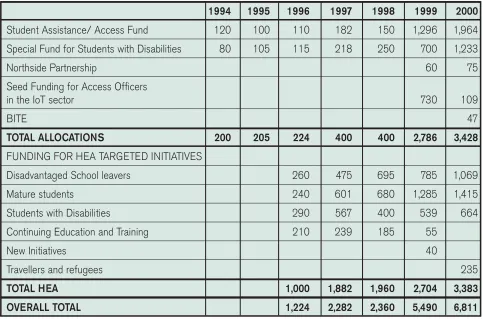
Funding for the Department of Education and Science’s Student Assistance/Access Fund (originally titled the Hardship Fund) has increased from £120,000 in 1994 to £1.8 million in 2000. The Fund is intended to tackle educational disadvantage by providing financial support to disadvantaged students who might otherwise, because of financial reasons, suffer severe hardship or be unable to continue their third-level studies.
The Fund is devolved to the third level institutions. Allocations to individual colleges are based on the total full-time student enrolment in the previous academic year. The Fund is administered locally by the individual colleges. In any particular year all registered students are eligible to apply for assistance.
1.6.2 Special Fund for Students with Disabilities
Funding for the Department of Education and Science’s Special Fund for Students with Disabilities has increased from £700,000 in 1999 to approx. £1.2 million in 2000. Funding is provided towards the cost of services and the purchase of equipment for students with disabilities attending courses in third level institutions or Post Leaving Certificate courses. The Fund applies to students who have serious sensory, physical and/or communicative disabilities. Grants are awarded towards the cost of special equipment, special materials, technological aids, targeted transport services, sign language interpreters and personal assistants.
The Fund is administered centrally by the Department. The Special Fund provided assistance to 314 individual students in the 1999/2000 academic year and to 512 students in 2000/01. Since its introduction in 1994, the Special Fund for Students with Disabilities has operated on a case-by-case basis.
1.6.3 Millennium Partnership Fund for Disadvantage
On 14 September, 2000, the Minister announced a new Millennium Partnership Fund for Disadvantage with a provision of £1 million in 2001. This Fund will be administered by the Department in conjunction with the Area Partnerships. It will build on the experience of the support scheme for students from disadvantaged families operated by the Dublin Northside Partnership which assists students to participate in higher education. The Area Partnerships will be invited to submit proposals.
1.6.4 HEA Targeted Initiatives
Since 1996, the HEA has been allocating funds to universities under the HEA’s targeted initiatives to support institutional initiatives in these areas. Universities are invited each year to apply for funds. The HEA has not, so far, been prescriptive as to the type of initiative that may be put forward, although they must be within the broad strategic guidelines of the White Paper on Education and the Report of the Steering Committee on the Future Development of Higher Education which both made
Disadvantaged School Leavers
Types of initiative supported by the HEA to address access and participation of disadvantaged school leavers include:
● Development of links with second level schools designated as disadvantaged, involving liaison
and outreach work;
● Direct entry arrangements;
● Summer schools and mentoring programmes; ● Co-operation with area-based partnership bodies; ● Parents’ programmes;
● Supervised study; ● Guidance counselling; ● Supplementary tuition; ● Orientation programmes;
● Input to teacher education in relation to combating disadvantage.
Mature Students
Initiatives supported by the HEA for mature students include:
Provision of outreach workers
● Training of adult tutors;
● Development of courses and course materials;
● Orientation programmes for mature students;
● Guidance and counselling support;
● Courses in preparatory skills (study, note-taking, library and computer usage etc);
● Information packs; ● Mentoring;
● Development of on-line materials; ● Promotional materials.
Students with Disabilities
HEA support for students with disabilities is for programmatic initiatives such as:
● The development of flexible assessment mechanisms;
● Devising suitable examination arrangements;
● Provision of assistive technology and services such as brailling; ● Counselling and guidance support;
TABLE 1
ALLOCATIONS PROVIDED BY/THROUGH THE DEPARTMENT OF EDUCATION
AND SCIENCE FOR THE ALLEVIATION OF DISADVANTAGE (£000)
1994 1995 1996 1997 1998 1999 2000
Student Assistance/ Access Fund 120 100 110 182 150 1,296 1,964
Special Fund for Students with Disabilities 80 105 115 218 250 700 1,233
Northside Partnership 60 75
Seed Funding for Access Officers
in the IoT sector 730 109
BITE 47
TOTAL ALLOCATIONS 200 205 224 400 400 2,786 3,428
FUNDING FOR HEA TARGETED INITIATIVES
Disadvantaged School leavers 260 475 695 785 1,069
Mature students 240 601 680 1,285 1,415
Students with Disabilities 290 567 400 539 664
Continuing Education and Training 210 239 185 55
New Initiatives 40
Travellers and refugees 235
TOTAL HEA 1,000 1,882 1,960 2,704 3,383
CHAPTER TWO
STUDENTS FROM SOCIO-ECONOMICALLY
DISADVANTAGED BACKGROUNDS
2.1 Introduction
Socio-economic disadvantage is about more than purely economic poverty: it is also about poverty of horizons or choices. Education is fundamental to the creation of an individual’s life options and, as such, is a major factor in the response to poverty and the risk of poverty.
People are living in poverty if their income and resources (material, cultural and social) are so
inadequate as to preclude them from having a standard of living that is regarded as ‘standard’ by Irish society generally. As a result of inadequate income and resources people may be excluded and marginalised from participating in activities that are considered standard for the majority of the population (ref. Combat Poverty Agency).
‘Poverty’, therefore, is not defined solely in terms of financial resources, but includes reference to the level of social exclusion experienced.
Barriers to access begin at birth and significant progress on increasing participation at third level can be achieved only in the context of the whole range of initiatives in place to tackle the underlying issues of poverty and social marginalisation. Poverty and educational disadvantage are concentrated in
disadvantaged communities. Perhaps the most critical environmental factor impeding educational
attainment and progression is the relatively low levels of educational attainment of the parents and adult relatives of many young disadvantaged people in junior and senior cycle education.
Poor progression rates to third level are a result of a variety of factors; however, there is a strong view that, to a significant extent, they reflect the lack of resources at second level.
In the Economic and Social Research Institute’s (ESRI) Medium Term Review 1999-2005, the authors note
that-“With over 80 per cent of the younger generation having at least a Leaving Certificate, low levels of education will not only make success in the labour market very difficult, they may cut those affected off from the bulk of the population in other ways, culturally and socially. Rising levels of education alters attitudes and tastes directly, as well as indirectly through the rise in incomes. The changing nature of employment is also affecting expectations about lifestyle, leading to more sophisticated tastes. As a result, the types of goods and services consumed will change; for example, dining out and expenditure on leisure activities will become more and more the norm. In such a society social exclusion may be defined differently from today, but that will not make it any the less real.
The opportunity to tackle the underlying structural roots of disadvantage by directing
support early education in a wide variety of settings, provides just one example of the type of initiative required. Finally, there will be a need to ensure that educational standards are further raised through attention to the training and evaluation of teachers.”
In short, improved equity of access opportunity can contribute to breaking the cycle of deprivation.
This chapter deals primarily with disadvantaged students other than mature students.
2.2 Clancy and Wall
Social Background of Higher Education Entrants is the first part of the fourth national survey of entrants to higher education compiled for the HEA by Professor Patrick Clancy and Ms. Joy Wall. This work builds upon the previous studies that were undertaken by Professor Clancy on behalf of the HEA, Participation in Higher Education (1982), Who Goes to College? (1988) and Access to College: Patterns of Continuity and Change (1995). These reports allow us to track the changing social
background of entrants to higher education in Ireland over almost two decades. They paint a picture of society in transition.
The current work is based on new entrants to higher education in Autumn 1998 and provides a comprehensive profile on the social background of entrants. The full report on 1998 entrants will be published in 2001 by the HEA. The work also looks at differential participation and performance in second-level education, updating work undertaken by Professor Clancy in 1995 for the Technical Working Group of the Steering Committee on the Future Development of Higher Education. In so doing, the report takes account of the information arising from surveys carried out in 1996, 1997 and 1998 by the ESRI for the Department of Enterprise, Trade and Employment.
2.2.1 Clancy and Wall Report - Summary of Key Findings
The report measures the progress of students from different social groups in entering higher education. Two indicators used are particularly relevant. The participation rate tracks the progress of different social groups in terms of estimating the proportion of that group entering higher education. The participation ratio tracks the progress of the groups in a relative way against the progress of the other social groups in society.
For the purpose of this report, the Action Group considered that it would focus its attention on the participation rate.
Participation Rate
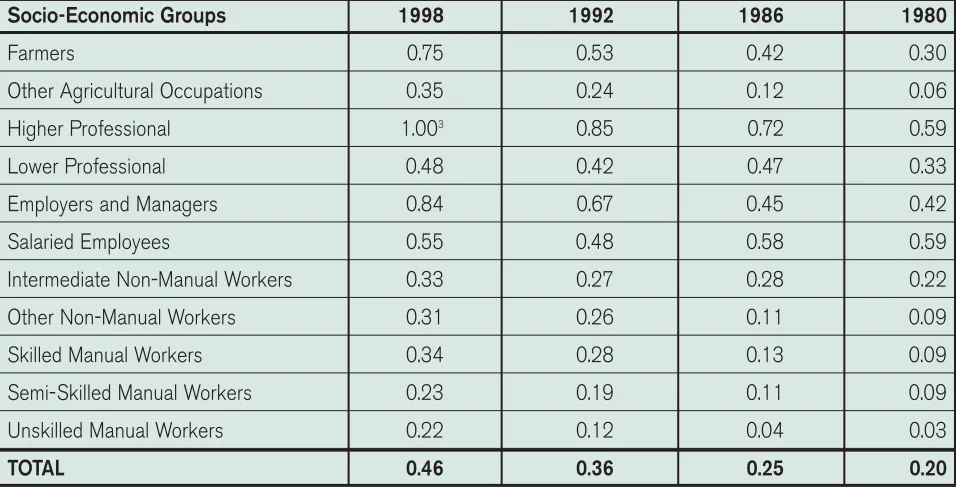
TABLE 2
ESTIMATED PROPORTION OF AGE COHORT ENTERING FULL-TIME HIGHER
EDUCATION BY FATHERS’ SOCIO-ECONOMIC GROUP IN 1980, 1986, 1992 AND
1998
Socio-Economic Groups 1998 1992 1986 1980
Farmers 0.75 0.53 0.42 0.30
Other Agricultural Occupations 0.35 0.24 0.12 0.06
Higher Professional 1.003 0.85 0.72 0.59
Lower Professional 0.48 0.42 0.47 0.33
Employers and Managers 0.84 0.67 0.45 0.42
Salaried Employees 0.55 0.48 0.58 0.59
Intermediate Non-Manual Workers 0.33 0.27 0.28 0.22
Other Non-Manual Workers 0.31 0.26 0.11 0.09
Skilled Manual Workers 0.34 0.28 0.13 0.09
Semi-Skilled Manual Workers 0.23 0.19 0.11 0.09
Unskilled Manual Workers 0.22 0.12 0.04 0.03
TOTAL 0.46 0.36 0.25 0.20
(Source: Table 15, Clancy and Wall, 2000)
The highest proportionate increase has occurred for those social groups which had very low
participation rates in 1980. However it is clear that there are still 6 of the 11 social groups where less than 40% of the relevant population enter higher education. A summary of the position for these social groups is as follows:
● 22% of the children of Unskilled Manual Workers entered higher education in 1998, up from
12% in 1992. This group includes transport porters and labourers;
● For the children of Semi-skilled Manual Workers, 23% entered, up from 19% in 1992. This
group includes office cleaners, laundry workers, textile and clothing workers and packers and bottlers;
● 31% of the children of Other Non-Manual Workers, for example, bus drivers and
postmen/women, entered, up from 26% in 1992;
● In relation to the children of Intermediate Non-Manual Workers, for example, clerks, typists, shop assistants and bar-workers, 33% entered, up from 27% in 1992;
● 34% of the children of Skilled Manual Workers entered, up from 28% in 1992. This group
includes electricians and mechanics;
● For other Agricultural Occupations, including agricultural labourers and foresters, 35%
entered, up from 24% in 1992.
Furthermore, it is clear that there is only a pattern of modest improvement in participation in higher education among two social groups over the period since the second report in 1986 - Lower