Workshop on Hybrid Approaches to Translation:
Overview and Developments
Marta R. Costa-juss`a, Rafael E. Banchs Institute for Infocomm Research1 Patrik Lambert
Barcelona Media3
Kurt Eberle Lingenio GmbH4
Reinhard Rapp Aix-Marseille Universit´e, LIF2
Bogdan Babych University of Leeds5
1{vismrc,rembanchs}@i2r.a-star.edu.sg, 2[email protected], 3[email protected], 4[email protected],
Abstract
A current increasing trend in machine translation is to combine data-driven and rule-based techniques. Such combinations typically involve the hybridization of dif-ferent paradigms such as, for instance, the introduction of linguistic knowledge into statistical paradigms, the incorpora-tion of data-driven components into rule-based paradigms, or the pre- and post-processing of either sort of translation sys-tem outputs. Aiming at bringing together researchers and practitioners from the dif-ferent multidisciplinary areas working in these directions, as well as at creating a brainstorming and discussion venue for Hybrid Translation approaches, the Hy-Tra initiative was born. This paper gives an overview of the Second Workshop on Hybrid Approaches to Translation (HyTra 2013) concerning its motivation, contents and outcomes.
1 Introduction
Machine translation (MT) has continuously been evolving from different perspectives. Early sys-tems were basically dictionary-based. These ap-proaches were further developed to more complex systems based on analysis, transfer and genera-tion. The objective was to climb up (and down) in the well-known Vauquois pyramid (see Figure 1) to facilitate the transfer phase or to even mini-mize the transfer by using an interlingua system. But then, corpus-based approaches irrupted, gen-erating a turning point in the field by putting aside the analysis, generation and transfer phases.
Although there had been such a tendency right from the beginning (Wilks, 1994), in the last
Figure 1: Vauquois pyramid (image from
Wikipedia).
years, the corpus-based approaches have reached a point where many researchers assume that rely-ing exclusively on data might have serious limi-tations. Therefore, research has focused either on syntactical/hierarchical-based methods or on try-ing to augment the popular phrase-based systems by incorporating linguistic knowledge. In addi-tion, and given the fact that research on rule-based has never stopped, there have been several propos-als of hybrid architectures combining both rule-based and data-driven approaches.
In summary, there is currently a clear trend to-wards hybridization, with researchers adding mor-phological, syntactic and semantic knowledge to statistical systems, as well as combining data-driven methods with existing rule-based systems.
In this paper we provide a general overview of current approaches to hybrid MT within the context of the Second Workshop on Hybrid Ap-proaches to Translation (HyTra 2013). In our overview, we classify hybrid MT approaches ac-cording to the linguistic levels that they address. We then briefly summarize the contributions pre-sented and collected in this volume.
The paper is organized as follows. First, we mo-tivate and summarize the main aspects of the Hy-Tra initiative. Then, we present a general overview of the accepted papers and discuss them within the context of other state-of-the-art research in the area. Finally, we present our conclusions and dis-cuss our proposed view of future directions for Hybrid MT research.
2 Overview of the HyTra Initiative
The HyTra initiative started in response to the in-creasing interest in hybrid approaches to machine translation, which is reflected on the substantial amount of work conducted on this topic. An-other important motivation was the observation that, up to now, no single paradigm has been able to successfully solve to a satisfactory extent all of the many challenges that the problem of machine translation poses.
The first HyTra workshop took part in conjunc-tion with the EACL 2012 conference (Costa-juss`a et al., 2012). The Second HyTra Workshop, which was co-organized by the authors of this paper, has been co-located with the ACL 2013 conference (Costa-juss`a et al., 2013). The workshop has been supported by an extensive programme committee comprising members from over 30 organizations and representing more than 20 countries. As the outcome of a comprehensive peer reviewing pro-cess, and based on the recommendations of the programme committee, 15 papers were finally se-lected for either oral or poster presentation at the workshop.
The workshop also had the privilege to be hon-ored by two exceptional keynote speeches:
• Controlled Ascent: Imbuing Statistical MT with Linguistic Knowledgeby Will Lewis and Chris Quirk (2013), Microsoft research. The intersection of rule-based and statistical ap-proaches in MT is explored, with a particular focus on past and current work done at Mi-crosoft Research. One of their motivations for a hybrid approach is the observation that the times are over when huge improvements in translation quality were possible by sim-ply adding more data to statistical systems. The reason is that most of the readily avail-able parallel data has already been found.
• How much hybridity do we have? by Her-mann Ney, RWTH Aachen. It is pointed
out that after about 25 years the statistical approach to MT has been widely accepted as an alternative to the classical approach with manually designed rules. But in prac-tice most statistical MT systems make use of manually designed rules at least for pre-processing in order to improve MT quality. This is exemplified by looking at the RWTH MT systems.
3 Hybrid Approaches Organized by Linguistic Levels
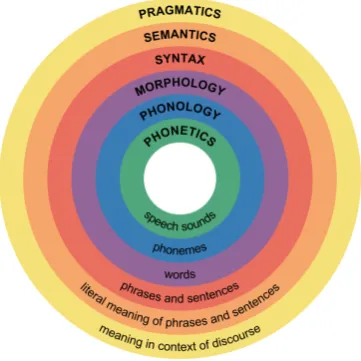
’Hybridization’ of MT can be understood as com-bination of several MT systems (possibly of very different architecture) where the single systems translate in parallel and compete for the best re-sult (which is chosen by the integrating meta sys-tem). The workshop and the papers do not fo-cus on this ’coarse-grained’ hybridization (Eisele et al., 2008), but on a more ’fine grained’ one where the systems mix information from differ-ent levels of linguistic represdiffer-entations (see Fig-ure 2). In the past and mostly in the framework of rule-based machine translation (RBMT) it has been experimented with information from nearly every level including phonetics and phonology for speech recognition and synthesis in speech-to-speech systems (Wahlster, 2000) and includ-ing pragmatics for dialog translation (Batliner et al., 2000a; Batliner et al., 2000b) and text coher-ence phenomena (Le Nagard and Koehn, 2010). With respect to work with emphasis on statisti-cal machine translation (SMT) and derivations of it mainly those information levels have been used that address text in the sense of sets of sentences.
As most of the workshop papers relate to this perspective - i.e. on hybridization which is de-fined using SMT as backbone, in this introduc-tion we can do with distinguishing between ap-proaches focused on morphology, syntax, and se-mantics. There are of course approaches which deal with more than one of these levels in an in-tegrated manner, which are commonly refered to as multilevel approaches. As the case of treat-ing syntax and morphology concurrently is espe-cially common, we also consider morpho-syntax as a separate multilevel approach.
3.1 Morphological approaches
Figure 2: Major linguistic levels (image from Wikipedia).
first one attempts to minimize the vocabulary of highly inflected languages in order to symmetrize the (lexical granularity of the) source and the tar-get language. The second one assumes that, due to data sparseness, not all morphological forms can be learned from parallel corpora and, there-fore, proposes techniques to learn new morpho-logical forms. The last one tries to enrich poorly inflected languages to compensate for their lack of morphology. In HyTra 2013, approaches treating morphology were addressed by the following con-tributions:
• Toral (2013) explores the selection of data to train domain-specific language models (LM) from non-domain specific corpora by means of simplified morphology forms (such as lemmas). The benefit of this technique is tested using automatic metrics in the English-to-Spanish task. Results show an improve-ment of up to 8.17% of perplexity reduction over the baseline system.
• Rios Gonzalez and Goehring (2013) propose machine learning techniques to decide on the correct form of a verb depending on the con-text. Basically they use tree-banks to train the classifiers. Results show that they are able to disambiguate up to 89% of the Quechua verbs.
3.2 Syntactic approaches
Syntax had been addressed originally in SMT in the form of so called phrase-based SMT with-out any reference to linguistic structures; during
the last decade (or more) the approach evolved to or, respectively, was complemented by - work on syntax-based models in the linguistic sense of the word. Most such approaches can be classi-fied into three different types of architecture that are defined by the type of syntactic analysis used for the source language and the type of generation aimed at for the target language: to-tree, tree-to-string and string-to-tree. Additionally, there are also the so called hierarchical systems, which combine the phrase-based and syntax-based ap-proaches by using phrases as translation-units and automatically generated context free grammars as rules. Approaches dealing with the syntactic ap-proach in HyTra 2013 include the following pa-pers:
• Green and Zabokrtsk´y (2013) study three dif-ferent ways to ensemble parsing techniques and provide results in MT. They compute cor-relations between parsing quality and transla-tion quality, showing that NIST is more cor-related than BLEU.
• Han et al. (2013) provide a framework for pre-reordering to make Chinese word order more similar to Japanese. To this purpose, they use unlabelled dependency structures of sentences and POS tags to identify verbal blocks and move them from after-the-object positions (SVO) to before-the-object posi-tions (SOV).
• Nath Patel et al. (2013) also propose a pre-reordering technique, which uses a limited set of rules based on parse-tree modification rules and manual revision. The set of rules is specifically listed in detail.
• Saers et al. (2013) report an unsupervised learning model that induces phrasal ITGs by breaking rules into smaller ones using mini-mum description length. The resulting trans-lation model provides a basis for generaliza-tion to more abstract transducgeneraliza-tion grammars with informative non-terminals.
3.3 Morphosyntactical approaches
[image:3.595.91.272.64.245.2]• Laki et al. (2013) combine pre-reordering rules with morphological and factored mod-els for English-to-Turkish.
• Li et al. (2013) propose pre-reordering rules to be used for alignment-based reordering, and corresponding POS-based restructuring of the input. Basically, they focus on tak-ing advantage of the fact that Korean has compound words, which - for the purpose of alignment - are split and reordered similarly to Chinese.
• Turki Khemakhem et al. (2013) present work about an English-Arabic SMT sys-tem that uses morphological decomposition and morpho-syntactic annotation of the target language and incorporates the correspond-ing information in a statistical feature model. Essentially, the statistical feature language model replaces words by feature arrays.
3.4 Semantic approaches
The introduction of semantics in statistical MT has been approached to solve word sense disambigua-tion challenges covering the area of lexical seman-tics and, more recently, there have been different techniques using semantic roles covering shallow semantics, as well as the use of distributional se-mantics for improving translation unit selection. Approaches treating the incorporation of seman-tics into MT in HyTra 2013 include the following research work:
• Rudnick et al. (2013) present a combina-tion of Maximum Entropy Markov Models and HMM to perform lexical selection in the sense of cross-lingual word sense disam-biguation (i.e. by choice from the set of trans-lation alternatives). The system is meant to be integrated into a RBMT system.
• Boujelbane (2013) proposes to build a bilin-gual lexicon for the Tunisian dialect us-ing modern standard Arabic (MSA). The methodology is based on leveraging the large available annotated MSA resources by ex-ploiting MSA-dialect similarities and ad-dressing the known differences. The author studies morphological, syntactic and lexical differences by exploiting Penn Arabic Tree-bank, and uses the differences to develop rules and to build dialectal concepts.
• Bouillon et al. (2013) presents two method-ologies to correct homophone confusions. The first one is based on hand-coded rules and the second one is based on weighted graphs derived from a pronunciation re-source.
3.5 Other multilevel approaches
In a number of linguistic theories information from the morphological, syntactic and semantic level is considered conjointly and merged in cor-responding representations (a RBMT example is LFG (Lexical Functional Grammars) analysis and the corresponding XLE translation architecture). In HyTra 2013 there are three approaches dealing with multilevel information:
• Pal et al. (2013) propose a combination of aligners: GIZA++, Berkeley and rule-based for English-Bengali.
• Hsieh et al. (2013) use comparable corpora extracted from Wikipedia to extract parallel fragments for the purpose of extending an English-Bengali training corpus.
• Tambouratzis et al. (2013) describe a hybrid MT architecture that uses very few bilingual corpus and a large monolingual one. The linguistic information is extracted using pattern recognition techniques.
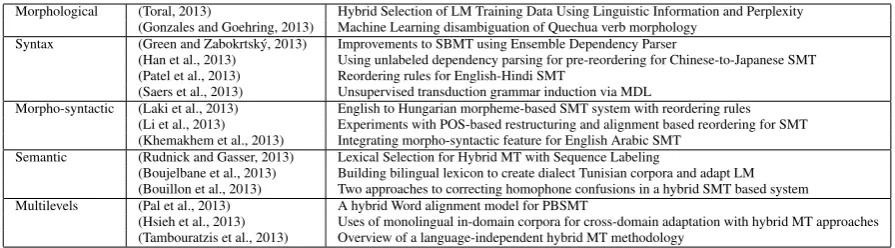
Table 1 summarizes the papers that have been presented in the Second HyTra Workshop. The papers are arranged into the table according to the linguistic level they address.
4 Conclusions and further work
The success of the Second HyTra Workshop con-firms that research in hybrid approaches to MT systems is a very active and promising area. The MT community seems to agree that pure data-driven or rule-based paradigms have strong lim-itations and that hybrid systems are a promising direction to overcome most of these limitations. Considerable progress has been made in this area recently, as demonstrated by consistent improve-ments for different language pairs and translation tasks.
Morphological (Toral, 2013) Hybrid Selection of LM Training Data Using Linguistic Information and Perplexity (Gonzales and Goehring, 2013) Machine Learning disambiguation of Quechua verb morphology
Syntax (Green and Zabokrtsk´y, 2013) Improvements to SBMT using Ensemble Dependency Parser
(Han et al., 2013) Using unlabeled dependency parsing for pre-reordering for Chinese-to-Japanese SMT (Patel et al., 2013) Reordering rules for English-Hindi SMT
(Saers et al., 2013) Unsupervised transduction grammar induction via MDL
Morpho-syntactic (Laki et al., 2013) English to Hungarian morpheme-based SMT system with reordering rules (Li et al., 2013) Experiments with POS-based restructuring and alignment based reordering for SMT (Khemakhem et al., 2013) Integrating morpho-syntactic feature for English Arabic SMT
Semantic (Rudnick and Gasser, 2013) Lexical Selection for Hybrid MT with Sequence Labeling
(Boujelbane et al., 2013) Building bilingual lexicon to create dialect Tunisian corpora and adapt LM (Bouillon et al., 2013) Two approaches to correcting homophone confusions in a hybrid SMT based system Multilevels (Pal et al., 2013) A hybrid Word alignment model for PBSMT
[image:5.595.75.523.61.185.2](Hsieh et al., 2013) Uses of monolingual in-domain corpora for cross-domain adaptation with hybrid MT approaches (Tambouratzis et al., 2013) Overview of a language-independent hybrid MT methodology
Table 1: HyTra 2013 paper overview.
whether technological breakthroughs as in the past are still possible are still possible, or if MT will be turning into a research field with only incremen-tal advances. The question is: have we reached the point at which only refinements to existing ap-proaches are needed? Or, on the contrary, do we need a new turning point?
Our guess is that, similar to the inflection point giving rise to the statistical MT approach during the last decade of the twentieth century, once again there might occur a new discovery which will rev-olutionize further the research on MT. We cannot know whether hybrid approaches will be involved; but, in any case, this seems to be a good and smart direction as it is open to the full spectrum of ideas and, thus, it should help to push the field forward.
Acknowledgments
This workshop has been supported by the Sev-enth Framework Program of the European Com-mission through the Marie Curie actions HyghTra, IMTraP, AutoWordNet and CrossLingMind and the Spanish “Ministerio de Econom´ıa y Competi-tividad” and the European Regional Development Fund through SpeechTech4all. We would like to thank the funding institution and all people who contributed towards making the workshop a suc-cess. For a more comprehensive list of acknowl-edgments refer to the preface of this volume.
References
Anton Batliner, J. Buckow, Heinrich Niemann, Elmar N¨oth, and Volker Warnke, 2000a. The Prosody Module, pages 106–121. New York, Berlin.
Anton Batliner, Richard Huber, Heinrich Niemann, El-mar N¨oth, J¨org Spilker, and K. Fischer, 2000b. The Recognition of Emotion, pages 122–130. New York, Berlin.
Pierrette Bouillon, Johanna Gerlach, Ulrich Germann, Barry Haddow, and Manny Rayner. 2013. Two ap-proaches to correcting homophone confusions in a hybrid machine translation system. In ACL Work-shop on Hybrid Machine Approaches to Translation, Sofia.
Rahma Boujelbane, Mariem Ellouze khemekhem, Si-war BenAyed, and Lamia HadrichBelguith. 2013. Building bilingual lexicon to create dialect tunisian corpora and adapt language model. InACL Work-shop on Hybrid Machine Approaches to Translation, Sofia.
Marta R. Costa-juss`a, Patrik Lambert, Rafael E. Banchs, Reinhard Rapp, and Bogdan Babych, edi-tors. 2012. Proceedings of the Joint Workshop on Exploiting Synergies between Information Retrieval and Machine Translation (ESIRMT) and Hybrid Ap-proaches to Machine Translation (HyTra). As-sociation for Computational Linguistics, Avignon, France, April.
Marta R. Costa-juss`a, Patrik Lambert, Rafael E. Banchs, Reinhard Rapp, Bogdan Babych, and Kurl Eberle, editors. 2013. Proceedings of the Sec-ond Workshop on Hybrid Approaches to Translation (HyTra). Association for Computational Linguis-tics, Sofia, Bulgaria, August.
Andreas Eisele, Christian Federmann, Hans Uszkoreit, Herv´e Saint-Amand, Martin Kay, Michael Jelling-haus, Sabine Hunsicker, Teresa Herrmann, and Yu Chen. 2008. Hybrid machine translation archi-tectures within and beyond the euromatrix project. In John Hutchins and Walther v.Hahn, editors,12th annual conference of the European Association for Machine Translation (EAMT), pages 27–34, Ham-burg, Germany.
Annette Rios Gonzales and Anne Goehring. 2013. Machine learning disambiguation of quechua verb morphology. InACL Workshop on Hybrid Machine Approaches to Translation, Sofia.
Dan Han, Pascual Martinez-Gomez, Yusuke Miyao, Katsuhito Sudoh, and Masaaki NAGATA. 2013. Using unlabeled dependency parsing for pre-reordering for chinese-to-japanese statistical ma-chine translation. InACL Workshop on Hybrid Ma-chine Approaches to Translation, Sofia.
An-Chang Hsieh, Hen-Hsen Huang, and Hsin-Hsi Chen. 2013. Uses of monolingual in-domain cor-pora for cross-domain adaptation with hybrid mt ap-proaches. InACL Workshop on Hybrid Machine Ap-proaches to Translation, Sofia.
Ines Turki Khemakhem, Salma Jamoussi, and Abdel-majid Ben Hamadou. 2013. Integrating morpho-syntactic feature in english-arabic statistical ma-chine translation. InACL Workshop on Hybrid Ma-chine Approaches to Translation, Sofia.
L´aszl´o Laki, Attila Novak, and Borb´ala Sikl´osi. 2013. English to hungarian morpheme-based statistical machine translation system with reordering rules. In
ACL Workshop on Hybrid Machine Approaches to Translation, Sofia.
Ronan Le Nagard and Philipp Koehn. 2010. Aiding pronoun translation with co-reference resolution. In
Proceedings of the Joint Fifth Workshop on Statisti-cal Machine Translation and MetricsMATR, pages 252–261, Uppsala, Sweden, July. Association for Computational Linguistics.
Will Lewis and Chris Quirk. 2013. Controlled ascent: Imbuing statistical mt with linguistic knowledge. In
ACL Workshop on Hybrid Machine Approaches to Translation, Sofia.
Shuo Li, Derek F. Wong, and Lidia S. Chao. 2013. Experiments with pos-based restructuring and alignment-based reordering for statistical machine translation. In ACL Workshop on Hybrid Machine Approaches to Translation, Sofia.
Santanu Pal, Sudip Naskar, and Sivaji Bandyopadhyay. 2013. A hybrid word alignment model for phrase-based statistical machine translation. InACL Work-shop on Hybrid Machine Approaches to Translation, Sofia.
Raj Nath Patel, Rohit Gupta, Prakash B. Pimpale, and Sasikumar M. 2013. Reordering rules for english-hindi smt. In ACL Workshop on Hybrid Machine Approaches to Translation, Sofia.
Alex Rudnick and Michael Gasser. 2013. Lexical se-lection for hybrid mt with sequence labeling. InACL Workshop on Hybrid Machine Approaches to Trans-lation, Sofia.
Markus Saers, Karteek Addanki, and Dekai Wu. 2013. Unsupervised transduction grammar induction via minimum description length. InACL Workshop on Hybrid Machine Approaches to Translation, Sofia. George Tambouratzis, Sokratis Sofianopoulos, and
Marina Vassiliou. 2013. Language-independent hy-brid mt with presemt. InACL Workshop on Hybrid Machine Approaches to Translation, Sofia.
Antonio Toral. 2013. Hybrid selection of language model training data using linguistic information and perplexity. In ACL Workshop on Hybrid Machine Approaches to Translation, Sofia.
Wolfgang Wahlster, editor. 2000. Verbmobil: Foun-dations of Speech-to-Speech Translation. Springer, Berlin, Heidelberg, New York.