RA-SR: Using a ranking algorithm to automatically building resources
for subjectivity analysis over annotated corpora
Yoan Gutiérrez, Andy González
University of Matanzas, Cuba
[email protected], [email protected]
Antonio Fernández Orquín, Andrés Montoyo, Rafael Muñoz
University of Alicante, Spain
[email protected], {montoyo, rafael}@dlsi.ua.es
Abstract
In this paper we propose a method that uses corpora where phrases are annotated as Positive, Negative, Objective and Neutral, to achieve new sentiment resources involving words dictionaries with their associated polarity. Our method was created to build sentiment words inventories based on senti-semantic evidences obtained after exploring text with annotated sentiment polarity information. Through this process a graph-based algorithm is used to obtain auto-balanced values that characterize sentiment polarities well used on Sentiment Analysis tasks. To assessment effectiveness of the obtained resource, sentiment classification was made, achieving objective instances over 80%.
1 Introduction
In recent years, textual information has become one of the most important sources of knowledge to extract useful data. Texts can provide factual information, such as: descriptions, lists of characteristics, or even instructions to opinion-based information, which would include reviews, emotions or feelings. These facts have motivated dealing with the identification and extraction of opinions and sentiments in texts that require special attention. Among most widely used terms in Natural Language Processing, in concrete in Sentiment Analysis (SA) and Opinion Mining, is the subjectivity term proposed by (Wiebe, 1994). This author defines it as “linguistic expression of somebody’s opinions, sentiments, emotions, evaluations, beliefs and speculations”. Another important aspect opposed to subjectivity is the objectivity, which constitute a fact expression (Balahur, 2011). Other interesting terms also proposed by (Wiebe et al., 2005) considers, private state, theses terms involve opinions,
beliefs, thoughts, feelings, emotions, goals, evaluations and judgments.
Many researchers such as (Balahur et al., 2010; Hatzivassiloglou et al., 2000; Kim and Hovy, 2006; Wiebe et al., 2005) and many others have been working in this way and related areas. To build systems able to lead SA challenges it is necessary to achieve sentiment resources previously developed. These resources could be annotated corpora, affective semantic structures, and sentiment dictionaries.
In this paper we propose a method that uses annotated corpora where phrases are annotated as Positive, Negative, Objective and Neutral, to achieve new resources for subjectivity analysis involving words dictionaries with their associated polarity.
The next section shows different sentiment and affective resources and their main characteristics. After that, our proposal is developed in section 3. Section 4, present a new sentiment resource obtained after evaluating RA-SR over many corpora. Section 5 described the evaluation and analysis of the obtained resource, and also an assessment of the obtained resource in Sentiment Classification task. Finally, conclusion and further works are presented in section 6.
2 Related work
It is known that the use of sentiment resources has proven to be a necessary step for training and evaluation for systems implementing sentiment analysis, including also fine-grained opinion mining (Balahur, 2011).
Different techniques have been used into product reviews to obtain lexicons of subjective words with their associated polarity. We can study the relevant research promoted by (Hu and Liu, 2004) which start with a set of seed adjectives (“good” and “bad”) and reinforce the semantic knowledge applying a expanding the lexicon with synonymy and antonymy relations provided by WordNet (Miller et al., 1990). As result of Hu and Liu researches an Opinion Lexicon is obtained with around 6800 positive
and negative English words (Hu and Liu, 2004; Liu et al., 2005).
A similar approach has been used in building WordNet-Affect (Strapparava and Valitutti, 2004). In this case the building method starting from a larger of seed affective words set. These words are classified according to the six basic categories of emotion (joy, sadness, fear, surprise, anger and disgust), are also expanded increase the lexicon using paths in WordNet.
Other widely used in SA has been SentiWordNet resource (Esuli and Sebastiani, 2006)). The main idea that encouraged its construction has been that “terms with similar glosses in WordNet tend to have similar polarity”.
Another popular lexicon is MicroWNOp (Cerini et al., 2007). It contains opinion words with their associated polarity. It has been built on the basis of a set of terms extracted from the General Inquirer1 (Stone et al., 1996).
The problem is that these resources do not consider the context in which the words appear. Some methods tried to overcome this critique and built sentiment lexicons using the local context of words.
We can mentioned to (Pang et al., 2002) whom built a lexicon with associated polarity value, starting with a set of classified seed adjectives and using conjunctions (“and”) disjunctions (“or”, “but”) to deduce orientation of new words in a corpus.
(Turney, 2002) classifies words according to their polarity based on the idea that terms with similar orientation tend to co-occur in documents.
On the contrary in (Balahur and Montoyo, 2008b), is computed the polarity of new words using “polarity anchors” (words whose polarity is known beforehand) and Normalized Google Distance (Cilibrasi and Vitányi, 2007) scores using as training examples opinion words extracted from “pros and cons reviews” from the same domain. This research achieved the lexical resource Emotion Triggers (Balahur and Montoyo, 2008a).
Another approach that uses the polarity of the local context for computing word polarity is the one presented by (Popescu and Etzioni, 2005), who use a weighting function of the words around the context to be classified.
All described resources have been obtained manually or semi-automatically. Therefore, we
1
http://www.wjh.harvard.edu/~inquirer/
focus our target in archiving automatically new sentiment resources supported over some of aforementioned resources. In particular, we will offer contributions related with methods to build sentiment lexicons using the local context of words.
3 Our method
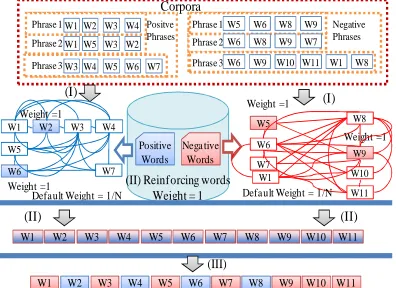
We propose a method named RA-SR (using Ranking Algorithms to build Sentiment Resources) to build sentiment words inventories based on senti-semantic evidences obtained after exploring text with annotated sentiment polarity information. Through this process a graph-based algorithm is used to obtain auto-balanced values that characterize sentiment polarities widely used on Sentiment Analysis tasks. This method consists of three main stages: (I) Building contextual words graphs; (II) Applying ranking algorithm; and (III) Adjusting sentiment polarity
[image:2.612.313.511.308.452.2]values.
Figure 1. Resource walkthrough development process.
These stages are represented in the diagram of Figure 1, where the development process begins introducing two corpuses of annotated sentences with positive and negative sentences respectively. Initially, a preprocessing of the text is made applying Freeling pos-tagger (Atserias et
al., 2006) version 2.2 to convert all words to
lemmas2. After that, all lemmas lists obtained are introduced in RA-SR, divided in two groups (i.e. positive and negative candidates, and
).
3.1 Building contextual words graphs
Giving two sets of sentences ( and ) annotated as positive and negative respectively,
where = [ , … , ] and =
[ , … , ] contains list involving words lemmatized by Freeling 2.2 Pos-Tagger
2 Lemma denotes canonic form of the words.
Corpora
Phrase 3 Phrase 2
W1 W2 W3 W4 W5 W3 W2
W3 W4 W5 W6 W1
W7 Phrase 1 Positve
Phrases
W5 W6 W8 W9 W8 W9 W7
W6 W9 W10 W11 W6
W1 W8 Negative Phrases
Phrase 3 Phrase 2 Phrase 1
Positive Words
Nega tive Words
W1 W2 W3 W4
W5
W6 W7
W5
W6
W7
W8
W9
W10
W11
(I)
(II) Reinforcing words Weight = 1
(II) (II)
(I)
Weight =1
Weight =1 Weight =1
Weight =1
W1 W2 W3 W4 W5 W6 W7 W8 W9 W10 W11
W1 W2 W3 W4 W5 W6 W7 W8 W9 W10 W11
(III)
W1
(Atserias et al., 2006), a process to build two lexical contextual graphs, and is applied. Those sentences are manually annotated as positive and negative respectively. These graphs involve lemmas from the positive and negative sentences respectively.
A contextual graph is defined as an undirected graph = ( , ), where denotes the set of vertices and the set of edges. Given the list = [1 … ] a lemma graph is created establishing links among all lemmas of each sentence, where words involved allow to interconnect sentences in . As a result
word/lemma networks and are
obtained, where = = [ … ] and for every edge ( , !)∈ being , !∈ . Therefore,
and " are the same.
Then, having two graphs, we proceed to initialize weight to apply graph-based ranking techniques in order to auto-balance the particular importance of each " into and .
3.2 Applying ranking algorithm
To apply a graph-based ranking process, it is necessary to assign weights to the vertices of the graph. Words involved into and take the default value 1/N as their weight to define the weight of " vector, which is used in our proposed ranking algorithm. In the case where words are identified on the sentiment repositories (see Table 2) as positive or negative, in relation to their respective graph, a weight value of 1 (in a range[0 … 1]) is assigned. represents the maximum quantity of words in the current graph. Thereafter, a graph-based ranking algorithm is applied in order to structurally raise the graph vertexes’ voting power. Once the reinforcement values are applied, the proposed ranking algorithm is able to increase the significance of the words related to these empowered vertices.
The PageRank (Brin and Page, 1998) adaptation, which was popularized by (Agirre and Soroa, 2009) in Word Sense Disambiguation thematic, and the one that has obtained relevant results, was an inspiration to us in this work. The main idea behind this algorithm is that, for each edge between "i and "j in graph , a vote is made
from "i to "j. As a result, the relevance of "j is
increased.
On top of that, the vote strength from & to ' depends on " ′ relevance. The philosophy behind it is that, the more important the vertex is, the more strength the voter would have. Thus, PageRank is generated by applying a random walkthrough from the internal interconnection of
, where the final relevance of " represents the random walkthrough probability over , and ending on " .
In our system, we apply the following equation and configuration:
)* = +,)* + (1 − +)" (1)
Where: , is a probabilistic transition matrix × , being ,!, =
/0 if a link from "i to "j exist, in other case zero is assigned; " is a vector
× 1 with values previously described in this section; )* is the probabilistic structural vector obtained after a random walkthrough to arrive to any vertex; + is a dumping factor with value 0.85, and like in (Agirre and Soroa, 2009) we used 30 iterations.
A detailed explanation about the PageRank algorithm can be found in (Agirre and Soroa, 2009).
After applying PageRank, in order to obtain standardized values for both graphs, we normalize the rank values by applying the following equation:
)*&= )*&/,12()*) (2)
Where ,12()*) obtains the maximum rank value of 34 vector.
3.3 Adjusting sentiment polarity values
After applying the PageRank algorithm on and , and having normalized their ranks, we proceed to obtain a final list of lemmas (named 5) while avoiding repeated elements.
5 is represented by 5 lemmas, which would have, at that time, two assigned values: Positive, and Negative, which correspond to a calculated rank obtained by the PageRank algorithm.
At that point, for each lemma from 5, the following equations are applied in order to select the definitive subjectivity polarity for each one:
6 = 76 −0 ; :ℎ <=& ; 6 > > (3)
= 7 0 ; :ℎ <=&− 6 ; > 6 > (4)
Where 6 is the Positive value and the Negative value related to each lemma in 5.
In order to standardize the 6 and values again and making them more representative in a [0…1] scale, we proceed to apply a normalization process over the 6 and values.
proceeding, where ?@' represent the objective value.
?@' = 1 − |6 − | (5)
4 Sentiment Resource obtained
At the same time we have obtained a 5 where each word is represented by 6 , and ?@' values, acquired automatically from annotated sentiment corpora. With our proposal we have been able to discover new sentiment words in concordance of contexts in which the words appear. Note that the new obtained resource involves all lemmas identified into the annotated corpora. 6 , , and ?@' are nominal values between range [0 … 1].
5 Evaluation
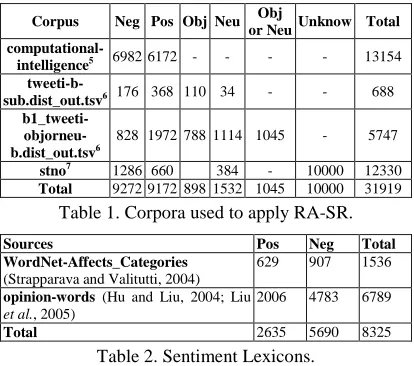
In the construction of the sentiment resource we used the annotated sentences provided from corpora described on Table 1. Note that we only used the sentences annotated positively and negatively. The resources involved into this table were a selection made to prove the functionality of the words annotation proposal of subjectivity and objectivity.
The sentiment lexicons used were provided from WordNetAffect_Categories3and opinion-words4 files and shown in detail in Table 2.
Corpus Neg Pos Obj Neu Obj
or Neu Unknow Total
computational-intelligence5 6982 6172 - - - - 13154
tweeti-b-sub.dist_out.tsv6 176 368 110 34 - - 688
b1_tweeti- objorneu-b.dist_out.tsv6
828 1972 788 1114 1045 - 5747
stno7
[image:4.612.88.295.390.573.2]1286 660 384 - 10000 12330 Total 9272 9172 898 1532 1045 10000 31919
Table 1. Corpora used to apply RA-SR.
Sources Pos Neg Total WordNet-Affects_Categories
(Strapparava and Valitutti, 2004)
629 907 1536
opinion-words (Hu and Liu, 2004; Liu
et al., 2005)
2006 4783 6789
Total 2635 5690 8325
Table 2. Sentiment Lexicons.
Some issues were taking into account through this process. For example, after obtaining a
3 http://wndomains.fbk.eu/wnaffect.html
4 http://www.cs.uic.edu/~liub/FBS/sentiment-analysis.html 5 A sentimental corpus obtained applying techniques
developed by GPLSI department. See (http://gplsi.dlsi.ua.es/gplsi11/allresourcespanel)
6 Train dataset of Semeval-2013 (Task 2. Sentiment
Analysis in Twitter, subtask b.)
7 Test dataset of NTCIR Multilingual Opinion Analysis
Task (MOAT) http://research.nii.ac.jp/ntcir/ntcir-ws8/meeting/
contextual graph factotum words are present in mostly of the involved sentences (i.e. verb “to
be”). This aspect is very dangerous after
applying PageRank algorithm, because this algorithm because this algorithm strengthens the nodes possessing many linked elements. For that reason, the subtractions 6 − and −
6 are applied, where the most frequently words in all contexts obtains high values and being the subtraction a damping factor.
Following an example; when we take the verb “to be”, before applying equation (2), verb “to
be” archives the highest values into each context
graph ( and ), 9.94 and 18.67 rank values respectively. These values, applying equation (2), are normalized obtaining both
6 = 1 and = 1 in a range [0...1]. Finally, when the next steps are executed (Equations (3) and (4)) verb “to be”
achieves 6 = 0 , = 0 and
therefore ?@' = 1. Through this example it seems as we subjectively discarded words that appear frequently in both contexts (Positive and Negative contexts).
Using the corpora from Table 1 we obtain 25792 sentimentally annotated lemmas with 6 , and ?@' features. Of them 12420 positive and 11999 negative lemmas were discovered, , and 1373 words already derived from existing lexical resources.
Another contribution has been the 6 , and ?@' scores assigned to words of lexical inventory, which were used to reinforce the contextual graphs in the building process. Those words in concordance to our scenario count 842 Positives and 383 Negatives.
5.1 Sentiment Resource Applied on Sentiment Analysis
To know if our method offers resources that improve the SA state of the art, we propose a
baseline supported on the sentiment dictionaries,
and other method (Ranking Sentiment Resource (RSR)) supported over our obtained resource. The baseline consists on analyzing sentences applying Equation (6) and Equation (7).
6 , 1 B< =D <EC B : 6 C B : (6)
, 1 B< =D <EC B : C B : (7)
in the sentence; D <EC B : is the total of words in the sentence.
Using these measures over the analyzed sentences, for each sentence, we obtain two attributes, 6 , 1 B< and , 1 B< ; and a third attribute (named Classification) corresponding to its classification.
On the other hand, we propose RSR. This SA method uses in a different way the Equation (6) and Equation (7), and introduces Equation (8).
?@', 1 B< =D <EC B : ?@'C B : (8)
Being 6 C B : the sum of Positive ranking values of the sentence words, aligned with the obtained resource ( 5); C B : the sum of Negative ranking values of the sentence words, aligned with the obtained resource ( 5); and
?@'C B : the sum of Objective ranking values of the sentence words, aligned with the obtained resource ( 5).
In RSR method we proved with two approach, RSR (1/di) and RSR (1-(1/di)). The first approach is based on a resource developed using PageRank with ,!, = 1/E and the other approach is using ,!, = 1 − (1/E ). Table 3 shows experimentation results.
The evaluation has been applied over a corpus provided by “Task 2. Sentiment Analysis in Twitter, subtask b”, in particular tweeti-b-sub.dist_out.tsv file. This corpus contains 597 annotated phrases, of them Positives (314), Negatives (155), Objectives (98) or Neutrals (30). For our understanding this quantity of instances offers a representative perception of RA-SR contribution; however we will think to evaluate RA-SR over other corpora in further researches.
C I R. Pos (%)
R. Neg (%)
R. Obj (%)
R. Neu (%)
Total P. (%)
Total R. (%) Baseline 366 231 91.1 51.6 0.0 0.0 48.2 61.3 RSR(1/di) 416 181 87.3 39.4 80.6 6.7% 67.8 69.7
RSR(1-(1/di) 469 128 88.5 70.3 81.6 6.7% 76.8 78.6 Table 3. Logistic function (Cross-validation 10 folds) over tweeti-b-sub.dist_out.tsv8 corpus (597 instances).
Recall (R), Precision (P), Correct (C), Incorrect (I).
As we can see the baseline only is able to dealing with negative and positive instances. Is important to remark that our proposal starting up knowing only the words used in baseline and is able to growing sentiment information to other words related to them. We can see this fact on
8 Semeval-2013 (Task 2. Sentiment Analysis in Twitter,
subtask b.)
Table 3, RSR is able to classify objective instances over 80% of Recall and the baseline does not.
Other relevant element is the recall difference between RSR (1/di) and RSR (1 − (1/E ) . Traditionally (1/E ) result value has been assigned to , in PageRank algorithm. We have demonstrated that in lexical contexts RSR (1-(1/di)) approach offers a better performance of PageRank algorithm, showing recall differences around 10 perceptual points.
6 Conclusion and further works
As a conclusion we can say that our proposal is able to automatically increase sentiment information, obtaining 25792 sentimentally annotated lemmas with 6 , and ?@' features. Of them 12420 positive and 11999 negative lemmas were discovered.
In other hand, The RSR is capable to classify objective instances over 80% and negatives over 70%. We cannot tackle efficiently neutral instances, perhaps it is due to the lack of neutral information in the sentiment resource we used. Also, it could be due to the low quantity of neutral instances in the evaluated corpus.
In further research we will evaluate RA-SR over different corpora, and we are also going to deal with the number of neutral instances.
The variant RSR(1 − (1/E ) performs better than RSR(1/E ) one. This demonstrates that in lexical contexts using PageRank with ,!, = 1 −
(1/E ) offers a better performance. Other further work consists in exploring Social Medias to expand our retrieved sentiment resource obtaining real time evidences that occur in Web 2.0.
Acknowledgments
This research work has been partially funded by the Spanish Government through the project TEXT-MESS 2.0 (TIN2009-13391-C04), "Análisis de Tendencias Mediante Técnicas de Opinión Semántica" (TIN2012-38536-C03-03) and “Técnicas de Deconstrucción en la Tecnologías del Lenguaje Humano” (TIN2012-31224); and by the Valencian Government
through the project PROMETEO
(PROMETEO/2009/199).
References
Association for Computational Linguistics (EACL-2009), Athens, Greece, 2009. p.
Atserias, J.; B. Casas; E. Comelles; M. González; L. Padró and M. Padró. FreeLing 1.3: Syntactic and semantic services in an opensource NLP library. Proceedings of LREC'06, Genoa, Italy, 2006. p.
Baccianella, S.; A. Esuli and F. Sebastiani. SENTIWORDNET 3.0: An Enhanced Lexical Resource for Sentiment Analysis and Opinion Mining. 7th Language Resources and Evaluation Conference, Valletta, MALTA., 2010. 2200-2204 p.
Balahur, A. Methods and Resources for Sentiment Analysis in Multilingual Documents of Different Text Types. Department of Software and Computing Systems. Alacant, Univeristy of Alacant, 2011. 299. p.
Balahur, A.; E. Boldrini; A. Montoyo and P. Martinez-Barco. The OpAL System at NTCIR 8 MOAT. Proceedings of NTCIR-8 Workshop Meeting, Tokyo, Japan., 2010. 241-245 p.
Balahur, A. and A. Montoyo. Applying a culture dependent emotion trigger database for text valence and emotion classification. Procesamiento del Lenguaje Natural, 2008a. p.
Balahur, A. and A. Montoyo. Building a
recommender system using community level social filtering. 5th International Workshop on Natural Language and Cognitive Science (NLPCS), 2008b. 32-41 p.
Brin, S. and L. Page The anatomy of a large-scale hypertextual Web search engine Computer Networks and ISDN Systems, 1998, 30(1-7): 107-117.
Cerini, S.; V. Compagnoni; A. Demontis; M. Formentelli and G. Gandini Language resources and linguistic theory: Typology, second language acquisition, English linguistics (Forthcoming), chapter Micro-WNOp: A gold standard for the evaluation of automatically compiled lexical resources for opinion mining., 2007.
Cilibrasi, R. L. and P. M. B. Vitányi The Google Similarity Distance IEEE TRANSACTIONS ON KNOWLEDGE AND DATA ENGINEERING, 2007, VOL. 19, NO 3.
Esuli, A. and F. Sebastiani. SentiWordNet: A Publicly Available Lexical Resource for Opinion Mining.
Fifth international conference on Languaje
Resources and Evaluation Genoa - ITaly., 2006. 417-422 p.
Hatzivassiloglou; Vasileios and J. Wiebe. Effects of Adjective Orientation and Gradability on Sentence
Subjectivity. International Conference on
Computational Linguistics (COLING-2000), 2000. p.
Hu, M. and B. Liu. Mining and Summarizing Customer Reviews. Proceedings of the ACM SIGKDD International Conference on Knowledge Discovery and Data Mining (KDD-2004), USA, 2004. p.
Kim, S.-M. and E. Hovy. Extracting Opinions, Opinion Holders, and Topics Expressed in Online News Media Text. In Proceedings of workshop on sentiment and subjectivity in text at proceedings of the 21st international conference on computational linguistics/the 44th annual meeting of the
association for computational linguistics
(COLING/ACL 2006), Sydney, Australia, 2006. 1-8 p.
Liu, B.; M. Hu and J. Cheng. Opinion Observer: Analyzing and Comparing Opinions on the Web. Proceedings of the 14th International World Wide Web conference (WWW-2005), Japan, 2005. p.
Miller, G. A.; R. Beckwith; C. Fellbaum; D. Gross and K. Miller Introduction to WordNet: An On-line
Lexical Database International Journal of
Lexicography, 3(4):235-244., 1990.
Pang, B.; L. Lee and S. Vaithyanathan. Thumbs up? Sentiment Classification using machine learning techniquies. EMNLP -02, the Conference on
Empirical Methods in Natural Language
Processing, USA, 2002. 79-86 p.
Popescu, A. M. and O. Etzioni. Extracting product features and opinions from reviews. Proccedings of HLT-EMNLP, Canada, 2005. p.
Stone, P.; D. C.Dumphy; M. S. Smith and D. M. Ogilvie The General Inquirer: A Computer Approach to Content Analysis The MIT Press, 1996.
Strapparava, C. and A. Valitutti. WordNet-Affect: an affective extension of WordNet. Proceedings of the
4th International Conference on Language
Resources and Evaluation (LREC 2004), Lisbon, 2004. 1083-1086 p.
Turney, P. D. Thumbs up or thumbs down? Semantic orientation applied to unsupervised classification of reviews. Proceeding 40th Annual Meeting of the Association for Computational Linguistic. ACL 2002, USA, 2002. 417-424 p.
Wiebe, J. Tracking point of view in narrative Computational Linguistic, 1994, 20(2): 233-287.
Wiebe, J.; T. Wilson and C. Cardie. Annotating Expressions of Opinions and Emotions in
Language. Kluwer Academic Publishers,