Linguistically Motivated Complementizer Choice in Surface Realization
Rajakrishnan Rajkumar and Michael White
Department of Linguistics The Ohio State University
Columbus, OH, USA
{raja,mwhite}@ling.osu.edu
Abstract
This paper shows that using
linguis-tically motivated features for English
that-complementizer choice in an averaged
perceptron model for classification can
improve upon the prediction accuracy of a state-of-the-art realization ranking model. We report results on a binary classification task for predicting the presence/absence of a
that-complementizer using features adapted from Jaeger’s (2010) investigation of the uniform information density principle in the
context ofthat-mentioning. Our experiments
confirm the efficacy of the features based
on Jaeger’s work, including information
density–based features. The experiments also show that the improvements in prediction accuracy apply to cases in which the presence
of a that-complementizer arguably makes a
substantial difference to fluency or intelli-giblity. Our ultimate goal is to improve the performance of a ranking model for surface realization, and to this end we conclude with a discussion of how we plan to combine the local complementizer-choice features with those in the global ranking model.
1 Introduction
Johnson (2009) observes that in developing statis-tical parsing models, “shotgun” features — that is, myriad scattershot features that pay attention to su-perficial aspects of structure — tend to be remark-ably useful, while features based on linguistic the-ory seem to be of more questionable utility, with the most basic linguistic insights tending to have the
greatest impact.1 Johnson also notes that feature design is perhaps the most important but least un-derstood aspect of statistical parsing, and thus the disappointing impact of linguistic theory on pars-ing models is of real consequence. In this paper, by contrast, we show that in the context of sur-face realization, using linguistically motivated fea-tures for English that-complementizer choice can improve upon the prediction accuracy of a state-of-the-art realization ranking model, arguably in ways that make a substantial difference to fluency and in-telligiblity.2 In particular, we report results on a bi-nary classification task for predicting the presence or absence of athat-complementizer using features adapted from Jaeger’s (2010) investigation of the
uniform information densityprinciple in the con-text ofthat-mentioning. This information-theoretic principle predicts that language production is af-fected by a preference to distribute information uni-formly across the linguistic signal. In Jaeger’s study, uniform information density emerges as an impor-tant predictor of speakers’ syntactic reduction pref-erences even when taking a sizeable variety of con-trols based on competing hypotheses into account. Our experiments confirm the efficacy of the fea-tures based on Jaeger’s work, including information density–based features.
1
The term “shotgun” feature appears in the slides for Johnson’s talk (http://www.cog.brown.edu/˜mj/ papers/johnson-eacl09-workshop.pdf), rather than in the paper itself.
2
For German surface realization, Cahill and Riester (2009) show that incorporating information status features based on the linguistics literature improves performance on realization ranking.
That-complementizers are optional words that in-troduce sentential complements in English. In the Penn Treebank, they are left out roughly two-thirds of the time, thereby enhancing conciseness. This follows the low complementizer rates reported in previous work (Tagliamonte and Smith, 2005; Ca-coullos and Walker, 2009). While some surface re-alizers, such as FUF/SURGE (Elhadad, 1991), have made use of input features to control the choice of whether to include athat-complementizer, for many applications the decision seems best left to the real-izer, since multiple surface syntactic factors appear to govern the choice, rather than semantic ones. In our experiments, we use the OpenCCG3surface re-alizer with logical form inputs underspecified for the presence of that in complement clauses. While in many cases, adding or removing that results in an acceptable paraphrase, in the following example, the absence ofthatin (2) introduces a local ambiguity, which the original Penn Treebank sentence avoids by including the complementizer.
(1) He said that for the second month in a row, food processors reported a shortage of nonfat dry milk. (WSJ0036.61)
(2) ? He said for the second month in a row, food processors reported a shortage of nonfat dry milk.
The starting point for this paper is White and Ra-jkumar’s (2009) realization ranking model, a state-of-the-art model employing shotgun features ga-lore. An error analysis of this model, performed by comparing CCGbank Section 00 realized tions with their corresponding gold standard deriva-tions, revealed that out of a total of 543 that -complementizer cases, the realized output did not match the gold standard choice 82 times (see Table 3 in Section 5 for details). Most of these mismatches involved cases where a clause originally containing athat-complementizer was realized in reduced form, with nothat. This under-prediction ofthat-inclusion is not surprising, since the realization ranking model makes use of baselinen-gram model features, and n-gram models are known to have a built-in bias for strings with fewer words.
3openccg.sf.net
We report here on experiments comparing this global model to ones that employ local features specifically designed forthat-choice in complement clauses. As a prelude to incorporating these fea-tures into a model for realization ranking, we study the efficacy of these features in isolation by means of a binary classification task to predict the pres-ence/absence of that in complement clauses. In a global realization ranking setting, the impact of these phenomenon-specific features might be less evident, as they would interact with other features for lexical selection and ordering choices that the ranker makes. Note that a comprehensive ranking model is desirable, since linear ordering and that -complementizer choices may interact. For exam-ple, Hawkins (2003) reports examples where explic-itly marked phrases can occur either close to or far from their heads as in (3) and (4), whereas zero-marked phrases are only rarely attested at some dis-tance from their heads and prefer adjacency, as (5) and (6) show.
(3) I realized [that he had done it] with sad-ness in my heart.
(4) I realized with sadness in my heart [that he had done it].
(5) I realized [he had done it] with sadness in my heart.
(6) ? I realized with sadness in my heart [he had done it].
2 Background
a
a1
he
h3
he
h2
<Det> <Arg0>
<Arg1> <TENSE>pres
<NUM>sg
<Arg0>
w1 want.01
m1
<Arg1>
<GenRel>
<Arg1> <TENSE>pres p1
point
h1
have.03
make.03
<Arg0>
s[b]\np/np np/n
np
n s[dcl]\np/np
s[dcl]\np/(s[to]\np)
np
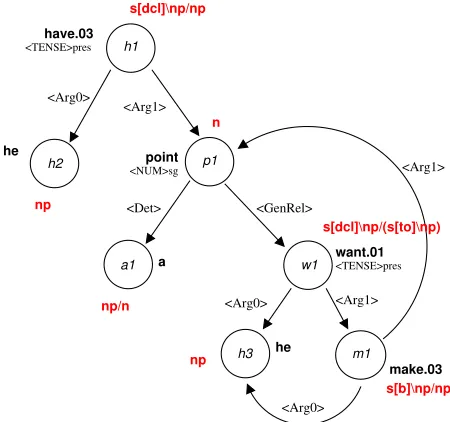
Figure 1: Semantic dependency graph from the CCGbank for He has a point he wants to make [. . . ], along with gold-standard supertags (category labels)
hNUMisg); nodes are connected via dependency re-lations (e.g.hARG0i). In HLDS, each semantic head (corresponding to a node in the graph) is associated with a nominal that identifies its discourse referent, and relations between heads and their dependents are modeled as modal relations. We extract HLDS-based quasi logical form graphs from the CCG-bank and semantically empty function words such as complementizers, infinitival-to, expletive subjects, and case-marking prepositions are adjusted to reflect their purely syntactic status. Alternative realizations are ranked using an averaged perceptron model de-scribed in the next section.
3 Feature Design
White and Rajkumar’s (2009) realization ranking model serves as the baseline for this paper. It is a global, averaged perceptron ranking model using three kinds of features: (1) the log probability of the candidate realization’s word sequence according to three linearly interpolated language models (as well as a feature for each component model), much as in the log-linear models of Velldal & Oepen (2005) and Nakanishi et al. (2005); (2) integer-valued syn-tactic features, representing counts of occurrences in a derivation, from Clark & Curran’s (2007) normal form model; and (3) discriminativen-gram features
[image:3.612.71.296.55.266.2](Roark et al., 2004), which count the occurrences of eachn-gram in the word sequence.
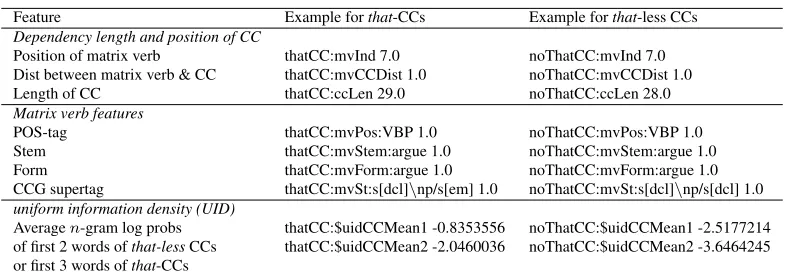
Table 1 shows the new complementizer-choice features investigated in this paper. The example fea-tures mentioned in the table are taken from the two complement clause (CC) forms (with-that CC vs.
that-less CC) of the sentence below:
(7) The finding probably will support those who argue [ that/∅ the U.S. should regu-late the class of asbestos including croci-dolite more stringently than the common kind of asbestos, chrysotile, found in most schools and other buildings], Dr. Talcott said. (WSJ0003.19)
The first class of features, dependency length and position of CC, have been adapted from the related control features in Jaeger’s (2010) study. For the above example, the position of the matrix verb with respect to the start of the sentence (feature name
Feature Example forthat-CCs Example forthat-less CCs
Dependency length and position of CC
Position of matrix verb thatCC:mvInd 7.0 noThatCC:mvInd 7.0 Dist between matrix verb & CC thatCC:mvCCDist 1.0 noThatCC:mvCCDist 1.0 Length of CC thatCC:ccLen 29.0 noThatCC:ccLen 28.0
Matrix verb features
POS-tag thatCC:mvPos:VBP 1.0 noThatCC:mvPos:VBP 1.0 Stem thatCC:mvStem:argue 1.0 noThatCC:mvStem:argue 1.0 Form thatCC:mvForm:argue 1.0 noThatCC:mvForm:argue 1.0 CCG supertag thatCC:mvSt:s[dcl]\np/s[em] 1.0 noThatCC:mvSt:s[dcl]\np/s[dcl] 1.0
uniform information density (UID)
[image:4.612.110.503.51.189.2]Averagen-gram log probs thatCC:$uidCCMean1 -0.8353556 noThatCC:$uidCCMean1 -2.5177214 of first 2 words ofthat-lessCCs thatCC:$uidCCMean2 -2.0460036 noThatCC:$uidCCMean2 -3.6464245 or first 3 words ofthat-CCs
Table 1: New features introduced (the prefix of each feature encodes the type of CC; subsequent parts supply the feature name)
last part of Table 1). In the that-less CC version,
$uidCCMeanfeatures were calculated by averaging the log probs of the first two words in the comple-ment clause, i.e.the U.S.
4 Classification Experiment
To train a local classification model to predict the presence of that in complement clauses, we used an averaged perceptron ranking model with the complementizer-specific features listed in Table 1 to rank alternate with-thatvs.that-less CC choices. For each CC classification instance in CCGbank Sections 02–21, the derivation of the competing al-ternate choice was created; i.e., in the case of athat -CC, the correspondingthat-less CC was created and vice versa. Table 2 illustrates classification results on Sections 00 (development) using models contain-ing different feature sets & Section 23 (final test) for the best-performing classification and ranking mod-els. For both the development as well as test sec-tions, the local classification model performed sig-nificantly better than the global realization ranking model according to McNemar’sχ2 test (p= 0.005, two-tailed). Feature ablation tests on the develop-ment data (Section 00) revealed that removing the information density features resulted in a loss of ac-curacy of around 1.8%.
5 Discussion
As noted in the introduction, in many cases, adding or removingthatto/from the corpus sentence results in an acceptable paraphrase, while in other cases the presence of that appears to make a substantial
Model Features % 00 % 23
Most Frequent Baseline 68.7 66.8
Global Realization Ranking 78.45 77.0
LocalThat-Classification
Only UID feats 74.77
Table 1 features except UID ones 81.4
[image:4.612.317.537.379.441.2]Both feature sets above 83.24 83.02
Table 2: Classification accuracy results (Section 00 has
170/543that-CCs; Section 23 has 192/579that-CCs)
Construction %that %that/ %Accuracy Gold Classification Ranking Gerundive (26) 53.8 61.5 / 92.3 26.9 / 57.7 Be-verb (21) 71.4 95.2 / 66.7 47.6 / 57.1 Non-adjacent CCs (53) 49.1 54.7 / 67.9 30.2 / 66.0 Total (543) 31.3 29.3 / 83.2 21.9 / 78.5
Table 3: Section 00 construction-wise that-CC
propor-tions and model accuracies (total CC counts given in brackets alongside labels); gold standard obviously has
100% accuracy; models are localthat-classification and
White and Rajkumar’s (2009) global realization ranking model
difference to intelligibility or fluency. In order to better understand the effect of the complementizer-specific features, we examined three construction types in the development data, viz. non-adjacent complement clauses, gerundive matrix verbs and a host of sub-cases involving a matrix be-verb (wh -clefts,be+adjective etc.), where the presence ofthat
classifica-WSJ0049.64 Observing[that/?∅the judge has never exhibited any bias or prejudice], Mr. Murray concluded that he would be impartial in any case involving a homosexual or prostitute as a victim.
WSJ0020.16 “ what this tells usis[that/?∅U.S. trade law is working] ”, he said .
WSJ0010.5 The idea, of course: toproveto 125 corporate decision makers [that/?∅the buckle on the Rust Belt is n’t so rusty after all , that it ’s a good place for a company to expand].
WSJ0044.118 Editorials in the Greenville newspaperallowed[that/?∅Mrs. Yeargin was wrong], but also said the case showed how testing was being overused.
WSJ0060.7 Viacomdenies[∅/?thatit ’s using pressure tactics].
WSJ0018.4 The documents alsosaid[that/?∅although the 64-year-old Mr. Cray has been working on the project for more than six years , the Cray-3 machine is at least another year away from a fully operational prototype].
Table 4: Examples from model comparison
tion model is closer to the gold standard in terms of
that-choice proportions. For all the three construc-tion types as well as overall, classifier performance was better than ranker performance. The difference in performance between the local classification and global ranking models in the case of gerundive ma-trix verbs is statistically significant according to the McNemar’sχ2test (Bonferroni corrected, two tailed p = 0.001). The performance difference was not significant with the other two constructions, how-ever, using only the cases in Section 00.
Table 4 lists relevant examples where the classi-fication model’sthat-choice prediction matched the gold standard while a competing model’s predic-tion did not. Example WSJ0049.64 is one such instance of classifier success involving a gerun-dive matrix verb (in contrast to the realization ranking model), Example WSJ0020.16 exemplifies success with a wh-cleft construction and Exam-ple WSJ0010.5 contains a non-adjacent CC. Apart from these construction-based analyses, examples like WSJ0044.118 indicate that the classification model prefers thethat-CC choice in cases that sub-stantially improve intelligiblity, as here the overt complementizer helps to avoid a local syntactic am-biguity where theNPinallowed NPis unlikely to be interpreted as the start of anS.
Finally, we also studied the effect of the uniform information density features by comparing the full classification model to a model without the UID features. The full classification model exhibited a trend towards significantly outperforming the ab-lated model (McNemar’sp = 0.10, 2-tailed); more test data would be needed to establish significance conclusively. Examples are shown at the bottom of Table 4. In WSJ0060.7, the full classification model predicted athat-less clause (matching the gold
stan-dard), while the ablated classification model pre-dicted a clause withthat. In all such examples ex-cept one, the information density features helped the classification model avoid predictingthat-inclusion when not necessary. Example WSJ0018.4 is the only instance where the best classification model differed in predicting thethat-choice.
6 Conclusions and Future Work
In this paper, we have shown that using linguistically motivated features for Englishthat-complementizer choice in a local classifier can improve upon the prediction accuracy of a state-of-the-art global re-alization ranking model employing myriad shotgun features, confirming the efficacy of features based on Jaeger’s (2010) investigation of the uniform in-formation density principle in the context of that -mentioning. Since that-complementizer choice in-teracts with other realization decisions, in future work we plan to investigate incorporating these fea-tures into the global realization ranking model. This move will require binning the real-valued features, as multiple complement clauses can appear in a sin-gle sentence. Should feature-level integration prove ineffective, we also plan to investigate alternative ar-chitectures, such as using the local classifier outputs as features in the global model.
Acknowledgements
References
Jason Baldridge and Geert-Jan Kruijff. 2002. Coupling CCG and Hybrid Logic Dependency Semantics. In
Proc. ACL-02.
Rena Torres Cacoullos and James A. Walker. 2009. On the persistence of grammar in discourse formulas: A
variationist study of “that”. Linguistics, 47(1):1–43.
Stephen Clark and James R. Curran. 2007.
Wide-Coverage Efficient Statistical Parsing with CCG and
Log-Linear Models. Computational Linguistics,
33(4):493–552.
Michael Elhadad. 1991. FUF: The universal unifier user manual version 5.0. Technical Report CUCS-038-91, Dept. of Computer Science, Columbia University. John A. Hawkins. 2003. Why are zero-marked phrases
close to their heads? In G¨unter Rohdenburg and Britta
Mondorf, editors,Determinants of Grammatical
Vari-ation in English, Topics in English Linguistics 43. De Gruyter Mouton, Berlin.
T. Florian Jaeger. 2010. Redundancy and reduction:
Speakers manage information density. Cognitive
Psy-chology, 61(1):23–62, August.
Mark Johnson. 2009. How the statistical revolution
changes (computational) linguistics. InProceedings of
the EACL 2009 Workshop on the Interaction between Linguistics and Computational Linguistics: Virtuous, Vicious or Vacuous?, pages 3–11, Athens, Greece, March. Association for Computational Linguistics. Roger Levy and T. Florian Jaeger. 2007. Speakers
opti-mize information density through syntactic reduction.
Advances in Neural Information Processing Systems, 19:849.
Hiroko Nakanishi, Yusuke Miyao, and Jun’ichi Tsujii. 2005. Probabilistic methods for disambiguation of an
HPSG-based chart generator. InProc. IWPT-05.
Brian Roark, Murat Saraclar, Michael Collins, and Mark Johnson. 2004. Discriminative language modeling with conditional random fields and the perceptron
al-gorithm. InProc. ACL-04.
Mark Steedman. 2000. The syntactic process. MIT
Press, Cambridge, MA, USA.
S. Tagliamonte and J. Smith. 2005. No momentary
fancy! the zero ‘complementizer’ in English dialects.
English Language and Linguistics, 9(2):289–309. Erik Velldal and Stephan Oepen. 2005. Maximum
en-tropy models for realization ranking. In Proc. MT
Summit X.
Michael White and Rajakrishnan Rajkumar. 2009.
Per-ceptron reranking for CCG realization. InProceedings
of the 2009 Conference on Empirical Methods in Nat-ural Language Processing, pages 410–419, Singapore, August. Association for Computational Linguistics.
Michael White. 2006. Efficient Realization of Coordi-nate Structures in Combinatory Categorial Grammar.