Towards Multi-Document Summarization of Scientific Articles:Making
Interesting Comparisons with SciSumm
Nitin Agarwal
Language Technologies Institute Carnegie Mellon University
Ravi Shankar Reddy
Language Technologies Resource Center IIIT-Hyderabad, India
Kiran Gvr
Language Technologies Resource Center IIIT-Hyderabad, India
kiran [email protected]
Carolyn Penstein Ros´e Language Technologies Institute
Carnegie Mellon University [email protected]
Abstract
We present a novel unsupervised approach to the problem of multi-document summariza-tion of scientific articles, in which the doc-ument collection is a list of papers cited to-gether within the same source article, other-wise known as a co-citation. At the heart of the approach is a topic based clustering of fragments extracted from each co-cited arti-cle and relevance ranking using a query gen-erated from the context surrounding the co-cited list of papers. This analysis enables the generation of an overview of common themes from the co-cited papers that relate to the con-text in which the co-citation was found. We present a system called SciSumm that em-bodies this approach and apply it to the 2008 ACL Anthology. We evaluate this summa-rization system for relevant content selection using gold standard summaries prepared on principle based guidelines. Evaluation with gold standard summaries demonstrates that our system performs better in content selec-tion than an existing summarizaselec-tion system (MEAD). We present a detailed summary of our findings and discuss possible directions for future research.
1 Introduction
In this paper we present a novel, unsupervised ap-proach to multi-document summarization of scien-tific articles. While the field of multi-document sum-marization has achieved impressive results with col-lections of news articles, summarization of collec-tions of scientific articles is a strikingly different problem. Multi-document summarization of news
articles amounts to synthesizing details about the same story as it has unfolded over a variety of re-ports, some of which contain redundant information. In contrast, each scientific article tells its own re-search story. Even with papers that address similar research questions, the argument being made is dif-ferent. Instead of collecting and arranging details into a single, synthesized story, the task is to abstract away from the specific details of individual papers and to find the common threads that unite them and make sense of the document collection as a whole.
Another challenge with summarization of scien-tific literature becomes clear as one compares alter-native reviews of the same literature. Each review author brings their own unique perspective and ques-tions to bear in their reading and presentation of that literature. While this is true of other genres of doc-uments that have been the target of multi-document summarization work in the past, we don’t find query oriented approaches to multi-document summariza-tion of scientific articles. One contribusummariza-tion of this work is a technical approach to query oriented multi-document summarization of scientific articles that has been evaluated in comparison with a competi-tive baseline that is not query oriented. The evalu-ation demonstrates the advantage of the query ori-ented approach for this type of summarization.
We present a system called SciSumm that sum-marizes document collections that are composed of lists of papers cited together within the same source article, otherwise known as a co-citation. Using the context of the co-citation in the source article, we generate a query that allows us to generate a sum-mary in a query-oriented fashion. The extracted
tions of the co-cited articles are then assembled into clusters that represent the main themes of the arti-cles that relate to the context in which they were cited. Our evaluation demonstrates that SciSumm achieves higher quality summaries than the MEAD summarization system (Radev, 2004).
The rest of the paper is organized as follows. We present an overview of relevant literature in Section 2. The end-to-end summarization pipeline has been described in Section 3 . Section 4 presents an eval-uation of summaries generated from the system. We end the paper with conclusions and some interesting further research directions in Section 5.
2 Literature Review
We begin our literature review by thinking about some common use cases for multi-document sum-marization of scientific articles.
First consider that as a researcher reads a scien-tific article, she/he encounters numerous citations, most of them citing the foundational and seminal work that is important in that scientific domain. The text surrounding these citations is a valuable re-source as it allows the author to make a statement about her viewpoint towards the cited articles. A tool that could provide a small summary of the col-lection of cited articles that is constructed specifi-cally to relate to the claims made by the author cit-ing them would be useful. It might also help the researcher determine if the cited work is relevant for her own research.
As an example of such a co-citation consider the following citation sentence
Various machine learning approaches have been proposed for chunking (Ramshaw and Marcus, 1995; Tjong Kim Sang, 2000a; Tjong Kim Sang et al. , 2000; Tjong Kim Sang, 2000b; Sassano and Utsuro, 2000; van Halteren, 2000).
Now imagine the reader trying to determine about widely usedmachine learningapproaches fornoun phrase chunking. Instead of going through these individual papers, it would be more useful to get the summary of the topics in all those papers that talk about the usage of machine learning methods in chunking.
2.1 Overview of Multi-Document Summarization
An exhaustive summary of recent work in summa-rization is out of the scope for this paper. Hence, we review only the most relevant approaches in summa-rization to our current work. As most recent work in multi-document summarization has been extractive, and in our observation, scientific articles contain the type of information that we would want in a sum-mary, we follow this convention. This allows us to avoid the complexities of natural language genera-tion based approaches in abstractive summarizagenera-tion. Multi-document summarization is an extension of single document summarization in which the the-matically important textual fragments are extracted from multiple comparable documents, e.g., news ar-ticles describing the same event. The techniques not only need to address identification and removal of redundant information but also inclusion of unique and novel contributions. Various graph based (Mani et al., 1997) and centroid clustering based meth-ods (Radev et al., 2000) have been proposed to address the problem of multi-document summa-rization. Both of these methods identify common themes present in a document collection using a sen-tence similarity metric.
2.2 Summarization of Scientific Articles
Surprisingly, not many approaches to the problem of summarization of scientific articles have been pro-posed in the past. One exception is Teufel and Moens (2002), who view summarization as a sification task in which they use a Naive Bayes clas-sifier to assign a rhetorical status to each sentence in an article and thus divide the whole article into regions with a specific argumentation status (e.g. categories such as AIM, CONTRAST and BACK-GROUND). In our proposed approach, we are trying to identify reoccurring topic themes that are com-mon across the articles and may appear under a va-riety of rhetorical headings.
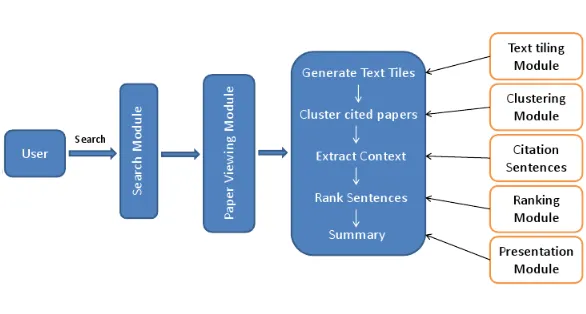
Figure 1: SciSumm summarization pipeline
In our work we make use of this insight by gen-erating a query to focus our multi-document sum-mary from the text closest to the citation. Qazvinian and colleagues (2008) present a summarization ap-proach that can be seen as the converse of what we are working to achieve. Rather than summarizing multiple papers cited in the same source article, they summarize different viewpoints expressed towards the same article from different citing articles. Some of the insights they use in their work also apply to our problem. They used a clustering approach over different citations for the same target article for dis-covery of different ways of thinking about that ar-ticle. Citation text has been already shown to con-tain important concepts about the article that might be absent from other important sections of an ar-ticle e.g. an Abstract (Mohammad et al., 2009) . Template based generation of summaries possess-ing similar hierarchical topic structure as theRelated Work section in an article has also been proposed (Hoang et al., 2010). In our work, we consider a flat topic structure in the form of topic clusters. More specifically, we discover the comparable attributes of the co-cited articles using Frequent Term Based Clustering (Beil et al., 2002). The clusters gener-ated in this process contain a set of topically relgener-ated text fragments called tiles, which are extracted from the set of co-cited articles. Each cluster is indexed with a label, which is a frequent term set present in the tile. We take this to be an approximation of a description for the topic represented by the cluster.
3 System Overview of the SciSumm Summarization System
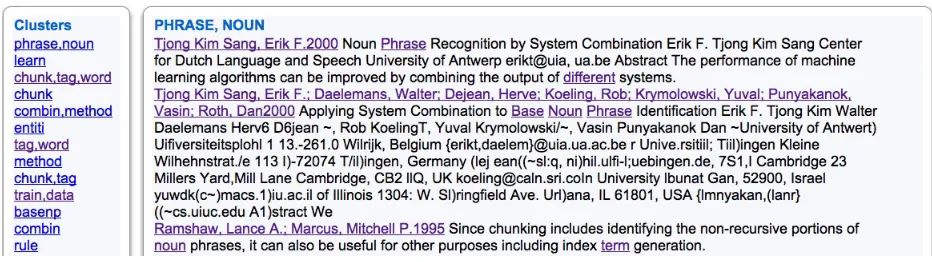
A high level overview of our system’s architecture is presented in Figure 1 . The system provides a web based interface for viewing and summarizing re-search articles in the ACL Anthology corpus, 2008. The summarization proceeds in three main stages. First, a user may retrieve a collection of articles of interest by entering a query. SciSumm responds by returning a list of relevant articles. The user can con-tinue to read an article of interest as shown in Figure 2. The co-citations in the paper are highlighted in bold and italics to mark them as points of interest for the user. If a user clicks on a co-citation, SciSumm responds by generating a query from the local con-text of the co-citation and uses it to rank the clusters generated.
identi-Figure 2: Interface to read a paper. The sentences containing co-citations are automatically highlighted and contain a “More” button beside them letting the user elaborate on the sentence.
fied by this label. In this specific example the topic was not shared by tiles present in the third paper. The words highlighted are interesting terms which are either part of the label of the cluster or show a low IDF (Inverse Document Frequency) amongst the tiles generated from the co-cited papers. These words are presented as hyper-links to the search in-terface and can be further used as search queries for finding articles on related topics.
3.1 System Description
SciSumm has four primary modules that are central to the functionality of the system, as displayed in Figure 1. First, the Text Tiling module takes care of obtaining tiles of text relevant to the citation context. It uses the Texttiling algorithm (Hearst, 1997), to segment the co-cited papers into text tiles based on topic shifts identified using a term overlap measure computed between fixed-length blocks of text. Next, the clustering module is used to generate labelled clusters using the text tiles extracted from the co-cited papers. The labels provide a conveniently com-prehensible and yet terse description of each cluster. We have used a Frequent Term Based Clustering al-gorithm (Beil et al., 2002) for clustering. The clus-ters are ordered according to relevance with respect to the generated query. This is accomplished by the
Ranking Module. Finally, the summary presenta-tion module is used to display the ranked clusters obtained from the ranking module. Alongside the clusters, an HTML pane also shows the labels of all the clusters. Having such a bird’s-eye view of all the cluster labels helps the user to quickly navigate to an interesting topic. The entire pipeline is used in real-time to generate topic clusters which are useful for generating snippet summary and more exploratory analysis.
In the following sections, we discuss each of the main modules in detail.
3.2 Texttiling
Figure 3: Clusters generated in response to a user click on the co-citation. The list of clusters in the left pane gives a bird-eye view of the topics which are present in the co-cited papers
3.3 Frequent Term Based Clustering
The clustering module employs Frequent Term Based Clustering (Beil et al., 2002). For each co-citation, we use this clustering technique to cluster all the of the extracted text tiles generated by seg-menting each of the co-cited papers. We settled on this clustering approach for the following reasons:
• Text tile contents coming from different papers constitute a sparse vector space, and thus the centroid based approaches would not work very well.
• Frequent Term based clustering is extremely fast in execution time as well as and relatively efficient in terms of space requirements.
• A frequent term set is generated for each clus-ter which gives a comprehensible description of the cluster.
Frequent Term Based text clustering uses a group of frequently co-occurring terms called a frequent term set. Each frequent term set indexes to a cor-responding cluster. The frequent term set has the property that it occurs at least once in each of the documents present in the cluster. The algorithm uses the firstk term sets if all the documents in the doc-ument collections are clustered.To discover all the possible candidates for clustering, i.e., term sets, we used the Apriori algorithm (Agrawal et al., 1994), which identifies the sets of terms that are relatively frequent. We use entropy measure to score each fre-quent term set as discovered from the Apriori algo-rithm. The entropy overlap of a clusterCi,EO(Ci) is calculated as follows:
EO(Ci) =
X
DjCi −1
fj
.ln( 1 fj
)
whereDj is the jth document which gets binned in the clusterCi,fj is the number of clusters which contain Dj. A smaller value means that the doc-ument Dj is contained in few other clusters Ci.
EO(Ci) increases monotonically as fj increases. We thus rank the clusters with their corresponding
EO(Ci) and then pick a cluster with the smallest entropy overlapEO(Ci). Once a cluster is chosen to be included in the final clustering, we remove the documents present in chosen cluster from other can-didate clusters. This results in a hard clustering of documents. We also remove term set correspond-ing to Ci from the list of candidate frequent term sets and then again recompute theEO(Ci)’s for the clusters. We continue this re-scoring and selecting a candidate cluster until the final clustering does not completely exhaust the entire document collection.
3.4 Cluster Ranking
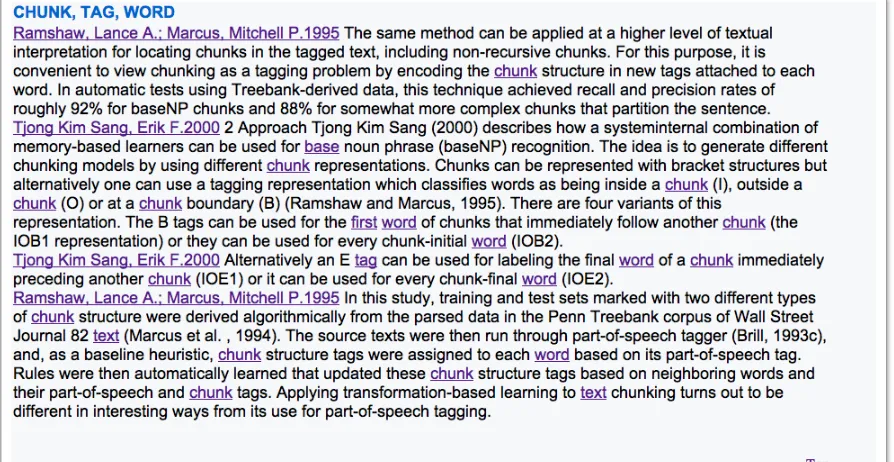
Figure 4: Example of a summary generated by our system. We can see that the clusters are cross cutting across different papers, thus giving the user a multi-document summary.
4 Evaluation
In a typical evaluation of a multi-document sum-marization system, gold standard summaries are evaluated against fixed length generated summaries. Summarization conferences such as DUC have com-petitions where different summarization systems compete on a standard task of generating summaries for a publicly available dataset. The summaries gen-erated using each individual summarization system are then evaluated against the summaries prepared by human annotators. Summarization of scientific article is a novel task and hence no test collection of gold standard summaries exist. Thus, it was neces-sary to prepare our own evaluation corpus, consist-ing of gold standard multi-document summaries for a set of randomly selected co-citations.
4.1 Experimental Setup
An important target user population for multi-document summarization of scientific articles is graduate students. Hence to get a measure of how well the summarization system is performing, we asked 2 graduate students who have been working in the computational linguistics community to cre-ate gold standard summaries of a fixed length (8
sen-tences∼200 words) for ten different randomly
se-lected co-citations. The students were given guide-lines to prepare summaries based on the design goals of the SciSumm system, but not any of its technical details. Thus, for 10 co-citations, we obtained two different gold standard summaries. For ROUGE-1 the average score between each pair of gold standard summaries was 0.518 (Min = 0.388, Max = 0.686). Similarly for ROUGE-2 the average score was 0.242 (Min = 0.119, Max=0.443). While these scores do not have a well-calibrated meaning to them, they give an indication of the complexity of the task. Since the annotators were creating extractive sum-maries which could justify the co-citation, they had to pay special attention to the section where the co-citation came from. One can consider this similar to the sense making process a reader might go through when using the citing paper as a lens through which to interpret the cited literature.
help us to evaluate the influence exerted by the ci-tation context in the gold standard summaries. In future work, we will evaluate the usability of the SciSumm system using a task based evaluation.
In the absence of any other multi-document sum-marization systems in the domain of scientific ar-ticle summarization, we used a widely used and freely available multi-document summarization sys-tem called MEAD (Radev, 2004) as our baseline. MEAD uses centroid based summarization to cre-ate informative clusters of topics. We use the de-fault configuration of MEAD in which MEAD uses length, position and centroid for ranking each sen-tence. We did not use query focussed summariza-tion with MEAD. We evaluate its performance with the same gold standard summaries we use to evalu-ate SciSumm. For generating a summary from our system we used sentences from the tiles which gets clustered in the top ranked cluster. When that entire cluster is exhausted we move on to the next highly ranked cluster. In this way we prepare a summary comprising of 8 sentences.
4.2 Results
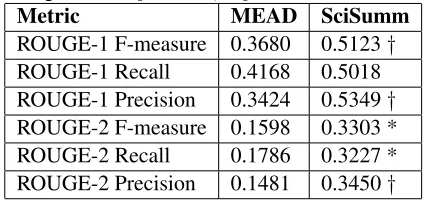
For measuring performance of the two summariza-tion systems (SciSumm and MEAD), we compute the ROUGE metric based on the 2 * 10 gold standard summaries that were manually created. ROUGE has been traditionally used to compute the perfor-mance based on the N-gram overlap (ROUGE-N) between the summaries generated by the system and the target gold summaries. For our evaluation we used two different versions of the ROUGE met-ric, namely ROUGE-1 and ROUGE-2, which cor-respond to measures of the unigram and bigram overlap respectively. We computed four metrics in order to measure SciSumm’s performance, namely 1 F-measure, 1 Recall, ROUGE-2 F-measure, and ROUGE-ROUGE-2 Recall. To measure the statistical significance of this result, we carried out a Student T-Test, the results of which are presented in the results section. The t-test results displayed in Table 1 show that our systems performs signif-icantly better than MEAD on three of the metrics (p < .05). On two additional metrics, SciSumm performs marginally better(p < .1).
[image:7.612.320.533.91.192.2]This shows that using the query generated out of the co-citation is useful for content selection
Table 1: Average ROUGE results. * represents improve-ment significant atp < .05,†atp < .01.
Metric MEAD SciSumm
ROUGE-1 F-measure 0.3680 0.5123†
ROUGE-1 Recall 0.4168 0.5018
ROUGE-1 Precision 0.3424 0.5349†
ROUGE-2 F-measure 0.1598 0.3303 *
ROUGE-2 Recall 0.1786 0.3227 *
ROUGE-2 Precision 0.1481 0.3450†
from cited papers. Intuitively, this makes sense as each researcher would have a unique perspective when reviewing scientific literature. Co-citations can be considered as micro-reviews which summa-rizes the thread unifying the research presented in each of the cited papers. This provides evidence that the co-citation context provides useful information for forming an effective query to focus the multi-document summary to reflect the perspective of the author of the citing paper.
5 Conclusions and Future Work
In this work, we proposed the first unsupervised ap-proach to the problem of multi-document summa-rization of scientific articles that we know of. In this approach, the document collection is a list of papers cited together within the same source arti-cle, otherwise known as a co-citation. The summary is presented in the form of topic labeled clusters, which provide easy navigation based on the user’s topic of interest. Another contribution is a techni-cal approach to query oriented multi-document sum-marization of scientific articles that has been evalu-ated in comparison with a competitive baseline that is not query oriented. Our evaluation shows that the SciSumm approach to content selection outperforms another multi-document summarization system for this summarization task.
et al., 1998), which can be used to optimize the di-versity of selected text tiles as well as the relevance based ordering of clusters in order to put a more di-verse set of observations from the co-cited articles at the fingertips of users. A natural extension would also be to discover the nature of citations to gen-erate improved summaries. Non-explicit citations (Qazvinian et al., 2010) which could be used to gen-erate similar topic clusters.
Another important direction is to refine the inter-action design through task-based user studies. As we collect more feedback from students and researchers through this process, we will use the insights gained to achieve a more robust and effective implementa-tion. We also plan to leverage research in informa-tion visualizainforma-tion to enhance the usability of the sys-tem.
6 Acknowledgements
This work was supported by NSF EEC-064848 and NSF EEC-0935127.
References
Agrawal R. and Srikant R. 1994. Fast Algorithm for Mining Association Rules InProceedings of the 20th VLDB Conference Santiago, Chile, 1994
Baxendale, P. 1958. Machine-made index for technical literature - an experiment. IBM Journal of Research and Development
Beil F., Ester M. and Xu X 2002. Frequent-Term based Text Clustering InProceedings of SIGKDD ’02 Ed-monton, Alberta, Canada
Carbonell J. and Goldstein J. 1998. The Use of MMR, Diversity-Based Reranking for Reordering Documents and Producing Summaries InResearch and Develop-ment in Information Retrieval, pages 335–336 Councill I. G. , Giles C. L. and Kan M. 2008. ParsCit:
An open-source CRF reference string parsing
pack-age INTERNATIONAL LANGUAGE RESOURCES
AND EVALUATION European Language Resources Association
Edmundson, H.P. 1969. New methods in automatic ex-tracting. Journal of ACM.
Hearst M.A. 1997 TextTiling: Segmenting text into multi-paragraph subtopic passages In proceedings of LREC 2004, Lisbon, Portugal, May 2004
Joseph M. T. and Radev D. R. 2007. Citation analysis, centrality, and the ACL Anthology
Kupiec J. , Pedersen J. , Chen F. 1995. A training doc-ument summarizer. InProceedings SIGIR ’95, pages 68-73, New York, NY, USA. 28(1):114–133.
Luhn, H. P. 1958. IBM Journal of Research Develop-ment.
Mani I. , Bloedorn E. 1997. Multi-Document Summa-rization by graph search and matching InAAAI/IAAI, pages 622-628. [15, 16].
Nanba H. , Okumura M. 1999. Towards Multi-paper Summarization Using Reference Information In Pro-ceedings of IJCAI-99, pages 926–931 .
Paice CD. 1990. Constructing Literature Abstracts by Computer: Techniques and Prospects Information Processing and ManagementVol. 26, No.1, pp, 171-186, 1990
Qazvinian V. , Radev D.R 2008. Scientific Paper summarization using Citation Summary Networks In
Proceedings of the 22nd International Conference on Computational Linguistics, pages 689–696 Manch-ester, August 2008
Radev D. R . , Jing H. and Budzikowska M. 2000. Centroid-based summarization of multiple documents: sentence extraction, utility based evaluation, and user studies In NAACL-ANLP 2000 Workshop on Auto-matic summarization, pages 21-30, Morristown, NJ, USA. [12, 16, 17].
Radev, Dragomir. 2004. MEAD - a platform for multi-document multilingual text summarization. In pro-ceedings of LREC 2004, Lisbon, Portugal, May 2004. Teufel S. , Moens M. 2002. Summarizing Scientific Articles - Experiments with Relevance and Rhetorical Status InJournal of Computational Linguistics, MIT Press.
Mohammad, Saif and Dorr, Bonnie and Egan, Melissa and Hassan, Ahmed and Muthukrishan, Pradeep and Qazvinian, Vahed and Radev, Dragomir and Zajic, David 2009. Using citations to generate surveys of scientific paradigms InProceedings of Human Lan-guage Technologies:The 2009 Annual Conference of the North American Chapter of the Association for Computational Linguistics
Qazvinian, Vahed and Radev, Dragomir R. 2010. Identi-fying non-explicit citing sentences for citation-based summarization In Proceedings of the 48th Annual Meeting of the Association for Computational Linguis-tics