ISSN Online: 2165-3925 ISSN Print: 2165-3917
DOI: 10.4236/ojapps.2017.79032 Sep. 1, 2017 433 Open Journal of Applied Sciences
Teaching Strategy Using Programming:
The Probability Case
Elena Fabiola Ruiz Ledesma, Juan Jesús Gutiérrez García
Basic Training Department, Escuela Superior de Cómputo, Instituto Politécnico Nacional, Ciudad de México, México
Abstract
This document presents the advantages of using different technology and computational programs, in order to support the teacher and the student during the teaching and learning experience regarding the subject of Proba-bility and Statistics, which is taught in upper levels. For the experimental work, a group of 40 students, who studied the third semester at the Compu-ting Advanced Faculty from the Instituto Politécnico Nacional (ESCOM-IPN) was taken as a sample. The form to assess the group was different than usual, because currently not only knowledge was assessed but also the skills on technology were used to program software that allowed calculation through binomial and normal distribution or develop animations that simulated prob-lems expressed in pencil and paper. For a semester, we worked with the group and obtained excellent results. The assessment was supported through a pre-viously created metric.
Keywords
Computational Programs, Education, Probability, Programming
1. Introduction
Probability is a mathematical branch present every day in human life; some-times, it is subject to forecasting the result of certain events surrounding the person and, to some others, it just performs incidentally, because long time ago, human beings found in gambling a source for trying to predict the result of fu-ture events [1][2]. Probability can be applied in different forms for computing and Artificial Intelligence areas, as in the case of the construction of intelligent systems, which require making decisions based on probability calculations [3] [4].
Currently, in many universities throughout the country, the teaching metho-How to cite this paper: Ruiz, E.F. and
García, J.J.G. (2017) Teaching Strategy Using Programming: The Probability Case. Open Journal of Applied Sciences, 7, 433-442. https://doi.org/10.4236/ojapps.2017.79032
Received: July 28, 2017 Accepted: August 28, 2017 Published: September 1, 2017
Copyright © 2017 by authors and Scientific Research Publishing Inc. This work is licensed under the Creative Commons Attribution-NonCommercial International License (CC BY-NC 4.0). http://creativecommons.org/licenses/by-nc/4.0/
DOI: 10.4236/ojapps.2017.79032 434 Open Journal of Applied Sciences dology has been modified in order to improve the students’ learning process. In new educational models, there is the intention to better involve the student, not only leaving the teaching process burden to the teacher; however, it is not enough to improve the students’ academic performance [5].
At the Probability and Statistics learning unit, the approach for problems or exercises is usually on different and wide topics [1]. The premise handled in this research is that students make mistakes when interpreting and/or understanding problems and, therefore, they do not know how to face them, which lead them to erroneous results. As part of this premise, it is considered that if the student creates or develops computational programs that involve the variables of a prob-lem, he will understand its logics in order to face it and select the correct proce-dure to successfully face such problem. This is a relevant consideration because the school, where the study was performed, teaches the degree of Computational Systems and, since the first semester, students start programming.
In order to solve a problem, it is not only necessary to find out the procedure starting with data and ending with the solution, but also a process stemming from the interpretation of the mathematical text; furthermore, there are several recurrent moments where tests are performed, data is ordered, those are com-bined and used for mathematical concepts, and information is verified in order to determine the answer [6]. Polya [7] stated that every problem solving process requires going through several stages, which he summarized in four stages (problem comprehension, plan design, plan execution, and results verification); meanwhile, Shoenfeld [8], years later, stated that each of the stages established by Polya should be divided in order to be more meticulous when using different strategies (heuristic and metaheuristic) leading to problem solving.
Therefore, the development of computational programs by students was pro-posed, either animations representing the situation involving rates of change or optimization features or programs that calculate probability distribution, such as binomial or normal.
2. Problem Formulation
At the Probability and Statistics Learning Unit taught at the Computing Ad-vanced Faculty from the IPN, the current syllabus (ESCOM-IPN) mentions the general objective, which is: “To generally pose and solve random problems in-volved in computational systems, particularly and interdisciplinary, through probability and statistics concept management, statistical software, and compu-ting programs performance in order to analyze results as another item of
evi-dence in the decision making process on the problems at hand” [9].
DOI: 10.4236/ojapps.2017.79032 435 Open Journal of Applied Sciences
Software, Extra Support
Currently, technology is quickly and constantly moving forward and it is increa-singly present in more aspects of daily life. Therefore, the idea of using software as a tool to complement the learning process of probability was posed, because, due to its essential characteristics, the student can have a better representation of probability events, which sometimes are difficult to recreate in the classroom [10].
On the other hand, the student can have the possibility to experiment with different variables that affect the behavior of probability in order to achieve learning improvement, as the theoretical part would be complemented with the problem analyses part, which is normally reviewed in class and, due to lack of time, such analysis cannot be taught in depth.
3. Methodology
The developed research had an exploratory nature; therefore, a questionnaire of the same nature was used as its support. Such questionnaire was applied to sam-ple of 40 out of 261 students attending the subject of Probability and Statistics at one of the Academic Units from the IPN.
The following formula was used to determine the sample
(
)
(
)
(
)
2 2 2 1 1 1N z p p
n
N e Z p p
⋅ − = − + − ⋅
(1) where:
N = population Z = confidence level
p = success probability or expected proportion q = failure probability
e = margin of error.
The population was comprised by 261 students attending the subject during the school year from January to June, 2017. There was a 95% confidence level, 5% margin of error, and 70% success probability.
As the confidence level was 95%, it is equivalent to Z = 1.96.
By substituting the data, the sample size should be 33 students; however, as the working group was comprised by 40 students, we decided to work with those 40 students.
So, as part of the methodology, a group of 40 students, who studied the third semester at the Computing Advanced Faculty of the ESCOM, was taken as a sample.
A questionnaire was made and applied in the student community in order to research on the students’ perception regarding the Probability and Statistics workshop, as well as to review the importance of technology as part of the teaching and learning processes.
DOI: 10.4236/ojapps.2017.79032 436 Open Journal of Applied Sciences Figure 1 shows the stages of the methodology used.
3.1. Initial Questionnaire
The questions are shown in Table 1.
3.2. Answers
[image:4.595.253.498.250.401.2] [image:4.595.223.513.543.710.2]The percentage of answers provided by the sample of 40 students is shown in Figures 2-6.
Figure 2 shows a graphic with the obtained answer percentage. Here, the stu-dents’ perception on the type of teaching that prevailed during the Probability and Statistics workshop was of relevance.
Figure 1. Stages of experimental methodology.
Table 1. Initial questionnaire.
1) What do you think about the quality of the Probability and Statistics workshop?
2) Do you think it would be convenient to get support from technological tools as part of the work done by the teacher and the students in the classroom?
3) If you were offered an app for playing in order to learn probability, would you use it? 4) Which tool or technology catches your attention the most?
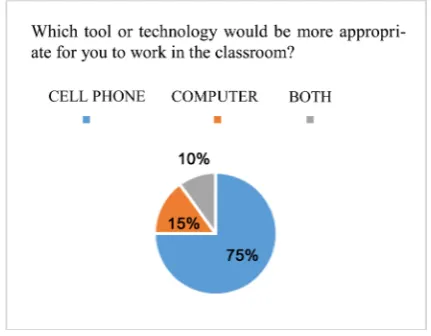
5) Which tool or technology would be more appropriate for you to work in the classroom?
DOI: 10.4236/ojapps.2017.79032 437 Open Journal of Applied Sciences Figure 3. Graphic that shows the results of question 2.
Figure 4. Graphic that shows the results of question 3.
Figure 5. Graphic that shows the results of question 4.
In Figure 2, it can be observed that more than half of the students consider that the subjects taught in the Probability and Statistics workshop were of aver-age quality; this implies that the student expects a greater effort from the teacher.
DOI: 10.4236/ojapps.2017.79032 438 Open Journal of Applied Sciences Figure 6. Graphic that shows the results of question 5.
Probability and Statistics subject (Figure 3).
Seventy two percent of the students consider that it would be convenient to use some technological tools to support the teaching and learning processes.
Figure 4 shows the question researching on the possibility to use games in order to support learning.
Most of the students (77%) were interested on being offered an application, which will be used by them, in order to practice or review the content learned in the subject of Probability. Therefore, this provides a real perspective that, cur-rently, technology can help reinforce what has been theoretically learned in class.
Question 4 is more specific regarding the use of some type of technology (Figure 5).
Seventy five percent prefers using an application via cell phone, which implied that the digital material or system to be developed shall be visible on a cell phone and adjusted to the screen.
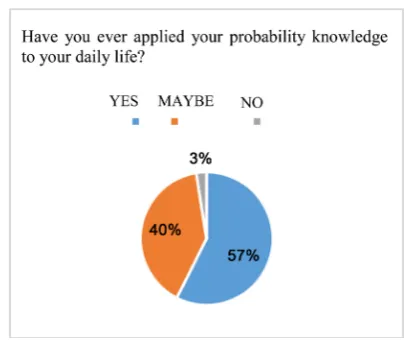
Finally, question 6 was regarding the information corresponding to the use they have given to what they learned in Probability and Statistics in their daily lives (Figure 6).
Just over half of the sample students have used probability in their daily lives. After analyzing the answers provided by the students, we started working with the group during the January-June 2017 semester, using programming by stu-dents, as a teaching and learning strategy, in order to make real some of the problems reviewed in class, either allowing their simulation to help students vi-sualize the situation posed by the problem or allowing the interactive use of the program they will develop, by introducing data and obtaining the required val-ues for their resolution.
4. Teaching Proposal
Description of the Work Performed with the Group during the
Semester 2017/2 (January-July)
DOI: 10.4236/ojapps.2017.79032 439 Open Journal of Applied Sciences strategy where they had to program the problems reviewed in class was de-scribed.
[image:7.595.259.487.518.707.2]Regarding the Thematic Unit 3 on Discrete and Continuous Distributions, one team programmed, by itself, the binomial distribution so it was not neces-sary to use the tables annexed in the Probability and Statistics textbooks for problem solving [3][4].
Figure 7 shows the interface image where the student introduced the data ex-tracted from a problem.
Students explain that, in order to program, they required to know the tables’ structure, as well as the binomial distribution formula and where the formula was obtained from.
It means that they expressed the need to work with binomial distribution through calculations using pencil and/or calculator to establish the program log-ics (Figure 7).
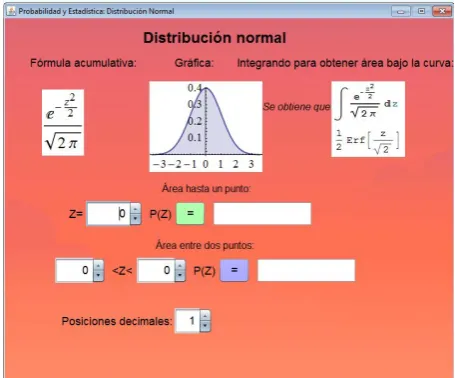
A second team worked in a similar way with normal distribution (see Figure 8).
Figure 7. Binominal distribution program.
DOI: 10.4236/ojapps.2017.79032 440 Open Journal of Applied Sciences Figure 9. Problem about probability distribution.
Figure 10. Problem about probability distribution.
Several problems were posed, where the student didn’t know the distribution he had to use; besides, he would be evaluated according to the form he would re-view the problem’s variables and how he would determine the type of distribu-tion necessary to solve the situadistribu-tion posed (binomial, multinomial, geometric, hypergeometric, normal, gamma, or exponential distribution). Once the distri-bution to be used was found, instead of using tables, he introduced data corres-ponding to the distribution programs.
Figure 9 and Figure 10 show examples of the problems and their solving processes.
It can be observed that the formula was used 10 times, as indicated by the ad-dition. However, when using the program that calculated Poisson distribution, a lot of time was saved.
Almost 100% of the students used the programs they created. At the begin-ning, they used the book’s tables, but they realized that, by using the programs, the time to solve problems was reduced and they were able to use more time to pose and detect variables.
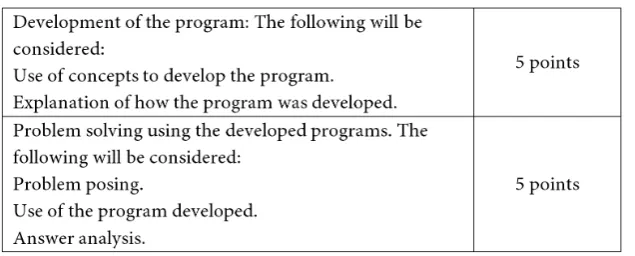
The form to evaluate the group was different than usual, which consisted of 3 written exams throughout the semester. A scoring guide was designed in order to evaluate students.
DOI: 10.4236/ojapps.2017.79032 441 Open Journal of Applied Sciences Figure 11. Scoring guide.
Per Thematic Unit, the student developed, in a group of 4 persons, a program or application where the student used his knowledge regarding the correspond-ing topic and, subsequently, solved problems by uscorrespond-ing the programs developed by him and his classmates.
5. Conclusion
Taking into account the information obtained as part of the experimental me-thodology used, it was possible to teach that the implementation of new metho-dologies and, specially, the addition of technological tools can represent addi-tional support to teachers in order to teach a better and more diversified class to pose several problems, in compliance with the subject proposed by the educa-tional institution. This also allows the student to develop skills related to his major and, in the future, they will try to develop the tools that generally support the development of the education in Mexico, without setting aside the relevance of teachers in the classrooms as their knowledge and experience in the academic field cannot be substituted.
References
[1] Batanero, C. and Sánchez, E. (2005) What Is the Nature of High School Student’s Conceptions and Misconceptions about Probability? In: Jones, G.A., Ed., Exploring Probability in School: Challenges for Teaching and Learning, Springer, New York, 241-266. https://doi.org/10.1007/0-387-24530-8_11
[2] Batanero, C. (2006) Razonamiento Probabilístico en la vida Cotidiana: Un desafío. Universidad de Granada, España.
[3] Walpole, E., Myers, H., Myers, S. and Ye, K. (2012) Probabilidad y Estadística para Ingeniería y Ciencias 9ª. Edición. Pearson.
[4] Myer, P.I. (2008) Probabilidad y Aplicaciones Estadísticas. Addison Wesley, Iberoamericana.
[5] Aranzabal, J.I. (2009) Una propuesta para la enseñanza de la probabilidad en la universidad basada en la investigación. España.
[6] Lesh, R. and Zawojewski, J.S. (2007) Problem Solving and Modeling. In: Lester, F., Ed., Second Handbook of Research on Mathematics Teaching and Learning, Infor-mation Age Publishing, Greenwich, CT, 763-802.
DOI: 10.4236/ojapps.2017.79032 442 Open Journal of Applied Sciences [8] Schoenfeld, A.H. (1992) Learning to Think Mathematically: Problem Solving, Me-tacognition, and Sense Making in Mathematics. In: Grouws, D., Ed., Handbook of Research on Mathematics Teaching and Learning, A Project of the National Council of Teachers of Mathematics, Macmillan, New York, 334-370.
[9] ESCOM-IPN. (2011) Programa de Estudios de la Unidad de Aprendizaje de Probabilidad y Estadística.
[10] Ferro, S., Martínez, S. and Otero, N. (2009) Ventajas del uso de las TICs en el proceso de enseñanza-aprendizaje desde la óptica de los docentes universitarios españoles. EDUTEC: Revista Electrónica de Tecnología Educativa, No. 29, 5.
Submit or recommend next manuscript to SCIRP and we will provide best service for you:
Accepting pre-submission inquiries through Email, Facebook, LinkedIn, Twitter, etc. A wide selection of journals (inclusive of 9 subjects, more than 200 journals)
Providing 24-hour high-quality service User-friendly online submission system Fair and swift peer-review system
Efficient typesetting and proofreading procedure
Display of the result of downloads and visits, as well as the number of cited articles Maximum dissemination of your research work