Corpus and dictionary development for classifiers/quantifiers
towards French-Japanese machine translation
Mutsuko Tomokiyo
LIG-GETALP, IMAG-CAMPUS 700 avenue Centrale 38401 Grenoble
Christian Boitet
UGA, LIG-GETALP, IMAG-CAMPUS 700 avenue Centrale 38401 Grenoble
Abstract
Although quantifiers/classifiers expressions occur frequently in everyday communications or written documents, there is no description for them in classical bilingual paper dictionaries, nor in machine-readable dictionaries. The paper describes a corpus and dictionary development for quantifiers/classifiers, and their usage in the framework of French-Japanese machine translation (MT). They often cause problems of lexical ambiguity and of set phrase recognition during analy-sis, in particular for a long-distance language pair like French and Japanese. For the development of a dictionary aiming at ambiguity resolution for expressions including quantifiers and classifiers which may be ambiguous with common nouns, we have annotated our corpus with UWs (interlin-gual lexemes) of UNL (Universal Networking Language) found on the UNL-jp dictionary. The extraction of potential classifiers/quantifiers from corpus is made by UNLexplorer web service. Keywords : classifiers, quantifiers, phraseology study, corpus annotation, UNL (Universal Net-working Language), UWs dictionary, Tori Bank, French-Japanese machine translation (MT).
1 Introduction
Recent Machine Translation (MT) evaluation tends to be conducted based on (1) Automatic evaluation metrics use reference translations for each segment such as BLEU, NIST, METEOR (Papineni et al., 2001; Banerjee and Lavie, 2005; Doddington, 2002).
This shows frequent efforts for MT, by measuring a similarity or a distance between a translation hypothesis and its post-editions. Basic operations used for post-editions are substitution, deletion, and insertion of words or phrases in a sentence, whatever the MT system is. (2) Subjective measures are based on human judgements of ”intelligibility”, ”fidelity”, “adequacy” and “fluency” of MT outputs.
These methods are really suitable for evaluating the progress of MT systems, but they do not contribute directly to improve the quality of MT outputs. Here we focus on lexical ambiguities, which are considered as a main cause of the degradation of the quality in MT for spoken or written sentences. Several types of ambiguity appear on each phase of MT for different types of documents.
We have categorized ambiguity problems according to the levels of MT analysis and to the MT con-texts in which they are encountered, and we have proposed a formal ambiguity representation as well as guidelines for ambiguity labelling to build an ambiguity data base1.
In fact, according to our studies of ambiguities, 14% of analysis errors2are due to polysemous words. Also, (G.Wisniewski and al., 2013) say the most frequent necessary post-edition in their French corpus translation into English is to correct articles like «les», «le», «du», etc., and the next one concerns lexical transfer errors of polysemous words. In addition, when polysemous words are used in their abstract or figurative meaning where they could be classifier or quantifier, translation results produced by current
This work is licensed under a Creative Commons Attribution 4.0 International Licence. 1
We have done research on ambiguity analysis from the lexical, semantic and contextual points of view since 1996. Ambi-guities have been defined, categorized, and formalized as objects in an ambiguity database, and we have used this theoretical background to label ambiguities in Japanese-English interpreted dialogues, collected for the development of a speech translation system at ATR in Japan (1994 ). (Boitet and Tomokiyo, 1995; Boitet and Tomokiyo, 1996;?)
2
The ambiguity analysis includes assignment of speech acts, although generally speaking speech act ambiguity isn’t taken account of, so the percentage is important.
MT systems are not at all good. Even measure words like cm, km, kg, etc. may be ambiguous with acronym (Anil K. et al., 2013).
Example: cm→centimètre, congrégation de la mission, coût marginal, etc.
The following example shows that «pincée (pinch,つまみ, tsumami) » in a quantifier phrase appears in form of «une pincée de», and is used in its figurative meaning. When one looks at the translation outputs produced by commercial MT systems, it’s not hard to deduce there is a lack of phraseology studies and polysemy disambiguation method for the word «pincée»3. For the treatment of the classifier/quantifier ex-pressions, at first, we must know whether a word or an expression in a document is the classifier/quantifier or not, and which kind of information is necessary to handle it in MT.
Example: Ajoutez une pincée de sel. (Add a pinch of salt.) →
塩のつねりを加えなさい/塩のピンチを加えなさい (Shio no tsuneri wo kuwaenasai/Shio no pinchi wo kuwaenasai)4
Sections 1 & 2 discuss the problems encountered in the processing of classifiers and quantifiers arising for meaning determination in the source language and from the structural differences between a language pair in the framework of MT. Section 3 describes morpho-syntactic problems between two languages for quantifier/classifier expressions. In Section 4, the difficulty of quantifiers/classifiers extraction is described. In Section 5, we propose a solution using a dictionary, edited from collected documents, themselves annotated with semantic UNL (hyper)graphs, presented as a parallel corpus, and give somme details about a small French-Japanese dictionary for quantifiers/classifiers, built for MT experimentation with an UNL system5.
2 Lexical ambiguity for classifiers/quantifiers
We call here words or phrases which are used in some languages to indicate the class of nouns or nomi-nal/adjectival phrases, depending on the type of these referent, classifiers/quantifiers, when they appear in quantitative expressions. They denote:
(a) temporal/spatial quantity of the referent and (b) states of the referent in an idiomatic expression.
Type (a) classifiers/quantifiers express concrete measurement, and type (b) classifiers/quantifiers express quantitative states of the referent based on speaker’s observation.
Examples:
Type (a): 2g de sel (2グラムの塩, 2-guramu-no shio, 2g of salt)
Type (b): une pièce de viande (一切れの肉, hitokire-no niku, a piece of meat) / un brin de causette (ちょっとしたおしゃべり, chottoshita osyaberi, a little chat)
Classifiers/quantifiers of type (a) are obligatory in quantitative expressions, and they often cause acronym ambiguities for MT as mentioned above, and also ambiguities due to the “floating quantifier” (Inoue, 1989) phenomenon in Japanese.
For classifiers/quantifiers of type (b), there are three different sorts of problems. The first one is the fact that classifiers/quantifiers have many to many meaning corespondences between source-target languages pairs. In the following example, the French word «pièce» is translated into «切れ, kire», «枚, mai», «点, ten», «頭, tou», etc. in Japanese, because, in many cases, Japanese classifiers depend upon the visual forms of referents.
The second problem arises in the case where classifiers/quantifiers don’t appear explicitly in one lan-guage of a lanlan-guage pair, nevertheless they are mandatorily expressed in the other, like «冊», satsu in
Japanese.
3
“pincée” is used as quantifier/classifier for pulverized substances. 4
These translations don’t make sense. http://www.reverso.net/translationresults.aspx?langF̄ R&directionf̄rancais-japonais. http://www.worldlingo.com/fr/products_services/worldlingo_translator.html.
5
Table 1: Translation of French word ”pièce” into Japanese French
en-tries
Examples Source Japanese translations
pièce une pièce de toile Royal 一枚(mai)の布(ichimai no nuno, a piece of cloth)
une pièce de mobilier Royal 一点(ten)の家具(itten no kagu, a piece of furniture)
dix pièces de bétail Royal 10頭(tou)の家畜 (jyuttou no kachiku, ten cattles)
plusieurs pièces de bois Royal 数枚(mai)の板 (suumai no ita, some boards)
une pièce de vin est un tonneau de vin contenant environ 220 litres.
Wiki, pièce 一樽(hitotaru)のワインとは
約220リットルを含むワイン 樽である(hitoraru no wain toha
yaku 220 littoru wo fukumu waindaru dearu, a barrel of wine includes 220 littles of wine) J’ai reçu une demi-pièce
de ce vin.
Vinothèque わたしは半樽(hantaru)
のワインを受け取った。
(watashiha hantaru no wain wo uketotta, I have received half barrel of this wine.)
Dans une pièce de théâtre, il n’y a pas de narrateur pour raconter les faits.
http://www.etudes- litteraires.com/etudier-
piece-de-theatre.php
ある作品(sakuhin)
では事実を語るナレータがいない。
(aru sakuhin deha jijitsuwo kataru nare)ta) ga inai, There is no narrator in a program.) Une pièce de viande Royal 一切れ(kire)の肉 (hitokire no
niku, a slice of meat)
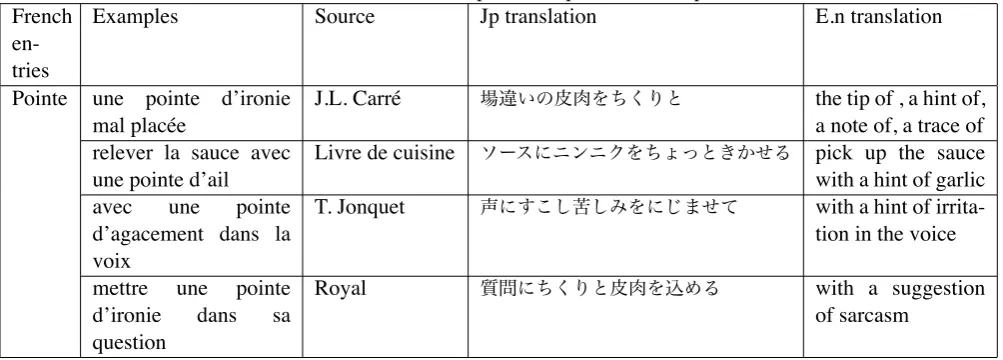
Table 2: Translation of the French expression «pointe» into Japanese French
en-tries
Examples Source Jp translation E.n translation
Pointe une pointe d’ironie mal placée
J.L. Carré 場違いの皮肉をちくりと the tip of , a hint of, a note of, a trace of relever la sauce avec
une pointe d’ail
Livre de cuisine ソースにニンニクをちょっときかせる pick up the sauce with a hint of garlic avec une pointe
d’agacement dans la voix
T. Jonquet 声にすこし苦しみをにじませて with a hint of irrita-tion in the voice
mettre une pointe d’ironie dans sa question
Royal 質問にちくりと皮肉を込める with a suggestion
of sarcasm
Examples:
2 livres→二冊の本 (ni-satsu no hon, two books)
un chat→一匹の猫 (i-ppiki no neko, a cat) (see →Table 1)
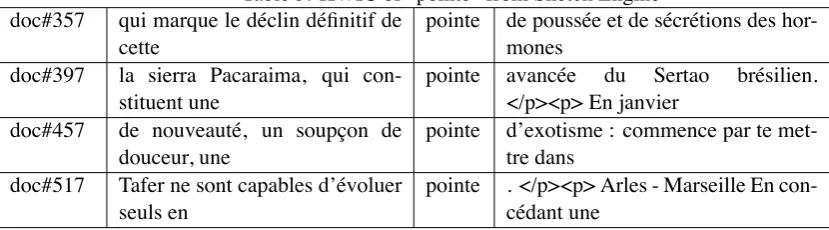
Table 3: KWIC of “pointe” from Sketch Engine doc#357 qui marque le déclin définitif de
cette
pointe de poussée et de sécrétions des hor-mones
doc#397 la sierra Pacaraima, qui con-stituent une
pointe avancée du Sertao brésilien. </p><p> En janvier
doc#457 de nouveauté, un soupçon de douceur, une
pointe d’exotisme : commence par te met-tre dans
doc#517 Tafer ne sont capables d’évoluer seuls en
pointe . </p><p> Arles - Marseille En con-cédant une
3 Morpho-syntactic differences between French-Japanese classifiers/quantifiers
As for the behaviour of floating quantifiers in Japanese (Inoue K.1989), the problem we encounter in building a Japanese-French MT lies in the fact that the Japanese quantifiers can be freely positioned between phrasal units in a sentence except after predicative verbs. They are morphosyntactically clas-sified into two types of quantifier expressions: (1) noun phrases in form of Number+Quantifier+の(no, of)+Noun («NQのN» type) , and (2) noun phrases in form of Noun+Number+Quantifier («NQN» type). The NQN type can syntactically be divided into «N» part and «QN» part and it s possible to use «QN» like an adverb before a predicative verb in a sentence.
Hence, three types of expressions are possible for the same meaning : (1) 二冊の本 (ni-satsu no hon, two books ), (2) 本二冊 (hon ni-satsu, two books) and also (3) 本を二冊 (hon-wo ni-satsu, two books)6. The floating quantifier can produce meaningless translation result in some cases. For instance,
3kgの子豚がいました (3 kiloguramu no kobutaga imashita, There was a 3kg piglet.) is acceptable as Japanese sentence, but 子豚が3kgいました(kobuta ga 3kiloguramu imashita) 7 doesn t literally make
sense, because, «子豚 (kobuta, piglet)» means only an alive pig and co-occurs with いました (there was), but 3kg cannot do [12]. So, to avoid the translation output 子豚が3kgいました , we need to have supplementary information for 子豚 and the verb いる(iru, there is, or exist) and implement method to use it. For that reason, we use the UWs dictionaries of the UNL system, which allows us to describe semantic constraints between words.
4 Recognition difficulty of quantifiers/classifiers
We extract type (a) quantifiers/classifiers from Tori Bank8(See Annex), while referring to existing weights
and measures dictionaries. For type (b) quantifiers/classifiers, it s laborious to pin down phrasemes9 in
row data.
Eg. pointe from Sketch Engine (Table 3).
However, French and English phrasemes are, in many cases, composed of Number+Noun+de (Number+noun+of)+Noun without particle like une poignée de sable (a handful of sand) , une pointe d ironie (a touch of irony) , un pouce de terre (a handful of) , so in order to collect data of type (b), we take note of the morphologic characteristic (Petit, 2004), and utilize a multilingual corpus management software, called Sketch Engine10. The software gives a list of tri-grams of
keywords in context. The used documents are journals, magazines, novels, existing expression dictionaries, French, Japanese and English leaner s manuals. The assignment of the QC for obtained keywords is made by linguistic intuition, while watching output from MT experiences on UNL Explorer11.
6In the full sentence, I bought 2 books (本を二冊 買いました, hon-wo nisatsu kaimashita) 7
子豚が3kgいました, For the piglet, there was 3 kg*. 8
Tori Bank is a phrase corpus which has been developed at Tottori Unversity in Japan in 2007. http://unicorn.ike.tottori-u.ac.jp/toribank/about_toribank.html
9
The term ”phraseme” means set phrase, idiomatic phrase, polylexical expression, etc. 10
The Sketch Engine refers to a text corpus management and analysis software developed by Lexical Computing Limited since 2003. (http://en.wikipedia.org/wiki/Sketch_Engine)
11
5 Specification of classifiers/quantifiers corpus
The corpus includes sentences which are manually or semi-automatically collected from novels, cooking articles, news papers, dictionaries, Tori Bank, etc. The description for pointe is given below as a typical example. The annotated keywords include, at the present time, about 1000 classifier/quantifier expressions for Japanese, French and English in PhraseBook II12 (see Annex).
1. Identification number: XX 2. Keywords and class: pointe (n.)
3. English sentence: to season the sauce with a hint of garlic 4. French sentence: relever la sauce avec une pointe d ail 5. Japanese sentence: ソースにニンニクをちょっときかせる 6. Source: Royal
7. UNL annotation (simplified):
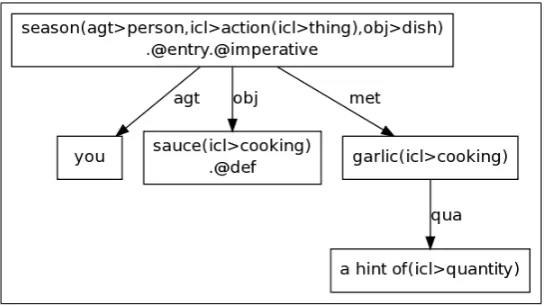
{org:fr} Relever la sauce avec une pointe d ail {/org} {unl}
agt(season(agt>person, obj>dish, icl>action>thing).@entry.@imperative, you)
obj(season(agt>person, obj>dish, icl>action>thing).@entry.@imperative, sauce(icl>cooking).@def) met(season(agt>person, obj>dish, icl>action>thing).@entry.@imperative, garlic(icl>cooking)) qua(garlic(icl>cooking), a hint of(icl>quantity))
{/unl}
[image:6.595.163.436.376.529.2]{en} Season the sauce with a hint of garlic {/en} {jp} ソースにニンニクをちょっときかせる {jp}
Figure 1: UNL graph for ”Relever la sauce avec une pointe d’ail”
6 UNL-UWs dictionary for quantifiers/classifiers
The collected documents in Japanese, French, English are annotated by their UNL expressions13, which
are composed of interlingual lexemes called universal words (UWs)14, semantic boolean features,
and semantic relation tags15. In general, a UW is made of an English word or locution, its headword ,
disambiguated by a list of restrictions. The set of UWs can be used as a lexical pivot between the
12
The corpus is going to become larger by extracting classifiers/quantifiers expressions from Tori Bank 13
UNL is a language for computer to represent the meaning of natural language expressions. The ”Universal Words” (UWs) constitute its vocabulary. A UW is in effect aninterlingual lexeme. Each node of a ”UNL expression” (in effect, a semantic hypergraph) bears a UW and a possibly empty set of semantic attributes (Uchida et al.,2006).
14
The UNL-UWs dictionary contains, at the moment 1269421 word senses (mapped to as many UWs) for Japanese, 520305 word senses for French, and 1458686 word senses for English.
15
lexical spaces of any set of natural languages, and the UNL graphs can similarly be used as an anglo-semantic abstract pivot language. The added information for classifier/quantifier expressions is merged into the UNL dictionaries. Here is an extract of our 3-lingual UNL dictionary. The first entry has 2 languages (jp, fr.). The second entry has 3 languages (jp, fr, en). The forth has again 2 languages (fr, en).
樽 (taru, pièce): cask(icl>wine,equ>2200 litres) 冊 (satsu, volume): volume(icl>quantity)
relever (to season): season(agt>person, obj>dish, icl>action>thing) pointe (touch): touch(icl>amount) → une pointe de (a touch of)
icl and equ in our UW dictionary are semantic relation tags, and mean headword s sub-meaning and equivalent quantity, respectively. The semantic relation agt indicates that the volitional agent of
relever is person .
Perspectives and Conclusion
We are making French-Japanese MT experiments using the UNL system.
We have studied the methodology for phraseology treatment on MT systems while developing a French-Japanese-English parallel corpus and have concluded that a deeper linguistic analysis (Petit, 2004, Mari, 2011) is necessary for UW dictionary description. Our corpus will be useful for software developers, as well as for learners of languages, because it covers semantic information which cannot be yet found in any bilingual dictionary. We also plan to develop a language software by processing the corpus, where corresponding words between 2 languages are shown on demand by character blinking or where the meaning of nouns or verbs in a sentence is shown without any ambiguity by interpreting the UNL annotations. A prototype of the software has been already presented in a PhD thesis (Chenon, 2005).
References
S. Banerjee and A. Lavie. 2005. Meteor: An automatic metric for mt evaluation with improved correlation with human judgments. Association of Computational Linguistics (ACL), Association of Computational Linguistics (ACL).
Christian Boitet and Mutsuko Tomokiyo. 1995. Ambiguity and ambiguity labelling : towards ambiguity data bases. In Proc. of RANLP-95, Bulgaria. Recent Advances in Natural Language Processing, Recent Advances in Natural Language Processing.
Christian Boitet and Mutsuko Tomokiyo. 1996. On the formal definition of ambiguity and related concepts, leading to an ambiguity-labelling scheme. In Actes de MIDDIM-96. MIDDIM-96 Post-COLING Seminar, GETA.
Christophe Chenon. 2005. Vers une meilleure utilisabilité des mémoires de traductions, fondée sur un alignement sous-phrastique. Ph.D. thesis, Université Joseph Fourier, Grenoble.
George Doddington. 2002. Automatic evaluation of machine translation quality using n-gram co-occurrence statistics. In Proc. of HLT-2002, pages 128‒132, San Diego. Human Language Technology, Human Language Technology.
Céline Gouverneur. 2005. The phraseological patterns of high-frequency verbs in advanced english for general purposes. TaLC 6.
Kazuko Inoue. pages 201‒204. Taisyûkan-syoten.
Alda Mari. 2011. Quantificateurs polysémiques. Ph.D. thesis, Université Paris-Sorbonne.
Kishore Papineni, Salim Roukos, Todd Ward, and Wei-Jing Zhu. 2001. Bleu: a method for automatic evaluation of machine translation. Research report RC22176, IBM.
Gérard Petit. 2004. La polysémie des séquences polylexicales, syntaxe et sémantique. HAL, (Id-00648029).
Hiroshi Uchida, Meiyin Zhu, and Tarcisio G. Della Senta. 2006. Universal Networking Language. UNDL Founda-tion, Japan.
Guillaume Wisniewski, Anil Kumar Singhand Natalia Segala, and François Yvon. 2013. Un corpus d erreurs de traduction. Les Sables d Olonne, France. TALN-RÉCITAL, TALN-RÉCITAL.
Annex「鳥バンク」(Tori Bank)
Examples: 「 塁 (rui, base)」 , 「寸 (sun, approx. 3.03 cm)」
AC00046100 P 11:二塁走者の生還を許し :VP@28:allowing the runner to score from second:VP AC00046100 P 4:一塁へ悪投し、:VP@7:threw wild to first:VP