chloride (0.12 mole of hydrogen chloride) and 0.5 ml. of dis- chloric acid in 65 ml. of absolute ethanol, yielding 2.1 g. tilled water. The flask was placed under a hydrogen pres- (28.7%) of spermidine trihydrochloride melting a t 256- sure of 60 p.s.i. and shaken for one hour at room tempera- 258'.
ture. The flask was then heated t o 70' and a t the end of the ~ ~ Calcd, ~ for l C,H&Ci3: . N, 16.5. Found: 9, second hour an almost quantitative amount
of
hydrogen 16.4, 16.3.tion mixture, dissolving the precipitate in thereductionves- pared and forlnd to melt at 219,5-220.5~ and 210-2,2 , sel. Thecatalyst w a s filtered off, and the filtrate of alcohol,
dryness on a steam-bath. The residue was triturated three a melting point of 220-222' for spermidine chloroaurate and a melting point of 210-212' for spermidine picrate. crystallized from a solution of 2 ml. of concentrated hydro- CORAL GABLES, FLORIDA RECEIVED
OCTOBER
10, 1951 had been taken up' water was added to the reduc- The chloroaurate and the picrate derivatives were pr:- water and spernlidirle trihydrochloride was evaporated to respectively. Dudley, Rosel1hei1n Starling7 reportedtimes with 30-m1. portions of absolute ethanol, then re-
[CONTRIBIJTION No. 247 FROM THE DEPARTMENT OF ORGANIC CHEMISTRY A N D ENZYMOLOGY, FORDHAM UNIVERSITY
1
Reverse Addition of Lithium Aluminum Hydride to Nitroolefins
BY
R.
T.
GILSDORF'
ANDF. F.
NORD
The reverse addition of lithium aluminum hydride to I-phenyl-2-nitropropene-1 was studied in detail in order to correlate this method with those previously recorded in the literature for the reduction of nitroolefins. A variety of products was iso- lated by varying the reaction temperature and the ratio of reactants. Among them was l-phenyl-2-nitropropane, arising from the selective reduction of the double bond. By employing acidic hydrolysis of the intermediate organometallic com.
plex, ph\enylacetone was obtained via a modified Nef reaction. A
study on the reverse addition of lithiium aluminum hydride to w-nitrostyrene, led to the development of a novel method of
converting benzaldehyde t o its next higher homolog.
Several other a-aryl ketones were similarly prepared.
A.
Reduction of
1-Phenyl-2-Nitropropene-
1
Introduction
It has been shown213
that when compounds of the
type ArCH=CRX, where
X
is a polar group such
as CHO, COOH or
NO2, are treated with lithium
aluminum hydride
Via
normal addition] the double
bond, as well as the functional group, is reduzed.
However experiments4 on the reverse addition of
the above reagent to cinnamaldehyde demon-
strated that the carbonyl function could be select-
ively reduced by such a method. I n view of the
above findings and of the fact that nitroolefins pre-
pared from aromatic aldehydes conform to the type,
ArCH=CRX, where X is NOz, the reverse addition
of lithium aluminum hydride to nitroolefins was
studied, as a continuation of our earlier investiga-
t i ~ n , ~
to correlate this method with those previ-
ously reported5 for the reduction of nitroolefins.
In these latter cases a wide variety of products has
been obtained
but
a t
no
time has any uncondensed6
p-aryl nitroalkane been isolated.
The nitroolefin chosen for study was l-phenyl-2-
nitropropene-1
.
Experimental
Reduction
of
1-Phenyl-2-nitropropene-1
to 8-Phenyliso- propylamine and N-(p-Phenylisopropyl)-hydroxylamine.-
(1) Condensed from a part of the dissertation submitted to the Graduate Faculty of Fordham University in partial fulfillment for the degree of Doctor of Philosophy.
(2) (a) R. F. Nystrom and W. G. Brown, THIS JOURNAL, 69, 1197 (1947); (b) 69, 2548 (1947); (c) 70, 3738 (1948).
(3) R . T. Gilsdorf and F. F. Nord, J . Org. Chem., 16, 807 (1950). (4) F. A. Hochstein and W. G. Brown, THIS JOURNAL, 70, 3484 (1948).
(5) (a) G. Alles, ibid., 64, 271 (1942); (b) 0. Schales, Ber., 68, 1579 (1935); (c) J. Kindler, E. Brandt and E. Geglhaar, Ann., 611,
209 (1934); (d) B. Reichert and W. Koch, Arch. der Phnrm., 173, 265 (1936); (e) L. Beauvault and A. Wahl; Compl. rend., 134, 1145 (1902); (f) A. Sann and A. Schellenberg, Ber., 60,1513 (1917); (9) H. Cerf de Mauney, Bull. soc. chin., [5] 7 , 133 (1940); (h) E. P. Kohler and N. L. Drake, THIS JOURNAL, 46, 1281 (1923).
(6) T h e reduction of w-nitmstyrene to 2,3-diphenyl-1,4-dinitro- butane has been
In a three-necked two-liter flask equipped with a mechanical stirrer, dropping funnel and a condenser through which was suspended a low temperature thermometer (openings pro- tected with calcium chloride tubes), a solution of 12.2 g. (0.075 mole) of 1-phenyl-2-nitropropene-1 in 300 ml. of absolute ether was cooled to below -30' with an acetone- Dry Ice-bath. During rapid stirring, a solution of 4.25 g. (0.112 mole, the calculated amount for the reduction of the nitro group) of lithium aluminum hydride in 100 ml. of ab- solute ether, was added a t such a rate that the temperature of the reaction mixture was maintained between -30 and -40". Exothermic reaction progressed during the addition and the color of the nitroalefin was discharged. The tem- perature in the reaction flask was then allowed to fall below -40°, the freezing bath was removed and the temperature allowed t o rise t o 15'. Hydrolysis was carried out with 400 ml. of 20% aqueous sodium potassium tartrate. The addi- tion of the first few drops of this solution caused slight re- action indicating that the hydride had not been completely utilized. The aqueous layer was extracted with two addi- tional 50-ml. portions of ether and the combined ethereal extracts, after drying over Drierite, yielded, on rectification, 4.4 g. (44%) of 8-phenylisopropylamine, b.p. 72-74' (4.0 mm.) and 2.6 g. (23%) of N-( p-phenylisopropy1)-hydroxyl- amine, b.p. 116-118' (4.0 mm.). The latter substance readily solidified. Recrystallization from light petroleum ether afforded a white crystalline solid, m.p. 63-64'. . .
Anal. Calcd. for CsH13NO: C, 71.42; H , 8.66. Found:
C,
71.69; H , 8.42.The 8-phenylisopropylamine isolated was characterized as its hydrochloride and phenylthioureide: The hygroscopic hydrochloride, prepared by bubbling anhydrous hydrogen chloride through a solution of the amine in absolute ether, after recrystallization from an absolute alcohol-ether com- bination, had a m.p. of 147-148'. In the literature,' the m.p. is listed as 145-147'.
Anal. Calcd. for GHt4ClN: N, 8.15. Found:
N,
8.30. The phenylthioureide, prepared in the usual way,8 hada m.p. of 131.5-132.5' after recrystallization from alcohol.
Anal. Calcd. for C I ~ H I ~ N ~ S : C, 71.07; H, 6.71. Found:
C, 71.30; H , 6.38.
The previously unreported N-( p-phenylisopropy1)-hy- droxylamine readily reduced Tollens reagent at room tem- perature. It had the same melting point as, and did not dc- press the melting point of, N-( 8-phenylisopropyl)-hy-
(7) D . H. Dey, J . Chem. Soc., 18 (1930).
1538
R.
T. GILSDORF
ANDF. F. NORD
VOl.
74
Nef 6 N
1
LiAlHd 6 N 6 NSPT
I Complex I1 __f CaHsCH=CCHs
CoHaCH?CI-ICHs t- Complex I
SPT
[
XHOH' I
I
i-
--AI
S O ?
iLiAIIIr
SPT
Complex 111
>
LiAlH, lLiAIHl
Complex IV JSPT
SPT SPT
Complex V f COHSCHIICHCHJ t-
I
C ~ H S C H ~ C C H ~ NOH H 2 , i P t and HC1
+
I1
C6HsCHzCHCHt
I
"OH
$LiAlH4
Complex VI
KHz
Fig droxylamine synthesized according to an earlier method9 : A mixture of 1.5 g. (0.01 mole) of phenylacetoxime dissolved in 25 ml. of 70% alcohol containing 0.365 g. of hydrogen chloride and 0.1 g. of platinum black was shaken under hydrogen until 0.01 mole was taken up. The catalyst was removed by filtration. The volume of the filtrate was in- creased t o 75 ml. with water and extracted with ether. The aqueous portion was then neutralized with aqueous so-
dium bicarbonate and the precipitate was collected. On
recrystallization from light petroleum ether, there was ob- tained 0.64 g. (42%) of N-( @-phenylisopropyl)-hydroxyl- amine, m.p. 63-84', which was not depressed when mixed with the sample obtained from the reverse addition of lith- ium aluminum hydride t o 1-phenyl-2-nitropropene-l .
N-( 8-Phenylisopropyl)-hydroxylamine Oxalate .--\Vhen 0.18 g. (0.02 mole) of oxalic acid dissolved in 10 ml. of ab- solute ether, was added, with stirring, to a solution of 0.6 g.
(0.04 mole) of N-( 8-phenylisopropyl)-hydroxylamine in 10 ml. of absolute ether, there was obtained a white precipitate of the neutral oxalate which, on recrystallization from an ab- solute methanol-ether mixture, melted at 175-176'.
Anal. Calcd. for C Z O H Z ~ N ~ O ~ : C, 61.21; H , 7.19. Found: C, 61.30; H, 6.99.
N-( @Phenylisopropyl )-Fnitrophenylnitrone .-The proce- dure employed here was essentially reported previously. lo There were mixed together 0.3 g. (0.02 mole) of N-( 8-phenyl- isopropyl)-hydroxylamine dissolved in 6 ml. of absolute alcohol and 0.3 g. (0.02 mole) Fnitrobenzaldehyde in 10 ml. of absolute alcohol. After standing 24 hours, the alco- hol was removed under reduced pressure and the residue was recrystallized from absolute ether (freezer). There was thus obtained a light yellow crystalline product, m.p. 119-120'.
Anal. Calcd. for Cl&aN&h: C, 67.59; H , 5.67.
Found: C, 67.45; H , 5.50.
~-Phcnylisopropylamhe.-A solution of 6.0 g. (0.04 mole) of N-( ,3-phenylisopropyl)-hydroxylamine in 80 ml. of absolute ether was treated with 1.9 g. (0.05 mole) of lithium aluminum hydride dissolved in 150 ml. of absolute ether in the usual manner and refluxed for an additional hour. After cooling, a sample of the reaction mixture gave a positive Gilman-Schulze color test* indicating an excess of the hydride. Hydrolysis was carried out with 400 ml. of
20% aqueous sodium potassium tartrate and after separation of' the layers, the aqueous portion was extracted with two additional 75-1111. volumes of ether. Rectification afforded 2.0 g. {37%) of @-phenylisopropylamine, b.p. 72-74' (4.0 mm.), ident&d by its phenylthioureide.
N-( p-Phenylisopro yl)-hydroxylamine and Phenylacetox- ime.-When 2.13 g. 6 . 0 5 6 mole, half the amount necessary (9) G. Vavon and Crajcinovic, Bull. soc. chim., (41 13, 231 (1928). (10) C. W. Watt and C . M. Knowles, J . Olg. Chcm., 8, 540 (1943).
SPT = Sodium potassium tartrate
1.
for the reduction of the nitro group) dissolved in 100 ml. of absolute ether, was added to 12.2 g. (0.075 mole) of 1- phenyl-2-nitropropene-1 in 300 ml. of absolute ether at
-30 to -40°, as before, and after hydrolysis with 20% aqueous sodium potassium tartrate, there were obtained 1.1 g. (8%) of p-phenylisopropylamine, b.p. 72-74' (4.0 mm.), and 5.6 g. of a fraction," b.p. 116-118' (4.0 mm.), which failed to reach rigid solidity after 2 days in a vacuum desic- cator over sulfuric acid. A portion of this material was treated with warm petroleum ether (b.p. 30-60'). After decantation the petroleum ether, on cooling, yielded crys- talline N-( @-phenylisopropyl )-hydroxylamine.
Another aliquot of the higher boiling fraction was dis- solved in ether and shaken with an excess of cold 1
N
hydro- chloric acid to remove the hydroxylamine derivative. The ether layer was then washed well with water and dried over Drierite. Removal of the ether on the steam-bath afforded an oil which on chilling and scraping, solidified. Recrys- tallization from petroleum ether (b.p. 60-75') yielded phenylacetoxime of m.p. 68.570'. In the literatureIz the m.p. is recorded as 68-70'.Anal. Calcd. for C9H11NO:
C,
72.45; H , 7.43. Found: C. 72.40: H , 7.24.-A third aliquot of the higher boiling fraction was weighed (2.0 g.) and dissolved in 100 ml. of 6
N
hydrochloric acid. Steam was passed through the solution until phenylacetone (identified as its semicarbazone) ceased to be distilled. The clear acidic hydrolytic solution was made basic with 4 Nsodium hydroxide, affording 1.36 g. of N-( p-phenylisopro- py1)-hydroxylamine. Assuming that the ketone was quantitatively hydrolyzed and that there was no loss of the hydroxylamine in handling, this experiment allows the esti- mation of the ketoxime content of the mixture as being 32%. This corresponds to over-all yields of 8% P-phenylisopropyl- amine, 16% phenylacetoxime and 34% N-( P-phenyliso- propyl)-hydroxylamine.
Action of 2.4-Dinitrophenylhydrazine Sulfate
on
Phenyl- acetoxime.-When phgnylacetoxime was treated with 2;4- dinitrophenylhydrazine sulfate in the usual manner,'* pre- cipitation occurred immediately. Recrystallization from (11) (a) This fraction was incorrectly described as benzyl methyl ketimine in our preliminary communication, THIS JOURNAL, 71, 4327 (1950). The hydrated trimer of the imine mentioned, actually was the hydroxylamine derivative; (b) similarly, a mixture of phenyl- acetaldoxime and N-(@-phenylethy1)-hydroxylamine was mistaken for phenylacetaldimine and the compound erroneously described as the hydrated trimer of the aldimine, mas actually the hydroxylamine de- rivative.(12) P. W. Neber and A. von Friedolsheim, Ann., 449, 109 (1926). (13) R. L. Shriner and R. C. Fuson, "Identification of Organic Compounds,'' 3rd edition, John Wiley and Sons, Inc., New York, N. Y . ,
April
5, 1952
REVERSE
ADLUT~ON
OFLIIITIUM
ALUMINUM
HYDRIDE
TON~TROOLEPINS
1839
an ethyl acetate-alcohol mixture afforded orange crystals
of
m.p. 152.5-153.5' which was not depressed when mixed with an authentic sample of the 2,4-dinitrophenylhydrazone of phenylacetone. This m.p. was originally reported as 155.5-156.5' .I4Anal. Calcd. for CljHlrNaOc: N, 17.83. Found: N, 17.70.
Phenylacetone (via Phenylacetoxime).-A solution of 2.13 g. (0.056 mole, half the amount necessary for the reduction of the nitro group) of lithium aluminum hydride in 100 ml. of absolute ether, was added to 12.2 g. (0.075 mole) of l-phenyl- 2-nitropropene-1 in 300 ml. of absolute ether, a t -30 to -40', as above. After the temperature of the reaction mixture had been allowed to rise to 15", 300 ml. of 6 N
hydrochloric acid was introduced to hydrolyze the intermedi- ate organometallic complex. The layers were separated and the ethereal layer was successively washed with two 100-ml. volumes of 6 N hydrochloric acid. The combined aqueous acidic portions were steam distilled. The distillate was ex- tracted with the original ether layer and two additional 50- ml. portions of ether. Rectification afforded 2.9 g. (29%)
of phenylacetone, b.p. 73-74' (4.0 mm.).
The 2,4-dinitrophenylhydrazone was prepared and re- crystallized as previously indicated. Its m.p. was 152.5-
153.5'.
The semicarbazone was prepared according to the usual procedure.16 Recrystallization from 75% alcohol afforded a white crystalline product of m.p. 186-187'. This m.p. was previously reported'c as 187'.
Anal. Calcd. for C10H13N30: C, 62.80; H, 6.85. Found: C, 63.25; H, 6.61.
l-Phenyl-2-nitropropane. A.-Lithium aluminum hy- dride (0.855 g., 0.0226 mole, a 20% excess of the amount required for the reduction of the double bond) in 100 ml. of absolute ether, was added to 12.2 g. (0.075 mole) of 1- phenyl-2-nitropropene-1 in 300 ml. of absolute ether a t -40 to -50" as described above. The organometallic complex was hydrolyzed with 20% aqueous sodium potassium tar- trate. On rectification, there was obtained 4.7 g. (38%) of l-phenyl-2-nitropropane, b.p. 103-104' (4.0 mm.).
Anal. Calcd. for CgH1102: C, 65.43; H , 6.71. Found: C, 65.99; H, 6.69.
B.-When the above experiment was repeated using as the hydrolytic agent the calculated amount of 1 N hydrochloric acid which was introduced dropwise over the course of three quarters of an hour, 1.5 g. (15%) of phenylacetone and 6.9 g. (56%) of l-phenyl-2-nitropropane were obtained.
l-Phenyl-2-nitropropane gave a definite blue-green colora- tion characteristic of the pseudo-nitroles produced by sec- ondary nitro compounds, when treated according to the con- ditions of the nitrous acid test.'? The coloration was chloro- form extractable. A similar test performed omitting the sodium nitrite, gave only a very faint green color.
&Phenylisopropylamine.-By the normal addition, 1.65 g. (0.01 mole) of l-phenyl-2-nitropropane in 50 ml. of abso- lute ether, was treated with 0.68 g. (0.018 mole, a 20y0 ex- cess) of lithium aluminum hydride in 70 ml. of absolute ether. Hydrolysis was brought about by means of 150 ml. of 20% aqueous sodium potassium tartrate. Upon dis- tillation of the ethereal layer, there was obtained a small amount of oil which gave a phenylthioureide of m.p. 131.5- 132.5' which was not depressed when mixed with an ana- lyzed sample of the phenylthioureide of p-phenylisopropyl- amine.
Nef Reaction18 on 1-Phenyl-2-nitropropane.-One-half of a gram of l-phenyl-2-nitropropane was dissolved in 10 ml. of aqueous solution containing 0.5 g. of sodium hydrox- ide. This solution was added dropwise to a solution of 2.5 ml. of concd. sulfuric acid and 16 ml. of water during rapid stirring and cooling with an ice-bath. An oil separated with the characteristic odor of phenylacetone. It was extracted with ether and after the removal of the ether, was treated with semicarbazide hydrochloride and sodium acetate in (14) W. D. McPhee and E. Klingsberg, THIS JOURNAL, 66, 1132
(1914).
(15) R. L. Shriner and R. C. Fuson, "Identification of Organic Compounds," 3rd edition, John Wiley and Sons, Inc., New York, N. Y., 1948, p. 170.
(16) P. A. Levene and A. Walti, J . B i d . Chcm.. 90, 81 (1931).
(17) V. Meyer, A n n . , 176, 120 (1875).
(18) H. B. Hass and E. F. Riley, Chcm. Revs., 31, 399 (1943).
the usual manner for the preparation of a semicarbazone.16
I n this way, there was obtained a white crystalline product which, after recrystallization from 80% alcohol, had the same m.p. as, and did not depress the m.p. of, an authentic sample of the semicarbazone of phenylacetone (186-187').
Absorption Data.-The infrared curves (Figs. 2, 3, 4) were obtained on a Perkin-Elmer 21-Double beam spectropho- tometer using Nujol mulls of the samples.
Discussion
The experiments carried out on 1 phenyl-2-nitro-
propene-1 and its reductive derivatives are out-
lined in Fig. 1. These reactions demonstrated
that the reduction was stepwise and capable of regu-
lation
so
as to afford the amine, hydroxyla-
mine derivative, oxime or nitroparaffin in various
mixtures. While the formation of Complex
I was
undoubtedly the favored reaction a t -40 to
-
50'
since the nitroparaffin,
l-phenyl-2-nitropropane,
was obtained in 56% yields, and while some
of
Complex I1 must have been formed a t
-30
to
-40"
to account for the phenylacetoxime isolated, neither
reaction has been proven as being mutually ex-
clusive of each other a t the temperatures involved.
The preparation of its hydrochloride and pKenyl-
thioureide served
to characterize the p-phenyliso-
propylamine formed. The identity of the
N-(P
phenylisopropyl)-hydroxylamine was proven by its
ready reduction of Tollens reagent, the preparation
of its oxalate, the nitrone formation and by the fact
that it did not depress the melting point of an au-
thentic sample prepared according to the method
of
Vavon and C r a j c i n o ~ i c . ~
The phenylacetoxime
was characterized by virtue of its melting point,
hydrolysis to phenylacetone and conversion to the
2,4-dinitrophenylhydrazone.
The blue-green col-
oration, manifested by pseudonitroles which are
formed by secondary nitro compounds under the
conditions of the V. Meyer nitrous acid test," its
reduction to 0-phenylisopropylamine with lithium
aluminum hydride and conversion to phenylace-
tone when treated according to the conditions
of
the
Nef reaction, established the structure of l-phenyl-
2-nitropropane.
The reduction of
N-(P-phenylisopropyl)-hy-
droxylamine to P-phenylisopropylamine with lith-
ium aluminum hydride is novel since we have been
able to find no report in the literature on the re-
duction of a hydroxylamine derivative with this
reagent.
It
is noteworthy that the phenylacetoxime and
N-(
/3-phenylisopropy1)-hydroxylamine
distilled to-
gether in the fraction obtained a t 116-11s' (4.0
mm.). The fact that the distillate failed to crys-
tallize readily, led to the assumption that i t might
be a mixture. This contention was verified by the
chemical separation of the components and sup-
ported
by
the infrared absorption data.
Curve H
was obtained for
N-( P-phenylisopropyl) -hydroxyl-
amine. I t is noticed that there is
a.
strong ab-
sorption band a t 1108 cm.-l which
is
absent in
curve
0. Curve 0, that
of
phenylacetoxime,
demonstrates absorption a t 1666 cm.
-lassignable
to the C=N bond
of
the oxime group. Curve D,
that
of
the reaction distillate, shows absorption at
both the above frequencies and, in general, has all
the peaks present in curves H and 0.
April
5 , 1952
REVERSE ADDITION OFLITHIUM
ALUMINUM HYDRIDE TO NITROOLEFINS1541
Starting material
Ketone
k?
Yield,%
8
Hydroxylamine3
2
*
4
CarbonCalcd. 0 Hydrogen
m Found
P
2
B
M.p., "C.
/
Calcd./
Found 'C SemicarbazonesCalcd.
I
Foundw
.*
YHydrogen
1
Calcd.1
Found 2,4-Dinitrop henyl-hydrazones
I
TABLE
I
1-Phenyl-2- nitrobutene-1 l-Phenyl-2-
butanone 5 . 0 83-85 62 N-( l-Phenyl-2- butyl)- 77-78 72.69 72.90 9.15 8 . 6 7 64.37 64.15 7.37 7.10 140-141' 17.04 17.05 148-14gb
l-Phenyl-2- 1-o-Chloro- nitropentene-1 phenyl-2- l-Phenyl-2-
pentanone 96-97
5 . 0 52
N- 1 -(Phenyl-2- amyl)- 58.5-60 73.70 73,37 9.56 9.06 66.18 66.20 7.82 7.66 16.34 16.40 97-98* 129.5-130.5 nitropropene-1 o-Chlorophenyl- acetone 6 . 0 103-104
62
N-( p-o-Chloro- phenyliso- Propyl)- 88-89 58.22 58.35 6.52 6.25 53.22 53.46 5.04 4.92 92-93 16.06 174-176 1-(2-Thienyl)-2- nitropropene-1 2-Thienyl- acetone 75-77
5 . 5 43 e 179-180' 48.71 48.53 5.72 5 . 5 6 116-117 17.49
16.20 17.48
0 All m.ps. and b.ps. are uncorrected.
150".
[5] 4 , 682 (1937), records the m.p. as 82
.
derivative was isolated.M. Montagne and M. Roch,
Comfit.
rend., 218, 679 (1944), list the m.p. as 148-D. Ivanov, Bull. soc. ckim.,
Decomposition occurred during the steam distillation and no hydroxylamine
T. Thomson and T . S. Stevens,
6.
Chenz. Soc., 2607 (1932), report the same m.p.P. Cagniant, Bull. soc. chim., [5] 16, 847 (1949), lists the m.p. as 194-195'.
sponding nitroparaffin,
1-phenyl-2-nitropropane1
is
novel since no similar reduction,
L e . ,
the selective
reduction of the double bond, has been reported in
the aryl series without condensation.
The fact that either 1-phenyl-2-nitropropane or
phenylacetone can be isolated from the same reac-
tion mixture depending on the type of hydrolysis,
indicates that the mechanism of the ketone forma-
tion when the lower concentration of hydride was
used, is a modified Nef reaction. The transitory
blue color which is characteristic of the Nef reac-
tion, and which was observed during the hydrolysis,
supports this contention.
In view of the findings by Hochstein and Brown4
on the reduction of cinnamyl alcohol to hydrocin-
namyl alcohol, i t is possible that the reduction of 1-
phenyl-2-nitropropene-1 to 1-phenyl-2-nitropropane
involves only the double bondlg and is effected by
0.25 mole of lithium aluminum hydride per mole of
nitroolefin.
B.
Synthesis
of
Other a-Aryl Ketones
Experimental
Preparation of Other a-Aryl Ketones and
N-(
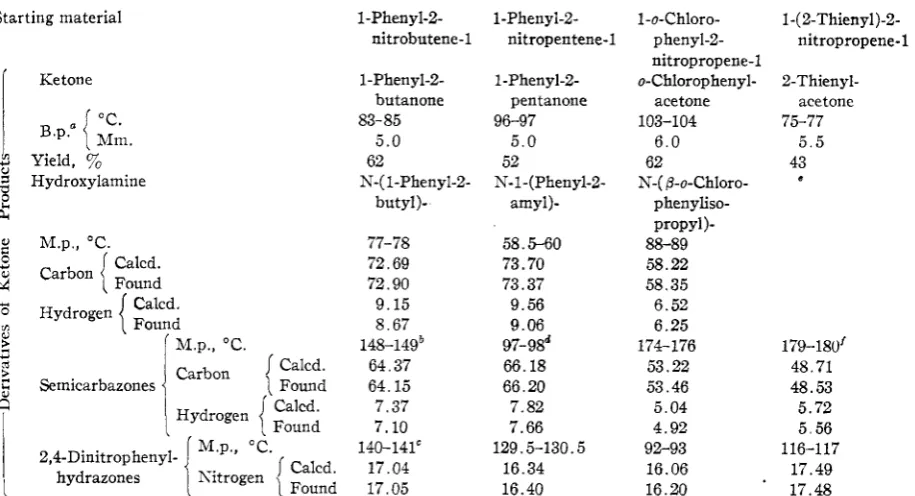
p-Aralkyl)- hydroxylamines.-By treating the corresponding nitro- olefins with a 20% excess of the amount of lithium alumi- num hydride necessary for the reduction of the double bondvia reverse addition at -40 to - 5 0 " , followed by hydrolysis by means of the rapid introduction of 400 ml. of 6 Ar hy- drochloric acid, and steam diqtillation of the aqueous phase, the ketones, listed in Table I, were prepared. The corre- sponding N-( 8-aralkyl)-hydroxylamines were isolated in low yields by making the aqueous acidic solution through (19) I t is also quite possible that the reduction m a y occur via a 1,4- addition especially in view of the polarity of the nitro group and of t4e fact that the reduction takes place a t -40 to -50". I t was reported' that the reduction of the double bond of cinnamyl alcohol proceeds slowly at room temperature after the rapid interaction of the polar alcoholic group with the hydride.
which the steam had been passed, alkaline and extracting with ether.
1-o-Chlorophenyl-2-nitropropene-1.
A.Modified
Knoe- venagel-Walter Synthesis.zO-There were refluxed together for 8 hours, 28.1 g. (0.2 mole) of o-chlorobenzaldehyde, 15.0g. (0.2 mole) of nitroethane, 1.74 g. (0.02 mole) of n-amyl- amine and 30 ml. of absolute alcohol. On cooling, the mix- ture was stored in the refrigerator until the precipitation was complete. The mixture was filtered and the precipitate washed with a few ml. of absolute alcohol. There were thus obtained 20.0 g. of 1-o-chlorophenyl-2-nitropropene-l . An additional amount of 2.0 g. was obtained by concentra- tion of the filtrate and washings, bringing the total yield t o 56%.
B. Knoevenagel-Walter Synthesis.z'-When the same quantities of the above reagents were mixed and alldtved t o stand a t room temperature for 2 weeks, and the product was isolated in the same manner, there was obtained a total yield of 24.1 g. (61%) of I-o-chlorophenyl-2-nitropropene-1. Recrystallization from oabsolute ethanol produced bright yellow crystals, m.p. 40
.
Anal. Calcd. for CgHsClNO: C, 55.00; H, 4.08. Found: C, 54.98; H , 3.88.
2-Thienylacetoxime .-When 2-thienylacetone was treated in the usual mLnnerZ2 for the preparation of an oxime there was obtained, on recrystallization from petroleum ether (b.p. 60-75"), a white crystalline product, m.p. 91-92', which was not depressed when mixed with a sample prepared according to the method of Bouveault and Wahlze by the action of aluminum amalgam on 1-(2-thieny1)-2-nitropro- pene-1.
Discussion
The preparation of the ketones listed in Table I
demonstrated the general applicability of this
method
of
synthesizing carbonyl compounds from
p-arylnitroolefins. In general, the yields were
good, the lowest
(43y0)
being obtained from the
(20) H. B. Hass, A. G. Susie and R. L. Heider, J . Org. Chcm., 16, 8 (1950).(21) E. Knoevenagel and L. Walter, Bcr., 37, 4502 (1904). (22) R, L. Shriner and R . C. Fuson, "Identification of Organic Com- pounds," 3rd edition, John Wiley and Sons, Inc., New York. N. Y.,
[image:5.574.63.521.82.330.2]1s42
VOl.
74
relatively uiistable
1-(2-tl~ienyl)-2-nitropropene-l.
The ketones are assumed to arise
via
the same mech-
anism as did phenylacetone in the previous experi-
ment,
;.e.,
by a modified Nef reaction after the se-
lective reduction of the double bond of the nitroal-
kene.
The substituted hydroxylamines listed in Table
I
all readily reduced Tollens reagent a t room tem-
perature.
The experiments on the synthesis of the previ-
ously unreported 1 -o-chlorophenyl-2-nitropropene- 1
showed a slightly higher yield for the Knoevenagel-
Walter synthesis (61%
vs.56%)
as compared t o the
much shorter reaction time of the modified Knoe-
venagel-Walter synthesis (8 hours
vs.14 days).
The authenticity of the oxime prepared from
2-
thienylacetone was proven by means of the mixed
itielting point determination with the sample ob-
tained by the reduction of 1-(2-thienyl) %nitropro-
lietie-1with aluminum anialgain.
C.
Reduction
of
w-Nitrostyrene
Experimental
Reduction of w-Nitrostyrene to (3-Phenylethylamine, N- (
4-Phenylethy1)-hydroxylamine
and Phenylacetaldolrime.-
When 2.13 g. (0.056 mole, half the amount necessary for the reduction of the nitro group) of lithium aluminum hydride dissolved in 100 ml. of absolute ether, was added to 11.2 g. (0.075 mole) of w-nitrostyrene a t -30 to -40' as before and after hydrolysis with 20% aqueous sodium potassium tartrate, a mixture of products was obtained. Upon dis- tillation, there was isolated 0.5 g. (6%) of P-phenylethyl- amine, b.p. 72-77' (6.0 mm.). The residuelIb in the dis- tilling flask was dissolved in ether and extracted with an excess of 1 N hydrochloric acid. After removal of the ether by distillation there was obtained 1.6 g. (16%) of phenyl- ;tcetaldoxime which melted a t 97-98' after recrystallization from petroleum ether (b.p. 60-75'). The recorded23 1ii.p. is 97-99'.Anal. Calcd. for C8I-I&0: C, 71-09; 11, 6.71. Found:
C, 71.03; H, 6.45.
Seutralization of the acidic washings with dilute aqueous sodium carbonate afforded 3.4 g. (33%) of N-( P-phenyl- cthy1)-hydroxylamine. After recrystallization from light petrolepn ether, it melted a t 83-84'.
(1naZ. Calcd. for CsHI1SO: C, 70.04; 11, 8.08. Found:
C, 70.12; H, 7.93.
Phenylthioureide of
0-Phenylethy1amine.-This
white crystalline substance was synthesized according to the pre- viously utilized p r o c e d ~ r e . ~ Its m.p. was 110-110.5". The n1.p. was previously reportedz4 as 111"..lnal. Calcd. for CISHIG1\TgS: C, 70.27; H, 6.29. Found:
C , 70.38; H, 6.10.
p-Phenylethylamine Hydrochloride .-This compound was prepared by the previously described procedure. It was recrystallized from an absolute alcohol-ether combination.
Its m.p. was 215-217". Literaturez5 records the m.p. as 217'.
Action of 2,4-Dinitrophenylhydrazine Sulfate
on
Phenyl- acetaldoldme.-Khen 0.5 g. of phenylacetaldoxime was treated according to the previously utilized procedure forI he preparation of n 2,4-dinitrophenylhydrazone, there was obtained an orange crystalline solid, m.p. 121-121.5', which (lid not depress the m.p. of an authentic sample of the 2,4- dinitrophenylhydrazone of phenylacetaldehyde.
N-( p-Phenylethy1)-p-nitophenylnitone .--When 2.7 g
.
i 0.02 mole) of N-( @-phenylethy1)-hydroxylamine dissolved
i n 6 ml. of absolute alcohol, and 0 . 3 g. (0.02 mole) of
p-
iiitrobenzaldehyde dissolved in 10 ml. of absolute alcohol, had been mixed together, the solution started to deposit yellow crystals after 2 hours standing at room temperature.123) W. Dolllus, Ber.. 26, 1917 (1892).
( 2 4 ) J . von Brauu a n d 11. Ikutsch, ibid., 46, 2188 (1912).
( 2 5 ) K. Rindler, Germ:w P;it-nt .i(i2.71 1 (1931).
After 24 hours the precipitate was filtered and rccrystallized from absolute alcohol. In this way there was obtained a
yellow crystalline solid, m.p. 157-158'.
Anal. Calcd. for C15H1,N~Oa: C, 66.65; H, 5.22. Found: C, 66.75; H, 5.29.
N-(
6-Phenylethy1)-hydroxylamine
Oxalate.-The neutral oxalate was prepared as previously described and recrystal- lized from a methanol-ether combination. Its m.p. was 165.5-167' with decomDosition.Anal. Calcd. for Cl8H2&!~O,j: C, 59.30; H, 6.59. Found: C, 59.85; H, 6.49.
Pheny1acetaldehyde.-When 0.855 g. (0.0225 mole., a 20% excess for the reduction of the double bond) of lithium aluminum hydride was treated with 11.2 g. (0.075 mole) of w-nitrostyrene via reverse addition a t -40 to -50' arid hydrolysis was brought about by 400 ml. of 6 N hydro- chloric acid introduced rapidly, there was obtained after steam distillation of the acidic hydrolytic mixture and rec- tification, 0 to 0.46 g.
(0-57,)
of phenylacetaldehyde, b.p. 63-69' (5.0 mni.).When hydrolysis of the intermediate organometallic coni- plex was effected with the calculated amount of 1 N hydro- chloric acid, added slowly, the ether layer afforded a crude yellow oil which, when treated according t o the nitrous acid test, gave an orange-red coloration comparable in shade and intensity to that given by 1-nitrobutane when similarly treated.
The crude oil was then triturated with a solution of 4.0 g. of sodium hydroxide in 75 ml.
of
water to yield a dispersion which, when added to an ice cold solution of 12.5 ml. of sulfuric acid in 80 ml. of water during rapid stirring (Nef reaction), allowed the separation of 0.92 g. (10%) of phenyl- acetaldehyde, b.p. 63-64' (5.0 mm.).The methone derivative of phenylacetaldehyde was pre- pared by the usual method.26 Its m.p. was 164-165', the same as reported p r e v i o ~ s l y . ~ ~
The 2,4-dinitrophenylhydrazone of phenylacetaldehydc was prepared as before. Its m.p. was 121-121.5' which was not depressed when mixed with an authentic sample.
Discussion
In general, the experiments
on the reduction
oi
o-nitrostyrene
Via
the reverse addition of lithium
aluminum hydride indicated that i t behaved simi-
larly to
1-phenyl-2-nitropropene-1.
I n most cases,
the same derivatives were prepared to characterize
the various products.
However, a dissimilarity showed itself in the
synthesis of the carbonyl derivative insofar as the
yield of phenylacetaldehyde was very low.
It
is
believed that here the mechanism of the reduction
is
still comparable while the ease of hydrolysis dif-
fers. The facts that a positive nitrous acid test
was obtained for a primary nitro compound and
that the yield of phenylacetaldehyde was improved
when the conditions of the Nef reaction were more
strictly imposed, support this contention.
The preparation of phenylacetaldehyde marks the
first
reliable synthesis
ofthe
next
higherhomolog
ofbenzaldehyde
via
w-nitrostyrene, since the reported
reduction of o-nitrostyrene to the aldoxime followed
by hydrolysis to the aldehyde,28 has been described
as being incapable
of
r e p e t i t i ~ n . ~ ~
Acknowledgments.-This
study was aided
i l lpart by a grant from the Office of Naval Research.
The authors wish to express their gratitude to Miss
Cecelia Vitiello of the Schering Corp., Bloomfield,
N. J., for the infrared absorption data and their
( 2 6 ) E. C. Homing and M. G. Homing, J . O t g . Chem., 11, 9;
(1946).
(27) R. H. Lin and R. Robinson, J . C h o n . Soc., 2003 (1938).
( 2 8 ) I,. Bouveault and X. \Val& BirLI. POC. cliim.. [ 3 j 29, 518
(1903).
April
5,
1952
THE
SYSTEMAMMONIUM
FLUORIDE-SODIUM
FLUORIDE-WATER1
S43
nterpretation. The analyses were performed by
A. A.
Sirotenko of this Department. The plati-
num black catalyst was placed a t our disposal by
Baker and
Co.,
Inc., Newark
5 ,
N.
J.,
and the
nitroparaffins by Commercial Solvents Corp.
NEW YORK 58, N.
Y.
RECEIVED OCTOBER 17, 1951[CONTRIBUTION FROM THE DEPARTMENT OF CHEMISTRY, UNIVERSITY OF KEW HAMPSHIRE]
The System
Ammonium
Fluoride-Sodium Fluoride-Water at
25’’
BY
HELMUT
M.
HAENDLER
ANDAvrs CLOW
The system ammonium fluoride-sodium fluoride-water has been studied a t 25’. The system is simple; the solid phases are ammonium fluoride and sodium fluoride. No hydrate of sodium fluoride was found.
I n a previous article2
a study of the system am-
monium fluoride-potassium
fluoride-water was
reported. Similar measurements have been made
on the corresponding system involving sodium fluo-
ride in place of potassium fluoride. The system is a
simple one; no double salts are formed, the solid
phases being only ammonium fluoride and sodium
fluoride.
No evidence was found for the existence
of hydrated sodium fluoride in the equilibrium
mixture.3
TABLE
I
ANALYSES OF SOLUTIONS AND WET RESIDUES Solutions, weight %
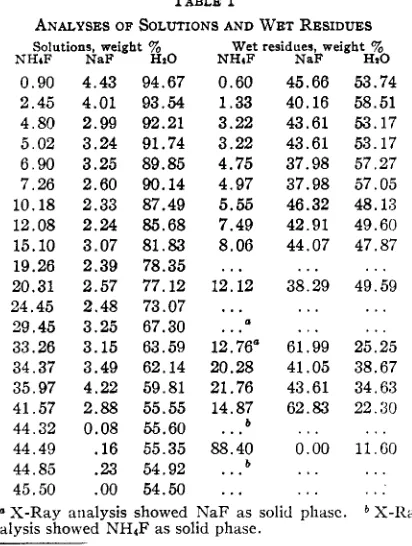
NH4F N a F Ha0 NHaF Wet residues, weight N a F HzO % 0 .9 0 4 . 4 3 94.67 0 . 6 0 45.66 53.74 2 . 4 5 4.01 93.54 1 . 3 3 40.16 58.51 4 . 8 0 2 .9 9 92.21 3.22 43.61 53.17 5 . 0 2 3 . 2 4 91.74 3 . 22 43.61 53.17 6.90 3 .25 89.85 4.75 37.98 57.27 7 . 2 6 2 .6 0 90.14 4 . 9 7 37.98 57.05 10.18 2. 33 87.49 5.55 46.32 48.13 12.08 2 .24 85.68 7.49 42.91 49.60 15.10 3. 07 81.83 8 . 06 44.07 47.87 19.26 2 . 3 9 78.35
...
. . .
. . .
20.31 2 . 5 7 77.12 12.12 38.29 49.59 24.45 2. 48 73.07
...
. . .
. . .
29.45 3. 25 67.30
...“
. . .
. . .
33.26 3.15 63.59 12.76“ 61.99 25.25 34.37 3.4 9 62.14 20.28 41.05 38.67 35.97 4.2 2 59.81 21.76 43.61 34.63 41.57 2.8 8 55.55 14.87 62.83 22.30 44.32 0.08 55.60 . . . b
. . .
. . .
44.49 .16 55.35 88.40 0.00 11.60 44.85 .23 54.92 . . . b
. . .
. . .
45.50 .OO 54.50
...
. . .
. . .
a X-Ray analysis showed NaF as solid phase. X-Ray aiialysis showed NH4F as solid phase.
(1) This work is part of a program of research on inorganic fluorides supported by the Research Corporation and the Atomic Energy Commission.
(2) H . M. Haendler and A. W. Jache. THIS J O U R N A L , 72, 4137 (18.50).
(3) Compare N. V. Sidgwick, “The Chemical Elements and their Compounds,” Vol. I, The Clarendon Press, Oxford, 1950, p. 94. and
H. J. Emeleus in J. H. Simons. ed.. “Fluorine Chemistry,” Vol. I , Academic Press, Inc., N e w York, N. Y., 1950, p. 27.
Experimental
As in the previous work, the Schreinemakers wet residue method was used. The apparatus was the same, with poly- ethylene cups fitted with motor-driven lucite stirrers. All chemicals were C.P. grade.
The solutions and wet residues were analyzed for am- monium ion and sodium ion. Ammonia was determined by distillation from alkaline solution into boric acid and titra- tion with standard acid. Sodium was weighed as sulfate
after ignition with sulfuric acid and heating with ammonium carbonate. The low concentration of sodium fluoride in the equilibrium mixture made satisfactory analysis more difficult than with the potassium fluoride system. The solutions were slow in attaining equilibrium.
In
several cases the identity of the solid phase was checked by X-ray diffraction. using copper radiation with a nickel filter and a Philips 114.59 mm. powder camera.HzO
NH4F Sal’
Fig. 1.-The system aiiiiiioniuin fluoride-sodium fluoridc- water a t 25’.