Graph Model for Chinese Spell Checking
∗Zhongye Jia, Peilu Wang and Hai Zhao†
MOE-Microsoft Key Laboratory for Intelligent Computing and Intelligent Systems, Center for Brain-Like Computing and Machine Intelligence
Department of Computer Science and Engineering, Shanghai Jiao Tong University 800 Dongchuan Road, Shanghai 200240, China
jia.zhongye,[email protected],[email protected]
Abstract
This paper describes our system in the Bake-Off 2013 task of SIGHAN 7. We illustrate that Chinese spell checking and correction can be efficiently tackled with by utilizing word segmenter. A graph model is used to represent the sentence and a single source shortest path (SSSP) algo-rithm is performed on the graph to correct spell errors. Our system achieves 4 first ranks out of 10 metrics on the standard test set.
1 Introduction and Task Description
Spell checking is a common task in every writ-ten language, which is an automatic mechanism to detect and correct human errors. However, spell checking in Chinese is very different from that in English or other alphabetical languages. In Bake-Off 2013, the evaluation includes two sub-tasks: detection and correction for Chinese spell errors. The errors are collected from students’ written es-says.
The object of spell checking is word, but “word” is not a natural concept for Chinese since there are no word delimiters between words. Most Chinese natural language processing tasks require an addi-tional word segmentation phase beforehand. When a word is misspelled, the word segmentation could not be processed properly. Another problem with Chinese is that the difference between “characters” and “words” is not very clear. Most Chinese char-acters itself can also be words which are called
∗This work was partially supported by the National Nat-ural Science Foundation of China (Grant No.60903119, Grant No.61170114, and Grant No.61272248), and the National Ba-sic Research Program of China (Grant No.2009CB320901 and Grant No.2013CB329401).
†Corresponding author
“single-character words” in Chinese. Thus Chi-nese is a language that may never encounter “out-of-vocabulary (OOV)” problem. Spell errors in al-phabetical languages, such as English, are always typically divided into two categories:
• The misspelled word is a non-word, for exam-ple “come” is misspelled into “cmoe”;
• The misspelled word is still a legal word, for example “come” is misspelled into “cone”.
Spell errors in Chinese are quite different. In Chi-nese, if the misspelled word is a non-word, the word segmenter will not recognize it as a word, but split it into two or more words with fewer characters. For example, if “你好世界 (hello world)” is misspelled into “你好世节”, the word segmenter will segment it into “你好/世/节” in-stead of “你好/世节”. For non-word spell error, the misspelled word will be mis-segmented.
Thus spell checking for Chinese cannot directly use those edit distance based methods which are commonly used for alphabetical languages. Spell checking for Chinese have to deal with word seg-mentation problem first, since misspelled sentence cannot be segmented properly by a normal word segmenter. And it is necessary to use information beyond word level to detect and correct those mis-segmented words.
In this paper, we describe the system submit-ted from the team of Shanghai Jiao Tong Univer-sity (SJTU). We are inspired by the idea of short-est path word segmentation algorithm. A directed acyclic graph (DAG) is built from the input sen-tence similar to the shortest path word segmenta-tion algorithm. The spell error detecsegmenta-tion and cor-rection problem is transformed to the SSSP prob-lem on the DAG. We also tried filters based on
tence perplexity (PPL) and character mutual infor-mation (MI).
2 System Architecture
We utilize a modified shortest path word seg-menter as the core part of spell checker. The origi-nal shortest path word segmentation algorithm is revised for spell checking. Instead of the seg-mented sentence, the output sentence of the modi-fied word segmenter is both segmented and spell-checked.
2.1 The Shortest Path Word Segmentation Algorithm
Shortest path word segmentation algorithm (Casey and Lecolinet, 1996) is based on the following as-sumption: a reasonable segmentation should max-imize the lengths of all segments or minmax-imize the total number of segments. For a sentence S of
mcharacters{c1, c2, . . . , cm}, the best segmented sentence S∗ of n∗ words {w1∗, w∗2, . . . , wn∗∗}
should be:
S∗= arg min {w1,w2,...,wn}
n. (1)
This optimization problem can be easily trans-formed to a SSSP problem on a DAG.
First a graphG = (V, E)must be built to rep-resent the sentence to be segmented. The ver-tices ofGare possible candidate words of adjacent characters. The words are fetched from a dictio-nary D. Two special verticesw−,0 = “<S>” and wn+1,− = “</S>” are added to represent the start and end of the sentence:
V ={wi,j|wi,j =ci. . . cj ∈D}∪{w−,0, wn+1,−}.
The edges are from a word to the next word:
E={< wi,j →wj+1,k, ω >|wi,j, wj+1,k ∈V},
where ω is the weight of edge which is set to 1,
ω=ω0≡1.
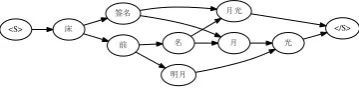
For example, the Chinese sentence “床前明 月光” can be represented by the graph shown in Figure 1. It can be easily proved that the graphG
is a DAG, and finding the best segmentation ac-cording to Equation 1 is finding the shortest path from “<S>” to “</S>”, which is an SSSP problem on DAG.
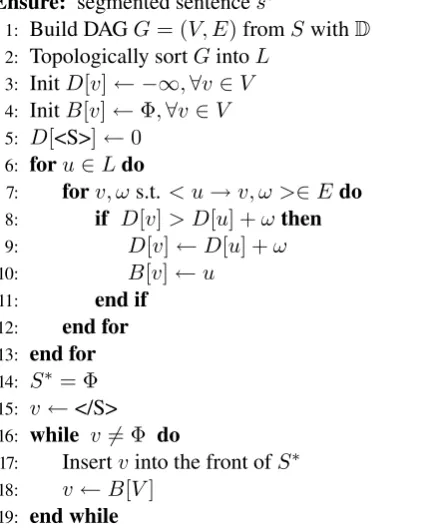
The SSSP problem on DAG have an simple al-gorithm (Eppstein, 1998) with time complexity of
<S> 床 前 明
明月 月 月光
光
[image:2.595.311.526.223.489.2]</S>
Figure 1: A sample of graph for segmentation
Algorithm 1SSSP algorithm for word segmenta-tion
Require: sentence of charactersS
Require: dictionaryD
Ensure: segmented sentences∗
1: Build DAGG= (V, E)fromSwithD
2: Topologically sortGintoL
3: InitD[v]← −∞,∀v∈V
4: InitB[v]←Φ,∀v∈V
5: D[<S>]←0
6: foru∈Ldo
7: forv, ωs.t. < u→v, ω >∈Edo
8: if D[v]> D[u] +ωthen
9: D[v]←D[u] +ω
10: B[v]←u
11: end if
12: end for 13: end for
14: S∗= Φ 15: v←</S>
16: while v̸= Φ do
17: Insertvinto the front ofS∗
18: v←B[V]
19: end while
O(|V|+|E|), The algorithm is shown in Algo-rithm 1.
The segmented sentence of the above ex-ample “床前明月光” is “床/前/明月/光” or “床/前/明/月光” by using the SSSP algorithm.
2.2 Using SSSP Algorithm fo Spell Checking
The basic idea of using SSSP algorithm for spell checking comes from the observation that a mis-spelled word is often splitted into two or more words by the shortest path word segmenter. If we can substitute the misspelled character with the correct one and provide it as a candidate word, then the shortest path word segmenter will choose the correct one, since it has less words.
charac-ters, but also characters substituted by those similar to the original ones. An additional map of similar charactersCis needed. The revised verticesV are:
V ={wi,j|wi,j =ci. . . cj ∈D}
∪ {wki,j|wi,jk =ci. . . c′k. . . cj ∈D,
τ ≤j−i≤T,
c′k∈C[ck], k=i, i+ 1, . . . , j}
∪ {w−,0, wn+1,−}.
The substitution is only performed on those words with lenth between some thresholdsτ andT. The weight of edges are respectively changed:
ω =f(ω0, ωs),
whereωsmeasures the similarity between the two characters andf(·,·)is a function to be selected.
With the modified DAG G, the SSSP algo-rithm can perform both segmentation task and spell checking task. Suppose the sentence “床前 明月光” is misspelled as “床前名月光”, the mod-ified graph is shown in Figure 2. The output of the
<S> 床 前
签名
名
明月 月 月光
光
[image:3.595.91.271.377.421.2]</S>
Figure 2: A sample of graph for spell checking
spell checker is “床/签名/月光”, note this is not the expected result.
2.3 Using Language Model with SSSP Algorithm
The problem with simple SSSP spell chekcer is that it only tries to merge short words into longer ones without considering whether that is reason-able. To reduce the false-alarm rate (Wu et al., 2010), we add some statistical criteria to the SSSP spell checker.
A natural statistical criteria is the conditional probability between words,P, which can be given by a language model (LM). The conditional prob-ability are combined into the weights of edges by some functiong(·,·,·):
ω=g(ω0, ωs, 1
P),
Note that the higher conditional probability means the sentence is more reasonable, so for the SSSP algorithm, the inverse of conditional probabilityP1 is used.
2.4 LM and MI Filter
In the sample set of Bake-Off 2013, we observed that there is at most one error in each sentence (Chen et al., 2011). But the spell checker may de-tect multiple errors. To choose the best correction, we run a filter and the one with lowest PPL or high-est MI gain is selected.
For LM filter, sentence PPL is used as the met-ric. The correction with lowest PPL is considered as best.
MI indicates how possible two characters are collocated together. Character based MI is used, for two adjacent charactersc1 andc2, the MI is:
MI(c1, c2) =log
P(c1)P(c2) P(c1c2)
The correction with highest MI gain∆M I is con-sidered as best:
∆MI=max(MI(ci−1, ci′)−MI(ci−1, ci),
MI(c′i, ci+1)−MI(ci, ci+1)).
3 Experiments
3.1 Data Sets and Resources
The Bake-Off 2013 sample data, Sample, con-sists 350 sentences without errors and 350 sen-tences with one error per sentence. The official test data, Test, consists of 1,000 unlabeled sen-tences for subtask 1 and another 1,000 sensen-tences for subtask 2. All the sentences are collected from students’ written essays. All the data are in tradi-tional Chinese.
The dictionary used in SSSP algorithm is So-gouW1 dictionary from Sogou inc., which is in simplified Chinese. The OpenCC2 converter is used to convert it into traditional Chinese. For similar character map the data set provided by (Liu et al., 2011) is used. The LM is built on the Academia Sinica corpus (Emerson, 2005) with IRSTLM toolkit (Federico et al., 2008). Prefix tree data structure is used to speed up the dictio-nary look-up. The implementation of Perl module Tree::Trie3is used with some modification.
3.2 Edge Weight Function selection
A series of experiments are performed to choose a good edge weight functiong(·,·,·). A simplified metric is used to evaluate different functions:
1http://www.sogou.com/labs/dl/w.html 2http://code.google.com/p/opencc/
3http://search.cpan.org/~avif/Tree-Trie-1.
• Correction precision:
P = # of correctly corrected characters # of all corrected characters ;
• Correction recall:
R= # of correctly corrected characters # of wrong characters of gold data;
• F1 macro:
F = 2PR
P+R.
The LM is set to 2-gram according to the obser-vations of (Yang et al., 2012). Improved Kneser-Ney (Chen and Goodman, 1999) algorithm is used for LM smoothing.
Multiplication of similarity and log conditional probability is firstly used as weight function:
ωM =−α(ω0+ωs)logP
whereω0 ≡1, andωsfor different kinds of charac-ters are shown in Table 1. The settings ofωsis in-spired by (Yang et al., 2012), in which pinyin4edit distance is used as weight. Word length threshold is set toτ = 2andT = 5. Experiments show that the choice ofαdoes not have notable influence on the result which remains atP = 0.49,R= 0.61,
F = 0.55onSample.
Type ωs
same pronunciation same tone 0 same pronunciation different tone 0 similar pronunciation same tone 1 similar pronunciation different tone 1
similar shape 1
Table 1:ωsused inωM
Linear combination of similarity and log condi-tional probability is then tried:
ωL=ωs−βlogP
where ω0 ≡ 0which is omitted in the equation,
andωsfor different kinds of characters are shown in Table 2.
We experimented with differentβand observed that with lager β, the spell checker tends to get more reasonable corrections soPgoes higher, but
R goes lower. TheP, R andF on Sample of differentβare shown in Figure 3.
LM and MI filters slightly improves the result of the spell checker. The results of applying two filters are shown in Figure 4.
4Pinyin is the official phonetic system for transcribing the
sound of Chinese characters into Latin script.
Type ωs
same pronunciation same tone 1 same pronunciation different tone 1 similar pronunciation same tone 2 similar pronunciation different tone 2
[image:4.595.309.527.58.319.2]similar shape 2
Table 2: ωsused inωL
0.2 0.3 0.4 0.5 0.6 0.7 0.8 0.9 1
0 2 4 6 8 10 12 14
Precision, R
ecall and F1 curves
β
Precision Recall F1
Figure 3:P,RandF achieved by differentβ
3.3 Results
In the final test we submitted 3 runs, using edge weight functionωL, of whichβ is set to 0, 6, and 10. Since there is no remarkable improvement by applying filters and the final test data has no claim that there’s only one error per sentence, no filters are applied in the final test. The results onTest
are listed in Table 3 and Table 4, in which those metrics that we got first rank are marked as bold.
Metric Run1 Run2 Run3
False-Alarm Rate 0.44 0.0957 0.0229
Detection Accuracy 0.662 0.856 0.844 Detection Precision 0.4671 0.769 0.9091
Detection Recall 0.9 0.7433 0.5333
Error Location Accuracy 0.522 0.805 0.809 Error Location Precision 0.2249 0.5931 0.7102
[image:4.595.82.281.417.519.2]Error Location Recall 0.4333 0.5733 0.4167
Table 3: Final test results of subtask 1
Metric Run1 Run2 Run3
Location Accuracy 0.372 0.475 0.37
Correction Accuracy 0.338 0.442 0.356 Correction Precision 0.3828 0.636 0.705
Table 4: Final test results of subtask 2
4 Conclusion and Future Work
the Bake-Off 2013 task. A graph model is utilized to represent the spell checking problem and SSSP algorithm is applied to solve it. By adjusting edge weight function, a trade-off can be made between precision and recall.
A problem with the current result is that the test data set is a manually collected one with very high error rate. In subtask 1, nearly 50% sentences con-tains spell errors and in subtask 2, every sentence contains at least one spell error. This error rate is far higher than that in normal text. We may con-sider using data from normal text in future work.
References
Richard G Casey and Eric Lecolinet. 1996. A sur-vey of methods and strategies in character
segmen-tation. Pattern Analysis and Machine Intelligence,
IEEE Transactions on, 18(7):690–706.
Stanley F Chen and Joshua Goodman. 1999. An
empirical study of smoothing techniques for
lan-guage modeling. Computer Speech & Language,
13(4):359–393.
Yong-Zhi Chen, Shih-Hung Wu, Ping-Che Yang, and
Tsun Ku. 2011. Improve the detection of
im-properly used chinese characters in students’ essays
with error model. International Journal of
Continu-ing EngineerContinu-ing Education and Life Long LearnContinu-ing, 21(1):103–116.
Thomas Emerson. 2005. The second international
chi-nese word segmentation bakeoff. In Proceedings
of the Fourth SIGHAN Workshop on Chinese Lan-guage Processing, pages 123–133.
David Eppstein. 1998. Finding the k shortest paths. SIAM Journal on computing, 28(2):652–673.
Marcello Federico, Nicola Bertoldi, and Mauro Cettolo. 2008. Irstlm: an open source toolkit for handling
large scale language models. InInterspeech, pages
1618–1621.
C.-L. Liu, M.-H. Lai, K.-W. Tien, Y.-H. Chuang,
S.-H. Wu, and C.-Y. Lee. 2011. Visually and
phonologically similar characters in incorrect chi-nese words: Analyses, identification, and applica-tions. 10(2):10:1–10:39, June.
Shih-Hung Wu, Yong-Zhi Chen, Ping-Che Yang, Tsun Ku, and Chao-Lin Liu. 2010. Reducing the false alarm rate of chinese character error detection and
correction. In CIPS-SIGHAN Joint Conference on
Chinese Language Processing.
Shaohua Yang, Hai Zhao, Xiaolin Wang, and Baoliang
Lu. 2012. Spell checking for chinese. In
Interna-tional Conference on Language Resources and Eval-uation, pages 730–736, Istanbul, Turkey, May.
0.3 0.4 0.5 0.6 0.7 0.8 0.9 1
0 2 4 6 8 10 12 14
Score
β
Original LM Filter MI Filter
(a) Precision
0.25 0.3 0.35 0.4 0.45 0.5 0.55 0.6 0.65
0 2 4 6 8 10 12 14
Score
β
Original LM Filter MI Filter
(b) Recall
0.4 0.45 0.5 0.55 0.6 0.65 0.7
0 2 4 6 8 10 12 14
Score
β
Original LM Filter MI Filter
[image:5.595.308.528.159.622.2](c) F1