You talking to me?
A predictive model for zero auxiliary constructions
Andrew Caines
Computation, Cognition & Language Group RCEAL, University of Cambridge, UK
Paula Buttery
Computation, Cognition & Language Group RCEAL, University of Cambridge, UK
Abstract
As a consequence of the established prac-tice to prefer training data obtained from written sources, NLP tools encounter problems in handling data from the spo-ken domain. However, accurate models of spoken data are increasingly in demand for naturalistic speech generation and ma-chine translations in speech-like contexts (such as chat windows and SMS). There is a widely held assumption in the lin-guistic field that spoken language is an impoverished form of written language. However, we show that spoken data is not unpredictably irregular and that lan-guage models can benefit from detailed consideration of spoken language features. This paper considers one specific con-struction which is largely restricted to the spoken domain - the ZERO AUXILIARY -and makes a predictive model of that con-struction for native speakers of British En-glish. The model can predict zero auxil-iary occurrence in the BNC with 96.9% accuracy. We will demonstrate how this model can be integrated into existing pars-ing tools, increaspars-ing the number of suc-cessful parses for this zero auxiliary con-struction by around 30%, and thus improv-ing the performance of NLP applications which rely on parsing.
1 Introduction
Up to this point, statistical Natural Language Pro-cessing (NLP) tools have generally been trained on corpora that are representative of written rather than spoken language. A major factor behind this decision to use written data is that it is far easier to collect than spoken data. Newswire, for instance, may be harvested readily and in abundance. Once
collected, written language requires relatively lit-tle processing before it can be used for training a statistical model.
Processing of spoken data, on the other hand, involves at the very least transcription - which usu-ally requires a human transcriber. Since transcrip-tion is a slow and laborious task, the collectranscrip-tion of spoken data is highly resource intensive. But this relative difficulty in collection is not the only rea-son that spoken language data has been sidelined. Had spoken data been considered to be crucial to the production of NLP applications greater efforts might have been made to obtain it. However, on account of some of its characteristic features such as hesitations, interruptions and ellipsis, spoken language is often dismissed as nothing more than a noisy approximation to ‘real’ or ‘intended’ lan-guage.
In some forums, written language is held up as an idealised form of language toward which speakers aspire and onto which spoken lan-guage should be retrofitted. This is an arte-fact of the theoretical notion of a ’competence’-’performance’ dichotomy (Chomsky 1965) with the latter deemed irrelevant and ignored in main-stream linguistic research.
The consequence of the established practice to sideline spoken data is that NLP tools are inher-ently error prone when handling data from the spo-ken domain. With increasing calls for speech to be considered the primary form of language and to be treated as such (Sampson 2001: 71; Cerm´ak 2009: 1152; Haugh 2009: 743) and a growing trend for NLP techniques to be integrated into cognitive and neurolinguistic research as well as forensic
appli-1
Speech is “unquestionably the more natural, basic mode of language behaviour”.
2“From a linguistic point of view, spoken corpora should
be primary for research but that has not been the case so far”.
3Haugh observes that “spoken language and interaction
lie at the core of human experience” but bemoans the “relative neglect of spoken language in corpora to date”.
cations, there are now compelling reasons to ex-amine spoken data more closely. Accurate mod-els of spoken data are increasingly in demand for naturalistic speech generation and machine trans-lations in speech-like contexts (such as human-machine dialogue, chat windows and SMS).
The main research aim of our work is to show that spoken data should not be considered error prone and therefore unpredictably irregular. We show that language models can be improved in in-crements as we deepen our understanding of spo-ken language features. We investigateZERO AUX -ILIARY progressive aspect constructions - those which do not feature the supposedly obligatory auxiliary verb, as in (1a) below (cf. 1b):
(1a) What you doing? Who you looking for? You been working?
(1b) What are you doing? Who are you looking for? Have you been working?
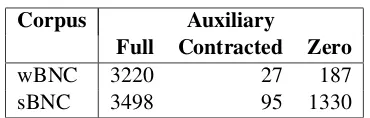
The zero auxiliary is a non-standard feature which for the most part is known to be restricted to speech. A corpus study of spoken British En-glish indicates that in progressive aspect interroga-tives with second person subjects (as in (1) above) the auxiliary occurs in zero form in 27% of con-structions found. The equivalent figure from the written section of the corpus is just 5.4%. Con-sequently, existing NLP techniques - since they are based on written training data - are unlikely to deal appropriately with zero auxiliary construc-tions. We report below on the corpus study in full and use the results of logistic regression to design a predictive model of zero auxiliary occurrence in spoken English. The model is based on con-textual grammatical features and can predict zero auxiliary occurrence in the British National Cor-pus (BNC; 2007) with 96.9% accuracy. Finally, we discuss how this model can be used to improve the performance of NLP techniques in the spoken domain, demonstrating its implementation in the RASP system (Robust Accurate Statistical Pars-ing; (Briscoe, Carroll and Watson, 2006)).
This paper underlines why awareness of non-standard linguistic features matters. Targeted data extraction from large corpus resources allows the construction of more informed language models which have been trained on naturalistic spoken usage rather than standard and restricted rules of written language. Such work has only been made possible with the advent of large spoken language
corpora such as the BNC. Even so, the resource-heavy nature of spoken data collection means that speech transcriptions constitute only one tenth of this 100 million word corpus 4. Nevertheless, it is an invaluable resource made up of a range of speech genres including spontaneous face-to-face conversation, a fact which makes it unique among corpora. Since conversational dialogue is the pre-dominant language medium, the BNC offers the best chance of modelling speech as it occurs natu-rally.
This work has important implications for both computational and theoretical linguistics. On the one hand, we can improve various NLP techniques with more informed language models, and on the other hand we are reminded that the space of grammatical possibility is not restricted and that continued empirical investigation is key in order to arrive at the fullest possible description of lan-guage use.
2 Spoken and written language
In the modern mainstream fields of linguistic research, based on Chomsky’s ‘ideal speaker-listener’ (1965), spoken language has been all too easily dismissed from consideration on the grounds that it is more error-prone and less impor-tant than written language. In this idealisation, the speaker-listener is “unaffected by such grammati-cally irrelevant conditions as memory limitations, distractions, shifts of attention and interest, and er-rors (random or characteristic)” (Chomsky, 1965). The ‘errors’ Chomsky refers to are features of speech production such as pauses, filled silence, hesitation, repetition and elision, or of dialogue such as backgrounding, overlap and truncation be-tween speakers. Thus ‘error’ is essentially here de-fined as that which is not normally found in well-formed written data, that which is ‘noisy’ and ‘un-predictable’. It is on these grounds - the gram-matical rigidity of the written medium relative to speech - that the divide between spoken and writ-ten language modelling has grown up.
The opposing, usage-based view is that spoken language is systematic and that it should be mod-elled as it is rather than as a crude approximation of the written form. On this view, the speech pro-duction and dialogue features listed above are not
4Cerm´ak estimates our experience with each language
considered mistakes but “regular products of the system of spoken English” (Halliday, 1994). ‘Er-ror’ is thus seen as a misnomer for these features because they are in fact all regular in some way. For example, the fact that people tend to put filler pauses in specific places.
We propose a middle way: that which builds on the NLP tools available, even though they are trained on written data, and on top of these models the features of spoken language as ‘noise’ in the communicative channel. This is a pragmatic ap-proach which recognises the considerable amount of work underpinning existing NLP tools and sees no value in discarding these and starting again from scratch. We demonstrate that spoken lan-guage is model-able and predictable, even with a feature which would not be seen as ‘correct’ in written form. For practical purposes we need to recognise the regularities in the apparently ‘in-correct’ features of speech and build these into the functioning language models we already have through statistical analysis of corpus distributions and appropriate adjustment to parser tools.
3 The zero auxiliary construction
According to standard grammatical rules, the aux-iliary verb is an obligatory feature of progressive aspect constructions. However, this rule is based on norms of written language and is in fact not al-ways adhered to in the production of speech. As a result, some progressive constructions do not fea-ture an auxiliary verb. These are termed ‘zero aux-iliary’ constructions and have been previously ex-amined in studies of dialect (Labov, 1969; Ander-sen, 1995) and first language acquisition (Brown, 1973; Rizzi, 1993/1994; Wexler, 1994; Lieven et al, 2003; Wilson, 2003; Theakston et al, 2005).
There are copious anecdotal examples of the zero auxiliary:
(2) You talking to me? Travis Bickle in Taxi Driver(1976).
(3) Where he going? Avon Barksdale in The Wire, Season 1: ‘Game Day’ (2002).
(4) What you doing? Holly Golightly in Breakfast at Tiffany’s(1961).
Natural language data taken from the spoken section of the British National Corpus (sBNC) shows that the zero auxiliary features in 1330
(27%) of the 4923 second person progressive in-terrogative constructions; as in (1), (2), (4) above. In first person singular declaratives (cf. (5a) and (5b)), in contrast, the proportion of zero auxiliary occurrence is just 0.9% (158 of 17,838 construc-tions). This already indicates the way that the zero auxiliary occurs in predictable contexts and how grammatical properties will feature in the predic-tive model.
(5a) What I saying? I annoying you? Why I doing this?
(5b) What am I saying? Am I annoying you? Why am I doing this?
Subject person, subject number, subject type (pronoun or other noun) and clause type (declar-ative or interrog(declar-ative) are four of the eight syntac-tic properties incorporated in the predictive model. The four other properties are clause tense (6), per-fect or non-perper-fect aspect (7), clause polarity (8) and presence or absence of subject (9).
(6) You are debugging. You were de-bugging.
(7) We have been looking for a present. We are looking for a present.
(8) She is watching the grand prix. He is not watching the grand prix.
(9) I am going to town in a minute. Go-ing to town in a minute.
result in the loss of tense and aspect information, but with the ability to predict where a zero auxil-iary might occur, the auxilauxil-iary can be restored so that translation can be performed with appropriate tense and aspect.
For all these reasons, the zero auxiliary in spo-ken English is an appropriate case study for find-ing the common ground between NLP and Lin-guistics. Awareness of this particular linguis-tic phenomenon through corpus study allows the construction of more informed language models which in turn enhance relevant NLP techniques. The cross-pollination of research from NLP and linguistics benefits both fields and ties in with the emergence of linguistic theories that “conceive of structure as gradient, malleable and probabilistic” and incorporate “knowledge of the frequency and probability of use of these categories in speakers’ experience” (Tily et al, 2009). These are collec-tively known as ‘usage-based’ approaches to lan-guage theory and are exerting a growing influ-ence on the field (e.g. Barlow and Kemmer 2000; Bybee and Hopper 2001; Bod, Hay and Jannedy 2003).
4 Corpus study
Training data was obtained through manual anno-tation of progressive constructions in the British National Corpus (2007). A preliminary study of interrogatives with second person subjects con-firmed that the zero auxiliary is more a feature of the spoken rather than the written domain (Ta-ble 1). Therefore a focus on the spoken section of the corpus (sBNC) was justified and so we under-took a comprehensive study of all progressive con-structions in sBNC. The genres contained in sBNC include a range of settings and levels of formality - from academic lectures to radio programmes to spontaneous, face-to-face conversation.
We extracted 93,253 sentences featuring a pro-gressive construction from sBNC and each was manually annotated for auxiliary realisation and the eight syntactic properties described in Ta-ble 2. In TaTa-ble 3 the progressive constructions are classified by auxiliary realisation. With approxi-mately 4.2% occurrence in progressive construc-tions, zero auxiliaries are a low frequency feature of spoken language but ones which are significant for the fact that existing NLP tools cannot suc-cessfully parse them, thus one in twenty-five pro-gressive constructions will not be fully parsed. We
Corpus Auxiliary
Full Contracted Zero
wBNC 3220 27 187
[image:4.595.324.509.59.118.2]sBNC 3498 95 1330
Table 1: Auxiliary realisation in second person progressive interrogatives in the BNC.
use the annotated corpus of these progressive con-structions to design the predictive model described below.
Properties Value encodings Aux realisation
Zero auxiliary full(0), contracted(1), zero(2) Variables
Subject person 1st(1), 2nd(2), 3rd(3) Subject number singular(0), plural(1) Subject type other noun(0), pronoun(1) Subj supplied zero subj(0), subj supplied(1) Clause type declarative(0), interrogative(1) Clause tense present(0), past(1)
Perfect aspect non-perfect(0), perfect(1) Polarity positive(0), negative(1)
Table 2: Syntactic features and their encodings in the annotated sBNC Progressive Corpus
5 Model
To predict the zero auxiliary in spoken language we use logistic regression. To train this model we took a 90% sample from our corpus of 93,253 progressive constructions extracted from the spo-ken section of the BNC, as described above and in Caines 2010. The dataset was split into two cat-egories: those sentences which exhibited the zero auxiliary and those which did not5. A logistic re-gression was then performed to ascertain the prob-ability of category membership using the eight previously described syntactic properties. Note that subject person is arguably not a scalar
vari-5
Contracted auxiliaries thus belong in the ‘not zero auxil-iary’ category.
Corpus Full Contracted Zero
sBNC 38,015 51,295 3943
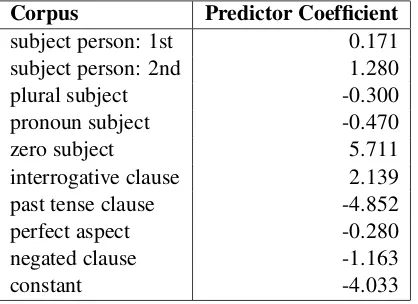
able and therefore is re-analysed as three boolean variables with separate binary values for use of the first, second and third person. However, the three subject person variables are dependent (ie. If the subject is not first or second person it will be in the third). Thus the eight syntactic properties become nine explanatory variables in the predictive model, as reported in Table 4.
Corpus Predictor Coefficient
subject person: 1st 0.171 subject person: 2nd 1.280
plural subject -0.300
pronoun subject -0.470
zero subject 5.711
interrogative clause 2.139 past tense clause -4.852
perfect aspect -0.280
negated clause -1.163
[image:5.595.79.288.183.335.2]constant -4.033
Table 4: Predictor coefficients for the presence of a zero auxiliary construction.
5.1 Model Evaluation
The logistic function is defined by:
f(Z) = 1
1 +e−z (1)
The variable z is representative of the set of pre-dictors and is defined by:
z=β0+β1x1+β2x2+. . .+βkxk (2)
whereβ0,β1,β2 ... βk are the regression
coeffi-cients of predictorsx1,x2.. xkrespectively. The
predictors explored in this paper are encodings of the syntactic properties of the annotated sentences. The predictors and their encodings are indicated in Table 2.
The logistic function is constrained to values between 0 and 1 and represents the probability of membership of one of the two categories (zero auxiliary or auxiliary supplied). In our case an
f(z) > 0.5 indicates that there is likely to be a zero auxiliary.
The logistic function defined by the coefficients in Table 4 is able to predict correct category mem-bership for 96.9% of the sentences in the annotated corpus. All coefficients are highly significant to
the logistic function (p<0.001) with the exception of perfect aspect and first person subject - which are both significant nevertheless (p<0.05).
For this model, positive coefficients indicate that the associated syntactic properties raise the probability of a zero auxiliary occurring. Large coefficients more strongly influence the probabil-ity of the zero auxiliary whereas near-zero coeffi-cients have little influence. From the coefficoeffi-cients in Table 4 we see that the strongest predictor of a zero auxiliary is the occurrence of a zero sub-ject (as in the utterance,‘leaving now.’). An inter-rogative utterance is also a good candidate, as is the second person subject (e.g. ‘you eating those olives?’). However, a past tense utterance is an un-likely candidate for a zero auxiliary construction, as is a negated utterance.
6 Discussion — using the predictive model to aid parsing
As mentioned above, since parsers are trained on written data they can often display poor perfor-mance on text transcribed from the spoken do-main. From the results of our corpus study we know that the zero auxiliary occurs in approxi-mately 4.2% of progressive constructions in spo-ken language and we can extrapolate that it will occur in less than 1% (approximately 0.8%) of all progressive constructions in written language. A statistical parser trained on written language will therefore be prone to undergo parsing fail-ure for every one in twenty-five progressive sen-tences. This is no insignificant problem, espe-cially when it is remarked that the progressive is in high frequency usage (there are one thousand ING-forms featuring in progressive constructions for every one million words of sBNC) and that its use is known to be spreading (Leech et al, 2009).
(|relation| |head| |dependant|) (3)
(|ncsubj| |play+ing:V V G| |you:P P Y|)(4)
(|obj| |play+ing:V V G| |what:DDQ|)(5)
(|aux| |play+ing :V V G| |be+ :V BR|) (6)
(|arg| |play+ing:V V G| |you:P P Y|) (7)
(|relation| |verb:V V G| |dependant|) (8)
Figure 1: Example grammatical relations from RASP.
may be integrated into a parser pipeline in order to aid the parsing of spoken language. In this way we build on the increasingly robust engineering of statistical NLP tools trained on written language by allowing them to adapt to the spoken domain on the basis of the linguistic study of speech phe-nomena.
In general the notion of ‘parsing’ an utterance involves a chain of several processes: utterance boundary detection, tokenization, part-of-speech tagging, and then parsing. We suggest that when it is known that the language to be parsed is from the spoken domain the pipeline of processes should be run in aSPEECH AWARE MODE. Extra functional-ity would be incorporated into each of the stages according to the findings of linguistic research into spoken language. In other work we have adapted the tokenization and tagging stages of the pipeline based on predictors that indicate when interjec-tions (e.g.‘umm’,‘err’and‘ah’) have been ‘used’ as punctuation or lexical items. We also incorpo-rate intonation phrases as predictors for utterance boundary detection (Buttery and Caines: in prepa-ration). Here, we augment the parsing stage of the pipeline by allowing an informed re-parse of ut-terances in which a parse failure is likely to have been caused by a zero auxiliary.
We present this section with reference to the specific mechanics and output formats of the RASP system but our algorithm is by no means parser specific and could be adapted for other parsers quite easily. Utterances parsed with RASP may be expressed as ‘grammatical rela-tions’. RASP’s grammatical relations are theory-general, binary relations between lexical terms and are expressed in the form of head-dependancy re-lations as shown in (3), Figure 1.
Consider the utterance‘what are you playing?’.
When we parse this with RASP we get grammati-cal relations (4), (5) and (6) in Figure 1. The capi-tal letter codes following the ‘:’ symbols are part-of-speech tags (from the CLAWS-2 tagset (Gar-side, 1987)) which have been assigned to the lexi-cal tokens by the tagger of the RASP system. Here PPY indicates the pronoun‘you’; VVG indicates the ING-form of lexical verb; VBRindicates‘be’ in 3rd person present tense; and DDQ indicates a wh-determiner. The relation (4) tells us that ‘you’is the subject of‘playing’; relation (5) tells us that‘what’is taking the place of the object be-ing played; and relation (6) tells us that there is an auxiliary relationship between‘are’and‘playing’. This is much as we would expect. However, if we try to parse ‘what you playing?’ the parse fails. The single relation (4) is returned where ideally we would like both (4) and (5), as we did when the auxiliary was present.
For the utterance,‘you playing?’ RASP returns the under-specified grammatical relation (7) which is simply indicating that‘you’ is an argument of ‘playing’but not which type of argument (whether a subject, direct object, etc). Ideally we would like to retrieve at least (4) as we would have if we parsed the utterance‘are you playing?’. For these examples, we shall consider the failure to identify the correct subject and object of the progressive verb to be a parsing failure.
We integrate the zero auxiliary predictive model with parsing technology to improve the parsing of zero auxiliaries in spoken language. Note that we use the RASP system but our algorithm is by no means parser specific. The only prerequisite is that the parser must be able to identify relations of some kind between the subject noun and ING-form (possibly via a parsing rule) and also be able extract values for the predictors (through either a rich tagset or from the identification of key speech tokens). The illustrative method we discuss here is integrated into the parsing pipeline in the event of a parse failure but there are several alternative methods that might also be considered.
deci-sion on where to add the spoken language modifi-cations within the parsing pipeline will largely de-pend on the interaction of the phenomena in ques-tion with other speech phenomena.6
With the proviso that it is a preliminary integra-tion of the predictive model into a parsing system, we propose the following algorithm for zero aux-iliaries in spoken language. When ‘speech aware mode’ is activated, if we encounter a parse failure then we first check the part-of-speech tags of the utterance to ascertain if the sentence contains the ING-form requisite for a progressive construction:
• IF no ING-form is found: STOP. Our
model predicts zero auxiliaries in progressive constructions—there is nothing more we can do with the input.
• ELSE: An ING-form is found. Extract all
grammatical relations that were obtained by the parse which contained the ING-form in the head position (these would be grammat-ical relations that have the general format of (8) in Figure 1). We will refer to this set of grammatical relations asGRS.
– IF there is an auxiliary relation present in GRS: STOP. If at least one of the extracted grammatical relations is an auxiliary relation, similar to (6) in Figure 1, an auxiliary is present—we do not have a zero auxiliary construction.7 – ELSE: The utterance is a candidate for
zero auxiliary.
Having determined a possible candidate for zero auxiliary we carry out the following steps:
1. Ascertain values for the zero auxiliary pre-dictors (explained in more detail below).
2. Calculate the value of the logistic function
f(z)using the obtained predictor values with their coefficients (shown in Table 4).
3. Iff(z) > 0.5, assume an auxiliary is miss-ing.
6Although, another major consideration is the overall
computational efficiency of the parsing system.
7
This step is actually subtly more complicated—auxiliary relations involving‘been’are allowed to be present inGRS
(this allows us to capture zero auxiliaries in the perfect such as‘been coming here long?’) but if there is any other auxil-iary relation present inGRSthen we STOP here.
4. Add the auxiliary to the sentence (choos-ing which auxiliary based on the predictor values—see below).
5. Re-parse the sentence.
6. Remove (or flag) the auxiliary grammatical relation from the newly obtained parser out-put.8
For step 1 above properties of the current utter-ance have to be obtained. The subject person, plu-ral subject, zero subject and pronoun subject prop-erties are ascertained by looking at the part-of-speech of the dependant noun/pronoun within any subject relations occurring in the setGRS (gram-matical relations headed by the ING-form). Sub-ject relations would look similar to (4) in Figure 1. If there is no subject grammatical relation, any un-derspecified ‘arg’ relation (such as (7) in Figure 1) are considered. If neither of these relations are present in GRS then a zero subject is inferred. The person and plurality of the subject noun is en-coded within its CLAWS2 part-of-speech tag. For instance, aPPHS1 tag, which is used to indicate ‘him’ or‘her’would tell us we have a third per-son, singular pronoun.9
The other properties are all ascertained by the presence or absence of a token within the utter-ance: interrogative property is inferred when the utterance ends with a question mark; the nega-tion property when either‘not’or‘n’t’(which are taggedXX) is present; the perfect is inferred from the presence of the word‘been’; and past tense is ascertained from a set of temporal marker lexical items (e.g. ‘yesterday, ‘before’). Once extracted the properties are encoded as shown in Table 4 for use as the predictor values in the logistic function. In order to select the correct auxiliary and loca-tion for inserloca-tion in step 4 the utterance values are consulted. For instance, an interrogative utterance in the present tense, not in perfect aspect, with a second person singular subject will require inser-tion of the auxiliary‘are’after the subject. A zero subject zero auxiliary, on the other hand, requires restoration of both subject and auxiliary. Where a question mark indicates it has been used in an in-terrogative clause the subject is assumed to be
sec-8We also remove (or flag) the subject relation in cases
where a subject also had to be added in step 4. This would occur when the original utterance exhibited a zero subject.
9All common nouns are assumed to be 3rd person and all
ond person - as is the case in most questions - and so the auxiliary-subject combination‘are you’ is restored before the ING-form. Without a question mark, the clause is assumed to be declarative and so the first person singular subject-auxiliary com-bination‘I am’is restored before the ING-form10. We withheld 10% of the zero auxiliary corpus for test purposes. The integration of the predic-tive model into the parser allowed us to success-fully parse 31.4% of previously unparsable zero-auxilaries. On cleaned spoken transcripts (i.e. with speech phenomena other than the zero aux-iliary, such as repetitions, removed) this algorithm allows us to retrieve the correct subject-object re-lations for an extra 1238 utterances within our annotated corpus (which again accounts for ap-proximately one third of the previously unparsable zero-auxilaries). This is a significant step forward for any applications building on top of a parsing infrastructure.
7 Conclusion
We have shown how awareness of a specific linguistic phenomenon enables improvements in NLP techniques. The zero auxiliary is mainly a feature of spoken language and so is not on the whole handled successfully by existing parsers, trained as they are on written data. As a so-lution, rather than proposing the construction of new models specifically designed for spoken lan-guage, thereby doing away with all previous work on NLP tools and starting again from scratch, we demonstrated how new training data from a spo-ken source could be applied to an existing parser - RASP. We designed a predictive model of zero auxiliary occurrence based on logistic regression with nine syntactic variables. The data came from an annotated corpus of 93,253 progressive con-structions which showed zero auxiliary frequency to be 4.2%. Without this new predictive informa-tion in the parser, the status quo would continue whereby one in twenty-five progressive construc-tions would continue to be mis-parsed. We found that instead the noise was regular and could be modelled, and we illustrated how this specific lin-guistic data could be integrated into existing NLP technology. This is a case study of one specific linguistic phenomenon. Our belief is that other
10A sample of one hundred zero subject declarative zero
auxiliaries indicates that the first person singular is the ap-propriate subject type to restore on 60% of occasions.
such spoken language phenomena can be mod-elled in the same way, given an appropriate corpus resource, accurate annotation and implementation into a parser.
By running in a ‘speech aware mode’ which supplements existing parsing architecture we ben-efit from the training that has already been under-taken on a large scale based on written data and complement it with specialized and predictable linguistic properties of speech. Ideally, we would like to train an entire parsing system on spoken language but until spoken corpora become more readily available this is not a practical option: the resulting parser would suffer greatly from data sparsity issues. Frustratingly, there is a circular problem in generating corpora of an appropriate size for training since until highly accurate mod-els for spoken language are built we can not expect speech-to-text systems to provide highly accurate transcripts. But to build these highly accurate models of spoken language in the first place a large amount of data is required. Augmenting the ex-isting statistical NLP tools trained on written lan-guage with specialized linguistic knowledge from the spoken domain is a pragmatic short-term fix for this problem.
We should note that tailoring parsers to deal with spoken language is by no means unheard of: the RASP system itself, for example (which parses using a probabilistic context-free grammar), al-ready has several rules in its grammar which are more appropriate for parsing spoken language. However, use of these rules can contribute to much over-generation and complexity in the parse for-est (the parser internal structure which holds all the possible parses for an utterance). In conse-quence, the specialized rules have to be expertly selected or deselected when configuring the parser. This work - and our research program as a whole - would instead allow parser configuration deci-sions and algorithmic adaptions to be made non-expertly and on-the-fly when running in ‘speech aware mode’. All rule activations and algorithm adaptions would be made based on predictions constructed from expert linguistic analysis of the spoken domain.
Acknowledgements
References
Gisle Andersen. 1995. Omission of the primary verbs BE and HAVE in London teenage speech - a so-ciolinguistic study. Hovedfag thesis, University of Bergen, Norway.
Michael Barlow and Suzanne Kemmer. 2000. Usage-based models of language. Chicago: CSLI.
Rens Bod, Jennifer Hay and Stefanie Jannedy (eds.). 2003. Probabilistic Linguistics. Cambridge, MA: MIT Press.
Ted Briscoe, John Carroll and Rebecca Watson. 2007. The second release of the RASP system. Proceed-ings of the COLING/ACL on Interactive presenta-tion sessions, July 17-18, 2006, Sydney, Australia.
The British National Corpus, version 3. 2007. Distributed by Oxford University Computing Ser-vices on behalf of the BNC Consortium. URL: http://www.natcorp.ox.ac.uk/
Roger Brown. 1973. A First Language: the early stages. London: George Allen and Unwin.
Paula Buttery and Andrew Caines. In preparation. An Empirical Approach to First Language Acquisition. Cambridge: Cambridge University Press.
Joan Bybee and Paul Hopper (eds.). 2001. Frequency and the emergence of linguistic structure. Amster-dam: John Benjamins.
Andrew Caines. 2010. You talking to me? Zero aux-iliary constructions in British English. Ph.D thesis, University of Cambridge.
Frantisek Cerm´ak. 2009. Spoken corpora design. Their constitutive parameters. International Journal of Corpus Linguistics14: 113-123.
Noam Chomsky. 1965. Aspects of the Theory of Syn-tax. Cambridge, MA: MIT Press.
Roger Garside. 1987. The CLAWS Word-tagging Sys-tem. In: Roger Garside, Geoffrey Leech and Ge-offrey Sampson (eds.), The Computational Analy-sis of English: A Corpus-based Approach. London: Longman.
Michael A. K. Halliday. 1994. Spoken and Writ-ten Modes of Meaning. In: David Graddol and Oliver Boyd-Barrett (eds.), Media Texts: Authors and Readers. Clevedon: Multilingual Matters.
Michael Haugh. 2009. Designing a Multimodal Spoken Component of the Australian National Cor-pus. In: Michael Haugh, Kate Burridge, Jean Mul-der, and Pam Peters (eds.),Selected Proceedings of the 2008 HCSNet Workshop on Designing the Aus-tralian National Corpus. Somerville, MA: Cas-cadilla Proceedings Project.
William Labov. 1969. Contraction, deletion, and in-herent variability of the English copula. Language 45: 715-762.
Geoffrey Leech, Marianne Hundt, Christian Mair and Nicholas Smith. 2009. Change in Contemporary English: a grammatical study. Cambridge: Cam-bridge University Press.
Elena Lieven, Heike Behrens, Jennifer Speares and Michael Tomasello. 2003. Early syntactic creativ-ity: a usage-based approach. Journal of Child Lan-guage30: 333-370.
Luigi Rizzi. 1993/1994. Some notes on linguistic the-ory and language development: The case of root in-finitives. Language Acquisition3: 371-393.
Geoffrey Sampson. 2001.Empirical Linguistics. Lon-don: Continuum.
Anna Theakston, Elena Lieven, Julian Pine and Caro-line Rowland. 2005. The acquisition of auxiliary syntax: BE and HAVE. Cognitive Linguistics16: 247-277.
Harry Tily, Susanne Gahl, Inbal Arnon, Neal Snider, Anubha Kothari and Joan Bresnan. 2009. Syntactic probabilities affect pronunciation variation in spon-taneous speech. Language and Cognition1: 147-165.
Kenneth Wexler. 1994. Optional Infinitives, head movement and the economy of derivations. In: David Lightfoot and Norbert Hornstein (eds.),Verb Movement. Cambridge: Cambridge University Press.