Proceedings of the NAACL HLT 2010 Workshop on Semantic Search, pages 1–9,
LDA Based Similarity Modeling for Question Answering
Asli Celikyilmaz
Computer Science Department University of California, Berkeley
Dilek Hakkani-Tur
International Computer Science Institute
Berkeley, CA
Gokhan Tur
Speech Technology and Research Laboratory
SRI International Menlo Park, CA, USA
Abstract
We present an exploration of generative mod-eling for the question answering (QA) task to rank candidate passages. We investigate La-tent Dirichlet Allocation (LDA) models to ob-tain ranking scores based on a novel similar-ity measure between a natural language ques-tion posed by the user and a candidate passage. We construct two models each one introducing deeper evaluations on latent characteristics of passages together with given question. With the new representation of topical structures on QA datasets, using a limited amount of world knowledge, we show improvements on perfor-mance of a QA ranking system.
1 Introduction
Question Answering (QA) is a task of automatic retrieval of an answer given a question. Typically the question is linguistically processed and search phrases are extracted, which are then used to retrieve the candidate documents, passages or sentences.
A typical QA system has a pipeline structure start-ing from extraction of candidate sentences to rank-ing true answers. Some approaches to QA use keyword-based techniques to locate candidate pas-sages/sentences in the retrieved documents and then filter based on the presence of the desired answer type in candidate text. Ranking is then done using syntactic features to characterize similarity to query. In cases where simple question formulation is not satisfactory, many advanced QA systems implement more sophisticated syntactic, semantic and contex-tual processing such as named-entity recognition (Molla et al., 2006), coreference resolution (Vicedo and Ferrandez, 2000), logical inferences (abduction
or entailment) (Harabagiu and Hickl, 2006) trans-lation (Ma and McKeowon, 2009), etc., to improve answer ranking. For instance,howquestions, or spa-tially constrained questions, etc., require such types of deeper understanding of the question and the re-trieved documents/passages.
Many studies on QA have focused on discrimina-tive models to predict a function of matching fea-tures between each question and candidate passage (set of sentences), namelyq/a pairs, e.g., (Ng et al., 2001; Echihabi and Marcu, 2003; Harabagiu and Hickl, 2006; Shen and Klakow, 2006; Celikyilmaz et al., 2009). Despite their success, they have some room for improvement which are not usually raised, e.g., they require hand engineered features; or cas-cade features learnt separately from other modules in a QA pipeline, thus propagating errors. The struc-tures to be learned can become more complex than the amount of training data, e.g., alignment, entail-ment, translation, etc. In such cases, other source of information, e.g., unlabeled examples, or human prior knowledge, should be used to improve perfor-mance. Generative modeling is a way of encoding this additional information, providing a natural way to use unlabeled data.
datasets, using a limited amount of world knowl-edge, we show performance improvements.
2 Background and Motivation
Previous research have focused on improving mod-ules of the QA pipeline such as question processing (Huang et al., 2009), information retrieval (Clarke et al., 2006), information extraction (Saggion and Gaizauskas, 2006). Recent work on textual en-tailment has shown improvements on QA results (Harabagiu and Hickl, 2006), (Celikyilmaz et al., 2009), when used for filtering and ranking answers. They discover similarities between q/a pairs, where the answer to a question should be entailed by the text that supports the correctness of its answer.
In this paper, we present a ranking schema fo-cusing on a new similarity modeling approach via generative and discriminative methods to utilize best features of both approaches. Combinations of dis-criminative and generative methodologies have been explored by several authors, e.g. (Bouchard and Triggs, 2004; McCallum et al., 2006; Bishop and Lasserre, 2007; Schmah et al., 2009), in many fields such as natural language processing, speech recog-nition, etc. In particular, the recent ”deep learning” approaches (Weston et al., 2008) rely heavily on a hybrid generative-discriminative approach: an un-supervised generative learning phase followed by a discriminative fine-tuning.
In an analogical way to the deep learning meth-ods, we discover relations between the q/a pairs based on the similarities on their latent topics dis-covered via Bayesian probabilistic approach. We in-vestigate different ways of discovering topic based similarities following the fact that it is more likely that the candidate passage entails given question and contains true answer if they share similar topics. Later we combine this information in different ways into a discriminative classifier-based QA model.
The underlying mechanism of our similarity mod-eling approach is Latent Dirichlet Allocation (LDA) (Blei et al., 2003b). We argue that similarities can be characterized better if we define a semantic simi-larity measure based on hidden concepts (topics) on top of lexico-syntactic features. We later extend our similarity model using a hierarchical LDA (hLDA) (Blei et al., 2003a) to discover latent topics that are
organized into hierarchies. A hierarchical structure is particularly appealing to QA task than a flat LDA, in that one can discover abstract and specific topics. For example, discovering thatbaseballandfootball
are both contained in a more abstract class sports
can help to relate to a general topic of a question.
3 Similarity Modeling with LDA
We assume that for a question posed by a user, the document sets D are retrieved by a search engine based on the query expanded from the question. Our aim is to build a measure to characterize similar-ities between a given question and each candidate passage/sentences ∈Din the retrieved documents based on similarities of their hidden topics. Thus, we built bayesian probabilistic models on passage level rather than document level toexplicitlyextract their hidden topics. Moreover, the fact that there is limited amount of retrieved documentsDper ques-tion (∼100 documents) makes it appealing to build probabilistic models on passages in place of docu-ments and define semantically coherent groups in passages aslatent concepts. Given window size n
sentences, we define a passage ass= (|D| −n) + 1
based on a n-sliding-window, where |D|is the to-tal number of sentences in retrieved documentsD. There are 25+ sentences in documents, hence we ex-tracted around 2500 passages for each question.
3.1 LDA Model for Q/A System
We briefly describe LDA (Blei et al., 2003b) model as used in our QA system. A passage in retrieved documents (document collection) is represented as a mixture of fixed topics, with topicz getting weight
θz(s) in passage s and each topic is a distribution over a finite vocabulary of words, with wordw hav-ing a probabilityφ(wz) in topic z. Placing symmet-ric Disymmet-richlet priors on θ(s) and φ(z), with θ(s) ∼
Dirichlet(α) and φ(z) ∼ Dirichlet(β), where α
andβ are hyper-parameters to control the sparsity of distributions, the generative model is given by:
wi|zi, φ(wzii) ∼ Discrete(φ
(zi)), i= 1, ..., W φ(z) ∼ Dirichlet(β), z= 1, ..., K zi|θ(si) ∼ Discrete(θ(si)), i= 1, ..., W
θ(s) ∼ Dirichlet(α), s= 1, ..., S
whereSis the number of passages discovered from the document collection, K is the total number of topics,W is the total number of words in the docu-ment collection, andsiandziare the passage and the topic of theith wordwi, respectively. Each word in the vocabularywi ∈ V = {w1, ...wW}is assigned to each latent topic variablezi=1,...,W of words.
After seeing the data, our goal is to calculate the expected posterior probabilities φˆ(zi)
wi of a wordwi
in a candidate passage given a topiczi =kand ex-pected posterior probabilityθˆ(s)of topic mixings of a given passages, using the count matrices:
ˆ
φ(zi)
wi =
nW K wik+β
PW
j=1nW Kwj k+W β ˆ
θ(s)= nSKsk +α
PK
j=1nSKsj +Kα
(2) wherenW Kw
ik is the count ofwi in topick, andn
SK sk is the count of topickin passages. The LDA model makes no attempt to account for the relation of topic mixtures, i.e., topics are distributed flat, and each passage is a distribution over all topics.
3.2 Degree of Similarity Between Q/A via Topics from LDA:
We build a LDA model on the set of retrieved pas-sagess along with a given questionqand calculate thedegree of similarityDESLDA(q,s) between each
q/a pair based on two measures (Algorithm 1): (1) simLDA
1 : To capture the lexical similarities
on hidden topics, we represent each s and q as two probability distributions at each topic z =
k. Thus, we sample sparse unigram distributions from each φˆ(z) using the words in q and s. Each
sparse word given topic distribution is denoted as
p(qz) = p(wq|z,φˆ(z)) with the set of words wq =
(w1, ..., w|q|) inq andps = p(ws|z,φˆ(z)) with the set of wordsws = (w1, ..., w|s|)ins, andz= 1...K
represent each topic.
The sparse probability distributions per topic are represented with only the words inqands, and the probabilities of the rest of the words in V are set to zero. The W dimensional word probabilities is the expected posteriors obtained from LDA model (Eq.(2)), p(sz) = ( ˆφ(wz1), ...,φˆ
(z)
w|s|,0,0, ..) ∈ (0,1) W,
p(qz) = ( ˆφ(wz1), ...,φˆ (z)
w|q|,0,0, ..) ∈ (0,1)
W . Given a
topicz, the similarity betweenp(qz) andp(sz)is mea-sured via transformed information radius (IR). We
Posterior Topic-Word Distributions
q :
s :
z1
.
.
.
.
.
w5.
w4w1
w6
w2
w7
w3
.
z2.
.
.
.
w5
.
w4w1
w6
w2
w7
w3
.
zK.
.
.
.
w5
.
w4w1 w6 w2 w7 w3
...
(b) Magnified view of word given topic and topic given passage
distributions showing s={w1,w2,w3,w4,w5} and q={w1,w2,w6,w7}
(a) Snapshot of Flat Topic Structure of passages s
for a question q on “global warming”.
s: “Global1 warming2 may rise3 incidence4 of malaria5.”
q: “How does global1 warming2 effect6 humans7?”
!
Posterior Passage- Topic Distributions
z1z2 ...zK
z
!(q)
z1z2 ...zK
z
!(s)
V
w1w2w3..w5w6w7....
pq(z1)
V
ps(z1)
w1w2w3w4w5w6w7....
V
w1w2w3w4w5w6w7....
pq(z2)
V
w1w2w3w4w5w6w7....
pq(zK)
...
...
V
ps(zK)
w1w2w3w4w5w6w7....
...
z1
warmingdisease healthpredict forecast
temperature malaria sneeze zK
z2 ! cooling Topic Proportions Topic-Word Distributions V
w1w2w3w4w5w6w7....
p(z2)
s
Figure 1: (a) The topic distributions of a passagesand a questionqobtained from LDA. Each topiczkis a distri-bution over words (Most probable terms are illustrated). (b) magnified view of (a) demonstrating sparse distribu-tions over the vocabularyV, where only words in passage
sand questionqget values. The passage-topic distribu-tions are topic mixtures,θ(s)andθ(q), forsandq.
first measure the divergence at each topic using IR
based on Kullback-Liebler (KL) divergence:
IR(p(qz),ps(z))=KL(p(qz)||
p(qz)+p(sz)
2 )+KL(p (z)
s ||
p(qz)+p(sz)
2 )
(3) where,KL(p||q) = P
ipilogpqii. The divergence is transformed into similarity measure (Manning and Schutze, 1999):
W(p(qz), ps(z)) = 10−δIR(p (z)
q ,p(sz))1 (4)
To measure the similarity between probability distri-butions we opted forIR instead of commonly used
KLbecause withIRthere is no problem with infinite values since pq+ps
2 6= 0if eitherpq 6= 0orps 6= 0,
and it is also symmetric,IR(p,q)=IR(q,p). The simi-larity of q/a pairs on topic-word basis is the average
1
[image:3.612.328.532.74.349.2]of transformed divergence over the entireKtopics:
simLDA
1 (q, s) = K1
PK
k=1W(p (z=k)
q , p(sz=k)) (5)
(2)simLDA
2 : We introduce another measure based on
passage-topic mixing proportions inqandsto cap-ture similarities between their topics using the trans-formedIRin Eq.(4) as follows:
simLDA
2 (q, s) = 10−IR(ˆθ
(q),θˆ(s))
(6)
The θˆ(q) andθˆ(s) areK-dimensional discrete topic weights in questionqand a passage s from Eq.(2). In summary, simLDA
1 is a measure of lexical
simi-larity on topic-word level andsimLDA
2 is a measure
of topical similarity on passage level. Together they form thedegree of similarity DESLDA(s, q) and are
combined as follows:
DESLDA
(s,q)=simLDA
1 (q,s)*sim
LDA
2 (q, s) (7)
Fig.1 shows sparse distributions obtained for sam-pleqands. Since the topics are not distributed hi-erarchially, each topic distribution is over the entire vocabulary of words in retrieved collectionD. Fig.1 only shows the most probable words in a given topic. Moreover, eachsandqare represented as a discrete probability distribution over allKtopics.
Algorithm 1 Flat Topic-Based Similarity Model
1: Given a queryqand candidate passagess∈D
2: Build an LDA model for the retrieved passages.
3: foreach passagess∈Ddo
4: - Calculatesim1(q, s)using Eq.(5)
5: - Calculatesim2(q, s)using Eq.(6)
6: - Calculate degree of similarity betweenqands:
7: DESLDA(q,s)=sim1(q, s)∗sim2(q, s)
8: end for
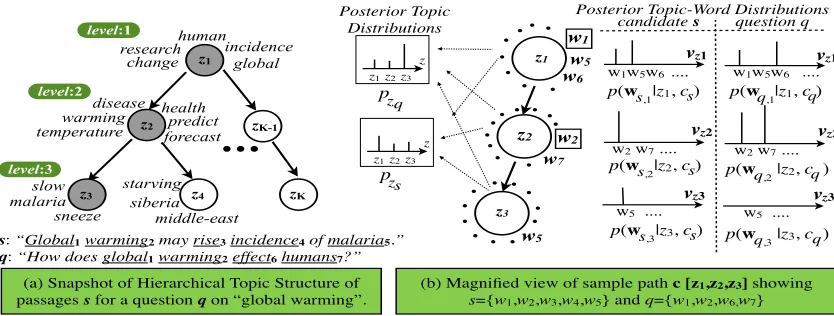
4 Similarity Modeling with hLDA
Given a question, we discover hidden topic distribu-tions using hLDA (Blei et al., 2003a). hLDA orga-nizes topics into a tree of a fixed depthL(Fig.2.(a)), as opposed toflatLDA. Each candidate passagesis assigned to a pathcsin the topic tree and each word
wi in s is assigned to a hidden topic zs at a level
l of cs. Each node is associated with a topic dis-tribution over words. The Gibbs sampler (Griffiths and Steyvers, 2004) alternates between choosing a
new path for each passage through the tree and as-signing each word in each passage to a topic along that path. The structure of tree is learnt along with the topics using a nested Chinese restaurant process (nCRP) (Blei et al., 2003a), which is used as a prior. The nCRP is a stochastic process, which assigns probability distributions to infinitely branching and deep trees. nCRP specifies a distribution of words in passages into paths in anL-level tree. Assignments of passages to paths are sampled sequentially: The first passage takes the initial L-level path, starting with a single branch tree. Next,mth subsequent pas-sage is assigned to a path drawn from distribution:
p(pathold, c|m, mc) = γ+mmc−1
p(pathnew, c|m, mc) = γ+mγ−1
(8)
patholdandpathnewrepresent an existing and novel (branch) path consecutively, mc is the number of previous passages assigned to path c, m is the to-tal number of passages seen so far, andγis a hyper-parameter, which controls the probability of creating new paths. Based on this probability each node can branch out a different number of child nodes propor-tional toγ. The generative process for hLDA is:
(1)For each topick∈T, sample a distributionβkv Dirichlet(η).
(2)For each passagesin retrieved documents,
(a)Draw a pathcsvnCRP(γ),
(b)SampleL-vectorθsmixing weights from Dirichlet distributionθs∼Dir(α).
(c)For each wordn, choose :
(i) a levelzs,n|θs, (ii) a wordws,n| {zs,n, cs, β} Given passage s, θs is a vector of topic propor-tions from L dimensional Dirichlet parameterized by α (distribution over levels in the tree.) The
nth word of sis sampled by first choosing a level
zs,n =lfrom the discrete distributionθswith prob-abilityθs,l. Dirichlet parameterηandγ control the size of tree effecting the number of topics. Large values ofηfavor more topics (Blei et al., 2003a).
Model Learning: Gibbs sampling is a common method to fit the hLDA models. The aim is to ob-tain the following samples from the posterior of: (i) the latent treeT, (ii) the level assignmentz for all words, (iii) the path assignmentscfor all passages conditioned on the observed wordsw.
(a) Snapshot of Hierarchical Topic Structure of passages s for a question q on “global warming”.
z1 z2 z3 z
z1 z2 z3 z Posterior Topic
Distributions
vz1
z3
.
.
.
.
.
.
.
.
.
.
w5z2
.
.
.
.
..
..
w2.
z1 w5
.
.
.
..
.
.
w7
w1
Posterior Topic-Word Distributions candidate s question q
(b) Magnified view of sample path c [z1,z2,z3] showing
s={w1,w2,w3,w4,w5} and q={w1,w2,w6,w7}
...
z1
zK-1
zK
z4
z2
z3
human
warming
incidence research
global
predict health change disease
forecast temperature
slow malaria
sneeze
starving middle-east siberia
s: “Global1 warming2 may rise3 incidence4 of malaria5.” q: “How does global1 warming2 effect6 humans7?”
vz1
vz2 vz2
vz3 vz3
w1w5w6 ....
w2 w7 ....
w5 .... w5 ....
w6 w1w5w6 ....
.
w2 w7 .....
ps z
p(w s ,1|z1, c s)
p(w q ,2|z2, c q)
p(w q ,3|z3, c q)
.
pq z
p(w s ,2|z2, c s)
p(w s ,3|z3, c s)
p(w q ,1|z1, c q)
level:3
level:1
level:2
Figure 2: (a) A sample 3-level tree using hLDA. Each passage is associated with a pathcthrough the hierarchy, where each nodezs=lis associated with a distribution over terms (Most probable terms are illustrated). (b) magnified view of a path (darker nodes) in (a). Distribution of words in given passagesand a question (q) using sub-vocabulary of words at each level topicvl. Discrete distributions on the left are topic mixtures for each passage,pzqandpzs.
posterior probability of a particular word w at a given topicz=lof a pathc=c is proportional to the number of timeswwas generated by that topic:
p(w|z,c,w, η)∝n(z=l,c=c,w=w)+η (9)
Similarly, posterior probability of a particular topic
zin a given passage sis proportional to number of timeszwas generated by that passage:
p(z|s,z,c, α)∝n(c=cc,z=l)+α (10)
n(.) is the count of elements of an array satisfying the condition. Posterior probabilities are normalized with total counts and their hyperparameters.
4.1 Tree-Based Similarity Model
The hLDA constructs a hierarchical tree structure of candidate passages and given question, each of which are represented by a path in the tree, and each path can be shared by many passages/question. The assumption is that passages sharing the same path should be more similar to each other because they share the same topics (Fig.2). Moreover, if a path includes a question, then other passages on that path are more likely to entail the question than passages on the other paths. Thus, the similarity of a can-didate passage s to a question q sharing the same path is a measure of semantic similarity (Algorithm 2). Given a question, we build an hLDA model on retrieved passages. Let cq be the path for a given
q. We identify the candidate passages that share the same path with q, M = {s∈D|cs=cq}. Given pathcqandM, we calculate the degree of similarity
DEShLDA(s, q) betweenq andsby calculating two
similarity measures: (1) simhLDA
1 : We define two sparse (discrete)
uni-gram distributions for candidatesand questionqat each node l to define lexical similarities on topic level. The distributions are over a vocabulary of words generated by the topic at that node, vl ⊂
V. Note that, in hLDA the topic distributions at each level of a path is sampled from the vocabu-lary of passages sharing that path, contrary to LDA, in which the topics are over entire vocabulary of words. This enables defining a similarity measure on specific topics. Givenwq =
w1, ..., w|q| , let
wq,l ⊂ wq be the set of words in q that are gener-ated from topiczqat levellon pathcq. The discrete unigram distributionpql=p(wq,l|zq =l, cq, vl) rep-resents the probability over all wordsvlassigned to topic zq at level l, by sampling only for words in wq,l. The probability of the rest of the words invlare set 0. Similarly,ps,l =p(ws,l|zs, cq, vl)is the proba-bility of wordswsinsextracted from the same topic (see Fig.2.b). The word probabilities inpq,l andps,l are obtained using Eq. (9) and then normalized.
The similarity betweenpq,l andps,l at each level is obtained by transformed information radius:
Wcq,l(pq,l, ps,l) = 10
[image:5.612.96.513.80.238.2]where theIRcq,l(pq,l, ps,l)is calculated as in Eq.(3)
this time forpq,landps,l(δ= 1). FinallysimhLDA1 is
obtained by averaging Eq.(11) over different levels:
simhLDA
1 (q, s) = L1
PL
l=1Wcq,l(pq,l, ps,l)∗l (12)
The similarity betweenpq,l andps,l is weighted by the levellbecause the similarity should be rewarded if there is a specific word overlap at child nodes.
Algorithm 2 Tree-Based Similarity Model
1: Given candidate passagessand questionq.
2: Build hLDA on set ofsandqto obtain treeT.
3: Find pathcqon treeT and candidate passages
4: on pathcq, i.e.,M ={s∈D|cs=cq}.
5: forcandidate passages∈M do
6: FindDEShDLA(q, s) =simhLDA
1 ∗simhLDA2
7: using Eq.(12) and Eq.(13)
8: end for
9: ifs /∈M,thenDEShDLA(q, s)=0.
(2) simhLDA
2 : We introduce a concept-base
mea-sure based on passage-topic mixing proportions to calculate the topical similarities between q and s. We calculate the topic proportions ofq ands, rep-resented bypzq = p(zq|cq) andpzs = p(zs|cq)via
Eq.(10). The similarity between the distributions is then measured with transformed IR as in Eq.(11) by:
simhLDA
2 (q, s) = 10
−IRcq(pzq,pzs) (13)
In summary, simhLDA
1 provides information about
the similarity betweenqandsbased on topic-word distributions, andsimhLDA
2 is the similarity between
the weights of their topics. The two measures are combined to calculate the degree of similarity:
DEShLDA(q,s)=simhLDA
1 (q,s)*simhLDA2 (q, s) (14)
Fig.2.b depicts a sample path illustrating sparse uni-gram distributions of aqandsat each level and their topic proportions, pzq, andpzs. The candidate
pas-sages that are not on the same path as the question are assignedDEShLDA(s, q) = 0
.
5 Discriminitive Model for QA
In (Celikyilmaz et al., 2009), the QA task is posed as a textual entailment problem using lexical and se-mantic features to characterize similarities between
q/a pairs. A discriminative classifier is built to pre-dict the existence of an answer in candidate sen-tences. Although they show that semi-supervised methods improve accuracy of their QA model un-der limited amount of labeled data, they suggest that with sufficient number of labeled data, supervised methods outperform semi-supervised methods. We argue that there is a lot to discover from unlabeled text to help improve QA accuracy. Thus, we pro-pose using Bayesian probabilistic models. First we briefly present the baseline method:
Baseline: We use the supervised classifier model presented in (Celikyilmaz et al., 2009) as our baseline QA model. Their datasets, provided in http://www.eecs.berkeley.edu/∼asli/asliPublish.html, are q/a pairs from TREC task. They define each q/a pair as ad dimensional feature vectorxi ∈ <d characterizing entailment information between them. They build a support vector machine (SVM) (Drucker et al., 1997) classifier model to predict the entailment scores for q/a pairs.
To characterize the similarity between q/a pairs they use: (i) features represented by similarities between semantic components, e.g., subject, ob-ject, verb, or named-entity types discovered in q/a pairs, and (ii) lexical features represented by lexico-syntactic alignments such as n-gram word overlaps or cause and entailment relations discovered from WordNet (Miller, 1995). For a given questionq, they rank the candidate sentences s based on predicted entailment scores from the classifier,T E(q, s).
We extend the baseline by using the degree of similarity between question and candidate passage obtained from LDA,DESLDA(q, s), as well as hLDA DEShLDA(q, s)
, and evaluate different models:
Model M-1: Degree of Similarity as Rank Scores: In this model, the QA is based on a fully generative approach in which the similarity mea-sures of Eq.(7) in§3 and Eq.(14) in §4 are used to obtain ranking scores. We build two separate mod-els,M-1.1usingDESLDA(q, s)
, andM-1.2using
DEShLDA(q, s) as rank scores and measure
accu-racy by re-ranking candidate passages accordingly. Given a question, this model requires training indi-vidual LDA and hLDA models.
mechanism of QA is the discriminative method presented in baseline. We linearly combine the probabilistic similarity scores from generative models, DES scores in M-1, with the baseline scores. We build two additional models to calculate the final rank scores;M-2.1using:
score(s|q) =a∗T E(q, s)+b∗DESLDA(q, s)
(15)
andM-2.2using:
score(s|q) =a∗T E(q, s)+b∗DEShLDA
(q, s) (16)
where0 ≤ a ≤ 1and0 ≤ b ≤ 1anda+b = 1. We find the optimuma∗ andb∗based on the valida-tion experiments on training dataset. The candidate sentences are re-ranked based on these scores.
Model M-3: Degree of Similarity as Entail-ment Features: Another way to incorporate the la-tent information into the discriminitive QA model is to utilize the latent similarities as explanatory variables in the classifier model. Particularly we build M-3.1 by using simLDA
1 , simLDA2 as well as
DESLDA(q, s)as additional features for the SVM, on
top of the the existing features used in (Celikyilmaz et al., 2009). Similarly, we buildM-3.2 by using
simhLDA
1 ,simhLDA2 as well asDEShLDA(q, s)as
addi-tional features to the SVM classifier model to predict entailment scores. This model requires building two new SVM classifier models with the new features.
6 Experiments and Discussions
We demonstrate the results of our experiments on exploration of the effect of different generative mod-els presented in§5 on TREC QA datasets.
We performed experiments on the datasets used in (Celikyilmaz et al., 2009). Their train dataset com-poses of a set of 1449 questions from TREC-99-03. For each question, the 5 top-ranked candidate sentences are extracted from a large newswire cor-pora (Acquaint corpus) through a search engine, i.e., Lucene2. The q/a pairs are labeled as true/false de-pending on the containment of the true answer string in retrieved passages. Additionally, to calculate the LDA and hLDA similarity measures for each candi-date passage, we also extract around 100 documents in the same fashion using Lucene and identify pas-sages to build the probabilistic models. We calculate
2
http://lucene.apache.org/java/
the probabilistic similarities, i.e., simLDA
1 , sim
LDA
2 ,
simhLDA
1 ,simhLDA2 , and the degree of similarity
val-ues, i.e., DESLDA(q, s) and DEShLDA(q, s) for
each of the 5 top-ranked candidate sentences in training dataset at inference time. Around 7200 q/a pairs are compiled accordingly.
The provided testing data contains a set of 202 questions from TREC2004 along with 20 candidate sentences for each question, which are labeled as true/false. To calculate the similarities for the 20 candidate sentences, we extract around 100 docu-ments for each question and build LDA and hLDA models. 4037 testing q/a pairs are compiled.
We report the retrieval performance of our mod-els in terms of Mean Reciprocal Rank (MRR), top 1 (Top1) and top 5 prediction accuracies (Top5) (Voorhees, 2004). We performed parameter opti-mization during training based on prediction ac-curacy to find the best C =
10−2, ..,102 and
Γ =
2−2, ..,23 for RBF kernel SVM. For the
LDA models we present the results with 10 top-ics. In hLDA models, we use four levels for the tree construction and set the topic Dirichlet hyper-parameters in decreasing order of levels at η =
{1.0,0.75,0.5,0.25}to encourage as many terms in the mid to low levels as the higher levels in the hi-erarchy, for a better comparison between q/a pairs. The nested CRP parameter γ is fixed at 1.0. We evaluatedn-sliding-window size of sentences in se-quence, n = {1,3,5}, to compile candidate pas-sages for probabilistic models (Table 1). The output scores for SVM models are normalized to [0,1].
?As our baseline (in§5), we consider supervised classifier based QA presented in (Celikyilmaz et al., 2009). The baseline MRR on TREC-2004 dataset is MRR=%67.6, Top1=%58, Top5=%82.2.
Window-size 1-window 3-window 5-window
MRR categories MRR Top1 Top5 MRR Top1 Top5 MRR Top1 Top5
Models
M-1.1(with LDA) 42.7 30.2 64.4 42.1 30.2 64.4 42.1 30.2 64.4
M-1.1(with hLDA) 55.8 45.5 71.0 55.8 45.5 71.0 54.9 45.5 71.0
M-2.1(with LDA) 66.2 55.1 82.2 65.2 54.5 80.7 65.2 54.5 80.7
M-2.2(with hLDA) 68.2 58.4 82.2 67.6 58.0 82.2 67.4 58.0 81.6
M-3.1(with LDA) 68.0 61.0 82.2 68.0 58.1 82.2 68.2 58.1 82.2
[image:8.612.88.525.70.183.2]M-3.2(with hLDA) 68.4 63.4 82.2 68.3 61.0 82.2 68.3 61.0 82.2
Table 1: The MRR results of the models presented in§5 on testing dataset (TREC 2004) using different window sizes of candidate passages. The statistically significant model results in each corresponding MRR category are bolded. Baseline MRR=%67.6, Top1=%58, Top5=%82.2.
M-1.1andM-1.2do not reveal as good results as the other models, suggesting room for improvement.
? In Table 1, Top1 MRR yields better improve-ment compared to the other two MRRs, especially for models M-3.1andM-3.2. This suggests that the probabilistic model outcome rewards the can-didate sentences containing the true answer by es-timating higher scores and moves them up to the higher levels of the rank.
? The analysis of different passage sizes suggest that the 1-window size yields best results and no sig-nificant performance improvement is observed when window size is increased. Thus, the similarity be-tween q/a pairs can be better explained if the candi-date passage contains less redundant sentences.
?The fact that the similarity scores obtained from the hLDA models are significantly better than LDA models in Table 1 indicates an important property of hierarchal topic models. With the hLDA specific and generic topics can be identified on different lev-els of the hierarchy. Two candidate passages can be characterized with different abstract and specific topics (Fig. 2) enabling representation of better fea-tures to identify similarity measures between them. Whereas in LDA, each candidate passage has a pro-portion in each topic. Rewarding the similarities on specific topics with the hLDA models help improve the QA rank performance.
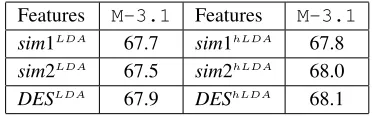
?InM-3.1andM-3.2we use probabilistic sim-ilarities andDESas inputs to the classifier. In Table 2 we show the individual effects of these features on the MRR testing performance along with other lexi-cal and semantic features of the baseline. Although the effect of each feature is comparable, theDESLDA
Features M-3.1 Features M-3.1
sim1LDA 67.7 sim1hLDA 67.8
sim2LDA 67.5 sim2hLDA 68.0
DESLDA 67.9 DEShLDA 68.1
Table 2: The MRR results of the similarity measures on testing dataset (TREC 2004) when used as input features.
andDEShLDAfeatures reveal slightly better results.
7 Conclusion and Future Work
In this paper we introduced a set of methods based on Latent Dirichlet Allocation (LDA) to character-ize the similarity between the question and the can-didate passages, which are used as ranking scores. The results of our experiments suggest that extract-ing information from hidden concepts improves the results of a classifier-based QA model.
Although unlabeled data exploration through probabilistic graphical models can help to improve information extraction, devising a machinery with suitable generative models for the given natural lan-guage task is a challenge. This work helps with such understanding via extensive simulations and puts forward and confirms a hypothesis explaining the mechanisms behind the effect of unsupervised pre-training for the final discriminant learning task.
In the future, we would like to further evaluate the models presented in this paper for larger datasets and for different tasks such as question paraphrase retrieval or query expansion. Moreover, we would like to enhance the similarities with other semantic components extracted from questions such as ques-tion topic and quesques-tion focus.
[image:8.612.333.520.250.308.2]References
C. M. Bishop and J. Lasserre. Generative or dis-criminative? getting the best of both worlds. InIn Bayesian Statistics 8, Bernardo, J. M. et al. (Eds), Oxford University Press, 2007.
D. Blei, T. Griffiths, M. Jordan, and J. Tenenbaum. Hierarchical topic models and the nested chinese restaurant process. InIn Neural Information Pro-cessing Systems [NIPS], 2003a.
D. M. Blei, A. Ng, and M. Jordan. Latent dirichlet allocation. InJrnl. Machine Learning Research, 3:993-1022, 2003b.
G. Bouchard and B. Triggs. The tradeoff between generative and discriminative classifiers. InProc. of COMPSTAT’04, 2004.
A. Celikyilmaz, M. Thint, and Z. Huang. Graph-based semi-supervised learning for question an-swering. InProc. of the ACL-2009, 2009.
C.L.A. Clarke, G. V. Cormack, R. T. Lynam, and E. L. Terra. Question answering by passage se-lection. InIn: Advances in open domain question answering, Strzalkowski, and Harabagiu (Eds.), pages 259–283. Springer, 2006.
H. Drucker, C.J.C. Burger, L. Kaufman, A. Smola, and V. Vapnik. Support vector regression ma-chines. InNIPS 9, 1997.
A. Echihabi and D. Marcu. A noisy-channel ap-proach to question answering. In ACL-2003, 2003.
T. Griffiths and M. Steyvers. Finding scientific top-ics. InPNAS, 101(Supp. 1): 5228-5235, 2004.
S. Harabagiu and A. Hickl. Methods for using tex-tual entailment in open-domain question answer-ing. In In Proc. of ACL-2006, pages 905–912, 2006.
Z. Huang, M. Thint, and A. Celikyilmaz. Investiga-tion of quesInvestiga-tion classifier in quesInvestiga-tion answering. InIn EMNLP’09, 2009.
W.-Y. Ma and K. McKeowon. Where’s the verb? correcting machine translation during question answering. InIn ACL-IJCNLP’09, 2009.
C. Manning and H. Schutze. Foundations of statis-tical natural language processing. In MIT Press. Cambridge, MA, 1999.
A. McCallum, C. Pal, G. Druck, and X. Wang. Multi-conditional learning: Gen-erative/discriminative training for clustering and classification. InAAAI 2006, 2006.
G.A. Miller. Wordnet: A lexical database for en-glish. InACM, 1995.
D. Molla, M.V. Zaanen, and D. Smith. Named en-tity recognition for question answering. In In ALTW2006, 2006.
H.T. Ng, J.L.P. Kwan, and Y. Xia. Question answer-ing usanswer-ing a large text database: A machine learn-ing approach. InEMNLP-2001, 2001.
H. Saggion and R. Gaizauskas. Experiments in pas-sage selection and answer extraction for ques-tion answering. InIn: Advances in open domain question answering, Strzalkowski, and Harabagiu (Eds.), pages 291–302. Springer, 2006.
T. Schmah, G. E Hinton, R. Zemel, S. L. Small, and S. Strother. Generative versus discriminative training of rbms for classification of fmri images. InProc. NIPS 2009, 2009.
Dan Shen and Dietrich Klakow. Exploring correla-tion of dependency relacorrela-tion paths for answer ex-traction. InProc. of ACL-2006, 2006.
J.L. Vicedo and A. Ferrandez. Applying anaphora resolution to question answering and information retrieval systems. In In LNCS, volume 1846, pages 344–355, 2000.
Ellen M. Voorhees. Overview of trec2004 question answering track. 2004.